
The Oz Files
How the First Outsider Granted Access to the RAAF's Classified UFO Files Wrote Australia's Own Case Record
Core Thesis
Published in 1996, fourteen years after research chemist Bill Chalker became the first civilian researcher ever granted sanctioned access to the Royal Australian Air Force's classified UFO files, The Oz Files: The Australian UFO Story assembles that access — alongside more than two decades of Chalker's own field investigations — into what remains the first comprehensive English-language survey of Australian UFO history. Rather than arguing a single thesis about what UFOs ultimately are, Chalker works case by case across more than two centuries of Australian reports, from eighteenth- and nineteenth-century historical curiosities through the country's own Cold War-era radar-visual incidents and its distinctive 1966 flap year, weighing each against the credibility of the witnesses involved — police officers, military pilots, senior public servants, missionaries, scientists — and against the RAAF's own internal paper trail, in a country whose UFO record had, before this book, rarely reached English-language readers outside Australia at all.
About the Author
Bill Chalker was born in 1952 in Grafton, New South Wales, and first became interested in the subject as a teenager in 1966, when his own hometown became the focus of a wave of UFO reports that made national headlines. He began investigating sightings in earnest in 1969 and went on to earn an honours science degree majoring in chemistry and mathematics at the University of New England between 1971 and 1974, followed by a long parallel career from 1975 onward as an industrial chemist, laboratory manager and quality manager in the food industry — a scientific day job that ran alongside, and lent methodological rigor to, his UFO research for the next five decades.
By the time this book appeared, Chalker had built one of the more substantial institutional records in Australian ufology: Australian representative for the Aerial Phenomena Research Organisation (APRO) from 1978 to 1986, New South Wales state representative for the Mutual UFO Network (MUFON) from 1976 to 1993, coordinator of the Sydney-based UFO Investigation Centre (UFOIC) since 1975, and a contributing editor to the Center for UFO Studies' International UFO Reporter. That combination of standing gave him something few UFO researchers anywhere in the world had achieved: a working, sanctioned relationship with his own country's defence and intelligence establishment.
That relationship produced the book's central asset. Beginning January 11, 1982, at the Russell Offices of the Department of Defence in Canberra, Chalker became the first civilian researcher ever granted sanctioned access to the Royal Australian Air Force's Directorate of Air Force Intelligence (DAFI) UFO files, working through the majority of the RAAF's extant case material across an initial four-day visit and several subsequent trips over the following two and a half years, into mid-1984. He separately reviewed the Department of Aviation's own UFO files at the Bureau of Air Safety Investigation in Melbourne, and in the same period conducted his 1982 interviews with retired defence intelligence scientist Harry Turner, who had headed the Joint Intelligence Bureau's Nuclear Branch and personally reviewed the RAAF's own historical UFO files in an unusually candid 1971 internal report, and examined classified RAAF UFO policy files directly with Squadron Leader Ian Frame of DAFI — interviews and documents that feed directly into this book's own account of the Woomera Rocket Range Sighting.
Chalker's UFO writing did not stop with this book. In 1996 he also produced the related research monograph UFOs Sub Rosa Down Under: The Australian Military & Government Role in the UFO Controversy, and in 2005 he published Hair of the Alien: DNA and Other Forensic Evidence of Alien Abductions (Pocket Books), built around the forensic DNA testing he arranged, with CSIRO molecular biologist Dr. Horace Drew, of a hair sample Peter Khoury showed him in 1996 — documented on this site's own Peter Khoury Sydney Abduction case file. Chalker went on to serve as the Australian content contributor for successive editions of Jerome Clark's The UFO Encyclopedia, including its 1992, 2018 and 2024 editions, and continues to publish research through his own long-running blog, The Oz Files, and through UFO Research (NSW), the organization that has hosted his own retrospective talks on cases first documented in this book.
Historical Context & Origins
By the mid-1990s, English-language ufology's most widely read reference works — from Blue Book's American case record to the Condon Report and the UK's own MoD file releases — were overwhelmingly built around United States and, secondarily, British material. Australia had a comparably deep and, in places, comparably well-documented UFO record of its own, stretching back to colonial-era newspaper accounts and running through a formal, decades-long chain of Royal Australian Air Force involvement, but almost none of it had reached international readers in a single, sourced, book-length account. This book was written directly into that gap: Chalker's own description frames it as covering "UFO history with a focus on the land down under," and it draws on more than nineteen distinct historical events, some reaching back as far as 1793, well before the RAAF itself existed to investigate anything.
The RAAF's own institutional posture toward UFO reports had shifted only gradually and unevenly across the preceding decades. Civilian researchers had won limited, piecemeal access before Chalker's own: in October 1979, the RAAF invited a group of Victorian researchers to visit the Intelligence Cell at RAAF Headquarters, a comparatively narrow opening that fell well short of the sustained, multi-year review Chalker negotiated beginning in January 1982. Chalker's own account situates his find of the earliest still-extant DAFI sighting report — a July 16, 1950 case from Bass Point, New South Wales — as the practical starting point of the RAAF's own formal documented UFO record, a base line no earlier civilian researcher had been in a position to establish.
The book also arrived, by Chalker's own later account, close to the effective end of that era of Australian government involvement altogether: after roughly four decades of Defence Department handling of UFO reports, the department moved by the mid-1990s to step back from the subject almost entirely, leaving the Australian Transport Safety Bureau and Air Services Australia to field reports from civil aviation crews and the Department of Defence to retain only a narrow military-incident role. Read against that closing window, this book functions as much as a closing statement on one government's UFO-investigation era as it does an opening one — the RAAF-era Australian equivalent of what The Hynek UFO Report did for Project Blue Book's American archive nineteen years earlier, written by the one researcher who had actually been let into the underlying government files while that access still existed.
Core Arguments & Key Concepts
The book's organizing method is evidentiary rather than theoretical: Chalker does not argue for a single unified explanation of what Australian UFO reports represent, instead presenting case after case — more than nineteen distinct historical incidents span the book's pre-1947 material alone — and explicitly weighting each one by the credibility of the witnesses and, where available, the corroborating official record: police officers, military and civilian pilots, senior public servants, missionaries and scientists, several of them named and interviewed directly by Chalker himself.
A central structural argument concerns the RAAF's own investigative behavior once Chalker could read its files directly: rather than either confirming extraordinary claims or definitively debunking them, the RAAF's Directorate of Air Force Intelligence repeatedly closed cases as officially unresolved "unknowns" while offering official explanations that Chalker's own review found scientifically thin — a pattern he reads as evidence of institutional caution and resource limits rather than either cover-up or genuine resolution, a notably more measured framing than the conspiratorial reading many contemporaneous American UFO books applied to their own governments' files.
The book gives substantial weight to Australia's formal government radar-visual record, using Chalker's own RAAF-file access to reconstruct cases like the 1954 Hawker Sea Fury Sighting and the RAAF's internal handling of the Woomera Rocket Range Sighting from the same year, both drawn substantially from material and interviews — including Chalker's 1982 conversations with Harry Turner and Squadron Leader Ian Frame — that had never previously been assembled into a public, sourced account.
Alongside the government-file material, the book incorporates Chalker's own decades of independent field investigation, most notably his detailed 1981 re-interview of George Pedley on the 1966 Tully Saucer Nests case and his research into the country's broader 1966 UFO "flap" year, including the Westall Encounter — demonstrating throughout that the book's authority rests on two distinct forms of access working together: official government documentation on one hand, and Chalker's own primary witness interviews, conducted as a working field investigator rather than an archive researcher alone, on the other.
Structurally, the book also serves an argument about the shape of the field itself: by assembling Australia's own UFO record into a single English-language volume for the first time, Chalker makes an implicit case that the country's UFO history is neither a derivative footnote to the American and British record nor a separate, self-contained curiosity, but a body of formally investigated, credibly witnessed material substantial enough to stand as its own national case study within international ufology.
Key Cases & Evidence Discussed
The Woomera Rocket Range Sighting (Case File #110, May 5, 1954) draws most directly on this book's central RAAF-access research: this site's own case file documents Chalker's 1982 interview with Harry Turner and his separate 1982 examination of classified RAAF UFO policy files with Squadron Leader Ian Frame of the Directorate of Air Force Intelligence, the same access this book and its companion monograph, UFOs Sub Rosa Down Under, were built from.
The Hawker Sea Fury Sighting (Case File #109, 1954) is treated on this site as Australia's most significant early Cold War radar-visual case, and is widely regarded within Australian ufological research, including in Chalker's own published survey work, as the country's closest counterpart to the American Gorman Dogfight and the British Lakenheath–Bentwaters incident, both cases pairing a credentialed pilot's account with independent radar corroboration.
The Tully Saucer Nests (Case File #106, January 19, 1966) reflects Chalker's parallel career as a field investigator rather than only an archive researcher: his detailed June 3, 1981 re-interview with witness George Pedley, conducted fifteen years after the original sighting, corrected media distortions that had accumulated around the case while confirming its core details had remained essentially unchanged — groundwork this book draws on directly and that Chalker would continue to revisit in a detailed 2017 retrospective.
The Westall Encounter (Case File #030, April 6, 1966) and the Frederick Valentich Disappearance (Case File #036, October 21, 1978) represent, respectively, the country's best-documented mass-witness UFO event and its most consequential unexplained aviation case, both part of the broader run of credentialed-witness Australian incidents this book was the first to assemble into a single sourced English-language account, spanning the 1966 flap year through the loss of a licensed pilot over Bass Strait twelve years later.
The Father Gill Sighting (Case File #062, June 26–27, 1959) sits at the edge of this book's usual Australian remit — the encounter itself took place at Boianai in the then Australian-administered Territory of Papua and New Guinea — but Chalker's own long personal relationship with witness Rev. William Gill, whom he interviewed directly beginning in 1978 and corresponded with for years afterward, made him the researcher who uncovered Gill's private, unpublicized theological speculation that the Boianai figures might have been angels rather than extraterrestrial visitors, material this site's own case file traces back to Chalker's research rather than to Gill's own public statements.
The Peter Khoury Sydney Abduction (Case File #299, 1988 and 1992) falls chronologically just outside this book's own case material — Khoury did not show Chalker the preserved hair sample from his 1992 encounter until 1996, the same year this book went to press, and the forensic DNA analysis that became the centerpiece of Chalker's later book Hair of the Alien did not begin until 1998 — but this site's own case file cites The Oz Files specifically as "Chalker's earlier survey of Australian UFO history, drawing on his access to Royal Australian Air Force files and establishing his research credentials," the exact institutional standing that made Khoury trust Chalker with the hair sample in the first place.
Critical Reception & Controversies
The book has not attracted sustained mainstream science-press review in the manner of a Hynek or Condon-era American title, consistent with how narrowly ufology's mainstream press coverage had already contracted by the mid-1990s even within a much larger publishing market than Australia's own; its readership and critical response have instead come almost entirely from within ufology itself, both in Australia and internationally.
Reader reception, aggregated on Goodreads at roughly 3.92 out of 5 stars across a modest 12 ratings — a small sample reflecting the book's limited print run and long out-of-print status rather than any lack of regard within the field — splits in a specific, substantive way. Reviewer Luke McCarthy praised its evidentiary strength directly, writing that the book was full of "lots of odd and inexplicable things" and noting cases with "multiple witnesses, corroborated by police reports, seen on radar, etc." that he found genuinely difficult to dismiss.
That same review is equally direct about the book's structural weakness: McCarthy wrote that it "often reads like a collection of unordered and plainly written anecdotes" and said he "wished it wasn't so poorly structured" — a criticism this article treats as a genuine trade-off rather than a simple flaw, since the book's case-by-case, evidence-forward method (weighing each report on witness credibility and documentary support rather than building a single sustained narrative) is the same method that gives its strongest chapters, like the Woomera and Sea Fury cases, their evidentiary weight.
Within Australia's own small community of UFO researchers and organizations — UFO Research Queensland, UFO Research (NSW), and the successor bodies to the original Victorian and Tasmanian UFO groups the book itself draws on — the book's standing has rested less on print reviews than on its continued citation as primary source material: this site's own resources library independently cites this exact 1996 edition (ISBN 1875989048) across seven separate case-file pages, a citation footprint built entirely from case files that needed Chalker's own government-file access and field interviews to document their subjects accurately.
Influence & Legacy
The book's most concrete, independently verifiable influence is documented on this very site: this exact 1996 Duffy & Snellgrove edition, under ISBN 1875989048, is cited across resources.html in connection with seven separate case-file pages — the Father Gill Sighting, the Frederick Valentich Disappearance, the Hawker Sea Fury Sighting, the Peter Khoury Sydney Abduction, the Tully Saucer Nests, the Westall Encounter, and the Woomera Rocket Range Sighting — making it, alongside Chalker's own later Hair of the Alien, the working documentary backbone of this site's entire Australian case-file coverage.
Within Australian ufology specifically, this book functioned as the credibility foundation for everything Chalker published afterward: it was the first place his 1982–1984 RAAF file access and his Harry Turner interviews reached print, groundwork he continued to draw on in his companion 1996 monograph UFOs Sub Rosa Down Under, in his 2017 Tully retrospective, and in his ongoing research blog and public talks for UFO Research (NSW), including a 2024 presentation on Turner's own Woomera investigation delivered nearly three decades after this book first brought that material to print.
The book's standing also helped establish Chalker as Australian ufology's primary point of international scholarly contact: he went on to serve as the Australian content contributor for successive editions of Jerome Clark's The UFO Encyclopedia (1992, 2018, and 2024), and to contribute chapters to broader academic surveys including Michael Swords's UFOs and Government: A Historical Inquiry (2012) — itself independently cited on this site's own resources library — a role that traces directly back to the credentialed, government-sourced research this book first assembled into a single volume.
More broadly, the book's 1996 publication landed close to the practical end of the RAAF's own four-decade involvement in UFO investigation, as Australia's Defence Department moved through the mid-to-late 1990s to step back from handling civilian UFO reports almost entirely. Read against that closing window, The Oz Files functions today less as a snapshot of an ongoing government program than as the closest thing Australian ufology has to a completed institutional record — the first, and to date still the primary, English-language account of a government UFO-investigation era that had, by the time later researchers went looking for it, already substantially closed.
The Book
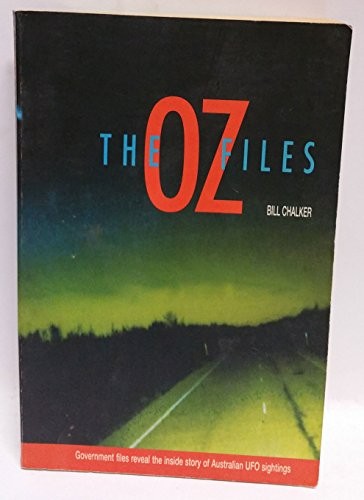
The Oz Files
How the First Outsider Granted Access to the RAAF's Classified UFO Files Wrote Australia's Own Case Record
Find on Amazon →As an Amazon Associate, OverClassified may earn from qualifying purchases made through this link, at no extra cost to you.
Why This Is Essential Reading
The Oz Files earns its place on this list for a reason distinct from most other government-access books here: it is the only entry built from a national UFO-investigation record outside the United States and United Kingdom, assembled by the one researcher — Bill Chalker — who had actually been let inside that record while it still existed. Its limits are real: a case-by-case structure some reviewers have found exhausting rather than narratively satisfying, and a scope that, like any single-country survey, leaves the reader wanting the fuller international comparison. But as the foundational English-language account of Australian government UFO investigation, built on RAAF files no earlier civilian researcher had reached and on field interviews no later researcher could now recreate with the same living witnesses, it remains the standard reference work for Australian UFO history — and the primary documentary source this site's own Australian case files keep citing back to.
Related Cases & Theories
Essential Viewing
UPA - Bill Chalker Interview
The Unexplained Network — An extended interview with Bill Chalker discussing his decades of Australian UFO research, including his RAAF file access and his top Australian cases — the same investigative record this book was built from. Verified via YouTube oEmbed before inclusion.
Bill Chalker Australian Author and UFO Researcher | Down South Anomalies #3
Untold Radio Network — Chalker discusses his career as an Australian UFO researcher and author, including this book's place in his published research record. Verified via YouTube oEmbed before inclusion.
Sources Cited
- Chalker, Bill. The Oz Files: The Australian UFO Story. Duffy & Snellgrove, 1996 (ISBN 1875989048 / 9781875989041, cited here, matching this site's own resources library citations). amazon.com
- "Bill Chalker." Wikipedia (biography: birth year and place, education, career, organizational roles, publications). en.wikipedia.org
- "Bill Chalker." Center for UFO Studies (CUFOS board, consultants and friends biography page). cufos.org
- "Bill Chalker." Project 1947 (Australian Historical UFO Encounters biography page). project1947.com
- "Bill Chalker – Aust. Military, Gov't Role In The UFO Controversy." Project 1947 Forum (details on Chalker's January 1982 RAAF/DAFI file access at the Russell Offices, Canberra, and the Directorate of Air Force Intelligence's role). project1947.com
- "The Oz Files : The Australian UFO Story : Government Files Reveal the Inside Story of Australian UFO Sightings." AbeBooks (bibliographic record: Duffy & Snellgrove, 1996, 246 pp., ISBN 1875989048/9781875989041). abebooks.com
- "The Oz Files." Goodreads (aggregate rating and reviewer Luke McCarthy's quoted assessment cited in this article's Critical Reception section). goodreads.com
- "The Search for Historical UFO Reports in Australia." UFO History Keys (Chalker's own summary of this book's pre-1947 historical case material, spanning 1793 onward). ufohistorykeys.blogspot.com
- "UFOs Around the World: Australia." ExoNews (context on the Australian Defence Department's mid-1990s withdrawal from routine UFO-report handling and Chalker's own commentary on official Australian UFO investigation). exonews.org
- "Australian ufology." Wikipedia (background on RAAF UFO-file access history, including the October 1979 Victorian-researcher visit to RAAF Headquarters' Intelligence Cell). en.wikipedia.org
- "The Oz files : the Australian UFO story / Bill Chalker." National Library of Australia catalogue (bibliographic record). catalogue.nla.gov.au
- This site's own resources library: Full Reading List, where this exact edition (ISBN 1875989048) is cited across seven separate case-file pages.
- This site's own case file: The Woomera Rocket Range Sighting, for the 1954 case built directly from Chalker's 1982 Harry Turner interview and RAAF policy-file access.
- This site's own case file: Peter Khoury Sydney Abduction, for the case that drew on the research credentials this book established.
- This site's own case file: The Tully Saucer Nests, for Chalker's 1981 field re-interview of witness George Pedley.
- This site's own key-figures entry: Bill Chalker, for his full biography and further case connections.
- This site's own key-figures entry: Harry Turner, for the retired defence intelligence scientist Chalker interviewed in 1982.
Have corrections, additional research, or peer-reviewed sources? Help improve this entry.
Suggest an Edit