
The Frederick Valentich Disappearance
On the evening of October 21, 1978, twenty-year-old Australian pilot Frederick Valentich disappeared while flying a hired Cessna 182L, VH-DSJ, from Moorabbin to King Island across Bass Strait. Over six minutes from 19:06 he told Melbourne Flight Service of an unidentified “aircraft” with four bright lights that passed over him and seemed to orbit him, with “a green light” and an exterior that was “all shiny on the outside.” He reported his engine “rough-idling” and “coughing,” said “it is hovering and it’s not an aircraft,” and his last transmission, at 19:12:28, ended in 17 seconds of open microphone. A four-day air and sea search found no trace of him or the aircraft, and the Department of Transport could not determine why the aircraft disappeared.
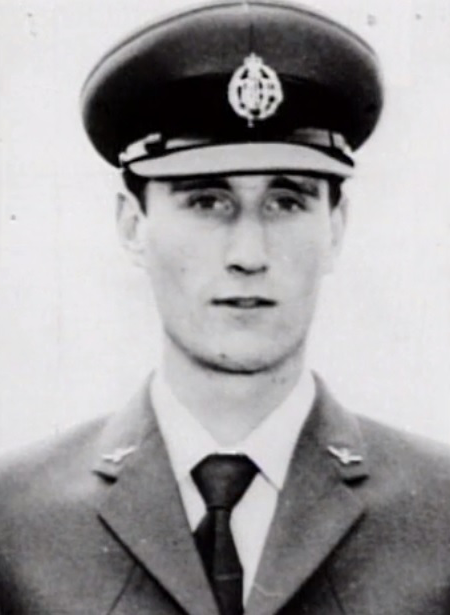
Pictured: Frederick Valentich himself, in a formal portrait in aviation uniform — the actual pilot at the center of the case, though not a photograph of his October 21, 1978 flight or the object he reported. No imagery of either exists: his account survives only as an audio transmission, and no wreckage of his Cessna was ever recovered.
Theoretical Alignment
Proponents of the extraterrestrial hypothesis point to the pilot’s real-time description of something with four bright lights, “a long shape,” a green light and a shiny exterior that he said was “not an aircraft,” and to reports from people on the ground of a green light in the region that evening. The ground reports are weaker than they first appear. Keith Basterfield’s 2013 catalogue of the evening’s reports lists sightings scattered across Victoria from about 19:00 to 22:30, several of them plausibly Venus, and the most-cited account near Apollo Bay, from a man published under the pseudonym “Ken Hansen,” first became known to investigators in 1991. Mount Stromlo Observatory also noted a meteor stream that night, with 10 to 15 sightings an hour.
From the psycho-social perspective, the case turns on expectation. By his father’s account Valentich was an ardent believer in UFOs who worried about being attacked by them, and six days before the flight he discussed with his girlfriend, Rhonda Rushton, the possibility of a UFO taking him away. Close Encounters of the Third Kind had opened in Australian cinemas in March 1978. Skeptical writers, including Brian Dunning (Skeptoid, 2013) and James McGaha and Joe Nickell (Skeptical Inquirer, 2013), argue that this expectation shaped how he read lights seen in the last of the twilight over the sea. Against a purely psychological reading, the rough-running engine and the loss of the aircraft were real events that need a physical explanation, although spatial disorientation and a spiral dive would supply one.
The interdimensional hypothesis is sometimes invoked for this case, but nothing in the record bears on it specifically. Earlier versions of this page described a magnetic “portal” profile for Bass Strait and an electromagnetic mechanism for the engine trouble; neither has any source and both have been removed.
Background
Frederick Valentich, born on 9 June 1958, was 20. He had about 150 hours of total flying experience and a private licence, and on 11 May 1978 he had obtained a Class Four instrument rating, which allowed him to fly at night in visual meteorological conditions (Department of Transport summary report). He wanted a career in aviation. He had twice applied to join the RAAF and been rejected for inadequate educational qualifications, and he was a member of the Air Training Corps. Studying part-time for a commercial licence, he had twice failed all five theory subjects and in July 1978 failed three of them again, though he told family and friends he was one subject short (Flight Safety Australia, citing the departmental files). His record also included straying into a controlled zone at Sydney, for which he was warned, and two occasions of deliberately flying into cloud, for which prosecution was considered. His father, Guido Valentich, described him as an ardent UFO believer who worried about being attacked by them and who had seen RAAF UFO files.
At 17:23 on Saturday 21 October 1978, after a meteorological briefing, Valentich submitted a flight plan at the Moorabbin Briefing Office for a night VMC flight from Moorabbin to King Island and back. He nominated a cruising altitude below 5,000 feet, via Cape Otway, with estimated intervals of 41 minutes to Cape Otway and 28 minutes from Cape Otway to King Island, and a total fuel endurance of 300 minutes. He made no arrangements for the aerodrome lighting at King Island to be switched on. He told the briefing officer and the operator’s representative that he was picking up friends at King Island, and he took four life jackets (Department of Transport summary report). He told others he was going for crayfish; later inquiries found neither reason to be true. King Island lies about 125 nautical miles (232 km) from Moorabbin.
The aircraft was refuelled to capacity at 18:10 and left Moorabbin at 18:19. Valentich then established two-way radio contact with the Melbourne Flight Service Unit (FSU). He reported at Cape Otway at 19:00, and his next transmission came at 19:06:14. The end of daylight at Cape Otway was at 19:18, so the encounter took place in the last of the evening twilight rather than in full darkness. A Bureau of Meteorology letter on the file described conditions as “perfect for night flying,” with no cloud between the Victorian ranges and the northern Tasmanian coast, no turbulence and excellent visibility; the Department of Transport report noted only a trace of stratocumulus at 5,000 to 7,000 feet and light winds.
VH-DSJ was a Cessna 182L, a four-seat, high-wing, single-engine aircraft, registered to Cephus Day of Beaumaris, Victoria, and operated by SAS Southern Air Services of Moorabbin Airport (Department of Transport report). Flight Safety Australia notes that it had just had its 100-hourly inspection. The Cessna 182 is powered by a Continental O-470 engine; earlier versions of this page named a Lycoming engine, which is wrong. Its high-wing tanks feed the engine by gravity, a point that matters to some of the disorientation explanations discussed below.
Several features of the flight puzzled investigators. Valentich was flying alone, at night, over water, in an aircraft hired by the hour. The reasons he gave for the trip did not hold up. He had not asked for King Island’s runway lights, and he was under pressure from repeated examination failures. The philosopher Patrick Stokes, who examined the files for ABC Radio National, says they “seem to have decided early on” that the disappearance was deliberate. Family and friends were adamant that he would not have planned to take his own life or disappear, and Keith Basterfield said that interviews with doctors and colleagues “virtually eliminated” suicide.
Complete Timeline
| Date | Event |
|---|---|
| October 21, 1978 (17:23 AEST) | Flight Plan. Frederick Valentich submits a night VMC flight plan at the Moorabbin Briefing Office: Moorabbin–Cape Otway–King Island and return, below 5,000 ft, endurance 300 minutes. |
| October 21, 1978 (18:10–18:19 AEST) | Departure. VH-DSJ is refuelled to capacity at 18:10 and departs Moorabbin at 18:19. |
| October 21, 1978 (19:00 AEST) | Cape Otway Position Report. Valentich reports at Cape Otway to Melbourne Flight Service before heading out over Bass Strait. |
| October 21, 1978 (19:06:14 AEST) | First Traffic Query. Valentich asks whether there is any known traffic below 5,000 ft; Melbourne replies there is none, and he describes what seems to be a large aircraft with four bright lights. |
| October 21, 1978 (19:07:31 AEST) | Overflight. He reports that the aircraft has just passed over him at least a thousand feet above, and asks whether air force aircraft are in the vicinity. |
| October 21, 1978 (19:08:48 AEST) | “Some sort of game.” He reports it flying over him two or three times at speeds he could not identify. |
| October 21, 1978 (19:09:27 AEST) | “It’s not an aircraft.” Asked to describe it, he calls it “a long shape.” |
| October 21, 1978 (19:10:19 AEST) | “Seems like it’s stationary.” He says he is orbiting and “the thing is just orbiting on top of me also,” with a green light and a shiny exterior. At 19:10:46 he says it has “just vanished,” then reports it approaching from the south-west. |
| October 21, 1978 (19:11:50 AEST) | Engine Trouble. He reports the engine “rough-idling” and “coughing,” says he intends to continue to King Island, and that “it is hovering and it’s not an aircraft.” |
| October 21, 1978 (19:12:28 AEST) | Last Transmission. His call sign, followed by 17 seconds of open microphone carrying an unexplained sound; no further transmission is received. |
| October 21, 1978 (19:12 & 19:33 AEST) | Alert and Distress Phases. The alert phase is declared at 19:12; at 19:33, when the aircraft has not arrived at King Island, the distress phase is declared and search action begins. |
| October 22–25, 1978 | Search. An air, sea and land search, including ocean shipping, an RAAF P-3 Orion and eight civilian aircraft, covers more than 1,000 square miles of Bass Strait. It ends on 25 October without finding any trace. |
| 1983 | Cowl Flap. A Cessna 182 engine cowl flap washes ashore on Flinders Island; in July 1983 the Bureau of Air Safety Investigation notes it came from a Cessna 182 in a serial range that includes VH-DSJ. |
| Early 1980s | Official Summary. The Department of Transport’s Aircraft Accident Investigation Summary Report (V116/783/1047) records the location as “not known” and the degree of injury as “presumed fatal”; the reason for the disappearance was not determined. |
| 2013 | Reassessments. Keith Basterfield publishes a catalogue of the evening’s ground reports; James McGaha and Joe Nickell propose the planets-and-disorientation explanation in Skeptical Inquirer. |
The Flight of VH-DSJ: Flight Log & Radio Transcripts
The Department of Transport’s summary report reproduces a transcript of the exchange between VH-DSJ and the Melbourne Flight Service Unit, with the note that “the word/words in brackets are open to other interpretations.” The version below follows that transcript as reproduced by Patrick Gross and, in part, by the Tasmanian Aviation Historical Society; times are given where the report gives them. FS is the Flight Service officer on duty, named in press accounts as Steve Robey. An earlier version of this page carried a different “verbatim” transcript with invented timestamps and several wrong words, including “negative” for “affirmative” and “chasing me” for “stationary”.
19:06:14 (DSJ): Melbourne, this is Delta Sierra Juliet. Is there any known traffic below five thousand?
19:06:23 (FS): Delta Sierra Juliet, no known traffic.
19:06:28 (DSJ): Delta Sierra Juliet, I am, seems (to) be a large aircraft below five thousand.
19:06:44 (FS): Delta Sierra Juliet, what type of aircraft is it?
(DSJ): Delta Sierra Juliet, I cannot affirm, it is four bright, it seems to me like landing lights.
19:07 (FS): Delta Sierra Juliet.
19:07:31 (DSJ): Melbourne, this (is) Delta Sierra Juliet, the aircraft has just passed over me at least a thousand feet above.
(FS): Delta Sierra Juliet, roger, and it is a large aircraft, confirm?
(DSJ): Er, unknown, due to the speed it’s travelling. Is there any air force aircraft in the vicinity?
(FS): Delta Sierra Juliet, no known aircraft in the vicinity.
19:08:18 (DSJ): Melbourne, it’s approaching now from due east towards me.
(FS): Delta Sierra Juliet.
19:08:41 (DSJ): [open microphone for two seconds]
19:08:48 (DSJ): Delta Sierra Juliet, it seems to me that he’s playing some sort of game, he’s flying over me two, three times at a time at speeds I could not identify.
19:09 (FS): Delta Sierra Juliet, roger, what is your actual level?
(DSJ): My level is four and a half thousand, four five zero zero.
(FS): Delta Sierra Juliet, and confirm you cannot identify the aircraft?
(DSJ): Affirmative.
(FS): Delta Sierra Juliet, roger, stand by.
19:09:27 (DSJ): Melbourne, Delta Sierra Juliet, it’s not an aircraft, it is [open microphone for two seconds]
19:09:42 (FS): Delta Sierra Juliet, Melbourne, can you describe the, er, aircraft?
(DSJ): Delta Sierra Juliet, as it’s flying past it’s a long shape [open microphone for three seconds] (cannot) identify more than (that it has such speed) [open microphone for three seconds] before me right now, Melbourne.
19:10 (FS): Delta Sierra Juliet, roger, and how large would the, er, object be?
19:10:19 (DSJ): Delta Sierra Juliet, Melbourne, it seems like it’s stationary. What I’m doing right now is orbiting, and the thing is just orbiting on top of me also. It’s got a green light and sort of metallic (like), it’s all shiny (on) the outside.
(FS): Delta Sierra Juliet.
19:10:46 (DSJ): Delta Sierra Juliet [open microphone] it’s just vanished.
(FS): Delta Sierra Juliet.
19:11 (DSJ): Melbourne, would you know what kind of aircraft I’ve got? Is it (a type) military aircraft?
(FS): Delta Sierra Juliet, confirm the, er, aircraft just vanished.
(DSJ): Say again.
(FS): Delta Sierra Juliet, is the aircraft still with you?
(DSJ): Delta Sierra Juliet, it’s [open microphone for two seconds] (now) approaching from the south-west.
(FS): Delta Sierra Juliet.
19:11:50 (DSJ): Delta Sierra Juliet, the engine is rough-idling. I’ve got it set at twenty-three, twenty-four, and the thing is (coughing).
(FS): Delta Sierra Juliet, roger, what are your intentions?
(DSJ): My intentions are, ah, to go to King Island, ah, Melbourne. That strange aircraft is hovering on top of me again [open microphone for two seconds] it is hovering and it’s not an aircraft.
(FS): Delta Sierra Juliet.
19:12:28 (DSJ): Delta Sierra Juliet, Melbourne [open microphone for seventeen seconds].
The Encounter: Detailed Breakdown of the Event
The exchange lasted just over six minutes, from 19:06:14 to 19:12:28. Valentich first asked about traffic below 5,000 feet and described what seemed to be a large aircraft with four bright lights “like landing lights.” At 19:07:31 he said it had passed over him at least a thousand feet above, and he asked whether there were air force aircraft nearby; none were known. At 19:08:18 he said it was approaching from due east, and at 19:08:48 that “he’s playing some sort of game, he’s flying over me two, three times at a time at speeds I could not identify.” His query about traffic, and his later questions about military aircraft, show him trying to fit what he saw to a conventional explanation before abandoning it.
At 19:09:27 he said, “it’s not an aircraft, it is,” followed by two seconds of open microphone. Asked to describe it, he called it “a long shape” and said he could not identify more than that it had such speed. Asked at 19:10 how large it was, he replied that “it seems like it’s stationary,” that he was orbiting and “the thing is just orbiting on top of me also,” and that it had “a green light and sort of metallic (like), it’s all shiny (on) the outside.” At 19:10:46 he said it had “just vanished,” then asked whether it might be a military aircraft and reported it “now approaching from the south-west.” Note that the “orbiting” was first his own manoeuvre: he was circling, and described the object as staying above him while he did so.
At 19:11:50 he reported that the engine was “rough-idling,” that he had it “set at twenty-three, twenty-four” (usually read as power settings), and that “the thing is (coughing).” Asked his intentions, he said he was going on to King Island and that “that strange aircraft is hovering on top of me again ... it is hovering and it’s not an aircraft.” His last transmission, at 19:12:28, was his call sign followed by 17 seconds of open microphone. The transcript records only the open microphone; accounts of the recording describe an unexplained sound, often called metallic or scraping, that ended it. Nothing further was heard from VH-DSJ.
What the closing sound was has never been established. This file found no published laboratory analysis of it. Earlier versions of this page described acoustic studies by the Royal Melbourne Institute of Technology, by researcher Paul Norman and by a “Ken Williams,” with findings about frequency spikes and a 120 Hz tone; none of these could be traced to any source, and they have been removed. Suggestions in the literature range from the sound of the aircraft breaking up or striking the water to a microphone key held down in a steep descent; none can be tested without the original recording, which this file has not been able to locate in an archive.
Valentich’s speech stayed broadly coherent through the exchange, and he kept using his call sign and answering questions. Proponents cite this against panic. The opposite reading is that a pilot who was disoriented in the twilight, and who believed he was being harassed by something, could remain articulate while misreading lights and losing control of the aircraft. The transcript alone cannot decide between the two.
The Craft: Detailed Analysis of the Unidentified Object
Everything known about the object comes from Valentich’s transmissions. He described, in order: four bright lights “like landing lights”; something that passed at least a thousand feet above him at a speed that prevented identification; repeated passes; “a long shape”; a green light; and a shiny, metallic-looking exterior. At one point he said “it seems like it’s stationary” while he was orbiting. He gave no estimate of size or distance and reported no sound. Earlier versions of this page drew conclusions from the object’s silence, its lack of wake turbulence and its supposed matching of the Cessna’s speed; none of these is in the transcript.
The “stationary” remark is central to the astronomical explanation. James McGaha, an astronomer and former US Air Force pilot, cites the departmental files as placing Venus at a bearing of 255 degrees and 25 degrees above the horizon. In Skeptical Inquirer (November/December 2013) he and Joe Nickell argue that the four bright lights were Venus, then near its brightest, with Mars, Mercury and the star Antares, which together would have formed a diamond-shaped group in the western twilight. On this reading the object “orbiting” and staying “on top of me” reflects the pilot’s own turning and a tilted-horizon illusion rather than any movement of the lights.
Proponents answer that Valentich described the object passing overhead, approaching from the east and later from the south-west, and “vanishing,” which is hard to reconcile with fixed lights low in the west. Skeptics reply that a disoriented pilot in a turn would see fixed lights appear to move and to come from changing directions, and that a light passing behind a wing or out of view would seem to vanish. Neither side has independent data on where the object actually was.
No radar recorded VH-DSJ or any object near it. The Tasmanian Aviation Historical Society’s summary notes that “despite ideal conditions, the aircraft was not plotted on radar,” a point some have used to question whether Valentich was ever near Cape Otway. This file has not found a published account of what radar coverage existed at 4,500 feet over the western strait that evening, so the absence of a return cannot be read as evidence that the object evaded radar.
A green light also features in several of the ground reports discussed below. Earlier versions of this page said the green light indicated a magneto-hydrodynamic plasma field that disrupted the engine’s ignition; that is speculation with no support in the record, and it has been removed.
The Search Operations
The alert phase of search and rescue procedures was declared at 19:12, when contact was lost. At 19:33, when the aircraft had not arrived at King Island, the distress phase was declared and search action began (Department of Transport report, as summarised by the Tasmanian Aviation Historical Society). An intensive air, sea and land search continued until 25 October 1978 without finding any trace of the aircraft.
The search involved ocean shipping, an RAAF Lockheed P-3 Orion and eight civilian aircraft, and covered more than 1,000 square miles (about 2,600 km²), according to contemporary press reports. Flight Safety Australia reports that a 1978 Department of Transport report uncovered in 2012 said search aircraft spotted a debris field but lost sight of it. No emergency locator signal was reported. Earlier versions of this page described a 10,000 km² grid, two Orions, a “98% effective” RAAF coverage review, drift modelling by maritime authorities and family-organised beach searches; none of these could be traced, and they have been removed.
The lack of wreckage has been read in opposite ways: as evidence of an anomalous disappearance or a staged one, or as the common outcome when a light aircraft is lost at night over a large stretch of open sea, where floating debris can disperse before a search begins the next morning. The Tasmanian Aviation Historical Society notes that, allowing for the 30 to 45 minutes to Cape Otway, the Cessna still had fuel for about 800 kilometres, and that Melbourne police received reports of a light aircraft making a mysterious landing not far from Cape Otway at about the time Valentich disappeared.
Five years later, in 1983, an engine cowl flap washed ashore on Flinders Island (Flight Safety Australia gives King Island). In July 1983 the Bureau of Air Safety Investigation asked the Royal Australian Navy Research Laboratory whether the part could have drifted there from the area where the aircraft disappeared. Nothing conclusive was recorded, but the bureau noted that “the part has been identified as having come from a Cessna 182 between a certain range of serial numbers,” and that range included VH-DSJ. The National Archives of Australia holds the record.
Key Witnesses
Frederick Valentich
The primary witness who reported the object on the radio. He described the craft's metallic skin, green light, and high-velocity maneuvers before his engine failed. His last words before the open microphone were that it was hovering and “not an aircraft.” He had about 150 hours, a Class Four instrument rating obtained in May 1978, a record of failed commercial-licence examinations and two RAAF rejections, and, by his father’s account, a strong belief in UFOs. His transmissions, preserved in the Department of Transport transcript, are the core of the case.
Steve Robey
The Melbourne Flight Service officer on duty, named in press accounts. He handled the exchange, confirming there was no known traffic and asking Valentich for his level, a description of the object and his intentions. Earlier versions of this page said he authenticated the recording, ruled out a hoax and maintained for decades that the pilot saw a real phenomenon; no source for these statements was found.
Roy Manifold
A plumber who photographed the sunset from Crayfish Bay, about 2.5 km east of Cape Otway, at about 18:45, using an Olympus OM-2 and timing six exposures by his watch. Accounts differ on which frames show something unusual: Bill Chalker describes a dense “black lump” on the water in the fourth and a strange mass in the sky in the sixth. The RAAF suggested a cumulus cloud breaking up; the US group Ground Saucer Watch considered it an unknown object; Snopes’s Jordan Liles suggested an out-of-focus insect or bird. Manifold no longer has the negatives (Basterfield, 2013).
Apollo Bay witnesses (“Ken Hansen”)
A man published under the pseudonym “Ken Hansen,” with two nieces, reported seeing near Apollo Bay at about 19:10 “two separate sets of lights” and a “second large, greenish light.” Later press versions say the group was rabbit shooting and saw the Cessna with a green light above it. The account became known to investigator Paul Norman in 1991 and was published by Richard Haines and Paul Norman in 2000 (Basterfield, 2013). It surfaced thirteen years after the event and the witness has not been publicly identified. Earlier versions of this page described a farmer named “Ken Williams” who gave police a statement on 22 October 1978; no such witness or statement could be found.
Guido Valentich
Valentich’s father. He told reporters his son was an ardent UFO believer who worried about being attacked by them, and he remained in contact with researchers; Basterfield records that Paul Norman heard the Apollo Bay witnesses’ story from him in 1991. Earlier versions of this page said he campaigned for release of the tape and worked to preserve the case files; no source for this was found.
Rhonda Rushton
Valentich’s girlfriend. Six days before the flight he discussed with her the possibility of a UFO taking him away; she later recalled him saying, “If a UFO landed in front of us now, I would go in it, but never without you,” and said that he “wasn’t himself Friday night” (Flight Safety Australia). Earlier versions of this page said her evidence showed him in good spirits and ruled out personal distress, which is not what the sources report.
The Five Observables Assessment
The Five Observables framework is applied to the performance characteristics reported in this case:
Assessment: Anti-gravity lift and instant acceleration rest only on the pilot’s words (“it seems like it’s stationary,” “hovering,” passes at speeds he “could not identify”) and are rated speculative, because a fixed light seen from a turning aircraft would produce the same description. Low observability is not documented: no radar is known to have covered the aircraft’s position, so the absence of a return says nothing about the object. Hypersonic speed and trans-medium travel were not reported.
Why "Disputed"
The case’s strength is its documentation. There is a contemporaneous official transcript of a pilot describing something he could not identify in real time, an official accident summary, and a real aircraft and pilot that were never found. Few UFO reports have a primary record this good.
Its weaknesses are just as concrete. There is one witness and no independent instrument record of the object. The ground reports are scattered across Victoria and across several hours, some surfaced years later, and several are plausibly Venus. An explanation exists that accounts for the main elements: bright planets low in the western twilight, a pilot primed to see UFOs, disorientation and a spiral dive that would explain the rough running and the loss of the aircraft. The pilot’s stated purposes for the flight were untrue, and investigators considered a deliberate disappearance.
Earlier versions of this section relied on an RMIT audio analysis, a Bureau of Air Safety Investigation finding that “no conventional cause could be established” after examining structural failure and other causes, RAAF files treating the event as an airspace intrusion, and independent ground witnesses at “the exact hour” of the flight. None of these could be found in any source. On the evidence that does exist, the case is a well-documented disappearance with an unresolved but credible conventional explanation.
Sensor & Instrumentation Detection Profile
The primary record is the Melbourne Flight Service Unit’s recording of the radio exchange, known through the transcript in the Department of Transport’s summary report (reference V116/783/1047, held by the National Archives of Australia in series B1497). The transcript marks the final 17 seconds only as open microphone; accounts of the recording describe an unexplained sound, often called metallic. The acoustic analyses formerly described here (RMIT, Paul Norman, “Ken Williams”) could not be traced and have been removed.
No radar is known to have recorded VH-DSJ or any other object during the flight. Earlier versions of this page gave specific reasons, such as a Cape Otway radar station not operating in the evening and Tullamarine’s coverage limits; this file could not confirm them. What is documented is only that the aircraft “was not plotted on radar.”
VH-DSJ’s radio was an ordinary VHF transceiver, and the only engine data are the pilot’s own words: “rough-idling,” the settings “twenty-three, twenty-four,” and “coughing.” Claims that carrier fluctuations or the engine trouble show an electromagnetic field have no support in the record.
This file found no published digital analysis of the tape. Statements formerly on this page about a 50 Hz mains hum, a 120 Hz tone that appeared only while the object was orbiting, and tape degradation could not be traced to any source and have been removed.
Environmental & Geospatial Context
A Bureau of Meteorology letter on the departmental file describes conditions as “perfect for night flying,” with no cloud between the Victorian ranges and the northern Tasmanian coast, no turbulence and excellent visibility; it adds that the Cape Otway lighthouse could be seen from over King Island at 7 pm local time. The Department of Transport report records a trace of stratocumulus at 5,000 to 7,000 feet, excellent visibility and light winds. Specific figures formerly given here (winds under 5 knots, 9°C at 4,500 feet, visibility “exceeding 20 kilometres”) could not be traced.
The end of daylight at Cape Otway was 19:18, six minutes after the last transmission, so the sky was still in evening twilight. James McGaha cites the departmental files as placing Venus at a bearing of 255 degrees and 25 degrees above the horizon, with Mars, Mercury and Antares also in the western sky. Mount Stromlo Observatory noted a meteor stream that night with 10 to 15 sightings an hour. Earlier versions of this page said Venus had set and that a gibbous moon lit the sea; neither is supported.
Valentich’s route ran from Moorabbin, in Melbourne’s south-eastern suburbs, south-west to Cape Otway, then across the western entrance of Bass Strait to King Island, a leg the flight plan put at 28 minutes. Over the water there are few ground lights, and in fading light the horizon can be hard to see, conditions that the disorientation explanations rely on.
Earlier versions of this page described magnetic anomalies from basalt and iron-ore deposits under Bass Strait and a compass check on VH-DSJ before departure. No source was found for either, and they have been removed.
Observer Credibility & Occupational Profile
The primary observer, Frederick Valentich, was a 20-year-old private pilot with about 150 hours of total experience and a Class Four instrument rating, which allowed night flight in visual conditions. He had twice been rejected by the RAAF for inadequate educational qualifications and had repeatedly failed his commercial-licence theory examinations. He had a strong interest in UFOs, and his record included a warning for straying into controlled airspace and two deliberate flights into cloud for which prosecution was considered. Earlier versions of this page said his instructors described him as competent and level-headed; no source for this was found.
The Flight Service officer on duty, named in press accounts as Steve Robey, heard the exchange but saw nothing; he is a witness to what Valentich said, not to the object. Statements formerly on this page that he authenticated the tape and judged the encounter genuine could not be traced.
Keith Basterfield’s 2013 catalogue lists the ground reports for the evening. They include the “Ken Hansen” group near Apollo Bay at about 19:10 (first known in 1991); a Mr B. Hardiman on the Great Ocean Road at about 19:00, who saw “a round light about the size of Venus”; bank manager Col Morgan and his wife, driving to Geelong at 19:10, who saw an object “just hovering” ahead (Basterfield thinks Venus); and reports from Ormond, Elwood and Frankston around 19:15 and from Queenscliff, Mount Martha, Ringwood and Blackwood between 20:00 and 22:30. The Associated Press reported that the air force received 11 reports. Roy Manifold’s photographs were taken at about 18:45 from Crayfish Bay. These reports are not a single corroborating sighting: they are spread over a wide area and several hours, and some are plausibly Venus or meteors.
Guido Valentich, Frederick’s father, described his son as an ardent UFO believer. Rhonda Rushton, his girlfriend, recalled that he “wasn’t himself Friday night” and that he had talked about a UFO taking him away; family and friends were nonetheless adamant he would not have planned to disappear or take his own life. Earlier versions of this page said Guido had an engineering background and that Rushton mentioned concert tickets; no source for either was found.
Physical & Material Assays
No wreckage, life jackets or debris from VH-DSJ were recovered during the search, although Flight Safety Australia reports a 1978 departmental note that search aircraft saw a debris field and lost sight of it. In 1983 a Cessna 182 engine cowl flap washed ashore on Flinders Island. The Bureau of Air Safety Investigation noted that it came from a Cessna 182 within a serial-number range that included VH-DSJ, and asked the Royal Australian Navy Research Laboratory whether it could have drifted from the disappearance area; no conclusive result was recorded. Descriptions formerly on this page of metallurgical and paint assays and barnacle dating could not be traced and have been removed.
The other surviving record is the radio transcript, including the 17 seconds of open microphone at the end. No published analysis of that sound was found; the claims of an RMIT study formerly repeated here have been removed.
Supporting Anomalous Origin (Material Evidence)
- The pilot’s contemporaneous description, recorded and transcribed officially, of something he could not identify, ending in an unexplained sound and the loss of the aircraft.
- The 1983 cowl flap came from a Cessna 182 in a serial range that included VH-DSJ, but nothing ties it to that aircraft specifically.
- No wreckage was recovered in the four-day search, which some read as unusual.
Supporting Terrestrial Origin (Material Evidence)
- The serial-range identification of the cowl flap fits a crash of VH-DSJ into the sea, with debris drifting eastward over the following years.
- The rough running and loss of the aircraft fit the spiral-dive explanation proposed by McGaha and Nickell.
- A 1978 departmental report records search aircraft seeing a debris field before losing sight of it (Flight Safety Australia).
Historical Precedents & Archive Matches
Bass Strait has a long record of aircraft and shipping losses. The best known aviation loss before Valentich is the Holyman Airways de Havilland DH.86 Miss Hobart, which disappeared over the strait in October 1934 with everyone on board. Losses like these reflect the strait’s weather, currents and size; the comparison some writers draw with the “Bermuda Triangle” has no basis in the record.
Earlier versions of this page said that AUFORA and APRO databases show a sighting wave in Victoria and King Island in October 1978, with at least six independent witnesses seeing a green light over Cape Otway, Apollo Bay and King Island between 18:30 and 19:30. No such database record was found. The best available listing is Keith Basterfield’s 2013 catalogue, summarised above, which shows reports scattered across Victoria between about 19:00 and 22:30 rather than a cluster along the flight path. Paul Norman later referred to “20 eye witnesses,” but Basterfield could not locate those reports.
The Department of Transport’s summary report and its file are held by the National Archives of Australia (series B1497, V116/783/1047), and Flight Safety Australia reports that departmental material on the case was uncovered in 2012. Earlier versions of this page said that the 2012 release showed the military treated an “October 1978 UAP wave” as a national-security issue and held confidential briefings; no source for this was found and it has been removed.
The case is often compared with other pilot encounters, such as the 1976 Tehran F-4 incident and the 2004 USS Nimitz encounter. Those cases involved military aircraft and, in the Nimitz case, radar; Valentich’s involves a single civilian pilot with no instrument record of the object, so the comparison is one of narrative rather than evidence.
Material Analysis
The only physical item that may be connected with the flight is the engine cowl flap found on Flinders Island in 1983, five years after the disappearance. Everything else is documentary: the transcript, the summary report and the departmental file.
Alloy and Paint Composition
What the record shows is limited. The Bureau of Air Safety Investigation identified the part as coming from a Cessna 182 within a range of serial numbers that included VH-DSJ, and asked the Royal Australian Navy Research Laboratory about the likelihood of its drifting to Flinders Island from the disappearance area. Earlier versions of this page described alloy grading, paint cross-sections and a factory-finish comparison; no source for any of them was found.
Marine Biofouling and Immersion-Duration Estimates
Earlier versions of this page also described barnacle-growth dating by marine biologists that fitted five years of immersion. No source for this was found, and it has been removed.
The Missing Serial Stamp
Because the identification was only to a serial range, the part cannot be tied to VH-DSJ itself. It remains a possible, unproven trace of the aircraft.
Supporting the Flap as Genuine Crash Debris
- The part was identified as coming from a Cessna 182 in a serial range that included VH-DSJ
- BASI thought the drift question worth putting to the Royal Australian Navy Research Laboratory
- Flinders Island lies within Bass Strait, east of the disappearance area
Supporting an Inconclusive or Unrelated Origin
- No serial number or unique identifier ties the fragment to VH-DSJ specifically, only to the general Cessna 182L parts family
- No conclusive drift result was recorded
- Aircraft parts from unrelated incidents, maintenance discards, or other regional Cessna operations cannot be fully excluded as a source
- A five-year gap between disappearance and recovery leaves an unrecorded chain of custody for the fragment's drift path
The Conventional Explanation Candidates (CEC)
A rigorous investigation of the Valentich disappearance requires the evaluation of terrestrial and conventional hypotheses. Four primary conventional candidates have been proposed by accident investigators, skeptics, and researchers to explain the pilot's reports and his subsequent disappearance. Each candidate offers a different perspective on the physical and psychological factors that may have influenced the flight's outcome, presenting a detailed breakdown of terrestrial explanations.
Candidate 1: Spatial Disorientation and the Graveyard Spiral
Highly PlausibleThe most widely held conventional explanation is that Frederick Valentich became spatially disoriented over the sea in fading light. Department of Transport officials in Western Australia suggested he became disoriented and, flying upside down, mistook lights reflected in the water, or the lights of the island, for another aircraft. James McGaha and Joe Nickell (2013) give a more detailed version: the four bright lights were Venus, Mars, Mercury and Antares, low in the western twilight; a tilted-horizon illusion led him to believe he was level while banking; his own orbiting made the lights seem to circle and hover above him; and he entered a tightening descending spiral, the “graveyard spiral,” which they argue would reduce fuel flow and explain the rough running before the aircraft struck the sea.
The graveyard spiral is a recognised cause of fatal accidents among pilots flying without a visible horizon. Once in a spiral, sensations mislead and pilots struggle to trust their instruments. Valentich had a night rating for visual conditions only and limited experience. Brian Dunning (Skeptoid, 2013) adds that the dialogue resembles a scene from Close Encounters of the Third Kind, suggesting an expectant pilot interpreting what he saw in those terms.
Plausibility Assessment: Highly plausible, and the leading conventional explanation. It accounts for the bright lights, the apparent hovering and orbiting, the engine trouble and the loss of the aircraft. Its weak points are that Valentich described the object moving, approaching from the east and later the south-west, and “vanishing,” which requires the illusion to be strong; and that no wreckage was recovered to confirm a crash, though that is common for light aircraft lost at sea.
Candidate 2: Staged Disappearance and Elopement
UnlikelyAnother explanation is that Valentich staged his disappearance. Points raised in its favour: he had failed his commercial theory examinations repeatedly and been rejected by the RAAF; the reasons he gave for the flight (friends, crayfish) were untrue; he had not asked for King Island’s runway lights; the aircraft had fuel for about 800 kilometres beyond Cape Otway; it was never plotted on radar; and Melbourne police received reports of a light aircraft making a mysterious landing not far from Cape Otway at the same time. Patrick Stokes says the departmental files seem to have leaned this way early on.
Against it: neither the aircraft nor Valentich has ever been found, and a disappearance lasting decades would have needed help to hide an aircraft and a person. His family and friends were adamant he would not have planned to disappear. Claims formerly on this page that federal investigators monitored his bank accounts for years and checked passport applications could not be traced and have been removed.
Plausibility Assessment: Possible but unlikely. Several facts invite it, but no trace of a successful disappearance has ever emerged in more than four decades.
Candidate 3: Contraband Smuggling Flight
UnlikelyA third suggestion, which circulates in popular retellings rather than in the official record, is that Valentich was making an illicit flight and that the UFO reports were cover, or the product of carbon monoxide poisoning from a faulty cabin heater. Those who raise it point to the missing King Island lighting arrangement and the untrue reasons for the trip.
The transcript gives his level as 4,500 feet, and he remained in radio contact with Melbourne until 19:12:28, which does not suggest a covert low-level flight. Nothing in the sources reviewed connects him with smuggling.
Plausibility Assessment: Speculative. No evidence supports it; carbon monoxide cannot be tested because the aircraft was never recovered.
Candidate 4: Astronomical Phenomenon and Atmospheric Illusion
PlausibleA fourth candidate, overlapping with the first, is that Valentich mistook astronomical objects for a craft. McGaha, citing the departmental files, places Venus at a bearing of 255 degrees and 25 degrees above the horizon, near its brightest, with Mars, Mercury and Antares nearby. Mount Stromlo Observatory recorded a meteor stream that night, which could account for something seen to flash past.
A planet low in the twilight is a frequent source of pilot UFO reports, and a fixed light can appear to pace or circle a turning aircraft. The difficulty is the sequence of directions Valentich gave (overhead, from the east, from the south-west), which a disoriented pilot might produce but which does not follow simply from fixed lights in the west. Earlier versions of this page said Venus had set; McGaha’s figures show it was well above the horizon.
Plausibility Assessment: Plausible in combination with disorientation; on its own it explains the lights but not the engine trouble or the loss of the aircraft.
Related Cases
Confirmed Documents & Official Records
The Department of Transport file on the disappearance (series B1497, V116/783/1047). The link goes to the NAA’s guide to its UFO-related holdings; search RecordSearch for the file itself.
UNCLASSIFIED (released via FOIA)The summary records the location as “not known” and the degree of injury as “presumed fatal,” and reproduces the radio transcript. Search NAA RecordSearch for the file.
UNCLASSIFIEDBASI’s July 1983 request to the Royal Australian Navy Research Laboratory about the cowl flap found on Flinders Island, identified as from a Cessna 182 in a serial range including VH-DSJ. An earlier version of this card described an RAAF search-and-rescue log; no such released record was found.
UNCLASSIFIEDFurther Reading — Recommended Literature
The Oz Files: UFOs in Australia
Chalker’s history of Australian government UFO investigation and of cases including Valentich, from the author who obtained the Sea Fury and RAAF files.
UFOs and Government
A history of how governments, principally the United States, handled UFO reports. This file has not confirmed how far it covers the Valentich case.
Hair of the Alien
Chalker’s account of the Peter Khoury DNA case; it is background on Australian investigation rather than a treatment of Valentich.
The UFO Experience
Hynek’s text establishing the close-encounter classification system, including the CE2 category claimed for this case. It predates the Valentich disappearance.
DISCLOSURE: Some links above are affiliate links. If you purchase through them, OverClassified receives a small commission at no additional cost to you. This helps support independent research.
Essential Viewing
Pilot Vanished: Frederick Valentich UFO Mystery (Shadow Matter)
A YouTube documentary on the case by the channel Shadow Matter. It is not the official recording; check its claims against the transcript above.

The Australian UFO Wave of 1978: Historical Analysis
A documentary detailing the regional wave of UAP reports that swept Victoria in October 1978, contextualizing the Valentich disappearance within dozens of independent sightings.
The Graveyard Spiral: Flight Simulation & Safety Analysis
An aviation safety video simulating a graveyard spiral in a Cessna 182, showing how spatial disorientation and gravity-fed fuel systems can cause pilot confusion and engine failure in inverted flight.
Sources
- Australian Department of Transport. Aircraft Accident Investigation Summary Report, Cessna 182L VH-DSJ, reference V116/783/1047 (first page reproduced by Patrick Gross). National Archives of Australia series B1497. recordsearch.naa.gov.au
- Gross, Patrick. “Valentich, 1978” (transcript as given in the DoT report). ufology.patrickgross.org
- Dearing, W. “Mysteries of Aviation: Frederick Valentich and VH-DSJ.” Tasmanian Aviation Historical Society report 2020.0002.0, July 2020. tahs.org.au
- Basterfield, Keith. Catalogue of reports for 21 October 1978 (Valentich), Project 1947, June 2013. project1947.com
- “Leaving this world.” Flight Safety Australia (Civil Aviation Safety Authority). flightsafetyaustralia.com
- McGaha, James, and Joe Nickell. “The Valentich Disappearance: Another UFO Cold Case Solved.” Skeptical Inquirer 37(6), November/December 2013. skepticalinquirer.org
- Dunning, Brian. “The Disappearance of Frederick Valentich.” Skeptoid #385, 22 October 2013.
- Haines, Richard F., and Paul Norman. “Valentich Disappearance: New Evidence and a New Conclusion.” Journal of Scientific Exploration 14(1), 2000 (not seen; cited via Basterfield).
- Haines, Richard F. Melbourne Episode: Case Study of a Missing Pilot. L.D.A. Press, 1987 (not seen for this revision).
- Chalker, Bill. The Oz Files: The Australian UFO Story. Duffy & Snellgrove, 1996.
- Associated Press. “UFO Enthusiast Missing After Reporting Craft.” The Blade, 24 October 1978 (via Wikipedia).
- Liles, Jordan. “Frederick Valentich’s ‘UFO’ Sighting and Disappearance.” Snopes, 3 December 2021 (via Wikipedia).
- United Press International. “Search for pilot who saw UFO, then disappeared discontinued.” 26 October 1978 (via Wikipedia).
- Clark, Jerome. The UFO Book. Visible Ink Press, 1998 (Ground Saucer Watch view of the Manifold photographs; via Wikipedia).
- “Disappearance of Frederick Valentich.” Wikipedia (pointer only). en.wikipedia.org
Corrections (October 2026)
This page was checked in October 2026 against the first page of the Department of Transport summary report (V116/783/1047), the transcript as reproduced by Patrick Gross and the Tasmanian Aviation Historical Society, Keith Basterfield’s 2013 catalogue of the evening’s reports, Flight Safety Australia’s account of the departmental files, and McGaha and Nickell (2013). Much of the earlier page could not be supported and has been rewritten. The transcript previously shown had invented timestamps and wrong words (“negative” for “affirmative,” “chasing me” for “stationary”), omitted the 19:11 exchange, and added an exchange that is not in the record. The engine is a Continental, not a Lycoming; the flight plan was filed at 17:23 for “below 5,000 ft”; the pilot gave “picking up friends” as the purpose; the encounter happened before the end of daylight at 19:18; and Venus was 25 degrees above the western horizon, not set. Removed as untraceable: an RMIT acoustic analysis and other studies of the closing sound (including 50 Hz and 120 Hz tones), a ground witness “Ken Williams” and his police statement (the key-figures link pointed to an unrelated Montana witness), metallurgical, paint and barnacle analyses of the cowl flap, a bunker-oil assay, an RAAF search log and “98% effective” coverage review, drift modelling, a 10,000 km² search grid, an AUFORA/APRO “wave” of six witnesses, a 2012 “declassification” showing confidential military briefings, Robey’s authentication of the tape, statements attributed to his family and instructors, and several sources that could not be found (an AUFORA analysis by Basterfield dated 1980, a Paul Norman photo analysis dated 1982, Victoria Police and RAAF records, and an RMIT report). The video formerly labelled “Official ATC Audio” is a third-party documentary.
Following this review, the rating was changed from Credible 82 to Disputed 40 (October 26, 2026), because the higher rating had rested partly on claims corrected or removed above.
See something inaccurate? Have additional information or sources?
Suggest an Edit →Last Updated: October 2026