
Nothing on Radar
The Valentich Mystery — By the VUFORS Investigator Who Watched the Start of the Flight From His Own Family Home
Core Thesis
Nothing on Radar: The Valentich Mystery is the fullest treatment of Australia's most famous aviation disappearance by the person with the longest and closest connection to it. On the evening of October 21, 1978, twenty-year-old pilot Frederick Valentich vanished flying a Cessna 182L over Bass Strait toward King Island. During the flight he radioed Melbourne Flight Service to report a large metallic object with green lights hovering and orbiting directly above him; his final transmissions described engine trouble and ended with the words 'it is not an aircraft,' followed by seventeen seconds of unexplained metallic scraping noise. No trace of pilot or aircraft has ever been recovered. George Simpson, long the director of the Victorian branch of VUFORS and Australia's principal long-term investigator of the case, watched the early part of that final flight from his own family home in Beaumaris. The book's title is its central evidentiary fact: the object Valentich described appeared on no radar anywhere.
About the Author
George Simpson's qualification is unusual and worth stating precisely: he was an eyewitness to the beginning of the flight. From his family home in Beaumaris, on Port Phillip Bay, he watched the early portion of Valentich's departure on the evening of October 21, 1978 — before anything had happened, before the case existed, and without any way of knowing what he was watching. He has investigated it ever since.
He served as director of the Victorian branch of VUFORS, the Victorian UFO Research Society, one of Australia's oldest continuously-operating civilian research organisations, founded in the 1950s. That institutional position gave him access to the case's Australian documentary record, to witnesses, and to the ongoing local investigation in a way no overseas writer has had.
This site's own Frederick Valentich Disappearance case file identifies Simpson exactly this way — the director of VUFORS's Victorian branch and Australia's primary long-term investigator of the case, who personally witnessed the early part of the final flight from his own home. That combination of proximity and duration is what the book has that other treatments do not.
The book is independently published, released in paperback on August 3, 2022 and as an ebook the following month. That means no external editorial process, and it also means the book exists at all — a forty-four-year single-case investigation by an Australian regional researcher is not a commercial trade proposition, and without self-publishing it would simply not have been written down.
Historical Context & Origins
The case's documentary spine is unusually good for a UFO incident, and that is why it has survived. There is a full official radio transcript of Valentich's exchanges with Melbourne Flight Service operator Steve Robey; there is an audio recording that has been subjected to technical analysis, including work at RMIT; there is a Department of Transport accident file; and there were ground observers who reported an object in the relevant area. This site's case file is stamped Credible on that basis.
The radar absence is the case's defining technical feature and the source of the book's title. No civil or military radar recorded any object accompanying the Cessna. That fact is used in opposite directions by proponents and sceptics — as evidence of something with unusual radar characteristics, or as evidence that there was nothing there — and it cannot resolve the case in either direction on its own, since a small aircraft at low altitude over water at that distance was itself at the margin of coverage.
Bass Strait is genuinely dangerous water and that has to be weighed honestly. It is shallow, subject to rapid weather change, notorious among Australian pilots, and it has swallowed aircraft before and since without trace. The conventional explanation — spatial disorientation leading to a graveyard spiral, with the described 'object' being the pilot's own navigation lights reflected in cloud or water — is not a frivolous one, and the seventeen seconds of metallic noise has candidate mundane explanations.
The case arrived at a specific moment in Australian ufology. The 1970s had produced a substantial Australian sighting record documented by researchers like Bill Chalker and Keith Basterfield, and a genuine pilot disappearance with an official radio transcript gave the Australian field its most defensible case by a wide margin — one it has been arguing about ever since.
Valentich's own background is part of the argument in both directions. He was twenty, held a restricted licence, had a documented history of aviation ambition frustrated by failed examinations, and had a known interest in UFOs. Sceptical accounts read those facts as motive and predisposition; proponents note that a young pilot's interest in UFOs does not make an object appear on his radio transcript, and that his father Guido Valentich spent the rest of his life pursuing the case.
Core Arguments & Key Concepts
Proximity is evidence too. Simpson's implicit claim to authority throughout: forty-four years of continuous local investigation, an eyewitness relationship to the flight's beginning, and access to Australian witnesses and records that overseas writers work from at second hand.
The transcript is the case. The Melbourne Flight Service exchange is the only unambiguous primary document, and every serious treatment of Valentich is ultimately an argument about how to read it. Simpson's version restores the full exchange rather than the fragments that circulate.
The radar absence needs explaining, not dismissing. The book's title argues that the negative radar result is itself a finding requiring account — whether the account is 'nothing was there' or 'something was there that radar did not see' is the question, and neither side of the case has settled it.
The mundane explanations have specific weaknesses. The disorientation-and-spiral reading has to account for a coherent, sustained, descriptive radio commentary from a pilot who sounded controlled rather than panicked; the hoax and staged-disappearance readings have to account for the total absence of any subsequent trace of a young man with no apparent motive to vanish.
And so does the anomalous reading. An object large enough to hover above a light aircraft, close enough to be described in detail, over water in clear conditions, seen by ground observers — and recorded by no radar, photographed by nobody, and leaving no wreckage to examine.
What the book cannot do. Forty-four years of investigation has not produced the aircraft, a body, a radar return, or a photograph. Simpson's contribution is completeness and proximity, not resolution, and readers should not expect the book to close a case that its author has spent his adult life failing to close.
A structural point the case makes better than any other. Valentich is the closest thing this subject has to a controlled comparison between a well-documented report and an unresolvable one, and the two turn out to be compatible. The transcript exists, the audio exists, the technical analysis exists, the official accident file exists, the ground reports exist — and none of it settles anything, because what is missing is not documentation but the object and the aircraft. A field that assumes better documentation would produce resolution should sit with the fact that its best-documented aviation case has been open for forty-seven years.
Key Cases & Evidence Discussed
The October 21, 1978 flight. Departure from Moorabbin, the Cessna 182L, the route toward King Island across Bass Strait, the 19:06–19:12 AEST radio sequence, clear skies and calm seas. See this site's Frederick Valentich Disappearance case file.
The radio transcript. Valentich's description of a large object with four bright landing lights, its passing overhead at speed, its orbiting, his report that it was 'not an aircraft,' and the final seventeen seconds of metallic scraping.
The RMIT audio analysis. Technical examination of the closing noise, one of the very few pieces of instrumented analysis available for any UFO case involving an aircraft loss.
The ground observers. Reports of an object in the relevant area at the relevant time, from people on the ground — the case's only external corroboration, and the element Simpson's regional access is best placed to have worked.
The search. An intensive air and sea operation that recovered nothing. Bass Strait's characteristics make that less conclusive than it sounds, and the absence of even a debris field has been argued both ways for nearly fifty years.
Simpson's own observation. The book's most distinctive content, and the piece of testimony no other account has: what the author saw from Beaumaris that evening, before the case existed.
The wider 1978 Australasian window. Valentich's disappearance sits three months before the December 31, 1978 Kaikōura filming off New Zealand — the best-documented aerial UFO film of the decade, covered in this site's Kaikōura Lights file and in Quentin Fogarty's own account of shooting it. Two of the Southern Hemisphere's most-cited cases occurring within one quarter, in adjacent countries, is the kind of clustering that regional catalogues make visible and international retellings obscure entirely.
Critical Reception & Controversies
The book is independently published and has no formal critical reception. Its reach has come through Australian and international UFO podcasting — Simpson has appeared on Encounters Down Under and other programmes discussing the case at length — rather than through review.
Within Australian ufology Simpson's standing is high and long-established, and the book has been received as the definitive local treatment. That reception is not independent verification; VUFORS and the Australian research community have a settled view of the case that this book largely confirms.
The substantive limitation is the one all single-case, single-author, decades-long investigations carry: an investigator who has lived with a case for forty-four years is not a neutral assessor of it, and the book does not present competing explanations with the weight a sceptical reader would want. The disorientation hypothesis in particular deserves more sustained engagement than a book with this much access gives it.
The absence of an index, formal citations and an editorial apparatus is a real cost. A book assembling forty-four years of local investigation is exactly the kind of work that needs a citation structure so later researchers can retrieve what it used, and this one does not have one.
Against those limits: this is the account by the person who was closest to the event and stayed with it longest, and no comparable book exists. For a case whose entire international literature consists of retellings of the same transcript, a treatment grounded in local investigation, local witnesses and local records is a genuine contribution regardless of its production values.
One more thing worth saying about a book like this, published by one person about one night. The Valentich case is retold constantly — in podcasts, documentaries, listicles and books — by people who have read the transcript and nothing else, and the retellings have accumulated errors that now circulate as established fact. A local investigator's full account, whatever its production limitations, is the only mechanism by which those errors get corrected, because it is the only account grounded in something other than the previous retellings. That function is worth more than the book's presentation suggests.
Influence & Legacy
The Valentich case has been retold in the international UFO literature for nearly fifty years almost entirely from the transcript and a handful of contemporary press accounts. Simpson's book is the corrective: the local record, the local witnesses, and the investigative history that the retellings do not contain.
It also documents something the field consistently undervalues — the regional investigator who stays with one case for a lifetime. Almost every genuinely well-documented case in this library has such a figure behind it: Ledger and Styles at Shag Harbour, Chalker in Australia, Clarke in Britain. Cases without one decay into anecdote.
For this site, the book is cited by the Valentich case file as the account by Australia's primary long-term investigator, and it is the source that gives the case file its Australian grounding rather than a reliance on the international retellings.
The case itself remains the strongest argument in the literature for the proposition that a UFO report can be simultaneously well-documented and unresolvable. There is an official transcript, an audio recording, technical analysis, ground observers, and a missing aircraft — and after forty-seven years it is no closer to an answer than it was in 1978. That is a real epistemic situation and not a failure of investigation.
A final observation about why this case in particular has resisted every attempt to close it, and why a book by the man who watched it start still matters forty-seven years on. Most disputed UFO cases fail on one of two things: the witness turns out to be unreliable, or the physical evidence turns out to be mundane. Valentich has neither exit. The witness was a licensed pilot transmitting in real time on a recorded official channel, and there is no physical evidence at all — no wreckage, no body, no radar return, nothing to test. What remains is a young man's voice on a tape describing something, and then silence. Whatever explains it, no version of the story is comfortable: either an unidentified object was over Bass Strait that evening, or a twenty-year-old pilot invented one while flying into water he did not survive. Simpson has spent his adult life with that, and the book carries it.
The Book
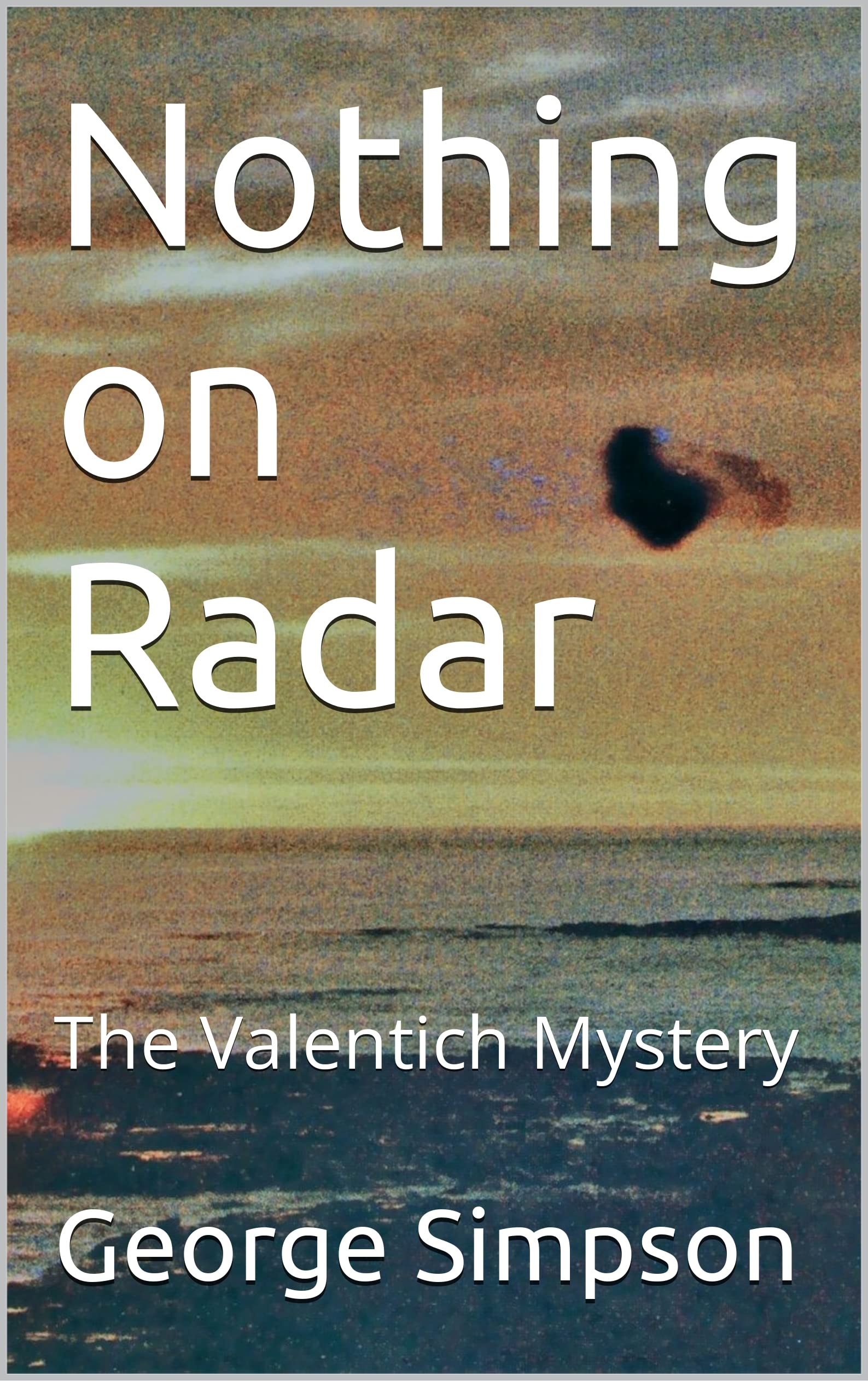
Nothing on Radar
The Valentich Mystery — By the VUFORS Investigator Who Watched the Start of the Flight From His Own Family Home
Find on Amazon →As an Amazon Associate, OverClassified may earn from qualifying purchases made through this link, at no extra cost to you.
Why This Is Essential Reading
The local account of a case the world knows only through its transcript. George Simpson watched the beginning of Frederick Valentich's final flight from his family home in Beaumaris on October 21, 1978, went on to direct VUFORS's Victorian branch, and has investigated the disappearance ever since — which makes this the fullest treatment by the person best placed to write one. It is independently published, has no citation apparatus, and gives the disorientation hypothesis less sustained engagement than a sceptical reader will want. What it has is the Australian record: the local witnesses, the investigative history, and the sustained attention that the international retellings, which mostly recycle the same transcript fragments, have never involved. Read it with this site's case file, and note that the title is the honest verdict — whatever Valentich described, nothing on radar saw it.
Related Cases & Theories
Sources Cited
- Simpson, George. Nothing on Radar: The Valentich Mystery. Independently published; paperback August 3, 2022 (ASIN B0B8H967PR), Kindle September 12, 2022 (ASIN B0BF53LL8X). amazon.com
- Amazon Australia listing, Nothing on Radar: The Valentich Mystery, ASIN B0B8H967PR — independent confirmation of the paperback edition. amazon.com.au
- Amazon UK listing, Nothing on Radar: The Valentich Mystery — independent bibliographic confirmation. amazon.co.uk
- Goodreads edition record, Nothing on Radar: The Valentich Mystery by George Simpson — cover-art source, publication data and reader reception. goodreads.com
- Encounters Down Under, S3 E12, "'Nothing On Radar' — The Fred Valentich Mystery With George Simpson" — long-form interview in which Simpson describes watching the early part of the final flight from his family home in Beaumaris. shows.acast.com
- Apple Podcasts, "George Simpson, Fredrick Valentich Incident" — a further recorded long-form discussion of the investigation. podcasts.apple.com
- Wikipedia, "Disappearance of Frederick Valentich" — the October 21, 1978 flight, the Cessna 182L, the Melbourne Flight Service exchange with Steve Robey, the 'it is not an aircraft' transmission, the seventeen seconds of metallic noise, the search, and the range of proposed explanations. en.wikipedia.org
- Australian Department of Transport, Aircraft Accident Investigation Summary Report, Cessna 182L VH-DSJ, 21 October 1978 — the official file, which records the aircraft as missing and the cause as undetermined.
- Bureau of Air Safety Investigation / Department of Transport aircraft accident summary for Cessna 182L VH-DSJ, 21 October 1978 — reproduced and discussed in the Wikipedia article above; records the aircraft as missing and the cause as undetermined.
- Project 1947, Keith Basterfield's Australian catalogues — the wider national sighting record the case sits inside. project1947.com
- Chalker, Bill. The Oz Files: The Australian UFO Story, 1996 — the national context for the Australian record this case sits inside. OverClassified breakdown
- Basterfield, Keith. UFOs: A Report on Australian Encounters — the Australian sighting catalogue. OverClassified breakdown
- Ledger, Don, and Chris Styles. Dark Object, 2001 — the comparable single-case, long-duration regional investigation. OverClassified breakdown
- OverClassified case file, The Frederick Valentich Disappearance — source for the October 21, 1978 date, the Cessna 182L, the Bass Strait route to King Island, the metallic green-lit object description, the 'it is not an aircraft' transmission and seventeen seconds of metallic scraping, the 19:06–19:12 AEST timing, the clear-sky conditions, the ATC transcript and RMIT audio analysis, the ground observers, and this site's Credible assessment. Identifies George Simpson as the director of VUFORS's Victorian branch and Australia's primary long-term investigator of the case.
- Fogarty, Quentin. Let's Hope They're Friendly: True Story of an Encounter with a UFO, 1982 — the first-person account of the December 1978 Kaikōura filming, three months after Valentich. OverClassified breakdown
Have corrections, additional research, or peer-reviewed sources? Help improve this entry.
Suggest an Edit