
Dark Object
The World's Only Government-Documented UFO Crash
Core Thesis
Dark Object: The World's Only Government-Documented UFO Crash is Don Ledger and Chris Styles's account of turning a fading local memory into a documented federal case file. The Shag Harbour UFO Incident of October 4, 1967 had circulated for a quarter-century as a well-known but thinly sourced piece of Nova Scotia folklore before Styles, informally collecting testimony since the 1970s, formally reopened the investigation in 1993 with Ledger. Over the following years the two re-interviewed surviving witnesses and, critically, filed federal Access to Information requests that produced something almost no other UFO case anywhere possesses: the Royal Canadian Navy's own internal records of its three-day Fleet Diving Unit search, and Department of National Defence documentation formally logging the object as genuinely unidentified rather than closing it as a hoax, a known aircraft, or a natural phenomenon. Published in 2001 by Dell as part of Whitley Strieber's 'Hidden Agendas' paperback line, with Strieber contributing the introduction, the book's title makes a carefully specific claim — not that extraterrestrial technology crashed at Shag Harbour, but that the government's own paper trail, obtained through the authors' own persistence rather than voluntary disclosure, documents that something genuinely unidentified entered the water and was searched for by the Canadian military without result.
About the Author
The book's two authors came to Shag Harbour from different directions and different decades. Chris Styles had his own, separate connection to the night in question: as a twelve-year-old in Dartmouth, Nova Scotia, well up the coast from Shag Harbour itself, he witnessed unexplained lights from his own bedroom window the same evening, October 4, 1967 — one of several scattered sightings reported along the Nova Scotia coast that night that this site's own Shag Harbour UFO Incident case file treats as a plausible but formally unproven part of the evening's broader pattern, rather than a confirmed extension of the harbour event itself. That personal experience did not turn into formal research for years; Styles began informally gathering testimony from Shag Harbour's original witnesses only in the 1970s, working as an independent, self-taught investigator rather than through any institutional UFO organization.
The investigation became a documented case rather than a local legend in 1993, when Styles partnered with Don Ledger, a fellow Nova Scotia-based writer and researcher, to formally reopen it. Together the two re-interviewed surviving witnesses and pursued federal Access to Information requests that eventually recovered the Royal Canadian Navy's own internal dive-search reports — documentary confirmation, from the military's own files rather than press accounts or secondhand recollection, that the Granby's divers had genuinely found nothing on the harbour floor. Styles's research continued long after this book's 2001 publication: he co-founded the Shag Harbour UFO Incident Society in 2006, and in 2018 published a second, more expansive book on the case, Impact to Contact: The Shag Harbour Incident, with co-author Graham Simms, representing roughly twenty additional years of accumulated work, including further material on the case's more speculative Government Point claims addressed critically below.
Don Ledger's own background sits well outside conventional ufology. Born in 1945 in Halifax, Nova Scotia, he worked over the course of his career as a musician, an audio technologist, and eventually a television director, later serving as a coordinator for a legislative television production service. He has held a private pilot's license for decades, logging more than a thousand hours as an aircraft owner, and served as a Zone Commander for the Halifax District's Civil Air Search and Rescue Association (CASARA) — a volunteer air-search organization whose work bears a direct, practical resemblance to the RCN dive search this book documents, if from the air rather than underwater. He has also served as president and editor of the Stanley Sport Aviation Association. Beyond Dark Object, his Nimbus Publishing titles Maritime UFO Files (1998) surveys a broader range of Atlantic Canadian sightings, while his non-UFO books include Swissair Down: A Pilot's View of the Crash at Peggy's Cove (2000), on the 1998 Swissair Flight 111 disaster off the Nova Scotia coast, and Blood Shock: The Dana Wilde Case (2014).
Whitley Strieber's contribution is explicitly editorial rather than investigative: he edited the manuscript and wrote its introduction as part of 'Whitley Strieber's Hidden Agendas,' a Dell mass-market paperback line he fronted in the late 1990s and early 2000s that also included titles such as Roger Leir's Casebook: Alien Implants. The arrangement gave Ledger and Styles's Access to Information-driven documentary work the commercial reach of Strieber's own Communion-era name recognition, already covered on this site's own Communion breakdown, while placing a comparatively sober piece of Canadian government-records journalism inside a paperback series otherwise built around more overtly speculative fare — a packaging tension this article's Critical Reception section returns to.
Historical Context & Origins
By the early 1990s, Shag Harbour had been public knowledge in Nova Scotia for a quarter-century but remained, outside the province, a comparatively obscure case next to Roswell or Rendlesham — kept alive mainly by local memory, RCMP and newspaper archives, and a scattering of earlier UFO-literature mentions, including Ivan T. Sanderson's brief but admiring 1970 treatment in Invisible Residents, covered separately in this site's own Invisible Residents breakdown, which called it 'perhaps the best-documented and most-publicized case of all' of an object diving into the sea. Styles and Ledger's 1993 decision to reopen the case formally, rather than simply retell what had already been reported, situates this book within the broader 1990s wave of FOIA- and ATIP-driven ufology — researchers on both sides of the border turning from witness testimony alone toward the harder, slower work of extracting official government records through formal information-access law.
The book's 2001 publication arrived at a specific institutional moment for Canadian UFO records: the same year, a broader wave of Canadian government UFO-file declassification began releasing what would eventually amount to an estimated 15,000 pages of Department of National Defence, Department of Transport, National Research Council, and RCMP records held by Library and Archives Canada, as this site's own Shag Harbour UFO Incident case file documents. Ledger and Styles's own years of individually pursued Access to Information requests had, in effect, anticipated that larger institutional opening by nearly a decade, giving Dark Object both a genuine documentary head start and a fortunate publication window that drew fresh national media attention to a case most Canadians outside Nova Scotia had never heard of.
Editorially, the book belongs to a specific and short-lived commercial category: 'Whitley Strieber's Hidden Agendas,' a Dell paperback line Whitley Strieber edited and introduced in the years following his own Communion-driven fame, built around pairing his own name recognition with other researchers' case-specific investigations. Dark Object shared shelf space in that series with titles considerably more speculative in method, including Roger Leir's alien-implant surgery casebook — a packaging choice that gave Ledger and Styles's more document-grounded regional case a mass-market audience it might not otherwise have reached, at the cost of being marketed alongside material far less anchored in recovered government paperwork.
Core Arguments & Key Concepts
Structurally, the book builds its case in the order the authors themselves assembled it: first the original October 4, 1967 witness accounts — the Air Canada flight crew's sighting, the MV Nickerson's radar contacts, the Shag Harbour witnesses who reported an object descending into the water, and the RCMP officers who responded and watched it for over an hour — then the Royal Canadian Navy's three-day Fleet Diving Unit Atlantic search of the harbour floor, and finally the modern investigation: Styles and Ledger's own 1993-onward re-interviews and their Access to Information requests for the Navy's internal dive-search paperwork. The book's central evidentiary claim rests on that documentary recovery rather than on any new witness testimony: official Department of National Defence records that explicitly classify the object as unidentified — not a hoax, not a known aircraft, not a meteor — giving the case, in the authors' framing, a rare formal government admission that an investigation concluded without resolution rather than one lost to simple bureaucratic silence.
The book's most debated addition to the case's literature is what has since become known as the Government Point or 'Shelburne connection' story: an account, built from interviews Styles conducted with retired Navy divers and other secondhand sources years after the fact, holding that whatever entered the water off Shag Harbour traveled roughly 25 miles underwater to the real, historically documented Cold War-era joint Royal Canadian Navy/U.S. Navy SOSUS submarine-detection installation at Government Point near Shelburne, where sonar operators are said to have tracked it before it surfaced and departed days later. This site's own Shag Harbour UFO Incident case file treats this story as unconfirmed folklore layered onto a well-documented core event, noting it has never been corroborated by any official government record, sonar log, or on-the-record military source despite gaining wide acceptance in later popular UFO literature — a caveat this book article preserves rather than smooths over, since the story's popularization traces directly back to Styles's own research for this book.
A second, less sensational but arguably more durable argument runs through the book's institutional material: the authors' account of exactly how Canadian federal agencies — the RCMP, the RCAF, and the Navy — actually processed an unusual report in real time in 1967, cross-referenced against what the same agencies' declassified files decades later confirmed or contradicted. This procedural through-line, more than any single dramatic claim, is what later researchers — including Chris A. Rutkowski, whose own Canada's UFOs: Declassified (2022) covers the same declassified DND record using the same document trail Ledger and Styles helped surface, and which this site separately breaks down in its own Canada's UFOs: Declassified entry — have continued to draw on when discussing how Canada's federal UFO-reporting apparatus actually functioned.
Key Cases & Evidence Discussed
The book's entire subject is this site's own Shag Harbour UFO Incident (Case File #032, October 4, 1967), which cites this exact book directly as the 'seminal, definitive account of the case' and draws on its documented timeline of the 1993 reopening, the Access to Information requests, and the 2001 publication itself as part of the case's own declassification history.
The disputed Government Point/Shelburne sonar story — centered on the real Cold War-era SOSUS installation at Government Point near Shelburne, Nova Scotia — originates substantially from interviews Styles conducted for this book and its 2018 sequel, and is presented here with the same critical caveat this site's own case file applies: a genuinely documented military installation attached to an undocumented, secondhand claim about what happened there in October 1967.
This site's own earlier Invisible Residents breakdown covers Ivan T. Sanderson's brief 1970 treatment of Shag Harbour, written just three years after the event and decades before Ledger and Styles's own government-records investigation; reading the two books together traces the case's evidentiary arc from an early journalist's admiring secondhand account to a document-based reinvestigation built on the authors' own Access to Information requests.
Canada's UFOs: Declassified, Chris A. Rutkowski's 2022 survey of the Library and Archives Canada UFO collection, places Shag Harbour alongside the Falcon Lake incident as one of the two major Canadian physical-evidence cases of 1967, working from the same declassified Department of National Defence record this book's authors helped bring into public view two decades earlier.
Critical Reception & Controversies
Dark Object has never attracted trade-press review coverage comparable to a Publishers Weekly or Kirkus Reviews notice; like several other single-case investigative titles on this site's own reading list, its critical record rests almost entirely on reader response and specialist UFO-research commentary rather than mainstream book criticism. Aggregated reader ratings on Goodreads sit at 3.46 out of 5 across 97 ratings and nine separate editions — a solidly positive but unspectacular reception consistent with a regionally focused case study rather than a genre-defining bestseller.
Where reader reviews single out a specific strength, it is usually the book's documentary grounding rather than its prose: one aggregated reader review describes it as weaving 'a fascinating story, even for a UFO skeptic,' crediting the authors with establishing 'that whatever the UFO was, it wasn't anything conventional' through the recovered Navy paperwork, and calling the read 'money and time well spent' — a specific, favorable but non-professional endorsement this article presents as exactly what it is, a reader review rather than a critic's assessment.
The book's most substantive weakness is the one this site's own case file identifies independently: its popularization of the Government Point/Shelburne sonar-tracking story, built from Styles's secondhand interviews with retired Navy personnel decades after the fact, has never been corroborated by any sonar log, official record, or named on-the-record military source, yet has gone on to be repeated as settled fact across a great deal of later popular UFO writing about the case. That the book's own most dramatic addition to the Shag Harbour literature is also its least documented claim sits in direct tension with the rigorously government-sourced material — the recovered RCN dive records, the DND 'unidentified' classification — that gives the book its title and its genuine evidentiary weight.
The book's placement within Whitley Strieber's 'Hidden Agendas' line is itself a source of reasonable critical friction: a paperback series built for a mass UFO-paranormal audience, sharing shelf space with material as speculative as alien-implant surgery casebooks, was not packaging designed to win the book a hearing among skeptical or academic readers inclined to dismiss anything carrying Strieber's editorial imprint on sight — regardless of how much of the book's own core content rests on recovered government paperwork rather than any claim requiring Strieber's own more contested visitor testimony to be credited.
Influence & Legacy
The book's most concrete, documented legacy is its direct role in the case's own modern revival: its 2001 publication, arriving the same year as Canada's broader wave of DND, RCMP, and NRC UFO-file declassification, drew renewed national media attention to a case that had previously been known mainly within Nova Scotia. This site's own Shag Harbour UFO Incident case file credits the book directly as the 'seminal, definitive account' underlying that revival.
Institutionally, the book's research fed directly into two lasting local structures: the Shag Harbour UFO Incident Society, which Styles co-founded in 2006, and the Shag Harbour UFO Museum, which opened in 2008 using the book's research as foundational material for its exhibits, according to the Shag Harbour UFO Incident Society's own account of Ledger's career. Both continue to operate as the case's ongoing public-facing institutions, including an annual UFO festival in the community.
Styles's own research continued well beyond this book, culminating in Impact to Contact: The Shag Harbour Incident (2018), co-authored with Graham Simms and representing roughly two further decades of investigation — a direct sequel relationship unusual among the single-case books on this site's own reading list, where most authors' definitive accounts remain standalone rather than revisited and expanded by the same researcher nearly twenty years later.
More broadly, the book helped establish Shag Harbour's now-standard framing, echoed in this site's own case file and in later surveys of Canadian UFO history including Chris A. Rutkowski's 2022 Canada's UFOs: Declassified, as one of the very few UFO incidents anywhere with a genuine, declassified government paper trail affirmatively stating that an official investigation concluded without identifying the object — a documented gap in the record, rather than a case simply left uninvestigated.
The Book
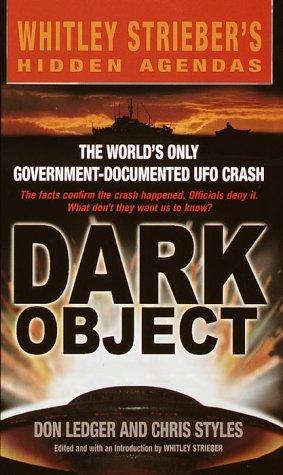
As an Amazon Associate, OverClassified may earn from qualifying purchases made through this link, at no extra cost to you.
Why This Is Essential Reading
Dark Object earns its place on this list for the same reason this site's own Shag Harbour UFO Incident case file cites it directly as the case's seminal account: it is the book that turned a well-known but thinly sourced piece of Nova Scotia folklore into a documented federal case, through Don Ledger and Chris Styles's own years of Access to Information requests rather than through any new witness coming forward. Its title's claim is narrower and more defensible than it might first appear — not that a craft of extraterrestrial origin crashed into Shag Harbour, but that the Canadian government's own recovered paperwork documents a genuine, unresolved investigation, which is itself a rare enough thing in UFO literature to justify the book's place here. Its real limitation is equally specific and worth stating plainly: the same research that recovered the Navy's dive records also produced the largely uncorroborated Government Point/Shelburne sonar story, a claim this site's own case file treats as unconfirmed folklore rather than established fact. Read against this site's earlier Invisible Residents entry, which covers Sanderson's admiring 1970 secondhand account, Dark Object is the moment Shag Harbour's literature shifted from retelling to documentary reinvestigation — genuinely earned government records sitting alongside a dramatic secondhand claim neither this book nor any book since has been able to confirm.
Related Cases & Theories
Essential Viewing
Chris Styles, Shag Harbour UFO Incident & Cape Sable Island UFO
Podcast UFO — Co-author Chris Styles discusses the Shag Harbour case and his continuing research directly, verified via YouTube oEmbed before inclusion.
UFO Crash Shag Harbour: Canada's Roswell, with Don Ledger
Night Fright Show — Co-author Don Ledger discusses the Shag Harbour case and the research behind Dark Object, verified via YouTube oEmbed before inclusion.
Sources Cited
- Ledger, Don & Styles, Chris. Dark Object: The World's Only Government-Documented UFO Crash. Edited and with an introduction by Whitley Strieber. Dell, 2001 (ISBN 9780440236474 / 0440236479, mass-market paperback first edition cited here). amazon.com
- "Dark object." Open Library edition record OL3964979M (publisher, publication place, pagination, LCCN 2001269794, OCLC 47163812, subject headings). openlibrary.org
- "Dark Object by Don Ledger and Chris Styles, edited and with an introduction by Whitley Strieber." Penguin Random House (publisher/imprint confirmation: Dell; publication date March 6, 2001; 192 pages, mass-market paperback). penguinrandomhouse.com
- "Dark Object: The World's Only Government-Documented UFO Crash." Goodreads (aggregated rating: 3.46 average across 97 ratings, nine editions). goodreads.com
- "Don Ledger (Author of Dark Object)." Goodreads author profile (bibliography: Dark Object, Swissair Down, Maritime UFO Files, Blood Shock: The Dana Wilde Case). goodreads.com
- "Dark Object: The World's Only Government-Documented UFO Crash." ThriftBooks (publisher: Random House Publishing Group; synopsis and aggregated reader review excerpt). thriftbooks.com
- "Casebook: Alien Implants (Whitley Streiber's Hidden Agendas)." Amazon.com (confirms Dell's 'Whitley Strieber's Hidden Agendas' series, of which this book is also a part). amazon.com
- "Don Ledger, UFO researcher and author." Shag Harbour UFO Incident Society (official case site), August 1, 2014 (Ledger's bibliography and the book's role as foundational material for the Shag Harbour UFO Museum since its 2008 opening). shagharbourincident.wordpress.com
- "Maritime UFO files." AbeBooks listing via Cape Breton Regional Library (Nimbus Publishing, 1998 first edition; Don Ledger publisher's biography note reproduced across Amazon.com, Amazon.ca, and affiliated booksellers for his Nimbus Publishing titles). abebooks.com
- "Whitley Strieber." Wikipedia (career background, Communion and its cultural reach, used here for cross-reference to this site's own Strieber key-figures card). en.wikipedia.org
- This site's own case file: The Shag Harbour UFO Incident (Case File #032), which cites this book directly as the case's seminal, definitive account and documents its 2001 publication within the case's own declassification history.
- This site's own key-figures entry: Don Ledger, for his full biography and role in reopening the case in 1993.
- This site's own key-figures entry: Chris Styles, for his full biography, 1967 Dartmouth sighting, and the Shag Harbour UFO Incident Society.
- This site's own key-figures entry: Whitley Strieber, for his own biography and the separate breakdown of his own book, Communion.
- This site's own Essential Reading title: Invisible Residents, for Ivan T. Sanderson's earlier 1970 treatment of the same case.
- This site's own Essential Reading title: Canada's UFOs: Declassified, for Chris A. Rutkowski's later 2022 survey of the same declassified Canadian government UFO-file record.
Have corrections, additional research, or peer-reviewed sources? Help improve this entry.
Suggest an Edit