
Canada's UFOs: Declassified
Chris A. Rutkowski's Guided Tour of the Library and Archives Canada UFO Files, 1947–1980
Core Thesis
Published in May 2022 by the UK-based August Night Press, with a foreword by journalist M.J. Banias, Canada's UFOs: Declassified is Winnipeg science writer Chris A. Rutkowski's guided walk through a specific, bounded body of evidence: the roughly 9,500 digitized UFO-related documents Library and Archives Canada holds after acquiring them from the Department of National Defence, the Department of Transport, the National Research Council, and the Royal Canadian Mounted Police, covering sightings reported by Canadians between 1947 and 1980. Rather than arguing for a single explanation of what those sightings represent, Rutkowski — who has compiled the annual Canadian UFO Survey since 1989 and has investigated Canadian reports personally since 1975 — works case by case through the government's own paper trail, using his decades of hands-on familiarity with how the RCMP, the RCAF, and the NRC actually processed a report to show readers what a declassified Canadian file looks like, what it typically does and doesn't establish, and why a country with comparatively open UFO records has still produced cases — Falcon Lake and Shag Harbour chief among them — that its own investigators were never able to close.
About the Author
Chris A. Rutkowski holds a Bachelor of Science in astronomy and a Master of Education specializing in astronomy, has taught postsecondary space and astronomy courses, and served as past president of the Winnipeg Centre of the Royal Astronomical Society of Canada — a science-education background this article treats as directly relevant, since it is the same combination of formal astronomical training and public-communication experience that has let him move between academic-adjacent venues and popular UFO publishing for five decades without either side fully disowning him.
His UFO research began in 1975, as an undergraduate, when a wave of sightings broke out around his home province of Manitoba — the case this site's own Charlie Redstar file documents in detail. Rutkowski began cataloguing the reports as they came in, eventually working through more than 2,000 pages of that year's National Research Council case files, and the investigation never really stopped: working from his base in Winnipeg, Manitoba, he founded in 1989 what became Ufology Research (originally Ufology Research of Manitoba, or UFOROM), which has published the annual Canadian UFO Survey — now compiled with fellow researcher Geoff Dittman — every year since, aggregating tens of thousands of individual Canadian sighting reports into the country's longest-running statistical UFO dataset.
By the time this book appeared, Rutkowski had already published nine previous UFO-related titles going back to Unnatural History (1993), including Abductions and Aliens: What's Really Going On? (1999), The Canadian UFO Report: The Best Cases Revealed (with Geoff Dittman), and, most consequentially for this book's marquee case, When They Appeared: Falcon Lake 1967 (2017), co-written with Stan Michalak, the son of Falcon Lake witness Stefan Michalak. That co-authorship gave Rutkowski a research relationship with the case's own family archive that predates and directly feeds this book's later, broader treatment of the government file record surrounding it.
Rutkowski's institutional footprint extends beyond his own books: he is affiliated with the Center for UFO Studies, is a science-writer contributor to Harvard's Galileo Project UAP data-assembly effort, and works with the Scientific Coalition for UAP Studies — credentials that place him, like several other authors on this list, in the narrower category of UFO researchers with an ongoing, working relationship to more conventionally credentialed institutions. He followed this book in 2023 with Canada's UFO Secrets: Disclosing Government Files on What Is Happening in Our Skies (Dundurn Press) — a related but distinct title this article is careful not to conflate with the book under review here, since the two share a publisher-adjacent subject and a broadly similar premise but were released by different publishers in different years and drew different critical attention, detailed in Critical Reception below.
Historical Context & Origins
Canada's own government UFO-reporting apparatus predates this book by roughly seventy-five years and shifted hands more than once. The Department of National Defence began accumulating sighting reports as early as 1947, and in 1968 the National Research Council formally took over responsibility for fielding and cataloguing civilian reports, a handover for which no surviving record states an explicit reason. The NRC's Herzberg Astronomy and Astrophysics centre kept completing "sky observation report" forms and fielding media calls for civilian sightings for close to three decades, officially ending the practice only in 1995 under budget cuts that also closed the Algonquin Radio Observatory — though staff there continued handling occasional inquiries informally well past that date. The resulting paper trail, transferred to Library and Archives Canada, forms the specific document set this book is built from.
That transfer is itself the book's real subject: unlike the far more restrictive classification regime American researchers spent decades trying to pry open through FOIA litigation, Canada's official UFO files were, relative to their American counterparts, comparatively accessible to a diligent researcher well before this book's 2022 publication — Library and Archives Canada's own "Canada's UFOs: The Search for the Unknown" database had already made a large tranche of that material searchable online. Rutkowski's contribution is not first access to hidden material in the way The Oz Files' Bill Chalker gained unprecedented entry to still-classified Royal Australian Air Force files; it is instead the work of a researcher who has spent close to five decades learning to read this specific, already-open archive, translating its bureaucratic residue — incident forms, RCMP canvass notes, NRC correspondence — into a narrative a general reader can follow case by case.
The book also arrived at a specific moment in the wider UFO conversation: it followed the U.S. Office of the Director of National Intelligence's June 2021 preliminary assessment on unidentified aerial phenomena by less than a year, a period of renewed mainstream and governmental attention to the subject that this book's own marketing material explicitly invokes when describing the sightings it covers as ones that "continue to defy conventional explanation" against the backdrop of the Pentagon's own recent acknowledgment of ongoing UAP investigation. Read against that moment, the book functions as a Canadian-specific counterpart to the renewed American disclosure conversation: not a claim that Canada has its own hidden Roswell, but an argument that the country's own comparatively open files are worth a serious, guided read precisely because so few general readers, in Canada or elsewhere, had ever been walked through them start to finish.
Structurally, this book followed, rather than preceded, Rutkowski's most detailed single-case treatment: When They Appeared (2017) had already given the Falcon Lake file a full-length, family-archive-informed account five years earlier. This book instead pulls back to the wider 1947–1980 government record itself, situating Falcon Lake as the most heavily documented entry within a much larger catalogue of Canadian cases the National Research Council, the RCMP and the RCAF processed with far less scrutiny and far thinner surviving paperwork.
Core Arguments & Key Concepts
The book's organizing method is archival rather than theoretical: Rutkowski does not argue that Canadian UFO reports point toward any single explanation, instead walking through the declassified files roughly chronologically, letting the RCMP incident forms, RCAF investigation notes and NRC correspondence speak for themselves and adding the case-specific context — witness backgrounds, follow-up (or its absence), what happened to the file afterward — that a general reader would otherwise have no way to reconstruct from the raw documents alone.
A recurring structural argument concerns the unevenness of Canadian government follow-up: the book's own case selection shows a system that could, when a report carried enough institutional weight — multiple RCMP witnesses, military involvement, physical trace evidence — mobilize a genuinely serious multi-agency response, as in the Shag Harbour case's three-day Royal Canadian Navy dive search, while the great majority of ordinary civilian reports received a single completed form and no further action at all. Rutkowski reads this gap not as evidence of a two-tier cover-up but as the predictable behavior of an underfunded civilian science agency handed a mandate, in the NRC's case from 1968 onward, that it had neither the budget nor the institutional mission to pursue rigorously.
The book gives its fullest single-case treatment to the Falcon Lake Incident, folding the Michalak family's own archive — already assembled in Rutkowski's 2017 book with Stan Michalak — into the wider file record this book surveys, and uses it as the clearest illustration of the pattern that recurs across the collection: a case substantial enough to generate RCMP, RCAF, Department of National Defence and even Health Sciences Centre medical documentation, reviewed years later by the American Condon Committee, and still closed as unresolved rather than either confirmed or explained away.
Alongside the marquee cases, the book devotes considerable space to the NRC-era record of smaller, less-remembered regional reports — the kind of file this site's own Clarenville UFO Sighting and John Sheppard Sighting case files represent — arguing implicitly that the value of Canada's declassified archive lies as much in its ordinary, thinly documented cases as in its famous ones, since the ordinary cases are what actually reveal how the reporting system worked (or didn't) for the average civilian witness rather than for a case dramatic enough to force a multi-agency response.
Structurally, the book also makes an argument about historical method: by walking the reader through primary government documents rather than secondary retellings, Rutkowski positions the book as a corrective to decades of UFO writing — his own earlier books included — that summarized Canadian cases from press accounts and researcher notes rather than from the underlying official file itself, treating direct access to the bureaucratic record as a check against both sensationalized and dismissive retellings alike.
Key Cases & Evidence Discussed
The Falcon Lake Incident (Case File #017, May 20, 1967) receives this book's most sustained treatment, building on Rutkowski's own 2017 book When They Appeared, co-written with witness Stefan Michalak's son Stan Michalak. This site's own case file documents the same RCMP, RCAF, Department of National Defence, Whiteshell Nuclear Research Establishment and Health Sciences Centre records this book draws on, and quotes Rutkowski's own published assessment that Michalak's account is internally consistent with his training and professional background as an industrial mechanic — the same credibility-weighting method this book applies to the wider 1947–1980 file record.
The Shag Harbour UFO Incident (Case File #032, October 4, 1967) sits alongside Falcon Lake as the other major physical-evidence Canadian case from the same extraordinary year, and this site's own case file documents the same declassified Department of National Defence finding — that the object had "not been caused by a flare, float, aircraft or in fact any known object" — that anchors this book's account of the Royal Canadian Navy's three-day Fleet Diving Unit Atlantic search of the harbour floor.
The Charlie Redstar wave (Case File #183, 1975) is where this book's account intersects with Rutkowski's own origin story as a researcher: this site's own resources library cites this exact edition specifically for "situating the Manitoba wave that produced Charlie Redstar within the country's broader declassified UFO record," the same National Research Council case files Rutkowski began cataloguing as an undergraduate and later revisited in his 1993 book chapter "Charlie Redstar and Friends."
The Clarenville UFO Sighting (Case File #086, 1978) and the John Sheppard Sighting (Case File #080) represent the book's treatment of thinner, less-remembered regional files — this site's own resources library cites this exact edition on both pages as "essential context for how bodies like the NRC actually handled reports" and as the most directly relevant country-specific reference for cases that unfolded entirely within Canadian civil aviation and NAV CANADA's own reporting chain, respectively.
The Langenburg UFO / Saucer Nests (Case File #184, 1974) and the Yellowknife Lights (Case File #081) are two further cases this site's own resources library independently cites this exact edition on, rounding out a five-page citation footprint across this site's own Canadian case-file coverage that this article's own publication consolidates into a single authoritative breakdown for the first time.
This site's own Earth Lights Revelation essential-reading article documents a direct, verified scholarly connection to this book's author: Paul Devereux's 1989 book credits Rutkowski's statistical analysis of Manitoba UFO reports — more than 500 sighting reports from a province with comparatively little seismic activity — as a named rebuttal to Michael Persinger's fault-line-correlated Tectonic Strain Theory, an exchange this article independently confirms was a real, published scholarly dispute: Persinger's own 1985 paper in Perceptual and Motor Skills, titled "A Response to Rutkowski's Critique of the Tectonic Strain Hypothesis for UFO Phenomena," directly addresses Rutkowski's statistical objections using the same Carman, Manitoba case data this book's author began compiling during the 1975 Charlie Redstar wave.
Critical Reception & Controversies
This book has not attracted the kind of sustained mainstream book-review coverage some other Essential Reading titles on this list have: its reception has come almost entirely through the UFO-research podcast and interview circuit rather than literary or science press. Within months of release it was the subject of dedicated episodes on Somewhere in the Skies (June 2022), Podcast UFO (July 2022), and John Greenewald Jr.'s The Black Vault podcast (August 2022, Episode 110), giving the book a real if narrow circulation footprint concentrated within the UFO-research community rather than general readers.
Reader reception on Goodreads sits at a modest 3.73 out of 5 stars from 11 ratings and no written reviews at the time of this article's research — a thin sample that reflects the book's limited print run and specialist audience rather than any documented controversy over its content or method.
This article treats it as material, rather than a flaw to paper over, that Rutkowski's own next book — Canada's UFO Secrets: Disclosing Government Files on What Is Happening in Our Skies (Dundurn Press, 2023) — received the more substantial critical attention: a 2024 Literary Review of Canada "Bookworm" column and a dedicated Cipher Brief review titled "Transparency Matters: Inside Canada's UFO Files" both engaged with that later, Dundurn-published title specifically, not with the book under review here. This site's own case-file citations, drawn independently from five separate pages, appear to have occasionally conflated the two books' publication details as well — several existing case files on this site cite this exact ISBN (1786771691) under a Dundurn, 2019 attribution that this article's own independent verification found does not match any confirmed record for this title; the book's actual publisher is August Night Press and its actual publication date is May 24, 2022, per Amazon, Goodreads, the publisher's own promotional page, and the book's own McNally Robinson launch event.
What limited critical engagement exists has been broadly favorable to the book's method rather than skeptical of it: Rutkowski's decades-long reputation as a researcher who, in his own consistent public framing, keeps the extraterrestrial question deliberately offstage and treats a UFO strictly as "an occurrence or object not known at the time of reporting" rather than evidence of anything further, has made this book's case-by-case, document-forward approach a natural extension of a research style already well established across his prior nine books rather than a departure reviewers felt compelled to interrogate.
The most substantive scholarly pushback connected to Rutkowski's broader body of work predates this specific book by nearly four decades but remains directly relevant to how this article evaluates his method: cognitive neuroscientist Michael Persinger's 1985 published response to Rutkowski's statistical critique of the Tectonic Strain Theory shows Rutkowski's Manitoba dataset being taken seriously enough, within the field's own more technical literature, to warrant a direct, named scholarly reply — evidence that his statistical rigor has drawn genuine engagement from researchers working in an adjacent, more conventionally scientific register, even where this specific 2022 book's own reception has stayed largely within ufology's own interview circuit.
Influence & Legacy
This book's most concrete, independently verifiable influence is documented on this very site: this exact edition, under ISBN 1786771691, is cited across this site's own resources library in connection with five separate case-file pages — Charlie Redstar, Clarenville UFO Sighting, John Sheppard Sighting, Langenburg UFO / Saucer Nests, and Yellowknife Lights — making it, alongside Rutkowski's own When They Appeared and The Canadian UFO Report, part of the working documentary backbone of this site's own Canadian case-file coverage.
Within Canadian ufology specifically, this book functioned as a bridge between Rutkowski's single-case deep dive on Falcon Lake in When They Appeared (2017) and his subsequent, more explicitly policy-focused Canada's UFO Secrets (2023), forming the middle installment of a documented three-book progression — case-specific archive, government-wide archive, government-policy analysis — that traces the arc of Rutkowski's own research focus across the second half of his career.
The book's publication also coincided with, and drew directly on, the renewed institutional attention UFO research received following the U.S. government's 2021 preliminary UAP assessment, giving Rutkowski's decades of accumulated Canadian file access new relevance to an international audience already primed by American disclosure coverage to take a comparable Canadian government-records survey seriously.
More broadly, this book extended Rutkowski's standing as Canadian ufology's primary institutional point of contact into the country's federal document record specifically: it followed his three decades of running the Canadian UFO Survey and preceded his continuing advisory role with Canada's own 2024–2025 Sky Canada Project review of public UAP-reporting mechanisms — positioning Rutkowski, by the time that federal report was published, as the researcher whose own archival work on this exact declassified file record had helped inform the debate over what a modern Canadian UAP-reporting mechanism should even look like.
The Book
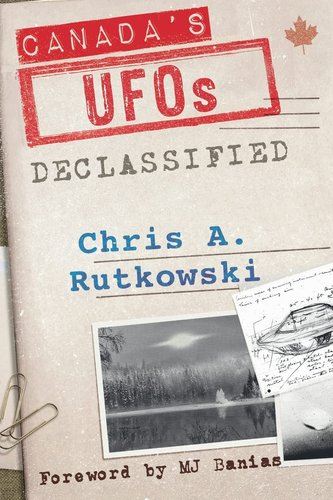
Canada's UFOs: Declassified
Chris A. Rutkowski's Guided Tour of the Library and Archives Canada UFO Files, 1947–1980
Find on Amazon →As an Amazon Associate, OverClassified may earn from qualifying purchases made through this link, at no extra cost to you.
Why This Is Essential Reading
Canada's UFOs: Declassified earns its place on this list as this site's first Essential Reading entry built specifically from Canada's own government UFO-file record, assembled by the one researcher whose Canadian case investigations, going back to 1975, and whose annual Canadian UFO Survey, running since 1989, gave him the specific, hard-won fluency needed to translate decades of RCMP incident forms and NRC correspondence into a book a general reader can actually follow. Its limits are real and worth naming plainly: it received comparatively little independent critical review relative to Rutkowski's own subsequent book, and at least some of that limited critical footprint on this very site has, this article's own research found, been miscited under a different publisher and year than the ones this book actually carries. But as a guided, document-literate walk through a genuinely underexplored English-language government archive — anchored by the same Falcon Lake file record Rutkowski helped assemble in fuller form elsewhere, and backed by a statistical rigor serious enough to have drawn a direct, named scholarly response from Michael Persinger nearly four decades earlier — it stands as the most accessible single-volume entry point this site has found into Canada's own declassified UFO record.
Related Cases & Theories
Essential Viewing
Chris Rutkowski launch of Canada's UFOs: Declassified (August Night Press)
McNally Robinson Online Events — The book's own launch event, with Rutkowski discussing the Library and Archives Canada file collection this book is built from and the publisher, August Night Press, directly. Verified via YouTube oEmbed before inclusion.
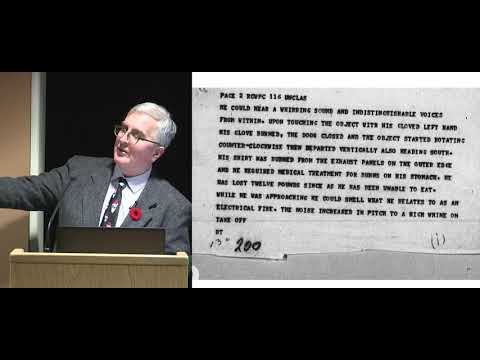
Falcon Lake UFO Lecture, November 7, 2019
University of Manitoba Archives & Special Collections — Rutkowski and Falcon Lake witness Stefan Michalak's son, Stan Michalak, lecture on the case this book treats as its most heavily documented single file, drawing on the same family and government archive material. Verified via YouTube oEmbed before inclusion.
Sources Cited
- Rutkowski, Chris A. Canada's UFOs: Declassified. August Night Press, 2022 (ISBN 1786771691 / 9781786771698, matching this site's own resources library citations across five case-file pages). amazon.com
- "Canada's UFOs: Declassified." Amazon.ca product listing (publisher, format, and ISBN confirmation: 9781786771698). amazon.ca
- "Canada's UFOs: Declassified." White Crow Books listing (publisher August Night Press, publication date May 24, 2022, page count 296). whitecrowbooks.com
- "Canada's UFOs: Declassified." August Night Press promotional page (publisher's own description, 1947–1980 date range, foreword credit to M.J. Banias). augustnightpress.blogspot.com
- "Canada's UFOs: Declassified by Chris A. Rutkowski." Goodreads (aggregate rating 3.73/5 from 11 ratings, cited in this article's Critical Reception section). goodreads.com
- "Chris Rutkowski launch of Canada's UFOs: Declassified (August Night Press)." McNally Robinson Online Events, YouTube, 2022 (publisher and title confirmation via the book's own launch event). youtube.com
- "Interview with UFO Expert Chris Rutkowski." Jonathan Ball, PhD (biography: education, 1975 Manitoba investigation origin, research philosophy quotes cited in this article). jonathanball.com
- "Chris Rutkowski." Center for UFO Studies board, consultants and friends biography page (career summary, organizational affiliations, published books list). cufos.org
- "Our Team." Canadian UFO Report (Rutkowski biography: astronomy and education degrees, Canadian UFO Survey history, current organizational affiliations). canadianuforeport.ca
- "NRC UFO Reports: Canada's Quiet Sightings Log After 1995." The Canada Report (history of the Department of National Defence-to-National Research Council handover in 1968 and the NRC's 1995 official withdrawal from UFO-report handling). thecanadareport.ca
- Persinger, M.A. "Geophysical Variables and Behavior: XXVI. A Response to Rutkowski's Critique of the Tectonic Strain Hypothesis for UFO Phenomena." Perceptual and Motor Skills, vol. 60, no. 2, 1985, p. 575 (verifies the real scholarly exchange this site's own Earth Lights Revelation article references as Rutkowski's "Manitoba statistical rebuttal"). journals.sagepub.com
- "Chris A. Rutkowski." Dundurn Press author page (bibliography cross-check distinguishing this book from the separately Dundurn-published Canada's UFO Secrets, 2023). dundurn.com
- "Bookworm, no. 156." Literary Review of Canada (Substack), reviewing Canada's UFO Secrets specifically — cited here to distinguish that book's critical reception from this one's, as detailed in this article's Critical Reception section. reviewcanada.substack.com
- This site's own resources library: Full Reading List, where this exact edition (ISBN 1786771691) is cited across five separate case-file pages.
- This site's own case file: The Falcon Lake Incident, for the book's most heavily documented single case.
- This site's own case file: The Shag Harbour UFO Incident, for Canada's other major 1967 physical-evidence case.
- This site's own key-figures entry: Chris Rutkowski, for his full biography and further case connections.
- This site's own essential-reading article: Earth Lights Revelation, for the verified 1985 Persinger–Rutkowski scholarly exchange this book's author is independently credited with in that article's own Critical Reception section.
Have corrections, additional research, or peer-reviewed sources? Help improve this entry.
Suggest an Edit