
The Kaikōura Lights
Over two nights in December 1978, Safe Air Ltd Argosy freighters flying night cargo runs from Blenheim and Wellington to Christchurch reported unexplained lights off the Kaikōura coast of New Zealand's South Island. In the early hours of 21 December, Vern Powell and Ian Pirie saw a bright light while Wellington radar was painting a strong return, and their own radar showed a fast-moving target. On 30–31 December a television crew put together by Melbourne's Channel 0, with reporter Quentin Fogarty and Wellington cameraman David Crockett, flew the route and filmed lights on 16mm colour film. The footage was broadcast around the world. The RNZAF and DSIR investigated at Prime Minister Robert Muldoon's request and put most of the sightings down to Venus seen through a disturbed atmosphere, squid-fleet lights and spurious radar returns, while a DSIR briefing to New Zealand's UN mission said the objects would "remain classified as UFOs until identified."
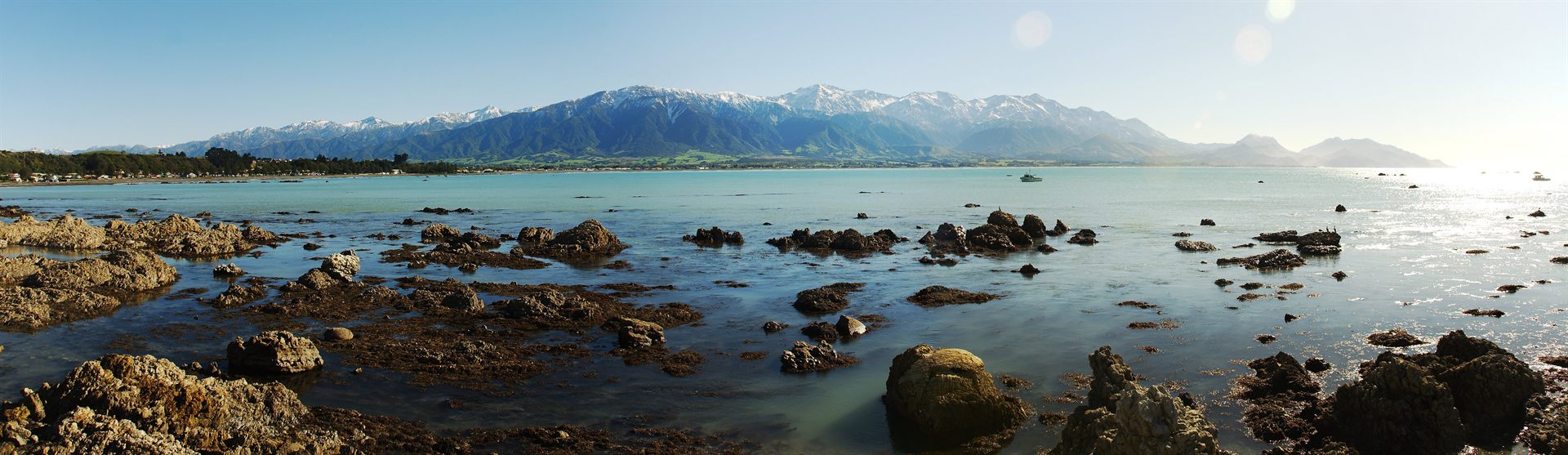
Pictured: the Seaward Kaikōura Range viewed from the Kaikōura coastline — the actual mountain range and coastal airspace above which both encounters occurred, not a photograph of the lights, the aircraft, or the film footage itself. No public-domain or rights-clear photograph of the original 16mm film frames, the Argosy ZK-SAE in period livery, or the incident aircraft's cockpit is known to exist; the surviving footage remains held by the New Zealand principals and TV1/Network Ten rather than freely licensed.
Theoretical Alignment
The Kaikōura case earns a modest ETH alignment because it combines visual reports by working pilots, radar returns on the ground and in the aircraft, and colour film shot by a professional cameraman. It scores lower than that combination might suggest because the radar and visual records do not line up cleanly, and New Zealand's own investigators never endorsed an exotic origin: the RNZAF and DSIR both concluded that most of the sightings were consistent with Venus seen through a disturbed atmosphere, with squid-fleet lights and spurious radar returns accounting for much of the rest. The Psycho-Social Hypothesis scores moderately. A fleet of about fifty Japanese squid boats sailed from Wellington down the coast in the same fortnight, the 21 December reports were heavily publicised, and the television crew flew nine nights later specifically to look for lights, which are conditions under which ambiguous lights can be read as a dramatic story. The Interdimensional Hypothesis finds no support in the record; nothing beyond lights, radar returns and film was ever reported.
Background
Safe Air Ltd, founded in 1950 as Straits Air Freight Express, ran New Zealand's main overnight air-freight network from Woodbourne Airport outside Blenheim, at the northern tip of the South Island. Its workhorse by the late 1970s was the Armstrong Whitworth Argosy, a twin-boom, four-engined turboprop freighter of the type flown in the 1960s by British European Airways and the RAF. Safe Air's Argosies flew nightly newspaper, mail and general freight runs linking Wellington, Blenheim, Christchurch and beyond, a route that took crews down the Kaikōura coast in the small hours. The Argosy on the 30–31 December flight was ZK-SAE, "Merchant Enterprise," which survives at Blenheim in the care of the Argosy Trust.
December 1978 was already a febrile month for aerial reports in the Tasman region. On 21 October 1978 the Australian pilot Frederick Valentich had vanished over Bass Strait after reporting an unknown aircraft above his Cessna, a story that dominated the Australian press. The RNZAF investigation later noted two other background facts that matter for any assessment of what followed. Venus was rising in the east before dawn and was near its greatest brilliance, about twelve times brighter than Sirius, according to the DSIR. And between 17 and 28 December some fifty Japanese squid boats sailed from Wellington in groups of about ten, tracking down the coast toward the Mernoo Bank east of Banks Peninsula; each, the RNZAF report noted, "puts out about 200kw of light."
Complete Timeline
| Date / Time | Event |
|---|---|
| 20 Dec. 1978, 11:50 PM | At Woodbourne, the RNZAF orderly officer, W/O Uffindell, sees three lights he first takes for a Bristol Freighter on approach. They move "upward and around in a rectangular pattern" for about 50 minutes; the duty air traffic controller, Mr Frame, watches from the tower balcony. Wellington radar tells Woodbourne it is painting five targets in the Clarence River area. The RNZAF later judged it "highly improbable" that the radar returns and these lights were connected. |
| 21 Dec., 01:10–04:06 AM | Safe Air Capt. John Randle's Argosy, outbound from Woodbourne, is asked at 01:59 to check Wellington radar returns off the Clarence River and sees intermittent lights low near the coast. Northbound at about 04:06 he sees lights again in the same area, making a "rectangular pattern." Randle later called his own sightings "most undramatic." |
| 21 Dec., 03:15–04:00 AM | Capt. Vern Powell and F/O Ian Pirie leave Woodbourne for Christchurch and Dunedin. At 03:58 Wellington radar asks them to identify a strong return about 25 nautical miles to port; both see a very bright light, "bright orb/pear shaped – reddish tinge then turned white," which looked stationary but "tracked the aircraft" on radar. At about 04:00, some 50 miles northeast of Christchurch, Powell watches five returns on the aircraft's own radar cross about 15 miles of the scale in roughly five seconds and veer off, while Pirie sees a strobe-like light follow the same path. |
| Late Dec. 1978 | The sightings make the New Zealand and Australian news. Channel 0 producer Leonard Lee in Melbourne contacts reporter Quentin Fogarty, who is on holiday in Christchurch, and the network hires Wellington freelance cameraman David Crockett, with his wife Ngaire Crockett operating the tape recorder. |
| 30 Dec., 11:46 PM | The crew boards Safe Air Argosy ZK-SAE at Wellington for the newspaper run to Christchurch, flown by Capt. Bill Startup and F/O Bob Guard. |
| 31 Dec., 00:13–00:42 AM | Climbing to 14,000 ft, the crew sees four or five lights near the coast by the Kaikōura Peninsula and a pulsing white light; Wellington radar reports contacts about 13 miles ahead. At 00:18 and 00:42 Wellington reports returns behind the aircraft, the second "tracking" it. Startup orbits each time; nobody sees anything. Crockett films lights on this leg; the aircraft radar was not in use. |
| 31 Dec., ~01:00–02:16 AM | Approaching Christchurch, the crew sees a white light to starboard and Christchurch radar reports a target that "moved off." Ngaire Crockett, frightened, stays in Christchurch. Crockett has used up his film; TV1 journalist Dennis Grant brings a fresh roll and joins the return flight. |
| 31 Dec., 02:16 AM onward | The Argosy leaves Christchurch for Blenheim. Near Woodend both pilots see a large white light to the northeast and the aircraft radar shows a large target at about 18 miles, though the crew "cannot be positive that the light and the radar return were coincident." Startup turns toward it; the radar image closes to 10 miles and holds station for a few minutes; the light then appears to pass above, behind and below the aircraft. The episode lasts about 20 minutes and is filmed by Crockett. Christchurch radar "was working but reported nothing." |
| 31 Dec., ~03:15 AM | The Argosy lands at Woodbourne. Fogarty interviews the pilots, then flies to Melbourne with the film. |
| 31 Dec. 1978–1 Jan. 1979 | The footage airs on Channel 0's prime-time news and is picked up worldwide, including by the New Zealand Herald and CBS. |
| 2–3 Jan. 1979 | An RNZAF Orion flies a night reconnaissance of the area on 2 January. On 3 January a TV1 crew directed by Terry Olson films lights from the Clarence River valley. |
| 12 Jan. 1979 | The DSIR's Physics and Engineering Laboratory (M. A. Collins) gives its interim conclusion: the major sightings "are consistent with observations of the planet Venus through a disturbed atmosphere." It finds Crockett's 31 December image "almost entirely due to imperfections of the window of the Argosy," and continues work on the TV1 Clarence River film. |
| Jan. 1979 | The RNZAF reporting officer concludes that "almost all the sightings" can be explained by natural but unusual phenomena and recommends a PR statement "to tone down much of the wild speculation." A DSIR briefing is sent to New Zealand's mission at the United Nations, saying the objects "remain classified as UFOs until identified." Leonard Lee takes a copy of Crockett's film to optical physicist Bruce Maccabee in the United States. |
| 1979–1980 | Maccabee's letter "Photometric properties of an unidentified bright object seen off the coast of New Zealand" appears in Applied Optics (1 Aug. 1979). DSIR scientists W. Ireland and M. K. Andrews publish comments (1 Dec. 1979); Maccabee replies (1 June 1980). |
| 1980–1983 | Startup, with Neill Illingworth, publishes The Kaikōura UFOs (1980); Fogarty publishes Let's Hope They're Friendly! (1982); Philip J. Klass gives the case three chapters of UFOs: The Public Deceived (1983). The BBC's Horizon broadcasts "The Case of the UFOs" (1982). |
| Spring 2000 | William Ireland publishes "Ghost squid boats in the sky" in the New Zealand Skeptic, arguing from frames of Crockett's film that the lights were a squid boat about 6 km away. |
| Dec. 2010 | The New Zealand Defence Force releases its UFO files, including the Kaikōura investigation file AIR 1080/6/897; the press reports the RNZAF's findings on 22 December. |
| July 2021 | RNZ reports on the Ministry of Foreign Affairs file from New Zealand's UN mission, held at Archives New Zealand, which contains the DSIR briefing. (Archives New Zealand had published an image of the record in December 2015.) |
First Light: The December 21 Sighting
The first documented report of the night came from the ground. At 11:50 PM on 20 December 1978, the orderly officer at RNZAF Base Woodbourne, Warrant Officer Uffindell, saw three lights that he first took for a Bristol Freighter on final approach. No engine noise reached him and the lights came no closer. Through binoculars, the middle light looked like "a white beam pointing northward," and the group seemed "to move upward and around in a rectangular pattern but at random speed" for about fifty minutes, at one point appearing to "rush forward." He compared the effect to "somebody spotlighting." The duty air traffic controller, Mr Frame, watching from the tower balcony, saw one bright orange light and two dimmer white ones, with a shaft of light angling down from the white lights; binoculars "apparently had no enlarging effect," which the RNZAF took as a sign that the lights were very distant. When Woodbourne checked with Wellington, radar was painting five targets in the Clarence River area but nothing in Cook Strait, and the RNZAF reporting officer judged it "highly improbable" that the radar returns and the Woodbourne lights were connected.
Two Safe Air Argosies then flew south. Capt. John Randle left Woodbourne at 1:10 AM on 21 December and at 1:59 was asked by Wellington radar to look at returns off the Clarence River; he saw unusually bright, intermittent lights low near the coast, and at 4:06 on his way north he saw lights again in the same area, "making a rectangular pattern at irregular frequency." His own notes describe his sightings as "most undramatic." The more striking encounter belonged to Capt. Vern Powell and First Officer Ian Pirie, who left Woodbourne at 3:15 AM for Christchurch and Dunedin. At 3:58 Wellington radar asked them to identify a strong return about 25 nautical miles to port. Both men saw a very bright light, which they described to the RNZAF as a "bright orb/pear shaped – reddish tinge then turned white." To the eye it seemed stationary, but on radar it appeared to "track the aircraft." Two minutes later, about 50 miles northeast of Christchurch, Powell watched five successive returns on the Argosy's own weather radar cross some 15 miles of the range scale in about five seconds and veer sharply away to port, while Pirie saw a flashing white light, like an airliner's strobe, follow the same path. The RNZAF report worked this out at about 10,800 mph and noted that this episode, "above all others during the night, caused the crew considerable consternation." Pirie's later recollection, quoted in a 2024 magazine retrospective, was simpler: "here was this light, but so close it was almost frightening."
Wellington Radar and the First Official Response
What set 21 December apart from an ordinary light-in-the-sky report was the radar. Wellington radar, on Hawkins Hill, had been painting unidentified returns off the Clarence River for much of the night, and it was Wellington that sent the Argosy crews to look. The radar controller John Cordy has stood by what he saw for more than forty years: speaking to the journalist Ross Coulthart for In Plain Sight (2021), he said the targets "parallel-tracked the plane for 40 miles" and could not have been squid boats or Venus. The official file is more cautious. When Powell asked Christchurch radar whether it had seen anything, he was told it was "not worth having the radar on." The RNZAF reporting officer wrote that there was "no doubt" Wellington's surveillance radar "was (and still is) giving spurious radar returns in the area," and suggested that the fast on-board return might have been a meteor or a "double bounce" return caused by ducting. The DSIR's Physics and Engineering Laboratory noted that two recent changes to the radar, a new signal processor and a tilted aerial, had produced effects the operators had not yet absorbed, and went further: "In no case brought to my attention was it shown that unidentified reflections were coincident with visual UFO sightings." When a DSIR physicist sat in the Wellington radar room on 7–8 January, in radio contact with three ground parties on the Kaikōura coast, he "observed many unidentified radar returns," none of which the ground parties could connect with anything other than known targets or spurious echoes.
A Television Crew Boards the Midnight Run
The sightings were news on both sides of the Tasman within days. In Melbourne, Channel 0 producer Leonard Lee tracked down Quentin Fogarty, a Dunedin-born reporter for the channel who was on holiday in Christchurch with his family, staying at the home of TV1 journalist Dennis Grant. The network hired a Wellington freelance cameraman, David Crockett, whose wife Ngaire operated the audio tape recorder. The plan was modest: ride one of Safe Air's newspaper runs down the same coast and shoot background footage for a story about the 21 December reports. Late on 30 December the three boarded Argosy ZK-SAE, "Merchant Enterprise," at Wellington; Capt. Bill Startup and First Officer Bob Guard took off at 11:46 PM.
At 12:13 AM on 31 December, climbing to 14,000 feet, the pilots saw four or five lights close to the surface near the Kaikōura Peninsula and a pulsing white light that "looked like a helicopter search light zooming onto the beach." Wellington radar reported contacts about 13 miles ahead. At 12:18 and again at 12:42 Wellington told the crew there was a return behind them, the second larger than the aircraft's own and "tracking" it; each time Startup flew an orbit, and neither pilot saw anything. The aircraft's own radar was not in use on this leg. Crockett, crowded onto the flight deck, filmed what lights he could. "While we were filming a standup to camera, Captain Bill Startup shouted to us that we should go to the flight deck immediately as something was happening again," he told the New Zealand Herald in 2018. Ngaire Crockett remembered the strain of the headset traffic: "With the conversation coming through my headphones from the pilots and radar from Wellington, it all started to get very scary." She could see the "bright light coming and going," and Fogarty "was a real mess and grabbed hold of both my hands and started shaking." Just before crossing the coast at Woodend the crew saw a white light to starboard, and radar reported a target that "moved off" as the Argosy came in to land at Christchurch.
On Film: The Christchurch–Blenheim Leg
At Christchurch the pilots asked the news team whether they wanted to fly back through the area. Ngaire Crockett was too frightened and stayed behind. Crockett had used up his film, so Fogarty rang Dennis Grant, who brought a fresh roll on condition that he could come along. The Argosy left Christchurch at 2:16 AM. Near Woodend both pilots saw a large white light to the northeast, and the weather radar, in mapping mode, showed a large target at about 18 miles. Even here the RNZAF report is careful: "The crew cannot be positive that the light and the radar return were coincident but that was the appearance that they gave." First Officer Guard had already seen through thin cloud a light that looked like "a squashed orange"; held against a thumb at arm's length, it measured about two inches. Cruising at 13,000 feet and 215 knots, Startup turned 90 degrees toward the light. The radar image closed to 10 miles and then held the same relative position for a few minutes, "as if it were backing up at the aircraft's speed," before the light appeared to go above, behind and below the Argosy as Startup turned back onto track. The episode lasted about twenty minutes, and the RNZAF noted that it was during this period that the TV film was made. Christchurch radar "was working but reported nothing," and Wellington, which was watching the Argosy, reported no unidentified contact in that area.
Fogarty's commentary on this leg produced the case's best-known lines. On camera he described an object that "appears to have a brightly-lit bottom, and a transparent sort of sphere on top," and said "Let's hope they're friendly," the line that gave his 1982 book its title. Grant, according to Coulthart the only person aboard to keep contemporaneous notes, later said the objects were tracked by Wellington radar while the crew described them, and that "Venus was at an entirely wrong angle to where we were looking." The official file argues the opposite: the RNZAF found that the light lay on the bearing where Venus would appear, and the DSIR advised that super-refraction could bring the planet into view before its rising at about 3:28 AM, even though the sighting began at about 2:25.
Landing, Departure, and the Second Pursuit
As the Argosy approached Kaikōura from the south, two or three returns appeared on the aircraft radar at about ten o'clock, in the area where Wellington had been painting targets off the Clarence most of the night. Approaching Cape Campbell, Startup saw what he took to be a fishing fleet off Cape Palliser, and as the aircraft turned for Blenheim, Guard saw orange lights over the Sounds that seemed to move toward Picton. The aircraft landed at Woodbourne at about 3:15 AM. Fogarty interviewed the two pilots before the group went to their homes in Blenheim; Startup's daughter later remembered the adults "talking about lights, unexplained radar" in the middle of the night. Guard's own retrospective, given to the Herald on Sunday forty years on, was unusually frank: "We didn't expect to see anything. It was a bit tense as it got closer to the aircraft." He did not believe in UFOs, he said, and would not report such a thing again: "It's not worth the hassle."
The Story Breaks: Melbourne, Sydney, and the World
Fogarty flew to Melbourne with the film and recordings, and Channel 0 ran the footage on its prime-time news, followed by a longer documentary piece. By New Year's Day 1979 it was international news, carried by the New Zealand Herald and by CBS. The reaction was immediate and often sceptical: Venus, squid boats, drug runners, "radar returns from a field of cabbages." Fogarty, who had expected none of this, spent a couple of weeks in hospital with "nervous exhaustion" and found himself labelled "the UFO reporter." Crockett went on to make his own documentary and to lecture on the case abroad; Startup and Fogarty each wrote a book.
Prime Minister Muldoon's Government Responds
The publicity drew the attention of Prime Minister Robert Muldoon. According to the RNZAF reporting officer, as quoted from the released file by 1964 magazine, Muldoon "took a close personal interest in what went on and specially asked he be informed of Defence's conclusions to the study it was undertaking." The Kaikōura episode became the only New Zealand UFO case the Air Force investigated in full: Civil Aviation called the Air Force in because of the number and nature of the reports, an Orion flew a reconnaissance on 2 January, and the principal witnesses were interviewed. The reporting officer concluded that "almost all the sightings made 20/21 December 78 can be explained by natural but unusual phenomena." His summary findings listed "freak propogation of radio and light waves," an unusually bright Venus, spurious and recently more frequent returns on Wellington radar, the squid fleet's lights and radar echoes, and, for the Clarence lights, possibly "trains or cars." He added that the aircrews "do not seem to be prepared to accept the fact that they might have observed Venus. Thankfully, however, neither do they believe that they saw a visitor from outer space!" and recommended that Defence "issue a PR statement fairly soon in order to tone down much of the wild speculation that has existed over recent weeks." When the file was released in December 2010, the press quoted these findings under the name of Wing Commander J. B. Clements, then Director of Operations at Defence Headquarters.
DSIR's Investigation and the UN Briefing
The Department of Scientific and Industrial Research supported the Defence inquiry through its Physics and Engineering Laboratory. Its interim report, signed by M. A. Collins on 12 January 1979, began from physical conditions: the atmosphere "was very clear"; Venus, rising at about 3:15–3:30 AM, was at its brightest; northwesterly winds were producing inversion layers over the Canterbury coast; and about 75 Japanese fishing boats were moving into the sea off that coast. Its judgement on the most famous evidence was blunt: there was "little merit in proceeding with an analysis of the film taken by Mr Crockett on 31 December, since the image recorded is almost entirely due to imperfections of the window of the Argosy aircraft." The laboratory illustrated the effect with an illuminated torch bulb seen through a window. Analysis continued only on a different film, shot on 3 January from the Clarence River valley by a TV1 crew under Terry Olson, whose main problem was that it was out of focus. The report's interim conclusion was that "the major sightings are consistent with observations of the planet Venus through a disturbed atmosphere." It named two exceptions that did not fit that pattern: Powell's fast on-board radar return of 21 December, for which it suggested a meteor, and Startup's on-board return "keeping station at about 16 km," which it attributed to a mirror-like atmospheric reflection that Wellington could not see.
A briefing based on this work went to New Zealand's Permanent Mission to the United Nations in January 1979, at a time when Grenada was pressing the UN to "initiate, conduct and coordinate research" into UFOs, a proposal New Zealand regarded as "not appropriate for discussion in a United Nations context." As reported by RNZ in July 2021, the briefing said that "both Crockett's and TV1's films are highly distorted," that Crockett's film was "now considered unmeritous because of visual discrepancies produced by filming through an argosy window," and that "DSIR have actually duplicated Crockett's results by shining a torch light onto the plane's window." The TV1 film was "proving more interesting as it was a straight shot free of any distortion produced by filming through glass and plastic," though "aberrations are apparent in the film which is making it difficult to analyse." According to RNZ, it added that atmospheric conditions could explain false radar readings at Christchurch and Wellington, and that those readings were not consistent with the pilots' or ground sightings. Its conclusion: "DSIR are not willing to make definite statements yet but their conjecture is that the objects filmed will turn out to be no more than general illumination (possibly produced by Jupiter or Venus) on the horizon. The objects remain classified as UFOs until identified. Prospect of extra terrestrial intervention being proved is regarded as extremely remote." Read alongside the 12 January laboratory report, the "TV1" film in this briefing is the 3 January Clarence River footage, not a second copy of the Argosy film.
Bruce Maccabee's Optical Analysis
The most detailed analysis sympathetic to an anomaly came from Bruce Maccabee, an optical physicist at the U.S. Naval Surface Weapons Center in Maryland, to whom Leonard Lee brought a copy of Crockett's film. Maccabee also travelled to New Zealand and Melbourne to interview the witnesses, and a copy of his analysis for the New Zealand UFO Studies Centre is in the Defence file. His letter "Photometric properties of an unidentified bright object seen off the coast of New Zealand" appeared in Applied Optics on 1 August 1979 (vol. 18, no. 15, pp. 2527–2528). He estimated the object at about 20 metres or more across, which he argued made plasma or ball lightning unlikely, and concluded that the events involved unknown objects or phenomena fitting the definition of UFOs. The letter was answered in the same journal by two DSIR scientists, W. Ireland and M. K. Andrews (1 December 1979), and Maccabee replied in June 1980. Forty years on he told the Herald that the sightings had been "relegated to the dustbin of history, forgotten by all except the witnesses and a few ufologists."
The Squid-Boat Hypothesis and William Ireland's Rebuttal
The squid-boat explanation rests on the fishing fleet that the RNZAF file documents: about fifty Japanese squid boats sailing from Wellington between 17 and 28 December, in groups of about ten, along a track the RNZAF found "almost identical" to the radar track Wellington had plotted, each boat putting out about 200 kW of light once on the grounds. The RNZAF noted that lights seen while taxiing at Christchurch lay on the bearing of the squid fleet, and that "if the lights could be proved to be refracted or reflected returns from the squid vessels much of the mystery would be solved." Maccabee rejected the squid-boat idea at length, later publishing what he called nineteen reasons it was not a squid boat.
William Ireland, one of the DSIR authors of the 1979 Applied Optics comment, returned to the film in "Ghost squid boats in the sky," New Zealand Skeptic, Spring 2000, pp. 12–13. Working from frames of Crockett's film shown in the BBC's 1982 Horizon documentary "The Case of the UFOs," he argued that Maccabee had used the wrong focal length for the two zoom lenses Crockett used (16–100 mm and 80–240 mm) and so overestimated the object's size and brightness. On his reconstruction the light was about 6 km away and showed rows of lamps 2–3 m apart, consistent with a squid boat 20–25 m long. Philip J. Klass had already argued a broadly similar case in UFOs: The Public Deceived (1983), where the New Zealand sightings take up three chapters. One reader who summarised them on Metabunk noted that Klass attributes different parts of the episode to different causes, with a squid boat as the subject of the best-known film sequence.
Neither analysis settles everything. The witnesses describe a light that appeared to move around a turning aircraft, which a stationary boat cannot do unless the motion is an artefact of the aircraft's own turn, of refraction or of perception, as the RNZAF and DSIR argued. The radar record cuts both ways. The returns that most impressed the crews were on the Argosy's own weather radar, which the crew could not tie firmly to the light, and neither Wellington nor Christchurch reported anything at the times of the two strongest on-board returns. Meanwhile, the Wellington returns off the Clarence River that did coincide in time with reports were never shown to be an object close to an aircraft. This file treats the squid-boat and refracted-Venus explanations as serious, technically argued candidates for the 30–31 December film, but not as settled.
The Paper Trail: Released Files
The New Zealand Defence Force released its UFO files in December 2010, and the Kaikōura investigation file, AIR 1080/6/897 (volume 1, 1978–1981), can now be read in a digitised copy on the Internet Archive. It contains the RNZAF report, the interview summaries for Randle, Powell, Startup and the Woodbourne duty staff, the DSIR laboratory report of 12 January 1979, a copy of Maccabee's analysis and much correspondence. A separate Ministry of Foreign Affairs file from New Zealand's UN mission, "Political Affairs – Outer Space – Unidentified Flying Objects (UFO's) [07/1977–12/1982]" (Archives New Zealand ABHS 6958 W5579 Box 227 NYP 3/58/13 Part 1), holds the DSIR briefing to the mission. Archives New Zealand published an image of it in December 2015, and RNZ reported its contents in July 2021. Together they show an official investigation that was confident about the planet, the fleet and the radar, and candid that two on-board radar returns did not fit its explanation.
Key Witnesses
Vern Powell
With First Officer Ian Pirie, Powell flew a Safe Air Argosy from Woodbourne toward Christchurch and Dunedin early on 21 December 1978. At 3:58 AM Wellington radar asked the crew to identify a strong return to port, and both men saw a very bright, pear-shaped light with a reddish tinge. Minutes later Powell watched five returns on the aircraft's own radar cover about 15 miles in roughly five seconds, the episode the RNZAF said caused the crew "considerable consternation." Powell later questioned how squid boats could explain lights seen from an aircraft at 13,000 feet.
Ian Pirie
Powell's first officer on 21 December. He saw the bright light reported by Wellington radar and, during the fast on-board radar return, a flashing white light like an airliner's strobe following the same path. His later recollection: "here was this light, but so close it was almost frightening."
Bill Startup
Captain of Argosy ZK-SAE on the night of 30–31 December 1978, carrying the television crew. On the return leg from Christchurch he turned toward a large light that appeared on his weather radar at about 18 miles. He wrote The Kaikōura UFOs (1980) with Neill Illingworth, to correct what his family described as misinformation. In 2017 he told Newshub that critics "haven't explained why I can see Jupiter, Venus and the harbour lights doing 140 knots on my radar."
Bob Guard
Startup's first officer on 30–31 December. He first saw the light he called a "squashed orange" through thin cloud. Forty years later he said, "We didn't know what the hell it was," but also that he did not believe in UFOs and would not report such a sighting again: "It's not worth the hassle." He later joined Air Nelson and retired as its flight operations manager in 2010.
Quentin Fogarty
A Dunedin-born Channel 0 reporter who was on holiday in Christchurch when producer Leonard Lee asked him to cover the 21 December reports. His on-camera commentary on the 30–31 December flight included "Let's hope they're friendly," the title of his 1982 book. He was hospitalised with "nervous exhaustion" afterwards and said the accusations of hoaxing "cut deep, it still does."
David Crockett
Shot the 16mm colour film on 30–31 December. His footage was analysed by Bruce Maccabee and criticised by DSIR scientists, including William Ireland; the DSIR considered his 31 December image "almost entirely due to imperfections of the window of the Argosy." He later tested his camera on Venus and said the planet "hardly shows at all," made his own documentary and lectured on the case abroad.
W/O Uffindell
The first witness in the RNZAF file. At 11:50 PM on 20 December he saw three lights he first took for a Bristol Freighter on approach, which moved "upward and around in a rectangular pattern" for about 50 minutes. The duty controller, Mr Frame, also saw them. The RNZAF judged it highly improbable that they were connected with Wellington's radar targets off the Clarence. His first name is not given in the file, and the scanned file spells his surname Uffindell.
Robert Muldoon
According to the RNZAF reporting officer, Muldoon "took a close personal interest in what went on and specially asked he be informed of Defence's conclusions." His government had the Air Force investigate, the only New Zealand UFO case it investigated in full.
Capt. John Randle
Flew the first Argosy south on 21 December. He saw intermittent lights low near the coast off the Clarence River where Wellington radar was painting returns, and, northbound at about 4:06 AM, lights making a "rectangular pattern." In his notes he called his sightings "most undramatic" and wrote that helicopters "could easily have reproduced all radar and visual effects," while adding that this did not mean he doubted what other pilots saw.
Dennis Grant
Brought Crockett a fresh roll of film at Christchurch and flew the return leg to Blenheim. He has said that what they saw "was unidentified and still is," and that Venus "was at an entirely wrong angle." He later became a political correspondent in Australia.
John Cordy
One of the Wellington controllers who tracked returns off the Kaikōura coast. He has said the targets "parallel-tracked the plane for 40 miles" and resents the official finding that controllers were confused by spurious returns.
The Five Observables Assessment
The Five Observables framework, developed by former AATIP director Luis Elizondo, is used to classify UAP encounters by performance characteristics exceeding known technology of their era:
Assessment: Hypersonic Velocity and Instant Acceleration are rated only speculative. The RNZAF file records that on 21 December five returns on the Argosy's own weather radar crossed about 15 miles in roughly five seconds, which the reporting officer worked out at about 10,800 mph. But Wellington radar did not confirm it, the DSIR suggested a meteor, and the RNZAF also considered a "double bounce" return from ducting. Anti-Gravity Lift is speculative: witnesses described lights that appeared to hold station or move around a turning aircraft, which the official investigators attributed to refraction and to the aircraft's own motion. Low Observability is rated absent, since every account describes bright, conspicuous lights, and Trans-Medium travel is absent, as no witness reported any transition between air and water.
Evidence Assessment
Supporting Anomalous Origin
- Three Safe Air crews on two nights reported unexplained lights over the same stretch of coast, and on 21 December the RNZAF duty staff at Woodbourne reported lights as well.
- Wellington radar was painting unidentified returns off the Clarence River while crews reported lights there, and on both nights the Argosies' own weather radar showed returns the crews linked to lights, including a target that closed to 10 miles and held station on the 31 December return leg.
- 16mm colour film was shot by a professional cameraman during the 30–31 December flight, with live commentary and audio recorded aboard.
- Optical physicist Bruce Maccabee's 1979 Applied Optics letter estimated the filmed object at about 20 metres or more across and concluded it fitted the definition of a UFO.
- The DSIR laboratory report itself listed two on-board radar returns it could not fit to its Venus explanation, and the January 1979 briefing to the UN mission left the objects "classified as UFOs until identified."
Supporting Conventional Explanation
- The DSIR judged Crockett's 31 December image "almost entirely due to imperfections of the window of the Argosy" and reproduced the effect with a torch.
- The RNZAF reporting officer concluded that "almost all" the 20–21 December sightings could be explained by natural but unusual phenomena, and the DSIR found the major sightings "consistent with observations of the planet Venus through a disturbed atmosphere."
- DSIR scientists challenged Maccabee in Applied Optics in 1979, and William Ireland's 2000 re-analysis argued that Maccabee used the wrong focal length and that the filmed lights fit a squid boat about 6 km away.
- Wellington radar had been giving spurious returns off the coast for some time, two recent changes to the radar had produced unfamiliar effects, and the DSIR found no case in which unidentified returns were shown to coincide with visual sightings.
- About fifty brightly lit Japanese squid boats sailed down the coast during the same fortnight, and the television crew flew specifically to look for the lights after heavy press coverage of the 21 December reports.
Why "Disputed"
The Kaikōura Lights are rated DISPUTED because the witnesses were working professionals with no wish for publicity, their reports were made in real time to air traffic control, and the record is unusually well documented: three Safe Air crews and the Woodbourne duty staff on one night, two pilots, a news crew and a second journalist on the other, Wellington radar reports and tapes, on-board weather-radar observations, 16mm film, and a released Air Force file with interview summaries made within days. Two on-board radar returns, Powell's fast five-second track and Startup's target that closed to 10 miles and held station, were left unexplained even by the DSIR laboratory, which offered only a meteor and an atmospheric reflection as possibilities.
Against that, the official explanations are specific and well grounded, and this file does not minimise them. The DSIR found Crockett's image "almost entirely due to imperfections of the window of the Argosy" and the major sightings "consistent with observations of the planet Venus through a disturbed atmosphere," with inversion layers recorded on the nights of the main sightings. About fifty brightly lit squid boats were sailing down the coast at the time. Wellington radar had been giving spurious returns for weeks, and the DSIR found no case in which an unidentified return was shown to coincide with a visual sighting. The crew themselves could not be sure that the light they turned toward and the radar target were the same thing. Ireland's and Klass's analyses give a coherent conventional reading of the best-known film. The case is rated Credible rather than Verified because the evidence for an unidentified object close to the aircraft rests chiefly on the crews' perception of distance and on the on-board radar, and neither was independently confirmed by ground radar at the critical moments.
Sensor & Instrumentation Detection Profile
Kaikōura is unusual in having several independent instruments in play, but they rarely confirm each other at the same moment. On 20–21 December, Wellington radar on Hawkins Hill painted returns off the Clarence River and passed them to Woodbourne and to the Argosy crews; Randle saw lights in that area, but only at ranges of 50 miles or more. Powell's and Pirie's bright light at 3:58 AM lay on a bearing indicated by both Wellington and their own radar, yet looked stationary to the eye, and the fast five-second return two minutes later was seen on the aircraft radar alone. On 30–31 December, Wellington reported returns behind the Argosy that the crew could not see, the aircraft radar was off on the southbound leg, and on the return leg the large on-board target was not reported by either Wellington or Christchurch. Crockett's 16mm camera and Ngaire Crockett's tape recorder captured the flight as it happened, and Wellington's radio exchanges were taped. The DSIR's verdict on the whole radar record was that "in no case brought to my attention was it shown that unidentified reflections were coincident with visual UFO sightings."
Environmental & Geospatial Context
The Kaikōura coast sits where the Seaward Kaikōura Range meets a narrow continental shelf that drops away into the deep Kaikōura Canyon, a combination of cold upwelling and rich marine life that makes the waters to the south valuable fishing grounds. In late December 1978 a Japanese squid fleet of about fifty boats sailed down this coast from Wellington toward the Mernoo Bank, each boat carrying lamps the RNZAF put at about 200 kW. The DSIR recorded that the atmosphere was very clear, that northwesterly winds were producing inversion layers over the Canterbury coast, and that inversions were recorded on the night of each major sighting. Such layers bend both light and radar waves. They can lift distant lights or planets into view early and make them shimmer and appear to move, and they can duct radar beams onto distant ships or terrain. Venus, rising in the east-southeast before dawn, was near its greatest brilliance, magnitude −4.3 on the DSIR's table.
Observer Credibility & Occupational Profile
The witnesses fall into three groups, none with an evident motive to invent a sighting. The Safe Air pilots (Vern Powell, Ian Pirie and John Randle on 21 December; Bill Startup and Bob Guard on 30–31 December) were cargo aviators on a routine night run. Randle's own notes are notably restrained, and Guard later said he did not believe in UFOs. The television group (Quentin Fogarty, David Crockett, Ngaire Crockett and Dennis Grant) were journalists sent to film background footage, though they boarded knowing they were looking for lights. Third come the ground observers: the Woodbourne orderly officer and duty controller, and the Wellington radar controllers, including John Cordy. The RNZAF reporting officer found the Safe Air pilots "most helpful" and "very frank," while also noting that the crews would have had no backdrop against which to judge the distance of a light.
Physical & Material Assays
No debris, landing trace or physical material was ever associated with the Kaikōura sightings, and no one has claimed otherwise. The case's evidence is instrumental and documentary: Crockett's 16mm colour film, audio recorded aboard on 30–31 December, the Wellington ATC tapes the RNZAF reporting officer requested, the RNZAF interview summaries, the DSIR laboratory report, and the published exchange in Applied Optics. No radar-scope photographs are known. The DSIR's main conclusion about the film was that the image on Crockett's footage was produced largely by the aircraft's window, which limits what any photometric analysis can extract from it.
Historical Precedents & Archive Matches
Kaikōura belongs to a group of radar-visual cases in which aircrew, not members of the public, made the core reports. It shares that structure with the July 1957 RB-47 bomber chase and the August 1956 Lakenheath–Bentwaters incident, both catalogued on this site. Its closest neighbour in time and place is the disappearance of Frederick Valentich over Bass Strait ten weeks earlier, on 21 October 1978, which had made Australian newsrooms alert to aviation UFO stories when Channel 0 sent its crew. The RNZAF file also records later radar oddities in the same weeks, including an RNZAF Orion that on 9 January tracked a fast radar contact off Cape Palliser with nothing visible, which Operations staff thought might be a distant target brought in by "freak propogation."
Material Analysis
The Kaikōura case produced no debris or physical trace, and no witness or investigator has claimed otherwise. Its record instead rests on film, audio, radar observations and contemporary official documents. Unusually for a film case of its era, the footage received both a sympathetic quantitative analysis (Maccabee's 1979 Applied Optics letter and 1980 reply) and published technical criticism by government scientists (Ireland and Andrews in 1979, Ireland again in 2000), as well as an official laboratory opinion that the most famous image was mainly a window artefact.
Supporting a Genuine Anomalous Effect
- Maccabee's photometric analysis estimated the filmed object at about 20 metres or more across and concluded that it fitted the definition of a UFO.
- The film and audio were recorded during the flight by a professional cameraman while the crew talked to Wellington radar, not reconstructed afterwards.
- The DSIR laboratory could not fit two on-board radar returns to its explanation, and its UN briefing left the objects "classified as UFOs until identified."
Supporting a Mundane Origin
- The DSIR concluded that Crockett's 31 December image was "almost entirely due to imperfections of the window of the Argosy" and illustrated the effect with a torch bulb.
- Ireland argued that Maccabee used the wrong focal length and that the filmed lights fit a squid boat about 6 km away.
- No independent physical sample, debris, or trace evidence was ever recovered or tested in any laboratory, leaving the entire case dependent on optical and radar interpretation rather than direct material analysis.
Conventional Explanation Candidates
Three conventional explanations were proposed by the official investigators at the time, and each applies to different parts of a case that spans two nights, several witness groups and several instruments.
Squid-Boat Fishing Fleet Lighting
Partially Plausible, IncompleteThe RNZAF file documents about fifty Japanese squid boats, each with roughly 200 kW of lamps, sailing down the coast in the same fortnight along a track it found "almost identical" to Wellington's radar track. DSIR scientists W. Ireland and M. K. Andrews challenged Maccabee in 1979, and Ireland's 2000 re-analysis, correcting what he argued was Maccabee's focal-length error, reconstructed the best-known film sequence as a squid boat about 6 km away with rows of lamps 2–3 m apart. Klass reached a similar conclusion in 1983. Its weakness is that witnesses describe the light moving around a turning aircraft, and that the aircraft radar showed a target closing to 10 miles and holding station, neither of which a boat explains directly; the official answer is that both were effects of refraction and spurious returns.
Astronomical Misidentification: Venus and Jupiter
Partially Plausible, IncompleteThis was the official investigators' leading explanation. Venus was at magnitude −4.3 and rising before dawn, and the DSIR found that "the majority of substantive sightings occurred from about 3 a.m, looking toward the east and low on the horizon," consistent with Venus "but not consistent with the normal appearance of that planet." For Startup's return-leg light, seen from about 2:25 AM, an hour before Venus rose, the RNZAF relied on DSIR advice that super-refraction could bring it into view early, and on a wave-shaped inversion layer (the "troublesome layer") to explain its apparent motion around the aircraft. Its weaknesses are the timing, which needs an unusually strong refraction, and Grant's and Startup's insistence that the light was not where Venus was; it says nothing about the on-board radar returns.
Anomalous Radar Propagation
Partially Plausible, IncompleteBoth the RNZAF and the DSIR concluded that Wellington's returns were most probably spurious. The RNZAF noted that the radar had been giving spurious indications off the coast for some time, the DSIR pointed to inversions and super-refraction and to two recent changes to the radar, and a DSIR physicist watching the Wellington screen on 7–8 January saw many unidentified returns that ground parties could not connect with anything unusual. This explains the Clarence River returns well. It is weaker for the on-board returns, which the DSIR attributed only tentatively to a meteor and to an atmospheric "mirror reflection" not visible to Wellington because of the different look angle and wavelength.
Taken together, the three candidates cover most of the record: Venus refracted by inversions for the major dawn sightings, the squid fleet for the coastal lights and for the best-known film sequence, and spurious radar for Wellington's targets. What they leave least explained are the two on-board radar returns and the crews' sense of a light close to the aircraft, which is why the DSIR's January 1979 formula, "UFOs until identified" alongside a "regarded as extremely remote" prospect of anything extraterrestrial, remains a fair summary of where the official investigation left the case.
Related Cases
Confirmed Documents & Official Records
Archives New Zealand's image of the record from the file "Political Affairs – Outer Space – Unidentified Flying Objects (UFO's) [07/1977–12/1982]" (ABHS 6958 W5579 Box 227 NYP 3/58/13 Part 1), which discusses the film, radar and atmospheric conditions and concludes the "prospect of extra terrestrial intervention being proved is regarded as extremely remote."
DECLASSIFIEDDigitised New Zealand Defence Force UFO files, including AIR 1080/6/897 volume 1 (1978–1981): the RNZAF report on the Kaikōura sightings, interview summaries, the DSIR Physics and Engineering Laboratory report of 12 January 1979, and correspondence.
DECLASSIFIEDSearch Government Archives Directly
Further Reading — Recommended Literature
Let's Hope They're Friendly: True Story of an Encounter with a UFO
The reporter's own account of the 30–31 December flight and its aftermath, including the origin of the book's title line.
The NZ Files: UFOs in New Zealand
A history of New Zealand UFO sightings which, according to its publisher's description, reprints the official defence report on the Kaikōura case.
Above Top Secret: The Worldwide U.F.O. Cover-Up
A wide-ranging international survey of government handling of UFO reports that situates Kaikōura among other major radar-visual and film cases worldwide.
DISCLOSURE: Some links above are affiliate links. If you purchase through them, OverClassified receives a small commission at no additional cost to you. This helps support independent research.
Essential Viewing
The 1978 Kaikoura UFO Lights Incident Was Caught on Camera and Radar
Eyes On Cinema's case walkthrough covering both flights, the radar corroboration, and the DSIR investigation.
Caught on Camera and Radar: Kaikōura UFO Lights Incident
Curiosity Vault's short documentary treatment of the December 1978 sightings and their aftermath.
Kaikōura Lights: The 1978 New Zealand UFO Sighting
A focused narrative overview of both flights and the resulting international news coverage.
The Kaikōura UFOs — 1978
Marlborough Video Vault's locally-sourced retrospective on the Safe Air Argosy sightings, drawing on regional archival material.
Kaikōura Lights: UFOs Tracked by Radar & Filmed by News Crew
Lehto Files' pilot-perspective analysis of the radar and film evidence from a working aviator's point of view.
Sources
- Royal New Zealand Air Force / NZ Defence Force. File AIR 1080/6/897, "Unidentified Flying Objects," Vol. 1 (1978–1981): RNZAF reporting officer's report on the sightings of 20/21 and 30/31 December 1978; interview summaries (Capt. J. Randle; W/O Uffindell and Mr Frame; Capt. V. Powell; Capt. W. Startup); M. A. Collins, DSIR Physics and Engineering Laboratory, interim report, 12 January 1979. Digitised at the Internet Archive. archive.org
- RNZ (Ben Strang). "Govt Officials Couldn't Explain Kaikōura Lights UFO Sightings, Documents Show," 31 July 2021 (also syndicated by the New Zealand Herald). rnz.co.nz
- New Zealand Herald (via RNZ). "Declassified Documents: UFO Sightings over Kaikoura Baffled NZ Government," 31 July 2021. nzherald.co.nz
- New Zealand Herald / Herald on Sunday. "Crew Remember the Day UFO Was Spotted over Kaikōura 40 Years On," 15 December 2018. nzherald.co.nz
- Otago Daily Times. "Air Force Report Explains Kaikoura 'UFO Sightings,'" 22 December 2010. odt.co.nz
- Stuff.co.nz / Marlborough Express. "UFOs Were 'All Natural.'" stuff.co.nz
- Williamson, Laura. "It's a Bird, It's a Plane, It's a Squid Boat." 1964: Mountain Culture / Aotearoa, Issue 17, Autumn 2024 (quotes Cordy, Pirie, Powell, Startup and Crockett, and the RNZAF reporting officer on Muldoon). 1964.co.nz
- Archives New Zealand (Flickr). "Kaikōura Lights, 31 December 1978," uploaded 23 December 2015 (record from ABHS 6958 W5579 Box 227 NYP 3/58/13 Part 1). flickr.com
- Maccabee, Bruce. "Photometric Properties of an Unidentified Bright Object Seen off the Coast of New Zealand." Applied Optics 18(15), 1 August 1979, pp. 2527–2528.
- Ireland, W., and M. K. Andrews. Comments on Maccabee. Applied Optics 18(23), 1 December 1979, pp. 3889–3890; Maccabee, reply, Applied Optics 19(11), 1 June 1980, pp. 1745–1746.
- Ireland, William. "Ghost Squid Boats in the Sky." New Zealand Skeptic, Spring 2000, pp. 12–13.
- Klass, Philip J. UFOs: The Public Deceived. Prometheus Books, 1983 (three chapters on the New Zealand sightings).
- Coulthart, Ross. In Plain Sight. HarperCollins, 2021 (interviews with John Cordy and Dennis Grant; quoted on Metabunk).
- Startup, Bill, with Neill Illingworth. The Kaikōura UFOs. Hodder & Stoughton, 1980.
- Fogarty, Quentin. Let's Hope They're Friendly! Angus & Robertson, 1982.
- Hassall, Peter. The NZ Files: UFOs in New Zealand. David Bateman, 1998.
- BBC. Horizon: "The Case of the UFOs" (1982).
- Argosy Trust. "UFO | The Marlborough Argosy ZK-SAE." argosy.org.nz
- Aviation Tours NZ. "'Merchant Enterprise' — Safe Air Argosy ZK-SAE." aviationtoursnz.com
- Metabunk. "Kaikoura Lights" (discussion thread; quotes Coulthart and summarises Klass). metabunk.org
- Wikipedia. "Kaikōura lights" (used as a pointer only). en.wikipedia.org
- Wikipedia. "Bruce Maccabee." en.wikipedia.org
- Wikipedia. "Armstrong Whitworth Argosy." en.wikipedia.org
- Wikipedia. "Frederick Valentich." en.wikipedia.org
- Enigma Labs. "Kaikoura Mountains, New Zealand, December 21, 1978." enigmalabs.io
- National Library of New Zealand. "The Kaikōura UFOs / Bill Startup, with Neil Illingworth" (catalogue record). natlib.govt.nz
- Archives New Zealand. Collections search. collections.archives.govt.nz
- Clark, Jerome. The UFO Encyclopedia, 4th Edition. Relevant Information LLC.
- Good, Timothy. Above Top Secret: The Worldwide U.F.O. Cover-Up. William Morrow, 1988.
Corrections (October 2026)
This file was rechecked in October 2026 against the RNZAF investigation file AIR 1080/6/897 (read in its digitised form), the DSIR laboratory report of 12 January 1979, RNZ's 2021 report on the DSIR briefing, and the 2018 Herald on Sunday interviews. Several details were wrong and have been corrected. The DSIR briefing's "TV1" film is the 3 January 1979 Clarence River footage, not a second copy of Crockett's film; the briefing was not a "Savingram" dated 23 January, and the quotations attributed to it about radar returns "not coincident" with sightings and an area "notorious for conditions conducive to" spurious returns could not be found in the reporting and were removed. The radar-visual correlation was overstated: the DSIR found no case in which unidentified returns coincided with visual sightings, and the aircraft radar was not in use during the outbound filming.
Following this review, the rating was changed from Credible 66 to Disputed 50 (October 27, 2026), because the higher rating had rested partly on claims corrected or removed above.
- Woodbourne sighting: at 11:50 PM on 20 December, by W/O Uffindell (spelled so in the file; no first name given) and duty controller Mr Frame, lasting about 50 minutes; it did not trigger the Powell flight. The earlier text's "11:30 PM on December 21," "reversed direction" and "beams toward the ground" details were not in the file.
- 21 December: a second crew (Capt. John Randle) was added. Powell and Pirie left Woodbourne at 3:15 AM for Christchurch and Dunedin; the encounter lasted minutes, not "several hours." The 24 km-in-five-seconds return was on the Argosy's own radar, not Wellington's, and is documented in the RNZAF report rather than only in the press.
- Quotations removed as unverified: Pirie's "the size of a house, burning in the sky," Startup's "a huge, bright white light with a red tinge to it," Muldoon "would wish to see a copy of the air staff report," "negative" press coverage, and Maccabee's "dismissed and forgotten." The headset quotation is Ngaire Crockett's, not David Crockett's. Guard's remarks were made to the Herald on Sunday, not to Fogarty.
- 30–31 December: David Crockett was a Wellington freelance cameraman, not Channel 0 staff; the TV crew had three members; the flight left Christchurch (did not land there) at 2:16 AM and landed at Blenheim about 3:15 AM; "Let's hope they're friendly" belongs to the return leg. The "roughly fourteen minutes" of film, the "2,000 feet" altitude and "two pursuits of about fifteen minutes each" were not supported; the RNZAF gives the return-leg episode as about 20 minutes at 13,000 feet.
- Maccabee's 1979 paper was a letter in Applied Optics, answered by DSIR scientists Ireland and Andrews in December 1979. Ireland's New Zealand Skeptic article appeared in Spring 2000, pp. 12–13; claims about window condensation and sea reflections in it were not verified and were removed. "Japanese and Korean" squid fleets: the file documents a Japanese fleet. The RNZAF report's title "Report on Unidentifiable Visual and Radar Sightings" could not be verified and was removed.
See something inaccurate? Have additional information or sources?
Suggest an Edit →Last Updated: October 2026