
Let's Hope They're Friendly
The Kaikōura UFOs — The Reporter Who Was On the Aircraft, With an Afterword by J. Allen Hynek
Core Thesis
Let's Hope They're Friendly is the primary witness document for the best-instrumented civilian UFO film ever shot. Quentin Fogarty was the Australian television reporter aboard a Safe Air Argosy freighter over the Kaikōura coast on the night of December 30–31, 1978, sent to shoot background footage about a sighting nine nights earlier and instead capturing roughly fourteen minutes of colour 16mm film of luminous objects that Wellington air traffic control tracked on radar at the same time. The book, published by Angus & Robertson in 1982 with an afterword by J. Allen Hynek, is his account of that night, of the investigations that followed, and of what being permanently labelled 'the UFO reporter' did to a working journalist's career. This site's case file on the Kaikōura lights is classified Credible.
About the Author
Quentin Fogarty was a working television journalist, not a UFO researcher. He began his career at Dunedin's Evening Star and was on assignment for Australian television when he was sent to New Zealand to cover the aftermath of the December 21, 1978 Safe Air pilot sighting. He had no prior involvement with the subject and no professional stake in its outcome.
That is the single most important fact about this book, and it distinguishes it sharply from most first-person UFO literature. Fogarty was not looking, not predisposed, and had every professional incentive not to become associated with the story. He became associated with it anyway, permanently, and the book is partly about the cost of that.
He has been consistent about the limits of what he knows. Interviewed forty years later, he said the level of initial scepticism both surprised and at times overwhelmed him; he suffered what he described as nervous exhaustion in the aftermath; and he has never claimed the objects were extraterrestrial. His stated position has remained that the film is unresolved and that better computer analysis might still get closer to an answer — a modest position he has held for more than four decades.
He revised the book once. A 2014 ebook edition adds a twentieth chapter, 'Reflections 2014,' in which he revisits the case and speculates about the origins of some of the objects filmed. That later chapter is the only substantive change, and readers wanting his current thinking rather than his 1982 thinking should seek out that edition.
The afterword is by J. Allen Hynek, the Northwestern University astronomer who had been the US Air Force's scientific consultant on Project Blue Book and who founded the Center for UFO Studies. Hynek's willingness to attach his name to a reporter's memoir is a measure of how seriously the Kaikōura material was taken by the field's most credentialed figure, and it gives the book an authority its author would not otherwise have claimed for it.
Historical Context & Origins
The sequence began on December 21, 1978, when Safe Air Ltd pilots Vern Powell and Ian Pirie, flying the night mail run between Blenheim, Wellington and Christchurch, watched a brilliant object pace their Argosy freighter while Wellington air traffic control simultaneously held it on radar. That first event was newsworthy enough for an Australian television network to send a crew.
Nine nights later, on December 30–31, the crew went up. Six people were aboard: pilots Bill Startup and Bob Guard, Fogarty, cameraman David Crockett, sound recordist Ngaire Crockett, and the television journalist Dennis Grant. The intention was to film scene-setting footage over the same airspace. Instead they filmed the objects.
The resulting material is what makes the case exceptional. Roughly fourteen minutes of colour 16mm film; cockpit audio recorded as events unfolded; simultaneous independent radar contact from ground stations; professional aircrew as witnesses; and a duration measured in hours rather than seconds. Almost no other civilian case combines those elements, and the optical physicist Bruce Maccabee, who analysed the footage at length, has consistently described it as among the most instrumented on record.
The footage went around the world within days, which is the second thing that made Kaikōura different. Most UFO cases become known slowly, through the specialist literature; this one was on international television almost immediately, in a form ordinary viewers could see for themselves.
The official response came fast and settled on ambivalence. Prime Minister Robert Muldoon's government ordered an Air Force inquiry, which concluded the sightings resulted from 'natural but unusual phenomena.' The Department of Scientific and Industrial Research investigated separately and reported to the United Nations in January 1979 that the objects would be classified as 'UFOs until identified.' Two arms of the same government produced two different formulations of the same non-answer.
The mundane candidates were tabled early and have never gone away: the Japanese and Korean squid-fishing fleets working the Kaikōura grounds with powerful lights; Venus and Jupiter, both well placed; and anomalous radar propagation in an area the DSIR itself described as notorious for producing spurious returns. Each explains part of the record. None has been shown to explain all of it, and Fogarty's book is in large part an argument about that gap.
The book appeared in 1982, four years after the event and after the initial scepticism had done its work. That timing matters: it is not a rushed cash-in on a news story but a considered account written once the author knew what the story had cost him.
Core Arguments & Key Concepts
The witness testimony is worth more than the film, and the film is what everyone argued about. Fogarty's implicit and most valuable argument is that a debate conducted entirely over frames of 16mm stock ignored six trained observers with hours of direct visual experience and a live radio link to controllers who were seeing the same thing on scopes. Film can be analysed; that is why it dominated the discussion. It does not follow that it was the strongest evidence present.
The sceptical explanations are individually reasonable and collectively incomplete. This is the book's core evidential position and it has held up. Squid boats explain lights below the horizon; they do not explain radar returns, objects tracked as moving relative to the aircraft, or the visual reports from the flight deck. Venus explains a fixed light; it does not explain the sequence. Anomalous propagation explains spurious radar; it does not explain concurrent visual observation. Fogarty's demand is not that sceptics be wrong but that they account for the whole record.
Being an accidental witness is professionally catastrophic and the field ignores this. The most original material in the book is what happened afterwards: the ridicule, the nervous exhaustion, the permanent label. Fogarty had done nothing but his job, filmed what was in front of him, and reported it. Consider the incentive structure that experience creates for every other pilot, controller and journalist who sees something they cannot explain, and the under-reporting problem in this field looks less like reticence and more like rational behaviour.
The official ambivalence was a decision, not a conclusion. 'Natural but unusual phenomena' and 'UFOs until identified' are not findings; they are formulations designed to close a file without asserting anything falsifiable. Fogarty is sharper on this than most authors in his position, and the New Zealand record has since borne him out: the Defence Force's own accumulated file was not released until December 2010, and the original documents behind that release remain sealed, some until 2080.
A journalist's account is a different kind of document from a researcher's. Fogarty makes no claim to expertise, offers no theory of the phenomenon, and does not attempt physical analysis. What he offers is a trained observer's contemporaneous narrative with the interviews and cross-checks a reporter is professionally obliged to do — including, notably, an interview extract with the Australian researcher Bill Chalker discussing Fogarty's own subjective experience during the filming. That reflexive move is unusual and creditable.
The crew's own positions diverge, and the book does not hide it. Startup wrote his own account to correct what he saw as misinformation. Guard, the co-pilot, said plainly that he did not believe in UFOs while equally plainly saying they did not know what it was. Crockett went on to lecture internationally. Six people saw the same thing and drew six different conclusions, and that spread is data about how witnesses process anomalous experience.
The weakest element is the book's structural optimism. Fogarty's title is a joke that has aged into a thesis, and the book occasionally slides from 'we do not know what this was' toward 'this was something.' The gap between those propositions is the whole argument, and a reader should watch for the places where the narrative crosses it without saying so.
Key Cases & Evidence Discussed
The December 21, 1978 pilot sighting. Safe Air pilots Vern Powell and Ian Pirie observing an object pacing their Argosy over the Kaikōura coast, with concurrent Wellington radar. The event that prompted the television assignment and therefore everything that followed.
The December 30–31 flights. The book's centre. The northbound and southbound legs, the objects acquired visually and on radar, the roughly fourteen minutes of colour film, the cockpit audio, and Fogarty's own real-time commentary — some of the most-replayed audio in the history of the subject.
The crew's individual accounts. Bill Startup and Bob Guard on the flight deck; David Crockett operating the camera in difficult conditions; Ngaire Crockett on sound; Dennis Grant. Fogarty reproduces their differing recollections rather than harmonising them, which is the right editorial choice and a rare one.
The radar record. The Wellington and Christchurch controllers' contemporaneous tracking, the correspondence between scope returns and visual observation, and the counter-argument about anomalous propagation over an area with known form for spurious returns.
The Maccabee analysis. Bruce Maccabee's photometric work on the film, his estimates of the objects' brightness and distance, and his conclusion that the events involved genuinely unidentified objects. The most technically serious examination the footage received.
The RNZAF and DSIR investigations. The 'natural but unusual phenomena' finding, the January 1979 report to the United Nations, and the documentary trail around both — material later published in full in Peter Hassall's The NZ Files.
The squid-boat hypothesis. The Japanese and Korean fishing fleets working the Kaikōura grounds with high-intensity lamps, advanced as the leading conventional explanation. Fogarty engages it directly rather than dismissing it, and his treatment is the fairest thing about the book.
The aftermath. The international broadcast, the wave of scepticism, Fogarty's nervous exhaustion, and the permanent professional label. The chapters no other Kaikōura source contains.
Critical Reception & Controversies
The book was reviewed as a news-adjacent title rather than a scientific one, and its reception followed the reception of the film itself: intense initial attention, then a rapid sceptical counter-reaction, then decades of quiet. It has never been out of the discussion in New Zealand and Australia and has never been much in it anywhere else.
Hynek's afterword is the strongest institutional endorsement the book carries, and it should be weighed carefully in both directions. Hynek was the most scientifically credentialed figure the field had, and his willingness to close a television reporter's memoir was a deliberate signal. He was also, by 1982, a committed advocate, and his imprimatur is not neutral verification.
The sceptical case against the book has always been that Fogarty is a witness writing about his own experience and therefore cannot be a disinterested assessor of it. This is true and unavoidable. The fair response is that he does not present himself as one, does not claim technical competence he lacks, and reproduces the conventional explanations at length rather than burying them.
The most durable criticism concerns the film's evidential ceiling. Photometric analysis of 16mm night footage of point sources, shot handheld from a vibrating aircraft, can establish quite a lot about brightness and rather little about distance or size without independently known parameters. Maccabee's work is careful and it is still bounded by that limitation. No amount of re-analysis, including the enhanced computer processing Fogarty still hopes for, obviously escapes it.
Within New Zealand the case and its literature have retained standing that surprises outsiders. The New Zealand Herald revisited the crew at forty years, treating them as participants in a genuine unresolved national event rather than as curiosities — a tone that would be difficult to imagine for an equivalent American case of the same vintage.
The comparison with the crew's other accounts is instructive and slightly uncomfortable for the book. Startup's own volume was written specifically to correct what he considered misinformation in the wider coverage, and the co-pilot's flat statement that he did not believe in UFOs sits awkwardly beside the book's framing. Fogarty does not conceal these divergences, but a reader relying on him alone will get a somewhat more coherent version of the night than the six witnesses collectively support.
The most useful thing to say about its standing today is that it remains a primary source. Everything written about Kaikōura since — including this site's own case file — depends on the contemporaneous accounts of the people who were aboard, and this is the fullest of them.
Influence & Legacy
The Kaikōura film has never been satisfactorily explained and has never been shown to be a hoax, and that combination has kept it in the front rank of the case literature for nearly fifty years. Fogarty's book is the reason the human side of that record survives in usable form: the film would exist without him, but the six accounts, the timings, the cockpit atmosphere and the aftermath would not.
Its more subtle legacy concerns witness treatment. Fogarty's experience — competent professional, unsought encounter, career-long label, documented psychological cost — is one of the clearest case studies available of why qualified observers do not report. The current official interest in unidentified anomalous phenomena has made under-reporting a live policy question, and the Kaikōura crew's experience is the standing empirical example of the mechanism at work.
For New Zealand specifically, this book and Peter Hassall's The NZ Files are the two pillars of a national literature that is otherwise almost nonexistent, and they are complementary: Fogarty supplies the inside account of the single best case, Hassall supplies the archive around it. Read together they are essentially the whole of the serious New Zealand material.
Its cautionary legacy is about the limits of the best evidence available. Kaikōura is what the field looks like when it gets nearly everything it asks for — trained witnesses, film, radar, duration, official investigation, immediate publicity, and a credentialed scientist doing the analysis — and it is still unresolved forty-seven years later. That should temper expectations about what any future case, however well documented, is likely to settle.
The Book
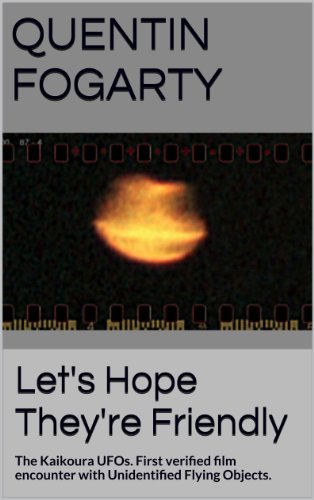
Let's Hope They're Friendly
The Kaikōura UFOs — The Reporter Who Was On the Aircraft, With an Afterword by J. Allen Hynek
Find on Amazon →As an Amazon Associate, OverClassified may earn from qualifying purchases made through this link, at no extra cost to you.
Why This Is Essential Reading
Read it, and read it as testimony rather than as argument. Let's Hope They're Friendly is the first-hand account of the best-instrumented civilian UFO film ever shot, written by a working journalist who did not want the story, did not profit from it, and paid for it professionally for the rest of his career. Its value is the six witnesses, the timings, the cockpit detail and the aftermath — material that exists nowhere else — and it should be read against the mundane explanations it engages more honestly than most books in its position. Hynek's afterword is worth having; the 2014 ebook edition's added final chapter is worth having if you can get it. Pair it with this site's Kaikōura case file and with The NZ Files, which prints the official defence report Fogarty could only describe.
Related Cases & Theories
Sources Cited
- Fogarty, Quentin. Let's Hope They're Friendly. Angus & Robertson, London and Sydney, 1982. 178 pp. With an afterword by J. Allen Hynek. ISBN-10 0207148023 / ISBN-13 9780207148026. amazon.com
- National Library of Australia catalogue record, "Let's hope they're friendly! / Quentin Fogarty; with an afterword by J. Allen Hynek" — the authoritative bibliographic record establishing the Angus & Robertson London and Sydney 1982 imprint and the Hynek afterword. catalogue.nla.gov.au
- Goodreads edition record, Let's Hope They're Friendly — edition data and the description of the December 31, 1978 Kaikōura filming as the first verified film encounter with unidentified flying objects. goodreads.com
- Apple Books edition record — the 2014 ebook edition, its subtitle, and the added 'Reflections 2014' chapter. books.apple.com
- Booktopia edition record, ebook ISBN 9781311789372 — the 2014 electronic edition's publication data. booktopia.com.au
- Barnes & Noble catalogue record, Let's Hope They're Friendly by Quentin Fogarty — edition verification. barnesandnoble.com
- New Zealand Herald, "The Kaikōura Files: Crew remember the day a UFO was spotted over Kaikōura, 40 years on" — the six crew members named and interviewed at forty years: Bill Startup, Bob Guard, Quentin Fogarty, David Crockett, Ngaire Crockett and Dennis Grant; Fogarty's account of the scepticism and nervous exhaustion that followed; the Muldoon government's Air Force inquiry and its 'natural but unusual phenomena' finding; and Bruce Maccabee's conclusion. nzherald.co.nz
- Bill Chalker, The OZ Files blog, "Let's Hope They're Friendly — Quentin Fogarty and the Kaikoura UFOs" — the 1982 Angus & Robertson Melbourne imprint, the book's subtitle, the 2014 ebook, and the interview extract with Chalker on Fogarty's subjective experience during the filming. theozfiles.blogspot.com
- Wikipedia, "Kaikōura lights" — the December 21 and December 30–31, 1978 sightings, the Safe Air crews, the radar corroboration, the film, and the official investigations. en.wikipedia.org
- Wikipedia, "UFO sightings in New Zealand" — the wider national reporting record within which the Kaikōura events sit. en.wikipedia.org
- Wikipedia, "J. Allen Hynek" — the Project Blue Book scientific consultant and CUFOS founder who supplied the book's afterword. en.wikipedia.org
- Wikipedia, "Bruce Maccabee" — the optical physicist whose photometric analysis of the Kaikōura footage remains the most technically detailed examination of the film. en.wikipedia.org
- Wikipedia, "Robert Muldoon" — the New Zealand prime minister whose government ordered the Air Force inquiry into the sightings. en.wikipedia.org
- Wikipedia, "Safe Air" — the New Zealand freight operator whose Argosy night mail runs carried both the December 21 and December 30–31 crews. en.wikipedia.org
- Wikipedia, "Armstrong Whitworth AW.660 Argosy" — the freighter type flown on both nights. en.wikipedia.org
Have corrections, additional research, or peer-reviewed sources? Help improve this entry.
Suggest an Edit