
The Westall UFO Encounter
On the morning of Wednesday, April 6, 1966, students and at least one teacher at Westall High School in Clayton South, Melbourne, watched one or more silvery objects over the school oval, circled by several light aircraft, before the object (or objects) dropped behind the pine trees of a scrubby paddock called "The Grange." The next day The Age suggested a weather balloon; the local Dandenong Journal led its front page on the story for two weeks and reported that the school had stopped students from talking to the press. Most of what the case is known for today — a landing, swirled grass circles, a girl taken away by ambulance, men in suits, soldiers and threats — comes from witnesses interviewed decades later, chiefly by researcher Shane Ryan from 2005. The sighting itself is well attested; what was seen remains disputed, with a weather balloon, a HIBAL radiation-sampling balloon and an aircraft-towed target drogue all proposed.
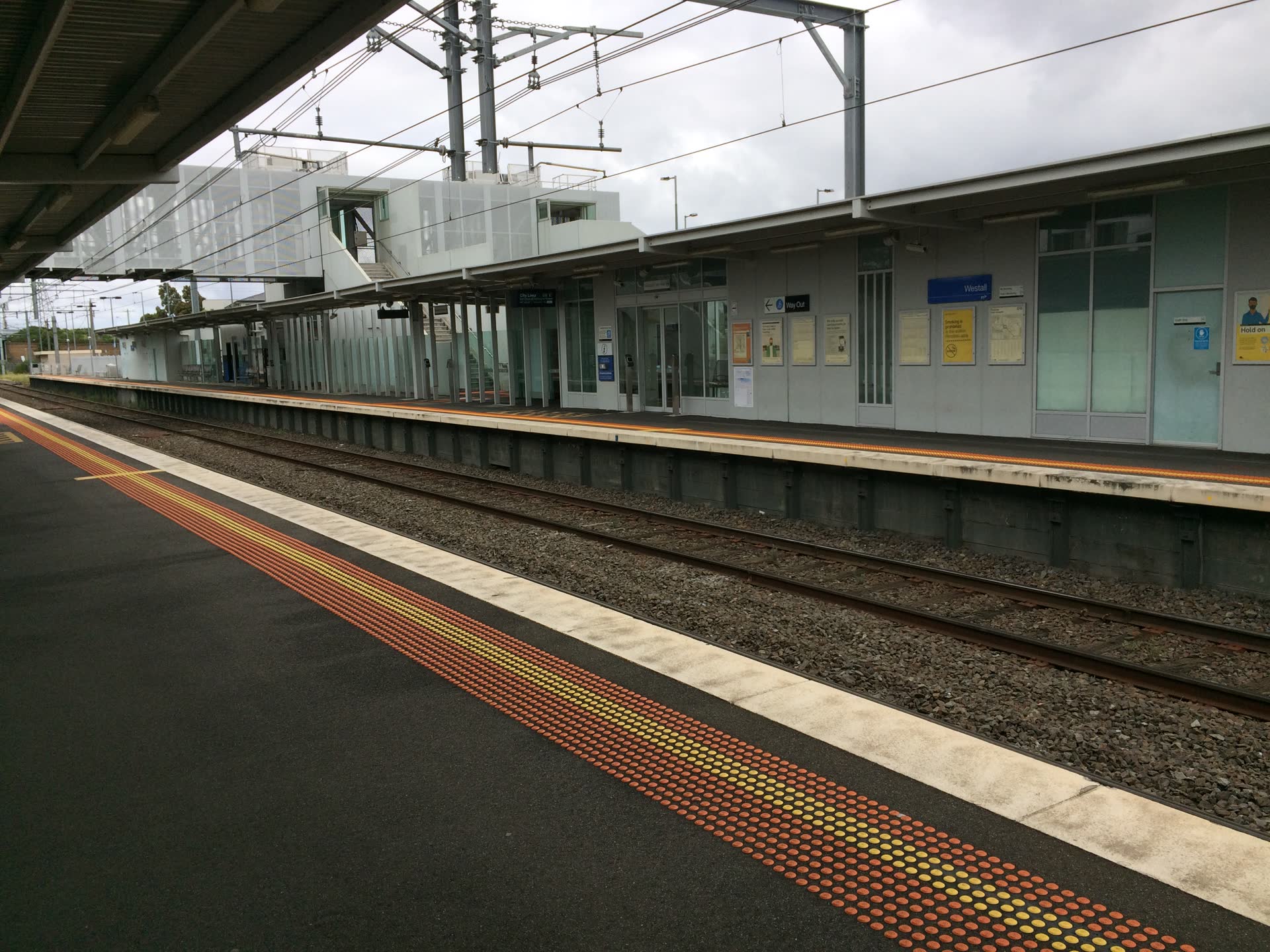
Pictured: Westall railway station in Clayton South, Melbourne — the locality that gives the case, Westall Secondary College, and "The Grange" their shared name, though it is not the school or the paddock itself. This is not a photograph of the April 1966 sighting, the object, or the witnesses. No photograph of the object is known; witnesses recall a Channel Nine crew filming at the school that afternoon, but the station's archives have not been able to locate the film.
Theoretical Alignment
These alignment figures describe how the case is usually read, not what the record proves. Proponents read Westall as an extraterrestrial craft: a domed, silver disc seen by a whole school, which they say landed in "The Grange" and drew a military and police response. That reading rests heavily on testimony gathered from the 1990s onward. The contemporaneous record is thinner and stranger. In 1966 the one teacher on record, Andrew Greenwood, described something "like a thin beam of light, about half the length of a light aircraft" that "seemed to 'thicken' at times" and moved back and forth for about 20 minutes. A 12-year-old pupil's report form, filled in for a flying-saucer society within weeks, records two circular objects and "flattened waist high grass for 10 yds diameter." Neither speaks of a landing seen up close, of beings, or of threats. An interdimensional reading has little to work with beyond reported speed. The psycho-social reading is stronger than its 10% suggests, though not as "mass hysteria": the people who have studied the testimony most closely, from skeptic Richard Saunders to the researcher Charlie Wiser, point to the way accounts collected 40 or more years later have grown, merged and changed. Westall remains a cornerstone of Australian UFO history because so many children saw something unusual, and because the school's handling of the press left a lasting sense that the truth had been suppressed.
Background
In 1966 Clayton South, the area locally called Westall, was a growing suburb roughly 20 kilometres south-east of Melbourne's central business district, a mix of new housing estates, market gardens, sand pits and patches of scrub. Westall High School (today Westall Secondary College) stood across from "The Grange," an area of open grass and scrubby bushland ringed by pine trees, south of the school. The Grange is now Grange Reserve. Moorabbin Airport, a busy light-aircraft field, was only a few kilometres away, and the Bureau of Meteorology launched weather balloons from Laverton, some 30 kilometres to the west-north-west.
The wider context matters to how the story was later told. Australia was committed to the Vietnam War and had reintroduced conscription in 1964. The Anglo-Australian rocket range at Woomera was operating in South Australia, and the agreement establishing the joint U.S.–Australian facility at Pine Gap was signed in December 1966, eight months after the sighting. Less often mentioned is HIBAL, a joint U.S.–Australian high-altitude balloon program flown from Mildura in north-western Victoria during the 1960s to sample the stratosphere for radioactive fallout. The RAAF collected and assessed UFO reports, and its public stance was generally dismissive.
Flying saucers were also very much in the news. The Victorian Flying Saucer Research Society (VFSRS), based in Moorabbin, was active and published the Australian Flying Saucer Review. Within a week of Westall it would send investigators to the school. Its members, rather than the RAAF, produced most of the record of the case that survives from 1966.
Complete Timeline
| Date | Event |
|---|---|
| April 6, 1966 (morning) | Weather balloon released. According to The Age the next day, the Weather Bureau "released a balloon at Laverton at 8.30 a.m.," some 30 km west-north-west of Westall. Westerly winds were forecast. |
| April 6, 1966 (around morning recess) | The sighting. Students on and around the Westall High School oval see one or more silvery objects, circled by several light aircraft (Greenwood counted five). The 1966–67 records put the time at 10:15–10:20 AM; later accounts say about 11 AM. Greenwood watched for about 20 minutes. |
| April 6, 1966 (late morning) | Into The Grange. The object is seen to drop behind the pine trees of "The Grange". Students run across to the paddock. Some later describe a flattened area of grass; reports differ on whether there was one circle or three. |
| April 6, 1966 (afternoon/evening) | Channel Nine. Witnesses recall a Channel Nine (GTV-9) crew at the school gate that afternoon and a short report on the evening news. The station's Melbourne and Sydney archives have not been able to locate the film. |
| April 7, 1966 | The Age. "Object perhaps balloon" (p. 6) reports that "hundreds of children and a number of teachers" saw an object over the Clayton–Moorabbin area that "might have been a weather balloon," and that "a number of small aeroplanes circled around it." |
| April 8–9, 1966 | Investigators visit. VFSRS investigators reach the area on Good Friday, April 8. Air Force personnel are reported at the field on April 9, accompanied by UFO enthusiasts; nothing of interest is found. James McDonald's 1967 notes say the RAAF did not come to the school for "about 2–3 days." |
| April 14, 1966 | "Flying Saucer Mystery: School Silent." The Dandenong Journal (p. 1) reports that the school will not allow further student interviews. It quotes "several children" and "at least one staff member." The Bureau of Meteorology supports the balloon explanation, and the Army says it had no personnel in the area. |
| April 21, 1966 | "Who Were 5 Pilots?" The Journal (p. 1) carries Greenwood's description and a student's drawing. Moorabbin Airport reports ordinary departures, and the RAAF says it had no aircraft in the area. |
| April 28, 1966 | The drogue letter. A former RAAF navigator writes to the Journal that Greenwood's account is a "reasonably accurate" description of a nylon target drogue towed behind an aircraft. |
| May 5, 1966 | Principal's comment. The Journal quotes principal Frank Samblebe: calls from the Air Force and the flying-saucer society had interrupted the children's studies. |
| June 1966 | Society report. The Australian Flying Saucer Review reprints a pupil's two-page account from the Clayton Calendar and an editorial by Judith Magee criticising the authorities' handling of the story. |
| June 28, 1967 | McDonald interview. American atmospheric physicist James E. McDonald, touring Australia, interviews Greenwood, who describes a cigar-shaped, elliptical object about two-thirds the size of a Cessna, to the south of the school, seen for at least 25 minutes. |
| 1996 | The Oz Files. Bill Chalker's book (pp. 116–121) brings later testimony, including a family's account of military personnel at the site, into the published record. |
| 2005 | Ryan begins interviewing. Shane Ryan starts collecting witness accounts. The Herald Sun (Mark Dunn) links the case to government radiation testing, and The Age reports an academic's new research on it. |
| April 8, 2006 | 40th-anniversary reunion of witnesses at the Westall Tennis Club Hall. |
| 2010 | Documentary. Westall '66: A Suburban UFO Mystery (dir. Rosie Jones, narrated by Shane Ryan) screens on Foxtel, with a Canberra premiere on November 7, 2010. |
| 2013 | UFO playground. The City of Kingston opens a UFO-themed playground at Grange Reserve. |
| 2014 | HIBAL hypothesis. Keith Basterfield tells the Herald Sun that the object may have been a HIBAL balloon from Mildura, possibly "flight number 292." |
| 2025–2026 | Petition and 60th anniversary. A petition calling for an independent inquiry is tabled in Federal Parliament (lead petitioner Grant Lavac). In April 2026 the Dandenong Star Journal reports that the Defence Minister has not yet responded. The anniversary is marked by a panel at Westall Library on April 12, 2026. |
What the 1966 Record Says
The sources closest to the event are few, and they are worth setting out because later retellings have drifted far from them. Keith Basterfield's Westall dossier on the Project 1947 site transcribes most of them.
The Age, 7 April 1966. The first press report, "Object perhaps balloon," says an unidentified flying object "seen over the Clayton-Moorabbin area yesterday morning might have been a weather balloon." It notes that "hundreds of children and a number of teachers" had seen it, that "a number of small aeroplanes circled around it," and that the Weather Bureau "released a balloon at Laverton at 8.30 a.m." which westerly winds could have carried towards Clayton.
The Dandenong Journal, 14 April to 5 May 1966. The local weekly, with writers Des Carroll and Dave Oakley, made the story its front-page lead for two weeks. On 14 April ("Flying Saucer Mystery: School Silent") it described "a round humped object with a flat base being circled by what appeared to be light aircraft," and said the school would allow no further interviews. It credited only "several children" and "at least one staff member" with seeing it, and noted that the Weather Bureau backed the balloon idea and that the Army said it had no men in the area. On 21 April ("Who Were 5 Pilots?") it printed Greenwood's description and a pupil's drawing, and reported that Moorabbin Airport had logged ordinary departures and that the RAAF had no aircraft in the area. On 28 April it published the letter from a former RAAF navigator proposing a target drogue. On 5 May it quoted the principal, Frank Samblebe, as saying that calls from the Air Force and the flying-saucer society had "interrupted the children's studies."
The VFSRS report form. A report form filled in for the Victorian Flying Saucer Research Society and signed "J Tighe 12 years old" gives the time as "10.20am." It records "Circular 2 UFOs flying in varying directions," a "whirring noise," a silver colour, and "flattened waist high grass for 10 yds diameter 600 yds from school."
The Clayton Calendar essay. A pupil's anonymous two-page account was reprinted in the June 1966 Australian Flying Saucer Review. It describes a silvery object "as long as one of the Cessnas, but very thin" and a crushed circle of grass 25–30 feet across, and wonders whether the craft were military aircraft from Moorabbin. Which school produced the Calendar is itself uncertain: the State Library of Victoria describes it as Westall High's journal, but a reader has said it was produced at Brown's Road State School in Clayton.
McDonald's 1967 notes. When James E. McDonald interviewed Greenwood on 28 June 1967, Greenwood first worked the time out as 10:20 AM and then said 10:15. He described a cigar-shaped, elliptical object that at times "bulged" in the middle, about two-thirds the size of a Cessna, to the south of the school, watched for at least 25 minutes. McDonald also spoke with Dr F. A. Berson, a government meteorological physicist who had tried to follow the case up. His notes record a school of 500–600 pupils, more than half of them on the oval, and that the principal had addressed the sighting at an assembly.
Read together, these sources establish a mid-morning sighting watched by many children and at least one teacher, light aircraft in the vicinity, an area of flattened grass in The Grange, and a school that tried to shut down press interest. They do not describe a close-range landing, an object seen on the ground, a ring of soldiers, confiscated film or threats of prosecution. Those elements enter the record later.
Visual Observations and Flight Dynamics
Descriptions of the object vary more than later summaries admit. Greenwood's 1966 "thin beam of light" that thickened, and his 1967 "cigar shaped, elliptical" object, sound like something seen side-on that sometimes showed more of itself. In the Journal he likened the thickening to "a disc ... turned a little to show the underside" and called the colour "silver grey." The Journal's summary called it "a round humped object with a flat base." Joy Tighe's form recorded two circular objects "flying in varying directions." Marilyn Eastwood, a Form 2 pupil whom the Journal interviewed, later described the larger object as "round with a hump on top and round things underneath" (quoted in Something is out there, 2010). Colin Kelly, another former student, has said he saw three objects. Shaun Matthews, who was on holiday at The Grange, described an object with a slight purple hue, about twice the size of a family car.
The light aircraft are part of the earliest reports. The Age mentions "a number of small aeroplanes," and the Journal asked "Who were 5 pilots?" Greenwood counted five aircraft and said that when he looked back at the end of recess the object and the aircraft were gone. No pilot came forward, and Moorabbin's records showed nothing unusual. Later accounts describe the aircraft chasing the object or being outmanoeuvred by it. The 1966 sources describe them only as circling it.
Witnesses agree that the object went down behind the pine trees on the edge of The Grange, and many children ran across to look. Accounts then divide. Some witnesses describe the object rising again and leaving at speed, others describe only the empty paddock. One account has it rising after about 20 minutes and shooting off to the north-west. The 1966 sources do not record an instantaneous vertical departure or a close-range view of a craft on the ground.
The Grange and the Flattened Grass
An area of flattened grass is in the record from the start. Joy Tighe's form gives about 10 yards across, the Clayton Calendar essay 25–30 feet. Later testimony collected by Shane Ryan adds detail: a circle with the grass swirled in one direction, a discoloured or scorched ring round the edge, three indentations, and, at first, no tracks leading to it. A former student, Russell Haynes, has recalled a circle of about eight metres. Witnesses do not agree on whether there was one circle or three, and Brian Dunning notes that the 1966 sources contain no claim of scorching.
The circle did not last. The landowner burned the paddock soon afterwards, and in Dunning's account he said he did it to keep sightseers from trampling his property. Some witnesses took the burning as an attempt to destroy evidence. Earlier versions of this page said the grass inside the rings was "cooked" by microwave or ultrasonic energy, that the soil stayed sterile for years, and that military technicians removed soil cores and ran radiation scans. No source for any of that has been found, and it has been removed. The closest documented account is Chalker's (1996), in which a family, "Ms A," said they took samples of earth while military personnel were present and that the military insisted they say nothing. That account was given decades after the event.
Officials, the School and the Press
The most firmly documented "suppression" is the school's own. The Journal reported on 14 April that the school would not allow further interviews and had asked staff and pupils not to talk to reporters. On 5 May the principal, Frank Samblebe, explained that calls from the Air Force and the flying-saucer society had been disrupting classes. Former students remember Samblebe telling an assembly that flying saucers did not exist and that they were not to speak to the media. Some remember men in dark suits or dark blue uniforms "from the Government" standing beside him. Greenwood and Marilyn Eastwood were both reprimanded for speaking to the Journal. Woodwork teacher Gerry Shepherd later summed up the day: "Westall High School, as a teaching institution, ceased!" Another teacher, Jeanette Muir from New Zealand, was probably the first adult to notice the object. According to Greenwood she "clammed up" and would not talk about it.
Officialdom outside the school is harder to pin down. In the 1966 record the Army denied having anyone in the area, the RAAF said it had no aircraft up, and Air Force personnel visited The Grange on 9 April with UFO enthusiasts and found nothing of interest. The later testimony is much more dramatic. Of the witnesses Ryan interviewed, 24 recalled police or military personnel, some saying army, some air force, and some unsure. Witnesses describe soldiers guarding barricades the next day. In later books Ray Fischer recalls the place "swarming with military personnel." A Springvale firefighter and a deputy controller of the Civil Defence Organisation have both described calls to The Grange that day. None of this has been matched to a record.
Andrew Greenwood has said for decades that he was warned off. Television programs since the 2010s, including Ross Coulthart's work for Channel 7, have reported that military officials threatened him to keep quiet. Earlier versions of this page went further, describing a home visit, threats under the Crimes Act, and a promise to brand him an alcoholic and a mental patient. No source for those details has been found, so they have been removed. Greenwood's 1966 interview with the Journal and his 1967 interview with McDonald show that he did talk about the sighting at the time.
The Channel Nine Film
Several witnesses remember a Channel Nine (GTV-9) crew at the front gate that afternoon and a short item on the evening news. Others remember students describing the sighting "to Chanel 9 news team" (Pinkney, 2000). Ryan reports that the station's Melbourne and Sydney archives could not find the film. That is the documented extent of the story. Earlier versions of this page said two Commonwealth agents seized the master reels, tapes and reporter's notes from the studio on April 12, under a written directive. No source for that has been found and it has been removed. Film from 1960s newsrooms was routinely lost, junked or reused, so the missing footage, though frustrating, is not evidence of seizure.
The newspapers were not suppressed either. Earlier versions of this page said the Dandenong Journal issues were collected and destroyed from libraries and newsstands, and quoted headlines such as "Flying Saucer Lands in Clayton Paddock." Neither claim holds. The real headlines ("Flying Saucer Mystery: School Silent"; "Who Were 5 Pilots?") survive, the articles have been transcribed and quoted by researchers, and the State Library of Victoria has written about them. The Journal published neither photographs of grass rings nor any claim of a landing.
Detailed Investigation Archives & Testimonies
The case was investigated in three waves. In 1966–67 the VFSRS visited the site and collected report forms, and McDonald interviewed Greenwood and Berson. The VFSRS published no full account, and it has since said it cannot find its photographs or notes. From the late 1960s to the 1990s, researchers such as Keith Basterfield (UFOs: The Image Hypothesis, 1981) and Bill Chalker (The Oz Files, 1996) gathered new testimony, and Chalker reported finding nothing on Westall in the RAAF files he examined. From 2005, Shane Ryan, a Canberra teacher and later an academic, began systematically tracking down former students and staff. By 2026 he had interviewed more than 330 witnesses (Dandenong Star Journal, April 2026). His 2012 essay for the City of Kingston's local-history site, "An Ongoing Mystery," summarises much of it.
The Social Impact on Clayton South
For many former students the sighting became a lifelong preoccupation. Their sense of having been disbelieved and silenced has shaped the case as much as the sighting itself. A witness reunion was held at the Westall Tennis Club Hall on 8 April 2006, the 40th anniversary. Journalist Cameron Lucadou-Wells has reported on the case for the local Star News Group papers since 2006, and has called it "an atypical case" whose witnesses feel "blessed" by the experience. The documentary Westall '66 was later used in schools as a lesson in critical analysis of historical sources. In 2013 the City of Kingston opened a UFO-themed playground at Grange Reserve.
The Girl Taken Away by Ambulance
One of the most repeated elements of the modern story is a girl found dazed or overcome at The Grange and later taken away by ambulance from the playing field. According to a friend who was in Form 2 at the time, she never came back to school. Ryan reports that she was a Form 1 student, and former student Jacqueline Argent has recalled that "she was taken away in an ambulance." The girl has never been named in any source traced for this page, and no ambulance or school record has been published. Earlier versions of this page named her "Tanya Banyard," made her a classmate of Joy Tighe, and said her family moved away. No source for that name or those details has been found, and they have been removed.
The High Altitude HIBAL Balloon Program
In 2014 Keith Basterfield proposed that the object was a balloon from HIBAL, a joint U.S.–Australian program flown from Mildura between 1960 and 1969 to sample the upper atmosphere for radioactive debris. Basterfield drew on Freedom of Information requests and National Archives files from the former Department of Supply. HIBAL balloons were large and white-silver. Each carried a payload of about 180 kg that could be released to come down by parachute, and a gas tube trailed from the top. Basterfield points out that a balloon trailing these parts could look like a domed object with "round things underneath." He told the Herald Sun that the object may have been "HIBAL flight number 292." He bases this on a "strikingly missing" memo that listed four April launches, one scheduled for the day before the sighting. On this view, the light aircraft were following the balloon and the uniformed men were a recovery team.
Basterfield has acknowledged that the launch documentation is missing or destroyed, so he cannot be sure. His critics make several points. HIBAL was reported in the newspapers from at least 1965, so it was not secret. A large balloon drifting on the wind does not explain the movements some witnesses describe. And on Ryan's reading the winds that day blew the wrong way for a balloon from Mildura or Laverton. Richard Saunders of Australian Skeptics replies that both the forecast and the reported winds were westerly, which would carry a balloon east towards Westall. Earlier versions of this page said the RAAF and Department of Supply records for 6 April contain no HIBAL recovery. That cannot be confirmed either way, since the relevant records have not been found.
Comparative Study: Westall vs. Ariel School (1994)
Westall is often paired with the September 1994 sighting at the Ariel School in Ruwa, Zimbabwe. In both cases a large group of children at break time reported something coming down near the school, and in both the most detailed accounts were collected weeks, months or years later. The differences are just as instructive. At Ariel the children described beings, and the telepathic messages first appear in John Mack's interviews some ten weeks afterwards. Westall has no beings at all. Neither case has documented physical traces: earlier claims of tripod marks at Ariel proved to be fabricated (see that file). And at Westall, whatever officials did, the record shows a school principal managing the press rather than a documented government operation. The parallels are real but structural, and they are the kind of pattern that research on how children's group memories form would predict.
Comparative Study: Westall vs. Broad Haven (1977)
On 4 February 1977, fifteen children at Broad Haven Primary School in Pembrokeshire, Wales, reported a silver, domed object in a field beside their playground. Some said they saw a suited figure. Their headmaster, Ralph Llewellyn, had the children draw what they had seen, and the similarity of the drawings became part of the case. Broad Haven opened the wider 1977 "Dyfed Triangle" wave on the surrounding coast. Like Westall, it rests on children's testimony from a single morning, with no instrument record. Unlike Westall, it was investigated and publicised within days, so its early record is fuller.
Interpreting the Object
No physical description of the object can be built from the record beyond its range: a silver or grey object that looked thin from one angle and rounded or domed from another, about the length of a light aircraft or smaller, seen with light aircraft around it and dropping behind trees. Earlier versions of this page gave a "technical profile" of a seamless 10–15 ft disc, 5–7 ft high, with anti-gravity or field propulsion. Elsewhere the same page gave 20–30 ft. None of those figures appears in a 1966–67 source, and they have been removed. A large balloon trailing a payload, a towed target, and an unknown craft are all compatible with "a thin beam of light ... that seemed to thicken."
The Political and Military Context of Australia in 1966
The Westall story took on much of its later shape in a Cold War setting where secrecy was ordinary. Harold Holt's government was expanding Australia's commitment in Vietnam. Woomera tests and the HIBAL fallout sampling were sensitive programs, and HIBAL was tied to the legacy of the British nuclear tests at Maralinga. In that setting, unexplained men in uniform at a paddock, and a school telling its pupils not to talk, were readily read as a cover-up, whether they were a balloon recovery team, Air Force investigators answering a public report, or simply a principal tired of reporters. The Defence Department has not released any file specifically on Westall, which keeps the question open. A petition tabled in Federal Parliament calling for an independent inquiry was still awaiting a ministerial response in April 2026.
The Legacy of the Westall Sighting
Sixty years on, Westall has a playground, a walking track, a documentary, a library panel and a parliamentary petition. It is the best-known UFO case in Australia. Its legacy is also a cautionary one. The witnesses are sincere and numerous, and something unusual was in the sky that morning. But the vivid core of the modern story (the landing, the scorched rings, the ambulance, the soldiers, the threats) was mostly collected four decades later, after the case had been publicised. The best way to honour the witnesses is to keep what they said in 1966 separate from what they remember now, and to keep looking for the records, the HIBAL launch memo and the Channel Nine film, that could settle it.
Key Witnesses
Andrew Greenwood
The only staff member known to have described the sighting publicly at the time. In the Dandenong Journal of 21 April 1966 he described something "like a thin beam of light, about half the length of a light aircraft," silver-grey, that "seemed to 'thicken' at times" and moved back and forth for about 20 minutes, with five light aircraft around it. To James McDonald in June 1967 he described a cigar-shaped, elliptical object about two-thirds the size of a Cessna, seen for at least 25 minutes. He was reprimanded for talking to the press, and later television accounts report that he was also warned off by military officials. He has stood by his account without claiming to explain it.
Joy Tighe
Signed one of the few contemporaneous witness records, a Victorian Flying Saucer Research Society report form ("J Tighe 12 years old"). It gives the time as 10:20 AM and records "Circular 2 UFOs flying in varying directions," a "whirring noise," silver colour, and an area of flattened waist-high grass about 10 yards across, 600 yards from the school. The form does not say that she went into the paddock. Earlier versions of this page described her running ahead to see a craft at close range, a violet light, ozone smells, and a television interview interrupted by a military official. None of those details appears in any source found, and they have been removed.
The girl taken by ambulance (unnamed)
Former students describe a girl found dazed at The Grange and later taken away by ambulance, who did not return to school. She has never been named in any source found. The name "Tanya Banyard" used on earlier versions of this page could not be traced and has been withdrawn.
Shane Ryan
A Canberra teacher, and later an academic, who began interviewing Westall witnesses in 2005 and had interviewed more than 330 by 2026. He narrated the 2010 documentary Westall '66: A Suburban UFO Mystery, directed by Rosie Jones, and wrote "An Ongoing Mystery: The Westall Flying Saucer Incident" (City of Kingston, 2012). His research documents the school's ban on speaking to the press, the recalled military and police presence, the ambulance girl and the missing Channel Nine film. Most of that material is later testimony, as he acknowledges.
Keith Basterfield
Basterfield compiled the documentary dossier on Westall that transcribes the 1966–67 sources, and in 2014 proposed that the object was a HIBAL radiation-sampling balloon from Mildura, possibly flight 292. He has acknowledged that the launch records are missing.
The Five Observables Assessment
The "Five Observables" framework asks whether a report shows specific performance characteristics. At Westall every characteristic depends on how witnesses judged distance and size, with no instrument record:
Assessment: A silent object hovering and drifting with light aircraft around it is reported, but hovering without visible means of lift is also what a balloon does, so Anti-Gravity Lift is speculative. Rapid departure appears in later accounts, not in the 1966 sources, so Instantaneous Acceleration is speculative too. No hypersonic speed or sonic boom was reported. There are no radar data at all, so low observability cannot be assessed. Trans-medium travel was not observed. Earlier versions of this page scored lift and acceleration as "Present" on the basis of flight details that do not appear in the early record.
Evidence Assessment
The evidence divides less between "anomalous" and "conventional" than between what was recorded in 1966–67 and what was remembered from the 1990s onward.
Supporting Anomalous Origin
- A large number of witnesses: "hundreds of children and a number of teachers" according to The Age the next day.
- A teacher, Andrew Greenwood, gave consistent accounts in 1966 and 1967 of an object watched for 20–25 minutes with light aircraft around it.
- A flattened area of grass in "The Grange" was recorded in 1966 by a pupil's report form and by the Clayton Calendar essay.
- No pilot came forward, and Moorabbin and the RAAF reported nothing unusual.
- The school banned pupils and staff from speaking to the press, and many later witnesses recall uniformed or official visitors.
- No HIBAL launch record matching the date has been produced. The Channel Nine film has not been found.
Supporting Conventional Explanation
- A weather balloon was released from Laverton at 8:30 AM, with westerly winds forecast. The Age raised that possibility the next day, and the Weather Bureau backed it.
- HIBAL launches from Mildura were in progress, and Basterfield points to a missing memo listing April launches, one the day before.
- A former RAAF navigator wrote in April 1966 that Greenwood's account fitted a towed nylon target drogue. Greenwood's "thin beam" that "thickened" fits an elongated object seen at changing angles.
- Moorabbin Airport, a busy light-aircraft field, was a few kilometres away.
- The early record is modest: one teacher, a few pupils, no landing and no close view. The dramatic elements were mostly collected 40 or more years later, and witness accounts have been shown to change over time (Saunders; Wiser).
- The landowner burned the paddock and said he did it to keep trespassers off, a mundane reason for the circle's disappearance.
Why "Credible"
Westall is rated CREDIBLE because the sighting itself is well documented for a 1966 event. It was reported by a major daily the next morning, covered for four weeks by the local paper, recorded on a flying-saucer society's report form, and described consistently by a named teacher in 1966 and again in 1967. Many children and some staff plainly saw something unusual in the sky, with aircraft around it. The rating does not extend to the later story. The landing, the scorched rings, the soldiers and the threats rest on testimony gathered decades later, and the 1966 record contains no physical evidence beyond a patch of flattened grass. Earlier versions of this section claimed sterile soil, confiscated film, destroyed newspapers and a documented government cover-up. None of these is supported, and they have been removed. Conventional explanations (the Laverton weather balloon, a HIBAL balloon, a target drogue) have not been confirmed, but neither have they been ruled out.
Sensor & Instrumentation Detection Profile
No instrument recorded the event. No radar data have ever been cited for Westall, and the 1966 sources say Moorabbin Airport saw nothing unusual and the RAAF had no aircraft in the area. Earlier versions of this page said that civil aviation researchers had found "anomalous radar tracks" in the Port Phillip Bay corridor that morning, that RAAF Laverton and Point Cook radar registered the object, and that Essendon controllers noted anomalies, with the logs then classified. No source for any of this has been found, and it has been removed. The only meteorological instrumentation in the record is the Laverton weather balloon itself, released at 8:30 AM and tracked by the Bureau of Meteorology. Its published trajectory, if it survives, would be the single most useful document for testing the balloon explanation. Dr F. A. Berson, the government meteorological physicist McDonald spoke to in 1967, tried to follow the case up, but no report of his has been published.
Environmental & Geospatial Context
The Age's forecast for 6 April 1966 called for "strong and gusty" westerly to south-westerly winds. That bears directly on the balloon explanations: a westerly would carry a balloon released at Laverton, about 34 km west and 9.5 km north of Westall, towards the school (Saunders). Shane Ryan has argued that the winds on the day blew the other way. Earlier versions of this page described the day as calm and cloudless at 19°C and said this "eliminates" meteorological explanations. No source for those figures has been found. The computed reanalysis in the profile below suggests a mixed day with some light rain, so those claims have been removed. Geographically, The Grange lay south of the school: open grass and scrub ringed by pines, about 600 yards from the school according to Joy Tighe's form. Moorabbin Airport, a few kilometres to the south-west, generated constant light-aircraft traffic, which matters for the "five pilots" puzzle. Port Phillip Bay lies roughly 8 km to the south-west.
Observer Credibility & Occupational Profile
The witnesses were overwhelmingly children of high-school age, with a smaller number of teachers. McDonald's notes put the school at 500–600 pupils, more than half of them on the oval at the time. The adult witness on record is Andrew Greenwood, a science teacher, whose 1966 and 1967 descriptions are broadly consistent with each other, though they differ in shape ("thin beam" and "cigar"), in duration (20 and 25 minutes) and in his recollection of the time. A New Zealand teacher, Jeanette Muir, probably saw it first but would not discuss it. Woodwork teacher Gerry Shepherd and several other staff appear in later testimony. The students' sincerity is not in doubt. The difficulty is the time gap: most were first systematically interviewed in the 2000s, forty years on, after the case had become locally famous, and their accounts have been shared at reunions, in the media and in a documentary. Skeptic Richard Saunders accepts that something happened, but attributes much of the detail to the fragility of memory, false memory and "memory contagion." The researcher Charlie Wiser found accounts that were inconsistent and that had changed over the years. Some witnesses told Wiser they thought the object had been a deflated weather balloon. Earlier versions of this page named a resident "Mrs. Burns" among the adult witnesses. That name has not been traced, and it has been removed.
Physical & Material Assays
No physical assay of any kind has been published for Westall. The physical evidence in the 1966 record is an area of flattened grass in The Grange: "flattened waist high grass for 10 yds diameter" on Joy Tighe's report form, and a crushed circle 25–30 feet across in the Clayton Calendar essay. Later witnesses describe a swirled circle with a discoloured or scorched edge and three indentations, and disagree on whether there were one or three circles. The paddock was burned soon afterwards by the landowner, who said he wanted to deter visitors, so nothing remained to sample. The only sampling in any account is the "Ms A" family's own collection of earth, in Chalker's 1996 book, with military personnel reportedly present; no results are known. Earlier versions of this page reported compaction too dense for "soil aerator probes," microwave-type cell collapse, multi-year sterility, military soil cores and radiation scans. No source for any of these has been found, and they have been removed.
Historical Precedents & Archive Matches
Westall came during a busy period for Australian UFO reports. The same year produced the Tully "saucer nest" in Queensland (January 1966), and a bayside newspaper report of about April 1967 on a sighting at Balwyn, Melbourne, compared it with Westall. Internationally, it is most often compared with the Broad Haven school sighting of 1977 and the Ariel School case of 1994 in Ruwa, Zimbabwe, both discussed above. The RAAF's UFO files for the 1960s are held by the National Archives of Australia in the Department of Air series A703. Chalker, who examined RAAF files in the 1980s, reported finding nothing on Westall. If a Westall file exists, it has not been identified publicly. Earlier versions of this page described a "Series A703, Control Symbol 554/1/30" file of Victorian reports "documenting military tracking patterns," and a reorganisation in June 1966 that left Westall "notably absent or classified under the Department of Supply." Neither description has been verified, and both have been removed.
Material Analysis
With no samples and no assays, a material analysis of Westall is limited to what witnesses said about the flattened grass in The Grange:
- Extent: About 10 yards across (Tighe form, 1966) or 25–30 feet (Clayton Calendar, 1966). Russell Haynes later recalled about 8 metres. The early figures are broadly consistent.
- Pattern: Later accounts describe grass swirled in one direction and three indentations. The 1966 sources say only "flattened" or "crushed."
- Discolouration: Later accounts describe a discoloured or scorched edge. Dunning notes that the 1966 sources contain no claim of scorching.
- Number: One circle in the 1966 sources; later witnesses disagree on one or three.
- Fate: The paddock was burned by the landowner within days, so no later inspection was possible.
A circle of flattened grass in a paddock where many children ran in to look could have several causes: wind, animals, children, a balloon's payload or envelope settling, or an unknown object. The 1966 description does not discriminate between them.
Supporting Anomalous Trace Signature
- A flattened area was noted within days by a pupil on a society report form, not only in later memory.
- Several later witnesses describe a sharply defined, swirled circle with no tracks leading to it when first seen.
- The circle lay roughly where witnesses saw the object go down behind the trees.
Supporting Conventional Trace Explanation
- A large group of children ran into the paddock straight away, so the scene was trampled before anyone recorded it.
- A balloon envelope or a parachuted payload coming down would also flatten grass.
- No sample, photograph or measurement survives, and the burned paddock removed the trace.
Conventional Explanation Candidates
Three conventional explanations have been seriously proposed, and memory effects bear on all of them. None has been confirmed.
The HIBAL (High Altitude Balloon) Project
Medium (45%)Proposed by Keith Basterfield in 2014 from Department of Supply records obtained through the National Archives and FOI. HIBAL was a joint U.S.–Australian program flown from Mildura between 1960 and 1969 to sample the stratosphere for radioactive debris, with links to the Maralinga test legacy. Its balloons were large and white-silver, with payloads of about 180 kg released by parachute and a trailing gas tube. A balloon seen from below, with its hardware hanging under it, could match a "round humped object" with "round things underneath." Light aircraft could have been following it, and a recovery team could account for the uniformed men later witnesses recall. Basterfield suggests "flight number 292," on the strength of a missing memo listing four April launches, one the day before. For: the right program, place and period; the description of a silver balloon with trailing parts; the aircraft and the uniforms. Against: the launch records are missing, so no specific flight can be tied to 6 April. HIBAL was publicly reported, not secret. A drifting balloon does not account for the back-and-forth movement Greenwood described. And Ryan disputes the wind direction.
Laverton Weather Balloon and a Towed Target Drogue
MediumThe explanation offered in 1966 itself. The Age noted that the Weather Bureau released a balloon at Laverton at 8:30 AM, about 30 km west-north-west, and that the forecast westerlies could have carried it over Clayton; the Bureau backed this to the Dandenong Journal. On 28 April 1966 a former RAAF navigator wrote that Greenwood's "thin beam of light" that thickened was a "reasonably accurate" description of a nylon target drogue, a windsock-like target towed by one aircraft for others to chase. Brian Dunning (Skeptoid #208, 2010) suggests the two together: a balloon for the first part of the sighting and a drogue for the "chase." Richard Saunders considers the weather balloon the most likely single explanation. For: a documented balloon launch that morning; westerly winds; a thin, elongated object with aircraft around it; Moorabbin nearby. Against: there is no record of any drogue exercise that day; the RAAF said it had no aircraft up; and a weather balloon is much smaller than most witnesses' estimates. An update by Australian Skeptics in May 2026 refers to new, as yet unverified, information that could rule the weather balloon out.
Memory Contamination and Story Growth
InconclusiveThis is not an explanation of what was in the sky, which plainly was something, but of how the story of the day grew. Most witnesses were first interviewed systematically in the 2000s, after forty years of local fame, newspaper features, reunions and a documentary. The details that make the modern case dramatic do not appear in the 1966–67 record: the close-range landing, the scorched rings, the ambulance girl, the soldiers, the threats and the confiscated film. Saunders attributes much of the detail to false memory and "memory contagion." Charlie Wiser documented inconsistent and changing accounts. Dunning concludes that genuine observations can no longer be separated from embellishment. For: the clear gap between the early and the late record, and the well-established research on how shared memories converge. Against: some later elements, such as the school's press ban and the flattened grass, are corroborated by 1966 sources, and the number of independent witnesses who recall officials at the site is large. Earlier versions of this page rated a "mass hysteria" explanation at 5%, citing fabricated physical evidence, confiscated reels and threats of prosecution as "documented facts."
Related Cases
Archive Collections & Search Guides
The NAA's guide to its RAAF UFO holdings. These are general RAAF report and policy files; no file specific to Westall has been publicly identified, and Bill Chalker reported finding nothing on Westall in the RAAF files he examined.
Collection guide (not a Westall record)Search interface for NAA holdings, including the Department of Air UFO files and the Department of Supply records Keith Basterfield used for his HIBAL research. The HIBAL launch memo he describes as missing has not been found.
Search toolCatalogue entry relating to the HIBAL high-altitude balloon program flown from Mildura. Its contents were not verified for this page, and it is not known to contain April 1966 launch or recovery logs.
Catalogue record (contents unverified)General guide to Defence records at the NAA, useful for anyone requesting Defence files on Westall. Earlier versions of this page described a "Joint Intelligence Bureau memorandum, May 1966" on radar anomalies; no such document has been identified, and the description was removed.
Collection guideSearch Government Archives Directly
Further Reading — Recommended Literature
In Plain Sight
An Australian journalist's survey of the UAP question. Coulthart has also covered Westall for television, giving prominence to the witnesses' accounts of being silenced.
The Oz Files: The Australian UFO Story
The standard history of Australian UFO reports, by a researcher who examined the RAAF files. Its Westall section (pp. 116–121) brought later witness testimony into print.
UFOs: Generals, Pilots, and Government Officials Go on the Record
Background reading: an anthology of official and aviation witnesses from other cases. It does not deal with Westall.
DISCLOSURE: Some links above are affiliate links. If you purchase through them, OverClassified receives a small commission at no additional cost to you. This helps support independent research.
Essential Viewing

7NEWS Spotlight: Secrets of the UFOs
Investigative journalist Ross Coulthart explores the global UAP phenomenon, featuring extensive witness interviews and a segment on the Westall High School incident.
Australian Story: The Westall Encounter
ABC News investigative segment features interviews with original student and teacher witnesses sixty years after the incident, highlighting the ongoing demands for official disclosure.
Studio 10: Melbourne UFO Mystery 50 Years On
Morning show segment featuring interviews with original student and teacher witnesses fifty years after the incident, highlighting the ongoing search for answers.
Sources
- Perkin and Macdonald. "Object perhaps balloon." The Age (Melbourne), April 7, 1966, p. 6.
- Dandenong Journal. "Flying Saucer Mystery: School Silent." April 14, 1966, p. 1; "Who Were 5 Pilots?" April 21, 1966, p. 1; letter from a former RAAF navigator, April 28, 1966; principal's comments, May 5, 1966.
- Victorian Flying Saucer Research Society report form, signed "J Tighe 12 years old," 1966 (transcribed in Basterfield, below).
- Australian Flying Saucer Review, June 1966, pp. 13–14: reprint of the Clayton Calendar account and note by Judith Magee.
- McDonald, James E. Interview notes with Andrew Greenwood, June 28, 1967 (transcribed in Basterfield, below).
- Basterfield, Keith. "Westall High School sighting, Clayton, Victoria, 6 April 1966" (documentary dossier of source texts). Project 1947. project1947.com
- Basterfield, Keith. UFOs: The Image Hypothesis. A.H. & A.W. Reed, 1981, p. 85.
- Chalker, Bill. The Oz Files: The Australian UFO Story. Duffy & Snellgrove, 1996, pp. 116–121.
- Ryan, Shane L. J. "An Ongoing Mystery: The Westall Flying Saucer Incident." City of Kingston Local History, June 11, 2012. localhistory.kingston.vic.gov.au
- Jones, Rosie (dir.), with Shane Ryan. Westall '66: A Suburban UFO Mystery. Documentary, 2010. justwatch.com
- Dunning, Brian. "The Westall '66 UFO." Skeptoid #208, June 1, 2010. skeptoid.com
- Saunders, Richard. "The Westall UFO of 1966." Australian Skeptics, 2026. skeptics.com.au
- Berends, Terri. "Strange lights in the sky: The Westall UFO event, 1966." State Library Victoria blog, April 6, 2024. blogs.slv.vic.gov.au
- "Talk to No One: The Continuing Mystery of the Westall UFO." We Are the Mutants, May 21, 2018 (Basterfield HIBAL summary; 2013 playground). wearethemutants.com
- Basterfield, Keith, quoted in the Herald Sun (2014), as summarised by Pedestrian.tv ("HIBAL flight number 292"). pedestrian.tv
- Dandenong Star Journal, April 14, 2026 (petition; Shane Ryan's 330+ interviews).
- Coulthart, Ross. In Plain Sight: An investigation into the UFO/UAP mystery. HarperCollins, 2021.
- "Westall UFO." Wikipedia (used as a pointer only).
Corrections (October 2026)
This page was fact-checked against the 1966–67 sources and the published research in October 2026. The following were removed because no source could be found for them: the principal's name "Richard Sanderson" (the principal was Frank Samblebe); the confiscation of Channel Nine film by Commonwealth agents on April 12; the destruction of Dandenong Journal issues and the invented headlines attributed to them; the "Tanya Banyard" and "Victor Carter" witnesses and a "Mrs. Burns"; Joy Tighe's close-range encounter (her 1966 form records two objects and flattened grass); the Crimes Act threats and "alcoholic" smear against Andrew Greenwood; "cooked" grass, soil sterility, soil cores and radiation scans; radar tracks at Laverton, Point Cook and Essendon; the 19°C calm weather; a "VFSRS Journal" special report; NAA file descriptions and a JIB memorandum; and a 1966 "Commonwealth Gazette" Crimes Act citation. The time, Greenwood's description, the documentary's credits and the title of Basterfield's book were corrected.
Following this review, the rating was changed from Credible 85 to Credible 58 (October 26, 2026), because the higher rating had rested partly on claims corrected or removed above.
See something inaccurate? Have additional information or sources?
Suggest an Edit →Last Updated: JUNE 2026