
Out of the Shadows
UFOs, the Establishment and the Official Cover-Up
Core Thesis
Out of the Shadows: UFOs, the Establishment and the Official Cover-Up is not a case-by-case investigation in the mode of its authors' earlier collaboration with Jenny Randles, The UFOs That Never Were — it is an institutional history, tracing how the British government actually handled the UFO question inside Whitehall from the early Cold War onward. David Clarke and Andy Roberts built the book from Ministry of Defence files, Air Ministry correspondence, and Public Record Office material that Clarke had spent the better part of a decade prising loose using the pre-2005 disclosure mechanisms then available — the 30-year rule, the Waldegrave Open Government Initiative, and the non-statutory 1994 Code of Practice on Access to Government Information — years before the UK's Freedom of Information Act 2000 came fully into force in January 2005 and made such requests a matter of statutory right rather than official discretion. Their central finding is a contrast rather than a single dramatic reveal: the government's public face on UFOs, from dismissive parliamentary answers to dry press-office lines, sat over a genuinely uncertain, occasionally anxious internal record in which named RAF officers, intelligence analysts and even senior ministers found specific incidents they could not explain, tracked reports for defence-significance reasons rather than public curiosity, and quietly wound down a UFO investigation apparatus that had never been as organized, as secretive, or as convinced of an answer as either believers or skeptics tended to assume.
About the Author
This site's breakdown of The UFOs That Never Were already covers David Clarke's and Andy Roberts's full biographies in detail, so this entry does not repeat that ground. The angle worth adding here is narrower and more specific to this particular book: the archival mechanics of how Clarke actually obtained the Ministry of Defence material Out of the Shadows is built from, at a time when no statutory right to see it yet existed.
Clarke began pursuing MoD UFO files in the early-to-mid 1990s, several years before this book's 2002 publication and roughly a decade before the UK's Freedom of Information Act 2000 came fully into force in January 2005. In that pre-FOI period, his access ran through three narrower channels: the long-standing "30-year rule" governing routine transfer of government papers to the Public Record Office, the Conservative government's 1994 non-statutory Code of Practice on Access to Government Information, and the accelerated declassification produced by the Waldegrave Open Government Initiative of the early-to-mid 1990s, which released roughly 96,000 previously withheld defence, intelligence and nuclear files by 1998. None of these routes carried the enforceable right of request the 2000 Act would later create, and each left the Ministry of Defence considerable discretion to withhold, redact, or simply not look particularly hard on a requester's behalf — a real, if less publicized, forerunner to the far larger 2008–2013 National Archives release Clarke would go on to curate directly.
Roberts's contribution to this specific book leaned on the same primary-document instincts this site's Berwyn Mountain and hoax-photograph chapters already credit him with, redirected here toward institutional rather than case-level material: cross-referencing witness and press accounts of specific sightings against what the two researchers could establish of the Air Ministry and MoD's actual internal paper trail. The result, across both books, is a consistent authorial partnership defined less by any single specialism than by a shared refusal to accept either a case's popular retelling or the government's public line at face value without documentary support.
Historical Context & Origins
By the time Clarke and Roberts were assembling Out of the Shadows in the late 1990s, British ufology's institutional history remained largely unwritten in any source-cited form. Nick Pope's 1996 Open Skies, Closed Minds had offered a first-person account from inside the MoD's own UFO desk, but no book had yet attempted a longer, document-driven institutional history spanning from the Air Ministry's earliest Cold War UFO files through to the book's present day. The gap Clarke and Roberts set out to fill was specifically that: not another catalogue of famous sightings, but a reconstruction of the bureaucratic machinery — who received reports, which branch filed them, what triggered escalation to Defence Intelligence, and when and why the whole apparatus was quietly run down — that had processed those sightings all along.
The book arrived in a narrow but significant legislative window. The UK's Freedom of Information Act received royal assent in November 2000 but did not come fully into force until January 1, 2005; Out of the Shadows, published in January 2002, sits squarely inside that three-year gap. Clarke's own research for the book therefore could not and did not rely on the statutory FOI mechanism his later, far more extensive 2008 file-release work would use. Instead it drew on the slower, more discretionary pre-FOI toolkit — the 30-year rule, the 1994 Code of Practice, and Waldegrave-era declassifications — a genuine methodological distinction this article treats carefully rather than glossing over, since attributing this book's research to "FOI requests" in the post-2005 statutory sense would misdate its own archival method by several years.
The book followed only two years after Clarke's own contribution, alongside Roberts and Jenny Randles, to The UFOs That Never Were (2000) — and the two books are usefully read as companion pieces rather than overlapping restatements of the same project. Where the earlier book worked case by case, reaching a specific verdict on nine well-known British sightings, Out of the Shadows works institutionally, asking not "what happened at this location" but "what did the government's own paper trail actually record, department by department, across five decades." Several of the cases the earlier book examined individually — including Berwyn Mountains — recur here in a different register, situated within the wider institutional history rather than adjudicated on their own merits a second time.
The book also landed amid a renewed wave of public and parliamentary interest in official UFO policy: MoD press queries and parliamentary questions about UFO sightings had picked up through the 1990s, and the department's own internal debate over whether to continue its low-key UFO-monitoring function at all — a debate that would culminate in the classified Project Condign study Defence Intelligence commissioned the same year this book appeared, and in the desk's eventual 2009 closure — was already underway inside Whitehall as Clarke and Roberts wrote.
Core Arguments & Key Concepts
The book's organizing argument is that the Ministry of Defence's public and private postures toward UFOs were never the same thing, and that only direct documentary access to the internal one could establish what British officialdom actually believed and did, as distinct from what it told journalists and MPs it believed and did. Clarke and Roberts trace this dual-track history from the Air Ministry's earliest Cold War-era UFO files, through the creation and several successive reorganizations of the department's UFO-handling function — the general secretariat desk that became known informally as S4(Air), and the transfer of defence-significance assessment to the Defence Intelligence Staff's DI55 branch from 1967 onward — up to the book's own present day.
A recurring structural argument concerns the sheer ordinariness of most of what officialdom actually did: the book documents a bureaucracy that mostly logged, filed, and quietly closed the overwhelming majority of UFO reports it received without escalation, staffed at various points by a single desk officer handling the function as one duty among several rather than a dedicated UFO investigation unit of the kind believers often imagined and skeptics sometimes claimed did not exist at all. Against that backdrop, the authors argue, the specific cases where the department's internal correspondence shows genuine puzzlement or defence-relevance concern — rather than routine dismissal — stand out as the more evidentially significant record, precisely because they represent a documented departure from the bureaucracy's usual pattern of unremarkable case-closing.
The book's treatment of the MoD's public messaging is its most pointed institutional critique: Clarke and Roberts show, from the department's own internal papers, a consistent gap between the confident public line that UFO reports were routinely explicable and had no defence significance, and internal correspondence in which officers and analysts privately acknowledged specific incidents they could not explain to their own satisfaction. The authors present this gap not as evidence of a conspiracy to conceal alien contact, but as a more mundane and more institutionally verifiable finding: a government department managing public reassurance and bureaucratic self-protection in ways that left a paper trail its own officials likely never expected outside researchers to read.
The book devotes sustained attention to several specific documented episodes that anchor its institutional argument in named individuals and dated files rather than generalized claims — including the 1977 RAF Boulmer radar-visual sighting at RAF Boulmer, Northumberland, published here in the fullest account then available, years ahead of the file's own 2005 declassification under the newly-enforced FOI Act, and the 1957 West Freugh multi-station radar case, reconstructed from the surviving AIR-series file alongside witness recollection gathered directly by the authors. Both cases function in the book less as standalone mysteries than as case studies in exactly how the S4(Air)/DI55 machinery actually processed a report that did, unusually, escalate beyond routine filing.
Key Cases & Evidence Discussed
This site's own RAF Boulmer Sighting (Case File #146, 1977) receives one of the book's fullest individual case treatments; this site's own case file credits Clarke and Roberts directly with publishing "the first detailed public account of the Boulmer sighting in 2002, years ahead of the file's own formal declassification" in January 2005 — itself delayed three years past the standard 25-year rule, a delay the book's institutional argument about bureaucratic discretion helps explain.
This site's own West Freugh UFO Sighting (Case File #085, 1957) is reconstructed in the book from the surviving AIR 20/9320 file, one of the documents David Clarke later ranked among his personal "Top 10 UFO documents" at The National Archives; this site's own case file draws its account of "how Clarke and Roberts first reconstructed the case" directly from this book.
This site's own Berwyn Mountains Incident (Case File #047, January 1974) — the subject of the fullest individual chapter in Clarke, Roberts and Randles's earlier The UFOs That Never Were — recurs here within the book's institutional framework, situated alongside the Air Ministry and MoD correspondence the earlier case-by-case treatment had less occasion to dwell on.
This site's own RAF Topcliffe Sighting (Case File #128, 1952) is cited on this site's own case file as "essential context for understanding the birth of the Air Ministry's AI3 desk" the book documents — useful here for exactly the institutional-origin material a case-by-case account would not normally cover.
This site's own Lakenheath–Bentwaters Radar-Visual Incident (Case File #015, August 1956) is cited on this site's own case file as drawing on "newly released Ministry of Defence files to reassess Britain's most significant UFO cases, including the earliest published groundwork for the later Lakenheath aircrew re-investigation" that Roberts and Martin Shough would go on to complete in the 2000s.
Critical Reception & Controversies
The Skeptic, the magazine of the Association for Skeptical Enquiry, reviewed the book on publication, crediting Clarke and Roberts with meticulously documenting the actual history of official British interest in the UFO phenomenon and concluding that the authors demonstrate a long, if institutionally mundane rather than dramatic, official engagement with the subject — a notably measured assessment from a publication with no reason to overstate a UFO book's evidentiary case, and one that treats the book's central contribution as historical documentation rather than paranormal advocacy.
Reader reception has been modest in volume relative to the book's influence within the field: Goodreads shows a small handful of ratings rather than the hundreds a mainstream UFO title might draw, reflecting the book's specialist, archival-history register rather than any dispute about its content. One representative reader account specifically praises the book for including facsimile reproductions of the actual government documents underpinning its argument, describing it as accurate and well-grounded in that documentary record even where a small number of individual case accounts show minor factual wobble — a fair characterization this article does not dispute: the book's institutional argument rests on its cited paper trail, and stands or falls with that record rather than with the retelling of any single sighting.
A structural limitation genuinely worth stating rather than smoothing over: because the book's central sources were themselves pre-FOI, discretionary releases — the 30-year rule, the Waldegrave initiative's selective declassifications, and MoD cooperation extended at the department's own discretion under the 1994 Code of Practice — the picture Clarke and Roberts could construct in 2002 was necessarily incomplete relative to what Clarke's own later, far larger 2008–2013 National Archives project would eventually make public. The authors could document what had been released to them by the book's press date; they could not compel disclosure of what had not, a real methodological ceiling on any institutional history published before the statutory FOI regime existed.
Set against that limitation, the book's core institutional finding — that the MoD's UFO-handling function was real, small, occasionally genuinely puzzled by specific reports, and considerably less organized or secretive than either popular cover-up narratives or blanket official dismissals suggested — has held up well against the subsequent decade of far more complete declassification. Clarke's own later National Archives work, released in the years after this book, did not overturn the institutional picture Out of the Shadows first sketched from more limited pre-FOI sources; it largely confirmed and filled in the same organizational history in much greater documentary depth.
Influence & Legacy
The book's most concrete, independently verifiable influence is documented on this very site: this exact 2002 Piatkus edition, under ISBN 0749922907, is cited across resources.html in connection with at least ten separate case-file pages, including the Berwyn Mountains Incident, the RAF Boulmer Sighting, the West Freugh UFO Sighting, the Lakenheath–Bentwaters Radar-Visual Incident, and the RAF Topcliffe Sighting — reflecting its continued use here as the primary secondary source for the institutional and documentary history of British government UFO policy specifically, distinct from the case-investigation citations this site's own breakdown of The UFOs That Never Were tracks separately.
Within David Clarke's own subsequent career, the book functioned as a direct research forerunner to his much larger 2008–2013 role as media consultant and curator for The National Archives' formal UFO-files release project, which oversaw the public transfer of roughly 60,000 pages across ten tranches — the statutory, FOI-era successor to the discretionary pre-2005 access this earlier book had to work within. That later project in turn produced Clarke's own The UFO Files: The Inside Story of Real-Life Sightings (2009) and, later still, How UFOs Conquered the World (2015), both of which extend the institutional-history project Out of the Shadows began.
For Andy Roberts, the book sits alongside The UFOs That Never Were as one of two major Clarke collaborations anchoring his published UFO research career, and its Boulmer and West Freugh material fed directly into his subsequent 2000s work with Martin Shough re-investigating the Lakenheath–Bentwaters case, tracking down and interviewing the original Venom aircrews decades after the 1956 incident.
More broadly within British ufology, the book helped establish institutional-history — reconstructing government process rather than adjudicating individual sightings — as a distinct and citable mode of serious UFO research alongside the case-by-case investigative method its authors had already demonstrated in their earlier book. Its ten-plus citations across this site's own British case-file library, spanning cases from 1952 to 1977, reflect its ongoing standing as the default secondary source whenever a British case file needs to explain not just what witnesses reported, but what the Ministry of Defence's own internal machinery actually did with that report once it landed on a desk officer's file.
The Book
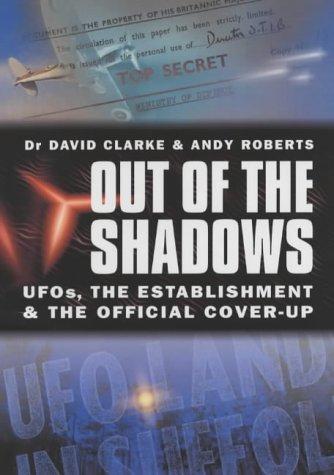
As an Amazon Associate, OverClassified may earn from qualifying purchases made through this link, at no extra cost to you.
Why This Is Essential Reading
Out of the Shadows earns its place on this list for a reason distinct from the earlier Clarke/Roberts collaboration already covered on this site: it is not a set of case verdicts but a documented institutional history of how the British government actually processed the UFO question for five decades, built from pre-FOI archival access — the 30-year rule, the Waldegrave initiative, the 1994 Code of Practice — that David Clarke spent years assembling years before the UK's Freedom of Information Act gave researchers a statutory right to ask. Its limits are real and stated plainly in this article rather than smoothed over: it worked from what pre-FOI discretion released rather than what a full statutory request would later compel, and its reader footprint remains modest next to the scale of its citation record here. But as the working institutional backbone behind ten of this site's own British case files — from Topcliffe in 1952 to Boulmer in 1977 — and as the direct forerunner to Clarke's own much larger National Archives declassification project, it remains the clearest single account of what Whitehall's UFO desk actually was, rather than what either believers or skeptics assumed it must have been.
Related Cases & Theories
Essential Viewing
UFO file release May 2008 Part 1 (audio with slides)
The National Archives UK — David Clarke discussing the May 2008 Ministry of Defence UFO file release he curated for The National Archives — the statutory, FOI-era successor to the discretionary pre-2005 archival access this book had to work within. Verified via YouTube oEmbed before inclusion.
#60 Dr. David Clarke - Project Condign, DI55 & UFOs in the UK
Disclosure Team — An extended interview with Clarke on the Ministry of Defence's DI55 branch and Project Condign — the same institutional UFO-desk history this book's S4(Air)/DI55 chapters reconstruct from primary MoD files. Verified via YouTube oEmbed before inclusion.
Sources Cited
- Clarke, David & Roberts, Andy. Out of the Shadows: UFOs, the Establishment and the Official Cover-Up. Piatkus, 2002 (ISBN 0749922907 / 9780749922900, cited here, matching this site's own resources library citations). amazon.com
- "Out of the Shadows: Ufos, the Establishment and Official Cover Up." AbeBooks (Piatkus, 2002, ISBN 9780749922900, bibliographic record). abebooks.com
- "David Clarke (journalist)." Wikipedia (biography: education, PhD in Folklore, journalism career, Freedom of Information UFO-files research, National Archives project, bibliography including Out of the Shadows). en.wikipedia.org
- "About Me." Dr David Clarke (drdavidclarke.co.uk), personal/academic biography page. drdavidclarke.co.uk
- "National Archives UFO Files." Dr David Clarke (drdavidclarke.co.uk), on the 2008–2013 National Archives release project curated by Clarke and its relationship to his earlier pre-FOI research. drdavidclarke.co.uk
- "Out of the Shadows: UFOs, the Establishment and the Official Cover-up." The Skeptic (Association for Skeptical Enquiry), review. skeptic.org.uk
- "Freedom of Information Act 2000." Hansard, UK Parliament (on royal assent in November 2000 and full commencement on January 1, 2005). hansard.parliament.uk
- "Did Waldegrave Work? The Impact of Open Government upon British History." Twentieth Century British History, Oxford Academic (on the Waldegrave Open Government Initiative's roughly 96,000 declassified defence, intelligence and nuclear files by 1998). academic.oup.com
- "Code of Practice on Access to Government Information – Guidance on Interpretation." Campaign for Freedom of Information (on the non-statutory 1994 Code that preceded the Freedom of Information Act 2000). cfoi.org.uk
- "Out of the Shadows." Goodreads (reader ratings and reviews). goodreads.com
- This site's own resources library: Full Reading List, where this exact edition (ISBN 0749922907) is cited across at least ten British case-file pages.
- This site's own case file: The RAF Boulmer Sighting, which credits this book with publishing the first detailed public account of the case years ahead of its 2005 declassification.
- This site's own case file: The West Freugh UFO Sighting, which draws its account of the case's reconstruction directly from this book.
- This site's own case file: The Berwyn Mountains Incident, for the case this book revisits within its wider institutional framework.
- This site's own key-figures entry: David Clarke, for his full biography and further case connections.
- This site's own key-figures entry: Andy Roberts, for his full biography and further case connections.
- This site's own essential reading entry: The UFOs That Never Were, for the authors' earlier, case-by-case collaboration this institutional history complements.
Have corrections, additional research, or peer-reviewed sources? Help improve this entry.
Suggest an Edit