
The West Freugh UFO Sighting
Around noon on April 4, 1957, two civilian Ministry of Supply operators, Jim McVey and John Kolosky, were in a radar van of the Bombing Trials Unit at Balscalloch, near Corsewall Point north of Stranraer. They were waiting for a Royal Aircraft Establishment bomber due over the Luce Bay range from RAF West Freugh. The aircraft was running late, and they kept their set on. It locked on to a strong, apparently stationary echo about 20–25 miles northwest of Stranraer. Its plan position held still for about ten minutes while its height read 50,000 rising to 70,000 feet. A stand-by radar at the same site tracked the same target. After about ten minutes it moved off northeast, gaining speed. A second van at Ardwell, about 14–20 miles to the south and crewed by Charles Hollands and Stanley Farley, then locked on as well. The target made a “very sharp turn” to the southeast and accelerated to about 240 mph, and the radars ended up tracking five echoes, four of them in line astern. The cloud base was about 1,000 feet, and nothing was seen. Station commander Wing Commander W. P. Whitworth told reporters it was “no freak.” The Air Ministry’s technical intelligence branch, DDI(Tech), concluded in a secret report of 30 April that the echoes came from “five reflecting objects of unidentified type and origin.” The files are at The National Archives (AIR 2/18564 and AIR 20/9320). Martin Shough’s 2009–10 technical study tested the main conventional explanations and found none that fits.
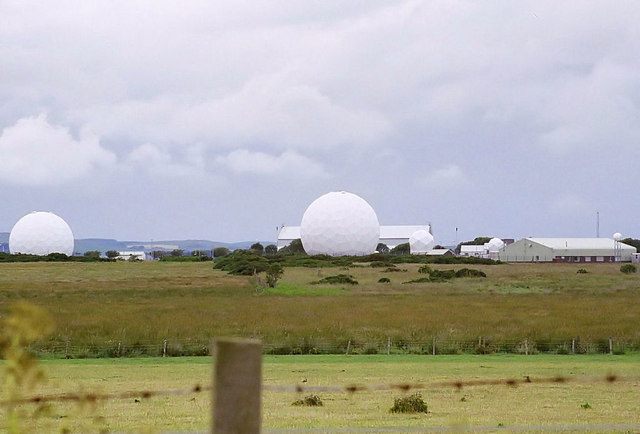
Pictured: radar domes at West Freugh Airfield, Wigtownshire — not the 1957 incident itself. No photograph of the radar traces or the encounter is known to survive in the public record; the original scope data remains inside the MoD's declassified paper files.
Theoretical Alignment
West Freugh’s Extraterrestrial Hypothesis score is modest. Its strengths are real: three tracking radars at two sites, built for precision rather than wide-area search, followed the same echoes and wrote them to a pen plotter. The Air Ministry’s own technical intelligence branch could not identify them. But nothing was seen, and the record holds no shape, colour or structure. The Psycho-Social Hypothesis scores low because no eyewitness perception is involved. The case rests on instrument tracks. The main brake on an anomalous reading is radar itself: tracking radars can lock on to strong reflectors, and propagation effects can mislead them. Shough examined those possibilities and found none satisfactory. The Interdimensional Hypothesis has nothing specific to work with here.
Background
RAF West Freugh, about five miles southeast of Stranraer in Wigtownshire, opened in the late 1930s as an armament training station on the shore of Luce Bay. By the 1950s it was home to the Bombing Trials Unit, which ran weapons trials over the Luce Bay range for the Royal Aircraft Establishment, Farnborough. The trials were tracked by mobile radar vans of the Ministry of Supply, the department then responsible for weapons research, and the vans were crewed by civilian operators. These were tracking radars, not search radars. Shough explains that such sets lock a narrow “pencil” beam on to one target and follow it automatically, giving accurate range, bearing and height. At West Freugh their output could be fed to a plotting board, where an electrically driven pen drew the target’s plan position and a meter showed its height. West Freugh itself was a small airfield. According to Shough, it had no fixed radar of its own.
On April 4, 1957, the vans were waiting for an RAE bomber due to make a trials run. Accounts of what happened when it was delayed differ in a small but telling way. Whitworth told Reuters that “we got a report stating that the plane would be one hour late, but instead of switching off our sets we kept them on.” In his 1971 account he wrote that “one radar operator left his radar set ‘on.’” Later secondary accounts, such as Patrick Gross’s summary, say the Balscalloch unit was simply not told of the delay. The timing is noon or late morning, not evening. Reuters quoted Whitworth as saying the sets were on “at noon on Thursday,” and the DDI(Tech) report says “on the morning of April 4th.”
Complete Timeline
| Date | Event |
|---|---|
| Late 1930s | RAF West Freugh opens as an armament training station on Luce Bay. |
| 1940s–1950s | The Bombing Trials Unit runs weapons trials over the Luce Bay range for the RAE, Farnborough, tracked by Ministry of Supply mobile radar vans with civilian crews. |
| April 4, 1957, about noon | An RAE bomber due over Luce Bay is about an hour late. The Balscalloch set stays on, and Jim McVey and John Kolosky lock on to a strong, apparently stationary echo over the sea 20–25 miles NW of Stranraer. |
| First ~10 minutes | The plotted position stays “at one spot” while the height reads 50,000 rising to 70,000 ft. A stand-by radar at Balscalloch is switched on and tracks the same target, and the operators switch between the two sets without seeing any discrepancy. |
| Next | The target moves off NE, slowly at first, and descends; at 54,000 ft its ground speed is 70 mph. The operators telephone West Freugh, where the air traffic control officer, Flt Lt Ken England, telephones the Ardwell van. |
| Next | At Ardwell, Charles Hollands and Stanley Farley find an echo “at the range and bearing given” and lock on. The three radars at two sites now follow the target. |
| After about 20 miles | The target makes a “very sharp turn” and heads SE, accelerating to about 240 mph. Balscalloch’s sets follow a target at about 50,000 ft. Ardwell follows one or more at 14,000 ft, then sees four echoes in line astern about 4,000 yards apart. |
| End of track | As Balscalloch’s large target passes out of range, its operators also pick up four smaller echoes before these too pass out of range. DDI(Tech) counts five objects in all. |
| Duration | DDI(Tech): tracked for 36 minutes “continually increasing in speed while losing height.” Shough, following Brad Sparks, reads this as excluding the first ten stationary minutes, giving about 46 minutes in all. Cloud was down to about 1,000 ft, and nothing was seen. |
| April 5–8, 1957 | The press reports the case. An Air Ministry official first says it was a weather balloon from Aldergrove, Northern Ireland, and later only “among other possibilities.” Other papers float a Soviet reconnaissance aircraft. Radar stations are reported to have been told to watch for strange objects (Whitworth denies a general alert). |
| April 6–7, 1957 | Wing Commander Whitworth tells reporters he has been ordered to say nothing about the object’s position, course and speed, but that “this was no freak.” |
| April 11, 1957 | A DDI(Tech) memo for the Secretary of State says no service or commercial aircraft were in the vicinity and that a balloon “has been eliminated because the object was proceeding against the wind.” It suggests he avoid referring to the radar cases specifically. |
| April 17, 1957 | In a written answer to Stanley Awbery MP, the Secretary of State for Air, George Ward, says UFO reports are investigated when details are sufficient and that most turn out to be balloons or meteors. West Freugh is not named. |
| April 30, 1957 | DDI(Tech) report “Unidentified Objects at West Freugh” concludes “five reflecting objects of unidentified type and origin,” unlikely to be “conventional aircraft, meteorological balloons or charged clouds.” |
| May 15, 1957 | Answering Major Patrick Wall and Frank Beswick, Ward tells the Commons that five objects reported that year remain unidentified, and that a 29 April Channel radar contact was two RAF Hunters. West Freugh is not named. |
| 1957 | Prompted by public and Parliamentary questions, the Joint Intelligence Committee asks the Air Ministry about such incidents. The Ministry replies that it cannot explain four recent incidents involving radar (Cabinet Office papers, per Shough). |
| 1971 | Researcher Julian Hennessey pursues the case. Whitworth, now a retired Group Captain, asks the MoD (30 May 1971) for permission to discuss his “Secret” report. The MoD, believing the pre-1962 files destroyed, later finds papers in a DDI(Tech) folder. Whitworth writes to Hennessey on 13 September 1971. |
| 2002 | David Clarke and Andy Roberts discuss the case in Out of the Shadows and suggest a U-2 with chase aircraft (as summarised by Shough). |
| 2009, rev. 2010 | Martin Shough publishes “Study of Unusual Radar Observations near RAF West Freugh,” using Met Office radiosonde data obtained under FOI. |
| 2018 | David Clarke lists the AIR 20/9320 West Freugh file among his personal "Top 10 UFO documents at The National Archives." |
The Set That Stayed On
The case began with a delay. The RAE aircraft due over Luce Bay was about an hour late, and the Balscalloch operators, Jim McVey and John Kolosky, kept their set running. (Some press reports misnamed McVey as “Jim England,” confusing him with the West Freugh air traffic control officer, Ken England.) Whether they chose to stay on or were never told to stand down depends on whose account is followed. The contemporaneous Reuters report and Whitworth’s 1971 account both describe a choice. Nothing in the documents describes a formal stand-down order that went astray.
Fifty to Seventy Thousand Feet, Northwest of Stranraer
The DDI(Tech) report describes what the Balscalloch radar showed: “The object was first observed as a stationary return… Although its range remained appreciably constant for about 10 minutes its height appeared to alter from about 50,000 to 70,000 ft. A second radar was switched on and detected the ‘object’ at the same range and height.” The two sets were switched to the plotting table in turn “to check for discrepancies,” and the pen “remained at one spot for about ten minutes.” The operators noted that the echoes were “considerably larger than would be expected from normal aircraft. In fact they considered that the size was nearer that of a ship’s echo.” Shough places the first position over the sea 20–25 miles northwest of Stranraer, and reckons the climb at roughly 2,000 feet per minute. Whitworth recalled in 1971 that the object rose “rapidly to approx. 60,000 ft,” and the newspapers in 1957 uniformly gave 60,000 feet. Shough treats the contemporaneous 70,000 ft as controlling.
Ardwell Confirms
When the pen began to move, the target was heading northeast and descending. At 54,000 feet a speed check gave 70 mph over the ground. McVey and Kolosky telephoned the Bombing Trials Unit base at RAF West Freugh. There, according to Shough, the air traffic control officer, Flt Lt Ken England, “exercised only a coordinating function” and telephoned the second van at Ardwell. An earlier version of this page said that West Freugh’s own radar confirmed the returns; Shough states the airfield had no fixed radar. At Ardwell, the 22-year-old Charles Hollands and the 30-year-old Stanley Farley found an echo “at the range and bearing given,” and their radar locked on. The Sunday Dispatch photographed the two men in their van and reported that Hollands went outside to look along the line of the scanner, but visibility was too poor. The distance between the sites is given variously: “20 miles” in the DDI(Tech) report, “about 14 miles” in Whitworth’s 1971 account, and about 18 miles in Shough’s reconstruction. The “three radars” of the official account are the two sets at Balscalloch and the one at Ardwell. There was no third station.
Five Objects
“After the ‘object’ had travelled about 20 miles it made a very sharp turn and proceeded to move S.E. at the same time increasing speed.” From that point, the DDI(Tech) report says, the two sites’ reports “differ in details.” The two Balscalloch sets tracked an object at about 50,000 feet at about 240 mph. Ardwell followed one or more objects at 14,000 feet. As they approached Ardwell, its operator “detected four ‘objects’ moving in line astern about 4,000 yards from each other.” Balscalloch confirmed this later: when its object “passed out of range they were able to detect four other smaller objects before they too passed out of range.” DDI(Tech) deduced “that altogether five objects were detected by the three radars. At least one of these rose to an altitude of 70,000 ft while remaining appreciably stationary in azimuth and range. All of these objects appeared to be capable of speeds of about 240 m.p.h.” Nothing could be said of their construction, “except that they were very effective reflectors of radar signals.” Whitworth’s 1971 memory differs: the object moved east toward Newton Stewart, made “a very sharp turn to the South-West,” and headed for the Isle of Man. He also recalled that one operator said the turn “would have been impossible for any conventional aircraft.” The highest speed in the official record is about 240 mph. An earlier version of this page cited “thousands of miles per hour” and a vertical climb to 60,000 feet “in well under a minute”; neither appears in any source found.
"No Freak": Whitworth’s Statements
The story was in the papers by 5–6 April. An Air Ministry official first told the Evening Standard that the object was a weather balloon sent up from Aldergrove in Northern Ireland, then backed away from this. Whitworth’s statements survive in several press versions. To the Evening News (6 April) he said: “I have been ordered by the Air Ministry to say nothing about the object… I am not allowed to reveal its position, course and speed.” To Reuters: “Quite definitely, this was no freak. It was an object of some substance and no mistake could have been made. The two civilians who reported the tracking are fully qualified and highly experienced operators.” To the Sunday Graphic: “It was no fluke or a technical hitch. A double check was taken by putting on another scanner, and by switching from one to the other the object was still there.” An earlier version of this page ran these together as a single quotation, and presented it as wording the Air Ministry had approved. Nothing in the record says it was. On the contrary, Whitworth said he had been ordered to say nothing.
The Press, the Ministry and Parliament
The leak worried the Air Ministry. On 11 April, A. Giffen Peacock of DDI(Tech) wrote that “it is unfortunate that the Wigtownshire incident fell into the hands of the press. The two other radar incidents have not been made public and reached us by means of official secret channels.” He suggested that the Secretary of State “does not specifically refer to these incidents as radar sightings,” and drafted an answer: “Of the fifteen incidents reported this year, ten have been identified as conventional objects, two contain insufficient information for identification, and three are under investigation.” The same memo said that enquiries had found no service or commercial aircraft in the vicinity, that a private aircraft was still being checked, and that “the possibility of a balloon has been eliminated because the object was proceeding against the wind.” Shough describes this as a recommendation to answer in a way “calculated to mislead Parliament.” In the Commons, West Freugh was never named. On 17 April, in a written answer to Stanley Awbery, the Secretary of State for Air, George Ward, said that reports were investigated where details were sufficient, that most turned out to be balloons or meteors, and that one recently publicised photograph had been faked. On 15 May, answering Major Patrick Wall and Frank Beswick, Ward said that “five flying objects reported this year are as yet unidentified,” compared with six in 1956, none in 1955 and six in 1954. He identified a 29 April radar contact over the Channel as two Hunters on exercise, and said that the speeds tracked on radar “were nothing like so fast as reported in the Press.” That last remark answered Wall’s question about reports of 1,000 mph objects. It was not a comment on West Freugh, whose recorded top speed was about 240 mph. Cabinet Office papers cited by Shough record that the publicity also led the Joint Intelligence Committee to ask the Air Ministry about such incidents, and the Ministry replied that it could not explain four recent radar cases.
The DDI(Tech) Verdict: "Unidentified Type and Origin"
The key document is a two-page report headed “D.D.I.(Tech)/C.290/3/ Unidentified Objects at West Freugh,” dated 30 April 1957, which Shough reproduces in full. Clarke lists the file containing it, AIR 20/9320, as number three in his “Top 10 UFO documents at The National Archives”; Shough cites it as AIR 20/9321. The report summarises the tracks and then addresses explanations. “There were not known to be any aircraft in the vicinity nor were there any meteorological balloons. Even if balloons had been in the area these would not account for the sudden change of direction and the movement at high speed against the prevailing wind.” It notes that the radar type “is capable of locking onto heavily charged clouds,” which could cause abnormally large echoes, but “it is not thought however that this incident was due to such phenomena.” It concludes: “It is concluded that the incident was due to the presence of five reflecting objects of unidentified type and origin. It is considered unlikely that they were conventional aircraft, meteorological balloons or charged clouds.” This is a genuine, contemporaneous non-identification by the department best placed to know about secret aircraft and trials. It does not say what the objects were, and it is brief: Shough calls it “only a summary of the main features and conclusions, not an exhaustive analysis.”
The 1971 Correspondence
In 1971 the case resurfaced through Julian Hennessey. He was a Scottish-born researcher who had chaired NICAP’s British sub-committee from 1968, ran a scheme for collecting airline pilots’ reports, and had been writing to the MoD for years about its UFO files. Whitworth, by then a retired Group Captain, wrote to the MoD on 30 May 1971 asking permission to discuss the incident. He reminded the Ministry that he had “on instruction submitted a full report to the Air Ministry [which] was classified ‘Secret’.” This caused some confusion, because pre-1962 case files were supposed to have been destroyed. An S4f(Air) minute admitted: “We are therefore unable to discover from our own sources what information Wing Commander Whitworth intends to disclose.” Whitworth supplied his own account and a set of 1957 press cuttings. Clarke and Roberts later wrote that some of the documents that no longer officially existed were then “found” in a DDI(Tech) folder. Permission was given, and Whitworth sent Hennessey his report on 13 September 1971. That 1971 recollection is the source of several details that differ from the 1957 report: 60,000 feet, a turn near Newton Stewart, and a final heading toward the Isle of Man.
Three Versions Compared
Because popular accounts mix sources, the table below sets the 1957 DDI(Tech) report beside Whitworth’s 1971 recollection and the April 1957 press. All three are reproduced in Shough’s appendices. Where they disagree, this page follows the DDI(Tech) report, which was written within four weeks from the radar records. Shough takes the same approach. The press figure of 60,000 feet is notable because it is lower than the official 70,000. Shough suggests the Air Ministry may have been content for the lower figure to circulate, to avoid revealing how high British trials radars could track. That is his inference, not a documented decision.
| Point | DDI(Tech), 30 Apr 1957 | Whitworth, 1971 | Press, Apr 1957 |
|---|---|---|---|
| Time | “On the morning of April 4th” | Not given | “Noon on Thursday” (Reuters); “Thursday afternoon” (Evening News) |
| Initial height | 50,000 ft rising to 70,000 ft while stationary | About 51,000 ft, rising “rapidly to approx. 60,000 ft” | 60,000 ft (all papers) |
| Radars | Two at Balscalloch, one at Ardwell, “20 miles away” | Balscalloch and Ardwell, “about 14 miles South” | “Three radar operators”; “another radar 90 miles away” (Evening News) |
| First movement | NE, slowly, descending; 70 mph at 54,000 ft | East, accelerating, toward Newton Stewart | Not given |
| Turn | “Very sharp turn” to the SE after about 20 miles; about 240 mph | “Very sharp turn to the South-West” near Newton Stewart | “Two twirls” (Sunday Dispatch); turned “at an amazing angle” (Daily Express) |
| Other targets | Four in line astern, about 4,000 yards apart; five objects in all | “A small number of ‘satellites’”, very indistinct | Not given |
| Last heading | SE, “passed out of range” | Toward the Isle of Man, down to about 15,000 ft | “Vanished in the direction of the Isle of Man” (Sunday Dispatch) |
| Duration | 36 minutes moving | “Approximately 4 minutes” (as typed; probably a slip) | “Some considerable time” |
Out of the Shadows and the U-2 Suggestion
David Clarke and Andy Roberts discussed West Freugh in Out of the Shadows: UFOs, the Establishment and Official Cover-Up (2002). According to Shough’s summary, they told the story of the rediscovered papers and, like the researcher John Heptonstall, favoured a U-2 spyplane as an explanation. U-2s were deployed in Europe from 1956. On this view, four chase aircraft at lower altitude could account for the four echoes in line astern. In 2018 Clarke listed AIR 20/9320, “the Air (Tech) Intelligence report on UFOs tracked by three ground radar stations in Scotland during April 1957,” at number three in his “Top 10 UFO documents at The National Archives.” (The radars were in fact at two sites.) An earlier version of this page credited Jenny Randles with documenting the case and noting the rejected balloon and cloud explanations. No source for this was found, and the claim has been removed.
Martin Shough's Radar Reanalysis
Martin Shough, a UK research associate of NARCAP, wrote the only detailed technical study of the case: “Study of Unusual Radar Observations near RAF West Freugh, Wigtownshire, SW Scotland, April 4 1957” (November 2009, revised March 2010). It reproduces the DDI(Tech) memo and report, Whitworth’s 1971 account and the 1957 press coverage, and it uses Met Office radiosonde records for 4 April 1957 obtained under freedom of information. Shough treats the contemporaneous DDI(Tech) report as controlling where it conflicts with Whitworth’s memory. He reconstructs the track, and following Brad Sparks, he reads the 36 minutes as the moving phase only, which makes the total nearer 46 minutes. He then tests the explanations one by one. The radiosondes showed the strongest winds, about 70 knots, near 35,000 feet. At 50,000 feet the winds were only about 10 knots, and the Leuchars and Liverpool balloons that reached 70,000 feet recorded 7 and 4 knots. An aircraft hovering against a headwind is therefore “rather conclusively falsified.” A U-2 could not fly slowly enough to hold station, and four chase planes for a secret flight seemed unlikely; in any case, DDI(Tech) was the office least likely to be unaware of U-2 operations. A ship seen through a sidelobe, or a ship echo given a false height, does not fit either. Two independent sets at Balscalloch agreed on the height, and sidelobe echoes would be far too weak. Large balloons climb at a few hundred feet per minute, not about 2,000. The 70 mph drift needed five or six times the measured wind, and a balloon cannot make a sharp turn. He also rejects electronic spoofing, meteors, aurora and ball lightning. His conclusion: “There appears to be no satisfactory explanation of these radar targets.” Shough is a researcher with a long interest in radar cases, not a neutral party, but his study sets out its data and reasoning in full.
"The UK's Most Reported UFO Incident"? Examining the Claim
Several websites describe West Freugh as “the UK’s most reported UFO incident.” No count or study supports the superlative, and it seems to have spread by copying between websites. What can be documented is the attention the case drew at the time. There was press coverage around the world within days, including speculation about balloons and Soviet aircraft. There was an internal DDI(Tech) memo and a formal report. Parliamentary answers were drafted with the case in mind, though West Freugh was never named in the Commons. And the Joint Intelligence Committee asked about the incidents.
Circumstantial Evidence
- Three tracking radars at two sites, built for precision tracking rather than search, locked on to and plotted the same targets, and the two Balscalloch sets were switched to the plotter in turn with no discrepancy.
- The station commander told the press the tracking was “no freak” and that the operators were “fully qualified and highly experienced.”
- The Air Ministry’s technical intelligence branch found no aircraft or balloons in the area and concluded on 30 April 1957 that the echoes came from “five reflecting objects of unidentified type and origin.”
- The incident shaped the Air Ministry’s drafting of Parliamentary answers, and the Joint Intelligence Committee asked the Ministry about it.
- The National Archives catalogue confirms the files AIR 2/18564 (1957–1971) and AIR 20/9320 (1957).
- Martin Shough’s 2009–10 study, using radiosonde data, tested aircraft, U-2, balloon, ship, sidelobe and propagation explanations and found none satisfactory.
Key Researchers
- David Clarke — Journalist and academic who, with Andy Roberts, discussed the case in Out of the Shadows (2002). In 2018 he listed AIR 20/9320 third in his “Top 10 UFO documents at The National Archives.”
- Andy Roberts — Co-author of Out of the Shadows, which, according to Shough, favoured a U-2 explanation.
- Martin Shough — NARCAP research associate and author of the only detailed technical study of the case (2009, rev. 2010), which reproduces the key documents and tests the main explanations against Met Office radiosonde data.
- Julian Hennessey — British researcher whose inquiries led Whitworth to seek MoD permission in 1971 and to send him a written account, which in turn led to papers being found in a DDI(Tech) folder.
Legacy: A Trials-Range Radar File in an Age of Air-Defence Panic
West Freugh never became as famous as Rendlesham Forest or even RAF Boulmer. Nothing was seen, so there is no human description of an object, and the operators gave only brief press interviews in 1957. But the core of the case has not grown in the retelling as much as some, because the key document survives. The errors that did creep in mostly come from Whitworth’s 1971 memory and from later website summaries: the “60,000 feet” figure, the “evening” timing, a third radar station, and speeds in the thousands of mph.
Among British radar cases, West Freugh is unusual in that the radars were precision tracking sets with a pen-plotter record, which DDI(Tech) was able to examine. It is also unusual in that the contemporaneous intelligence report, written in secret by the office best placed to know about secret aircraft, concluded that the objects were unidentified. That document, rather than any later retelling, is what keeps the case among the more serious British radar reports.
Key Witnesses
Wing Commander Walter Whitworth
Station commander at RAF West Freugh (named in 1957 press reports as Walter, and signing himself W. P. Whitworth). He made a telephoned and then a written report to the Air Ministry, which he later said was classified Secret. He told reporters he had been ordered to say nothing about the object’s position, course and speed, but that “this was no freak.” In 1971, as a retired Group Captain, he asked the MoD for permission before sending Julian Hennessey his recollections.
Flight Lieutenant Ken England and the Balscalloch operators
The Balscalloch van was crewed by Ministry of Supply operators Jim McVey and John Kolosky, who first locked on to the target. (In some press reports McVey’s name was confused with England’s.) They telephoned West Freugh, where Flt Lt Ken England, the air traffic control officer, coordinated and called the Ardwell van. According to Shough, West Freugh had no fixed radar, so England did not see the returns himself. He wrote to David Clarke about the case in 2001.
Charles Hollands
Ministry of Supply operator, aged 22 and from Oxted, Surrey, according to the Sunday Dispatch. He was in the Ardwell van when the call came, checked the scope, and confirmed an echo “at the range and bearing given.” He went outside to try to see the object along the line of the scanner, but visibility was too poor. Shough’s study also spells his name “Holland.”
Stanley Farley
Ministry of Supply operator, aged 30 and from Bushmills, Northern Ireland, according to the Sunday Dispatch. He worked the Ardwell set with Hollands, which locked on to the target and later tracked the four echoes in line astern.
The Five Observables Assessment
The Five Observables framework, popularised by former AATIP figure Luis Elizondo, rates reported UAP performance against known technology. West Freugh can be assessed only from the radar tracks recorded in the DDI(Tech) report, because nothing was seen.
Assessment: Anti-Gravity Lift is rated speculative. The one striking kinematic feature in the record is that a target “rose to an altitude of 70,000 ft while remaining appreciably stationary in azimuth and range” for about ten minutes. That is roughly 2,000 feet per minute with no horizontal movement, at a height where no aircraft of the day could hover. Shough shows the measured winds were far too light for an aircraft to hold station against them. Instant Acceleration and Hypersonic Velocity are also speculative at most. The record gives a “very sharp turn” and acceleration to about 240 mph, which is unusual for a target that had been stationary at 70,000 feet but is not hypersonic. An earlier version of this page cited speeds in “thousands of miles per hour,” and no source gives them. Low Observability is absent: the echoes were unusually strong. Trans-Medium Travel is absent.
Evidence Assessment
Supporting Anomalous Origin
- Three tracking radars at two sites locked on to the same targets, and the two Balscalloch sets agreed when switched to the plotter in turn.
- The target held a fixed plan position while its height rose from 50,000 to 70,000 ft, in light winds aloft.
- DDI(Tech) found no aircraft or balloons in the area and concluded that the echoes came from five objects “of unidentified type and origin.”
- Shough’s radiosonde-based study rules out an aircraft hovering against a headwind, a drifting balloon, and a U-2.
- Echoes “nearer that of a ship’s echo” in size were recorded at 50,000–70,000 ft, where no known reflector of that size should have been.
Supporting Conventional Explanation
- No visual sighting of any kind occurred; the entire case rests on radar returns alone, with no morphology, color, or structure ever observed.
- Tracking radars can lock on to strong reflectors and can be misled by unusual propagation; the DDI(Tech) report itself noted the sets could lock on to heavily charged cloud.
- The two sites’ reports “differ in details” (50,000 ft vs. 14,000 ft) after the turn, so it is not certain both were tracking the same thing.
- The pen-plotter records are not among the published papers. The surviving official account is a two-page summary, which Shough calls “not an exhaustive analysis.”
- No physical evidence, trace, or recovered material of any kind exists to corroborate the radar data.
Why "Credible"
The case rests on a genuine contemporaneous document, and the conventional explanations tested so far fail. Three precision tracking radars at two sites locked on to and plotted the same targets, and the two co-located sets were checked against each other. The Air Ministry’s technical intelligence branch looked for aircraft and balloons, found none, and concluded in a secret report that the echoes came from “five reflecting objects of unidentified type and origin.” Shough’s later study, using Met Office radiosonde data, rules out the obvious mundane candidates. Against this, nothing was seen; the plotter records have not been published; the sites’ reports diverge after the sharp turn; and the official analysis is short. Several popular details turned out to be wrong: the evening timing, West Freugh’s “own radar,” a third station, a vertical climb in under a minute, and speeds in the thousands of mph. But the core of the case comes from the 1957 report itself, and those errors do not touch it.
Sensor & Instrumentation Detection Profile
Every piece of evidence in this case comes from radar. The Bombing Trials Unit’s mobile vans carried tracking radars used for precision blind guidance of aircraft in trials over Luce Bay. Whitworth called them “extremely accurate and reliable,” giving “a true and accurate plot.” Shough notes that the exact specifications are not known. He explains that tracking radars of the type use short wavelengths and a narrow pencil beam that locks on to a single target, so they can measure range, bearing and height more accurately than a search radar. They illuminate the target continuously instead of once per sweep. At West Freugh the output went to a plotting board whose pen drew the target’s plan position, and a meter gave its height. The Balscalloch site had two identical sets, the second switched on as a stand-by, and the operators switched each to the plotter in turn “to check for discrepancies.” Ardwell had a third set of the same type. West Freugh airfield itself had no fixed radar, according to Shough. DDI(Tech) appears to have examined the plots, but no plotter record has been published. The surviving account is the DDI(Tech) summary.
Environmental & Geospatial Context
RAF West Freugh lies on the low ground between Loch Ryan and Luce Bay, about five miles southeast of Stranraer. Its trials range extends over Luce Bay. Balscalloch is near Corsewall Point at the northwest tip of the Rhins of Galloway, and Ardwell is on the Luce Bay shore to the south. The weather was dull with poor visibility and cloud down to about 1,000 feet, so nobody could have seen an object at 50,000–70,000 feet. Shough obtained the Met Office radiosonde ascents for that morning. The strongest winds, about 70 knots, were near 35,000 feet; at 50,000 feet they were about 10 knots, and lighter still higher up. The direction at the significant levels was southwesterly. These figures falsify any explanation that needs strong winds at high altitude. The coastal setting is often cited as favouring anomalous propagation. Shough points out, however, that the tracking beams were pointing several degrees above the horizon toward targets at 14,000–50,000 feet, well clear of any terrain.
Observer Credibility & Occupational Profile
The witnesses were civilian Ministry of Supply radar operators whose daily work was tracking trials aircraft: Jim McVey and John Kolosky at Balscalloch, and Charles Hollands and Stanley Farley at Ardwell. Whitworth called them “fully qualified and highly experienced operators,” and the DDI(Tech) report records their professional judgment that the echoes were far larger than an aircraft’s. The operators were told not to talk, and their 1957 press comments are brief. No later interviews with them were found. The RAF officer involved, Flt Lt Ken England, coordinated by telephone and did not observe the returns himself, and he wrote to David Clarke about the case in 2001. As in every radar-only case, nobody saw anything, so the testimony is about what instruments showed.
Physical & Material Assays
There is no physical evidence: no material, no ground trace, no photograph and no visual sighting. The evidence is the record of radar tracks, which DDI(Tech) summarised in its report. That ceiling applies whatever weight the radar evidence is given.
Historical Precedents & Archive Matches
West Freugh belongs to the same period of British radar reports as the August 1956 Lakenheath–Bentwaters incident, and Air Ministry files on both are in the AIR 2 series at The National Archives. The DDI(Tech) memo of 11 April 1957 refers to two other radar incidents that spring that had not been made public. Like the American Kinross Incident, it is a case defined by radar specialists tracking a target nobody saw. It differs from RAF Boulmer (1977), where the radar contacts followed a long visual sighting and were reported 20–30 miles from the lights. At West Freugh the radar data stand alone.
Material Analysis
There is no physical material. The closest thing to physical data is the radar record: three tracking sets, a pen plotter and a height meter. Its main features are the stationary climb, the “ship-sized” echo, the sharp turn and the five targets, together with the measured winds aloft that Shough added from Met Office records. Nothing can be said of the objects’ construction, as DDI(Tech) put it, “except that they were very effective reflectors of radar signals, and that they must have been either of considerable size or else constructed to be especially good reflectors.”
Supporting a Genuine Anomaly
- The two co-located sets at Balscalloch and a third at Ardwell agreed on the target, which rules out a fault in a single set.
- The measured winds aloft (about 10 knots at 50,000 ft) rule out a balloon drifting at 70 mph and an aircraft hovering against a headwind.
Supporting a Mundane, if Unconfirmed, Origin
- Nothing was seen, and the plotter records have not been published, so the case cannot be re-examined beyond the written summary.
- Tracking radars can lock on to unusual reflectors, and DDI(Tech) itself raised charged cloud as a possibility before discounting it.
The Conventional Explanation Candidates
Anomalous propagation and false targets. Bending of radar beams in layered air can produce false targets, and the coastal site is often cited as favouring it. For West Freugh the case is weak. Shough points out that the tracking beams were aimed several degrees above the horizon at targets between 14,000 and 50,000 feet. Two independent sets at Balscalloch agreed on the height. And the targets moved coherently for about 20 miles, turned, and accelerated. Shough also considers a ship echo received through a sidelobe or given a false height. He rejects it because sidelobe returns are far too weak and the two Balscalloch sets agreed. DDI(Tech), with the plots in front of it, did not attribute the case to propagation. Propagation remains possible in principle, but nobody has shown how it could produce these tracks.
Aircraft (Including a U-2), Balloons, or Charged Cloud
DDI(Tech) found no service or commercial aircraft and no meteorological balloons in the area, and it judged charged cloud unlikely. The Air Ministry’s early press suggestion of a weather balloon from Aldergrove was withdrawn. The DDI(Tech) memo of 11 April said a balloon had been eliminated because the object moved against the wind. Shough’s radiosonde data back this up. Winds of about 10 knots at 50,000 feet cannot carry a balloon at 70 mph, and a large balloon climbs at a few hundred feet per minute, not about 2,000. Clarke and Roberts, according to Shough, favoured a U-2 with chase aircraft. Shough argues that a U-2 must fly fast to stay up and could not hold a fixed position, that the winds were nowhere near strong enough to cancel its airspeed, and that DDI(Tech) would have been the office most likely to know of U-2 flights.
Retelling and Inflation
Some of the case’s more dramatic details are later additions: speeds in the thousands of mph, a climb to 60,000 feet in under a minute, and an “impossible” turn. They come from Whitworth’s 1971 memory, from 1957 press paraphrase, or from later websites, not from the DDI(Tech) report. Removing them leaves a smaller case, but not an explained one. Ward’s May 1957 remark that radar speeds were “nothing like so fast as reported in the Press” referred to a different contact.
Anomalous Propagation / Radar Ducting
Plausible InconclusivePOSSIBLE in principle for some features, but not demonstrated. The beam elevations, the agreement between independent sets and the coherent, turning track all count against it, and DDI(Tech), with the plots in hand, did not attribute the case to propagation.
Aircraft (incl. U-2), Balloon, or Charged Cloud
ImplausibleIMPLAUSIBLE — rejected by DDI(Tech) in 1957, and tested against radiosonde winds by Shough in 2009–10.
Related Cases
Confirmed Documents & Official Records
The primary Air Ministry/Ministry of Defence registered file on the incident, covering the period from the April 1957 sighting through the 1971 correspondence with researcher Julian Hennessey.
UNCLASSIFIED (open document)Catalogued under Air Traffic Control and Radar & Radio Countermeasures subject codes; described by researcher David Clarke as containing the Air (Tech) Intelligence report on UFOs tracked by three ground radar stations in Scotland during April 1957.
UNCLASSIFIED (open document)Search Government Archives Directly
Further Reading — Recommended Literature
Out of the Shadows: UFOs, the Establishment and Official Cover-Up
The fullest published account of the West Freugh case, reconstructed by the two researchers most closely associated with British MoD UFO-file scholarship.
The UFO Files: The Inside Story of Real-Life Sightings
A comprehensive history of British government UFO investigation drawn directly from the declassified National Archives files, essential context for how the DDI(Tech) assessment and the AIR series files that document West Freugh actually came to exist.
Open Skies, Closed Minds
A firsthand account from the former head of the MoD's own UFO desk, offering direct insight into how the department that eventually inherited files like West Freugh's actually assessed and processed radar-corroborated sightings.
DISCLOSURE: Some links above are affiliate links. If you purchase through them, OverClassified receives a small commission at no additional cost to you. This helps support independent research.
Essential Viewing
The Mysterious West Freugh UFO Incident of 1957
A dedicated overview of the April 1957 radar tracking incident, covering the Balscalloch, West Freugh, and Ardwell radar confirmations and the case's official handling.
1957: West Freugh incident
A concise case retrospective covering the radar tracking sequence, Wing Commander Whitworth's public statement, and the case's press coverage.
Sources
- The National Archives (UK). "UFO report: West Freugh 1957" (AIR 2/18564). beta.nationalarchives.gov.uk
- The National Archives (UK). AIR 20/9320 (1957), Air Historical Branch file, catalogued under Air Traffic Control and Radar & Radio Countermeasures, concerning a Parliamentary Question on unidentified flying objects; contains DDI(Tech) “Unidentified Objects at West Freugh,” 30 Apr 1957 (cited by Shough as AIR 20/9321). beta.nationalarchives.gov.uk
- The National Archives (UK). "Unidentified Flying Objects (UFOs) — postwar records." nationalarchives.gov.uk
- UK Parliament, Historic Hansard. "Unidentified Flying Objects," Written Answers (Commons), April 17, 1957. api.parliament.uk
- UK Parliament, Historic Hansard. "Unidentified Flying Objects," Commons Sitting, May 15, 1957. api.parliament.uk
- Shough, Martin. “Study of Unusual Radar Observations near RAF West Freugh, Wigtownshire, SW Scotland, April 4 1957” (Nov. 2009, rev. Mar. 2010), with appendices reproducing the DDI(Tech) memo of 11 Apr 1957 (A. Giffen Peacock), the DDI(Tech) report of 30 Apr 1957, Whitworth’s 1971 report to Hennessey, and 1957 press coverage (Evening Standard, Evening News, Sunday Dispatch, Sunday Graphic, Daily Express, Reuters); Met Office radiosonde data. martinshough.com
- Clarke, David. "Top 10 UFO documents at The National Archives." drdavidclarke.co.uk
- Gross, Patrick. "The West Freugh Incident, 1957." ufologie.patrickgross.org
- Hennessey, J.J.A. "West Freugh UFO Sighting, 1957," Sign Historical Group / Project 1947. project1947.com
- Magonia Magazine (blog). "UFOs at the National Archives." magoniamagazine.blogspot.com
- Magonia Magazine (blog). "Julian Hennessey: Portrait of a British UFO Pioneer." magoniamagazine.blogspot.com
- Beams Investigations. "April 1957: UFO Incident RAF West Freugh, Wigtownshire, South-West Scotland, UK." beamsinvestigations.org
- The Hidden Truth. "1957: West Freugh incident." thehiddentruth.co
- Liquisearch. "RAF West Freugh — West Freugh Incident." liquisearch.com
- Center for UFO Studies (CUFOS). "Martin Shough." cufos.org
- "RAF West Freugh," Wikipedia. en.wikipedia.org
- "MOD West Freugh," Wikipedia. en.wikipedia.org
- "Luce Bay," Wikipedia. en.wikipedia.org
- "Stranraer," Wikipedia. en.wikipedia.org
- "David Clarke (journalist)," Wikipedia. en.wikipedia.org
- Wikimedia Commons. "File: West Freugh Airfield - geograph.org.uk - 434249.jpg" (CC BY-SA 2.0, hero image source, photograph by John McLeish). commons.wikimedia.org
- Clarke, David & Roberts, Andy. Out of the Shadows: UFOs, the Establishment and Official Cover-Up, Piatkus, 2002, ISBN 0-7499-2290-7. amazon.com
- Clarke, David. The UFO Files: The Inside Story of Real-Life Sightings, The National Archives, 2009, ISBN 1-905615-50-7. amazon.com
- Pope, Nick. Open Skies, Closed Minds: Official Reactions to the UFO Phenomenon, Simon & Schuster, 1996, ISBN 0-684-81664-4. amazon.com
- Randles, Jenny, Roberts, Andy & Clarke, David. The UFOs That Never Were, Allison & Busby, 2000, ISBN 1-902809-35-1. amazon.com
- Clark, Jerome. The UFO Encyclopedia, 4th Edition, Relevant Information LLC (entry covering British Cold War–era radar-corroborated cases).
- YouTube. "The Mysterious West Freugh UFO Incident of 1957," The Disclosure Vault. youtube.com
- YouTube. "1957: West Freugh incident," The Hidden Truth. youtube.com
Corrections (October 2026)
This page was checked in October 2026 against Martin Shough’s 2009–10 study, which reproduces the DDI(Tech) memo of 11 April 1957, the DDI(Tech) report of 30 April 1957, Whitworth’s 1971 account and the 1957 press coverage. It was also checked against Hansard for 17 April and 15 May 1957, The National Archives catalogue, David Clarke’s 2018 “Top 10” list, and the Magonia profile of Julian Hennessey. The core of the case is confirmed: the Balscalloch detection, the stationary climb from 50,000 to 70,000 feet, the Ardwell confirmation by Hollands and Farley, the ship-sized echoes, the sharp turn and 240 mph, the five objects, the cloud at 1,000 feet, the 36 minutes, and DDI(Tech)’s “five reflecting objects of unidentified type and origin” conclusion. Several narrative details were wrong. The event began around noon (“on the morning of April 4th”), not in the evening. RAF West Freugh had no fixed radar; Flt Lt Ken England only coordinated by telephone and did not confirm the returns on “West Freugh’s own radar.” The “three radars” were two sets at Balscalloch and one at Ardwell, not three stations. The Balscalloch operators are named (Jim McVey and John Kolosky), not unnamed. Whitworth’s quotation was a composite of separate press statements, and nothing shows it was Air Ministry-approved; he said he had been ordered to say nothing.
Following this review, the rating was changed from Credible 68 to Credible 66 (October 27, 2026), because the higher rating had rested partly on claims corrected or removed above.
Detail. Removed as unsourced: a vertical climb to 60,000 feet “in under a minute” and speeds in “the thousands of miles per hour” (the record gives about 2,000 ft/min and 240 mph); “From the moment of picking it up, it was well within our area”; a stand-down order that “one unit did not receive” (contemporary accounts say the set was kept on); the claim that Jenny Randles documented the case; and the Bombing Trials Unit dates “Aug. 1942 – Jan. 1957.” Corrected: George Ward was Secretary of State for Air, not Under-Secretary; neither Commons answer named West Freugh; Ward’s “nothing like so fast” remark concerned a different contact; the JIC was told of four unexplained radar incidents, not “several”; Hennessey chaired NICAP’s British sub-committee rather than being its “European representative”; the first position was northwest, not north, of Stranraer; and Lakenheath is in the AIR 2 series, not “AIR 2/18564.” Added: the DDI(Tech) memo of 11 April and its suggested Parliamentary wording, the Aldergrove balloon and Soviet-aircraft press speculation, the Clarke–Roberts U-2 suggestion, and Shough’s radiosonde analysis.
See something inaccurate? Have additional information or sources?
Suggest an Edit →Last Updated: October 2026