
Open Skies, Closed Minds
For the First Time a Government UFO Expert Speaks Out
Core Thesis
Open Skies, Closed Minds: For the First Time a Government UFO Expert Speaks Out is Nick Pope's account of the three years, from July 29, 1991 to 1994, he spent staffing Secretariat (Air Staff) 2a — the Ministry of Defence's UFO desk, a section that had existed in some institutional form since the 1950s before he took it over — and the book that, more than any single later event, created the public figure who would go on to co-author this site's own Encounter in Rendlesham Forest nearly two decades later. Where that later book paired Pope with two of the Rendlesham witnesses to revisit one specific case, this earlier one is narrower and closer to the source: written and internally vetted while Pope was still a serving Ministry of Defence civil servant in a different post, and built almost entirely from his own memory, notes, and the case files that crossed his desk rather than from documents later released under the Freedom of Information Act. Its central, oft-quoted claim is a conversion narrative — "I started my tour of duty believing in aircraft lights," Pope told Popular Mechanics two years after publication, "I ended it believing in aliens" — framed throughout not as evidence of an American-style government conspiracy, but as a case that the MoD's own institutional apathy and narrow terms of reference, not secrecy, were what kept Britain's UFO reports from ever receiving the sustained scientific study Pope came to believe at least some of them deserved.
About the Author
Nick Pope was born September 19, 1965, in London, and joined the Ministry of Defence as a civil servant in 1985. On July 29, 1991, he was posted to Secretariat (Air Staff) 2a — informally, the UFO desk — a section this site's own West London/Heathrow UFO Sighting case file notes had existed in some institutional form since the 1950s, with a narrowly defined job: assessing whether a reported sighting carried any defence significance, not investigating the UFO phenomenon as a subject in its own right. Pope held the post for three years, until 1994, before moving to other MoD roles; he did not leave the department itself until 2006, after a 21-year career that also included a posting in the Directorate of Defence Security.
This book was written, and internally vetted by the Ministry of Defence prior to release, while Pope was still a serving civil servant in another post — its reliance on official UFO case files required departmental sign-off before publication. Released in 1996 by Simon & Schuster's UK trade division with a foreword by veteran British ufologist Timothy Good, it became a genuine UK hardback bestseller, reaching number three on the nonfiction chart and holding a top-ten spot for ten weeks, after Pope promoted it on Newsnight and the Daily Mail serialized excerpts. Later scrutiny of how Pope himself characterized the post, including a 2008 profile in The Skeptic, has noted a gap between his own description of it — something close to Britain's "chief UFO investigator" — and its more modest actual standing inside the Ministry's hierarchy, where it functioned, by design, as one minor duty within a broader executive-officer job rather than a dedicated specialist post; this book, more than any of Pope's later media appearances, is where that self-characterization first took public shape.
Pope left government service for a full-time media and writing career after 2006, becoming one of the most recognizable former-government voices in American and British UFO commentary and a recurring contributor to History Channel's Ancient Aliens, before co-authoring this site's own Encounter in Rendlesham Forest in 2014. He died April 6, 2026, in Tucson, Arizona, at age 60, following a diagnosis of stage 4 esophageal cancer; this book, his first, remains the origin point of both the public career and the specific institutional-apathy narrative about British official UFO secrecy that followed.
Historical Context & Origins
When Pope wrote Open Skies, Closed Minds, the Ministry of Defence's UFO-handling apparatus had operated in near-total public obscurity for four decades. Sec(AS)2a and its institutional predecessors had processed civilian and military sighting reports since the 1950s, but no one who had actually staffed the desk had ever published a firsthand account of what the job involved; the public record consisted almost entirely of outside researchers' speculation, occasional parliamentary answers, and the department's own boilerplate replies stating that a given report posed no defence threat. Into that vacuum, a recently departed desk officer publishing a full memoir — complete with case specifics, internal procedure, and his own change of opinion over three years on the job — was a genuinely novel kind of book for the UK UFO literature of the period.
Pope's own tenure ran directly through several of the cases this site documents independently. He took up the post on July 29, 1991, more than three months after an Alitalia airliner's April 21, 1991 near-encounter approaching Heathrow had already been investigated and closed as unidentified — a file he inherited rather than personally worked, per this site's own West London/Heathrow UFO Sighting case file. Within his actual three-year window, he did personally investigate the March 1993 RAF Cosford/Shawbury Sighting, and the January 1992 Bonnybridge UFO Wave began during the exact 1991–1994 window he held the desk, though Pope did not personally handle the flood of individual Bonnybridge reports the way local councillor Billy Buchanan did on the ground.
The book also arrived more than a decade before the documentary record it drew on became independently checkable: The National Archives did not begin releasing the Ministry of Defence's own UFO files until 2008, continuing through 2013, and it was that release — not this 1996 book — that let outside researchers like David Clarke verify or complicate Pope's own recollections against the department's contemporaneous paperwork. Open Skies, Closed Minds is consequently a different kind of source than the FOIA-document compilations this site's own Clear Intent exemplifies: a firsthand memoir written from memory and personal notes, published years before the underlying files it describes could be checked against the department's own release, rather than a book built directly from declassified paper.
Core Arguments & Key Concepts
The book's central argument runs deliberately against the American cover-up narrative that had dominated UFO publishing for decades: Pope maintains, across the book and in later interviews, that Britain's UFO reports were mishandled not because the government was hiding proof of alien visitation, but because the desk assigned to assess them was chronically under-resourced, narrowly mandated, and institutionally indifferent — a case of apathy and neglect rather than conspiracy. Kirkus Reviews specifically credited the book for avoiding the "paranoia" typical of its American genre-mates, noting that rather than alleging deliberate concealment, Pope suggests the government "simply hasn't investigated thoroughly."
A second load-bearing element is Pope's own account of changing his mind over the course of the posting. "I started my tour of duty believing in aircraft lights," he told Popular Mechanics in July 1998, "I ended it believing in aliens" — a framing the book repeats throughout, presenting his conclusions as the product of genuine caseload review rather than a starting ideological position. Mother Jones later summarized his overall stance succinctly, quoting Pope's own description of the UFO phenomenon as "as real as toast," a formulation the book uses to argue for continued, better-funded official study rather than for any specific extraterrestrial conclusion.
Structurally, the book moves between broad survey and specific case narrative: roughly a third of it revisits well-known international cases, including the 1947 Roswell incident this site's own Roswell case file covers independently, alongside a chapter-length review of the December 1980 Rendlesham Forest Incident — the case Pope would return to eighteen years later, at much greater length and with two of its own witnesses, in Encounter in Rendlesham Forest. The book's more original material sits in its direct, personal account of desk-level MoD casework Pope handled himself, including, per this site's own RAF Cosford/Shawbury Sighting case file, his own investigation of that 1993 radar-and-visual case.
The book's least examined claim is Pope's estimate, repeated in later interviews rather than independently audited by any outside body during the period, that a genuine minority of the reports his desk processed each year resisted every conventional explanation his section could apply — misidentified aircraft, astronomical objects, weather balloons, and flare drops accounting for the large majority. Pope treats that residual minority as the book's evidentiary core: not proof of anything specific, but, in his own framing, a legitimate open scientific question the department's own resources and remit were never built to answer.
Key Cases & Evidence Discussed
The book's chapter-length review of the December 1980 Rendlesham Forest Incident (Case File #004) represents Pope's earliest public treatment of the case he would later call the most significant he encountered during his MoD tenure; readers of this site's own Encounter in Rendlesham Forest essential-reading entry are, in effect, seeing the same case revisited eighteen years apart — first as one chapter among many in a broad 1996 survey, later as the entire subject of a 2014 book co-authored with two of the case's own USAF witnesses.
This site's own RAF Cosford/Shawbury Sighting (Case File #135, March 1993) receives, per that case file's own citation, Pope's "direct, personal telling" of the investigation — one of the few cases in the book Pope actually worked himself during his three years on the desk, rather than a case reviewed secondhand or inherited from before his tenure began.
The book's institutional argument about MoD casework more broadly is what draws in the largest number of this site's own case-file citations: the Bonnybridge UFO Wave (Case File #231, 1992, whose reports began within Pope's own tenure), the RAF Boulmer Sighting (Case File #146, 1977), the West Freugh UFO Sighting (Case File #085, 1957), and the Capt. William Schaffner Incident (Case File #073, 1970) all cite this exact 1996 edition on this site as a source for how the department that eventually handled or inherited each file actually operated, even though Pope was not personally posted to the desk when most of these individual cases occurred.
This site's own West London/Heathrow UFO Sighting (Case File #136, April 1991) offers a useful corrective to how the book's authority is sometimes read: Pope took up the UFO desk on July 29, 1991, more than three months after that Alitalia case had already been investigated and closed as unidentified by the Civil Aviation Authority and Military Air Traffic Operations, meaning he inherited the closed file rather than personally investigating it — a distinction this site's own case file draws explicitly against the more general public assumption that Pope personally handled every notable MoD UFO case of the early 1990s.
The book also surveys American cases outside Pope's own institutional authority, most notably the 1947 Roswell incident (Case File #001), which the book treats as background context for the broader UFO phenomenon rather than as material Pope investigated in any official capacity.
Critical Reception & Controversies
British reviewers on publication were largely favorable to the book's access, if not always to its conclusions. The Sunday Times called it "the first book on UFOs from someone with inside knowledge and access to Top Secret material," while The Independent wrote that "if you have the slightest interest in unidentified flying objects, you owe it to yourself to read what Nick Pope has to say," and Review of Books described it more measuredly as "a provocative book, written in a reasoned, dispassionate manner."
American critical reception was considerably cooler. Kirkus Reviews called the book "odd, unconvincing," faulting roughly a third of it for rehashing familiar cases like Roswell rather than developing original analysis, and specifically challenging Pope's claim that the large majority of UFO sightings go unreported, noting his only cited source for that figure was private UFO advocacy groups making the same claim. The same review nonetheless credited the book for avoiding American-style government-conspiracy paranoia and for occasional "lyrical" passages, particularly on crop circles, while noting Pope could just as easily "turn around and be facile and trite" — singling out his own summary verdict on ghosts and spirits, "the spirit world is highly complicated," as an example of the latter.
Mother Jones situated the book within Pope's broader public stance, quoting his description of the UFO phenomenon as "as real as toast" while noting the book's UK bestseller status; the magazine's framing treated Pope less as a debunker or a true believer than as a case study in how official caution can shade into genuine, media-friendly ambiguity once a government investigator leaves the payroll.
The most durable critical scrutiny of the book has concerned not its case material but Pope's own characterization of the post it describes. The Skeptic's 2008 profile noted a persistent gap between descriptions of Pope's role ranging from "head of the Ministry of Defence UFO department" down to, in less flattering accounts, a "glorified clerical officer who filed things," and observed that Pope's own promotional framing of the position as a "special position" with himself as effectively Britain's chief UFO investigator sat awkwardly against its more mundane standing inside the department's actual org chart.
That same pattern surfaces concretely in how Pope later discussed individual cases in the press: in a widely circulated 1998 account of the April 1991 Alitalia sighting this site's own West London/Heathrow UFO Sighting case file documents, Pope used first-person plural language — "we launched a full investigation and eliminated all the usual possibilities" — despite not having taken up the UFO desk post until July 29, 1991, more than three months after that case had already been investigated and closed. It is a small, concrete instance of the broader tendency The Skeptic flagged: MoD casework retold in Pope's own later voice as more personally, and more institutionally central, than the department's own timeline supports.
Influence & Legacy
The book's most direct, measurable influence on this site is its citation, under this exact ISBN, across resources.html in connection with 7 separate UK case-file pages — the Bonnybridge UFO Wave, the RAF Boulmer Sighting, the RAF Cosford/Shawbury Sighting, the West Freugh UFO Sighting, the West London/Heathrow UFO Sighting, the Capt. William Schaffner Incident, and a Long Island Sound airliner sighting — making it the single most cited Nick Pope title in this site's own reading library, ahead of both the 2015 reissue and his co-authored Rendlesham book.
For Pope personally, the book's most concrete downstream consequence was the media career it launched: its UK bestseller run, Newsnight appearance, and Daily Mail serialization established the public profile — later summarized in tabloid shorthand as "Britain's real-life Fox Mulder" — that carried him through two decades of American and British television commentary, a regular seat on History Channel's Ancient Aliens, and eventually co-authorship of this site's own Encounter in Rendlesham Forest in 2014.
The institutional-apathy argument at the book's center has had a longer afterlife than any single case it covers. A 2024–2025 TalkTV documentary captured Pope personally apologizing on camera to Billy Buchanan and Bonnybridge residents for the Ministry's historical dismissal of their reports, decades after this book first argued that dismissal was the product of institutional neglect rather than deliberate secrecy — an apology Buchanan publicly rejected, per this site's own Bonnybridge UFO Wave case file, as insufficient.
Pope revisited the same underlying material twice more in book form: a 2015 UK reissue, retitled Open Skies, Closed Minds: For the First Time a Government UFO Investigator Speaks Out and cited separately on this site's own resources library, and, at far greater scope, the 2014 Encounter in Rendlesham Forest this site treats as its own separate Essential Reading entry — leaving this 1996 original as the foundational text both later books built on rather than superseded.
The Book
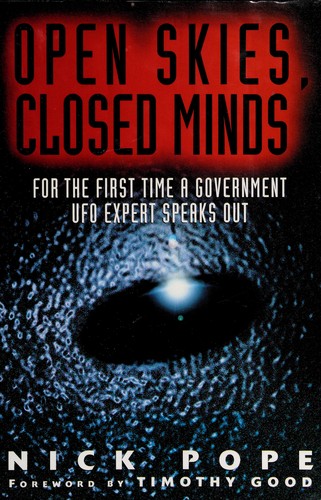
As an Amazon Associate, OverClassified may earn from qualifying purchases made through this link, at no extra cost to you.
Why This Is Essential Reading
Open Skies, Closed Minds earns its place on this list as the origin point for a public career this site cites more than almost any other single UFO-commentator figure: it is the book that first put Nick Pope's name in front of a mass audience, the single most-cited Pope title across this site's own case-file library, and the earliest published account of a real, documented British government UFO-assessment role that few outside the Ministry of Defence had ever described firsthand. Its limits are just as real and just as documented: Kirkus's contemporary review found its evidentiary claims thin in places, and later scrutiny — from The Skeptic's 2008 profile to this site's own case-file research on the April 1991 Alitalia sighting — has identified a specific, recurring gap between how Pope characterized his own institutional importance and what the Ministry of Defence's own organizational structure and timeline actually support. Read together with this site's own Encounter in Rendlesham Forest, it traces the full arc of Pope's public career from its first, more modest starting claim — three years on a narrowly mandated desk, apathy rather than conspiracy — to the far larger public figure that claim eventually built.
Related Cases & Theories
Essential Viewing
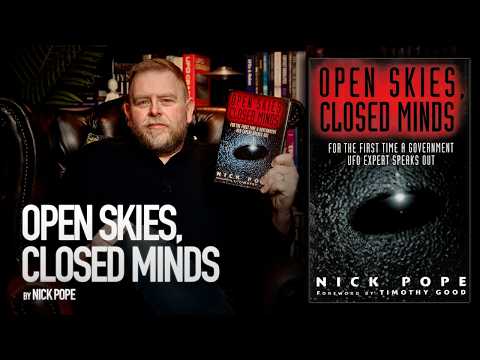
Open Skies, Closed Minds by Nick Pope - Inside UK UFO Files, MoD Secrets & Skeptic Battles
The UFO Book Library — A book-specific breakdown of Open Skies, Closed Minds covering Pope's MoD UFO-desk tenure, the book's contents, and its skeptic-side reception, verified via YouTube oEmbed before inclusion.
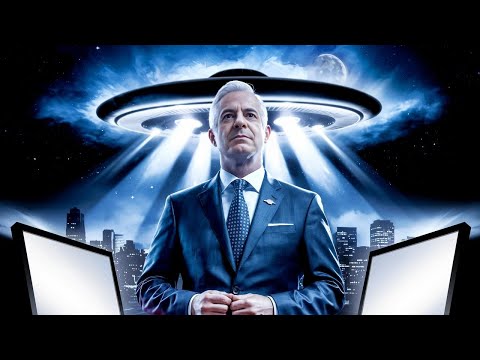
Nick Pope's Radical Disclosure: The Ministry Of Defense Spent Years Studying UFOs
Dr Brian Keating — An interview with Nick Pope discussing his years running the Ministry of Defence's UFO desk and the government's own study of the phenomenon, verified via YouTube oEmbed before inclusion.
Sources Cited
- Pope, Nick. Open Skies, Closed Minds: For the First Time a Government UFO Expert Speaks Out. Simon & Schuster UK, 1996 (ISBN 9780684816647 / 0684816644, matching this site's own resources library citation under this exact edition; foreword by Timothy Good). amazon.com
- "Open Skies, Closed Minds." Wikipedia (book article: content summary, UK bestseller performance, Newsnight/Daily Mail promotion, and critical reception quotes drawn from Mother Jones and Popular Mechanics). en.wikipedia.org
- "Nick Pope (journalist)." Wikipedia (biography: birth date, MoD career 1985–2006, UFO desk 1991–1994, bibliography, death April 6, 2026). en.wikipedia.org
- "Open skies, closed minds." Open Library edition record (ISBN 0684816644 / 9780684816647, Simon & Schuster, 1996, London; 270 pp. plus plates). openlibrary.org
- "Open Skies, Closed Minds." Kirkus Reviews (contemporary trade review: praise for avoiding American-style conspiracy framing, criticism of unsupported sighting-rate claims and rehashed case material). kirkusreviews.com
- "Nick Pope." Andrew Lownie Literary Agency, author page for Open Skies, Closed Minds (UK bestseller performance, MoD internal vetting requirement, Sunday Times/Independent/Review of Books quotes). andrewlownie.co.uk
- "Nick Pope: The Man Who Left the MOD." The Skeptic, September 2008 (critical profile examining the gap between Pope's own description of the UFO-desk post and its actual standing within the Ministry of Defence). skeptic.org.uk
- "Nick Pope, U.F.O. sleuth who chased the truth, dies at 60." The Spokesman-Review, April 29, 2026 (obituary: career summary, esophageal cancer diagnosis, death in Tucson, Arizona; matches this site's own Rendlesham Forest essential-reading citation; page no longer live as of Aug 2026, no archived mirror found).
- "Ex-UFO researcher details British government 'X-Files.'" Fox News (Pope's own account of investigating the April 1991 Alitalia sighting and other MoD casework, including first-person-plural framing this site's own case-file research complicates). foxnews.com
- This site's own case file: West London/Heathrow UFO Sighting, for Pope's exact July 29, 1991 UFO-desk start date and the case he inherited rather than personally investigated.
- This site's own case file: RAF Cosford/Shawbury Sighting, for the case this book covers as Pope's own direct, personal investigation.
- This site's own case file: Bonnybridge UFO Wave, for the 2024–2025 TalkTV apology connecting directly back to this book's institutional-apathy argument.
- This site's own case file: The Rendlesham Forest Incident, the case this book first reviewed in 1996, eighteen years before Pope's own co-authored return to it.
- This site's own essential-reading entry: Encounter in Rendlesham Forest, Pope's 2014 co-authored return to the case this earlier book first covered.
- This site's own key-figures entry: Nick Pope, for his full biography and further case connections beyond this book.
- This site's own resources library: Full Reading List, where this exact 1996 edition (ISBN 0684816644) is cited across 7 case-file pages.
Have corrections, additional research, or peer-reviewed sources? Help improve this entry.
Suggest an Edit