
The RAF Boulmer Sighting
In the early hours of Saturday, July 30, 1977, a civilian telephone call alerted the night shift at RAF Boulmer, an RAF air defence control and reporting centre on the Northumberland coast, to two bright objects hovering over the North Sea. The duty controller, Flight Lieutenant A.M. Wood, went outside with Corporal Torrington and Sergeant Graham, and the three men watched two lights for one hour and forty minutes. Wood estimated them at 4,000–5,000 feet, close to the shore; the nearest he called “round, luminous, [and] 4 to 5 times larger than a Whirlwind helicopter,” and he said the westerly one looked conical, then “arrowhead in shape.” Shortly after the lights faded from view, he reported, two unidentified radar contacts were seen 20–30 miles out to sea. The controller at RAF Patrington said he could see them on his radar picture, but the senior officer at headquarters was, in David Clarke’s words, “less forthcoming.” The MoD papers describe the men as “reliable and sober.” They were opened at the National Archives in January 2005 among more than fifty late-1970s UFO files. Clarke, the first researcher to write up the report, suspected bright stars or planets. An ephemeris check supports him: Venus and Jupiter, the two brightest objects in the night sky that week, rose together over the sea in the east-northeast at about 2 a.m. local time, less than two degrees apart, and climbed slowly until dawn.
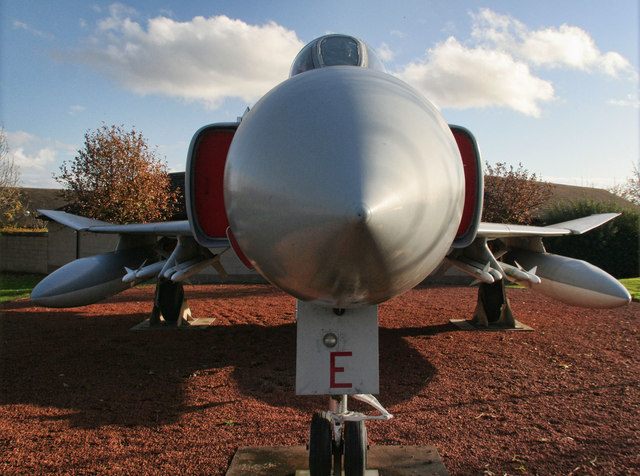
Pictured: the gate and perimeter of RAF Boulmer, Northumberland — not the 1977 encounter itself. No photograph of the sighting or the objects is known, and no radar recording has been published.
Theoretical Alignment
The alignment scores reflect a case whose visual half has a strong ordinary candidate. The three witnesses watched two bright lights for 100 minutes as they “slowly climbed into the clear sky” over the sea, and on that night Venus and Jupiter, the two brightest planets, were rising together in the east-northeast less than two degrees apart. David Clarke, who first published the report, suspected stars or planets because of the descriptions and the duration. The shape changes Wood and his NCOs described are the kind that low, twinkling planets often produce through a turbulent sea-level atmosphere. The radar half is different: two unidentified contacts 20–30 miles out, reported after the lights had faded, and seen on at least one other station’s picture. Those contacts were not in the place the lights had been, so they do not corroborate the visual sighting, and nothing in the published record says what they were. The Extraterrestrial Hypothesis score is kept low for that reason. The Psycho-Social score reflects how readily experienced observers can read structure and shape change into a bright, low light watched for a long time. The Interdimensional Hypothesis has nothing in the record to work with.
Background
RAF Boulmer occupies a working stretch of the Northumberland coast a few miles from Alnwick. It was built as a Cold War ROTOR-programme radar station: the target date for opening was 21 August 1953, and it became fully operational when its underground R3 operations room was completed in September 1954. By 1974 it had become both a Sector Operations Centre and a Control and Reporting Centre within the UK air defence network; its control and reporting centre is named Hotspur. The station also hosted a search-and-rescue flight of No. 202 Squadron, which flew Westland Whirlwind helicopters until Sea Kings replaced them in December 1978. That is why a Whirlwind was the size reference the duty controller reached for.
The night of Friday into Saturday, July 29–30, 1977 began as an ordinary overnight shift. A civilian telephone call reported two bright objects over the North Sea, and the duty controller and others came up from the underground operations room to look. Wood then wrote what David Clarke later called a “detailed report to MoD,” which was filed with the Ministry of Defence’s UFO desk. The file stayed closed until January 2005, when it was opened at the National Archives with dozens of other late-1970s UFO files. Wood’s account is known today mainly through Clarke’s summary in Fortean Times 197 (2005) and a Northumberland Gazette report on the release.
Complete Timeline
| Date | Event |
|---|---|
| Aug. 1953 | RAF Boulmer opens on its 21 August 1953 target date with limited capability; it becomes fully operational when its underground ROTOR-programme R3 bunker is completed in September 1954. |
| By 1974 | Boulmer has become both a Sector Operations Centre and a Control and Reporting Centre within the UK air defence network. |
| 1970s | A No. 202 Squadron search-and-rescue flight is based at Boulmer with Westland Whirlwind helicopters (replaced by Sea Kings in December 1978), the type Wood later used as his size reference. |
| Early hours, Sat. July 30, 1977 | A civilian telephone call reports two bright objects hovering over the North Sea; duty controller Flight Lieutenant A.M. Wood and NCOs Corporal Torrington and Sergeant Graham go outside to look and see the objects for themselves. |
| Same night, over ~100 minutes | The three men watch two lights that Wood describes as stationary and close to the shore at an estimated 4,000–5,000 feet. The nearest is “round, luminous” and judged four to five times larger than a Whirlwind; the westerly one looks conical and then “arrowhead in shape” (the NCOs say “body shaped with projections like arms and legs”). The lights seem to move apart and together as they slowly climb. |
| Same night, shortly after visual loss | According to Wood’s report, two unidentified contacts are detected on the base radars 20–30 miles out to sea. They move slowly northeast as they climb, then part, one climbing to an estimated 9,000 feet and moving east, the other holding 5,000–6,000 feet. |
| Same night | Wood contacts the controller at RAF Patrington, who confirms the two blips are visible on the radar picture there. The Northumberland Gazette adds that radar staff at RAF Staxton Wold also picked them up. The Senior Reporting Officer at headquarters is “less forthcoming” when asked whether he can see them (Clarke). |
| Same night | The Patrington radar picture is relayed to RAF West Drayton, home of the Linesman system’s Air Defence Data Centre; the Gazette says checks were made with West Drayton “to see if it had spotted them,” without giving a result. |
| 1977 | The report goes to the Ministry of Defence’s UFO desk, which David Clarke identifies as the civilian secretariat branch S4f (Air). The Northumberland Gazette calls it a department “known only by the code name SF4.” |
| Jan. 2005 | More than fifty formerly closed MoD UFO files from the late 1970s are opened at the National Archives, including the Boulmer papers. The National Archives catalogue gives both 1977 UFO correspondence files (DEFE 24/1205 and DEFE 24/1206) a closure date of 2005. |
| Jan. 1, 2005 | The UK Freedom of Information Act 2000 comes fully into force. The Northumberland Gazette credits the Act with the review that led to the Boulmer file’s release. |
| 2005 | David Clarke summarises Wood’s report in “The Secret Files” (Fortean Times 197) and suggests the lights may have been bright stars or planets. UFO Casebook (27 Jan.) and the Northumberland Gazette (28 Jan.) report the release. |
| Nov. 2014 | UFO Casebook publishes an undated childhood recollection from a reader near Alnwick, about five miles from Boulmer, of two bright discs; it cannot be tied to the night of the RAF report. |
A Call from the Coast: The Sighting Begins
The sequence began with an ordinary night-shift telephone call. A civilian, not named in any published account, rang RAF Boulmer to report two bright objects over the North Sea. According to David Clarke’s summary of the file, the duty controller, Flight Lieutenant A.M. Wood, “and a group of airmen then emerged from their bunker and saw the UFOs for themselves.” Corporal Torrington and Sergeant Graham, who supported Wood’s account, were on duty at a picket post outside the underground operations room. The released papers have not been published in facsimile, so the wording below comes from Clarke’s quotations and from the press reports of January 2005.
One Hundred Minutes Over the North Sea
In his report Wood said the objects were “close to the shore and stationary,” at a height he estimated at 4,000 to 5,000 feet; the Northumberland Gazette put them about three miles out to sea. They “appeared to move apart and then together as they slowly climbed into the clear sky.” Wood wrote that “no imagination was required to distinguish the shape”: the “westerly object [was] conical with apex at top,” and it “seemed to rotate and change shape to become arrowhead in shape,” while “the easterly object was indistinct.” The UFO closest to the base was “round, luminous, [and] 4 to 5 times larger than a Whirlwind helicopter,” a type based at Boulmer itself. Torrington and Graham said the westerly object moved “and changed shape to become body shaped with projections like arms and legs.” The three men watched for one hour and forty minutes. The size comparison is less useful than it sounds: an observer cannot judge the size of a light in the sky without knowing its distance, and the distance here was itself an estimate.
The Objects Vanish, and the Radar Picks Up the Trail
Wood’s report then turns to radar. According to Clarke, Wood says that “shortly after disappearing visually, two unidentified contacts were detected on the base radars at a range of between 20 and 30 miles out to sea.” These moved slowly northeast as they climbed, “then parted, one climbing to 9,000 feet estimated and moving east, the other holding 5–6,000 ft.” While they were being tracked, Wood contacted the controller at RAF Patrington, an early-warning station on the Yorkshire coast, who confirmed that the two blips were visible on the radar picture there; that picture was relayed to RAF West Drayton in Middlesex. “But oddly,” Clarke adds, “the Senior Reporting Officer at headquarters was less forthcoming when asked if he could see the UFOs.” The Northumberland Gazette’s account differs in two respects. It says a radar station at the base “picked up the objects in the same position before they vanished,” and that radar staff at RAF Staxton Wold also detected them; it does not mention Patrington. Clarke, who quotes the file directly, places the contacts 20–30 miles offshore and after the visual loss. That is several times farther out than the lights were estimated to be, so the radar contacts and the lights were not shown to be the same objects.
"Reliable and Sober": The MoD's Own Assessment
The MoD paperwork describes the witnesses as “reliable and sober.” Clarke applies the phrase to all three men; the Gazette applies it to Wood. The phrase rules out drink or a prank. It does not make the identification reliable: sober, experienced observers misidentify bright planets often, especially when the planets are low over the sea, where the atmosphere makes them twinkle, flare and change colour. No published account says what, if anything, the MoD concluded about the sighting.
When and How the File Was Released
The Northumberland Gazette reported in January 2005 that the report had been “deemed so sensitive that instead of being released to the public 25 years later as normal a further three-year ban was imposed,” and that it was declassified only because the Freedom of Information Act, in force from 1 January, led to a review. The premise is doubtful. UK public records were then governed by a 30-year rule, not 25, so a 1977 file would ordinarily have opened in 2008. The National Archives catalogue lists the two 1977 UFO correspondence files as DEFE 24/1206 (“UFO reports and correspondence: April–October 1977”) and DEFE 24/1205 (“October–December 1977”), each with a closure date of 2005. David Clarke described the January 2005 release as the opening of “more than 50 formerly secret files” from the late 1970s. On the catalogue evidence, the Boulmer papers were released with a whole batch of files and earlier than the normal rule required; nothing shows a special extension for this report. The published sources do not say which of the two files holds the Boulmer report, though the April–October file covers July. The Gazette also said the report was held by a department “known only by the code name SF4.” Clarke identifies the MoD’s UFO desk at the time as S4f (Air), a civilian secretariat branch.
How the Case Became Known
The fullest account of the Boulmer report is David Clarke’s “The Secret Files” in Fortean Times 197 (2005), written after the January 2005 release. In it Clarke quotes Wood’s report on the shapes, heights and radar contacts. Clarke presents Boulmer as one of the most puzzling of the military reports in the batch, then writes that the descriptions, and “more significantly, the fact these UFOs were visible for one hour forty minutes make me suspect they may have been bright stars or planets,” before turning to the radar contacts. The UFO Casebook and Northumberland Gazette pieces of 27–28 January 2005 give a shorter version with the “three-year ban” framing. An earlier version of this page said that Clarke and Andy Roberts had published the first detailed account in their 2002 book Out of the Shadows, years before the file was opened. No evidence of that was found, and Clarke’s 2005 article treats the material as newly released.
A Second Witness, Decades Later
In November 2014, UFO Casebook published an account from a reader who signed himself Phil and said he was a qualified journalist. He wrote that as a twelve-year-old he and some friends had watched two luminous discs from Meadowriggs, near Alnwick, about five miles from RAF Boulmer. He described them as “brighter than the moon” and apparently self-luminous; one moved vertically while the other hovered, before it shot off roughly westward. The episode lasted “maybes half-an-hour.” A friend’s father suggested they were “some new kind of flare or something.” Phil gave no date, and the movements and duration do not match the RAF report. The account is not evidence about the night of 30 July 1977.
The Sky Over Boulmer That Morning
The planets explanation can be checked against the record, so this page checks it. The figures below were computed with NASA/JPL’s Horizons ephemeris service for an observer at RAF Boulmer (55.42°N, 1.60°W) on 30 July 1977. Times are in Universal Time; local clocks were on British Summer Time, one hour ahead. The published accounts give no clock times for the sighting. They say only that the civilian call came “in the early hours,” that the lights were watched for one hour and forty minutes, and that they “slowly climbed into the clear sky” before the men lost sight of them.
| Time (UT) | Venus (mag −4.1) | Jupiter (mag −2.0) | Sun |
|---|---|---|---|
| 01:00 (02:00 BST) | Rising; azimuth 50° (NE by E), altitude 0° | Azimuth 49°, altitude 1° | 15° below horizon |
| 02:00 (03:00 BST) | Azimuth 62°, altitude 7° | Azimuth 61°, altitude 8° | 13° below |
| 03:00 (04:00 BST) | Azimuth 74°, altitude 15° | Azimuth 73°, altitude 16° | 8° below |
| 04:00 (05:00 BST) | Azimuth 86°, altitude 23° | Azimuth 85°, altitude 25° | 2° below |
| 04:10 (05:10 BST) | Both still climbing in the east, about 25° up | Sunrise, azimuth 55° | |
Two things stand out. First, the two brightest planets rose together out of the North Sea, directly in front of a station that looks east over open water. They were about as far apart as three full Moons laid side by side. For the next three hours they climbed slowly to the east-northeast and east, which fits the report of two lights “close to the shore,” at first apparently stationary, that “slowly climbed into the clear sky.” A planet rising at a shallow angle over the sea climbs only about 8° an hour, slowly enough to look like hovering for minutes at a time. Second, the date was not a random night. A run of nightly computations from 20 July to 10 August shows that the gap between Venus and Jupiter closed from more than 9° to its minimum of about 1.6° on the morning of 30 July, and then opened again. The Boulmer report fell on the morning of the closest conjunction of the two brightest planets that summer, which is also the kind of event that prompts civilians to telephone the authorities. Mars, much fainter at magnitude +1, was about 15° higher and farther east, and a Moon about 99% full stood low in the south-southwest, behind the observers if they were facing the sea.
| Morning (02:30 UT) | Venus–Jupiter separation |
|---|---|
| 20 July 1977 | 9.5° |
| 25 July | 5.1° |
| 28 July | 2.6° |
| 29 July | 2.0° |
| 30 July | 1.6° (closest) |
| 31 July | 1.7° |
| 2 August | 3.0° |
| 5 August | 5.6° |
| 10 August | 10.3° |
The end of the sighting fits as well. Civil twilight began at about 03:25 UT (04:25 BST), and the Sun rose at 05:10 BST about 20° to the left of the planets. Jupiter, the fainter of the pair, would have faded into the brightening sky first. Venus can stay visible after sunrise for anyone who knows exactly where to look, but it becomes very hard to pick out in a brightening sky. If the watch began soon after the planets rose at about 02:00 BST, one hour and forty minutes brings it to about 03:40 BST. That is earlier than dawn, though a low haze bank over the sea, common on summer nights, could hide them sooner. If it began later, the end comes close to twilight. Without clock times the match cannot be made exact. Nothing in the computed sky contradicts the report, and everything Wood described about position, number, pairing, brightness and slow climb is what the planets were doing.
How Bright Planets Come to Be Reported as Structured Objects
A light low over the sea is seen through the thickest and most turbulent part of the atmosphere. Scintillation breaks a bright point source into flickering, colour-shifting flashes, and to the naked eye the image can appear to spin, elongate or sprout points. Wood’s “conical with apex at top” light that “seemed to rotate and change shape to become arrowhead in shape” describes that effect closely. A second effect matters for a long watch. When an observer stares at a lone bright light against a dark, featureless background such as a night sea, the eye’s small involuntary movements make the light appear to drift and wander (the autokinetic effect). That fits two lights that “appeared to move apart and then together.” Finally, a point of light carries no cue to its distance. Once an observer assumes it is a nearby object, perhaps three miles off and a few thousand feet up, its brightness turns into apparent size. That is how a planet can come to be described as several times larger than a helicopter. None of this is special to Boulmer. Venus and Jupiter are among the objects most often misreported as UFOs, by police officers and aircrew as well as the public; Project Blue Book’s astronomical category was dominated by them. David Clarke’s own reaction to the Boulmer description, written before any ephemeris check, was that the shapes and the duration pointed to “bright stars or planets.”
Where the Report Went: The MoD UFO Desk in 1977
Clarke’s 2005 article also explains why the released file says nothing about what the MoD concluded. UFO reports in 1977 went to S4f (Air), a civilian secretariat branch that was, in Clarke’s words, “the only branch which the MoD publicly admits to having an interest in UFOs.” Reports that might matter for defence were passed to “specialist branches,” including the Defence Intelligence section DI 55. In the minutes of a May 1976 Whitehall meeting between S4 and DI 55 staff, Clarke found the agreement that “S4(Air) has no ‘need to know’ about enquiries made by any specialist branch.” The minutes add that “detailed reports on such investigations could not be included in the files which would ultimately be disclosed when UFO reports were opened to the public.” So the S4 file Boulmer sits in was never designed to record an analysis. Whether anyone in Defence Intelligence looked at Wood’s report is unknown. Most reports, as Clarke notes of another 1978 case, ended up “filed away with hundreds of others marked ‘no defence significance.’”
The year also matters. Clarke records that the MoD received 750 UFO reports in 1978, “almost double the figure for 1977” and the highest total on record, a surge he links partly to the UK release of Close Encounters of the Third Kind in February 1978. Boulmer came in the year before that peak, during a wave of reports that Clarke says “actually began in 1976.”
Other 1977 Military Reports in the Same Release
Boulmer was not the only military report of 1977 that Clarke drew from the January 2005 files, and the others give useful context. Two months earlier, at 10:20 p.m. on 21 May 1977, three airmen at RAF Waddington in Lincolnshire, then a Vulcan bomber base, saw a “triangular shaped” white light moving erratically overhead. Minutes later the duty controller at RAF Patrington, the same station that later saw the Boulmer blips, tracked an “unidentified contact” moving “in a zig-zag fashion” in a similar direction. Waddington’s radars also “saw” it for four minutes before their screens were “partially obliterated by high powered interference.” Five days later, on 26 May, a Vulcan crew over the Bay of Biscay reported a light with a “long pencil beam,” a diffuse orange glow and a radar “strong response” on the aircraft’s radar camera film. An intelligence report noted that some details resembled a “surface or sub-surface launched missile firing.” Clarke presents these alongside Boulmer as the more puzzling military cases of the period. They also show that unexplained radar contacts on the east-coast air defence radars were not rare in 1977, which is one reason the Boulmer contacts, taken alone, carry limited weight.
What the Published Record Does Not Contain
Several things a reader might expect are missing from everything published about Boulmer. No clock times for the call, the start of the watch, the loss of sight or the radar detections have been published. No radar plot, track history, bearing or speed for the two contacts has been published, beyond the ranges, directions and heights Clarke quotes. Nothing is known of any identification check against civil or military flight plans. No statement from the Staxton Wold radar staff has been published; their part rests on the Northumberland Gazette. No MoD or DI 55 assessment has been found. No facsimile of Wood’s report has been published. The National Archives lists the 1977 UFO correspondence files (DEFE 24/1205 and 24/1206) as not digitised, so the original can only be seen at Kew. Until someone publishes the papers, the account on this page rests on Clarke’s quotations, which are detailed and are the closest thing to the primary source currently available.
How the Story Changed in the Retelling
Boulmer is a small but clear example of how a case gains detail as it is passed along. Clarke’s 2005 article, the closest source to the file, has two lights watched for 100 minutes and a planets suggestion. It reports radar contacts 20–30 miles out after the lights faded, confirmed by Patrington but not by headquarters. The same month’s newspaper version dropped the planets suggestion and the headquarters detail. It added Staxton Wold, moved the radar detection to “the same position before they vanished,” and framed the release as the lifting of a special “further three-year ban” on a report “deemed so sensitive,” held by a “possible extra-terrestrial contact” department “known only by the code name SF4.” Later website retellings built on that version. By the time this page was first written, the case had acquired confirmation by “three physically separate radar heads,” a radar check “in the same airspace” as the lights, a quotation about the SRO that appears in no source, and a 2002 book account that predates the file’s release. Each step made the case look stronger, and none of them rested on new evidence. The version on this page goes back to the earliest detailed source and flags where the later accounts differ from it.
Circumstantial Evidence
- The MoD paperwork describes the witnesses as “reliable and sober.”
- Wood, a duty controller at an air defence centre, reported unidentified radar contacts shortly after the lights faded from view.
- The controller at RAF Patrington confirmed the two blips on his radar picture; the Northumberland Gazette says RAF Staxton Wold radar staff also picked them up. The senior officer at headquarters was “less forthcoming.”
- The radar contacts were 20–30 miles offshore, several times the estimated distance of the lights, so they do not corroborate the visual sighting.
- The National Archives catalogue gives the 1977 UFO correspondence files a closure date of 2005; they were opened with a batch of more than fifty late-1970s files, earlier than the 30-year rule required.
- David Clarke, who first published the report’s details, suspected stars or planets.
- No MoD conclusion on either the lights or the radar contacts has been published.
Key Researchers
- David Clarke — Journalist and Sheffield Hallam University academic whose Fortean Times article on the January 2005 release (“The Secret Files,” FT 197) quotes Wood’s report and is the main source for the case. He suggested the lights may have been bright stars or planets.
- Andy Roberts — British UFO researcher and Clarke’s co-author on other books about British MoD cases. An earlier version of this page credited him with a 2002 account of Boulmer; no evidence of one was found.
- UFO Casebook — The website that carried a short summary of the 2005 release (citing Northumberland Today) and, in 2014, an undated reader’s recollection from near Alnwick.
Legacy: A Working Radar Station's Own Case File
Boulmer has never achieved the recognition of Rendlesham Forest, the British case most people associate with RAF bases and UFOs. Rendlesham unfolded over several nights, had American witnesses who spoke on the record for decades, and produced a widely reproduced memo from the deputy base commander. Boulmer is a single night known from one MoD report that sat closed for twenty-seven years, and its public record is short: Clarke’s 2005 article, two short press reports and a handful of website retellings. Those retellings have added detail along the way, including a three-station radar confirmation and radar “in the same airspace” as the lights. Clarke’s quotation of the file supports neither.
Among British MoD files, Boulmer is unusual because the witnesses worked at an air defence centre and the duty controller could check the radar picture himself. That is also its lesson. Even with trained personnel and radar at hand, the visual sighting and the radar contacts do not line up in place, and the senior officer at headquarters did not confirm what Boulmer and Patrington reported. The case shows how a long look at bright, low lights over the sea can produce a confident report from careful observers. The radar contacts remain a separate, unexplained loose end.
Key Witnesses
Flight Lieutenant A.M. Wood
The station's duty controller on the night of the sighting. Wood went outside after a civilian telephone report and watched both lights for one hour and forty minutes. He wrote the detailed report to the MoD that describes the shapes and heights and the radar contacts 20–30 miles offshore, and he contacted RAF Patrington about them. Clarke records that the men were described in an MoD report as “reliable and sober.” Nothing else is known about him publicly.
Corporal Torrington
One of two NCOs on duty at a picket post outside Boulmer's underground operations room. With Sergeant Graham, he supported Wood's account and said the westerly object moved “and changed shape to become body shaped with projections like arms and legs.”
Sergeant Graham
The second NCO at the picket post. With Corporal Torrington, he supported Wood's account and gave the “body shaped” description of the westerly object.
The Five Observables Assessment
The Five Observables framework, developed by former AATIP director Luis Elizondo, classifies witnessed UAP flight performance against the limits of known technology. Boulmer offers little for it: the lights were described as stationary, then slowly climbing, and the radar contacts moved slowly. The visual and radar data come from different places and times.
Assessment: Anti-Gravity Lift is rated speculative only because the witnesses described lights hanging motionless with no visible support. The slow climb they reported is also exactly what rising planets do, so it is weak evidence of anything. Instant Acceleration and Hypersonic Velocity are absent: no fast motion was reported by eye, and the radar contacts climbed and moved slowly. Low Observability is rated present only in the narrow sense that the objects were never identified. Nothing suggests they were hard to see or to track. Trans-Medium travel is absent.
Evidence Assessment
Supporting Anomalous Origin
- Three on-duty RAF personnel watched the lights for about 100 minutes and gave a consistent account.
- The MoD paperwork describes the witnesses as “reliable and sober.”
- Two unidentified radar contacts were reported 20–30 miles offshore shortly afterwards.
- The RAF Patrington controller confirmed the blips on his picture (and, per the press, Staxton Wold also saw them).
- No conventional source has been published for the radar contacts.
- The witnesses described shape changes (conical, “arrowhead,” “body shaped”) that they felt required “no imagination.”
Supporting Conventional Explanation
- Venus (magnitude −4.1) and Jupiter (−2.0) rose together in the east-northeast over the sea at about 2 a.m. BST that night, less than two degrees apart, and climbed slowly until dawn (JPL Horizons ephemeris). That matches two bright lights “close to the shore” that “slowly climbed into the clear sky” and were watched for 100 minutes.
- David Clarke, who first published the report, suspected bright stars or planets because of the descriptions and the duration.
- The radar contacts were 20–30 miles out and were seen after the lights faded, so they were not shown to be the same objects; the senior officer at headquarters was “less forthcoming” about seeing them.
- No photograph, film or radar recording has been published, and the original papers have not been published in facsimile.
- Slow-moving unidentified radar contacts over the sea at 20–30 miles were commonly produced by aircraft, shipping and anomalous propagation on radar of the period.
Why "Disputed"
The witnesses are good and the report is genuine, but the strongest-sounding parts of the case do not hold up. The earlier rating rested on three claims: a 100-minute sighting of structured craft, radar confirmation of those craft by three stations, and a file held back three extra years because it was sensitive. On the record, the visual sighting matches the Venus–Jupiter pair that rose over the sea that night, and the man who first published the report suspected planets. The radar contacts were 20–30 miles away from where the lights were thought to be, and were reported only after the lights faded. One other station confirmed them and headquarters did not. The 2005 release was routine. What remains unexplained is two radar contacts of unknown origin over the North Sea. That is not strong evidence of anything anomalous, and the visual report has a specific, checkable ordinary explanation. The case is therefore best treated as disputed and leaning toward explained, with a score in the low 40s.
Sensor & Instrumentation Detection Profile
RAF Boulmer was a Sector Operations Centre and Control and Reporting Centre, built around an underground ROTOR-era R3 operations room. Wood and others came up from that room to look at the lights. According to Clarke’s summary of Wood’s report, two unidentified contacts were “detected on the base radars” 20–30 miles out to sea shortly after the lights faded from view. They moved slowly northeast as they climbed, then parted, one to an estimated 9,000 feet heading east and the other holding 5,000–6,000 feet. The controller at RAF Patrington confirmed the two blips were visible on his picture, which was relayed to RAF West Drayton, the Linesman system’s Air Defence Data Centre. The Senior Reporting Officer at headquarters was “less forthcoming.” The Northumberland Gazette adds that radar staff at RAF Staxton Wold in North Yorkshire also picked up the objects. The published sources do not make clear how far these were independent detections. Control centres like Boulmer worked from shared radar feeds, so confirmations from more than one station could reflect the same remote radar head. No radar recording or plot has been published.
Environmental & Geospatial Context
RAF Boulmer sits on the Northumberland coast near Alnwick, looking east over the North Sea. Wood described a “clear sky.” A computed reanalysis for the date (below) suggests cloud and light drizzle over the area at some point during the day; it is a model estimate, not an observation from the station. In the small hours of 30 July 1977, JPL Horizons places Venus and Jupiter rising together in the east-northeast (azimuth about 50°) at about 01:00 UT (02:00 BST). They were less than two degrees apart, and by 03:00 UT both stood about 15° up at azimuth about 73–74°, still over the sea. The Sun rose at about 04:10 UT. A Moon about 99% full was low in the south-southwest. Bright planets that low over water flicker, flare and change colour, and observers often describe them as changing shape. That fits the conical-then-arrowhead description, and the fading at dawn fits the end of the sighting.
Observer Credibility & Occupational Profile
The three named witnesses were on duty at an RAF air defence centre: Flight Lieutenant A.M. Wood, the duty controller, and Corporal Torrington and Sergeant Graham, who were at a picket post outside the operations room. The MoD paperwork calls them “reliable and sober.” Their training was in controlling and reporting from radar, not in identifying lights in the sky by eye. Their report is consistent and detailed, and nothing suggests they were anything but honest. The question is identification. A long look at a pair of bright, low lights over water is exactly the situation in which honest, sober observers most often misjudge distance, size and shape. No independent civilian witness to the same night has been identified; the 2014 recollection discussed above is undated.
Physical & Material Assays
Boulmer generated no physical evidence: no recovered material, no ground trace, no photograph or film. The case rests on Wood’s written report, the NCOs’ statements and the radar descriptions, as summarised by David Clarke and the press. No radiation readings, electromagnetic interference or equipment malfunctions are mentioned in any published account.
Historical Precedents & Archive Matches
Boulmer belongs with other British reports from military installations, including the August 1956 Lakenheath–Bentwaters incident and the December 1980 Rendlesham Forest incident. In both, bright lights and stars or planets have also been proposed as explanations for parts of the observations. In the same 2005 article, Clarke described a second 1977 report from the MoD files: on 21 May, airmen at RAF Waddington saw a “triangular shaped” light while the RAF Patrington controller tracked an unidentified contact moving “in a zig-zag fashion.” Boulmer was one of the MoD files later examined by David Clarke, who has written extensively on the department’s UFO desk and on cases such as the 1974 Berwyn Mountains Incident.
Material Analysis
Boulmer has no physical material to analyse. What exists is a paper record: Wood’s written report and the radar descriptions, as quoted by Clarke and summarised in the press. The original papers at the National Archives have not been published in facsimile, and this page relies on those quotations.
Supporting a Genuine Anomaly
- Two radar contacts were reported, and one other station confirmed them; their source has not been identified.
- No aircraft, vessel or exercise has been publicly matched to the radar contacts.
Supporting a Mundane, if Unconfirmed, Origin
- The visual report matches the rising Venus–Jupiter pair in direction, timing, brightness and slow climb.
- The radar contacts were not where the lights were, and headquarters did not confirm them.
The Conventional Explanation Candidate: Venus and Jupiter
The leading candidate for the visual sighting is the pair of planets rising over the sea. David Clarke raised it in 2005: the descriptions, and especially the 100-minute duration, made him “suspect they may have been bright stars or planets.” The ephemeris bears him out. In the early hours of 30 July 1977, Venus (magnitude −4.1, by far the brightest object in the sky after the Moon) and Jupiter (−2.0) rose almost together in the east-northeast from Boulmer, less than two degrees apart (JPL Horizons). They climbed slowly over the sea, about 15° up by 04:00 BST, until the sky brightened toward sunrise at about 05:10 BST. That matches the report closely: two bright lights to seaward, apparently “stationary,” that “appeared to move apart and then together as they slowly climbed into the clear sky,” and then were lost. The shape changes and the “arrowhead” and “body” outlines are typical of bright planets seen low through the turbulent air over the sea. The 4,000–5,000-foot height and the size comparison with a Whirlwind are estimates that assume the lights were nearby. A planet gives no cue to its distance. What the candidate does not explain is the radar. Clarke’s summary has the contacts 20–30 miles out and detected after the lights faded; the planets do not produce radar returns at all. The radar contacts therefore have to be treated on their own.
Flares, Ship or Aircraft Lights
A second category is ordinary lights at sea or in the air: shipping, aircraft or illumination flares. Flares burn out within minutes and cannot explain a 100-minute sighting. Ships and aircraft cannot be ruled out, but no specific vessel or flight has been matched, and they explain the report less well than the planets do, because the planets were known to be in the right part of the sky for the whole period. The 2014 reader’s recollection, in which a friend’s father suggested “some new kind of flare,” is undated and does not bear on this night.
Radar Anomalous Propagation or Ducting
The radar contacts need their own explanation. Two slow contacts 20–30 miles offshore, climbing and then separating, could be aircraft (including unlogged military traffic), or returns produced by anomalous propagation over the sea, which was common on radar of the period. The record is too thin to decide between them: no plot, track history or identification check has been published. The confirmations also carry less weight than they seem to. The Patrington controller saw the blips on a picture that may have shared radar inputs with Boulmer’s, the Staxton Wold report comes from the press alone, and the senior officer at headquarters did not confirm them. Because the contacts were well away from the estimated position of the lights, explaining them, or failing to, does not change the assessment of the visual sighting.
Venus and Jupiter (visual phase)
Partially Plausible InconclusivePARTIALLY PLAUSIBLE: the planets fit the direction, timing, brightness, slow climb and duration of the visual sighting, and the researcher who first published the report suspected them. INCONCLUSIVE overall, because the planets cannot account for the separate radar contacts 20–30 miles offshore, which remain unidentified.
Related Cases
Confirmed Documents & Official Records
The MoD UFO correspondence file for April–October 1977, the period that includes the Boulmer report; the catalogue gives a closure date of 2005. Published sources do not confirm which file holds the Boulmer papers.
UNCLASSIFIED (declassified 2005)The companion 1977 file in the same DEFE 24 series, also with a 2005 closure date. Both files were opened with a batch of late-1970s UFO files in January 2005, earlier than the 30-year rule would have required.
UNCLASSIFIED (declassified 2005)Search Government Archives Directly
Further Reading — Recommended Literature
Out of the Shadows: UFOs, the Establishment and Official Cover-Up
Clarke and Roberts's history of official British UFO investigation. It predates the 2005 release of the Boulmer papers, and no evidence was found that it discusses Boulmer; it is listed here as background on the MoD's UFO desk.
The UFO Files: The Inside Story of Real-Life Sightings
A comprehensive history of British government UFO investigation drawn from declassified National Archives files, essential context for how the MoD secretariats that handled Boulmer actually operated.
Open Skies, Closed Minds
An account by Nick Pope, who worked on the MoD's UFO desk from 1991 to 1994, of how the department handled reports. It predates the Boulmer release.
DISCLOSURE: Some links above are affiliate links. If you purchase through them, OverClassified receives a small commission at no additional cost to you. This helps support independent research.
Essential Viewing
No Videos Available
A genuine search for video content dedicated specifically to the RAF Boulmer sighting — as opposed to general MoD UFO-file compilations or unrelated modern radar/UAP coverage — did not turn up any videos that could be verified as directly and primarily about this specific case via the required YouTube oEmbed check. Consistent with this site's standard of never padding a case file with mismatched or unrelated video content, no videos are listed here.
Sources
- The National Archives (UK). "UFO reports and correspondence: April–October 1977" (DEFE 24/1206). beta.nationalarchives.gov.uk
- The National Archives (UK). "UFO reports and correspondence: October–December 1977" (DEFE 24/1205). beta.nationalarchives.gov.uk
- The National Archives (UK). "Unidentified Flying Objects (UFOs) — postwar records." nationalarchives.gov.uk
- Clarke, David. “The Secret Files: The Unidentified.” Fortean Times 197 (2005); reproduced at uk-ufo.org. Main source for Wood’s report, the radar details and the planets suggestion. uk-ufo.org
- NASA/JPL Solar System Dynamics. Horizons ephemeris for Venus, Jupiter and the Moon from 55.42°N, 1.60°W, 29–30 July 1977 (computed October 2026). ssd.jpl.nasa.gov
- UFO Casebook. "RAF Boulmer Reports of UFO Sightings were Hushed Up, July 1977" (27 Jan. 2005, citing Northumberland Today). ufocasebook.com
- UFO Casebook. "Eyewitness to 1977 RAF Boulmer Event Comes Forward" (2014). ufocasebook.com
- Northumberland Gazette. "Boulmer reports of UFO sightings were hushed up" (28 Jan. 2005; reproduced by Patrick Gross). northumberlandgazette.co.uk
- The Night Sky II. "Bizarre UFO Witnessed At RAF Boulmer" (an unattributed copy of Clarke's FT 197 text). thenightskyii.org
- Clarke, David & Roberts, Andy. Out of the Shadows: UFOs, the Establishment and Official Cover-Up, Piatkus, 2002, ISBN 0-7499-2290-7 (background; no Boulmer coverage found). amazon.com
- Clarke, David. "The National Archives Research Guide — Unidentified Flying Objects (UFOs)," Sheffield Hallam University Research Archive. shura.shu.ac.uk
- "David Clarke (journalist)," Wikipedia. en.wikipedia.org
- "RAF Boulmer," Wikipedia. en.wikipedia.org
- "RAF Patrington," Wikipedia. en.wikipedia.org
- "RRH Staxton Wold," Wikipedia. en.wikipedia.org
- "RAF West Drayton," Wikipedia. en.wikipedia.org
- "No. 202 Squadron RAF," Wikipedia. en.wikipedia.org
- "Westland Whirlwind (helicopter)," Wikipedia. en.wikipedia.org
- RAF.mod.uk. "RAF Boulmer" (official station page). raf.mod.uk
- Subterranea Britannica. "Patrington GCI Radar Station." subbrit.org.uk
- atchistory. "LATCC (Mil) and RAF West Drayton." atchistory.wordpress.com
- Pope, Nick. Open Skies, Closed Minds: Official Reactions to the UFO Phenomenon, Simon & Schuster, 1996, ISBN 0-684-81664-4. amazon.com
- Randles, Jenny, Roberts, Andy & Clarke, David. The UFOs That Never Were, Allison & Busby, 2000, ISBN 1-902809-35-1. amazon.com
- Clarke, David. The UFO Files: The Inside Story of Real-Life Sightings, The National Archives, 2009, ISBN 1-905615-50-7. amazon.com
- Clark, Jerome. The UFO Encyclopedia (general reference; edition and any Boulmer entry not checked).
- Wikimedia Commons. "File: RAF Boulmer - geograph.org.uk - 1562877.jpg" (CC BY-SA 2.0, hero image source, photograph by Peter McDermott). commons.wikimedia.org
- Wikimedia Commons. "Category: RAF Boulmer." commons.wikimedia.org
- The National Archives (UK) Blog. "Guest blog: Do you believe in UFOs? Part 1 of 2." webarchive.nationalarchives.gov.uk
- Amazon.com. "Out of the Shadows," David Clarke & Andy Roberts. amazon.com
- Amazon.com. "The UFOs That Never Were," Jenny Randles, Andy Roberts & David Clarke. amazon.com
Corrections (October 2026)
This page was checked in October 2026 against David Clarke’s “The Secret Files” (Fortean Times 197, 2005), which quotes Flight Lieutenant Wood’s report; the Northumberland Gazette (28 January 2005) and UFO Casebook (27 January 2005) reports on the release; the National Archives catalogue entries for DEFE 24/1205 and 24/1206; the 2014 UFO Casebook reader account; and a JPL Horizons ephemeris for the night. The core facts are confirmed: a civilian call; Wood, Torrington and Graham; two bright lights watched for one hour and forty minutes at an estimated 4,000–5,000 feet; the Whirlwind comparison; the conical, “arrowhead” and “body shaped” descriptions; “reliable and sober”; and radar contacts 20–30 miles out that the Patrington controller confirmed. Corrected: the radar contacts were 20–30 miles out, not “in the same airspace” as the lights. The Senior Reporting Officer at headquarters was “less forthcoming” and did not confirm them. The “three-station independent confirmation” rests on Patrington (Clarke) plus Staxton Wold (press only). The file was not held three years beyond a 25-year rule: the UK rule was 30 years, and the file was opened in 2005 with a batch of more than fifty late-1970s files. The “nearer object to the east” was corrected, because Wood called the easterly object “indistinct.” The “body shaped” description is now attributed to the NCOs rather than to “press summaries.” The 2014 witness was with “some friends,” gave no date at all and called the discs “brighter than the moon.” Added: Clarke’s own suggestion of stars or planets, and the computed Venus–Jupiter rising that matches the visual report. The page previously said that “no astronomical misidentification theory has been documented for this case.”
Following this review, the rating was changed from Credible 73 to Disputed 42 (October 27, 2026), because the higher rating had rested partly on claims corrected or removed above.
Removed as unsupported: the quotation “checked with the SRO as to whether he could see the objects on radar supplied from.” It was not found in any source, and the published account says the opposite. Also removed: the claim that Clarke and Roberts’s Out of the Shadows (2002) gave the first detailed account of Boulmer years before the file’s release (no evidence found; Clarke’s 2005 article presents the material as newly released); the claim of “unusually extensive” internal correspondence; the release date of exactly 27 January 2005, which was the date of the first press report; 202 Squadron’s “1975” arrival and the “HAR.10” variant; the description of the North Sea off Boulmer as a busy flare-exercise corridor; and the computed “100% full Moon” (it was about 99%).
See something inaccurate? Have additional information or sources?
Suggest an Edit →Last Updated: October 2026