
UFOs, 1947–1987
The 40-Year Search for an Explanation — BUFORA's Fortieth-Anniversary Anthology, and the Best Snapshot of What the Field Actually Thought
Core Thesis
UFOs, 1947–1987: The 40-Year Search for an Explanation is the closest thing this subject has to a collective, in-period self-assessment. Published by Fortean Tomes in association with BUFORA for the fortieth anniversary of Kenneth Arnold's June 1947 sighting, and edited by Hilary Evans, John Spencer and Martin Shough, it gathers essays from the working researchers of the moment — Jacques Vallée, John Keel, Jenny Randles, Cynthia Hind, Mark Moravec and dozens of others — each contribution preceded by a biographical note and publication list. It has no single thesis, which is the point: it is a book about what forty years of investigation had and had not established, written by the people who had done the investigating, and its most valuable feature is how much of it consists of researchers conceding ground.
About the Author
Hilary Evans (1929–2011) was a British writer, picture researcher and archivist whose UFO work sat inside a much wider interest in anomalous human experience — visions, apparitions, alternate states, and the history of belief. His own books, particularly Visions, Apparitions, Alien Visitors (1984), argued for a psychosocial reading in which the UFO encounter is one form of a much older class of experience, and that orientation shaped the anthology's editorial breadth.
John Spencer was a BUFORA officer and prolific author whose work ran to case surveys, encyclopedias and abduction studies. Martin Shough is a British researcher with a specialist and unusually technical focus on radar cases and on the physics of anomalous optical reports — the kind of contributor who supplies the quantitative discipline that anthologies of this sort often lack.
BUFORA, the British UFO Research Association, is the institutional context and it matters. British ufology in the 1980s was considerably less committed to the extraterrestrial hypothesis than its American counterpart, considerably more interested in psychosocial and folkloric explanation, and had a culture in which a researcher could publish a negative finding without being read as a traitor. An anniversary anthology from that community is a very different object from one produced by MUFON in the same year would have been.
The contributor list is the book's principal asset and the reason it still gets cited. Getting Vallée, Keel, Randles and Hind into one volume, each writing about where they thought the field stood, produced a document no single-author survey could match — and the biographical notes and publication lists preceding each essay turn it into a usable reference on the researchers themselves.
Historical Context & Origins
1987 was a natural moment for stocktaking and a strange one for the field. Forty years after Arnold, official investigation had been closed in the United States for eighteen years, the abduction paradigm was at its commercial peak — Communion and Intruders both appeared that year — and the serious research community was increasingly divided between an American mainstream committed to physical craft and a European one increasingly convinced the phenomenon was social and psychological.
The anthology sits on that fault line and does not resolve it, which is its chief virtue. Vallée had by then moved decisively toward the interdimensional and control-system framings of Passport to Magonia and Dimensions; Keel was in his own ultraterrestrial territory; Randles was working the British case record with characteristic caution; Hind was documenting Africa. Putting them in one volume documents a field that no longer agreed with itself about what it was studying.
The book's status as a methodological reference has outlasted its status as a survey, and this site uses it that way. Its treatment of formation-of-lights cases — the photometric questions, the eyewitness-credibility issues, the geometry of multiple luminous objects reported by dispersed observers — is why this site's Greifswald Lights case file cites it as 'a landmark European-focused survey and methodological reference for exactly the kind of formation-of-lights case Greifswald represents.'
That case is a good illustration of why the reference matters. On August 24, 1990, hundreds of witnesses across the Greifswald, Rostock, Rügen, Usedom and Neubrandenburg area of the collapsing East German state watched, photographed and filmed a ring of seven luminous spheres and a rotating 'Y' formation hovering near the Greifswald Nuclear Power Plant for between thirty and sixty minutes — six videos, more than twenty-five photographs, and a physicist-led MUFON-CES analysis. Assessing a case of that shape requires exactly the photometric and multiple-witness methodology this anthology collects.
European ufology's institutional strength in this period is easy to underestimate from an American vantage. BUFORA, MUFON-CES in Germany, GEPAN/SEPRA in France, and the Scandinavian archives together constituted a research infrastructure with better documentary discipline and less commercial pressure than the American scene, and this book is its fortieth-anniversary statement.
Core Arguments & Key Concepts
Forty years had not produced an explanation, and the field should say so. The anthology's collective position, arrived at by assembling people who disagreed about everything else. That candour is rare enough in this literature to be the book's headline finding.
The disagreement is about categories, not just conclusions. Contributors do not merely differ on whether UFOs are craft; they differ on whether 'UFO' names a single phenomenon at all. Vallée's control system, Keel's ultraterrestrials, the psychosocial school's culturally-structured experience and the physical-craft position are not competing answers to one question but competing accounts of what the question is.
Method has advanced further than explanation. The strongest through-line. By 1987 the field genuinely knew more about how to assess a photograph, evaluate a radar return, interview a witness and identify a misidentification than it had in 1947 — and knew no more about what the residue was. Progress in method without progress in explanation is a real and instructive outcome.
Geography shapes the field's beliefs. Reading British, American, Australian and African contributors together makes visible how much of what each community 'knows' is a function of which cases its own record contains. Hind's Africa and Moravec's Australia produce different intuitions from Ohio's.
The anthology form is the argument. A single-author fortieth-anniversary survey would have imposed coherence. This one declines to, and the resulting incoherence is a more accurate representation of the field's actual state than any synthesis would have been.
What the book cannot do. Anthologies date faster than monographs, and the case material here has been superseded by four decades of subsequent work. Its enduring value is the methodological chapters and the record of a moment, not its factual content.
An implicit finding about the shape of the evidence. Reading forty contributors in sequence surfaces something none of them states directly: the cases that survive scrutiny cluster in a narrow band. They tend to involve multiple independent observers, instrumentation of some kind, and short duration; they tend not to involve single witnesses, recovered memory, physical exhibits without provenance, or long narrative content. That pattern was visible in 1987 and has held since — the 2004 Nimitz encounters sit squarely inside it, and the crash-retrieval and abduction literatures sit squarely outside. A field that had taken its own anthology seriously would have reallocated its attention accordingly, and largely did not.
Key Cases & Evidence Discussed
Formation-of-lights cases generally. The methodological material this site cites the book for — the photometric, geometric and witness-credibility questions raised by multiple luminous objects reported and photographed by dispersed observers.
The Greifswald Lights (Baltic coast, August 24, 1990). Three years after this anthology, and the case its methodology is best suited to. This site's Greifswald Lights file cites it directly for exactly that purpose, and records that after three decades no investigator on either side has produced a confirmed unit, exercise log or launch order for the proposed Warsaw Pact flare explanation.
The British case record. BUFORA's own material, worked by Jenny Randles and colleagues — the tradition that later produced David Clarke's National Archives work.
The African record. Cynthia Hind's contribution, and one of very few places African cases appear in a major international volume of the period. See this site's breakdown of her UFOs Over Africa.
The Vallée and Keel positions. Both contributors were, by 1987, arguing that the physical-craft model was inadequate. Their essays here are compact statements of positions developed at length in Dimensions and Operation Trojan Horse.
The radar material. Martin Shough's specialism, and the technical backbone of any serious anthology of this kind. Radar cases are the subset of the record least amenable to psychosocial explanation and most demanding of quantitative competence.
What the anthology's own coverage omits, and why it matters. There is almost nothing here on crash retrieval, very little on Roswell, and comparatively little on abduction — in a volume published the same year as Communion and Intruders. That is not an oversight; it is a statement about what BUFORA's contributors thought was worth forty years of the field's attention. American readers encountering this book cold in 1987 would have found an entire research tradition that had quietly declined to make the topics dominating their own bookshops central to its stocktaking, and the divergence has only widened since.
Critical Reception & Controversies
The book was received within European ufology as a significant institutional statement and made little impression outside it. Fortean Tomes was a small British press, BUFORA a national research association, and the audience was the field itself — which is appropriate for a volume that is essentially the field talking to itself.
Its limitations are the ordinary ones of anthologies. Quality varies between contributors, there is no editorial synthesis, and the whole is less than the sum of its better parts. A reader looking for an argument will not find one.
The most substantive criticism is that a fortieth-anniversary volume assembled from the field's own established figures is not well placed to identify what the field is getting wrong. Everyone represented had a position and a publication record to defend, and the book contains no contribution from a sustained external critic. A volume that had included a serious sceptic writing at length would have been considerably more valuable.
It has also dated in a specific and instructive way. The psychosocial confidence of the European contributors, entirely reasonable in 1987, sits oddly against the 2017–2025 disclosure period's instrumented military data, which is exactly the kind of evidence the psychosocial framing was least equipped to anticipate. That is not a failure of the book so much as a demonstration that the field's centre of gravity moves.
Its durable value is as a reference and a record. Semantic Scholar and WorldCat both catalogue it, it carries an OCLC record, and it remains citable — which for a small-press UFO anthology is genuinely unusual and reflects the seriousness of the contributor list.
A comparison worth making, since this site holds all three. The three serious multi-author or historian-written surveys of the late twentieth century — this anthology (1987), Curtis Peebles' Watch the Skies! (1994) and Swords and Powell's UFOs and Government (2012) — work broadly the same material and reach three different conclusions: that the question is open, that the phenomenon is a cultural myth, and that the official response is itself the documented story. That three careful treatments of one record diverge so completely is the single most important thing a new reader can learn about this subject, and no one of them will tell you.
Influence & Legacy
The anthology's principal legacy is documentary. It preserves what a generation of working researchers thought at a specific moment, in their own words, with their credentials and publication lists attached — a resource for anyone writing the history of the field rather than the history of the phenomenon.
Its methodological chapters have outlived its case material, and that is why this site still cites it. A 1987 discussion of how to assess a multiple-witness formation-of-lights report remains applicable to a 1990 East German case, to Phoenix in 1997, and to whatever comes next, because the assessment problems are structural rather than era-specific.
It also records the moment European and American ufology diverged permanently. The British and continental contributors here are, on the whole, further from the extraterrestrial hypothesis in 1987 than their American contemporaries were, and the two traditions have never fully reconverged — a split visible throughout this site's library, where the British archival tradition of Clarke and the American crash-retrieval tradition barely acknowledge each other.
Within this library it functions as the European counterpart to the American survey shelf, and as the standing methodological reference for formation and multiple-witness light cases — cited by the Greifswald file for exactly that.
There is a final, unglamorous reason anthologies like this matter and monographs do not fully substitute for them. A single-author survey preserves one researcher's judgement; an anthology preserves the field's disagreements, including the ones later consensus smooths away. Anyone trying to reconstruct why ufology went the direction it did after 1987 — why the abduction paradigm dominated the next decade, why the European psychosocial school did not travel, why radar-visual work was neglected until sensor data forced it back — will find the raw material for that history here and almost nowhere else, because the arguments are preserved unresolved.
The Book
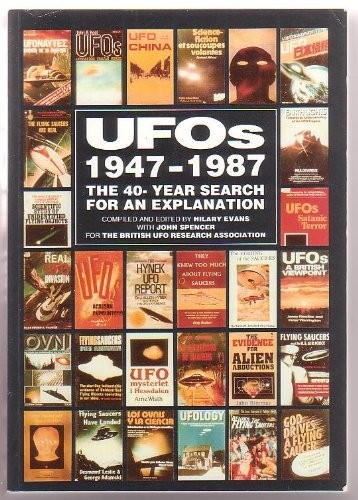
UFOs, 1947–1987
The 40-Year Search for an Explanation — BUFORA's Fortieth-Anniversary Anthology, and the Best Snapshot of What the Field Actually Thought
Find on Amazon →As an Amazon Associate, OverClassified may earn from qualifying purchases made through this link, at no extra cost to you.
Why This Is Essential Reading
The field's most honest collective self-portrait, and a methodological reference that has outlived its case material. Forty years after Arnold, BUFORA assembled Vallée, Keel, Randles, Hind and dozens more to say where the search had got to, and the answer they collectively produced was that method had advanced a long way and explanation had not moved at all. That is a more useful finding than any of the individual essays. Its case material is four decades stale and it contains no serious external critic, which is a real gap. Read it for the methodological chapters on formation and multiple-witness light cases — this site's Greifswald file relies on them — and as the record of the moment European and American ufology stopped agreeing about what they were studying.
Related Cases & Theories
Sources Cited
- Evans, Hilary, John Spencer and Martin Shough, eds. UFOs, 1947–1987: The 40-Year Search for an Explanation. Fortean Tomes, in association with BUFORA, September 1, 1987, 384 pp. ISBN-10 1870021029 / ISBN-13 9781870021029. amazon.com
- WorldCat record, UFOs, 1947-1987: the 40-year search for an explanation, OCLC 18560737 — institutional bibliographic verification. search.worldcat.org
- Semantic Scholar record, UFOs, 1947-1987: the 40-year search for an explanation by Evans and Spencer — academic indexing record. semanticscholar.org
- AbeBooks bibliographic record, ISBN 9781870021029 — Fortean Tomes 1987 edition, and the description of the volume as a compilation of articles each preceded by biographical information and publication lists, with contributors including Jenny Randles, Jacques Vallée, John Keel, Mark Moravec and Cynthia Hind. abebooks.com
- AbeBooks first-edition listing, UFOs 1947-1987: The 40-Year Search for an Explanation — edition detail. abebooks.co.uk
- Goodreads edition record, UFOs, 1947-1987 by Hilary Evans — reader-side publication record. goodreads.com
- Peebles, Curtis. Watch the Skies! A Chronicle of the Flying Saucer Myth, Smithsonian Institution Press, 1994 — the sceptical historian's survey of the same forty years. OverClassified breakdown
- Swords, Michael D., and Robert Powell. UFOs and Government: A Historical Inquiry, 2012 — the documentary-history treatment of the same period. OverClassified breakdown
- Walmart listing, UFOs, 1947-1987: The 40-year search for an explanation, ISBN 9781870021029 — independent bibliographic confirmation. walmart.com
- Vallée, Jacques. Passport to Magonia: From Folklore to Flying Saucers, 1969. OverClassified breakdown
- Vallée, Jacques. Dimensions: A Casebook of Alien Contact, 1988. OverClassified breakdown
- Keel, John A. UFOs: Operation Trojan Horse, 1970. OverClassified breakdown
- Hind, Cynthia. UFOs Over Africa, 1997. OverClassified breakdown
- Clarke, David. The UFO Files: The Inside Story of Real-Life Sightings, The National Archives, 2009 — the later British archival tradition this anthology's community produced. OverClassified breakdown
- OverClassified case file, Greifswald Lights — cites this book as a landmark European-focused survey and methodological reference for formation-of-lights cases; source for the August 24, 1990 sequence, the ring of seven and rotating 'Y' formations near the Greifswald Nuclear Power Plant, the six videos and twenty-five-plus photographs, cameraman Valery Vinogradov, Illobrand von Ludwiger's MUFON-CES photometric and triangulation analysis, and the absence after three decades of any confirmed unit, exercise log or launch order supporting the Warsaw Pact flare explanation.
Have corrections, additional research, or peer-reviewed sources? Help improve this entry.
Suggest an Edit