
RAAF Williamtown "Operation Close Encounter"
In late June 1983, senior air traffic controllers at Sydney's Mascot Airport began reporting repeated unidentified radar contacts 70–150 nautical miles north of the city, moving at speeds officially logged as 1,100–6,500 km/h. On June 30, 1983, No. 3 Control and Reporting Unit at RAAF Base Williamtown formally launched a classified response codenamed "Operation Close Encounter," placing two Mirage III interceptors on standby alert. A Tarro, New South Wales resident later described watching the jets pursue a flat, saucer-shaped object for roughly ten minutes before it "changed position in the blink of an eye" and vanished at extreme speed. The restricted files remained secret for three decades until the National Archives of Australia released them in 2012, by which point the Royal Australian Air Force's own internal testing had already quietly attributed the radar returns to "running rabbits" — a known radar-interference phenomenon — leaving the ground-level visual account unaddressed by that explanation.
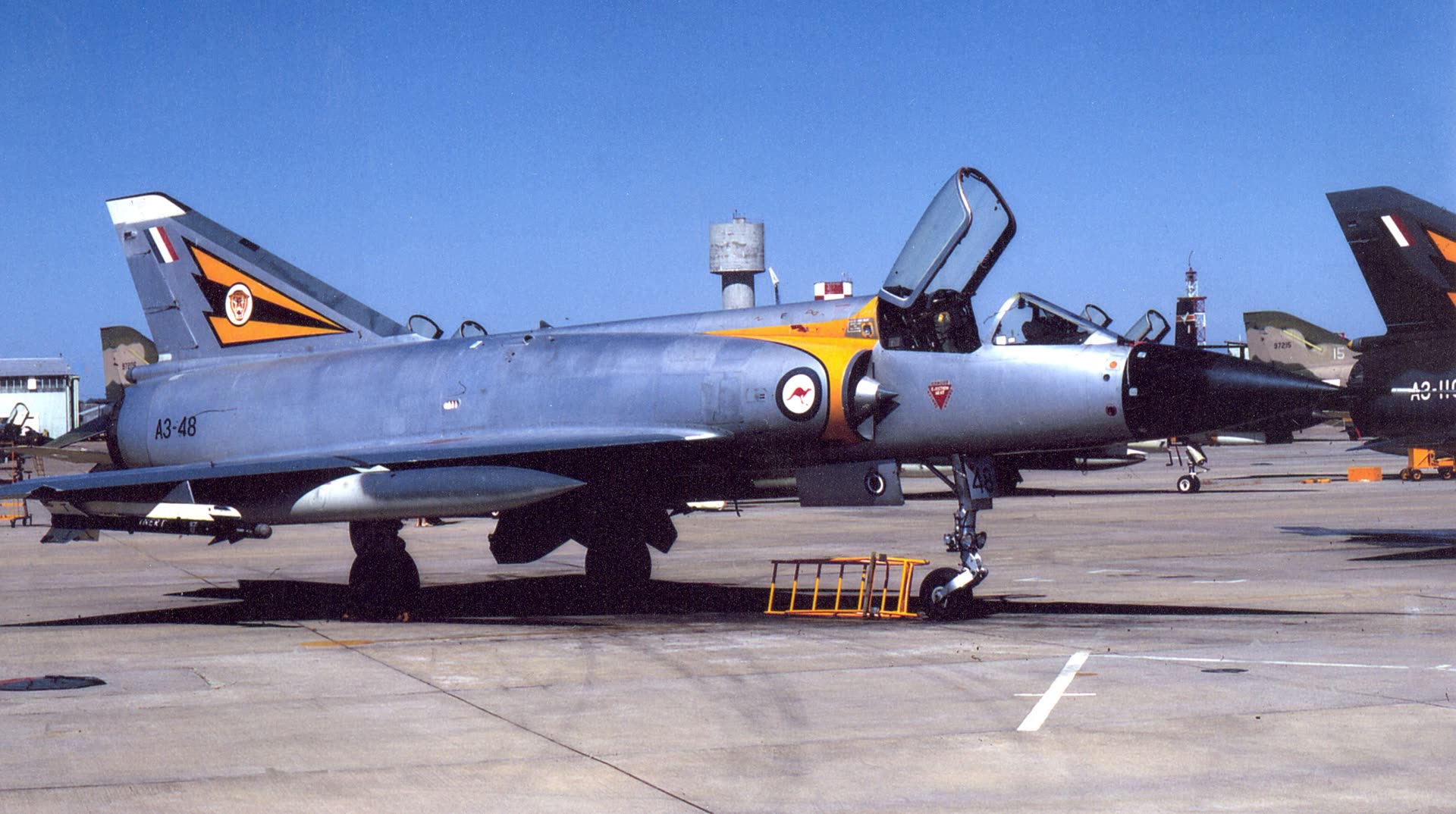
Pictured: a Royal Australian Air Force Dassault Mirage IIIO photographed at RAAF Base Williamtown in 1978 — the same base and the same interceptor type placed on alert during Operation Close Encounter five years later, not a photograph of the actual June 1983 incident itself. No photograph of the radar returns, the intercept, or the object reported by ground witness Geoff Masters is known to exist.
Theoretical Alignment
This case genuinely splits into two separately-evaluated components that align differently. The radar-only phenomenon that triggered the official operation aligns most strongly with a mundane, instrumentation-artifact explanation once the RAAF's own internal "running rabbits" finding is weighed seriously. The independent ground-level visual account, however — an object reportedly outmaneuvering two fighter jets in real time — was never addressed by that explanation at all, keeping a modest but real alignment with the Extraterrestrial Hypothesis open for that specific, separate strand of the case.
The Psycho-Social Hypothesis's comparatively strong alignment here reflects less a claim of outright fabrication and more the specific evidentiary conditions under which Geoff Masters's account was formed and later retold: a genuinely eventful period for air activity around Williamtown, a lone civilian observer without technical training attempting to interpret a fast, distant aerial event in real time, and a multi-decade gap between the original experience and its first public telling, all conditions the broader UFO literature independently associates with a heightened risk of perceptual and memory distortion even in an entirely sincere witness — without this framework requiring any judgment about Masters's honesty or the genuine strangeness of what he believed he saw.
Background
By 1983, the Royal Australian Air Force had been quietly logging and investigating civilian and military UFO reports for decades, dating back to a formal reporting system established in the 1950s alongside similar Cold War-era programs in the United States (Project Blue Book) and United Kingdom (the Ministry of Defence's own UFO desk). According to researcher Bill Chalker's own account of this history, the Australian government decided in concert with the UK and US governments that informed investigation should be undertaken, and the RAAF was formally designated Australia's "official governmental examiner" of UFO reports — a bureaucratic responsibility Chalker has noted the Air Force itself, for a long stretch of that history, regarded as an unwelcome obligation rather than a genuine research priority. Unlike its American counterpart, the RAAF's UFO investigation function was never a standalone, publicly acknowledged office; reports were typically absorbed into routine air-defense and air-traffic-control channels, logged, and then filed under standard 30-year secrecy provisions governing Australian government and defence records, meaning the public would not see any of this material until three decades after the fact regardless of its content.
RAAF Base Williamtown, located immediately north of Newcastle in New South Wales, has served since the Second World War as one of the RAAF's primary fighter bases and, throughout the 1960s, 1970s, and into the 1980s, was home to squadrons flying the French-designed, Australian-license-built Dassault Mirage III interceptor — the RAAF's frontline air-defense fighter until it was progressively replaced by the F/A-18 Hornet beginning in 1985. The base's own No. 3 Control and Reporting Unit (3CRU), established in 1967, was and remains responsible for surveillance of Australia's eastern airspace and for coordinating fighter response to unidentified or unauthorized air traffic detected by the network of ground radar stations feeding into RAAF and civilian air-traffic-control systems.
Williamtown's Mirage squadrons during this specific period were flying the Australian-built IIIO variant, license-manufactured domestically by the Government Aircraft Factories and Commonwealth Aircraft Corporation from the early 1960s onward rather than imported directly from France — a program that gave the RAAF a genuinely self-sufficient sustainment and modification capability for its frontline interceptor fleet throughout the aircraft's operational life. By 1983, the type was approaching the end of its two-decade RAAF service, aging but still fully operational and considered capable enough to serve as the nation's primary quick-reaction air-defense asset for exactly this kind of unidentified-contact scramble, making it entirely unsurprising that Mirages, rather than any other RAAF airframe, were the aircraft placed on alert during Operation Close Encounter.
Sydney's Mascot Airport (now Sydney Kingsford Smith Airport, and referred to throughout this case's own contemporary documentation simply as "Mascot," its name at the time) sat at the center of the specific radar picture this case is built on. As Australia's busiest civil airport and a major node in the national air-traffic-control network, Mascot's radar controllers routinely monitored a wide swath of airspace across New South Wales, including the corridor north of the city toward Newcastle and Williamtown — precisely the region where the June 1983 contacts were reported. A genuinely unidentified, high-speed radar return appearing repeatedly in this corridor was, by definition, a legitimate air-safety and air-defense concern independent of any UFO framing, since Mascot's own civil air-traffic system would have no way to distinguish a classified military exercise, a foreign incursion, a weather phenomenon, or an instrumentation fault from a genuine unknown aircraft without further investigation.
The winter of 1983 would go on to become a genuinely significant period in Australian ufology more broadly. In the weeks following Operation Close Encounter's June 30 launch, a much larger and more widely reported wave of sightings broke out across New South Wales, centered on the Gosford and Central Coast region north of Sydney during late July and early August 1983 — a period Bill Chalker and other Australian investigators, including UFO Research (NSW), have separately documented in detail. One representative report from that wider flap, investigated by UFOR (NSW), describes a witness at the Gosford RSL club between 9 and 10 p.m. on August 26, 1983 watching a bright light on a nearby mountain approach at low altitude — estimated at only 200 to 300 metres and moving slowly rather than at any anomalous speed — before resolving into a massive, diamond-shaped object with straight back and side surfaces. Whether the earlier Williamtown radar contacts and the subsequent Gosford flap were connected phenomena, coincidental timing, or entirely separate events remains an open question the released documents themselves do not resolve.
Contemporary UFO-research accounts of this period place the Mascot radar activity in a somewhat broader quantitative context than the Operation Close Encounter files alone convey: investigators have described "more than 30 unidentified radar returns" recorded at Mascot during the same general June–July 1983 window, explicitly noting that none of these individual returns were ever correlated with any independent visual sighting. This detail is significant for how the case should be weighted — it suggests the phenomenon behind Operation Close Encounter was a sustained, repeated pattern of spurious contacts over an extended period rather than one or two isolated events, which is itself more consistent with a persistent instrumentation or propagation artifact than with a small number of discrete, physical intrusions, and it further underscores that Geoff Masters's ground-level account of an actual pursuit was never one of the correlated radar contacts in the RAAF's own accounting.
Complete Timeline
| Date | Event |
|---|---|
| Early-mid June 1983 | Unidentified radar contacts begin appearing repeatedly on screens at Sydney's Mascot air-traffic-control facility, in the corridor 70–150 nautical miles north of the city |
| June 30, 1983 | No. 3 Control and Reporting Unit at RAAF Base Williamtown formally launches the classified response codenamed "Operation Close Encounter"; two Mirage III interceptors placed on second-highest alert status |
| 1983 (date undisclosed) | Tarro, NSW resident Geoff Masters reports witnessing RAAF jets pursue a flat, saucer-shaped object near his home for approximately ten minutes before it outmaneuvers them and departs at extreme speed toward the north |
| 1983 (date undisclosed) | Internal RAAF testing attributes the Mascot radar contacts to "running rabbits," a known radar-interference/anomalous-propagation phenomenon |
| Late July–early August 1983 | A separate, much larger UFO sighting wave breaks out across the Gosford/Central Coast region of New South Wales |
| August 5, 2012 | The National Archives of Australia releases the restricted Operation Close Encounter files publicly under the standard 30-year secrecy rule |
| 2012 | The Newcastle Herald publishes an investigative feature on the newly released files, including witness Geoff Masters's on-the-record account |
| December 2024 | ABC News profiles researcher Bill Chalker's decades-long access to RAAF UFO files, situating Operation Close Encounter within the broader body of declassified Australian material |
The Radar Contacts and the Official Response
The documentary record for this case begins not with a witness account but with an instrumentation problem: repeated, unexplained radar returns appearing on Mascot's air-traffic-control screens over a period of days or weeks in June 1983. Senior controllers characterized the contacts as located consistently in a corridor roughly 70 to 150 nautical miles north of Sydney — placing them squarely in the airspace between the city and Newcastle/Williamtown — and logged apparent speeds between 1,100 and 6,500 km/h, a range spanning from roughly the cruising speed of a commercial airliner at the low end to multiple times the speed of sound at the high end, "suggested" (in the documents' own careful phrasing) to indicate the contacts were operating at high altitude.
This pattern of repeated, unexplained returns was serious enough that the RAAF formally stood up Operation Close Encounter on June 30, 1983, placing two Mirage III interceptors from Williamtown on the second-highest level of alert readiness — a real, resourced military response, not an informal or offhand one. Critically, however, the restricted documents specify a deliberately conservative scramble protocol: interceptors were authorized to launch only if the contacts also appeared on Williamtown's own radar, or on any radar system other than Mascot's alone. This detail matters enormously for how the case should be read. It indicates the RAAF's own controllers harbored real doubt about whether the Mascot returns represented a genuine airborne target at all, versus a fault or artifact isolated to that single radar site — precisely the kind of institutional skepticism that later testing would substantiate.
The released documents do not explicitly state whether the interceptors were ever actually launched during a live contact, a genuine and significant gap in the official record. This is where the case's two strands — the radar phenomenon and Geoff Masters's independent ground-level account of jets pursuing a visible object — either intersect or diverge, depending on which source is weighted more heavily; official paperwork that stops short of confirming a scramble occurred does not, on its own, prove that no scramble ever happened, particularly for operationally sensitive missions where after-action reporting may have been handled through separate, still-classified channels.
The overall scale of the phenomenon, as later described by independent Australian UFO researchers reviewing the same declassified material, was substantially larger than a single triggering incident: more than 30 individual unidentified radar returns were reportedly logged at Mascot across the same general June–July 1983 window, a volume that on its own argues for a persistent underlying cause — whether a genuine, unidentified airborne target repeatedly transiting the same corridor, or, as ultimately concluded, a recurring instrumentation artifact affecting that specific radar site or its immediate operating environment. Critically, none of these 30-plus individual returns were ever reported as correlated with a visual sighting by any pilot, ground observer, or independent radar station, a detail that sits uneasily alongside Geoff Masters's account and reinforces that his sighting, whatever its true explanation, appears to exist as its own separate data point rather than as one of the formally logged and cross-referenced radar contacts.
The "Running Rabbits" Explanation
According to the released files, RAAF testing subsequently determined that the unidentified radar contacts reported by Mascot controllers were "generated entirely by radar interference known colloquially as 'running rabbits.'" This is a real, well-established technical phenomenon in radar and air-traffic-control circles, not an invented or after-the-fact rationalization: so-called "rabbits," "ghosts," or "angel echoes" arise from a range of known causes including anomalous atmospheric propagation (radar energy bending or ducting along temperature-inversion layers, allowing echoes to appear from far beyond a radar's normal range or at implausible positions), mutual interference between radars operating on similar frequencies, second-time-around returns (a strong echo from a genuine but very distant target being processed as if it arrived during the following pulse cycle, producing a spurious closer-range "ghost"), and electronic countermeasure/jamming-adjacent effects.
The specific phrase "generated entirely by radar interference" in the released documents is itself notable for its lack of hedging — it is not phrased as a probable, likely, or leading explanation, but as a definitive statement of internal RAAF technical conclusion. Institutional documents of this kind, prepared for internal air-defense purposes rather than public reassurance, generally have little incentive to overstate confidence in a mundane finding if genuine doubt remained; a body actively worried that a real, unidentified target had penetrated its air-defense radar picture would have far more institutional reason to keep such a case flagged as unresolved than to close it out with unqualified language, which lends the RAAF's own stated conclusion additional, if still not conclusive, weight.
The specific term "running rabbits" traditionally describes a particular visual signature on an analog radar display: apparent targets that seem to "hop" or "run" erratically across the screen in a manner inconsistent with any physically plausible real aircraft track — behavior that would naturally produce exactly the kind of wildly inconsistent apparent-speed readings (1,100 to 6,500 km/h across the same reported contacts) documented in the Mascot logs, since a genuine aircraft cannot plausibly range from airliner speed to multiple times the speed of sound within the same tracking session. This internal inconsistency in the reported speed data is itself a meaningful technical signal independent of the RAAF's own stated conclusion, and is broadly the same class of finding — an instrumentation reading that fails a basic internal-consistency check — that has separately undercut other instrumented UAP cases on this site (compare the rangefinder-mismatch finding in the Nellis Range S-13/S-30 UFO Video).
The Geoff Masters Ground Sighting
Independent of the radar and interception paperwork, Tarro, New South Wales resident Geoff Masters gave an on-the-record account, later published by the Newcastle Herald, of personally witnessing RAAF jets pursuing an object near his home. Masters described the object as having a "typical flat saucer shape" and recalled the pursuit lasting close to ten minutes, characterizing it as "a comedy of cat and mouse" as the jets repeatedly closed on the object only for it to reposition. In Masters's own words, "when the jets got too close, this UFO just changed position in the blink of an eye" — a description of instantaneous repositioning, rather than a fast but continuous acceleration, that if taken at face value would represent a genuinely anomalous performance characteristic well beyond any conventional aircraft's capability. Masters further recalled the object ultimately departing northward at extraordinary speed, speculating it could have covered the distance to the RAAF's Amberley base in Queensland within minutes.
Masters's account is the only detailed, named, first-person description of the object's actual appearance and behavior anywhere in this case's public record; every other detail comes from institutional radar logs and administrative paperwork describing detection and response procedure, not what anyone actually saw. This makes his testimony both the case's most vivid and specific evidence and, simultaneously, its most difficult to independently corroborate: no second named witness has come forward describing the same pursuit, no photograph or film exists, and the surviving official documents neither confirm nor explicitly deny that an interception involving visual contact took place on the date and in the manner Masters describes.
Tarro itself is a small suburb sitting almost directly beneath the approach and departure corridors used by aircraft operating from RAAF Base Williamtown, only a short distance from the base's own perimeter — a location where a resident would be entirely accustomed to the ordinary sound and sight of military jet traffic overhead, and would plausibly have both the opportunity and the frame of reference to distinguish a genuine intercept-style pursuit (multiple aircraft maneuvering together at unusual angles and speeds relative to routine training-circuit patterns) from ordinary base operations. This local familiarity cuts in two directions for assessing his account's reliability: it makes Masters a more informed observer of what "normal" Williamtown air activity looks like than a witness elsewhere in NSW would have been, while also meaning that a genuinely unusual but still conventional exercise — an aggressive practice intercept against a target drone or another aircraft, for instance — might have looked more dramatic and less easily explained to him than it would have to base personnel who understood exactly what exercise was underway.
Declassification and the 2012 Release
Like all Australian government and defence records not otherwise exempted, the Operation Close Encounter files were automatically subject to release under Australia's standard 30-year secrecy provision, administered by the National Archives of Australia. The files were formally released to the public on August 5, 2012, stamped "restricted" in their original form, alongside a broader tranche of historical RAAF UFO-related material covering multiple decades of reports. This release fits a well-established international pattern — the United Kingdom's Ministry of Defence conducted a similar phased declassification of its own UFO files beginning in 2008, and the pattern of institutionally mundane, procedurally cautious internal documents contrasting with more dramatic public reporting recurs across nearly every national UFO-file release conducted this way.
Australian UFO researcher Bill Chalker, described by ABC News as one of the first civilians ever to gain access to RAAF UFO files and widely regarded within Australian ufology as the field's most methodologically serious researcher, has spent decades working with exactly this category of declassified material, providing crucial continuity and expert context between the RAAF's own restrained institutional language and the more sensational framing the case has sometimes received in popular press coverage. Chalker's access predates the 2012 general release by many years; his own published accounts describe a long, incremental working relationship with RAAF and Department of Defence records custodians that allowed him to review individual case files well before Australia's blanket 30-year rule brought the broader tranche automatically into the public domain, giving his interpretation of documents like Operation Close Encounter's own files a depth of institutional context that a researcher encountering them for the first time in 2012 would not have had.
The 2012 release itself did not arrive with an accompanying official reassessment or reinterpretation of any individual case — the National Archives of Australia's role is archival custodianship, not investigative reopening, meaning Operation Close Encounter's files were released in essentially the same administrative form in which they were originally filed nearly three decades earlier, "running rabbits" conclusion and all, with no new testing, no follow-up interviews, and no attempt made in 2012 to locate or re-interview Geoff Masters or any other member of the public who might have witnessed related activity during the same period.
Key Witnesses
Geoff Masters
The case's only named, on-the-record eyewitness. Masters described watching RAAF jets pursue a flat, saucer-shaped object near his home for approximately ten minutes, recalling that the object instantly repositioned whenever the jets closed the distance before ultimately departing northward at extreme speed. His account, given years after the fact but consistent in its retelling, is the case's most specific and vivid evidence, though it remains uncorroborated by any second named witness.
Senior Air Traffic Controllers, Mascot Airport
Professional, trained radar controllers whose repeated reports of unidentified contacts in a specific, consistent air corridor triggered the entire official response. Their professional context lends the initial radar reports real institutional credibility, even though the contacts themselves were subsequently attributed to interference rather than a genuine airborne target.
RAAF Mirage III Interceptor Pilots
The two pilots placed on alert status during Operation Close Encounter. Whether either pilot ever achieved visual or radar contact with a genuine target during an actual scramble is the single most consequential unresolved question in the entire case, since the surviving released documents stop short of confirming a launch occurred.
The Five Observables Assessment
The Five Observables framework is applied to the performance characteristics reported in this case:
Assessment: The radar-only strand of this case shows no genuine anomalous performance once the "running rabbits" finding is weighed — internally inconsistent apparent speeds are the signature of an interference artifact, not evidence of hypersonic flight. Geoff Masters's independent ground account, however, explicitly describes instantaneous repositioning ("changed position in the blink of an eye"), which if accurate would represent a genuine, difficult-to-explain anomalous capability; this observable is scored present specifically and only on the strength of that single, uncorroborated witness account, not on the official radar/interception record.
Evidence Assessment
Weighing the two evidentiary strands of this case side by side, rather than treating "Operation Close Encounter" as a single undifferentiated claim, is the only way to reach a defensible overall assessment: the radar phenomenon and the ground sighting rest on different evidence, different witness classes, and different levels of official engagement, and conflating them risks either over-crediting the whole case on the strength of the (thin) ground sighting, or dismissing the whole case on the strength of the (well-explained) radar phenomenon.
Supporting Anomalous Origin
- Geoff Masters's detailed, consistent, on-the-record account describes an object performing an instantaneous repositioning maneuver no conventional aircraft of 1983 (or today) is capable of
- Trained, professional air-traffic controllers, not untrained civilians, generated the original reports that triggered a real, resourced military response
- The RAAF's own scramble protocol required corroboration from a second independent radar source before authorizing a launch — institutional caution that does not, on its own, explain away the underlying contacts
- The released documents never explicitly confirm or deny that a visual interception took place, leaving Masters's account formally uncontradicted by the official record
- The case involves a real, verified, formally codenamed military operation with declassified documentary backing — a stronger evidentiary foundation than the great majority of UFO reports, which have no official paper trail at all
Supporting Conventional Explanation
- Internal RAAF testing directly attributed the radar contacts to "running rabbits," a well-documented, non-exotic radar-interference phenomenon
- The reported speed range for the contacts (1,100–6,500 km/h) is internally inconsistent for a single physical target, a strong technical signature of an instrumentation artifact rather than a real tracked object
- The scramble protocol's own requirement for independent radar corroboration suggests RAAF controllers themselves suspected a single-site fault from early on
- Geoff Masters's account is the only detailed eyewitness testimony in the entire case, uncorroborated by any second named witness, photograph, or film
- No physical trace evidence, radar tape, or gun-camera/cockpit-camera footage from either Mirage has ever been publicly released or referenced in available documentation
Why "Disputed"
This case receives a DISPUTED classification because it genuinely contains two evidentiarily distinct sub-cases wearing one name. The radar phenomenon that gave Operation Close Encounter its name is well-explained: "running rabbits" is a real, technically coherent, RAAF-endorsed conclusion that correctly accounts for the internally inconsistent speed readings in the Mascot logs, and this site's own case file treats that strand as effectively resolved rather than genuinely anomalous.
What keeps the case as a whole from a lower, more clearly "explained" rating is that Geoff Masters's independent ground-level account was never addressed by the running-rabbits finding at all — a radar-interference explanation for spurious contacts on an air-traffic-control screen says nothing about what, if anything, a civilian witness physically saw jets pursuing near Williamtown. Whether Masters witnessed a real, still-unexplained event; misremembered or conflated separate incidents from a genuinely eventful period for NSW air-traffic activity; or described something that did not actually involve interceptors at all cannot be determined from the public record as it currently stands. A single, uncorroborated, though consistent and named witness account describing extraordinary performance, sitting alongside an official record that resolves a related-but-distinct radar phenomenon without ever engaging with that witness's specific claim, is exactly the kind of case that belongs at Disputed rather than at either Debunked or Credible.
This case's rating also reflects a deliberate editorial choice about how to treat named, on-the-record eyewitness testimony that a government document neither confirms nor contradicts. Some UFO researchers would treat the absence of an explicit official denial as meaningfully supportive of the witness account; others would treat a single uncorroborated civilian story, decades removed from the event and impossible to independently verify, as inherently too weak to move a case's rating regardless of how consistent or sincere it appears. This case file takes the middle position reflected in its Disputed rating and comparatively low numeric score: Masters's account is taken seriously enough to prevent the case from being closed as simply "explained," but not treated as sufficient, on its own, to establish a credible anomalous event.
Sensor & Instrumentation Detection Profile
The only instrumented data associated with this case is Mascot Airport's civil air-traffic-control radar, which generated the original unidentified contacts later attributed to interference. Early-1980s Australian civil ATC radar of this class operated on established primary and secondary surveillance principles broadly similar to systems used throughout the Western world at the time, feeding controller display consoles rather than producing any independently archived scope photography or raw data recording as standard practice — a real technical limitation on what could ever be re-examined after the fact, since without a preserved scope photograph or raw radar tape, later researchers (including this case file) are entirely dependent on the RAAF's own written summary of what the contacts showed, not the original data itself.
No RAAF ground radar at Williamtown itself, no airborne intercept radar from either Mirage, and no gun-camera or cockpit-camera footage has ever been publicly released, referenced, or confirmed to exist for this specific case. This leaves a real, significant sensor gap: the single data source that triggered the entire operation is also the one source RAAF testing subsequently found unreliable, and no independent instrument ever corroborated either the original contacts or Masters's separate visual account. Had a scramble actually occurred with the interceptor's own airborne radar achieving lock on a genuine target, that data would represent an entirely independent confirmation source distinct from Mascot's ground radar — precisely the kind of corroboration the RAAF's own scramble protocol was designed to require before authorizing a launch in the first place, and precisely the data point that, if it exists, remains unreleased or was never generated at all.
Environmental & Geospatial Context
The reported radar corridor sits in the coastal airspace between Sydney and Newcastle, a busy, radar-dense region with multiple overlapping civil and military systems operating in relatively close proximity — exactly the kind of environment where mutual radar interference and anomalous propagation effects are most likely to occur, since "running rabbits" and related artifacts are frequently associated with radar systems operating near one another on similar frequencies. Coastal New South Wales's temperature-inversion-prone atmospheric conditions, particularly along the humid eastern seaboard, are also independently associated with the kind of anomalous ducting propagation that produces exactly this class of spurious long-range radar return.
Geographically, the specific 70–150 nautical mile corridor north of Sydney logged in the Mascot reports runs almost directly along the coastal flight path linking Sydney, the Central Coast/Gosford region, and Newcastle/Williamtown — the same general strip of coastline where the later Gosford flap's own reports, including the August 26 diamond-shaped-object sighting, were independently logged. This geographic overlap does not, on its own, establish that the two episodes shared a common cause, but it does mean that whatever combination of genuine air traffic, military activity, and atmospheric conditions characterized this corridor during the winter of 1983 was operating across both the June radar-contact period and the following month's more dramatic visual wave, a detail worth weighing when considering whether any of these reports might share an underlying explanation.
Observer Credibility & Occupational Profile
The original Mascot radar reports came from senior, professionally trained air-traffic controllers operating one of Australia's busiest civil radar facilities as their full-time occupation — a genuinely credible source class for the initial detection, even though their reported contacts were subsequently explained as an artifact rather than a real target. Geoff Masters, by contrast, was an ordinary civilian resident with no stated aviation or technical background; his account carries the inherent limitations of any single, untrained eyewitness describing a fast-moving aerial event from the ground, though his description has remained detailed and consistent in its retelling years after the fact, and he had no apparent motive to fabricate an elaborate account of a specific, named military operation years before that operation's existence was ever publicly confirmed by the 2012 declassification.
This timing detail deserves particular weight in any credibility assessment. Because "Operation Close Encounter" as a specific codename remained officially secret until August 2012, Masters could not have simply read about the operation and retrofitted his own story to match a known official narrative — whatever he told the Newcastle Herald in 2012 necessarily originated from his own thirty-year-old memory of the event, not from cross-referencing a declassified document that had not yet been released at the time he would have needed to fabricate a matching account. This does not prove his account is accurate (long-term eyewitness memory is well-documented in the broader psychological literature as prone to distortion, compression, and unconscious embellishment over multi-decade timescales, independent of any sincere intent to deceive), but it does meaningfully reduce, though not eliminate, the likelihood that his testimony was deliberately constructed to match the official record after the fact.
Physical & Material Assays
No physical trace evidence of any kind is associated with this case. No debris, landing mark, or material sample was ever recovered or reported, and the entire evidentiary record consists of institutional radar/operational documentation and a single witness's verbal testimony. This absence is itself unremarkable rather than suspicious: the case never involved a claimed landing, close-range physical encounter, or any other circumstance in which a UFO investigation would ordinarily expect to find recoverable trace evidence in the first place — a purely radar-and-airborne case of this kind simply has no physical mechanism by which trace evidence could plausibly exist, regardless of whether the underlying phenomenon was ultimately mundane or genuinely anomalous.
Historical Precedents & Archive Matches
Operation Close Encounter sits within a broader, internationally recurring pattern of Cold War-era air-defense radar contacts that prompted a real fighter-interceptor response, only for the underlying radar phenomenon to later be attributed to interference, anomalous propagation, or other instrumentation artifacts rather than a genuine airborne threat or craft — a pattern independently documented on this site in cases such as the Kinross Incident and various NORAD-adjacent Cold War scramble reports. It also belongs to the specific sub-category of Australian UFO cases that only became publicly knowable through the country's 30-year declassification rule, a pattern shared with the broader 2012 National Archives of Australia UFO-file release this case's own documents were part of, and echoed internationally by comparable UK Ministry of Defence and U.S. Air Force document releases decades after the fact.
Within Australian ufology specifically, this case forms one part of a longer chain of RAAF-adjacent radar and interception reports stretching back decades before 1983 and continuing after it, most of which share the same basic evidentiary shape: real, verifiable institutional documentation of an official response to an unidentified contact, combined with genuinely incomplete public information about what, if anything, was ever visually or physically confirmed. The Westall Encounter of April 1966, involving mass witness testimony from students and teachers at a Melbourne school rather than radar or interceptor involvement, represents the opposite evidentiary profile within the same national UFO tradition — overwhelming numbers of independent lay witnesses but no instrumented data at all — making the two cases a useful contrast in the different ways Australian UFO reports have historically been evidenced.
Material Analysis
There is no physical or material evidence associated with this case beyond the released documentary paper trail and Geoff Masters's verbal testimony. Unlike cases involving landing traces, metallic fragments, or biological samples, nothing here can ever be resolved through laboratory analysis; every line of investigation runs through either the RAAF's own internal radar/interception paperwork or a single witness's recollection.
What the Declassified Documents Do and Do Not Establish
The released files establish, beyond reasonable dispute, that a real, formally codenamed military response occurred: Operation Close Encounter was launched, two interceptors were placed on alert, and a specific scramble-authorization protocol was drafted requiring independent radar corroboration before any launch. What the documents do not establish is whether that alert status was ever actually exercised in a live intercept, whether any pilot achieved contact of any kind with a genuine airborne target, or how — if at all — the RAAF's internal investigation engaged with Geoff Masters's specific, later-published account of watching jets pursue a visible object near his home.
The Limits of a Partial Declassification
Like most government UFO-file releases conducted under a blanket time-based rule rather than a case-specific Freedom of Information request, the 2012 release cannot be assumed to represent the complete surviving record. Sensitive operational details, radar tape recordings (which even when retained are rarely preserved in a form suitable for public archival release), pilot debriefing transcripts, and any follow-up correspondence with Geoff Masters or other members of the public who may have reported similar sightings during this period are all plausible categories of material that may exist in a still-classified, since-destroyed, or simply never centrally filed state, independent of any deliberate suppression.
It is also worth noting that Australian record-retention practices for routine air-defense alert logs of this vintage were not necessarily designed with long-term historical preservation in mind — operational squadron and unit records from the early 1980s were, in many documented cases across multiple air forces internationally, retained only for a standard administrative period before routine destruction, unless specifically flagged for permanent archival retention. Whether Operation Close Encounter's full underlying record (as opposed to the summary-level restricted file actually released in 2012) survived in complete form, or whether portions were already lost to ordinary records-management practice well before any 30-year secrecy clock even applied, is itself an open and probably unanswerable question given the information currently available.
Supporting Non-Terrestrial or Unresolved Origin
- Geoff Masters's account of instantaneous repositioning was never addressed or contradicted by the RAAF's own radar-interference finding
- The official documents never confirm or rule out a live intercept, leaving the case formally open on that specific question
Supporting Terrestrial (Interference) Origin
- The RAAF's own internal testing directly and specifically attributed the radar phenomenon that gave the operation its name to a known, non-exotic interference effect
- No physical evidence of any kind exists to weigh against that official technical finding
The Conventional Explanation Candidate: Radar Interference ("Running Rabbits")
The RAAF's own internal explanation, attributing the Mascot radar contacts to "running rabbits" interference, is the leading conventional candidate and deserves serious weight precisely because it comes from the same institution that generated the original alert — a body with every operational incentive to correctly identify a genuine airspace threat rather than dismiss one, making its own conclusion that the contacts were spurious a meaningful, not self-serving, technical finding. The internally inconsistent reported speed range (1,100–6,500 km/h for what was treated as the same recurring phenomenon) is independently, technically consistent with known "running rabbits" behavior, in which apparent targets "hop" erratically across a radar display in a manner no genuine aircraft track could physically produce.
A caveat on trusting the RAAF's self-assessment: the argument that the RAAF had no incentive to dismiss a genuine threat is a real one, but it is not the only institutional incentive in play — an air force also has a strong, ordinary interest in confirming that its own radar network is functioning correctly and did not simply glitch during a live alert, which cuts in the opposite direction from a motive to falsely dismiss a target. This file credits the "running rabbits" explanation because it is independently, technically consistent with a well-documented radar artifact and with Masters's own decoupled ground sighting, not because an institution investigating its own equipment should be assumed to have gotten it right.
Anomalous Atmospheric Propagation and Ducting
A closely related, non-exclusive candidate holds that temperature-inversion layers along the humid coastal New South Wales seaboard produced ducting conditions capable of bending radar energy and returning echoes from unexpected ranges or bearings — a well-documented meteorological effect entirely capable of generating the kind of spurious, inconsistent contacts reported at Mascot, and one that would naturally recur across multiple days if the underlying atmospheric conditions persisted through the reported period in June 1983.
A Misidentified Training Intercept or Target Exercise
A closely related variant of the conventional-aircraft candidate specifically proposes that Masters witnessed a genuine, scheduled RAAF training exercise rather than a response to an actual unidentified contact — two Mirage IIIs practicing an intercept against a target drone, a towed target, or a third aircraft playing the role of an adversary, all routine activities for an operational fighter base like Williamtown in the early 1980s. Such an exercise would naturally produce exactly the "cat and mouse" dynamic Masters described, with the interceptors repeatedly closing on and being out-turned by a smaller, more maneuverable target, and could plausibly appear more dramatic and less readily explicable to an untrained ground observer than to the aircrew involved, who would have understood the exercise's actual parameters throughout. This candidate does not require any unidentified contact, radar-based or otherwise, to have been involved at all, treating the entire ground sighting as a case of an ordinary, scheduled activity being witnessed without the context needed to correctly interpret it — though it does not explain why Masters would have specifically perceived the target as "changing position in the blink of an eye" rather than executing a hard but continuous turn, the kind of maneuver a target drone or towed target is mechanically capable of.
A Genuine but Separate Aerial Event
A third possibility treats Geoff Masters's ground sighting as a real, separate event only loosely connected in time to the radar interference episode — potentially a misidentified conventional aircraft (a civil or military flight operating in a manner Masters, an untrained observer, could not correctly interpret at a distance), a genuinely anomalous but conventionally-explicable phenomenon unrelated to the specific radar contacts that gave the operation its name, or, less charitably, an account that has become embellished or conflated with unrelated details across the decades between the actual 1983 event and its 2012 publication. No evidence currently available can distinguish decisively among these possibilities.
It is worth noting explicitly what would be required to move this case toward a firmer resolution in either direction. A surviving Mascot radar-scope photograph or raw data tape from the period, if one exists in an as-yet-unreleased archive, could directly test whether the logged contacts show the characteristic erratic "hopping" signature of running-rabbits interference or a more consistent track. A second independent witness corroborating some version of Geoff Masters's account — another Tarro-area resident, a Williamtown ground crew member, or a pilot's own after-action statement, none of which have surfaced in the 40-plus years since the event — would substantially strengthen the case's anomalous strand. Absent either, the case is likely to remain permanently split between a well-explained radar phenomenon and an unresolved, uncorroborated eyewitness account.
Radar Interference ("Running Rabbits")
PlausiblePLAUSIBLE for the radar-contact strand specifically. Endorsed by the RAAF's own internal testing, technically consistent with the internally inconsistent reported speed data, and grounded in a well-established, non-exotic radar phenomenon.
Anomalous Atmospheric Propagation
PlausiblePLAUSIBLE and largely complementary to the "running rabbits" finding rather than competing with it — coastal NSW's known ducting-prone conditions provide a specific physical mechanism consistent with the RAAF's own stated conclusion.
Misidentified Conventional Aircraft (Masters Sighting)
InconclusiveINCONCLUSIVE. Plausible in principle for an untrained ground observer, but does not obviously explain the specific "instantaneous repositioning" detail central to Masters's account, which is not characteristic of any conventional aircraft's actual flight behavior.
Misidentified Training Intercept/Target Exercise
InconclusiveINCONCLUSIVE. Correctly predicts the "cat and mouse" dynamic and would require no genuine unidentified contact at all, but does not obviously account for the specific "instantaneous repositioning" detail Masters emphasized.
Genuinely Unresolved Anomalous Event (Masters Sighting)
InconclusiveINCONCLUSIVE. Masters's account remains internally consistent and uncontradicted by the official record, but rests on a single, uncorroborated civilian witness with no supporting instrumented data of any kind.
Related Cases
The three related cases listed below each share this case file's own core evidentiary shape — a fighter-interceptor response to an unidentified radar or visual contact — with final outcomes ranging from fully resolved to permanently unexplained.
Confirmed Documents & Official Records
The National Archives of Australia's collection covering historical RAAF and Department of Defence UFO-related records, including material released under the standard 30-year secrecy provision that governs Operation Close Encounter's own files.
Search Government & Defence Archives Directly
Further Reading — Recommended Literature
The OZ Files: The Australian UFO Story
Written by the Australian researcher most closely associated with accessing and interpreting RAAF UFO files, this is the essential English-language reference for Australia's declassified UFO record, including the broader 1983 NSW sighting period.
Hair of the Alien: DNA and Other Forensic Evidence of Alien Abductions
Chalker's later work, useful here for understanding his broader investigative methodology and standing within Australian ufology when weighing his documented commentary on RAAF file releases.
UFOs: Generals, Pilots, and Government Officials Go on the Record
Kean's credential-focused, cross-national approach to evaluating radar-visual and intercept cases provides a useful comparative framework for weighing this case's mix of official documentation and uncorroborated eyewitness testimony.
Watch the Skies!: A Chronicle of the Flying Saucer Myth
A skeptically-oriented history of Cold War-era UFO scares and official responses, useful context for how air-defense institutions internationally have handled radar-triggered alerts like Operation Close Encounter.
Out of the Shadows: UFOs, the Establishment and the Official Cover-Up
Clarke and Roberts's account of the UK Ministry of Defence's own UFO-file declassification process offers a directly comparable international case study to the National Archives of Australia's 2012 release of the Williamtown documents.
DISCLOSURE: Some links above are affiliate links. If you purchase through them, OverClassified receives a small commission at no additional cost to you. This helps support independent research.
Essential Viewing
Sources
- "A witness describes jets chasing a UFO at Williamtown in 1983." Newcastle Herald. newcastleherald.com.au
- "Secret UFO Files (Australia) Released — 5 August 2012." Lucas 2012 Infos. lucas2012infos.wordpress.com
- "How Bill Chalker became one of the first civilians to access the RAAF's UFO files." ABC News, Dec. 7, 2024. abc.net.au
- "No. 3 Control and Reporting Unit RAAF," Wikipedia. en.wikipedia.org
- "RAAF Base Williamtown," Wikipedia. en.wikipedia.org
- "UFO Investigation Centre Australia: The New South Wales Spotlight on UFOs." ufoicaustralia.blogspot.com
- "Bill Chalker," Wikipedia. en.wikipedia.org
- "Australian UFO Files," Internet Archive collection. archive.org
- "Cue the conspiracies: Australia UFO X-Files 'lost'." NBC News. nbcnews.com
- National Archives of Australia — UFO & Unexplained Aerial Sightings collection. naa.gov.au
- "No. 76 Squadron RAAF," Wikipedia — Mirage III operational history at Williamtown. en.wikipedia.org
- "RAAF Williamtown Air Traffic Control and Radar 1981." VH-MDX. vhmdx.com.au
- "RAAF Station Mascot," Wikipedia. en.wikipedia.org
- "Fighter World," Wikipedia — Williamtown's aviation heritage museum, home to a Mirage IIIO from this era. en.wikipedia.org
- "Australian Defence Department not looking at UFOs despite landmark report handed to US Congress." ABC News, June 26, 2021. abc.net.au
- "Williamtown, New South Wales," Wikipedia. en.wikipedia.org
- "Australian Ufology," Wikipedia. en.wikipedia.org
- "UFO Files Released: Defense Department Publishes Trove of Records." NPR. npr.org (comparative U.S. context on time-delayed UFO document releases)
- File:RAAF Mirage IIIO (6131016059).jpg, Wikimedia Commons — CC BY-SA 2.0 photograph of a Mirage IIIO at RAAF Base Williamtown, 1978. commons.wikimedia.org
See something inaccurate? Have additional information or sources?
Suggest an Edit →Last Updated: August 2026