
Soucoupes volantes et folklore
Bertrand Méheust's 1985 Companion to Science-fiction et soucoupes volantes — Abduction Accounts as Living Folklore
Core Thesis
This is a hundred-page essay that does more work than most three-hundred-page books on the same subject. Bertrand Méheust takes the accounts collected from people who report having been taken aboard a craft and reads them as folklore — not as fiction, and not as delusion, but as narrative material of a recognisable traditional type, being lived and reported in the present tense. Two ideas carry it. The first is the mimetic effect: the phenomenon, as reported, imitates. The second is cultural adaptation: what gets described conforms to the imaginative resources of the culture doing the describing, so that the same core encounter is furnished differently in France in 1954 and in America in 1975. Neither claim requires that nothing happened. Both bear directly on what the accounts can be used to establish, and that is the point Méheust is making.
About the Author
Bertrand Méheust was born on 12 July 1947. He is a French writer on parapsychology and the history of the psychic sciences, a retired teacher of philosophy, and holds a doctorate in sociology.
The doctorate is worth stating precisely because it is often loosely reported. It was awarded by the Université Paris 1 Panthéon-Sorbonne in 1997, and the thesis was on mesmerism and animal magnetism — the eighteenth- and nineteenth-century movement around Franz Anton Mesmer, its clinical claims, its investigation by official commissions, and its long afterlife. That work became the two-volume Somnambulisme et médiumnité in 1999 and is the basis of his standing outside ufology.
His route into the subject is unusually well documented and unusually charming. As a child he was formed by Jules Verne and by the French UFO sightings of the 1950s, which he lived through as news. In 1971 he met Aimé Michel — the science writer whose 1958 compilation and orthoteny hypothesis dominated European ufology for a decade — and the meeting decided him on studying philosophy. He is, in other words, a scholar of the psychic sciences who arrived there through flying saucers, which is the reverse of the usual direction.
His first substantial contribution was Science-fiction et soucoupes volantes (Mercure de France, 1978), which examined the overlap between pre-1947 science-fiction imagery and post-1947 sighting reports. It is his best-known work in this field and the volume this one accompanies; a reissue in 2007 carried the pointed subtitle Une réalité mythico-physique.
He later published En soucoupes volantes: vers une ethnologie des récits d'enlèvements, extending the abduction material into explicit ethnography, and he sits on the steering committee of the Institut Métapsychique International, the French research body founded in 1919 to study psychic phenomena.
The position he occupies is genuinely uncomfortable and genuinely his own, and readers should not mistake him for a debunker. Méheust has spent a career arguing that the historical record of anomalous claims is more interesting than either the credulous or the dismissive account of it allows, and his mesmerism work is essentially a study of how a real, investigated phenomenon was processed by the institutions that examined it. Applied to flying saucers, that stance produces analysis of the reports' cultural machinery without a corresponding verdict on their cause — which frustrates both camps and is the reason the work has lasted.
Historical Context & Origins
France produced the psycho-social hypothesis, and this book belongs to the decade in which it was built.
The background is the 1954 wave — the densest concentration of close-encounter reports ever recorded, with dozens of occupant cases across a single French autumn. This site covers it in its own file. That wave gave French researchers something no other country's record supplied: a very large, very fast, geographically compact body of reports, produced by a population that had all read the same newspapers. Its defining case — Marius Dewilde's encounter with two small figures beside the railway line at Quarouble on 10 September 1954 — supplied the imagery that the rest of the wave, and much of what followed it, was furnished from.
The 1958 response was Aimé Michel's, and it was geometric — the orthoteny alignments of Mystérieux objets célestes. The 1963 response was Michel Carrouges', and it was testimonial. Both assumed, in different ways, that the reports were reports of something.
Orthoteny collapsed in the 1960s under statistical criticism from Donald Menzel, and later from Jacques Vallée and Pierre Guérin. What followed in France was a reconstruction of the question rather than a retreat from it. Michel Monnerie, Méheust and Thierry Pinvidic built the explicit psycho-social framework in the years after 1977, on ground that Vallée's Passport to Magonia and John Keel's Operation Trojan Horse had cleared a decade earlier by taking the folkloric parallels seriously. See this site's Psycho-Social Hypothesis file.
The abduction material was the immediate provocation for this particular book. By 1985 the American abduction literature was established — the Hill case, Budd Hopkins' Missing Time in 1981, the Andreasson series — and it had arrived in France as an import. A French analyst reading American abduction accounts in the mid-1980s was, by construction, watching a narrative form cross a cultural border, which is exactly the condition under which mimicry and adaptation become visible.
The institutional situation had also changed. GEPAN had existed inside CNES since March 1977, giving France a state body that investigated cases rather than a vacuum; see Les OVNI du CNES. Méheust was not writing to fill a gap in investigation. He was writing about what investigation could not reach.
Core Arguments & Key Concepts
Abduction accounts are folklore in the process of being lived. The book's organising claim, and one that has to be read carefully: folklore in the technical sense means traditional narrative material transmitted and reshaped within a community, not falsehood.
The phenomenon, as reported, is mimetic. Méheust's central and most-cited idea. What is described imitates — earlier reports, available imagery, the expectations of the moment — and the imitation is a property of the material that any analysis has to account for before it accounts for anything else.
The imagery adapts to the surrounding culture. The corollary. Accounts collected in different places and decades vary in exactly the way one would expect of narratives furnished from local imaginative stock, and in ways harder to explain if they were straightforward descriptions of a single stable object.
Traditional narrative supplies the structure. The book's connection to the older material: tales and legends of abduction, of time distortion, of encounters with small beings and of returns to a changed world long predate 1947, and the modern accounts recognisably inhabit those forms.
This is a companion argument, not a stand-alone one. The 1978 Science-fiction et soucoupes volantes established the pre-1947 science-fiction parallels; this volume applies the same instrument to the abduction corpus. The two are meant to be read together.
Cultural analysis does not settle the causal question. Méheust's own position, and the reason the work irritates both sides. Showing where a narrative's furniture comes from does not establish that there was nothing to furnish.
The witnesses are not the problem. A consistent feature of the French psycho-social literature at its best, and something the label is often unfairly taken to deny: sincerity is assumed throughout. The question is what shapes an experience's report, not whether the reporter is honest.
Key Cases & Evidence Discussed
A note on scope. This 102-page essay has no accessible scan or contents listing, and this article does not claim to summarise material it has not read. What is documented is its subject and method — abduction accounts examined for the mimetic effect and for the phenomenon's adaptation to surrounding cultures, read against tales and legends — and its place in the French literature. The entries below describe that material and the cases on this site that belong to it.
The abduction corpus. The accounts collected from people reporting having been taken aboard a craft, which by 1985 formed a substantial and largely American body of material; see Missing Time and The Interrupted Journey.
The 1954 French wave. The national reference point behind all French analysis of this kind, and the corpus whose narrative motifs Méheust's framework was developed to handle.
The mimetic effect. Not a case but the book's central observation: reported encounters resemble prior reported encounters more closely than independent observations of a common object would predict.
Cross-cultural variation in occupant descriptions. The comparative material that makes the adaptation argument: figures described in France in 1954, in South America in the 1960s and in North America in the 1970s differ in ways that track the reporting culture.
Traditional abduction narratives. Fairy abductions, changelings, time distortion in the otherworld, the returned traveller who finds decades have passed — the pre-modern forms the modern accounts inhabit. Vallée assembled the same parallels in Passport to Magonia.
Pre-1947 science-fiction imagery. The subject of the 1978 companion volume, and the evidentiary basis for treating the post-1947 reports as drawing on an already-formed stock of images.
Hypnotic regression. The technique through which most of the abduction corpus was elicited, and the methodological problem underneath the whole argument — a procedure now understood to generate as readily as it recovers. See The Abduction Enigma.
Critical Reception & Controversies
This is a short book with no English translation and no critical literature attached to it that this site could locate. Its reception has been within French research, where it is treated as an essential complement to Science-fiction et soucoupes volantes — the phrasing used by readers of the Mercure de France edition — rather than as a free-standing statement.
The most obvious limitation is length. A hundred pages on the abduction corpus is an essay, and it operates at the level of pattern rather than of case. A reader wanting the specific accounts worked through, with sources and dates, will not find them here and should go to the 1978 volume or to En soucoupes volantes.
The substantive criticism is the standing one against the whole psycho-social programme, and it has real force. Demonstrating that a body of narrative has cultural sources does not establish that it has only cultural sources. Every human account of anything is furnished from the reporter's available imagery; that is true of accounts of aircraft and thunderstorms as well as of accounts of saucers, and it does not by itself discriminate between a report of nothing and a report of something unfamiliar. Méheust knows this and does not overclaim, but the framework is regularly deployed by others as though it settled the question, and a reader should keep the two apart.
There is a specific version of the objection that the physical-trace cases pose, and it is the strongest one available. Reports accompanied by ground marks, vegetation damage, radar returns or independent instrumented data are not fully accounted for by any analysis of narrative motifs, however good. Cultural adaptation explains why a witness describes a figure one way rather than another; it does not explain a depression in a railway embankment. See Physical Traces.
A subtler risk is unfalsifiability. If similarity between accounts is evidence of mimicry, and difference between accounts is evidence of cultural adaptation, then the framework absorbs both outcomes, and it becomes difficult to say what pattern in the data would count against it. This is a real methodological weakness in the psycho-social approach generally and it is not solved anywhere in this literature.
In its favour, and this is the part that has aged best: the mimetic observation was correct, and it was correct earlier than almost anyone else was saying it. The abduction corpus of the 1980s was overwhelmingly elicited under hypnotic regression, a technique now understood to generate accounts as readily as it recovers them, and it was elicited by a small number of investigators using shared assumptions and shared imagery. That accounts produced that way should resemble each other is not a mystery, and Méheust identified the mechanism while the field was still treating the resemblance as corroboration.
The fairest summary is that this is a diagnostic rather than a verdict, delivered by someone whose broader career is a sustained argument against dismissing anomalous claims. Read as an account of what the abduction narratives are made of, it is excellent. Read as an account of what caused them, it does not claim to be one.
Influence & Legacy
Méheust is one of the three names most often given when the French psycho-social hypothesis is credited — with Michel Monnerie and Thierry Pinvidic — and this essay, with its 1978 companion, is his contribution to it. That framework is now one of the standing positions in the subject internationally; see this site's Psycho-Social Hypothesis file.
The mimetic-effect idea has outlived its origin. It reappears, usually unattributed, whenever anyone notices that a new wave of reports resembles the last one, that a case's details firm up in the direction of the investigator's expectations, or that the imagery in sighting accounts tracks the year's popular cinema.
The French line this book belongs to also connects directly to the Anglophone folklore work. Thomas Bullard and Peter Rojcewicz brought the same instruments to the same material from a formal folklore-studies training, crediting Passport to Magonia and Operation Trojan Horse as the works that made the subject respectable for a folklorist. Méheust arrived at the same place from sociology, independently.
Its most durable practical consequence is the one that changed how careful investigators work. If accounts are mimetic, then the interview is part of the evidence: how a witness was questioned, what they had read, who else they had spoken to and in what order all become data rather than background. That is now standard practice among serious investigators, and it was not in 1985.
The reason to read it now rather than a summary of it is that Méheust himself never took the framework where its enthusiasts took it. His subsequent career — a Sorbonne doctorate on mesmerism, two volumes on somnambulism and mediumship, a seat on the Institut Métapsychique International — is that of someone who thinks the history of anomalous claims deserves better than either dismissal or credulity. That is the temperament the essay was written from, and it does not survive being extracted into a slogan.
The Book
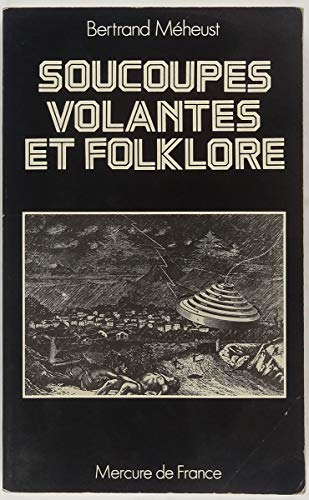
Soucoupes volantes et folklore
Bertrand Méheust's 1985 Companion to Science-fiction et soucoupes volantes — Abduction Accounts as Living Folklore
Find on Amazon →As an Amazon Associate, OverClassified may earn from qualifying purchases made through this link, at no extra cost to you.
Why This Is Essential Reading
A hundred pages, and worth more than most books ten times the length. Bertrand Méheust reads abduction accounts as folklore being lived in the present tense, and the two ideas he builds on — that the reported phenomenon is mimetic, and that its imagery adapts to the culture doing the reporting — were correct, were early, and are now so widely assumed that almost nobody remembers where they came from. The context is what makes it land: by 1985 the abduction corpus had been elicited overwhelmingly under hypnotic regression, by a small number of investigators working from shared assumptions, and the field was treating the resulting resemblance between accounts as corroboration. Méheust named the mechanism instead. The limitations are honest ones: it is an essay rather than a study, it operates on patterns rather than cases, and the psycho-social framework it belongs to absorbs both similarity and difference in a way that makes it hard to falsify — and it does not touch the physical-trace cases at all. Read it with its 1978 companion Science-fiction et soucoupes volantes, with Passport to Magonia, and with Carrouges' 1963 study, which asked the adjacent question twenty-two years earlier.
Related Cases & Theories
Sources Cited
- Méheust, Bertrand. Soucoupes volantes et folklore. Mercure de France, Paris, 13 March 1985. 102 pp. ISBN-10 2715202156 / ISBN-13 9782715202153. amazon.com
- Amazon France listing for the same edition — the source for the reader assessments describing the book's emphasis on the mimetic effect and on the phenomenon's adaptation to surrounding cultures, and for its characterisation as an essential complement to Science-fiction et soucoupes volantes. amazon.fr
- Decitre catalogue record, ISBN 9782715202153 — independent French bookseller record confirming publisher, date and extent. decitre.fr
- Librairie Mollat author page, Bertrand Méheust — independent French bibliographic record of his published work. mollat.com
- Wikipedia, “Bertrand Méheust” — the source for his birth on 12 July 1947, his work on parapsychology, his career as a philosophy teacher, his 1997 sociology doctorate from the Université Paris 1 Panthéon-Sorbonne on mesmerism and animal magnetism, the two-volume Somnambulisme et médiumnité (1999), his membership of the Institut Métapsychique International's steering committee, his childhood formation by Jules Verne and the 1950s French sightings, and the 1971 meeting with Aimé Michel that decided him on philosophy. en.wikipedia.org
- Wikidata entry Q2899639, Bertrand Méheust — structured biographical record. wikidata.org
- Persée author authority record for Bertrand Méheust — the French academic publishing portal's own entry, confirming his standing as a published scholar. persee.fr
- Babelio author page, Bertrand Méheust — independent French bibliographic listing across his output. babelio.com
- Méheust, Bertrand. En soucoupes volantes: vers une ethnologie des récits d'enlèvements, ISBN 290270271X — the author's later, explicitly ethnographic treatment of the abduction accounts. amazon.com
- Méheust, Bertrand. Science-fiction et soucoupes volantes: Une réalité mythico-physique, Terre de Brume reissue, ISBN 2843623529 — the 1978 companion volume this book accompanies. amazon.fr
- Internet Speculative Fiction Database, summary bibliography for Bertrand Méheust — independent bibliographic record. isfdb.org
- Wikipedia, “Institut Métapsychique International” — the French research body, founded 1919, on whose steering committee Méheust sits. en.wikipedia.org
- Wikipedia, “Franz Mesmer” — background on animal magnetism, the subject of Méheust's doctoral work and the basis of his academic standing. en.wikipedia.org
- OverClassified, The Great French UFO Wave of 1954 — this site's case file, the source for the wave's chronology, the orthoteny controversy, and this book's 1985 place in the wave's historiography.
- OverClassified, Psycho-Social Hypothesis — this site's theory file on the framework Méheust helped build with Michel Monnerie and Thierry Pinvidic after 1977.
- OverClassified, Passport to Magonia — the work this site's own research credits, with Keel's Operation Trojan Horse, as having cleared the ground the French psycho-social framework was built on.
Have corrections, additional research, or peer-reviewed sources? Help improve this entry.
Suggest an Edit