
Les Apparitions de Martiens
Michel Carrouges' 1963 Study of the 1954 Humanoid Reports — and of How Witnesses Correct Their Own Illusions
Core Thesis
In the autumn of 1954 France reported more close encounters with humanoid figures than any country had before or has since, and almost nobody with serious analytical training went near them. Michel Carrouges did. A Catholic literary critic and scholar of surrealism, best known for coining the critical term les machines célibataires, he spent 287 pages taking the humanoid reports apart — not to prove or disprove them, but to test them against each other for internal consistency, and to ask what a body of testimony of this kind is actually worth. The book's structure gives the game away and is its lasting contribution. Part one classifies what was reported. Part two, titled Valeur des témoignages, examines whether the witnesses were hallucinating, deluded or mistaken — and then, remarkably for 1963, devotes matched sections to illusions running in favour of saucers and illusions running against them. Part three weighs four hypotheses about what the objects were, and one, dryly, about where they came from.
About the Author
Michel Carrouges was the pen name of Louis Joseph Couturier, born in Poitiers on 22 February 1910 and died in the 15th arrondissement of Paris on 13 June 1988. He was a French writer of some standing, and the standing is worth establishing because it is unusual in this literature.
His work sits at the intersection of surrealism, modern myth and mystical experience. In 1954 he published Les Machines célibataires, taking the phrase from Marcel Duchamp's name for the lower half of the Large Glass and turning it into a critical concept — the self-contained, purposeless mechanism — that has been in circulation in art and literary criticism ever since. He also wrote La Mystique du Surhomme and André Breton et les données fondamentales du surréalisme for Gallimard, Kafka contre Kafka for Plon, Éluard et Claudel for Seuil, biographies of Charles de Foucauld and of Père Jacques, and two novels.
That is the profile of a serious literary intellectual, and it explains what this book is and is not. Carrouges came to the 1954 reports the way he came to Duchamp and Breton: as a body of material with recurring motifs, internal logic and possible sources, to be read closely. He was not an investigator in the field sense, had no scientific training, and made no pretence of either.
His entry into the subject was the wave itself. Something was invading the skies of France, the United States and elsewhere, and it presented as a modern myth in formation — precisely the object he had spent his career studying. He wrote this book, in his own account, to try to decipher the testimonies and to bring out their convergences and their inconsistencies. Those two words, taken together, describe an unusually balanced programme.
He was a participant in the French UFO research milieu of the period, which was small, literate and centred on Paris. That world's dominant figure was Aimé Michel, whose 1958 Mystérieux objets célestes proposed the “orthoteny” alignments that dominated European discussion for a decade before being statistically demolished.
Carrouges' later years were difficult: early blindness ended his regular literary activity. He published nothing further of consequence on this subject, and the book stands alone in his bibliography — a single, sustained engagement by a first-rate critical mind, and then silence.
Historical Context & Origins
The autumn of 1954 remains the densest concentration of close-encounter reports in the history of the subject. Between late August and November, France produced hundreds of sightings, with the sharpest cluster between mid-September and late October, and — the part that made it unlike any earlier wave — dozens of reports involving figures seen on or beside a landed object.
The state had no machinery for any of this. The gendarmerie and, near sensitive sites, the DST handled individual reports as ordinary local matters, taking statements and occasionally inspecting a site. There was no central office, no scientific review, no mechanism for cross-referencing between departments. That vacuum would not be filled until CNES created GEPAN in March 1977, twenty-three years later.
So the wave was investigated, insofar as it was investigated, by writers. Aimé Michel compiled the cases and published Mystérieux objets célestes in 1958, proposing that the sightings of a single day fell along straight lines — orthoteny. It was elegant, it was European ufology's central claim for a decade, and by the mid-1960s the astronomer Donald Menzel had shown in Flying Saucer Review that the alignments were statistically indistinguishable from chance. Jacques Vallée and Pierre Guérin extended the critique in the later 1960s.
Carrouges published in 1963, between Michel's compilation and Menzel's refutation, and he chose a different target. Michel's project was geometric; this one is testimonial. The question is not where the reports fall on a map but whether the accounts hold together when set against one another.
The framing of 1954 also has to be understood in period terms. The default hypothesis was not extraterrestrial in the modern sense but Martian, and the book's title says so. The idea that the objects were terrestrial secret weapons was equally live, and Carrouges devotes a full section to it — with two arguments against it that have aged extremely well.
The wave's aftermath produced a second literature two decades later, when the sociologist Bertrand Méheust approached the same reports as folklore — see Soucoupes volantes et folklore. Carrouges' book is the missing middle term between Michel's compilation and Méheust's cultural reading.
Core Arguments & Key Concepts
The humanoid reports are the wave's real subject. Carrouges organises around the occupant cases rather than the lights, and part one classifies the pilots directly: those of ordinary human stature, the small ones, and a residual category he calls cas hétéroclites — the ones that fit nothing.
Physical effects are the testable layer. A full chapter enumerates them: auditory effects, paralysis, heat, tangible contact, photographic effects, falls of dissolving filaments, and ground impressions. Setting these out as a checklist in 1963 is a genuinely methodological move.
Testimony has a value, and the value can be examined. The book's second part is given entirely to this. It works through material illusions — flying objects, objects on the ground, and what he calls Martiens postiches, false Martians — and then asks whether the witnesses were hallucinating, deluded, or simply mistaken in perception.
Bias runs in both directions, and both must be catalogued. The book's most striking single feature. Its section on witnesses correcting their own illusions has two matched sub-parts: the reduction of prosoucoupiques illusions — those tending toward saucers — and the reduction of antisoucoupiques illusions, those tending against them. In 1963 almost nobody in this field acknowledged that skeptical bias was a form of bias at all.
A mass event generates its own pseudo-critical illusions. A related and unusually sophisticated point: the sheer scale of the wave produced not only credulous distortions but spurious debunkings, and both are artefacts of the event rather than facts about the objects.
Testimony is conditioned. The section closing part two. What a witness reports is shaped by what they have already read, heard and been asked — the insight that would become central to the field twenty years later.
Four hypotheses about what the objects are. Part three sets them out squarely: natural meteors, erratic by-products of local industry, a symptom-product of a secret weapon, and unknown craft.
The secret-weapon hypothesis fails on two structural grounds. The book's sharpest reasoning, and the part most worth reading today. A secret weapon is inseparable from the notion of a guarded enclosure — secret devices are tested inside controlled perimeters, not over French villages. And a machine is inseparable from the notion of accident — anything flown in quantity crashes, and crashes leave debris, casualties and paperwork.
Key Cases & Evidence Discussed
The 1954 French wave. The book's entire subject: hundreds of sightings between late August and November 1954, with an unprecedented concentration of close-encounter and occupant reports.
The Quarouble encounter, 10 September 1954. The wave's defining case, and this site's own file's focus: Marius Dewilde, a metalworker at Onnaing, reported an object on the railway line beside his house and two small figures, and was interviewed within about a day by gendarmes and by the DST. Carrouges' study of the humanoid reports is centrally concerned with it.
Pilots of ordinary human stature. One of the three occupant categories part one classifies — the reports describing figures of normal size, which are commoner in the 1954 record than the popular memory of it allows.
The small pilots. The second category, and the one that became the dominant image of the wave and eventually of the phenomenon generally.
Cas hétéroclites. Carrouges' third category: the encounters that fit neither pattern. Retaining a residual class rather than forcing every report into a scheme is a small but real methodological virtue.
Falls of dissolving filaments. The “angel hair” reports, given their own section among the physical effects — a genuinely trans-national feature of 1950s waves and one of the few with a claimed material residue.
Ground impressions. Landing traces, the class of evidence that later became a research programme in its own right; see Physical Traces Associated with UFO Sightings.
The Martian hypothesis. Part three's closing section and the book's title. In 1963 the extraterrestrial hypothesis in its European form was still specifically Martian, and Carrouges treats it as one candidate among several rather than as a destination.
The secret-weapon hypothesis. Examined at length and rejected on the guarded-enclosure and inevitable-accident arguments — reasoning that applies just as forcefully to modern versions of the claim; compare Man-Made UFOs.
Critical Reception & Controversies
The book has no critical literature attached to it in any language this site could locate, and it has never been translated into English. It is a 287-page French monograph from 1963, long out of print, held in a handful of university libraries and circulating second-hand at modest prices. Its author is remembered in French letters for Les Machines célibataires, not for this.
Within French ufology it has a quiet, durable standing as the serious contemporary treatment of the 1954 humanoid reports — the book people cite when they want something from the period that is neither Michel's geometry nor journalism. This site's own 1954 wave file lists it in its timeline for exactly that reason.
The substantive limitations are those of its moment and are worth stating plainly. Carrouges was working entirely from reports gathered by others — press accounts, gendarmerie statements, the compilations then circulating — with no capacity to re-interview, verify a site, or check a witness's account against a contemporaneous record. Everything downstream of the source material inherits its quality, and the quality was uneven.
The psychological framework has dated. His three-way question — hallucination, delusion, or perceptual error — was a reasonable set of options in 1963 and is now known to be incomplete. The mechanisms that dominate modern discussion of testimony, notably reconstructive memory and the generative effects of suggestive questioning, were not available to him.
The book is also, in the end, inconclusive by design, and some readers will find that unsatisfying. It concludes with propositions finales rather than a verdict. A study whose whole method is testing accounts against one another cannot deliver a finding stronger than its material supports, and Carrouges does not pretend otherwise.
There is one further limitation worth naming because it is invisible from outside the French record: the 1954 wave contains at least one confirmed hoax, and its case base has never been systematically re-examined with modern standards. A 1963 analysis of internal consistency across that corpus is testing the consistency of a corpus that was not itself audited.
Against all of that, the achievement stands. The matched treatment of pro-saucer and anti-saucer illusions is, so far as this site is aware, without precedent in 1963. So is the observation that a mass event generates spurious debunkings as well as spurious sightings. And the two arguments against the secret-weapon hypothesis — the guarded enclosure and the inevitability of accident — are as good today, applied to any nation's claimed exotic aircraft, as they were sixty years ago. A literary critic with no scientific training reasoned his way to several things the field would take decades to formalise.
Influence & Legacy
Its most direct legacy is as the missing middle term in the French treatment of 1954. Michel compiled the wave and drew lines through it; Carrouges asked what the accounts were worth; Méheust, twenty-two years later, asked where their imagery came from. Read in sequence the three books describe an intellectual trajectory that the Anglophone literature took much longer to travel.
The occupant reports Carrouges classified became, through the humanoid catalogues of the following decades, one of the field's standing research objects — see Flying Saucer Occupants and The Humanoids. His three-part typology, with its explicit residual category, is a recognisable ancestor of that work.
The prosoucoupiques / antisoucoupiques pairing is the idea most worth reviving. Sixty years on, the field still overwhelmingly treats credulity as the bias requiring correction and skepticism as the corrected state. Carrouges treated both as distortions to be measured, and did it before either side had a vocabulary for the point.
His argument against the secret-weapon hypothesis has gone on doing work he never saw. Every generation of this subject produces a new terrestrial-technology explanation, and every one of them runs into the two objections he set out on pages 251 and 254: exotic machines are tested inside guarded perimeters, and machines flown in quantity crash.
The book's obscurity is itself instructive. A first-rate critical intelligence spent a full monograph on the best-documented close-encounter wave in history, and the result is untranslated, unreviewed and largely unread outside France. A great deal of what this field believes it does not know is simply material it has not read.
The Book
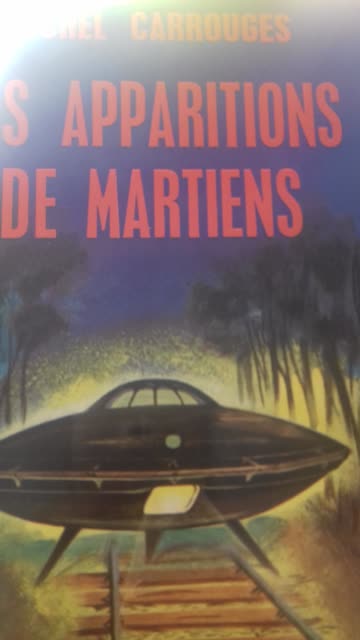
Les Apparitions de Martiens
Michel Carrouges' 1963 Study of the 1954 Humanoid Reports — and of How Witnesses Correct Their Own Illusions
Find on Amazon →As an Amazon Associate, OverClassified may earn from qualifying purchases made through this link, at no extra cost to you.
Why This Is Essential Reading
Read it for its second part, which is sixty years ahead of its shelf. Les Apparitions de Martiens is Michel Carrouges — the pen name of Louis Couturier, the critic who gave les machines célibataires to twentieth-century criticism — spending 287 Fayard pages on the humanoid encounters of the 1954 French wave, including Quarouble. Part one classifies the occupants and the physical effects; part three weighs four hypotheses and rejects the secret-weapon one on two arguments that still hold — secret devices are tested inside guarded perimeters, and machines flown in quantity crash. But the reason to find a copy is part two, Valeur des témoignages, which asks whether witnesses were hallucinating, deluded or simply mistaken, and then gives matched sections to illusions running toward saucers and illusions running against them. In 1963 essentially nobody in this field conceded that skeptical bias was bias. The limitations are real: no field access, a dated psychological vocabulary, an un-audited case base and no verdict at the end. Read it with Michel's compilation, which it follows, and Méheust's folklore study, which follows it.
Related Cases & Theories
Sources Cited
- Carrouges, Michel. Les Apparitions de Martiens. Librairie Arthème Fayard, 18 rue du Saint-Gothard, Paris XIV, 1963. 287 pp., with maps and bibliography. Amazon ASIN B001EL998S. amazon.com
- AbeBooks first-edition listing (inventory 22402999419) — the source for the 1963 Fayard imprint, the hardcover binding, the dust jacket signed by Henri Dimpre (d. 1971), and the seller photographs of the jacket, the title page and the table of contents from which this article's account of the book's structure and pagination is taken directly. abebooks.com
- AbeBooks France search results for the title — further seller listings confirming the 1963 Fayard edition, the red-orange cloth boards stamped with a flying saucer, and the 287-page extent. abebooks.fr
- Bibliothèque de l'Université Catholique de Lille, catalogue record SYRACUSE 416190 for Les Apparitions de Martiens — an institutional library holding confirming the title's presence in French academic collections (the catalogue's public detail page returns a non-standard session-challenge response to automated requests, so it is cited here without a direct link).
- French Wikipedia, “Michel Carrouges” — the source for the pen name of Louis Joseph Couturier, his birth in Poitiers on 22 February 1910 and death in Paris on 13 June 1988, his surrealist and mystical body of work, the 1954 Les Machines célibataires and its 1976 augmented edition, his interest in flying saucers as a modern myth in formation, his stated purpose in writing this book, and the early blindness that ended his literary activity. fr.wikipedia.org
- Spiteri, Richard. “Michel Carrouges: vers un surréalisme analogue” (2008), University of Malta open-access repository — peer-reviewed academic treatment of Carrouges' place in surrealist criticism. um.edu.mt
- Bibliothèque nationale de France, “Sélection de dons faits à la BnF en 2011” — record of Carrouges material entering the French national library's collections. bnf.fr
- Babelio author page, Michel Carrouges — independent French bibliographic record of his published work. babelio.com
- Michel Carrouges bibliography (dedicated author site) — the fuller list of his Gallimard, Plon, Seuil and Cerf titles. michelcarrouges.blogspot.com
- Patrick Gross, Les OVNIS vus de près — the long-running French case-by-case archive of the 1954 wave, which cites Carrouges among its period sources. ufologie.patrickgross.org
- GEIPAN (CNES), Son histoire — the French state study group's own institutional history, covering the twenty-three-year gap between the 1954 wave and the creation of GEPAN in March 1977. geipan.fr
- Wikipedia, “Marius Dewilde” — the Quarouble witness whose 10 September 1954 encounter is the wave's defining occupant case. en.wikipedia.org
- Wikipedia, “The Bride Stripped Bare by Her Bachelors, Even” — Duchamp's Large Glass, whose lower half gave Carrouges the term les machines célibataires. en.wikipedia.org
- Wikipedia, “GEIPAN” — the French state study group created in 1977, twenty-three years after the wave, and the institutional vacuum this book was written into. en.wikipedia.org
- OverClassified, The Great French UFO Wave of 1954 — this site's case file, the source for the wave's chronology, the gendarmerie and DST handling of reports, the orthoteny controversy and its statistical refutation, and this book's place in the wave's own historiography.
Have corrections, additional research, or peer-reviewed sources? Help improve this entry.
Suggest an Edit