
Flying Saucer Occupants
Core Thesis
Flying Saucer Occupants is the Aerial Phenomena Research Organization's 1967 casebook of entity and occupant reports, credited on this site's own citing case files to Coral and Jim Lorenzen, APRO's co-founders, together with Dr. Olavo Fontes, the Brazilian physician who personally examined farmer Antônio Vilas-Boas, and João Martins, the journalist who first brought Vilas-Boas's account to public attention. Published a decade before the term "close encounter" entered common usage, the book gathers dozens of reports of landed craft and their occupants from around the world, organized as a reference catalog rather than a single narrative argument — among them the book's most significant entry, the 1957 Vilas-Boas case now recognized as the foundational text of the modern abduction narrative, and a far more modest 1965 sighting by a Minnesota radio announcer that APRO's own director personally cross-checked by telephone with the local sheriff — a pairing that captures both the best and the most contested ends of what a mid-1960s occupant casebook could actually document.
About the Author
Coral Lorenzen (1925–1988) and Jim Lorenzen (born Leslie James Lorenzen, 1922–1986, in Grand Meadow, Minnesota) co-founded the Aerial Phenomena Research Organization in Sturgeon Bay, Wisconsin, in January 1952, building what this site's own research treats as the first UFO research organization to maintain a network of volunteer national representatives worldwide. Jim, trained as an electronics technician, brought a technical, cross-checking investigative style to the organization; among APRO's representatives was Dr. Olavo Fontes in Brazil, whose casework this book incorporates directly.
Dr. Olavo T. Fontes (1924–1968) was a Brazilian physician and professor at Rio de Janeiro's National School of Medicine whose academic post and private gastroenterology practice gave him the flexible schedule to pursue UFO investigations alongside his medical career. As APRO's Brazilian representative, Fontes took custody of the Ubatuba magnesium fragments in September 1957 and, within weeks, opened APRO's investigation into farmer Antônio Vilas-Boas's claimed October 1957 encounter, examining him on February 22, 1958 and documenting skin lesions and other symptoms he judged consistent with mild radiation exposure — the clinical findings this book's Vilas-Boas chapter draws on most directly. Fontes died in 1968, the year before the case's fuller English-language documentation appeared in the anthology The Humanoids.
João Martins was a journalist at Rio de Janeiro's illustrated weekly O Cruzeiro, one of Brazil's largest-circulation magazines, where he ran regular features on UFO sightings during the 1950s saucer wave. It was Vilas-Boas's own reading of Martins's reporting that led him to write to Martins directly in November 1957, enclosing a wood model of the craft he described; Martins in turn brought Vilas-Boas to Rio de Janeiro in February 1958 to meet Dr. Fontes, making Martins the connective figure between the case's origin and its first formal medical documentation.
With Coral, Jim Lorenzen went on to co-author four books on UFO occupant and abduction reports, culminating in 1977's Abducted!: Confrontations with Beings from Outer Space, already a separate essential-reading entry on this site, drawn from APRO's own real-time investigations of the Carl Higdon, Travis Walton, and Stanford, Kentucky cases. Jim also personally led APRO's field investigation into Air Force Sergeant Charles Moody's 1975 Alamogordo sighting and was, as APRO co-director, at the center of the organization's public rivalry with Ground Saucer Watch over the Travis Walton case's initially withheld polygraph result — episodes that came a full decade after this 1967 book but that grew directly out of the same investigative apparatus it documents in its earlier, formative stage. This 1967 book, a decade before Abducted!, represents the same organization's foundational cataloging work before the abduction narrative had a name of its own.
The book's continued availability today rests on a 2017 New Saucerian Books reprint, which this article's own rating data is drawn from since the original 1967 Signet paperback predates the ISBN system and carries no active, image-bearing Amazon listing of its own; this article's cover image instead comes from a Biblio.com marketplace photograph of an actual surviving copy of the original 1967 printing, matching the edition this site's own case files cite. The 2017 reprint edition adds bonus material not present in the original 1967 printing: a chapter on the psychological implications of UFO contact by University of Wyoming professor R. Leo Sprinkle, Ph.D. — though the original 1967 cover itself already advertises an introduction by Utah State University professor Frank Salisbury, Ph.D., meaning Salisbury's contribution was present from the first printing while Sprinkle's was added later. This article focuses on the original 1967 content this site's own case files actually cite, and discloses the reprint's added material honestly as a later publisher's addition rather than treating it as part of the Lorenzens' own original text.
Historical Context & Origins
Signet published Flying Saucer Occupants in 1967, at the tail end of a decade-long American "flying saucer" boom and only a year after the U.S. Air Force commissioned the Condon Committee's university-led review of UFO evidence — a period of intense public and institutional attention to the subject that made a mass-market paperback casebook of occupant reports commercially viable in a way it might not have been a decade earlier.
The book's inclusion of the Antônio Vilas-Boas case gives it real documentary significance beyond its general survey format: this site's own case file's timeline shows the case existed only in scattered Portuguese-language sources for its first seven years — a brief 1962 bulletin summary from the Sociedade Brasileira de Estudos sobre Discos Voadores, edited by Dr. Walter Bühler — before Gordon Creighton's early-1965 English-language account in Flying Saucer Review first introduced it internationally. This 1967 book followed barely two years later, making it one of the very first English-language books, not just magazine articles, to carry the case to a general readership — two full years before Creighton's fuller translation and Fontes's supporting commentary were collected in the 1969 anthology The Humanoids, which would become the case's standard English-language reference text.
The book's back-cover framing — describing its contents as reports from "hundreds of eyewitnesses whose reliability has been thoroughly checked by psychiatric and scientific experts" — reflects APRO's own self-positioning in the mid-1960s as a rigorous, credentialed counterweight to both government dismissal (Project Blue Book's official skepticism) and the contactee movement's more overtly religious or utopian claims associated with figures like George Adamski, whose 1952 Venusian-contact narrative had already reached and influenced Brazilian readers by the time of the Vilas-Boas case.
APRO's own institutional identity in 1967 is worth situating against its principal American rival, the National Investigations Committee on Aerial Phenomena (NICAP), which by the mid-1960s had built a reputation resting more heavily on retired military and government contacts and congressional lobbying than on the kind of direct, sustained international representative network the Lorenzens built through figures like Fontes in Brazil. This book's dual-country case selection — a Brazilian farmer and a Minnesota radio announcer, gathered through APRO's own channels rather than syndicated wholesale from newspaper wire coverage — reflects that structural difference directly, and represents one of the clearer surviving demonstrations of what the Lorenzens' representative-network model could produce that a Washington-focused organization's own approach could not as easily replicate.
Core Arguments & Key Concepts
The book's organizing argument is that occupant and entity reports, cataloged with enough volume and geographic spread, reveal a consistent underlying pattern worth taking seriously as a body of evidence rather than dismissing case-by-case as isolated hoaxes or misidentifications. Placing a Brazilian farmer's account alongside a Minnesota radio announcer's sighting in the same volume is itself an argument: structurally similar reports from witnesses with no plausible connection to each other, in different countries and different social contexts, are harder to explain as a single shared hoax or cultural script.
A second theme, consistent with Jim Lorenzen's technical background, is procedural cross-checking as the basis for including a case at all: this site's own Long Prairie case file documents that Coral Lorenzen personally telephoned Sheriff James Bain to verify witness Jerry Townsend's sobriety, reputation, and visible distress at the time of his report — a direct, named investigative step distinct from simply reprinting a witness's own account or newspaper coverage of it.
A third theme is treating physical or medical corroboration as more significant than testimony alone wherever it exists: the book's Vilas-Boas chapter leans on Dr. Fontes's own clinical examination and documented skin lesions specifically because they represent a category of evidence — an outside professional's contemporaneous physical finding — distinct from and, in the authors' framing, more persuasive than the witness's own uncorroborated narrative of what happened aboard the craft.
A fourth theme, visible in retrospect from this site's own research rather than stated explicitly by the authors, is an evidentiary optimism the book's own most significant case would later complicate: this site's own dedicated Vilas-Boas case file finds the case's specific narrative details — a sexually aggressive humanoid female, symbolic markings, a message about a hybrid child — track unusually closely with contactee literature already circulating in Brazil at the time, a Psycho-Social Hypothesis reading the 1967 book's more credulous framing does not weigh.
A fifth theme, evident from the book's inclusion of two structurally very different cases in the same volume, is a working definition of "occupant report" broad enough to span a multi-hour physiological abduction narrative on one end and a brief, three-minute standoff with no missing time or claimed physical contact on the other. This site's own research treats that breadth as a genuine methodological choice rather than an inconsistency: both cases share a landed or hovering craft, directly observed humanoid entities, and a credentialed third-party investigator (Fontes in one case, Sheriff Bain in the other) willing to attach their own professional judgment to the witness's character, even though the two accounts otherwise differ enormously in claimed content and evidentiary weight.
Key Cases & Evidence Discussed
The Antônio Vilas-Boas Abduction (Case File #153, October 15–16, 1957) near São Francisco de Sales, Minas Gerais, near the São Paulo border, is the book's most historically significant entry and, per this site's own research, the foundational text of the modern abduction narrative. Vilas-Boas, a 23-year-old farmer from an established landholding family, reported an egg-shaped craft landing near him while plowing at night; being seized by a roughly five-foot-tall humanoid in grey coveralls and dragged aboard; being stripped, coated in a gel-like liquid, and having blood drawn from his chin; and, following isolation in a gas-filled chamber, a sexual encounter with a female humanoid occupant before his release roughly four hours later. He developed nausea, headaches, and hardened skin lesions in the following weeks. Having read journalist João Martins's UFO reporting in O Cruzeiro, Vilas-Boas wrote to Martins in November 1957; Martins brought him to Rio de Janeiro in February 1958 to meet Dr. Olavo Fontes, who examined him and documented the skin lesions as consistent with mild radiation exposure. Unable to photograph the craft, Vilas-Boas later carved a small wood model of it from memory and separately reproduced by hand a set of angular red symbols he said marked an interior doorway; investigators compared the marks to unidentified script without reaching any firm conclusion, and this site's own case file treats both artifacts as records of what he described at the time rather than independent evidence that it occurred. Vilas-Boas maintained the same account for the rest of his life, going on to practice law, marry, and raise four children before his death in Uberaba, Minas Gerais, in January 1991.
The Long Prairie sighting (Case File #026, October 23, 1965) in Long Prairie, Minnesota is a far more modest entry, involving a single direct witness: 19-year-old local radio announcer James "Jerry" Townsend of station KEYL, a Bible-camp counselor that same summer with no history of practical jokes. After his car stalled on Highway 27, Townsend reported a rocket-shaped, lighted object at close range and three entities that withdrew after a roughly three-minute standoff before the object rose vertically, silently, and without any visible exhaust to an estimated quarter-mile altitude before simply going dark. His car's engine and headlights, dead throughout the encounter, came back on by themselves the instant the object departed. This site's own case file records that Coral Lorenzen personally telephoned Sheriff James Bain of Todd County shortly after the sighting became public, and that Bain vouched personally for Townsend's sobriety, reputation, and visible fright at the time of his report — a direct investigative step this site's own research treats as a genuine, checkable piece of APRO's methodology rather than an unverifiable claim of due diligence. Bain and Officer Lavern Lubitz had accompanied Townsend back to the site that same night and found three narrow, parallel strips of dark, oily residue on the roadway — the case's only physical trace evidence, never properly photographed, sampled, or preserved before ordinary traffic erased it. The U.S. Air Force's Project Blue Book logged the sighting as case number 10035, closing it with the catch-all "psychological" classification; consultant J. Allen Hynek received written correspondence about the case but never traveled to Minnesota to conduct a field investigation of his own, a gap he would later cite as characteristic of Blue Book's underresourced handling of civilian reports generally in his 1977 book The Hynek UFO Report. Journalist John Keel profiled the case for True: The Man's Magazine in 1967, coining the "Tin Can" nickname that stuck in popular retellings, the same year this book incorporated its own detailed account; Jacques Vallée catalogued it in his 1969 survey Passport to Magonia, and Jerome Clark gave it a full entry in his 2000 encyclopedia Extraordinary Encounters. Fifty years later, in July 2015, Long Prairie itself hosted a UFO-themed community event built around the case, a small but telling sign of how thoroughly the story had become part of local identity.
Critical Reception & Controversies
On Amazon, the 2017 New Saucerian Books reprint edition (ISBN 9781546355267) carries a 4.5-out-of-5 average from 9 ratings (checked August 2026). The original 1967 Signet mass-market paperback predates the modern ISBN system and, per this site's research, has no active, image-bearing Amazon listing of its own, consistent with the Book Cover Sourcing Protocol's handling of pre-ISBN vintage paperbacks elsewhere in this library.
On Goodreads, this specific edition's page carries a 3.56-out-of-5 average from 16 ratings and 6 written reviews (checked August 2026); Goodreads' own aggregated cross-edition figure for the work as a whole runs somewhat higher, at roughly 3.75 from a combined 64 ratings across all editions — both figures presented honestly here rather than citing only the more flattering one. Reviewer John Dybowski called it "a solid work here," adding he had "never read any of the Lorenzen's work before" despite decades of encountering their name in the field and that he would "definitely be purchasing more of their books." Another reviewer wrote that Coral and Jim Lorenzen's books, "although written in the 50's and 60's are still excellent reading today," while a third recalled finding the book "in an antique store" and being surprised by "stories here I had never heard."
This site's own research also discloses a specific tension the 1967 book itself does not address: its most significant case, Vilas-Boas, is treated by this site's own dedicated case file as scoring highest on the Psycho-Social Hypothesis rather than the Extraterrestrial Hypothesis, precisely because its most distinctive narrative details — the sexually aggressive humanoid female, symbolic markings, a message about a hybrid child — track unusually closely with contactee literature already circulating in Brazil via João Martins's own O Cruzeiro reporting and George Adamski's widely translated contactee narrative. This book's own 1967 framing, written before that comparative folklore analysis had been done, presents the case with more evidentiary confidence than this site's own later, more skeptically weighted research finds fully warranted — a real limitation of a decade-old primary casebook, disclosed here rather than glossed over. Researcher Peter Rogerson made the specific comparison explicit, noting that Vilas-Boas's physical description of the female occupant's eyes "suggests a derivation from Adamski," who had described his own claimed Venusian visitor's eyes in similar terms in the widely translated 1953 book Flying Saucers Have Landed — a named, checkable textual parallel this site's own research treats as genuinely significant rather than circumstantial.
Influence & Legacy
The clearest evidence of this book's lasting relevance on this site specifically is its citation record: two case files, an ocean apart in geography and separated by eight years in time, cite the Lorenzens' work directly, and one of them — Vilas-Boas — is, per this site's own research, the foundational case of the entire modern abduction narrative that would come to dominate American ufology within the following two decades.
As one of the earliest English-language book treatments of the Vilas-Boas case, published two years before the more complete The Humanoids anthology, this book played a real, checkable role in carrying the case from a scattered Portuguese-language record into the wider English-speaking ufological literature, a full eight years before the case would be positioned by later writers as the direct forerunner of the far more famous 1961 Betty and Barney Hill case, itself not widely publicized in book form until John Fuller's 1966 The Interrupted Journey.
Institutionally, the book represents APRO's methodology in its most mature pre-abduction-era form: a network of credentialed national representatives (Fontes in Brazil), direct witness cross-checking by the organization's own directors (Coral Lorenzen's Long Prairie phone call), and a deliberate framing around psychiatric and scientific vetting rather than uncritical acceptance — the same institutional approach that would carry forward, a decade later, into the Lorenzens' more famous Abducted!.
Both authors died before ufology's next major documentary wave (Jim in 1986, Coral in 1988), and this book's continued availability today rests entirely on the 2017 New Saucerian Books reprint — without which, per this site's own research, the original 1967 Signet paperback would likely have remained accessible only through the secondhand and collector's market represented by the AbeBooks, Biblio, and eBay listings this site's research located for the original printing.
The Long Prairie case's own popular afterlife traces a similar multi-decade arc running parallel to Vilas-Boas's: from this book's 1967 treatment, through Jacques Vallée's 1969 Passport to Magonia catalog entry and Jerome Clark's full 2000 encyclopedia entry, to a 2015 fiftieth-anniversary community event in the town itself. That a single Minnesota radio announcer's three-minute roadside encounter generated a continuous fifty-year documentary record, anchored at its earliest point by this book, is itself a measure of how much a credentialed organization's early published attention could do to keep a modest regional case from disappearing into local newspaper microfilm.
The Book
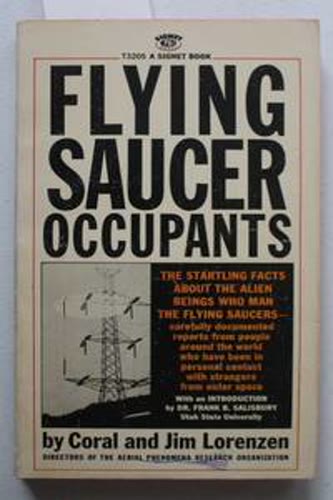
Flying Saucer Occupants
Find on Amazon →As an Amazon Associate, OverClassified may earn from qualifying purchases made through this link, at no extra cost to you.
Why This Is Essential Reading
Flying Saucer Occupants earns its place on this list as the first English-language book to carry the Antônio Vilas-Boas case — now recognized as the foundational text of the modern abduction narrative — to a general readership, and as a direct primary record of APRO's own investigative methodology during its most influential decade. Coral and Jim Lorenzen, already established as the co-founders of the first UFO research organization to build a genuine international representative network, assembled a casebook that placed a Brazilian farmer's account alongside a Minnesota radio announcer's more modest sighting, cross-checked in Coral's own words directly with the responding sheriff. Its most significant case is also, per this site's own later and more skeptically weighted research, its most contested: the Vilas-Boas narrative's closest similarities to contactee literature already circulating in Brazil complicate the book's own more credulous 1967 framing, a tension this article discloses rather than smooths over. Read alongside the Lorenzens' own later, more famous Abducted! as the earlier half of a career-spanning occupant-report project, this book is essential because it preserves, in close to real time, the first substantial English-language documentation of the case that would define an entire subsequent genre of UFO literature.
Related Cases & Theories
Essential Viewing
Sources Cited
- Lorenzen, Coral & Jim, with Olavo Fontes, M.D. and João Martins. Flying Saucer Occupants. Signet, 1967 (T3205, cited here).
- "Flying Saucer Occupants: Carefully Documented Reports..." Amazon.com (2017 New Saucerian Books reprint, ISBN 9781546355267, rating 4.5/5 from 9 ratings, checked August 2026). amazon.com
- "Flying saucer occupants." Goodreads (this edition: rating 3.56/5, 16 ratings, 6 written reviews quoted; work-level aggregate approx. 3.75/5 from 64 ratings across all editions). goodreads.com
- "Flying saucer occupants." Internet Archive (scanned original 1967 edition, page count and physical description). archive.org
- "Flying Saucer Occupants" by Coral Lorenzen. Biblio.com (marketplace listing photograph of an original 1967 Signet paperback copy, T3205, used as this article's cover image; confirms Frank Salisbury's introduction was present in the first printing). biblio.com
- This site's own resources library: Full Reading List, where this exact 1967 edition is cited across 2 separate case-file pages.
- This site's own key-figures entry: Coral Lorenzen, for her full biography and site-wide case connections.
- This site's own key-figures entry: Jim Lorenzen, for his full biography and site-wide case connections.
- This site's own key-figures entry: Dr. Olavo T. Fontes, for his role examining Vilas-Boas and his dual role in Brazil's two most significant 1957 UFO cases.
- This site's own case file: Antônio Vilas-Boas Abduction, which documents the case's full timeline and this site's own Psycho-Social Hypothesis weighting.
- This site's own case file: Long Prairie Sighting, which documents Coral Lorenzen's direct telephone cross-check with Sheriff James Bain.
- This site's own essential-reading entry: Abducted!, the Lorenzens' later, more famous 1977 occupant-report casebook this 1967 book directly preceded.
- Creighton, Gordon. "The Amazing Case of Antonio Villas Boas." Flying Saucer Review, Vol. 11, No. 1, Jan–Feb 1965 (first detailed English-language account of the case).
- Bowen, Charles (ed.). The Humanoids: Reports of Landings of Unconventional Aerial Objects and Their Occupants. Henry Regnery Company / Neville Spearman, 1969 (the case's standard later English-language reference text, published two years after this book).
- Hynek, J. Allen. The Hynek UFO Report. Dell, 1977 (Hynek's own retrospective critique of Project Blue Book's handling of the Long Prairie case).
- Vallée, Jacques. Passport to Magonia: From Folklore to Flying Saucers. Henry Regnery Company, 1969 (catalogues the Long Prairie sighting).
- Keel, John A. "Who Was That Six-Inch-High Animated Tin Can?" True: The Man's Magazine, 1967 (contemporaneous popular account of the Long Prairie case, published the same year as this book).
- "Flying saucer occupants." WorldCat (library catalog record for the original 1967 Signet edition, physical description and holding libraries). worldcat.org
- "Antônio Vilas-Boas." Wikipedia (used lightly, for basic biographical orientation only; not relied upon for case facts, which follow this site's own dedicated case file and primary sources above). en.wikipedia.org
- Gross, Patrick. "UFOs at Close Sight: URECAT-000428 — October 23, 1965, Long Prairie, Minnesota, USA, Jerry Townsend." Case file compiling contemporary press and published sources, cited directly by this site's own Long Prairie case file. ufologie.patrickgross.org
Have corrections, additional research, or peer-reviewed sources? Help improve this entry.
Suggest an Edit