
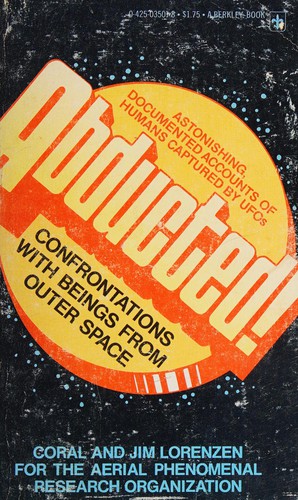
Abducted!
Confrontations with Beings from Outer Space
Core Thesis
Abducted!: Confrontations with Beings from Outer Space is the book-length casebook the directors of the Aerial Phenomena Research Organization (APRO) built from their own real-time field files rather than from correspondence or after-the-fact reconstruction. Coral Lorenzen and Jim Lorenzen had co-founded APRO in January 1952 and spent the following twenty-five years building a worldwide network of volunteer investigators, consulting scientists, and international correspondents dedicated to treating UFO reports as data rather than folklore. By the mid-1970s that network was, for the first time, running directly into a specific and startling sub-pattern: witnesses reporting not just a sighting but a period of unaccounted-for time, followed under hypnosis by detailed accounts of physical examination aboard a craft. Rather than a general occupant catalogue in the mode of their own earlier books, Abducted! narrowed to seven such cases — Carl Higdon, Charles Moody, Sandra Larson, the Casey County, Kentucky trio, an unnamed Maine case, the Travis Walton disappearance, and the cluster of 1973 reports that included Pascagoula — each investigated with the same toolkit: personal interviews, hypnotic regression conducted by cooperating professionals, and polygraph testing where witnesses would consent. The book's real argument was methodological as much as substantive: that a civilian research organization with two decades of case-comparison experience could apply a consistent, semi-scientific process to an emerging phenomenon and let the cross-case pattern speak for itself, four years before Budd Hopkins's Missing Time gave that same pattern its lasting name.
About the Author
Coral Elsie Lightner Lorenzen was born in 1925 in Barron, Wisconsin, and traced her own interest in the subject to a single childhood sighting: at age nine, in the summer of 1934, she watched a silent, glowing, umbrella-shaped object drift across the sky over Barron for roughly twenty seconds before it vanished — an event she later described simply as "the beginning of the mystery of UFOs" for her, thirteen years before the Kenneth Arnold sighting that popularized the term "flying saucer" nationally. She worked afterward as a small-market news correspondent, including a stint with the Green Bay Press-Gazette, a job that gave her both a journalist's interviewing habits and a standing local platform for tracking Wisconsin sighting reports. She married electronics technician Leslie James "Jim" Lorenzen, born January 2, 1922, in Grand Meadow, Minnesota, in 1944; his technical trade background became APRO's methodological backbone, favoring documentation, cross-checking, and consulting expertise over speculation.
The specific trigger for founding a formal organization arrived within months of each other in 1952. The Lorenzens established the Aerial Phenomena Research Organization in January of that year from Sturgeon Bay, Wisconsin — by most accounts the first dedicated civilian UFO research group in the country — and then, on May 21, 1952, Coral was among the crowd of Door County residents who watched a large, silver, ellipsoid object with a glowing red base pass overhead. Working the sighting's geometry themselves, the Lorenzens calculated a craft roughly 780 feet in diameter at an altitude of some 40 miles, a scale the Air Force's standard weather-balloon explanation could not obviously accommodate, and the case became an early proof of concept for the investigative approach APRO would apply for the next thirty-six years. APRO relocated to Alamogordo, New Mexico in 1954 and finally to Tucson, Arizona in 1960, and the Lorenzens maintained working ties to nearby Holloman Air Force Base throughout the New Mexico years, a proximity that fed the organization occasional military-adjacent contacts even as it stayed institutionally independent of any government sponsor.
What distinguished APRO from other UFO groups of its era, and what runs directly through to this book, was its early insistence on a standing scientific advisory board. Atmospheric physicist James E. McDonald of the University of Arizona and UC Berkeley civil-engineering professor James Harder, who served as APRO's research director from 1969 to 1982 and who personally conducted the hypnotic regression sessions in this book's Travis Walton chapter, both lent APRO a credential base that astronomer J. Allen Hynek cited by name when he called APRO and NICAP "the two best civilian UFO groups" active in the period. Coral also corresponded directly with psychiatrist Carl Jung about the subject during this period — a connection this site's own essential-reading entry on Jung's Flying Saucers: A Modern Myth of Things Seen in the Sky situates within the same broader mid-century effort to take the phenomenon seriously as a subject for disciplined inquiry rather than dismiss it outright.
By the time Abducted! appeared in 1977, the Lorenzens had already published four earlier books charting an explicit narrowing of focus: The Great Flying Saucer Hoax (1962), reissued as Flying Saucers: The Startling Evidence of the Invasion from Outer Space in 1966; Flying Saucer Occupants (1967), their first book specifically on humanoid encounter reports; and Encounters with UFO Occupants (1976), a 424-page catalogue of close encounters of the third kind worldwide, complete with an appendix listing CE3 reports from 1947 to 1975. Abducted!, published the following year, dropped the broad catalogue format entirely and isolated just the subset of cases involving missing time and a recovered examination narrative — the same subset Hopkins would later brand "missing time" cases and build an entire investigative career around.
Jim Lorenzen died on August 28, 1986, in Tucson at age 64. Coral continued directing APRO alone for two more years before her own death in Tucson on April 12, 1988; because APRO had never really been separable from the two people who ran it, her death effectively ended the organization after thirty-six years of continuous operation. By the couple's own stated wish, their files were meant to remain publicly accessible at no charge rather than sold or sealed, and in 2023–2024 the surviving APRO archive — roughly thirteen file cabinets and fifty boxes of case correspondence, bulletins, and investigative notes — was transferred to the National UFO Historical Records Center in Rio Rancho, New Mexico, where it now anchors what the Center describes as the largest civilian UFO case-file collection in the country.
Historical Context & Origins
APRO's occupant-report tradition, the direct ancestor of this book, actually predates the abduction narrative's more famous origin point. In February 1958, APRO's Brazilian representative Dr. Olavo Fontes personally examined farmer Antônio Vilas-Boas, whose October 1957 account — forcibly taken aboard a craft and subjected to what he described as a reproductive procedure — is documented on this site's own Antônio Vilas-Boas case file and predates Betty and Barney Hill's better-known 1961 New Hampshire encounter by nearly four years. The Lorenzens themselves took up the Vilas-Boas case directly in their own published work in 1966, meaning that by the time they sat down to write Abducted! a decade later, APRO's institutional experience with occupant and abduction-adjacent reports already stretched back nearly two full decades — not as a sudden 1970s discovery, but as a slow accumulation the organization had been quietly building since before John G. Fuller's 1966 bestseller The Interrupted Journey made the Hill case, and the entire abduction narrative, a mainstream phenomenon.
The mid-1970s specifically handed APRO an unusually dense run of cases in rapid succession: Carl Higdon's October 1974 encounter near Rawlins, Wyoming; Air Force Sergeant Charles Moody's August 1975 sighting near Alamogordo, New Mexico, the town APRO itself had been headquartered in two decades earlier; Sandra Larson's August 1975 North Dakota experience; Travis Walton's November 1975 disappearance in Arizona; and the January 1976 encounter of three Kentucky women that this site's own Stanford, Kentucky case file documents in full. That five-case run within roughly eighteen months is what made a dedicated abduction-specific book, rather than another general occupant catalogue, feel warranted to the Lorenzens by 1977.
It is worth being precise about what this book does and does not cover, since two later, more famous Essential Reading titles are sometimes conflated with it. Abducted!'s table of contents includes a chapter titled "Abduction in Maine," but that chapter documents a separate, now largely unremembered 1976 Maine case rather than the far more famous Allagash Waterway Abduction — the four canoeists' hypnotically recovered memories of their own August 1976 Maine encounter did not surface until 1988–89, more than a decade after this book went to press, when investigator Raymond Fowler opened his own separate case file. Readers looking for the Allagash story specifically will not find it here; what Abducted! offers instead is a snapshot of what APRO's abduction casework looked like in the narrow window between the Higdon investigation and Hopkins's 1981 Missing Time, before the field had a shared vocabulary for what it was looking at.
Core Arguments & Key Concepts
The book's organizing claim was that a real-time investigative process — interviews conducted within weeks or months of the reported event, hypnosis performed by outside professionals rather than by the Lorenzens themselves, and polygraph testing wherever a witness would consent — produced more reliable case material than after-the-fact reconstruction from press clippings or reader mail. This is the specific methodological distinction that separates Abducted! from the correspondence-driven casework Budd Hopkins would build four years later: APRO's cases arrived through the organization's own standing field-investigator network, often within days of the triggering event, rather than through a newspaper article's fan mail.
A second, closely related claim concerned corroboration through independent physical evidence wherever it existed. The Higdon case centered on a deformed 7mm rifle bullet that an APRO-retained metallurgist, alongside a local police examiner, could not explain through any ordinary mechanical process; the book treats that unexplained object as exactly the kind of independent, non-testimonial data point capable of anchoring an otherwise entirely hypnosis-derived narrative.
A third argument concerned the value, and the limits, of polygraph testing. The Lorenzens used polygraph examinations across several of the book's cases as a credibility check on witness sincerity, while explicitly treating a passed test as evidence the witness believed their own account rather than as proof the account was objectively true — a distinction the book's own Travis Walton chapter had to grapple with directly once Philip J. Klass and Ground Saucer Watch's William Spaulding publicly disputed Walton's first, failed McCarthy polygraph result, which James Lorenzen had initially kept from public view.
A fourth claim was comparative: that examining seven geographically and demographically unconnected cases side by side revealed recurring structural details — missing time, a medical or reproductive-focused examination, small humanoid beings, and a returning witness who initially resisted or delayed coming forward — that the Lorenzens argued were too specific and too consistent to be coincidental cultural cross-contamination, particularly for witnesses APRO's investigators judged to have no prior exposure to each other's accounts.
Underlying all of this was APRO's institutional self-conception, carried over from the Lorenzens' three earlier books: that a civilian organization staffed with consulting physicists, engineers, and psychologists could apply genuinely scientific standards to a phenomenon mainstream science had largely refused to examine at all, and that the resulting case files deserved to be judged on that basis rather than dismissed by association with tabloid UFO coverage.
Key Cases & Evidence Discussed
Abducted! is structured around seven real-time investigations rather than a broad historical survey, and several of them are documented in detail on this site's own case-file library. The Carl Higdon / Rawlins Encounter file cites this exact book directly, describing it as "APRO's own contemporaneous compilation of abduction cases, published while the Higdon investigation was still fresh, from the organization that retained the metallurgist who examined his rifle bullet" — among the most direct citations of this title anywhere on the site.
The book's "Casey County abduction" chapter is this site's own Stanford, Kentucky Abduction case file in earlier form: the three witnesses, Louise Smith, Mona Stafford, and Elaine Thomas, lived in Liberty, the seat of Casey County, though their January 1976 encounter occurred on the drive back from Stanford, Kentucky. That case file likewise cites this book directly, crediting the Lorenzens as having "personally investigated the Kentucky case in 1976 and published its details in that year's APRO Bulletin — the primary-source account closest in time to the events themselves," and documents the three-way investigative competition between APRO, MUFON investigator Jerry Black, and Hynek's Center for UFO Studies that the case attracted.
The book's chapter on "the 1973 cases" centers on the wave of humanoid reports that produced the Pascagoula Abduction, in which shipyard worker Charles Hickson and teenager Calvin Parker reported being examined by mummy-like, clawed beings on the banks of the Pascagoula River in Pascagoula, Mississippi. That case file documents James Harder's field investigation on APRO's behalf alongside Hynek within a day of the report, and lists APRO's own contemporaneous APRO Bulletin write-up among its cited sources.
The Travis Walton chapter covers the November 1975 disappearance of a logging-crew member in Arizona's Apache-Sitgreaves National Forest, a case that put APRO at the center of a public and occasionally bitter rivalry with Ground Saucer Watch over the National Enquirer's financing of the investigation and the initially suppressed McCarthy polygraph result — a dispute this site's own case file on the incident documents as "a significant blemish on the case's history."
Two further chapters — the Charles Moody sighting near Alamogordo, New Mexico, and the Sandra Larson case from Fargo, North Dakota — do not currently have dedicated case files on this site, and the book's "Abduction in Maine" chapter documents a different, less-remembered 1976 case rather than the later, far more famous Allagash Waterway incident, as noted above.
Critical Reception & Controversies
Contemporary reviews of the 1977 paperback were sparse compared to the coverage the abduction genre would draw a few years later, once Hopkins and then John E. Mack brought it wider mainstream attention; Abducted! largely circulated within the existing UFO-interested readership rather than breaking out to general audiences the way Fuller's The Interrupted Journey or, later, Hopkins's Missing Time did.
The most sustained skeptical pressure on the Lorenzens' methodology came from Philip J. Klass, who corresponded directly and repeatedly with APRO's directors through the mid-1970s pressing for falsifiable evidentiary standards rather than accumulated anecdotal pattern-matching. Klass's specific critique of the Travis Walton chapter's material — documented in detail on this site's own essential-reading entry on his book UFOs: The Public Deceived — was that James Lorenzen withheld Walton's failed November 15, 1975 polygraph result from public view for months until Klass circulated his own 17-page white paper the following June, a sequence Klass treated as evidence of institutional advocacy overriding disinterested investigation.
The Higdon chapter drew a comparable, if later, critique on independent literary-analysis grounds: researchers subsequently traced Higdon's hypnotically-recovered narrative point-for-point against a specific, obscure early-twentieth-century science-fiction novel with a documented pre-1974 American publication history, and identified the case's lead investigator introducing specific terminology during a hypnosis session that Higdon then incorporated into later retellings — a pattern this site's own Carl Higdon case file treats at length as a serious, unresolved confabulation concern rather than settled fact either way.
More broadly, critics of APRO's investigative culture — including some within the wider UFO research community itself — argued the organization's willingness to publish cases while investigations were still active, and its reliance on hypnotic regression as a primary evidence-gathering tool years before that method's reliability came under sustained scientific scrutiny, built structural credulity into its case files regardless of the Lorenzens' own genuine effort at rigor. The Travis Walton rivalry with Ground Saucer Watch, in which each organization publicly accused the other of bad faith, is frequently cited as the clearest example of how that combination of urgency and advocacy could compromise an investigation's credibility even when the underlying witnesses were never shown to be lying.
Set against those criticisms, the book's defenders — then and since — point to the same feature its critics distrust: APRO's direct, on-the-ground access. Unlike researchers reconstructing cases from press coverage or after-the-fact witness recruitment, the Lorenzens' own field investigators frequently reached witnesses within days of the reported event, and Coral's explicit public position throughout her career — "we do not pretend to know the source or the substance of these objects" — was a narrower and more defensible claim than the extraterrestrial-hypothesis certainty later critics sometimes projected onto her.
Influence & Legacy
Abducted!'s most durable legacy is bibliographic: it remains a live, directly cited primary source on this site's own case files for two of the seven incidents it covers, the Carl Higdon and Stanford, Kentucky cases, each of which quotes this exact 1977 edition as the closest surviving investigative account to the events themselves.
Structurally, the book is the direct ancestor of the abduction-book genre Budd Hopkins's Missing Time would popularize under a catchier name four years later: both books share the same basic architecture of individual case chapters built from hypnotic-regression transcripts, and both share the same underlying methodological bet that consistency across independently regressed witnesses constitutes meaningful evidence — a bet this site's own Missing Time entry documents Philip Klass, Robert Baker, and Elizabeth Loftus all later challenging in more systematic form than Klass's 1970s correspondence with the Lorenzens managed to do.
Institutionally, the book represents APRO near the peak of its influence rather than at its founding: the organization's later 1980s decline, accelerated by the 1969 membership split that produced the Midwest UFO Network (the direct predecessor of MUFON) and then by Jim Lorenzen's 1986 death, meant that Abducted! was the last full-length Lorenzen book published while APRO still operated as the dominant civilian UFO research organization in the country, before MUFON's continued growth through the 1980s and 1990s eclipsed it entirely.
The book's afterlife is now substantially archival rather than literary. Following the Lorenzens' own stated wish that their files remain publicly accessible without charge, APRO's surviving case archive — including, presumably, the original field notes behind this book's seven chapters — was transferred to the National UFO Historical Records Center in Rio Rancho, New Mexico in 2023–2024, where researchers can now examine the primary-source material this book was written from directly, a level of archival access very few 1970s ufology titles can still offer.
The Book
As an Amazon Associate, OverClassified may earn from qualifying purchases made through this link, at no extra cost to you.
Why This Is Essential Reading
Abducted! earns its place on this list less for literary polish than for chronological and institutional position: it is a real-time casebook, assembled by the directors of the era's most methodologically serious civilian UFO research organization, of the exact cluster of mid-1970s cases — Higdon, the Casey County/Stanford, Kentucky trio, Travis Walton, and the 1973 wave that produced Pascagoula — that would define the abduction genre for the following decade. Coral and Jim Lorenzen had spent twenty-five years building the investigative network and scientific-advisory infrastructure that let them reach these witnesses within weeks of the event rather than years later through reader mail, and that access is both the book's genuine strength and, per its critics, the source of its structural credulity risk. Read against Hopkins's Missing Time, which would popularize the same basic method under a more memorable name just four years later, Abducted! is essential as the primary-source document showing what organized abduction investigation actually looked like before the genre had a name, written by the two people with the longest continuous track record of doing that specific work anywhere in American ufology.
Related Cases & Theories
Essential Viewing
Sources Cited
- Lorenzen, Coral E. & Jim Lorenzen. Abducted!: Confrontations with Beings from Outer Space. Berkley Medallion, 1977 (ISBN 0425035018 / 9780425035016, cited here and on this site's own Carl Higdon and Stanford, Kentucky case files). archive.org
- Open Library / Internet Archive. Bibliographic record and table of contents for Abducted! (228 pages; includes bibliographical references pp. 217–222). openlibrary.org
- "Aerial Phenomena Research Organization." Wikipedia (APRO founding, scientific advisory board, Hynek's assessment, 1969 Midwest UFO Network split, 1988 dissolution). en.wikipedia.org
- "The Wisconsin Flying Saucer that Changed UFO Research Forever." WisconsinFrights.com (Coral Lorenzen's 1934 Barron sighting, founding of APRO, key quote). wisconsinfrights.com
- "Coral Lorenzen — The 'Flying Saucer Lady' Who Pioneered UFO Research." Cult of Weird (biography, 1952 Sturgeon Bay sighting and craft-size calculation, Hynek quote, bibliography). cultofweird.com
- "This Arizona couple compiled much of what we know about UFO encounters. Now their work is on display." KJZZ (Phoenix NPR affiliate), July 3, 2025 (Holloman AFB ties, Carl Jung correspondence, Lorenzens' stated wish for public archive access, 2023–2024 transfer to the National UFO Historical Records Center). kjzz.org
- "Jim and Coral Lorenzen: Pioneers of UFO Research and the Legacy of APRO." UFO Timeline Project (biographical details, marriage, bibliography including Encounters with UFO Occupants). ufotimelineproject.com
- "Leslie James 'Jim' Lorenzen (1922–1986)." Find a Grave Memorial (birth and death dates). findagrave.com
- "Coral Elsie Lightner Lorenzen (1925–1988)." Find a Grave Memorial (full name, birth and death dates, Tucson death location). findagrave.com
- "The Aerial Phenomena Research Organization (APRO) Records Have Been Transferred." The UFO Chronicles, November 2023 (archive transfer details). theufochronicles.com
- "1975, UFO Encounter; Abduction of Air Force Sergeant Charles L. Moody." UFO Casebook (Alamogordo case summary and investigation by Jim Lorenzen, citing this book). ufocasebook.com
- "The Sandra Larson Incident." High Plains Reader, Fargo, ND (North Dakota case summary and APRO's documentation of it). hpr1.com
- This site's own case file: Carl Higdon / Rawlins Encounter, which cites this exact 1977 edition directly as "APRO's own contemporaneous compilation of abduction cases."
- This site's own case file: Stanford, Kentucky Abduction, which likewise cites this exact edition as "the primary-source account closest in time to the events themselves."
- This site's own case file: Pascagoula Abduction, documenting APRO researcher James Harder's field investigation within a day of the report.
- This site's own case file: Travis Walton Abduction, documenting the APRO/Ground Saucer Watch rivalry and the suppressed McCarthy polygraph result.
- This site's own case file: Antônio Vilas-Boas Encounter, documenting Dr. Olavo Fontes's 1958 APRO field examination and the Lorenzens' own 1966 published discussion of the case.
- This site's own essential-reading entry: Missing Time by Budd Hopkins, the 1981 study that popularized this same case-comparison method under the "missing time" name.
- This site's own essential-reading entry: The Interrupted Journey by John G. Fuller, the 1966 book that brought the Hill case, and the broader abduction narrative, to a mainstream audience ahead of this book.
- This site's own essential-reading entry: UFOs: The Public Deceived by Philip J. Klass, documenting his direct methodological critique of the Lorenzens' Travis Walton investigation.
- This site's own essential-reading entry: Flying Saucers: A Modern Myth of Things Seen in the Sky by Carl Jung, whose correspondence with Coral Lorenzen situates her within the same mid-century effort to study the phenomenon seriously.
- This site's own resources library: Full Reading List, where this exact 1977 edition is cited across multiple case-file pages.
Have corrections, additional research, or peer-reviewed sources? Help improve this entry.
Suggest an Edit