
The Charles Moody Abduction
In the early morning hours of August 13, 1975, U.S. Air Force Sergeant Charles L. Moody was watching a meteor shower in the desert outside Alamogordo, New Mexico when, by his account, a glowing, fifty-foot metallic disc descended to within feet of his stalled car, and roughly ninety minutes vanished from his memory. Weeks of self-hypnosis produced a detailed abduction narrative involving small grey-skinned beings, a telepathic warning, and a tour of the craft's propulsion system. A polygraph specialist who examined Moody found no evidence of deception, but the era's leading civilian investigation organization identified real, specific contradictions between his early and later accounts — making this case a frequently cited example of how sincere-seeming testimony and demonstrable inconsistency can coexist in the same abduction narrative.
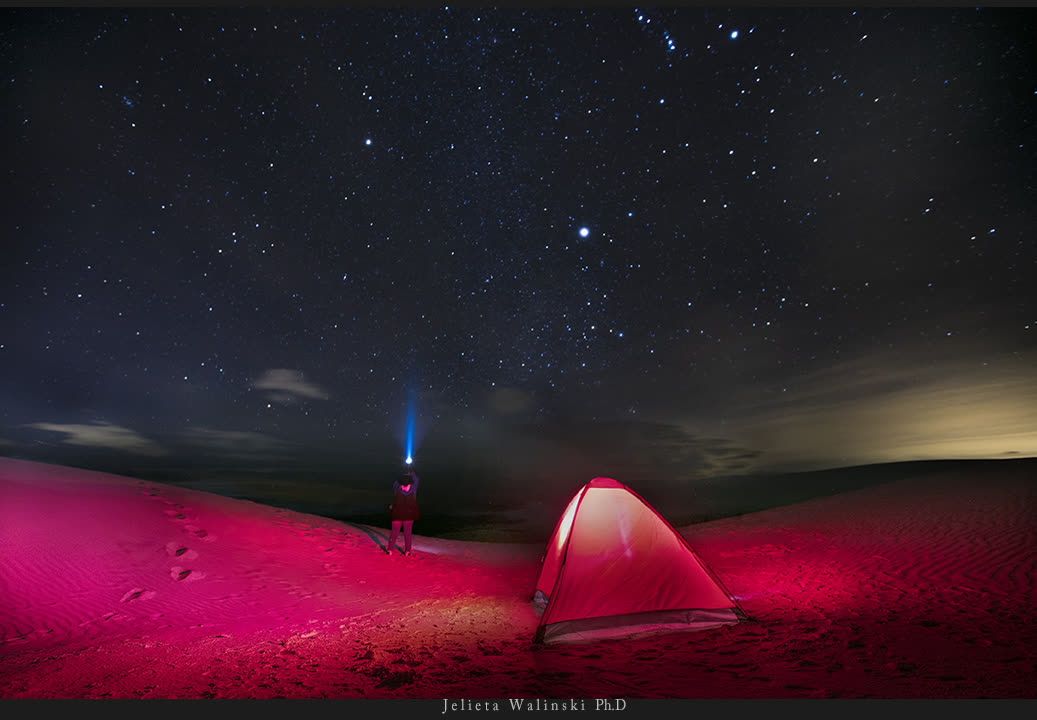
Pictured: a clear, starlit night over the White Sands region near Alamogordo, New Mexico — the general desert landscape where Moody reported watching for meteors before his sighting, not a photograph of the actual event or location itself. No photograph of the reported craft, the beings, or the specific site is known to exist.
Theoretical Alignment
The case aligns moderately with both a genuine-encounter framework and a psycho-social framework, reflecting its genuinely mixed evidentiary profile. The Extraterrestrial Hypothesis is supported by the narrative's internal richness, the physical aftereffects Moody reported, and a formal deception-analysis result finding no indicators of conscious fabrication. The Psycho-Social Hypothesis is equally well-supported by the case's sole reliance on hypnotically recovered memory (a technique with well-documented confabulation risk) and by investigator-documented factual contradictions between Moody's own successive retellings.
Background
By the mid-1970s, the American UFO abduction narrative had a well-established template, set a decade earlier by Betty and Barney Hill's 1961 case and reinforced by a steady stream of subsequent reports: missing time, physical aftereffects, and a detailed account recovered only through hypnosis rather than conscious memory. Moody's case arrived in the middle of an especially active period for the genre — 1975 alone would also produce Travis Walton's much more publicized Arizona disappearance that November, and the broader cultural climate of UFO-abduction reporting was arguably at its 1970s peak.
Part of this period's intensity traces directly to the Hill case's own growing cultural reach: the 1966 book The Interrupted Journey and the 1975 NBC television film The UFO Incident, broadcast in October of the very year Moody reported his experience, brought the specific narrative elements of missing time and hypnotic memory recovery to a mass audience just as Moody's own case was unfolding — a genuine coincidence of timing that skeptical commentators have separately noted as relevant context for how widely the "abduction template" had already permeated American popular culture by the time any individual witness in this period sought hypnotic regression for an unexplained experience.
Moody was, at the time of his reported experience, a career non-commissioned U.S. Air Force sergeant, a detail investigators and later commentators have repeatedly emphasized as lending his account a baseline credibility uncommon among abduction witnesses — a trained, disciplined military professional with an ostensible interest in protecting his career reputation rather than seeking public attention. Alamogordo itself sits in the Tularosa Basin of south-central New Mexico, adjacent to Holloman Air Force Base and the White Sands Missile Range, one of the most militarily significant and heavily monitored stretches of American airspace, a detail that has fed both anomalous and mundane interpretations of the case in roughly equal measure: proponents note the area's documented history of unconventional aerospace testing as circumstantial support for genuinely advanced technology being present, while skeptics note the same history as fertile ground for a witness (however sincerely) misidentifying classified conventional test activity.
The Tularosa Basin's own place in American nuclear and aerospace history predates this case by three decades: the Trinity nuclear test site, where the first atomic weapon was detonated in July 1945, sits within the same broader basin, and the region's identity as a center of secretive, technologically advanced government activity was already well established in the American public imagination by 1975, independent of anything UFO-related. This pre-existing cultural association between the Tularosa Basin and extraordinary, classified government technology is itself a relevant psycho-social factor: a witness reporting an unexplained aerial event from this specific region enters a cultural context already primed to interpret ambiguous phenomena through a "secret advanced technology" lens, whether the underlying explanation ultimately proves terrestrial or not.
Moody did not report his experience immediately or seek public attention on his own initiative. His account only became widely known after he approached the Aerial Phenomena Research Organization (APRO), at the time one of the two most established civilian UFO investigation bodies in the United States (alongside the National Investigations Committee on Aerial Phenomena, NICAP), co-directed by Jim Lorenzen and Coral Lorenzen. APRO's investigation, and its documented findings, remain the primary independent evidentiary record for this case, separate from Moody's own retellings in later popular UFO literature.
APRO itself, founded in 1952 by Coral Lorenzen and continuing under her and Jim Lorenzen's joint direction through the 1970s, maintained a network of field investigators and a formal case-review process considerably more structured than the loose, informal reporting that characterized much of civilian ufology at the time. By the mid-1970s the organization had built a substantial institutional reputation specifically around investigating and, where the evidence supported it, publicly validating physical-trace and abduction-type cases — making its willingness to publish Moody's contradictions alongside its investigation, rather than quietly setting the case aside, a meaningful signal of the organization's own editorial standards rather than uncritical advocacy.
Complete Timeline
The following chronology draws on the consistent core facts reported across published secondary sources; exact dates for individual investigative milestones (the precise date APRO first opened its file, the exact date of McQuiston's PSE session) are not independently documented and are given here by year or approximate period where the more specific date is unavailable.
| Date | Event |
|---|---|
| Aug 13, 1975, ~1:15 A.M. | Moody drives into the desert near Alamogordo to observe a meteor shower and reports watching a glowing object descend toward the ground |
| Aug 13, 1975 | The object, described as a ~50-foot metallic disc, approaches to roughly 70 feet; Moody's car becomes inoperable and he experiences numbness before losing conscious memory |
| Aug 13, 1975, ~3:00 A.M. | Moody regains awareness in his car, finds it starts normally, and arrives home approximately 90 minutes later than expected |
| Following days | Moody develops back pain and a rash across his lower body; consults a physician, who suggests self-hypnosis to address the memory gap |
| Following weeks | Through repeated self-hypnosis sessions, Moody reconstructs a detailed narrative of an onboard abduction and examination |
| 1975–1976 | Moody reports his experience to APRO; Jim Lorenzen conducts a formal investigation and documents inconsistencies between Moody's successive accounts |
| 1976 | Charles McQuiston, co-inventor of the Psychological Stress Evaluator (PSE), analyzes a recording of Moody's account and reports no indicators of deception |
The Sighting and the Missing Time
By Moody's account, he drove alone into the desert outside Alamogordo specifically to observe an expected meteor shower, arriving at his chosen viewing spot around 1:15 A.M. As he watched the sky, he noticed a distinct, glowing object separate from the ordinary meteor activity and begin a controlled, wobbling descent rather than a meteor's characteristic streak-and-burn trajectory — his first indication, in his own retelling, that he was watching something other than a natural phenomenon.
The object resolved into a disc-shaped craft roughly fifty feet in length and eighteen to twenty feet wide, emitting a high-pitched humming sound as it descended to a hovering altitude of fifteen to twenty feet before beginning to close the distance toward his parked car. As it approached to within an estimated seventy feet, Moody reported that his car's engine died and would not restart, and that he could make out a rectangular window in the craft's hull through which he perceived shadows resembling human silhouettes moving inside. A creeping numbness overtook his body shortly afterward, and his conscious memory of the encounter ends at this point.
This portion of the account — the conscious, non-hypnotically-recovered sighting from initial observation through the onset of numbness — is evidentiarily distinct from everything that follows it, and this case file treats that distinction as analytically important throughout. Whatever one concludes about the abduction narrative recovered weeks later under self-hypnosis, the initial sighting itself represents Moody's ordinary, waking-memory account, given close in time to the event and without the intervening weeks of hypnotic reconstruction that shape the later material. This makes the initial sighting portion, on its own, a more conventionally evaluable eyewitness report—subject to the same limitations any single, uncorroborated nighttime sighting carries, but not to the additional, specific confabulation risk that applies to the abduction content.
When Moody's awareness returned, he found himself still in the driver's seat of his car, which started without difficulty. Arriving home, he discovered it was approximately 3:00 A.M. rather than the roughly 1:30 A.M. he expected based on how long he believed he had been watching the sky — an unaccounted gap of about ninety minutes that became the case's central "missing time" element, the same structural feature present in the Hill case and in the great majority of subsequent American abduction reports.
Notably, mid-August places the sighting squarely within the annual Perseid meteor shower's active period, which typically peaks around August 11–13 — meaning Moody's own stated reason for being in the desert that night (deliberately observing a meteor shower rather than being there for any other purpose) is independently, astronomically consistent with the real calendar, a small but genuine corroborating detail for the mundane framing of his evening's activity, whatever one concludes about what he subsequently reported seeing.
Physical Aftereffects and the Path to Hypnosis
In the day following the encounter, Moody began experiencing back pain, and within a matter of days a rash developed across his lower body. Concerned enough by these physical symptoms combined with his memory gap to seek medical attention, he consulted a physician and described the full circumstances of the missing ninety minutes. The physician's specific recommendation — that Moody attempt self-hypnosis to recover what had happened during the gap — set the case on the path that would produce its most detailed and most contested content.
Over a period of several weeks, through repeated self-hypnosis sessions conducted without a trained professional hypnotist present at each session (a detail that distinguishes Moody's process from many other prominent abduction cases, which typically involved a psychiatrist or psychologist directing hypnotic regression), Moody progressively assembled what he described as an almost complete recollection of the missing time period. This self-directed hypnotic method is itself a point of methodological concern independent of any judgment about Moody's sincerity: self-hypnosis lacks the structured, session-to-session consistency checks a trained hypnotist can apply, and is generally considered, within the broader psychological literature on hypnotically recovered memory, to carry an elevated risk of unconscious confabulation and narrative elaboration relative to a professionally supervised process.
The specific mechanism by which repeated self-hypnosis sessions can progressively alter recalled content is well documented independent of this case: each session does not simply "replay" a fixed memory but actively reconstructs it, and any detail introduced (consciously or not) in an earlier session — through a leading internal question, an association with something read or seen elsewhere, or simple narrative pressure to produce a more complete story than the previous session yielded — can become incorporated as if it were an original memory in the next. Over "several weeks" of sessions, as multiple sources describe Moody's process, this compounding effect has more opportunity to operate than in the single- or few-session hypnotic regressions used in many other abduction investigations, a detail worth weighing when assessing how much the final, detailed narrative reflects the original event versus the recovery process itself.
No published source identifies exactly how many individual self-hypnosis sessions Moody conducted, what specific questions or prompts he used to guide each session, or whether he kept contemporaneous written notes between sessions that might later have been compared for consistency. This absence of procedural detail is itself notable: a more rigorously documented self-hypnosis process, even an unsupervised one, would have left a clearer record for later researchers to evaluate than the general "several weeks" description that has become the standard, secondhand summary of how Moody's narrative was actually assembled.
The Recovered Abduction Narrative
Under self-hypnosis, Moody recalled two humanoid beings, each about six feet tall and dressed in tight-fitting black clothing, approaching his immobilized car and rendering him fully unconscious. He next recalled awakening aboard the craft, lying paralyzed on a table-like surface, with a third being — shorter than the first two at approximately five feet, dressed in a silvery-white suit, and possessing an evident air of authority — standing over him.
This leader figure, Moody recalled, communicated with him telepathically, asking whether he would remain calm and cooperative. Upon Moody's assent, the leader touched him with a rod-shaped device that relieved his paralysis. Moody described the beings generally as roughly five feet tall (a detail investigators would later flag as inconsistent with his own separate six-foot description of the two initial beings), with larger-than-human hairless heads, small ears, somewhat enlarged eyes, and a small nose above thin lips.
This physical description — diminutive stature, an enlarged hairless head, small facial features, large eyes — sits at an early point in what would become, over the following decade, the now-familiar "Grey" archetype standardized by later, more culturally influential cases such as the 1987 publication of Whitley Strieber's Communion and Budd Hopkins's abduction research through the 1980s. Moody's account predates the archetype's full cultural crystallization by roughly a decade, making it a useful, if secondary, data point for researchers studying how the being-description template evolved (or, on a psycho-social reading, was progressively reinforced and homogenized) across successive American abduction cases over the 1970s and 1980s.
The leader reportedly showed Moody a portion of the craft's interior, including what Moody described as its propulsion or "drive" mechanism — a large central rod surrounded by three glass-canopied enclosures, each containing a crystalline object with its own attached rod. Moody also recalled a persistent sweet, stifling odor throughout the craft's interior. Before returning him to unconsciousness and, ultimately, to his car, the leader delivered a specific message: that the beings maintained a mother ship at a great distance from Earth, and that closer, more direct contact with humanity would not occur for approximately another twenty years.
The propulsion-device description is one of the case's more distinctive details relative to other 1970s abduction narratives, which more commonly describe medical-examination content (the Hill case, Pascagoula) than a guided tour of onboard engineering. Whether this represents a genuinely novel piece of testimony, drawn from an actual perception during the missing ninety minutes, or an elaboration influenced by the extensive "flying saucer" technical speculation already circulating in 1970s popular UFO literature — crystalline power sources and rod-based propulsion mechanisms both had precedent in earlier contactee-era claims dating to the 1950s — cannot be determined from the available record. The twenty-year contact timeline the leader reportedly gave has also never been treated by any serious investigator, including Lorenzen, as a testable prediction; it would have placed a promised "closer contact" around 1995, a date that passed without any event ufology researchers have connected back to this specific claim.
APRO's Investigation and the Contradictions
Jim Lorenzen, conducting APRO's formal investigation of the case, identified specific, documented inconsistencies between different points in Moody's own retelling of the same events — not vague stylistic drift, but concrete factual contradictions on details that should have remained stable across an accurate memory. Most significantly, Moody's stated distance to the beings' mother ship shifted dramatically between accounts: at one point placing it approximately 400 miles from Earth, at another placing it at roughly 6,000 miles — a fifteenfold discrepancy on a single, specific, and presumably memorable figure the beings had directly communicated to him.
A second, physically-descriptive contradiction concerned the beings themselves: Moody at different points characterized his captors as "frail creatures" and, separately, as fully six feet tall — descriptions that sit uneasily together as accounts of the same individuals. Lorenzen's identification of these specific discrepancies represents the single strongest piece of evidence weighing against the account's full reliability, precisely because it comes from the same investigative body that took the case seriously enough to formally document and publish it, rather than from an outside skeptic dismissing the case wholesale.
It bears emphasizing that these two contradictions are of a genuinely different character from ordinary witness misremembering of peripheral detail (an incorrect estimate of how many minutes an event lasted, or a slightly misremembered color). A fifteenfold discrepancy in a single, specific, directly-communicated numeric fact, and a description of the same beings as simultaneously "frail" and "six feet tall," are the kind of inconsistency more readily explained by two entirely separate hypnotic sessions independently generating different specific content for the same narrative slot, than by ordinary memory decay acting on a single, stable underlying recollection.
These contradictions do not, on their own, prove deliberate fabrication; they are equally consistent with the well-documented tendency of self-hypnotically recovered memory to drift, elaborate, and internally reconstruct details across repeated retellings, particularly numeric or spatial details a witness has no independent means of verifying (Moody had no way to confirm any claimed distance to a "mother ship" regardless of what he believed he was told). But they do meaningfully undercut treating Moody's hypnotic narrative as a stable, verbatim record of a single external event, and are a central reason this case is rated Disputed rather than Credible.
It is also worth noting what Lorenzen's investigation did not find: no evidence that Moody had any prior established interest in UFO literature or contactee culture before his reported experience, no financial motive (he never appears to have profited directly from the case in the way some later, more commercially-oriented abduction claimants did), and no history of similar extraordinary claims before or after this single reported event. APRO's willingness to publish the contradictions it found, rather than either suppressing them to protect a case it had invested investigative resources in or using them to dismiss the case outright, is itself a data point about the organization's own editorial integrity on this specific case — a middle path that left the case exactly where this file ultimately rates it: genuinely disputed, not resolved in either direction.
Key Witnesses
Sgt. Charles L. Moody
The case's only witness, reporting the entire encounter and abduction from personal experience, with the abduction content specifically recovered through weeks of self-directed hypnosis rather than conscious memory. A career military professional at the time of the event, a credential investigators have repeatedly cited as supporting his sincerity, though his account also contains the specific, documented internal contradictions APRO's own investigation identified. Available published sources do not specify his exact Air Force specialty, rank progression, or subsequent military career following this incident, and it is not clear from the record whether he faced any professional consequences within the service for reporting the experience.
Jim Lorenzen
Conducted APRO's formal investigation of the case and is the source of the documented contradictions in Moody's account (the mother-ship distance discrepancy and the "frail" versus six-foot being descriptions) — findings published through the same organization that treated the case as worth serious investigation, lending them particular evidentiary weight.
Charles McQuiston
A voice-stress-analysis specialist who examined a recorded account of Moody's experience using the PSE, a polygraph-adjacent deception-detection technology analyzing micro-tremors in vocal patterns rather than the respiration/perspiration/heart-rate metrics of a conventional polygraph. McQuiston reported finding no indicators consistent with deliberate deception in Moody's account, a finding that, as discussed in Material Analysis below, must be weighed against PSE's own more contested scientific standing relative to a conventional polygraph.
The Five Observables Assessment
Because every performance detail in this case originates from Moody's own uncorroborated, hypnotically-assisted testimony, the assessment below should be read as a description of what was claimed rather than what was independently confirmed — a distinction that applies to this case with unusual force given the memory-recovery concerns discussed throughout this file.
The Five Observables framework is applied to the performance characteristics reported in this case:
Assessment: The craft's reported hovering, wobbling descent, and steady low-altitude approach are consistent with a claimed anti-gravity-style lift mechanism, though this rests entirely on Moody's own uncorroborated description with no instrumented confirmation. No sudden acceleration, hypersonic movement, or trans-medium transition was ever reported. The object's silent approach and unconventional descent profile leave Low Observability as speculative rather than confirmed, since no radar or independent sensor data of any kind exists for this single-witness encounter.
Evidence Assessment
Weighing this case requires holding its two central findings — a passing deception analysis and documented internal contradictions — in view simultaneously, rather than treating either one as dispositive on its own. Neither by itself settles what actually happened in the desert outside Alamogordo on the night of August 13, 1975; together, they describe a witness who most likely believed his own account sincerely while that account's underlying content was shaped, at least in part, by an unreliable memory-recovery process.
Supporting Anomalous Origin
- A qualified deception-analysis specialist (Charles McQuiston, PSE co-inventor) examined Moody's account and reported no indicators of conscious fabrication
- Moody's status as a career Air Force sergeant with an ostensible professional interest in avoiding ridicule is repeatedly cited by investigators as circumstantial support for sincerity
- Documented physical aftereffects (back pain, a lower-body rash) followed immediately in the days after the reported encounter
- The account's internal detail — specific propulsion-system description, specific being physiology, a specific delivered message — exceeds what a fabricated account typically requires to be superficially convincing
- APRO, a serious contemporary investigative body with no institutional incentive to validate a weak case, treated the report as worth formal investigation
Supporting Conventional Explanation
- The entire abduction narrative was recovered exclusively through self-directed hypnosis, a technique with a well-documented elevated risk of confabulation relative to professionally supervised regression
- APRO's own investigator, Jim Lorenzen, documented specific, substantive contradictions between Moody's successive retellings (a fifteenfold discrepancy in stated mother-ship distance; incompatible "frail" versus six-foot being descriptions)
- Moody is the case's sole witness, with no independent corroboration of the sighting, the missing time, or the abduction content from any other named individual
- No physical trace evidence, photograph, or instrumented data of any kind exists beyond Moody's own testimony and its physical aftereffects, which have no confirmed causal link to a genuine encounter
- PSE-based voice stress analysis, while a real forensic technique, has a more contested scientific validity record than a conventional polygraph and is generally regarded as less reliable for definitively establishing truthfulness
Why "Disputed"
Assigning this case a numeric score independent of its qualitative Disputed label requires holding two calibration points in tension: cases with genuine multi-witness corroboration or instrumented data properly score much higher, while cases showing clear evidence of deliberate hoaxing properly score much lower. Moody's case sits in a real middle zone precisely because neither extreme applies — there is no independent corroboration to elevate it, but there is also no strong evidence of conscious fraud to sink it, leaving a passing but genuinely uncorroborated deception-analysis result and a set of internally-inconsistent specifics as the two data points actually available to weigh.
This case receives a DISPUTED classification because its two principal evidentiary signals point in genuinely opposite directions on the specific question of Moody's reliability. On one hand, a real deception-analysis specialist examined his account and found no indicators of conscious lying — a meaningful, if not conclusive, positive signal. On the other hand, the same organization that took the case seriously enough to investigate it formally also documented concrete, substantive contradictions in what Moody actually said from one telling to the next, on details (mother-ship distance, being physical description) specific and memorable enough that an accurate single-event memory should not have drifted this far.
These two findings are not actually contradictory once properly understood: a PSE or polygraph examination tests whether a subject believes they are telling the truth, not whether their underlying memory is objectively accurate. It is entirely possible — and, given the well-documented unreliability of self-directed hypnotic memory recovery, arguably the most parsimonious reading of this specific case — for Moody to have sincerely believed every version of his account at the time he gave it, passing a deception test in good faith, while his underlying hypnotically-reconstructed memory itself drifted and elaborated between sessions. This combination of sincere testimony atop an unreliable memory-recovery method is exactly the profile that belongs at Disputed: not a hoax, but not a stable, verifiable record of an external event either.
This rating is also calibrated relative to how the site treats comparable multi-witness cases with instrumented corroboration, which score meaningfully higher precisely because they do not depend on any single individual's memory-recovery process at all. A case resting entirely on one witness's hypnotically-reconstructed testimony, however sincere, structurally cannot reach the same evidentiary tier as a case with independent radar confirmation, multiple mutually-corroborating witnesses, or physical trace evidence subjected to laboratory analysis — not because Moody is judged less trustworthy as a person, but because the underlying evidence type carries a lower verifiability ceiling regardless of witness sincerity.
Sensor & Instrumentation Detection Profile
This section covers instrumented technical data specifically; the PSE deception analysis is treated in full separately under Material Analysis, since it examines witness sincerity rather than the sighting event itself.
No radar, photographic, film, or physical-trace instrumentation of any kind was ever associated with this case. The only quasi-instrumented data is Charles McQuiston's PSE analysis of a recorded verbal account, a voice-stress deception-detection technique that measures the subject's own confidence in their statements rather than any external confirmation of the events described. No sensor data corroborating the sighting, the disabled vehicle, or the abduction exists.
The reported vehicle-ignition failure as the object approached is itself a commonly cited detail across many close-encounter and abduction cases — the so-called "electromagnetic effects" (E-M) category of UFO reports — and has occasionally been treated by proponents as a quasi-instrumented data point, on the reasoning that an ordinary witness would have no independent reason to fabricate a specific claim about their car's electrical system failing unless something genuinely unusual occurred. This site treats the claim honestly as reported testimony rather than verified data: no mechanic's report, contemporaneous witness to the stall, or documented pattern of the vehicle's subsequent electrical reliability has ever been published, so the ignition failure remains part of Moody's own uncorroborated account rather than an independently confirmed technical anomaly.
Environmental & Geospatial Context
Both the geographic and astronomical dimensions of this context are treated below, since the case's own initial framing (a witness deliberately positioned to observe a meteor shower) makes both genuinely relevant to any complete evaluation.
The Alamogordo area sits within the Tularosa Basin, immediately adjacent to Holloman Air Force Base and the White Sands Missile Range — one of the most heavily used and closely monitored military test corridors in the United States, with a documented history of experimental aircraft, missile, and rocket testing dating to the 1940s. This context cuts in two directions for evaluating the case: it provides a plausible source population of genuinely unconventional (but terrestrial) test activity a witness might misidentify, while also lending circumstantial support to proponents who note the area's established association with genuinely advanced aerospace technology.
By 1975, Holloman AFB's mission portfolio included high-altitude research, missile guidance testing, and drone/target operations, all of which routinely produced unusual lights, flares, and aircraft behavior visible from surrounding civilian land after dark — the same basic dynamic that has generated misidentification-based UFO reports around other American test ranges throughout the Cold War era (compare the White Sands 1951 radar-visual case and various Area 51-adjacent sightings documented elsewhere on this site). No specific Holloman or White Sands test activity for the night of August 13, 1975 has ever been publicly confirmed or denied, and range activity logs from this period, if they still exist, have never been released in connection with this case.
Observer Credibility & Occupational Profile
No corroborating character references, service record excerpts, or performance evaluations from Moody's Air Force career have ever been published in connection with this case, so his professional standing is known only in the most general terms.
Moody's status as an active-duty U.S. Air Force sergeant is the case's single most consistently cited credibility factor across virtually every published account, on the reasoning that a military professional would have real career and reputational incentives against fabricating or publicizing an implausible story. This is a genuine, relevant consideration, though it is not, on its own, sufficient to resolve the case's central evidentiary problem: military service establishes a witness's general character and stake in credibility, but says nothing about the independent reliability of self-directed hypnotic memory recovery, which is the actual source of nearly every specific detail in the abduction narrative.
It is also worth noting a real tension in how this same credential has been used across the wider abduction literature: a witness's military or professional standing is frequently cited as evidence of credibility when their account is being taken seriously, yet the same institutional affiliation is just as often cited by proponents as evidence of a cover-up when official channels decline to investigate or comment. Neither framing is available on genuinely neutral grounds; Moody's Air Force service is a real, verifiable fact about who he was, but the specific inferences drawn from it in either direction — "he wouldn't lie" or "the Air Force is hiding something" — are interpretive additions the bare fact of his employment does not, by itself, support.
Physical & Material Assays
This section covers claimed physical/bodily effects specifically; the case's broader lack of any recovered object, sample, or trace is addressed at greater length in Material Analysis below.
No physical object, debris, or material sample was ever recovered in connection with this case. Moody's reported back pain and lower-body rash in the days following the encounter are physical symptoms rather than physical trace evidence in the forensic sense — they were never medically documented as having a specific, confirmed external cause, and are consistent with a range of mundane explanations (unrelated dermatological or musculoskeletal issues occurring coincidentally) as much as with a genuine anomalous encounter.
The absence of any documented dermatological examination or biopsy of the reported rash is a genuine gap in the case's evidentiary record, not merely an inconvenience: a contemporaneous medical record establishing the rash's actual character (a burn, an allergic reaction, an unrelated skin condition, radiation-type erythema) would have been directly relevant to evaluating any claimed link between the physical symptoms and the reported encounter, whether that link turned out to support or undercut the anomalous reading. No such record has ever surfaced in any published account of the case, and it is unclear from available sources whether one was ever created and simply never released, or whether Moody's treating physician addressed the symptoms without formally documenting a suspected cause in writing.
Historical Precedents & Archive Matches
These comparisons are offered to situate the case within its broader historical genre, not to imply that any of the outcomes reached in those other cases automatically transfers to Moody's own; each case file on this site is evaluated independently on its own specific evidence.
The Moody case follows the abduction template established by the 1961 Betty and Barney Hill case almost exactly — missing time, physical aftereffects, and a detailed narrative recovered only through hypnosis — and sits chronologically within 1975's especially dense cluster of American abduction reports, the same year that produced Travis Walton's far more publicized Arizona case. It is also a useful comparison case for the Pascagoula Abduction of 1973, another Southern-state case involving a polygraph-adjacent deception analysis of the witnesses; unlike Pascagoula, however, where Charles Hickson and Calvin Parker's accounts were substantially corroborated by each other as two independent witnesses, Moody's case rests entirely on a single, uncorroborated individual.
The specific pattern of a passing deception-analysis result alongside documented internal contradictions also recurs elsewhere in the broader abduction literature of this era, and Moody's case is frequently cited in comparative discussions of exactly this tension precisely because both findings were independently and separately documented by credible contemporary sources rather than reconstructed after the fact. This makes it a useful reference case for the general methodological point that deception analysis (whether conventional polygraph or PSE) and factual-consistency analysis are answering two different questions, and a case passing one while failing the other is not internally paradoxical — it is exactly what the theory of confabulated-but-sincere testimony would predict.
Material Analysis
There is no physical or material evidence associated with this case. Moody's back pain and skin rash, while genuine reported physical symptoms, were never subjected to forensic or medical documentation establishing a specific external cause, and the entirety of the evidentiary record beyond Moody's own testimony consists of Charles McQuiston's PSE voice-stress analysis — itself an assessment of testimonial sincerity, not physical evidence of the event's occurrence.
The Psychological Stress Evaluator: What It Does and Does Not Establish
The PSE, developed in the late 1960s and applied to this case by its own co-inventor, analyzes involuntary micro-tremors in the human voice theorized to correlate with psychological stress, offering a covert, recording-based alternative to a conventional polygraph's physiological measurements. Its scientific validity has been more consistently and more seriously contested within the forensic-science and psychological communities than the conventional polygraph's own already-debated reliability record, with peer-reviewed studies generally finding PSE accuracy rates in the range of chance to modestly above chance for genuine deception detection. A "no indicators of deception" PSE result on this case, while a real and honestly-reported finding, therefore carries meaningfully less evidentiary weight than a comparable finding from a more rigorously validated technique would.
A further, specific complication applies to Charles McQuiston's own examination of Moody: as PSE's co-inventor, McQuiston had a direct professional and commercial interest in the technology's credibility being demonstrated through high-profile applications, a conflict of interest independent of any question about his personal integrity or the sincerity of his stated findings. Neither a conventional polygraph examiner nor a PSE analyst is measuring objective truth directly in any case; both techniques measure physiological or vocal correlates of the examinee's own subjective stress response while answering questions, which is why deception-analysis results are properly described as evidence of a subject's apparent sincerity, not as independent confirmation that the events described actually occurred as stated.
Supporting Sincere (Though Not Necessarily Accurate) Testimony
- McQuiston's PSE analysis, whatever its broader scientific limitations, is a real, documented finding of no deception indicators from a qualified specialist in the technique
- Moody's physical symptoms followed close in time to his reported experience, consistent with (though not proof of) a genuinely stressful or traumatic event of some kind having occurred
Supporting an Unreliable Memory-Recovery Process
- The entire detailed abduction narrative originates exclusively from unsupervised self-hypnosis, a technique with a well-documented elevated confabulation risk relative to professionally supervised regression
- APRO's own investigation documented specific, substantive contradictions in Moody's account of two of its most memorable details
- No independent witness, photograph, or physical trace exists to corroborate any element of the account beyond Moody's own testimony
The Conventional Explanation Candidate: Hypnotically Confabulated Memory Atop a Genuine but Misperceived Event
The most parsimonious conventional explanation does not require treating Moody as dishonest at all. It holds that he genuinely experienced something unusual and disorienting in the desert — very plausibly involving a real light or aerial phenomenon, whether a meteor-related atmospheric effect, distant classified test activity from the adjacent White Sands Missile Range, or a more mundane misidentified light source — that produced real disorientation, a subjectively perceived gap in time, and genuine subsequent stress symptoms, all without a genuine abduction ever taking place. The subsequent weeks of unsupervised self-hypnosis then progressively constructed the detailed, internally inconsistent abduction narrative now associated with the case, a well-documented psychological pattern independent of any judgment about Moody's honesty or the PSE result's validity.
A genuinely bright fireball meteor — a real, well-documented atmospheric phenomenon capable of appearing far more structured, slow-moving, and object-like than a typical shooting star, particularly to an observer already primed by the context of watching for meteors — deserves specific mention as a candidate initial trigger, since fireball reports have independently generated numerous UFO misidentifications throughout the twentieth century precisely because their unusual brightness, color, and occasionally fragmenting or wobbling appearance as they break up in the atmosphere can superficially resemble a controlled, craft-like descent to an observer without technical astronomical training.
Sleep-Related or Fatigue-Induced Disorientation
A more minimal alternative holds that Moody, alone in his car in the pre-dawn hours after an extended period watching for meteors, may have briefly fallen asleep or experienced a fatigue-related lapse in awareness — a phenomenon well-documented among solitary overnight observers — genuinely losing track of elapsed time without any external light or craft ever being involved at all, with the entire sighting and abduction narrative constructed afterward, first through ordinary memory reconstruction and then elaborated significantly under hypnosis.
This candidate has real explanatory appeal for the missing-time element specifically: unintentional sleep onset while parked and stationary in the pre-dawn hours, followed by disoriented waking and an inaccurate subjective estimate of elapsed time, is an ordinary and well-understood human experience requiring no anomalous cause whatsoever. Its weakness is that it does not, on its own, explain why Moody's very first, pre-hypnosis account already included the vivid initial sighting (the descending disc, the humming sound, the disabled car) rather than simply "I lost track of time and I'm not sure why" — meaning this candidate works best in combination with a genuine bright-fireball or misidentified-light trigger rather than as a complete standalone explanation.
Deliberate Fabrication
Though the PSE finding weighs against this candidate, it cannot be entirely excluded on the strength of a single, scientifically contested deception-analysis technique alone; a small minority of published commentary on the case has suggested the specific, documented contradictions Lorenzen identified are more consistent with an evolving, deliberately embellished story than with genuine memory drift. This site does not find this the best-supported reading given the available evidence, but notes it as a candidate a thorough accounting must acknowledge.
What Would Resolve This Case Further
Moving this case's rating beyond Disputed in either direction would most plausibly require either a surviving, still-unpublished portion of APRO's own case file — field notes, session-by-session transcripts rather than only the final synthesized narrative, or Lorenzen's own working documentation of exactly when and how each contradiction emerged across Moody's retellings — or a second independent witness account never previously connected to the case. Neither has surfaced in the roughly five decades since the event, and given Moody's comparatively limited subsequent public profile relative to more widely publicized 1970s contemporaries like Travis Walton, further primary material specific to this case appears unlikely to emerge through ordinary archival research going forward.
A Genuinely Anomalous Encounter
The candidate this site's own rating treats as least likely, though not impossible, holds the account largely at face value: that Moody encountered a genuinely unidentified craft and underwent a real abduction substantially as later recalled, with the documented contradictions representing honest, minor memory errors on secondary details (the exact stated distance to a mother ship, a description of beings' build) rather than evidence the entire narrative is unreliable. Proponents of this reading point to the specificity and internal coherence of the core narrative elements — the craft's dimensions, the beings' basic physiology, the sequence of events — as harder to attribute to confabulation than the two flagged inconsistencies alone would suggest. This site's own assessment gives this candidate meaningfully less weight than the confabulation-atop-a-real-event candidate specifically because the entire narrative, not just the disputed details, originates from the same unsupervised self-hypnosis process, which provides no principled way to treat some recovered details as reliable and others as not.
Confabulated Memory Atop a Genuine, Misperceived Event
PlausiblePLAUSIBLE. Best accounts for both the PSE result (Moody sincerely believes his account) and the documented contradictions (hypnotic elaboration, not conscious lying, most readily explains inconsistent specific details).
Fatigue-Related Disorientation
InconclusiveINCONCLUSIVE. A real, common phenomenon for solitary overnight observers, but cannot on its own explain the specific, vivid initial sighting details (the disc, the humming sound, the disabled car) Moody reported before any hypnosis occurred.
Deliberate Fabrication
ImplausibleIMPLAUSIBLE as the primary explanation. Weighed against by the PSE deception-analysis result and by Moody's professional military standing, though not completely excludable given PSE's own contested scientific reliability.
Genuinely Anomalous Encounter (At Face Value)
InconclusiveINCONCLUSIVE. Supported by the narrative's internal coherence and the PSE result, but undercut by the same unsupervised self-hypnosis process that produced both the reliable-seeming core details and the documented contradictions.
Related Cases
The three cases below each share at least one central evidentiary feature with Moody's own account — hypnotic memory recovery, a credentialed witness, or a formal deception-analysis result — while differing in ways that usefully illustrate the range of outcomes such features can produce.
Confirmed Documents & Official Records
No U.S. Air Force, Project Blue Book, or other government agency investigation of this case is known to exist — Moody reported his experience to the civilian Aerial Phenomena Research Organization (APRO) rather than through any official military or government UFO-reporting channel, and Project Blue Book had itself been formally terminated in December 1969, nearly six years before this event.
Search Government & Military Archives Directly
Further Reading — Recommended Literature
Encounters with UFO Occupants
Written by the APRO co-directors who personally investigated the Moody case, this is the primary published source for the organization's contemporary findings, including the documented contradictions in his account.
UFOs: Generals, Pilots, and Government Officials Go on the Record
Kean's credential-focused evaluative approach to UAP testimony offers a useful comparative framework for weighing a military witness's credibility against a hypnotically-recovered narrative's inherent limitations.
Missing Time: A Documented Study of UFO Abductions
A foundational study of the American abduction narrative's hypnotic-recovery methodology and its documented risks, directly relevant to evaluating how Moody's own detailed account was constructed.
Abduction: Human Encounters with Aliens
A Harvard psychiatrist's clinical examination of abduction testimony and hypnotic memory, useful for weighing the specific psychological mechanisms that could produce a sincere but internally inconsistent account like Moody's.
UFO Investigations Manual
A practical guide to weighing exactly the mixed evidentiary signals present in this case — deception-analysis results, physical aftereffects, and hypnotically-recovered testimony — from a working UFO investigator's methodological perspective.
DISCLOSURE: Some links above are affiliate links. If you purchase through them, OverClassified receives a small commission at no additional cost to you. This helps support independent research.
Essential Viewing
Sources
- "1975, UFO Encounter; Abduction of Air Force Sergeant Charles L. Moody." UFO Casebook Files. ufocasebook.com
- "Air Force Sergeant Charles L. Moody Alien Abduction Case." Anomalien. anomalien.com
- "The Alien Abduction Of Air Force Sergeant Charles L Moody: Met Aliens And Saw The Interior Of The UFO." Infinity Explorers. infinityexplorers.com
- "Abduction of Airborne Sergeant Charles L. Moody." UFOAC. ufoac.com
- "The Case of the Abducted US Air Force Sergeant." Conexão UFO. conexaoufo.com
- Lorenzen, Coral & Jim. Encounters with UFO Occupants. Berkley Publishing, 1976.
- "Aerial Phenomena Research Organization," Wikipedia. en.wikipedia.org
- "Voice Stress Analysis," Wikipedia — background on the Psychological Stress Evaluator deception-detection method applied to this case. en.wikipedia.org
- "White Sands Missile Range," Wikipedia — background on the adjacent military test corridor. en.wikipedia.org
- "Holloman Air Force Base," Wikipedia. en.wikipedia.org
- "Alamogordo, New Mexico," Wikipedia. en.wikipedia.org
- Hopkins, Budd. Missing Time: A Documented Study of UFO Abductions. Richard Marek Publishers, 1981.
- Mack, John E. Abduction: Human Encounters with Aliens. Charles Scribner's Sons, 1994.
- "Belitionlee: The Sgt. Charles L. Moody Alien Abduction." belitionlee.blogspot.com
- "Charles L. Moody (Sergeant Moody's) Alien Abduction Story." topicswhatsoever.blogspot.com
- "Air Force Sergeant Charles L. Moody Alien Abduction Case." Planet Today. planet-today.com
- "UFO Abduction of Air Force Sergeant Charles L. Moody." Tall White Aliens. tall-white-aliens.com
- "Charles Moody's UFO Encounter: A Detailed Account." Connect Paranormal Blog, June 29, 2024. connectparanormal.net
See something inaccurate? Have additional information or sources?
Suggest an Edit →Last Updated: August 2026