
Scientific Ufology
How the Application of Scientific Methodology Can Analyze, Illuminate, and Prove the Reality of UFOs — Kevin Randle's Attempt to Give the Field a Standard
Core Thesis
Scientific Ufology is Kevin D. Randle's attempt to solve the field's oldest structural problem: that after fifty years it still had no agreed standard for what counts as evidence. His answer is procedural rather than theoretical. State the criteria first — eyewitness testimony, preferably from multiple independent witnesses; photographic or instrumented evidence; and written documentation recorded immediately or very shortly after the event, before memory and narrative have had time to work on it. Then apply them, without exception, to the case record. The book's bulk is fifteen cases that meet those criteria, each accompanied by a detailed critique of how the official investigation of it was conducted and where it failed. Randle's premise, as Publishers Weekly summarised it in August 1999, is that 'government-sponsored projects have a history of bias, creating a need for neutral studies.' And the conclusion he reaches on his own stated terms is worth quoting exactly, because it is not the one his reputation predicts: 'There is no evidence that conclusively proves that UFOs represent alien visitation.'
About the Author
Kevin D. Randle (b. 1949) is a retired United States Air Force captain and one of the most prolific investigators in the history of American ufology, with a bibliography running to dozens of titles across UFO research, military history and fiction. His military service and intelligence background give him a working familiarity with how service documentation is actually produced and filed — a genuinely useful qualification when the evidence in question is a unit journal entry or an incident report.
His reputation was made on Roswell. Randle and Donald Schmitt co-authored UFO Crash at Roswell (1991) and The Truth About the UFO Crash at Roswell (1994), and for most of the 1990s the pair were the case's leading proponent investigators. That association is on this book's own cover, which identifies him as 'Co-Author of UFO Crash At Roswell.'
What makes Randle unusual, and what makes this book worth reading, is that he has repeatedly revised or abandoned positions when the evidence turned. He publicly withdrew support for witnesses whose testimony he came to doubt, criticised the MJ-12 documents at length in Case MJ-12 (2002) while Stanton Friedman was defending them, and produced in The Abduction Enigma (1999) one of the most sceptical treatments of the abduction phenomenon written by anyone inside the field. A proponent who publishes against his own side's weakest claims is doing the thing this book argues for.
This site's library carries five further Randle titles — Project Blue Book Exposed, Crash: When UFOs Fall From the Sky, Case MJ-12, The Abduction Enigma, and (forthcoming in this pass) his two government-files volumes — and reading across them shows a researcher whose positions moved considerably over three decades. Scientific Ufology is the book where he tries to explain the standard by which he was moving them.
Historical Context & Origins
1999 was a bad year to be arguing for rigour. The field was two years past the Roswell fiftieth-anniversary media saturation, the alien-autopsy footage had been comprehensively discredited, the abduction literature had expanded far beyond what its evidentiary base could support, and mainstream scientific engagement was at a low ebb. A book proposing that ufology adopt explicit evidentiary standards was, in that context, as much a rebuke to the field as to its critics.
The specific target is the history of official investigation. Project Sign, Project Grudge, Project Blue Book and the Condon Committee had each produced conclusions that Randle argues do not survive examination of their own case files — a claim he had already made at length in Project Blue Book Exposed (1997). This book generalises it: the problem is not that the official investigators reached the wrong answer, but that they were not running a procedure capable of reaching a right one.
The methodological criteria Randle proposes have an obvious lineage in J. Allen Hynek's work — the Close Encounter classification system and the strangeness/credibility rating in The UFO Experience (1972) were the field's first serious attempt at a standard. Randle's contribution is to make the criteria exclusionary rather than descriptive: a case that does not meet them does not get analysed.
The book also arrives just as the physical-evidence and instrumented-data strands were becoming the field's most defensible. Peter Sturrock's The UFO Enigma (1999), published the same year, made a parallel argument from a Stanford astrophysicist's chair, and the 1997 Pocantico workshop Sturrock organised had brought scientists and investigators together specifically to assess physical evidence. Randle's book is the investigator-side counterpart to that effort.
Its subsequent reissue as Scientific Ufology: Roswell and Beyond (ISBN-10 0380813831) is worth noting for what it says about the market: a book arguing for methodological restraint was repackaged with Roswell in the title. The publisher's instincts were probably correct and the substitution is its own small comment on the field.
A structural point about the book's audience that explains its reception. Scientific Ufology is addressed simultaneously to two groups who wanted opposite things from it: proponents who hoped a methodological argument would legitimise the case record, and sceptics who assumed any book by a Roswell author was advocacy. It satisfies neither, because its actual argument is that most of the case record does not survive scrutiny and that what survives does not prove what proponents want it to. Books that tell both sides of an argument something they do not want to hear tend to be praised in the abstract and ignored in practice, and that is precisely what happened to this one.
Core Arguments & Key Concepts
State your criteria before you look at the cases. The book's central and simplest move, and the one the field most consistently fails to make. Randle sets out what will count as adequate evidence — multiple independent witnesses, photographic or instrumented corroboration, contemporaneous documentation — and then applies the standard uniformly, including to cases proponents would prefer to keep.
Contemporaneity is the underrated criterion. Randle's insistence on documentation recorded immediately or very shortly after an event is the requirement that does the most work, because it is the one most of the famous cases fail. Testimony collected decades later, however sincere, has passed through a process that reliably introduces narrative structure. This is the same standard a historian or an accident investigator would apply.
Official investigations must be audited, not cited. The bulk of the book is case-by-case critique of how each investigation was actually conducted — what was checked, what was not, which explanation was adopted and on what basis. Randle's argument is that citing an official conclusion without auditing the process behind it is a category error, and his critiques of Blue Book-era case dispositions are the most substantive part of the book.
The residue is real and it is small. Randle's criteria dramatically thin the case record, and he accepts that outcome. Fifteen cases from fifty years is what survives his own filter, and his position is that fifteen well-evidenced cases are worth more to the field than fifteen hundred poorly-evidenced ones.
And the residue does not prove visitation. The book's most quotable and most-ignored line, from a leading Roswell proponent: 'There is no evidence that conclusively proves that UFOs represent alien visitation,' though substantial evidence suggests the possibility. Holding that distinction — between evidence that supports a hypothesis and evidence that establishes it — is exactly what the book is arguing the field must learn to do.
The obvious objection, which Randle does not fully answer. Criteria chosen after the case record is known are not neutral. A researcher who has spent twenty years on Roswell and then formulates the standards by which cases should be judged is exposed to the charge that the standards were shaped to admit the cases he already valued. Randle's criteria are defensible on independent grounds, but the book does not confront the circularity directly.
Key Cases & Evidence Discussed
The Chilean Navy helicopter FLIR video (November 11, 2014). Off the coast near Santiago, Chile, this site cites Randle's book directly in its Chilean Navy Helicopter UFO Video file — not for the case itself, which postdates the book by fifteen years, but for the methodological argument that bears on it: CEFAA's own multi-disciplinary two-year technical review of the footage is precisely the kind of process Randle argues for, and the citizen-science rebuttal that arrived five days after the video's release and was never formally answered is precisely the kind of failure he documents.
The fifteen qualifying cases. The book's spine. Randle's selection is drawn heavily from radar-visual and multiple-witness military reports of the 1948–1970 period — the class of case that survives his contemporaneity requirement because service documentation was generated at the time.
Roswell (New Mexico, July 1947). Present but handled with unusual restraint for its author, and the reissue title notwithstanding. Randle's later work, particularly Crash: When UFOs Fall From the Sky (2010), shows how far his assessment of the crash-retrieval literature moved. This site's Roswell Incident file carries the full evidentiary treatment.
The Project Blue Book dispositions (Wright-Patterson AFB). Randle's audit of how individual Blue Book cases were closed — which explanations were adopted, which evidence was not pursued — is developed at length in Project Blue Book Exposed and applied here as method.
The Condon Committee. The recurring counter-example: an official scientific investigation whose own case studies left a substantial unexplained residue that its summary conclusions did not reflect. See this site's Condon Report breakdown for the document.
What the criteria exclude, and why that matters. Almost the entire abduction literature fails the contemporaneity test, as does most single-witness close-encounter material. Randle knew this and published The Abduction Enigma the same year, applying the same standards to that body of claims and reaching a largely negative verdict. The two books are best read together.
Critical Reception & Controversies
Publishers Weekly reviewed the book on August 30, 1999 and gave it a fair, mixed assessment: Randle is 'a big name in the study of UFOs' and a retired Air Force captain; his criteria are reasonable; his critiques of official investigations are substantive; and the book is dull. The reviewer's specific complaint — that Randle 'makes no attempt to liven things up,' and that his commitment to credibility may have cost him readability — is accurate and, on this book's own terms, close to a compliment.
Within the field the reception was warmer than the book's argument deserved from partisans on either side, largely because Randle's standing insulated him. UFO Magazine's verdict — 'Well worth your time and money' — is representative of a readership that liked the rigour in principle without necessarily accepting the case losses it entailed.
The deepest criticism is the one noted above and never resolved: the criteria are formulated by a researcher who already knows which cases he wants to keep. Randle's standards are individually defensible — each is one any accident investigator or historian would recognise — but the package was assembled with the case record in view, and the book does not engage that problem.
A second, sharper objection comes from the sceptical side. If the residue after filtering is fifteen cases and none of them conclusively demonstrates anything, a critic can reasonably ask what the exercise establishes. Randle's answer — that a small well-evidenced anomalous residue is a legitimate scientific object regardless of whether it has been explained — is the same answer the Condon Report's own unexplained cases pose, and it is a better answer than either side usually credits.
The book's real limitation is that it argues for a discipline the field then declined to adopt. Twenty-five years later, the standards that actually drove the 2017–2025 UAP disclosure period were imposed from outside — by naval sensor systems, by congressional reporting requirements, and by AARO's own procedures — not by ufology reforming itself. Randle proposed the right thing to the wrong audience.
Influence & Legacy
The book's influence has been slower and more diffuse than its arguments merit, but it is real. The evidentiary criteria it states explicitly — multiple independent witnesses, instrumented corroboration, contemporaneous documentation — are now roughly the working standard applied in serious UAP analysis, including by government bodies, and Randle was arguing for them when almost nobody in the field was.
Its most concrete legacy is the auditing method. Randle established that citing an official case disposition without examining how the investigation was conducted is not evidence, and that the audit itself frequently is. This site applies the same principle in its own case files, and its standing rule requiring explicit caveats around official government findings is a direct descendant of the argument this book makes.
Within this site's library, this book functions as the methodological reference behind the assessments rather than as a source of case facts. It is cited by the Chilean Navy video file for exactly that purpose, and it pairs with Sturrock's The UFO Enigma, published the same year, as the two 1999 attempts to give the subject a defensible standard from inside and outside the field respectively.
One last observation about Randle himself, which the book earns. Very few people in this subject have publicly moved as far as he has: from the leading Roswell crash proponent of the early 1990s to the author of sustained critiques of MJ-12, of the abduction literature, and of the crash-retrieval genre he helped build. Whatever one concludes about his positions, the willingness to revise them in public is the behaviour this book is arguing for, demonstrated by its author over thirty years.
The Book
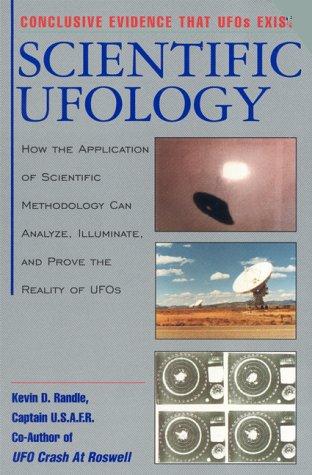
Scientific Ufology
How the Application of Scientific Methodology Can Analyze, Illuminate, and Prove the Reality of UFOs — Kevin Randle's Attempt to Give the Field a Standard
Find on Amazon →As an Amazon Associate, OverClassified may earn from qualifying purchases made through this link, at no extra cost to you.
Why This Is Essential Reading
Dry, important, and largely ignored. Scientific Ufology is a leading Roswell proponent's attempt to give his own field the thing it has never had — stated, exclusionary, defensible criteria for what counts as evidence — and then to apply them without special pleading. The result thins fifty years of case record down to fifteen incidents, and Randle concedes in his own words that even those do not conclusively prove alien visitation. Publishers Weekly was right that the book is not entertaining; that is close to the point. Read it for the criteria, for the auditing method it demonstrates against official investigations, and as the honest self-assessment of a researcher who has revised more of his own published positions than almost anyone else in this subject. Read it alongside The Abduction Enigma, published the same year, where he applies the same standards to the material he concludes fails them.
Related Cases & Theories
Sources Cited
- Randle, Kevin D. Scientific Ufology: How the Application of Scientific Methodology Can Analyze, Illuminate, and Prove the Reality of UFOs. New York: Avon Books, 1999, 241 pp., $12.50. ISBN-10 0380798522 / ISBN-13 9780380798520. amazon.com
- Publishers Weekly review of Scientific Ufology, August 30, 1999 — source of the publication data (Avon, 241 pp., $12.50), the summary of Randle's criteria and the fifteen-case structure, the 'government-sponsored projects have a history of bias' framing, the 'There is no evidence that conclusively proves that UFOs represent alien visitation' quotation, and the criticism that Randle 'makes no attempt to liven things up.' publishersweekly.com
- Amazon listing for the reissue, Scientific Ufology: Roswell and Beyond — How Scientific Methodology Can Prove the Reality of UFOs, ISBN-10 0380813831. amazon.com
- Encyclopedia.com, "Randle, Kevin D. 1949–" — biographical reference entry covering his Air Force service and bibliography. encyclopedia.com
- The Encyclopedia of Science Fiction, "Randle, Kevin D" — independent biographical and bibliographic entry. sf-encyclopedia.com
- Goodreads edition record, A History of UFO Crashes by Kevin D. Randle — context for his crash-retrieval work. goodreads.com
- Amazon Canada listing, Scientific Ufology by Kevin D. Randle, ISBN-10 0380798522 — independent bibliographic confirmation. amazon.ca
- Randle, Kevin D. Project Blue Book Exposed. Marlowe & Company, 1997. OverClassified breakdown
- Randle, Kevin D., Russ Estes and William P. Cone. The Abduction Enigma. Forge, 1999. OverClassified breakdown
- Randle, Kevin D. Case MJ-12: The True Story Behind the Government's UFO Conspiracies, 2002. OverClassified breakdown
- Randle, Kevin D. Crash: When UFOs Fall From the Sky, 2010. OverClassified breakdown
- Sturrock, Peter A. The UFO Enigma: A New Review of the Physical Evidence. Warner Books, 1999 — the parallel 1999 argument for evidentiary standards from a Stanford astrophysicist. OverClassified breakdown
- Hynek, J. Allen. The UFO Experience: A Scientific Inquiry, 1972 — the field's first serious classification and rating system. OverClassified breakdown
- Condon, Edward U., ed. Scientific Study of Unidentified Flying Objects, 1968. OverClassified breakdown
- OverClassified case file, The Chilean Navy Helicopter UFO Video — cites this book for the argument that UAP reports should be treated as data subject to ordinary scientific method, as it bears on CEFAA's two-year multi-disciplinary technical review and the unanswered citizen-science rebuttal.
- OverClassified case file, The Roswell Incident — the case that made Randle's reputation and that he subsequently reassessed.
Have corrections, additional research, or peer-reviewed sources? Help improve this entry.
Suggest an Edit