
Case MJ-12
The True Story Behind the Government's UFO Conspiracies
Core Thesis
Case MJ-12: The True Story Behind the Government's UFO Conspiracies is Kevin D. Randle's book-length forensic case against the authenticity of the so-called Majestic 12 documents — the papers this site's own Roswell case file already describes as "officially recognized by the U.S. government as forgeries." First published in 2002 by Avon Books and reissued in an updated 2018 edition from Speaking Volumes, the book is not an outside skeptic's dismissal of a claim ufology takes seriously; it is one of the field's own most credentialed Roswell investigators turning the same forensic rigor he applied to that case onto a set of documents many within ufology, at the time, still defended as genuine. Randle's own stated conclusion, drawn directly from his research, is unambiguous: "there is no evidence that the EBD is anything other than a fraud, written by someone who had a specific agenda."
About the Author
Kevin D. Randle was born June 4, 1949, in Cheyenne, Wyoming, and served in the U.S. Army, U.S. Air Force, and Iowa National Guard across a military career running from 1968 to 2009, retiring as a Lieutenant Colonel. He flew UH-1 helicopters in Vietnam with the 116th and 187th Assault Helicopter Companies, later serving as an intelligence officer with the Iowa National Guard's 234th Signal Battalion at Baghdad International Airport during the Iraq War, and holds the Distinguished Flying Cross, the Bronze Star Medal, and the Air Medal with Combat "V" among his decorations. That military-intelligence background is directly relevant to how this book reads: it applies the same methodical, document-and-chain-of-custody-focused approach Randle brought to his own landmark Roswell investigations to a body of paperwork he ultimately concluded could not withstand it.
Randle is among ufology's most prolific authors, with a bibliography exceeding eighty titles spanning UFO nonfiction, military and science fiction (some under the pseudonyms Eric Helm and Steve MacKenzie), and other genres; his UFO-specific work includes UFO Crash at Roswell (1991) and The Truth About the UFO Crash at Roswell (1994), both with Donald Schmitt, The Roswell Encyclopedia (2000), and Roswell in the 21st Century (2016). He is widely regarded, alongside Stanton Friedman, as one of the two or three most prominent researchers in the case's history, and by his own more recent public statements has grown, in his words, "more skeptical in his old age" about aspects of Roswell he once treated with more certainty — a trajectory of increasing rather than decreasing rigor that this book, sitting roughly at the midpoint of that career, reflects directly.
Historical Context & Origins
The Majestic 12 documents entered ufology in December 1984, when an undeveloped roll of 35mm film arrived anonymously in a plain package, postmarked New Mexico, through the mail slot of television producer Jaime Shandera. Developed, it contained a Truman-Forrestal memo dated September 24, 1947, and a seven-page "Top Secret/Eyes Only" briefing document dated November 18, 1952 and addressed to President-elect Eisenhower, describing a secret committee overseeing recovered material and bodies from the 1947 crash near Roswell, New Mexico and referencing a second, undisclosed 1950 crash near the U.S.-Mexico border. A follow-up document, the so-called Cutler-Twining memo, surfaced the following year among declassified National Archives files.
The documents arrived at what this book's own historical framing treats as a second wave of MJ-12 material: a further batch of related papers surfaced in the late 1990s, prompting renewed skeptical investigation, including CSICOP researcher Philip Klass's own detailed forensic reports. Randle's 2002 book arrives directly in the wake of that renewed scrutiny, building on rather than departing from Klass's earlier documented findings — the two men's skeptical conclusions align closely rather than compete.
By the time of the book's 2018 updated edition, official skepticism toward the documents had long been formalized: the White House and National Security Council denied in 1987 that any organization called Majestic 12 had ever existed, Air Force OSI investigators found no record such a committee was ever authorized, and the FBI, after its own 1988 review, declared the documents "completely bogus" — a verdict stamped directly onto the FBI's own released copies of the papers. This site's Roswell case file's characterization of the documents as confirmed forgeries reflects that same institutional consensus rather than a contested minority position within skeptical circles.
Core Arguments & Key Concepts
Randle's forensic case rests on several specific, independently checkable points rather than general suspicion. The briefing document lists Roscoe H. Hillenkoetter, the CIA's first director, as simply "Admiral" at a time when he held only the rank of rear admiral and, per Randle's argument, would not have been addressed that way in an authentic 1947 government document — a specific, if not universally accepted, anachronism he treats as one thread among several rather than the case's single deciding fact.
He also directly dismantles the stylometric defense some MJ-12 proponents leaned on: a linguistic analysis commissioned to compare the briefing document's prose style against Hillenkoetter's known writing, whose own author acknowledged the results were fundamentally inconclusive ("inconclusiveness seems to be of its essence," in the analyst's own words). When defenders including Stanton Friedman responded that a skilled forger could simply have simulated Hillenkoetter's style, Randle characterizes that fallback as circular — a defense that can absorb any negative result without ever being falsifiable — and concludes the entire stylometric exercise "proves nothing" in either direction.
The book's most concrete evidence concerns the Cutler-Twining memo specifically: Robert Cutler, the Eisenhower aide the memo is attributed to, was verifiably out of the country inspecting foreign military installations on the date the document bears, making his authorship physically impossible; the typewriter face used in the memo (Pica type) does not match the Elite type used in genuine, independently verified Cutler-office correspondence from the Eisenhower Library's own archives; and Truman's signature on the earlier Truman-Forrestal memo was identified as a pasted-in photocopy of his genuine signature from an unrelated October 1, 1947 memo to Vannevar Bush, down to matching accidental scratch marks — forensic findings Randle's book compiles and extends rather than originates, building directly on Klass's earlier documented analysis.
Key Cases & Evidence Discussed
The book's central subject connects directly to this site's own Roswell case file, which documents the underlying 1947 crash claim the Majestic 12 documents were fabricated to appear to authenticate, and to the site's Twining Memo case file, which covers the genuine, independently verified 1948 document the forged Cutler-Twining memo was designed to be mistaken for — a real historical record versus a forged one bearing a similar name, a distinction this book's forensic work depends on readers understanding clearly.
Randle's book also names, and this site's own Roswell case file independently corroborates, the two figures most widely suspected of having created or disseminated the documents: William Moore, co-author of The Roswell Incident, who has separately admitted to retyping and adding a false date stamp to at least one related document, and Richard Doty, an Air Force Office of Special Investigations agent who has been separately identified as confessing to forging a related Ellsworth Air Force Base document — both consistent with a deliberate disinformation operation rather than an innocent leak of genuine material.
Critical Reception & Controversies
As of this article's research (August 2026), the book carries a 3.54-out-of-5 rating on Goodreads across 28 ratings and 6 written reviews — a modest sample reflecting a specialized nonfiction title rather than a mainstream bestseller. Reception is genuinely mixed: one reviewer praised it as bringing "a healthy dose of skepticism, packed with facts," and an Amazon reviewer called it "a very practical analysis of the MJ-12 issue without unwanted speculation," while another reviewer felt Randle "feels compelled and competent to pass judgment over an entire body of paperwork he hasn't examined" firsthand, and a more critical reader found the book repetitive of "the same old information."
The book's most consequential reception came not from a review but from a real, documented public dispute: in 2014, Stanton Friedman — MJ-12's most prominent remaining defender, by his own account essentially the only ufologist still maintaining the documents' authenticity by that point — publicly argued that Randle "has not achieved his purpose of disgracing the original MJ-12 documents," dismissing Randle's absence-of-evidence reasoning as illogical. Randle countered that Friedman's practice of defending individual documents piecemeal, without addressing the full forensic case against them collectively, was not a productive basis for the debate. That exchange, playing out publicly between two of Roswell research's most established names, is a more revealing measure of the book's impact than any star rating: it forced ufology's own leading authenticity-defender to argue his position in direct, named opposition to one of the field's own most credentialed investigators, rather than leaving MJ-12 skepticism to outside critics alone.
Influence & Legacy
The book's lasting effect has been to help move MJ-12 skepticism from a purely external, outside-ufology critique into an argument ufology's own most established researchers largely accept: by the time of the 2018 updated edition, authenticity belief had narrowed to a small number of holdouts, with Friedman, until his death in 2019, its last major defender within the field itself.
Randle's forensic approach in this book — treating typewriter analysis, signature provenance, and verifiable travel and duty records as decisive rather than secondary to witness testimony or narrative plausibility — reflects the same document-centered method this site's own case files on Roswell and the Twining Memo apply when separating genuine historical records from later fabrications designed to resemble them.
The Book
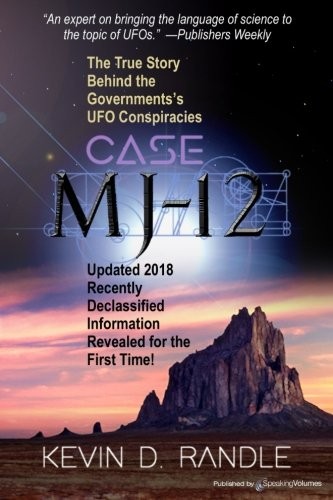
As an Amazon Associate, OverClassified may earn from qualifying purchases made through this link, at no extra cost to you.
Why This Is Essential Reading
Case MJ-12 earns its place on this reading list not for introducing skepticism toward the Majestic 12 documents from outside ufology, but for building the field's own internal case against them with the same rigor its author brought to Roswell itself — and for doing so directly and publicly against a fellow prominent researcher's continued defense of the documents, rather than leaving that argument to outside critics. Read alongside this site's own Roswell and Twining Memo case files, which independently corroborate the book's central forensic findings, it stands as one of the clearest examples in this site's collection of a UFO researcher's methodology turned, without flinching, on a claim many in his own field wanted to be true.
Related Cases & Theories
Sources Cited
- Randle, Kevin D. Case MJ-12: The True Story Behind the Government's UFO Conspiracies. Updated ed., Speaking Volumes, LLC, 2018 (ISBN 1628157461 / 9781628157468; originally Avon Books, 2002, ISBN 0380814730 / 9780380814732). amazon.com
- "Case MJ-12." Goodreads (reader rating 3.54/5, 28 ratings, 6 reviews, as fetched Aug 2026). goodreads.com
- "Case MJ-12." Google Books entry (2002 edition bibliographic record). books.google.com
- Randle, Kevin D. "Although I Really Don't Have Time for This..." Kevin Randle's blog (Randle's own direct argument on Hillenkoetter's rank, the Wescott stylometric analysis, and his fraud conclusion). kevinrandle.blogspot.com
- "MJ-12: Kevin Randle Rails Against..." The UFO Chronicles, 2014 (documentation of the public Randle-Friedman dispute). theufochronicles.com
- "MJ-12 Debate Continues: Stanton Friedman..." The UFO Chronicles, 2014 (Friedman's counter-rebuttal to Randle). theufochronicles.com
- "Majestic 12." Wikipedia (documents' history, forensic evidence against authenticity, Moore/Doty disinformation angle, official government denials). en.wikipedia.org
- "Kevin D. Randle." Wikipedia (author biography, military career, bibliography). en.wikipedia.org
- Klass, Philip J. "New Evidence of MJ-12 Hoax." Skeptics UFO Newsletter, Committee for Skeptical Inquiry (original forensic typewriter and signature analysis this book builds on). centerforinquiry.org
- Klass, Philip J. "The New Bogus Majestic-12 Documents." Skeptics UFO Newsletter, 2000 (analysis of the second wave of MJ-12 documents preceding this book). centerforinquiry.org
- "Case MJ-12." Blackwell's (2018 Speaking Volumes edition, bibliographic record). blackwells.co.uk
- This site's own Roswell and Twining Memo case files, drawing on the FBI's own "BOGUS"-stamped released copies and the National Archives' genuine Twining Memo record (full sourcing documented there).
Have corrections, additional research, or peer-reviewed sources? Help improve this entry.
Suggest an Edit