
Crash: When UFOs Fall From the Sky
A History of Famous Incidents, Conspiracies, and Cover-Ups
Core Thesis
Crash: When UFOs Fall From the Sky: A History of Famous Incidents, Conspiracies, and Cover-Ups is retired U.S. Army Lieutenant Colonel Kevin D. Randle's 2010 chronological survey of UFO crash-retrieval claims, organized as a decade-by-decade march from pre-1947 incidents through 2009 rather than as a set of standalone chapter investigations. It is cited on this site as a comparative-context source for two separate case files: the Coyame, Mexico crash claim and the Tarija, Bolivia crash claim -- though direct full-text verification for this article found the book's actual coverage of both to be considerably thinner than a first read of either case file's book-recommendation card previously suggested, a discrepancy corrected on both pages as part of this article's research.
About the Author
Kevin D. Randle is a retired U.S. Army lieutenant colonel who flew UH-1 helicopters in Vietnam, later served as a battalion intelligence officer in Iraq, and holds a PhD credited on this book's cover. He is one of ufology's most prolific authors, with more than eighty published books, and is best known as a career Roswell investigator, having authored The UFO Crash at Roswell and The Truth About the UFO Crash at Roswell -- both already covered on this site's key-figures page alongside three other Randle titles in this Essential Reading collection: UFO Crash at Roswell (1991), Invasion Washington (2001), and Case MJ-12 (2002).
This site's own key-figures entry on Randle already documents his reputation for what it calls "unusual intellectual honesty": he has publicly withdrawn support for Roswell witnesses as credibility problems emerged, declined to join the promotional "Roswell Dream Team" behind the 2015 Roswell Slides, and has separately called Nick Mariana's 1950 Great Falls film one of the strongest cases for the phenomenon's reality. That same mixed skeptical-but-not-uniformly-dismissive posture defines this book: reader reviews found after this article's research describe him as someone who "takes great pride in trying to convince you that just about everything... is a hoax," while also crediting "a very few" cases, Roswell chief among them, as more likely genuine.
Historical Context & Origins
The book is structured as a chronology rather than a case-by-case investigation: a prologue and a pre-1947 chapter are followed by chapters covering 1947, 1948, 1949-1952, 1953-1964, 1965, 1966-1978, 1979-1999, and 2000-2009, each chapter working through dozens of individual claims in brief, encyclopedia-style entries rather than devoting sustained chapters to any single case.
That structure matters directly for how this book was previously described on two of this site's own case files, and this article's research required correcting both descriptions. This site's Tarija, Bolivia case file previously credited the book with "a chapter-length treatment of the Tarija incident, describing the same 30-mile shattered-window radius and El Zaire impact site" documented there. Independent full-text search of the actual scanned book, run against both Google Books' and the Internet Archive's separate digitized copies, found exactly one mention of "Tarija" in the entire 320-page text -- a single page (264) inside the broad 1966-1978 chronological chapter, sourced in the book's bibliography to a 1993 UFO Universe magazine article rather than original investigation -- and zero occurrences anywhere of "El Zaire" or "shattered windows." That case file's book card has been corrected accordingly.
The book's connection to this site's Coyame, Mexico case file is even thinner: the same full-text search method found zero occurrences of "Coyame" anywhere in the book, meaning it never once names the case in relation to the Coyame, Chihuahua desert site the case file documents. That case file's existing book card was already worded cautiously, framing the book as useful for genre-level comparison rather than as a source that covers Coyame directly, and this article's research confirms that caution was warranted -- a clarifying note has been added there too.
Core Arguments & Key Concepts
The book's implicit argument, consistent with Randle's broader body of work, is that the UFO crash-retrieval genre is dominated by weakly sourced or fabricated claims that collapse under the same standard of documentary evidence Randle applies rigorously to his own signature case, Roswell -- with a small number of exceptions he considers to have survived that scrutiny.
Reader reviews located during this article's research describe the book's actual reading experience as closer to a reference catalog than a narrative argument: short, dated entries moving rapidly through dozens of claims, with one reviewer calling it "disjointed and repetitive" and another noting the omission of well-known cases such as Varginha, already covered on this site in Incident in Varginha. That format helps explain why cases like Tarija and Coyame receive only passing treatment rather than dedicated analysis: the book's method favors breadth across the full sweep of crash-claim history over depth on any single incident.
Key Cases & Evidence Discussed
This site's own Tarija, Bolivia case file documents the 1978 claim near Tarija in far greater depth than this book's single sourced page attempts: the reported sighting over the Bermejo Valley, the panic and rumor around an "enormous crater," and the disputed El Zaire impact site. Readers wanting the complete, independently sourced record should consult that case file directly rather than this book's brief mention.
This site's own Coyame, Mexico case file similarly documents the 1974 claim's full, thin evidentiary chain -- an anonymous 1992 letter surfacing eighteen years after the fact, and Kevin Randle's own separate 2013 blog post (not this book) calling that case's evidence "definitely thin" while crediting the authors' research effort. This book itself does not treat Coyame at all.
Critical Reception & Controversies
As of this article's research (August 2026), the book holds modest, mixed aggregate reader ratings -- roughly 3.5/5 on Amazon and 3.6/5 on Goodreads from a small number of ratings. Reviewers consistently described its character as an exhaustive but repetitive survey that debunks considerably more cases than it validates, with specific complaints about disjointed pacing and notable case omissions.
This article could not locate a dedicated trade review (Publishers Weekly or Library Journal) specific to this title, as distinct from general author-endorsement blurbs reused across multiple Randle book listings; that absence is noted here rather than a specific review being misattributed to this book.
Influence & Legacy
The book's legacy is modest relative to Randle's Roswell-specific work: it functions less as a landmark text in its own right than as a broad reference point within Randle's much larger body of crash-claim writing, useful chiefly for situating individual claims -- including several this site covers in depth -- within the wider universe of the genre's stronger and weaker cases.
Set alongside this site's own case files on Tarija and Coyame, both of which draw on far more extensive sourcing than this book's brief, secondary-sourced mentions, this book is best read as a broad orientation to the crash-retrieval genre's scale and evidentiary variance, rather than as a primary source for either specific case.
The Book
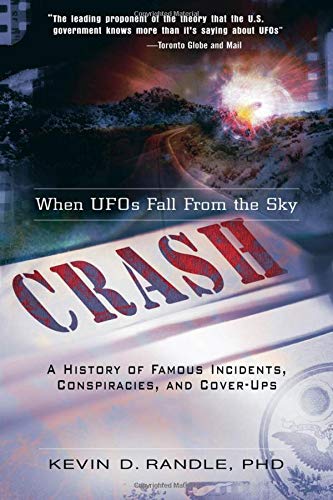
Crash: When UFOs Fall From the Sky
A History of Famous Incidents, Conspiracies, and Cover-Ups
Find on Amazon →As an Amazon Associate, OverClassified may earn from qualifying purchases made through this link, at no extra cost to you.
Why This Is Essential Reading
Crash: When UFOs Fall From the Sky earns a place on this reading list less for depth on any single case than as a useful, credentialed-skeptic's map of the crash-retrieval genre's full chronological sweep -- and this article's own verification of its actual Tarija and Coyame coverage is itself a case study in why claims about a source's contents should always be checked against the source directly. Read alongside this site's own Tarija, Bolivia and Coyame, Mexico case files, which supply the fuller, independently sourced record for both claims, it remains a useful orientation to how one of ufology's most prolific skeptical investigators situates weaker crash claims against his own stronger benchmark case, Roswell.
Related Cases & Theories
Sources Cited
- Randle, Kevin D. Crash: When UFOs Fall From the Sky: A History of Famous Incidents, Conspiracies, and Cover-Ups. New Page Books, 2010. amazon.com
- Google Books, full-text search of volume id 8d1EDwAAQBAJ (independent verification of "Tarija," "El Zaire," "shattered windows," and "Coyame" occurrence counts within the book's searchable text). books.google.com
- Internet Archive, Crash: When UFOs Fall From the Sky, San Rafael Public Library scan, full-text search (independent corroboration of the Google Books search results). archive.org
- Open Library, edition record and cover scan for ISBN 1601631006. openlibrary.org
- This site's own Kevin Randle key-figures entry (his career, Roswell investigation, and other Essential Reading titles).
- This site's own Tarija, Bolivia UFO Crash Claim case file (full sourcing and the corrected book-card description).
- This site's own Coyame, Mexico UFO Crash Claim case file (full sourcing and the corrected book-card description).
- Kevin Randle, "A Different Perspective: The Coyame UFO Crash" (2013 blog post, distinct from this book, cited separately on the Coyame case file). kevinrandle.blogspot.com
- Goodreads listing for Crash: When UFOs Fall From the Sky (aggregate reader rating and reviews). goodreads.com
- Amazon product listing and reader reviews for Crash: When UFOs Fall From the Sky (aggregate rating, format history, and reader-review sentiment).
- This site's own Incident in Varginha Essential Reading entry (an example case this book's reviewers noted as a notable omission).
- This site's own UFO Crash at Roswell Essential Reading entry (Randle's signature, most-defended case, for contrast with the thin Tarija and Coyame coverage documented here).
- This site's own Locations index (Tarija, Bolivia and Coyame, Chihuahua entries referenced by the two case files this book is cited on).
Have corrections, additional research, or peer-reviewed sources? Help improve this entry.
Suggest an Edit