
Coyame, Mexico UFO Crash Claim
On the night of August 25, 1974, according to a story that entered the public record only in 1994, U.S. air defense radar tracked an unidentified object coming in from the Gulf of Mexico at about 2,530 miles per hour before it turned inland over Mexican territory, collided with a small civilian airplane, and crashed in the remote Chihuahuan Desert near Coyame, Chihuahua. Per the story, Mexico refused an American request to help and sent its own military convoy to recover a battered silver disc roughly sixteen feet across; the convoy was then found stopped on the road with every man dead, and an American team flown in by helicopter from Fort Bliss lifted the disc out to U.S. territory. The story's actual documented origin is far thinner than its dramatic content suggests: no version of it appears anywhere in print or in any government record before 1992, when an anonymous document from someone signing as "J.S." and claiming membership in an unverified group called the "Deneb Team" reached UFO researcher Elaine Douglass. Researcher Leonard Stringfield published the full anonymous text in 1994 while explicitly flagging his own doubt about it. No named eyewitness, contemporary press account, FAA record, or independently examined physical exhibit corroborates any part of the claim, even after a 2007 and a more extensive 2013 book by researchers Noe Torres and Ruben Uriarte sought out further testimony. Coyame also lies about 70 km from Ojinaga, the border town that became a major drug-smuggling hub, and the mundane explanations offered for the story point that way: a self-published local history attributes it to a 1974 crash of a drug-running Cessna, and Mexico Unexplained reports a 1980 military search north of Coyame for drugs and cash scattered by a crashed smuggling plane. Neither is documented well enough to prove, but both are more ordinary than a mid-air collision with an unidentified craft.
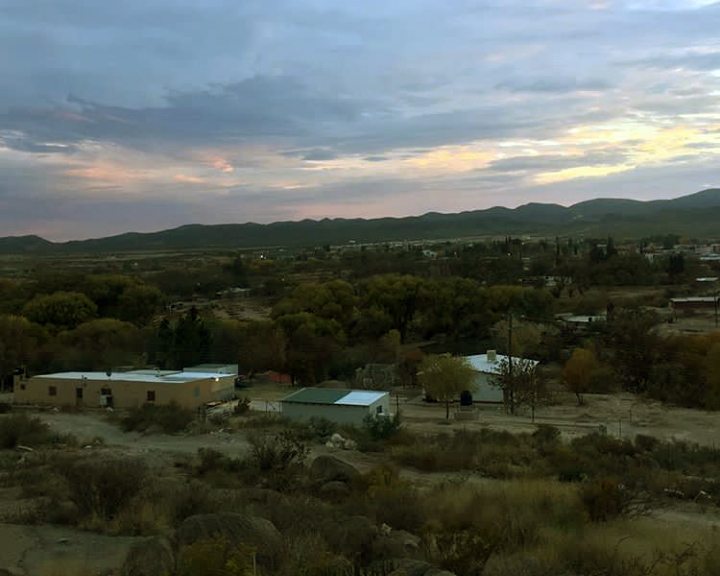
Pictured: Santiago de Coyame, the small municipal seat of Coyame del Sotol Municipality in the Chihuahuan Desert of northern Mexico, near which the claimed August 1974 crash and recovery allegedly occurred. This is not a photograph of any crash site, wreckage, or recovery operation — no such photograph has ever surfaced from any source, and the claim's own anonymous origin means no documented crash site has ever been independently located or examined. Photo by MikSed, via Wikimedia Commons, licensed CC BY 4.0.
Theoretical Alignment
This case's alignment leans heavily toward the Psycho-Social hypothesis, reflecting this site's research finding that the story's actual documented history is a print/document phenomenon — an anonymous 1992 letter amplified by a chain of researchers and authors over three subsequent decades — rather than a phenomenon rooted in any independently verified physical event. The residual Extraterrestrial allowance reflects only that the claim's own content, if taken completely at face value, would describe a genuine non-terrestrial craft; this site's research found no independent evidence supporting that the claimed content reflects anything that actually happened as described. The near-zero Interdimensional allowance reflects that no version of the story invokes any interdimensional framing at all.
Background
The Coyame story belongs to a specific, identifiable sub-genre of American ufology: the 1990s wave of "crash/retrieval" claims that circulated among a small community of researchers trading photocopied documents, anonymous letters, and Usenet postings, often overlapping with — though not identical to — the same document ecosystem that produced the disputed "MJ-12" papers earlier in the decade. Understanding why this specific claim carries the evidentiary weight it does requires understanding both that ecosystem and the specific, real history of the region it claims as its setting.
The 1990s Crash-Retrieval Document Ecosystem
Beginning in the late 1970s and accelerating through the 1990s, American UFO researchers circulated claims of further UFO crash retrievals beyond Roswell, many sourced to anonymous or pseudonymous informants who claimed access to classified programs. Leonard H. Stringfield of Cincinnati, who had served in Fifth Air Force intelligence in the Second World War and later founded the civilian group CRIFO, became the best-known chronicler of these claims through his self-published "Status Report" series on UFO crash retrievals, which began with his 1978 MUFON symposium paper "Retrievals of the Third Kind" and ended with Status Report VII in 1994, the year he died. Stringfield published claims as raw material for future verification, often with his own caveats about sourcing, and his seventh and final Status Report is where the Coyame story first appeared in print.
Operation Right to Know and the Anonymous Letter
Elaine Douglass, a UFO researcher associated with the disclosure-advocacy group Operation Right to Know, received in 1992 an envelope with no return address containing a report on the alleged August 1974 incident (Mexico Unexplained gives February 1992; the report itself, titled "Research Findings on the Chihuahua Disk Crash," is dated March 23, 1992, according to Kevin Randle). The sender signed only as "J.S." and claimed membership in a "Deneb Team," a name that matches no documented government program, contractor or research organization. A version of the same text later circulated online, credited to a "Vince Johnson" and the Usenet group alt.paranet.ufo.deneb, and is reproduced by UFO Casebook. Douglass passed the document to Stringfield, who printed its full text in UFO Crash/Retrievals: Search for Proof in a Hall of Mirrors (Status Report VII, February 1994). As Randle quotes him, Stringfield was unhappy with the data and wrote that he was reproducing it "despite the risk of publishing a bunch of baloney," in the hope it could be verified or exposed as misinformation or disinformation. That is the claim's entire documented paper trail before any book-length treatment: an anonymous document of unknown provenance, passed from one researcher to another and published by the second with an explicit disclaimer.
Coyame, Chihuahua: A Real, Remote Border Town
Coyame (formally Santiago de Coyame) is a small town founded in 1715, the municipal seat of Coyame del Sotol Municipality in the Mexican state of Chihuahua, with 709 inhabitants at the 2010 census. It sits in remote high desert at about 1,220 m (4,000 ft), roughly 70 km west-southwest of Ojinaga and the Presidio, Texas border crossing and about 130 km northeast of the city of Chihuahua. The setting is real, and its remoteness means that a crash of almost any kind there in the mid-1970s could have gone unrecorded in accessible public sources for a long time, whatever it actually was.
An Active Drug-Smuggling Corridor in 1974
Independent of anything related to UFOs, the Ojinaga–Presidio stretch of the border was a smuggling route long before it became notorious in the 1980s as the base of trafficker Pablo Acosta Villarreal. Acosta, born in 1937 at Manuel Benavides, Chihuahua, moved marijuana and heroin across the border before he turned to Colombian cocaine; at the height of his power in the mid-1980s, turboprop aircraft flew cocaine from Colombia into Ojinaga's municipal airport and dirt strips on ranches upriver. Texas mugshots of Acosta from 1968 and 1974 show that he was already in trouble with U.S. law in the period the Coyame story describes. That history makes light aircraft carrying contraband through this part of Chihuahua a realistic background for the conventional explanations discussed below, though no source places a specific smuggling flight at Coyame in August 1974.
Why a Story This Dramatic Took Eighteen Years to Surface
If a mid-air collision, a two-country recovery operation and the deaths of an entire military convoy really occurred in 1974, no trace of it appears in print, in any newspaper on either side of the border, or in any UFO newsletter of the period until the anonymous document surfaced eighteen years later. Proponents answer that an operation serious enough to send American helicopters across an international border would also be serious enough to keep quiet for a long time, and treat the 1992 document as the kind of late leak such secrecy eventually produces. That answer cannot be tested. The same eighteen-year gap is also exactly what one would expect if the story was written, or heavily embellished, close to 1992, perhaps drawing on vaguer local memories of real crashes in the region. Without the writer's identity the question cannot be settled, but the second reading fits the claim's total absence from every other record of the period better.
Complete Timeline
| Date | Event |
|---|---|
| August 25, 1974, ~22:07 | Per the anonymous document, U.S. air defense radar detects an object approaching from the Gulf of Mexico at about 2,200 knots (2,530 mph) and 75,000 ft. |
| Later that night (claimed) | The object slows to about 1,700 knots, turns roughly 35 degrees onto a heading of about 290 degrees, levels at 45,000 ft over Mexico, then descends in steps of about five minutes each to about 20,000 ft before vanishing from radar near Coyame after some 500 miles of tracking. |
| About 52 minutes later (claimed) | Civilian radio traffic reports a light aircraft, which had left El Paso International for Mexico City, down in the same area near Coyame, Chihuahua; the document infers a mid-air collision. |
| August 26, about 10:35 (claimed) | Wreckage is reported from the air; a second object is found a few miles from the first, per the anonymous account. |
| August 26 (claimed) | U.S. officials ask at high levels to send a recovery team to "assist"; Mexico is said to have professed ignorance and refused, and sent its own military convoy to take the wreckage away. |
| August 26 (claimed) | Radio interceptions are passed to the CIA, which forms a recovery team at Fort Bliss, Texas; the Mexican convoy stops on the road before reaching inhabited areas and radio contact with its headquarters ceases. |
| Claimed aftermath | Four helicopters (three probably UH-1 Hueys, one possibly a Sea Stallion) are said to have flown from Fort Bliss, found every member of the convoy dead, most inside the trucks, and lifted the disc out by cable towards U.S. territory; after a stop in the Davis Mountains near Valentine, Texas, it was reportedly trucked towards Atlanta, Georgia, with an unconfirmed report of transfer to Wright-Patterson AFB. |
| 1992 | An anonymous report, "Research Findings on the Chihuahua Disk Crash," from someone signing as "J.S." and claiming membership in an unverified "Deneb Team," reaches UFO researcher Elaine Douglass of Operation Right to Know — the claim's first documented appearance in any form, eighteen years after the events it describes. |
| February 1994 | Leonard Stringfield publishes the full anonymous document in UFO Crash/Retrievals: Search for Proof in a Hall of Mirrors (Status Report VII), explicitly flagging his own doubt about it. |
| 2007 | Noe Torres and Ruben Uriarte publish Mexico's Roswell: The Chihuahua UFO Crash (Virtualbookworm), the first book-length treatment, with an afterword by Stanton T. Friedman; a second edition follows in 2008. |
| 2013 | Torres and Uriarte publish an expanded follow-up, The Coyame Incident: UFO Crash Near Presidio, Texas, describing local testimony gathered decades after the fact and laboratory analysis of debris and soil from a field where a small plane had crashed. |
| November 2013 | UFO researcher Kevin Randle reviews The Coyame Incident on his blog, quoting Torres's own remark that "the evidence is definitely thin" and calling it a story that "cries out for more data," while recommending the book. |
Detailed Narrative
The Claimed Radar Track and Collision
The anonymous 1992 document, as published by Stringfield and reproduced online, says that at 22:07 hours on August 25, 1974, U.S. air defense radar picked up an object approaching from the Gulf of Mexico at about 2,200 knots (2,530 mph) and 75,000 ft on a course of about 325 degrees. It slowed to about 1,700 knots, turned onto roughly 290 degrees, levelled at 45,000 ft over Mexico and then descended in steps to about 20,000 ft before vanishing from radar near Coyame after some 500 miles of tracking. About 52 minutes later, civilian radio traffic reported a light aircraft down in the same area; it had left El Paso International for Mexico City, and the document concludes the two had collided. The document gives no make or model for the plane: the "Cessna" of later retellings comes from a separate, mundane account discussed below. No radar log, station or operator has ever been produced to check any of these figures.
The Alleged Wreckage and Disc
Per the anonymous account, wreckage was reported from the air at about 10:35 the next morning, and a second object was found a few miles from the first. The document describes it as a disc about 16 feet 5 inches across and slightly under five feet thick, weighing an estimated 1,500 pounds, with an irregular hole about 12 inches across in the rim and a dent about two feet wide, and no doors, windows or markings. The document mentions reconnaissance photographs, but no photograph of the object has ever been produced, and no measurement, weight or damage description is corroborated by anything beyond the anonymous text and its retellings.
The Refused U.S. Offer and Mexican Recovery
The document says U.S. officials asked at high levels to send a recovery team into Mexico to "assist," and that Mexico "professed ignorance" and flatly refused, sending its own military convoy instead. Proponents read this as Mexican awareness of something serious. It is equally consistent with an ordinary explanation: a government refusing foreign military help with a crash on its own territory is unremarkable whatever crashed, and would be a normal response to an aviation accident or a narcotics incident Mexican authorities had no wish to share with American counterparts.
The Dead Convoy and the Covert Extraction
The most dramatic element is already in the anonymous document: low-altitude reconnaissance reportedly photographed the Mexican convoy stopped on a remote road, doors open and two bodies beside the vehicles, and the American team later found that "all convoy personnel were dead, most within the trucks." The document gives no number and no cause, speculating about a chemical or microbiological agent. It says radio interceptions were passed to the CIA, which formed a recovery team at Fort Bliss, Texas; four helicopters reached the convoy, lifted the disc out by cable and carried it towards U.S. territory, landing overnight in the Davis Mountains near Valentine, Texas; the object was then reportedly trucked towards Atlanta, Georgia, with one unconfirmed report of Wright-Patterson Air Force Base. No part of this segment has been traced to any named source, Mexican military record, American diplomatic or intelligence record, or contemporary press report in either country.
The Document's Clockwork Detail
Much of the document's persuasive force comes from its precision. As reproduced by UFO Casebook, it gives the American side of the operation almost minute by minute: four helicopters, three "very probably UH1 Hueys" and one larger craft "possibly a Sea Stallion," leave Fort Bliss at 14:38 on August 26; they are over the convoy site at 16:53; the disc is slung beneath the larger helicopter and "on its way to US territory" by 17:14; the Hueys leave at 17:46. The team then sets down for the night in the Davis Mountains near Valentine, Texas, and resumes flight at 02:25 the next morning, after which the object is said to have been moved by road. Mexico Unexplained's retelling adds a meeting with a ground convoy near Van Horn, Texas, at about 2:00 a.m. on August 27.
None of these times, aircraft or places can be checked against any record. The specificity reads like an operations log, but it is the specificity of the anonymous writer, not of any surviving log, and it is the kind of detail that is easy to compose and impossible to test. The internal geography is at least self-consistent: a track of some 500 miles ending at Coyame fits an entry over the Texas Gulf coast (Corpus Christi is about 770 km, or 480 miles, from Coyame in a straight line); Fort Bliss lies about 290 km to the northwest; and the overnight stop near Valentine is about 140 km north of Coyame, on the U.S. side of the border. A writer with a road atlas could have produced the same consistency. The document also hedges at the point where a real insider would be most useful: the disc's final destination is given only as "reportedly" Atlanta, with Wright-Patterson Air Force Base and another unnamed base offered as unconfirmed possibilities, and the cause of the convoy deaths is left to speculation about a chemical or microbiological agent.
The Story on Television
The case reached a wide audience through television rather than through Stringfield's report or the books. The History Channel series UFO Hunters devoted its season-one episode "UFO Crash and Retrieval" (February 2008) to it; the publisher Roswell Books says the episode drew on Mexico's Roswell and that Torres and Uriarte served as technical advisers. A contemporary description of the episode shows the story drifting as it was retold: "Two bodies lay outside of the burning trucks," whereas the 1992 document describes stopped vehicles with open doors and men dead mostly inside the trucks, and mentions no fire. Mexico Unexplained also cites a Spanish-language History Channel Mexico episode, Contacto Extraterrestre: "Secretos Militares" (June 21, 2013). Each retelling adds or changes detail without adding a source, which is why this page sticks to the text of the original document wherever it can.
Book-Length Expansion: Torres and Uriarte
MUFON researchers Noe Torres, of Texas, and Ruben Uriarte, of Northern California, took up the story in Mexico's Roswell: The Chihuahua UFO Crash (2007; second edition 2008), which carries an afterword by Stanton T. Friedman, and then in the expanded The Coyame Incident: UFO Crash Near Presidio, Texas (2013). According to Randle's review, the 2013 book adds testimony gathered long after the event, including a retired California police officer who said that as a 13-year-old visiting his grandmother in the Coyame area in 1974 he saw a small, strange creature, and that his grandmother said she had seen the same thing before the crash. The authors also found bits of wreckage and signs of a hot fire at a field where a small aircraft had crashed, and sent debris and soil samples to an independent laboratory, which could not identify every element. Randle notes that the authors did not conclude anything alien was present. None of the published testimony comes from a named witness to the radar track, the disc, the convoy or the recovery.
Kevin Randle's Review
Kevin Randle, a prolific Roswell researcher who served in the U.S. Army and Air Force and retired as a lieutenant colonel from the Iowa National Guard in 2009, reviewed The Coyame Incident on his blog on November 2, 2013. He noted that almost nothing is known about the crashed civilian plane, "including the name of the pilot," and wrote of the lab work that "while not all elements could be identified, that does not lead to the conclusion that there was something alien in it." He suggested the witnesses, interviewed long after the event, "might have seen the plane crash," and argued that the grandmother's sightings, which came before the crash, could not tie the creature to it. He quoted Torres himself: "The evidence is definitely thin, as we always say in our presentations," adding that this "sums up everything about the book." Randle called it "an amazing story but one that cries out for more data," and still recommended the book. Separately, a flight from El Paso to Mexico City would normally have left paperwork, and Mexico Unexplained notes that no FAA record of the missing plane has been found.
Conflation With Real, Documented Regional Crashes
Two ordinary events have been suggested as sources of local talk about "something falling near Coyame." First, on September 12, 1967, an unarmed Pershing test missile fired from the Black Mesa site near Blanding, Utah, went astray and came down in Chihuahua just across the border south of Van Horn, Texas, roughly 175 km north of Coyame; the United States quietly paid compensation. Second, Mexico Unexplained reports that in 1980 Mexican military authorities searched the area north of Coyame for drugs and cash scattered across the landscape from a crashed smuggling plane. Mexico Unexplained offers both as possible sources of confusion for residents. Neither matches the story's date, and the 1980 search rests on that single secondary account, but both show that crashes and military searches in this desert were not unique to the UFO claim.
Key Witnesses
“J.S.” (anonymous claimant, unidentified)
The entire story traces to a single anonymous document received by Elaine Douglass in 1992, signed only with the initials "J.S." and claiming membership in a group called the "Deneb Team" that this site's research could not independently verify ever existed as a real organization. No subsequent investigation by any researcher, proponent or skeptic, has identified this individual's real name, credentials, or actual relationship (if any) to the events described. Every other version of the story, including both Torres and Uriarte books, ultimately traces back to this single unidentified source for its core narrative framework.
Elaine Douglass
Douglass received the anonymous document and passed it to Leonard Stringfield for evaluation and eventual publication. She is a conduit for the claim's transmission into the historical record, not a witness to any part of the events themselves, and this site's research found no indication she ever claimed firsthand knowledge of the underlying incident beyond having received and forwarded the document.
Leonard H. Stringfield
Stringfield's own extensive prior work cataloguing UFO crash-retrieval claims gave the Coyame story its first public airing, in his final "Status Report" before his 1994 death. Stringfield published the document with an explicit statement of his doubts, reproducing it, in his words, "despite the risk of publishing a bunch of baloney," rather than endorsing it as verified fact — a level of transparency about sourcing this site's research treats as a genuine point in his favor as a chronicler, even though it does nothing to establish the underlying claim's truth.
Noe Torres & Ruben Uriarte
Torres and Uriarte are secondary researchers and authors, not eyewitnesses to the 1974 events; their contribution was gathering regional testimony and having debris and soil from a small-plane crash field tested decades after the fact. That is a real attempt at verification, but the published testimony, as Randle summarizes it, concerns a creature sighting and a plane crash rather than a named witness to the radar track, the disc, the convoy or the recovery.
The Five Observables Assessment
The Five Observables framework describes flight-performance characteristics claimed of an observed craft. Because this case's only description of the object's behavior comes entirely from a single anonymous, unverifiable 1992 document rather than from any named eyewitness or instrumented record ever independently examined, every rating below reflects the claim's own stated content, not this site's assessment of what actually occurred.
Assessment: Taken entirely at face value, the claimed radar track would describe a craft exhibiting genuinely anomalous flight characteristics. This site's research, however, finds no independently verifiable radar log, no named radar operator, and no corroborating instrument record of any kind behind any of these claimed characteristics — the entire performance profile exists only within a single anonymous document of unverifiable origin, making this among the least independently supported Five Observables assessments in this site's published archive.
Evidence Assessment
Supporting a Genuine Anomalous Crash & Recovery
- The setting is real: Coyame is a remote desert town where a crash could go unrecorded for a long time
- A laboratory could not identify every element in debris and soil Torres and Uriarte collected at a small-plane crash field, though the authors themselves did not conclude anything alien was present
- A refusal of foreign assistance and an independent Mexican military response to a crash on sovereign Mexican soil is consistent with how a government might respond to a genuinely serious unexplained event, though equally consistent with several mundane alternatives
Supporting a Fabricated, Misattributed, or Conflated Origin
- The claim's entire evidentiary chain traces to a single anonymous 1992 document from "J.S.," from an unverified "Deneb Team" that appears nowhere else in the historical record
- Leonard Stringfield, the claim's first publisher, explicitly doubted it even while publishing it, citing "the risk of publishing a bunch of baloney"
- No named eyewitness to any part of the events has ever been identified, in more than three decades of subsequent research by proponents and skeptics alike
- No FAA record of the claimed missing civilian aircraft has been found, and no pilot's name has ever surfaced for a flight the story says left El Paso International
- No Mexican military record, American diplomatic record, or contemporary press account in either country corroborates any part of the story, including its most dramatic claims (the dead convoy, the covert American extraction)
- Ordinary crashes are reported in the region: a stray Pershing test missile came down in Chihuahua south of Van Horn, Texas, in September 1967, and Mexico Unexplained reports a 1980 military search north of Coyame for drugs and cash from a crashed smuggling plane; a self-published local history attributes the story to a 1974 drug-plane crash
- The Ojinaga border region was already a smuggling route in the 1970s, an ordinary context for secretive military activity, unreported light aircraft and violent incidents
Why “Disputed”
This case is stamped Disputed rather than Debunked, and scored a very low 9 out of 100, because the distinction this site draws between those two stamps turns on whether a claim has actually been conclusively disproven or merely left almost entirely uncorroborated. A Debunked case, as this site's own Aztec, New Mexico Crash Claim file documents at Debunked/12, requires a demonstrated falsehood: a criminal fraud conviction, a confession, a physical test conclusively returning a mundane result. None of that exists here. No one has produced a confession that the Coyame story was invented, no court has ever examined it, and no single, dated, name-attached mundane event has been proven to be the origin of the anonymous 1992 document. What the record does show is a claim resting entirely on an anonymous source, first published with an explicit statement of doubt, and never corroborated by any named witness or official record across more than three decades and two books of further research, set against a region where drug flights and crashes were real and where ordinary explanations for "something crashed near Coyame and the military came" have been proposed.
That combination — essentially zero positive evidence for the anomalous claim, plausible competing mundane explanations, but no conclusive proof of fabrication — is what this site's "Disputed" stamp is built to describe, distinct from the "Personal" stamp used for cases like Albert Bender & the Three Men in Black (Personal, 15/100), which rests on a real, named individual's own firsthand testimony rather than an anonymous, unidentified source. Coyame's score sits below Bender's specifically because Bender at least had an identifiable person testifying to his own claimed experience; Coyame does not even have that — its sole originating source has never been identified by name, credential, or verifiable relationship to the events at all. This score also sits close to, though not below, this site's Debunked-rated Aztec file (12/100), reflecting that while Coyame's positive evidentiary basis is if anything even thinner than Aztec's, Aztec's additional fraud conviction and confessed hoax justify treating it as more conclusively resolved than Coyame's genuinely unresolved (if extremely weak) anonymous claim.
Sensor & Instrumentation Detection Profile
The claim describes a U.S. Air Defense radar detection as its foundational piece of evidence, but no radar log, station identification, operator name, or any other primary instrumentation record has ever been produced, declassified, leaked, or independently examined by any investigator, proponent or skeptic, at any point in the more than three decades since the claim first surfaced. No photograph, film, or audio recording of any kind exists for any part of the claimed event. The only physical material associated with the case is debris and soil that Torres and Uriarte collected decades later at a field where a small plane had crashed, which a laboratory analysed with an inconclusive result (discussed in full in the Physical & Material Assays and Material Analysis sections below). This is among the thinnest instrumented-evidence records of any crash-retrieval claim in this site's published archive, a direct consequence of the claim's entirely document-based, anonymously sourced origin.
Environmental & Geospatial Context
Coyame, Chihuahua, sits in remote high desert in the Chihuahuan Desert ecoregion at about 1,220 meters (4,000 ft), roughly 70 kilometers west-southwest of Ojinaga and the Presidio, Texas border crossing. Its remoteness matters to this case: a crash of almost any kind there in 1974 could have gone unreported in accessible public records for a long time, because the area had (and still has) a tiny population and little law-enforcement or aviation infrastructure. The same conditions made the wider Ojinaga region attractive to smugglers using light aircraft, as discussed in the Conventional Explanation section below. No military installation or radar station is known at Coyame itself. Fort Bliss, the U.S. Army post named in the document's recovery narrative, is real but lies near El Paso, Texas, nearly 300 kilometers from Coyame in a straight line, and nothing beyond the anonymous document connects it to this case.
Observer Credibility & Occupational Profile
The claim's central weakness, assessed from a credibility standpoint, is that it has no observer at all in any conventional sense: the entire narrative traces to an anonymous letter-writer whose real identity, occupation, and actual relationship (if any) to the U.S. military, Mexican military, or any aviation authority has never been established by anyone. Elaine Douglass and Leonard Stringfield, the two named individuals most responsible for the claim's entry into the historical record, were both experienced UFO researchers operating in good faith as documentarians and conduits rather than as firsthand witnesses; Stringfield in particular is credited across this site's research, and by UFO historians generally, with a genuine, consistent practice of flagging uncertain sourcing rather than presenting speculative material as confirmed fact, a real point in his favor as a chronicler even though it cannot substitute for actual verification of the underlying claim. Noe Torres and Ruben Uriarte bring real research experience (Torres holds a Master's in Library Science from the University of Texas at Austin; both are longtime MUFON members) but are secondary researchers working from the same anonymous source material rather than firsthand witnesses, a distinction this site's research treats as significant: extensive, careful secondary research does not convert an anonymous, unverifiable original claim into a corroborated one. Kevin Randle, a retired officer and veteran Roswell investigator, reviewed the 2013 book sympathetically, yet his summary of it is telling: he quoted Torres's own admission that "the evidence is definitely thin" and called the case one that "cries out for more data."
Physical & Material Assays
The only physical evidence associated with this case is material Torres and Uriarte collected for their 2013 book: according to Randle's review, they found bits of wreckage and signs of a "hot fire" at a field where a small aircraft had crashed, and sent debris and soil samples to an independent laboratory, which could not identify every element. Randle wrote that this "does not lead to the conclusion that there was something alien in it," and the authors did not claim otherwise. An incomplete identification in a field sample of unknown age and exposure is consistent with ordinary contamination, weathering products or the limits of the method, and the samples come from the plane-crash field, not from any recovered disc. The field's link to the specific 1974 story rests on testimony gathered decades later. No other exhibit — the disc, the civilian plane's wreckage, or anything from the Mexican convoy — has ever been produced for independent examination.
Historical Precedents & Archive Matches
A Reported Precedent: The 1980 Coyame-Area Drug-Plane Search
The most relevant precedent on record is not a UFO case. Mexico Unexplained reports that in 1980, after a failed drug run, Mexican military authorities conducted an extensive search of the area north of Coyame to recover drugs and cash scattered across the landscape from a plane crash. The site gives no primary source and offers the episode only as a possible source of confusion for residents, so it is best treated as a reported event rather than a documented one. If accurate, it shares the setting, a crashed aircraft and a military search with the UFO story, which would show that "an aircraft down near Coyame and the army came" was an ordinary kind of local event, without proving that the 1992 document describes it.
The 1967 Pershing Missile Impact
A second, unrelated event is better documented. On September 12, 1967, an unarmed Pershing I test missile fired from the Black Mesa site near Blanding, Utah, went astray and came down in Chihuahua just across the border south of Van Horn, Texas; the United States quietly paid compensation, and the incident drew little press. White Sands Missile Range histories note that the range's liaison to the Mexican government handled it, as he did the Athena rocket launched from Green River, Utah, in July 1970 that came down in the Mapimí desert of Durango, the event behind the "Zone of Silence" legend. The impact area lies roughly 175 km north of Coyame, so it is a regional rather than a local precedent.
Comparison to This Site's Aztec Crash-Claim File
This site's own Aztec, New Mexico Crash Claim file (Debunked, 12/100) documents a structurally similar but evidentially distinct American crash-retrieval claim: both cases became widely circulated within ufology substantially on the strength of a small number of individuals' own written accounts rather than broad independent corroboration, and both ultimately trace to identifiable authors eager to publish a dramatic narrative. The two cases resolve differently under this site's methodology specifically because Aztec produced an actual criminal fraud conviction of its central promoters and a confessed, provably staged hoax, while Coyame has produced neither a confession nor a criminal proceeding of any kind — only an anonymous, never-identified original source and a persistent absence of independent corroboration. This comparison illustrates the same general methodological point this site's Albert Bender file also makes: the specific stamp a case receives has to track the actual documented shape of its evidence, not simply how skeptical this site's overall conclusion happens to be.
Material Analysis
This case's material record consists entirely of the debris and soil samples described above in Physical & Material Assays, collected by Torres and Uriarte decades after the claimed event at a small-plane crash field. No wreckage from the claimed disc has ever been produced, and no radiation reading or other trace evidence from any claimed disc site has been reported.
Supporting Non-Terrestrial or Genuinely Unexplained Origin
- A laboratory could not identify every element in the debris and soil samples — unresolved, but not confirmatory, and the authors did not claim an alien origin
Supporting Terrestrial/Conventional Origin
- The samples come from a small-plane crash field, and their link to the 1974 story rests on testimony gathered decades later
- An incomplete elemental identification in a field-collected sample of unknown age and prior exposure is fully consistent with ordinary contamination or weathering, not only with an exotic origin
- No other physical exhibit from the case — the disc or the convoy's equipment — has ever been produced for any independent examination
The Conventional Explanation Candidate: A Documented Drug-Trafficking Corridor
Because this claim's own evidentiary basis is so thin, its "conventional explanation" question is less about identifying a single mundane stimulus for a well-documented sighting than about identifying the most plausible mundane account of how the story itself came to exist and gain the specific, superficially corroborating regional details it has.
The Ojinaga–Presidio Drug-Smuggling Corridor
The Ojinaga–Presidio stretch of the border was already a smuggling route in the 1970s, before trafficker Pablo Acosta Villarreal made Ojinaga notorious in the 1980s. Acosta moved marijuana and heroin before turning to Colombian cocaine, which by the mid-1980s was flown into Ojinaga's airport and ranch airstrips upriver. A smuggling aircraft would have every reason to avoid an honest flight plan, fly outside normal routes and go unreported if it crashed, which would fit the absence of any FAA record for the story's missing plane. A self-published local history by Francisco Natera (2012), cited by Wikipedia, goes further and attributes the UFO reports to a real 1974 crash and military recovery of a Cessna used for drug trafficking. Wikipedia itself flags that citation as a self-published source, and this site has not been able to examine the book or check its sources, but it is the only specific mundane account tied to the story's own year.
A Drug-Related Confrontation and the “Dead Convoy” Detail
One possible origin for the story's most dramatic detail is a violent encounter: if a drug flight came down in the area and Mexican soldiers or police who went to investigate met armed traffickers, deaths on one or both sides would be realistic for the region. This is a speculative mechanism, not a documented incident, and no source has tied it to a specific event. Randle's own review suggests only that witnesses "might have seen the plane crash" and that soldiers may have been in the area.
Conflation With a Reported 1974 or 1980 Drug-Plane Crash
Two reported drug-plane crashes could have seeded or coloured the story: the 1974 Cessna crash and military recovery described in Natera's local history, and the 1980 search north of Coyame for drugs and cash reported by Mexico Unexplained. Neither is documented beyond those secondary sources. If either is accurate, an ordinary crash followed by a military recovery in the same desert is a likelier seed for at least the story's core structure than an unwitnessed, unrecorded collision between a UFO and a civilian plane, whether the 1992 writer misremembered such an event, heard a garbled retelling, or simply set an invented story where such things happened.
Deliberate Disinformation or Hoax Document
A further possibility this site's research treats as genuinely plausible, though impossible to confirm without identifying the original "J.S." letter-writer, is that the document was a deliberate fabrication from the outset — whether a hoax aimed at the UFO-research community that received it or, given its resemblance to the anonymous MJ-12 papers that circulated from the mid-1980s, a deliberate piece of disinformation. Stringfield himself raised the possibility that it was misinformation or disinformation. This site's research found no specific evidence identifying who actually wrote the anonymous letter or why, and treats this candidate as a live, unresolved possibility rather than a confirmed conclusion.
A Genuine, Unexplained Mid-Air Collision With an Unidentified Craft
The claim's own literal account — that a genuinely unidentified craft collided with a civilian plane and was covertly recovered — remains the explanation its proponents maintain. This site's research finds it neither disprovable nor supported by any independent evidence: it survives only as an unverifiable possibility resting entirely on an anonymous document whose author has never been identified, corroborated by no named witness, no official record, and no physical exhibit with a verified chain of custody, at any point across more than three decades of subsequent research.
Documented Drug-Smuggling Corridor Activity
Highly PlausibleSmuggling through the Ojinaga region in the 1970s is well documented, and a smuggling flight would explain a missing plane with no FAA record; no specific flight has been tied to Coyame in August 1974.
Drug-Related Confrontation Explaining the “Dead Convoy”
PlausibleA realistic mechanism for the region, but speculative: no incident record has been identified.
Conflation With a Reported 1974 or 1980 Drug-Plane Crash
PlausibleTwo secondary sources report drug-plane crashes followed by military recovery or search near Coyame (1974 per Natera; 1980 per Mexico Unexplained); neither is documented by a primary record.
Deliberate Hoax or Disinformation Document
InconclusivePlausible given the document's anonymous origin and the broader 1990s crash-retrieval document ecosystem, but the original author's identity and motive remain entirely unknown.
A Genuine Unexplained Collision With an Unidentified Craft
UnprovenNeither disprovable nor supported by any independent evidence; rests entirely on a single anonymous, never-identified source with no corroboration of any kind.
Related Cases
Official Records & Research Guides
NARA's federal UFO/UAP records research guide; this site's research located no record specifically corroborating any part of the Coyame claim, consistent with the claim's own entirely anonymous, non-governmental documentary origin.
The CIA's public FOIA reading room; no record naming Coyame, a 1974 Mexican crash recovery, or a "Deneb Team" was located by this site's research.
Further Reading — Recommended Literature
The Coyame Incident: UFO Crash Near Presidio, Texas
The most extensive published treatment, expanding the original claim with regional testimony gathered decades later and laboratory analysis of debris and soil from a small-plane crash field — essential reading for the claim's fullest documented form, alongside its genuine, if inconclusive, evidentiary limits.
Mexico's Roswell: The Chihuahua UFO Crash, 2nd Edition
The authors' first book-length treatment of the case, first published in 2007, six years before their expanded 2013 follow-up, situating the claim within the broader tradition of American crash-retrieval literature.
Crash: When UFOs Fall From the Sky
A broad survey of UFO crash-retrieval claims by a veteran Roswell researcher, useful for situating Coyame's evidentiary thinness against comparable cases in the genre — though a full-text search found no mention of Coyame in the book.
Down by the River: Drugs, Money, Murder, and Family
A reported account of the El Paso–Juárez drug trade and the Juárez cartel in the 1990s, useful general background on cross-border trafficking rather than a history of Ojinaga or Coyame specifically.
DISCLOSURE: Some links above are affiliate links. If you purchase through them, OverClassified receives a small commission at no additional cost to you. This helps support independent research.
Essential Viewing
Sources
- Wikipedia, “UFO sightings in Mexico” — summary of the Coyame claim, citing Francisco Natera's self-published Coyame: A History of the American Settler (2012) for a 1974 drug-trafficking Cessna crash as the source of the story
- Mexico Unexplained, “The Flying Saucer Crash at Coyame: A Mexican Roswell?” — detailed narrative of the claim, Douglass's receipt of the documents, and the September 1967 Pershing missile and 1980 drug-plane search offered as sources of local confusion
- Kevin Randle, “The Coyame UFO Crash,” A Different Perspective (blog), November 2, 2013 — review of Torres & Uriarte's 2013 book; source for the Stringfield "bunch of baloney" quotation, the document's title and March 23, 1992 date, the lab results, and Torres's "definitely thin" remark
- UFO Casebook, “1974 Aug 25 – Coyame, Chihuahua, Mexico – Disk Crashes” — full reproduction of the claim's text, sourced to Vince Johnson's alt.paranet.ufo.deneb Usenet posting
- Noe Torres & Ruben Uriarte, The Coyame Incident: UFO Crash Near Presidio, Texas (2013) — the most extensive published treatment of the claim
- Noe Torres & Ruben Uriarte, Mexico's Roswell: The Chihuahua UFO Crash, 2nd Edition (2008; afterword by Stanton T. Friedman) — the authors' first book-length treatment (1st ed. Virtualbookworm, 2007)
- Ryan Sprague, “The Coyame UFO Crash: Mexico's Most Secretive UFO Incident” — popular retelling of the claim's narrative content
- Above the Norm, “Death in the Desert: The Coyame UFO Incident” — narrative summary of the claim's full content, including the “Deneb Team” sourcing chain
- Wikipedia, “Pablo Acosta Villarreal” — Acosta's career, Ojinaga operation and cocaine flights; does not mention Coyame
- Robert Draper, “Carrillo's Crossing,” Texas Monthly, December 1995 — profile of Amado Carrillo Fuentes, touching on Ojinaga and the Acosta era
- Charles Bowden, Down by the River: Drugs, Money, Murder, and Family (2002) — reported account of the El Paso–Juárez drug trade; general border background
- History Channel, UFO Hunters, season 1, “UFO Crash and Retrieval” (February 2008) — episode listing (TVmaze); contemporary episode description, Terrifying Tales blog, February 20, 2008 — terrifyingtales.blogspot.com; Roswell Books on the authors' advisory role — roswellbooks.com
- Kevin D. Randle, Crash: When UFOs Fall From the Sky (2010) — comparative survey of American UFO crash-retrieval claims
- Jerome Clark, The UFO Encyclopedia, 4th ed. (Relevant Information LLC, 2024) — standard reference for cataloged UFO cases (Coyame coverage not confirmed)
- White Sands Missile Range Museum, “In 1970, an Athena Missile Went Deep Into Mexico” and WSMR Hall of Fame biographies — context for the 1967 Pershing impact south of Van Horn and the range's Mexico liaison
- Mex Files, “Oops, they almost did it again” (May 5, 2022) — the September 12, 1967 Pershing I from Black Mesa, Utah, landing in Chihuahua south of Van Horn; quiet U.S. compensation
- NASA JPL Horizons, observer ephemeris for the Moon from Coyame (29.461° N, 105.097° W), 1974-08-26 04:00–05:00 UT — illumination about 65%, altitude 30° to 22°
- National Archives, Records Related to Unidentified Flying Objects (UFOs) and Unidentified Anomalous Phenomena (UAPs): Textual and Microfilm — federal UAP records research guide
- Central Intelligence Agency, Electronic Reading Room — public FOIA reading room, searched for any Coyame-related record
- YouTube (oEmbed-verified), Mexico Unexplained, “The Flying Saucer Crash at Coyame, A Mexican Roswell? Mexico Unexplained, Episode 31” — detailed video treatment of the claim and its sourcing
- Wikimedia Commons, File: Coyame, Chihuahua.jpg — hero image source and license (CC BY 4.0, MikSed)
- This site, case-files/aztec-new-mexico-crash-claim.html — a comparably thin crash-retrieval claim, conclusively resolved as confessed fraud, for comparison
- This site, case-files/albert-bender-three-men-in-black.html — a comparable single-source, uncorroborated claim from a named (rather than anonymous) individual, for comparison
- This site, locations/index.html, entry on Coyame, Chihuahua — regional geography and background
Corrections (October 2026)
A fact-check against the anonymous document as reproduced by UFO Casebook, Kevin Randle's November 2013 review, Mexico Unexplained, and geographic and astronomical sources found that the earlier version of this page misstated the document's content, misattributed quotations to Randle, overstated the mundane precedents, and misplaced Coyame. The document names no aircraft type (the "Cessna 180" came from elsewhere), gives no 05:45 discovery, no 18:30–20:15 convoy times and no count of 23 soldiers, and says the American team recovered the disc from the dead convoy rather than finding the cargo gone; the dead convoy is in the original text, not a later addition; no sonic-boom detail appears in it. "The evidence is definitely thin" was Noe Torres's remark, quoted by Randle, not Randle's verdict, and the drug-confrontation mechanism was not Randle's. The 2013 lab work tested debris and soil from a small-plane crash field, not metal fragments from a disc. The 1980 drug-plane search rests on a single secondary account, and the 1967 Pershing missile fell south of Van Horn, about 175 km from Coyame, not in the same area.
Other corrections: Coyame is about 70 km west-southwest of Ojinaga, not 175 km south of the border crossing, has about 700 inhabitants rather than "the low hundreds", and lies about 130 km from the city of Chihuahua; Stringfield's quoted disclaimer is "despite the risk of publishing a bunch of baloney"; the document is dated March 23, 1992 and Status Report VII appeared in February 1994; Randle retired from the Iowa National Guard and is not a skeptic; Mexico's Roswell first appeared in 2007, with a second edition in 2008; the claimed speed is supersonic (about Mach 3.8), not hypersonic, and the document describes no sudden acceleration; the Moon was about 65% lit, not at first quarter (JPL Horizons); Bowden's Down by the River concerns El Paso–Juárez, not Ojinaga.
See something inaccurate? Have additional information or sources?
Suggest an Edit →Last Updated: October 2026