
The Coyame Incident
UFO Crash Near Presidio, Texas — The Fullest Documented Form of a Claim With No Named Witness, and What Two Researchers Found When They Went Looking
Core Thesis
The Coyame Incident: UFO Crash Near Presidio, Texas is the second and much fuller of two books Noe Torres and Ruben Uriarte devoted to a single claim: that on the night of August 25, 1974, U.S. air defence radar tracked an unidentified object crossing into Mexican airspace, that it collided with a small civilian aircraft over the Chihuahuan Desert near Coyame, Chihuahua, that a Mexican military convoy sent to recover the wreckage was found entirely dead, and that an American team covertly extracted the object. It is a genuinely dramatic story. It is also, on the documented record, a story with no named eyewitness, no contemporary press account, no FAA or military document, and no independently examined physical exhibit — a claim whose earliest surviving form is an anonymous letter written eighteen years after the alleged event. What makes this book worth an entry in this library is not the claim but the effort: Torres and Uriarte went to the region, sought out further testimony, and obtained metal fragments for laboratory analysis. This article treats both halves honestly — the fullest documented form of the claim, and the genuine, inconclusive limits of what six years of investigation produced.
About the Author
Noe Torres is a MUFON member with a Bachelor's degree in English and a Master's in Library Science from the University of Texas at Austin, and a librarian's instincts are visible in his method: he works the regional record, the local newspapers, and the recollections of people still living in the area rather than reasoning from the claim outward. He has written a series of books on historical UFO cases, several with Ruben Uriarte, and he edited Stonehill and Mantle's Russia's Roswell Incident — the same 'regional crash claim, documented as fully as the record allows' genre.
Ruben Uriarte is a California-based MUFON state director and researcher whose contribution to the partnership is principally the Mexican and Spanish-language side: locating regional sources, conducting interviews in Spanish, and working Mexican press and municipal records that an English-only researcher could not reach. For a claim set in rural Chihuahua, that capability is the pair's central asset.
Their first Coyame book, Mexico's Roswell: The Chihuahua UFO Crash (2007), established the case's framework for English-language readers. This 2013 volume is the expanded return visit: more regional testimony, more geographic reconstruction, and the physical-material component the first book lacked.
The authors' body of work sits in a specific and slightly uncomfortable niche. They investigate crash-retrieval claims seriously, at length, with genuine fieldwork — and their subject matter is a category of claim that has almost never survived that scrutiny. A reader should hold both facts: the investigative effort is real, and the claims being investigated have a very poor track record.
Historical Context & Origins
The claim's documented origin is the single most important fact about it, and it is not in dispute. No version of the Coyame story appears in print, in any government record, or in any UFO publication before February 1992, when an anonymous letter signed only 'J.S.' — claiming membership in an unverified group called the 'Deneb Team' — reached the researcher Elaine Douglass. Leonard Stringfield published the full anonymous text in 1994 while explicitly flagging his own doubt about it.
That places the claim squarely inside the early-1990s crash-retrieval document boom. The same period produced the MJ-12 documents controversy, a wave of anonymously-sourced 'insider' material, and a market that rewarded exactly this kind of narrative. Stringfield's own UFO Crash/Retrievals Status Report series was the principal venue for such claims, and his willingness to publish while doubting is characteristic of the whole genre's evidentiary problem.
The geography is real and the claim's originator got it right, which cuts both ways. Coyame is a genuine town founded in 1715, the municipal seat of Coyame del Sotol in Chihuahua, with a population in the low hundreds, sitting in remote high desert along the Río Conchos roughly 175 kilometres south of the Presidio, Texas–Ojinaga border crossing. Accurate regional detail is what you would expect from a genuine account and also from a well-researched fabrication.
The mundane context is the strongest single objection and Torres and Uriarte engage it. Coyame in 1974 sat inside a documented drug-smuggling corridor, and a genuine narcotics-aircraft crash was recovered by the Mexican military in the same immediate area in 1980. Unexplained military activity, unusual air traffic and unreported violent incidents in that region during that period have an ordinary explanation available that requires nothing anomalous at all.
This site's own Coyame, Mexico UFO Crash Claim file stamps the case Disputed and scores it 9 out of 100 — an unusually low figure, and one the file explains carefully: Disputed rather than Debunked because the claim has been left almost entirely uncorroborated rather than conclusively disproven, which is a different thing.
Core Arguments & Key Concepts
The claim deserves investigation rather than dismissal. The authors' governing position, and a defensible one. A story with accurate geography, a plausible operational shape and a specific date is worth going to look at, whatever its provenance. Whether it deserves two books is a separate question.
Regional testimony can be recovered decades later. The book's principal new content is testimony Torres and Uriarte gathered in the Presidio–Ojinaga–Coyame region: recollections of unusual military activity, roadblocks and aircraft in the relevant period. This is real fieldwork and it is the reason the book exists.
Physical material can be tested. The authors obtained small metal fragments said to derive from the site and had them analysed. This is the right instinct and the right procedure — and the results, as this site's case file records, were inconclusive.
The absence of documentation is itself evidence of something. The authors' framing treats the total absence of contemporaneous records as consistent with a successful covert operation. This is the crash-retrieval genre's characteristic move and its central methodological weakness: an explanation that predicts the absence of all evidence cannot be tested against the absence of all evidence.
What the fieldwork actually established. Stated plainly, because the book does not: after a 2007 volume and this more extensive 2013 return, no named firsthand witness to the claimed events has ever been publicly identified, no contemporaneous document has surfaced, and the recovered material returned inconclusive laboratory results. Regional recollections of military activity in a documented smuggling corridor during the height of a smuggling era are not corroboration of a UFO crash.
Why this still belongs in the library. Because it is the fullest documented form of the claim, because it records what a genuine investigative effort produced, and because that record is what allows the claim to be assessed at all. A reader who wants to know whether Coyame holds up needs to see the strongest case for it, and this is the strongest case for it.
The one thing the fieldwork genuinely settles. There is a real, positive result buried in the negative ones, and it is worth stating because the authors do not press it. Torres and Uriarte's regional work establishes that the story is not remembered locally as a UFO crash. Whatever people in the Presidio–Ojinaga–Coyame area recall of the mid-1970s — military movement, aircraft, secrecy — they do not carry an independent oral tradition of a disc, dead soldiers and an American extraction. For a claim of that magnitude, in a region with a small, stable, long-memoried population, the absence of a local legend is a meaningful finding. A genuine event of the kind described would almost certainly have left one.
Key Cases & Evidence Discussed
The claimed Coyame event (Chihuahua, August 25–26, 1974). Per the anonymous account: a silver metallic disc roughly 16 feet across and 5 feet thick, unmarked, with no doors or windows described, colliding with a light aircraft at approximately 22:07–22:30 local time; a Mexican recovery convoy found dead; a covert American extraction. This site's case file carries the full assessment.
The 1992 'J.S.' letter. The claim's entire documentary root. Anonymous, unverifiable, written eighteen years after the alleged event, claiming membership in a group ('the Deneb Team') whose existence has never been established.
The Stringfield publication (1994). Leonard Stringfield's decision to print the full anonymous text while stating his own doubts is worth studying as a case in research ethics: it preserved a document for later examination while explicitly declining to vouch for it, which is arguably the right call and also the mechanism by which the claim entered the literature.
The metal fragments. Obtained decades after the fact, with no chain of custody from the alleged site, and returning inconclusive results. This site's case file records them exactly that way. A sample without provenance cannot establish anything regardless of what the laboratory finds.
The 1980 narcotics-aircraft recovery. The documented event in the same immediate area that supplies an ordinary explanation for regional recollections of military recovery operations, roadblocks and secrecy — and a reminder that a rural population's memory of 'the army came and took something away' is not case-specific evidence.
Mexico's Roswell (2007). The authors' first treatment, which established the framework this book expands. This site covers it separately in its Mexico's Roswell breakdown.
Critical Reception & Controversies
The book is self-published through CreateSpace and has no formal critical reception — the standard situation for the regional crash-claim genre. Its readership is the UFO market, and within that market Torres and Uriarte have a reasonable reputation for doing actual fieldwork rather than recycling.
The claim itself has been treated sceptically by serious researchers from the beginning, starting with Stringfield, who published it while doubting it. The pattern — an anonymous document, no named witness, dramatic content, accurate background geography — is the signature of the 1990s crash-retrieval document wave, and researchers who lived through that period recognise it immediately.
The strongest specific criticism is the one this site's own case file makes: there is no observer. Not a discredited observer, not a contested observer — none. The entire narrative traces to an anonymous letter-writer whose identity, occupation and relationship to the claimed events have never been established, relayed through two named secondary researchers. That is a categorically different evidentiary position from a case with a witness whose reliability is in dispute.
In the authors' favour: they engage the mundane explanation rather than ignoring it, they went to the region rather than writing from a desk, and they submitted material for testing rather than asserting its properties. Those are the right instincts, applied to a claim that could not reward them. The 2013 book is a better book than the claim deserves.
The case's television afterlife is worth noting as a caution. Coyame has featured on multiple documentary programmes including History Channel productions — venues this site's own sourcing rules exclude as unreliable for UAP analysis — and the effect of that exposure has been to give a claim with an anonymous single-document origin the public profile of a well-attested incident. This site's case file exists in part to correct that impression, and it uses this book to do it.
A note on the standard this article is applying, since it is unusually harsh on a book it is nonetheless recommending. This site's rule is that an official statement is one input among several rather than a trump card, and the same rule runs in reverse: an anonymous document is one input among several rather than a foundation. The Coyame claim has only the anonymous document. Every subsequent element — the regional interviews, the fragments, the television coverage — was generated after and downstream of it, and none of it independently reaches the alleged 1974 event. That structure, rather than any judgement about the authors' honesty or effort, is why the claim scores where it does.
Influence & Legacy
This book's real function in the literature is as the endpoint of an inquiry. Two researchers spent years testing a claim as thoroughly as it could be tested from the outside, and the result was inconclusive laboratory work and regional recollections that a documented smuggling corridor explains as well as a UFO crash does. That is a finding, and it should be treated as one.
It also demonstrates the crash-retrieval genre's structural problem cleanly. A claim engineered so that all corroborating evidence would have been removed by the operation it describes is unfalsifiable by construction, and no amount of fieldwork can resolve it. Torres and Uriarte did the fieldwork honestly and the structure defeated it, which is more instructive than a book that had never tried.
Within this site's library it serves exactly the purpose its own description records: essential reading for the claim's fullest documented form, alongside its genuine but inconclusive evidentiary limits. The Coyame case file cites it for both.
Finally, the pairing of this book with the site's 9-out-of-100 assessment illustrates something about how a library like this should work. A book can be the best available treatment of a subject and the subject can still not hold up. Including it, reading it carefully, and saying so is more useful than either excluding it or repeating its conclusions.
There is one further reason to keep a book like this on the shelf rather than quietly dropping it. Crash-retrieval claims of the Coyame type are not rare, and most of them never receive any serious examination at all — they circulate for decades, accumulate television appearances, and become part of the received history without anyone having gone to the place, talked to the residents, or tested the material. When someone finally does the work and the claim does not survive, that result is worth as much to the field as a confirmation would have been, and it only exists because a book was written. Discarding the negative results and keeping only the confirmations is how a literature becomes unreliable, and it is precisely what has happened to this subject over seventy years.
The Book
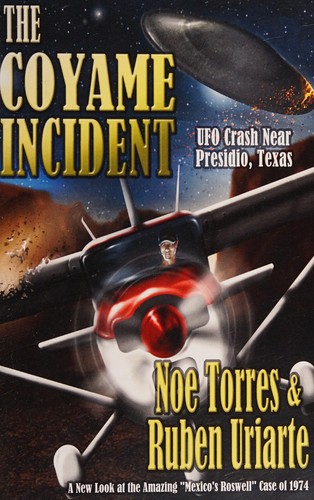
The Coyame Incident
UFO Crash Near Presidio, Texas — The Fullest Documented Form of a Claim With No Named Witness, and What Two Researchers Found When They Went Looking
Find on Amazon →As an Amazon Associate, OverClassified may earn from qualifying purchases made through this link, at no extra cost to you.
Why This Is Essential Reading
Read it for the claim's fullest form and for an honest record of what serious effort against an unfalsifiable story produces. Torres and Uriarte did the right things: they went to Chihuahua, they interviewed in Spanish, they sought regional testimony, they engaged the mundane smuggling-corridor explanation, and they had recovered material analysed. None of it corroborated the story, because the story has no named witness, no contemporaneous document, and no chain of custody on any physical exhibit — and its earliest surviving form is an anonymous 1992 letter published in 1994 by a researcher who said he doubted it. This site's Coyame case file scores the claim 9 out of 100. This book is why that assessment can be made with confidence rather than by dismissal, and that is a real service.
Related Cases & Theories
Sources Cited
- Torres, Noe, and Ruben Uriarte. The Coyame Incident: UFO Crash Near Presidio, Texas. CreateSpace / Roswell Books, 2013, 158 pp. ISBN-10 1492191892 / ISBN-13 9781492191896. amazon.com
- AbeBooks bibliographic record, The Coyame Incident: UFO Crash Near Presidio, Texas, ISBN 9781492191896 — edition and format data. abebooks.com
- BetterWorldBooks listing, The Coyame Incident — independent bibliographic confirmation and publisher description identifying the book as a follow-up to Mexico's Roswell. betterworldbooks.com
- The StoryGraph edition record, The Coyame Incident by Noe Torres and Ruben Uriarte — reader-side bibliographic record. thestorygraph.com
- Biblio bibliographic record, ISBN 9781492191896 — independent bookseller listing. biblio.com
- Amazon Spain listing, The Coyame Incident, ASIN 1492191892 — independent confirmation of the ASIN. amazon.es
- eBay listing archive for The Coyame Incident: UFO Crash near Presidio, Texas by Noe Torres and Ruben Uriarte — independent confirmation of the 2013 trade paperback edition. ebay.com
- Torres, Noe. Mexico's Roswell: The Chihuahua UFO Crash, 2nd ed., 2007 — the authors' first treatment of the same claim. OverClassified breakdown
- Stonehill, Paul, and Philip Mantle. Russia's Roswell Incident, 2012, Noe Torres ed. — the same genre and the same editorial hand. OverClassified breakdown
- Friedman, Stanton T. Top Secret/MAJIC, 1996 — the defining controversy of the early-1990s anonymous-document wave this claim belongs to. OverClassified breakdown
- OverClassified case file, Coyame, Mexico UFO Crash Claim — source for the February 1992 anonymous 'J.S.' letter and the unverified 'Deneb Team' claim, Elaine Douglass's receipt of it, Leonard Stringfield's 1994 publication with stated doubts, the claimed craft dimensions and 22:07–22:30 timing, the documented 1974 drug-smuggling corridor and the 1980 narcotics-aircraft recovery in the same area, the inconclusive lab results on the Torres and Uriarte fragments, and this site's Disputed / 9-out-of-100 assessment.
- OverClassified case file, The Roswell Incident — the crash-retrieval template every subsequent claim of this class is measured against.
- OverClassified essential-reading breakdown, Crash: When UFOs Fall From the Sky (Kevin D. Randle) — a survey of the crash-retrieval genre by a researcher who came to doubt most of it.
Have corrections, additional research, or peer-reviewed sources? Help improve this entry.
Suggest an Edit