
Russia's Roswell Incident
And Other Amazing UFO Cases From the Former Soviet Union — The English-Language Record of a Case the USSR Academy of Sciences Actually Investigated
Core Thesis
Russia's Roswell Incident: And Other Amazing UFO Cases From the Former Soviet Union exists because of a language barrier. For four decades the Soviet Union generated a substantial body of UFO reporting, official investigation and material analysis that Western researchers could not read, could not verify, and mostly could not obtain — and when fragments of it did surface in English they arrived through third-hand summaries whose provenance was untraceable. Paul Stonehill, a Soviet émigré who founded the Russian Ufology Research Center, and the veteran British researcher Philip Mantle set out to close that gap. Their central case is the January 29, 1986 crash on Dalnegorsk's Height 611, and the book's specific claim to attention is not that a UFO crashed there but that the recovered material went through a genuine, documented, multi-institute analysis chain inside the USSR Academy of Sciences — roughly eleven research institutes and three academic centres — producing findings several credentialed Soviet specialists stated on the record they could not explain. Around that spine the book assembles Tunguska, Voronezh, Kapustin Yar, and cosmonaut and military sighting reports. It is a compilation rather than an investigation, and its value is entirely a function of the archive it opens.
About the Author
Paul Stonehill is a Soviet-born researcher who emigrated to the United States and founded the Russian Ufology Research Center, and his qualification for this book is one no American or British researcher could replicate: native Russian, direct familiarity with Soviet institutional structures, and access to the regional and specialist Russian-language literature that constitutes almost all of the primary record for these cases. Almost every English-language account of a Soviet UFO case published since the 1990s passes through Stonehill's translation work somewhere in its chain of custody, which makes him simultaneously indispensable and a single point of failure.
Philip Mantle is a long-serving British researcher, formerly MUFON's Director of Investigations for England and a co-author across several international case books; his work on the alleged Roswell 'alien autopsy' footage and on Eastern European cases made him one of the few UK figures with a sustained interest in the non-Anglophone record. This site's library already carries his Pascagoula Uncovered (2025) and his and Stonehill's separate The Soviet UFO Files, and the two books should be read as companions rather than substitutes: The Soviet UFO Files is the broader survey, this is the case-led one.
The book was edited by Noe Torres, himself the author of several UFO case studies including Mexico's Roswell — a small but relevant detail, since the editorial hand belongs to someone working the same 'regional crash claim, documented as fully as the record allows' genre. The house style is visible: heavy on primary testimony, light on interpretive framing, structured case by case.
The publishing arrangement is worth stating plainly because it bears on the book's apparatus. This is a CreateSpace title — self-published through Amazon's print-on-demand platform — running 302 pages, released May 26, 2012. That is not a mark against the content, but it does mean there was no external editorial fact-check, no institutional imprint standing behind the translations, and no independent verification of the Russian-language sources by anyone outside the two authors. For a book whose entire value proposition is access to an archive the reader cannot check, that is the central limitation.
Historical Context & Origins
Soviet UFO reporting operated inside an institutional structure with no Western equivalent. From 1978 a centralised, multi-institute reporting and evaluation network operated under physicist Yuli Platov of IZMIRAN, examining thousands of reports through to 1990 with a documented institutional preference for conventional and especially aerospace-related explanations — a bias that had a straightforward cause, since a large share of anomalous sightings in Soviet airspace really were classified launches from Plesetsk, Kapustin Yar and Baikonur. Understanding that this network existed, and what it was for, is the single most useful piece of context for reading any Soviet UFO claim.
Regional investigators like Valeri Dvuzhilny, who headed a Far Eastern Committee for Anomalous Atmospheric Phenomena, operated in a looser orbit around that ecosystem — credentialed enough to route physical samples into real state laboratories, but personally a committed regional investigator rather than a fixture of the Moscow scientific establishment. That intermediate position is exactly what produced the Dalnegorsk analysis chain, and it is why the case has an evidentiary texture unlike almost any Western equivalent.
The book's timing matters too. It appeared in 2012, more than two decades after the Soviet collapse, at a point when the archives had been partially opened, many of the original investigators were still alive, and a generation of Russian-language regional publication had accumulated with essentially no English-language readership. Stonehill and Mantle were harvesting a window that has since narrowed again.
One further piece of context the book leans on heavily: the deliberate parallel with Roswell. The framing is a marketing decision as much as an analytic one, and it cuts both ways. Dalnegorsk resembles Roswell in having a crash claim, recovered material and official involvement; it differs in that the material analysis is documented, contemporaneous and institutional rather than reconstructed from testimony four decades later. Readers should hold both halves of that comparison.
Core Arguments & Key Concepts
Dalnegorsk has a physical-evidence chain that most crash claims do not. The book's strongest argument, and the one this site's own Dalnegorsk Height 611 Crash case file independently confirms: Dvuzhilny's recovered material — fine metallic mesh, glassy lead-bearing beads, scorched rock and vegetation — was routed not through a single sympathetic laboratory but through roughly eleven research institutes and three academic centres of the USSR Academy of Sciences. Whatever the material was, the chain of analysis is real and documented.
Some of those analyses reported anomalies their own authors could not explain. Elements that appeared to disappear and reappear under vacuum heating; a mesh structure some specialists could not identify as any known industrial or natural process; gold concentrations far beyond anything economically present in local ore. These are the findings the book builds on, and they are attributable to named Soviet specialists rather than to the authors.
The Soviet record is large and largely unread in English. Beyond Dalnegorsk the book surveys the Voronezh landing, the Kapustin Yar reports, cosmonaut sightings, and military encounters — a body of material whose sheer volume is itself an argument that the phenomenon was not a Western cultural artefact.
Tunguska belongs in the conversation, cautiously. The 1908 Siberian event gets full treatment, including the exotic-hypothesis literature that has surrounded it since the 1940s. This is the book's weakest structural decision: Tunguska has a well-supported conventional explanation as an airburst of a stony asteroid or cometary body, and folding it into a UFO casebook lends the surrounding material an atmosphere of unresolved mystery that the physics does not support.
What the book does not do. It does not adjudicate. Stonehill and Mantle present the record, including the sceptical Soviet findings, and largely leave the reader to weigh it. That restraint is a genuine virtue in a self-published casebook, and it is also why the book cannot substitute for a critical case assessment — for Dalnegorsk specifically, the countervailing evidence (a lead isotope signature traced to a real known Siberian ore deposit hundreds of miles away, and Jacques Vallée's hands-on 1990 examination) needs to be weighed alongside the anomalies, and this site's own case file does that work. The clearest single instance: the lead in the recovered spheres was isotopically traced to the Kholodninskoye deposit rather than to local Dalnegorsk ore, which establishes a terrestrial origin for at least part of the recovered material and is not something a crash-claim casebook can leave in a footnote.
Key Cases & Evidence Discussed
The Dalnegorsk Height 611 crash (Primorsky Krai, January 29, 1986). More than a hundred residents of the lead-zinc mining town of Dalnegorsk watched a reddish-orange luminous sphere roughly three metres across cross the sky, 'jerk' as if faltering, and descend onto Height 611 (Mount Izvestkovaya), where it burned for close to an hour. No occupants, no structure, no manoeuvre under apparent intelligent control was ever documented. This site's case file is stamped Disputed and carries follow-on sightings from February 8, 1986 and November 28, 1987.
The recovered material and the analysis chain. The book's core. Dvuzhilny's collection and the eleven-institute analysis are covered in the detail the English-language literature otherwise lacks entirely, and this is the specific reason this site's Dalnegorsk file cites the book as the definitive English treatment.
The Tunguska event (Yeniseysk Governorate, June 30, 1908). Given full-chapter treatment and framed around the exotic-spacecraft hypothesis that Alexander Kazantsev popularised in 1946. Readers should treat this chapter as a history of a belief rather than as a live scientific controversy.
The Voronezh landing (September 1989). The mass-witnessed park landing reported by TASS itself, which briefly made Soviet UFO reports front-page news worldwide. See this site's Voronezh Landing file.
Kapustin Yar. The Soviet missile test range that accumulated a long sighting record and, in Western UFO literature, a persistent 'Soviet Roswell' legend of its own. This site's Kapustin Yar UAP Sighting file covers it.
Cosmonaut and military reports. A recurring category throughout the book. These are the cases where the Platov network's aerospace-explanation bias is most obviously relevant, and where a reader should be most alert to the possibility that the object really was a classified launch.
Critical Reception & Controversies
Formal critical reception is essentially nonexistent, which is the standard situation for a self-published UFO casebook and needs saying rather than papering over. The book has accumulated reader ratings in the 4.0–4.7 range across two Goodreads listings on small sample sizes, and no substantive published review by a subject specialist has been identified.
The strongest criticism a serious reader can make is about verifiability rather than content. Nearly every primary source in the book is a Russian-language document, interview or regional publication that an English-speaking reader cannot check, translated and summarised by one of the two authors, with no independent scholarly apparatus behind it. That is not a reason to disbelieve the book; it is a reason to treat it as testimony about an archive rather than as the archive itself.
The Tunguska inclusion is the clearest editorial misjudgement. The 1908 event is one of the best-studied natural impact events in history, with a strong scientific consensus behind an atmospheric airburst; presenting it inside a UFO casebook without foregrounding that consensus imports unearned mystery into a book whose actual best case does not need it.
The sceptical counter-record is more specific than the book acknowledges, and a reader should know it. Jacques Vallée, who travelled to the Soviet Union with Martine Castello in 1990 and was shown a Dalnegorsk sample at a Moscow UFO exhibition arranged through the geologist Alexis Zolotov and the writer Alexander Kazantsev, wrote afterwards that the examination "although obviously cursory and informal, reinforced my impression that the object in question was an ordinary piece of human technology, although it certainly was intriguing." The isotope work points the same way: the lead in the recovered spheres was traced not to the local Dalnegorsk ore body but to the Kholodninskoye deposit — that is, to a real, identifiable, terrestrial source. Neither finding closes the case, since neither accounts for every reported anomaly in the mesh material, but a book presenting Dalnegorsk as Russia's Roswell owes its reader both of them prominently rather than in passing.
Against that, the book earns real credit for reproducing the Soviet sceptical findings rather than suppressing them. A less scrupulous compilation would have presented the eleven-institute anomalies and omitted the lead isotope trace to a known Siberian ore deposit. Stonehill and Mantle's willingness to include material that cuts against their own framing is the best evidence available that the rest of their reporting is being handled honestly.
This site's own assessment of the underlying case is more cautious than the book's, and the divergence is instructive. The Dalnegorsk case file stamps the case Disputed and notes that it remains genuinely contested precisely because there are real witnesses and a real sustained state-scientific investigation, but no craft, occupant or intelligent manoeuvre was ever documented, and no single explanation has satisfied everyone who has examined the material.
Influence & Legacy
This book, together with Stonehill and Mantle's The Soviet UFO Files, is the reason Dalnegorsk is a case Western researchers can discuss at all. Before their work the English-language literature carried a paragraph-length summary, usually garbled, usually without the analysis-chain detail that is the case's entire evidentiary interest. Almost every subsequent English treatment of Height 611 traces back through these two volumes.
It also demonstrated a model worth more attention than it has received: pairing a native-language researcher with an experienced Anglophone investigator to move a national case record across the language barrier. The same gap exists for the Chinese, Brazilian, Iranian and Japanese records, and it is largely still open. This site's own library carries a handful of comparable bridging works — UFOs Over Modern China, UFOs Over Africa — and the shortage of them is a real structural weakness in the field.
Within this site's library it is used exactly as its record supports: as the definitive English-language account of what the Soviet investigation of Dalnegorsk actually consisted of, cited by the Dalnegorsk case file, and cross-checked against the sceptical material rather than relied on for a conclusion.
One last point about why a book like this matters more than its production values suggest. The Dalnegorsk material analysis is, on the documented record, among the most substantial physical-evidence investigations any state scientific establishment has ever conducted on a UFO-associated sample. That it exists at all is the important fact, and for English-language readers this book is where it exists.
The Book
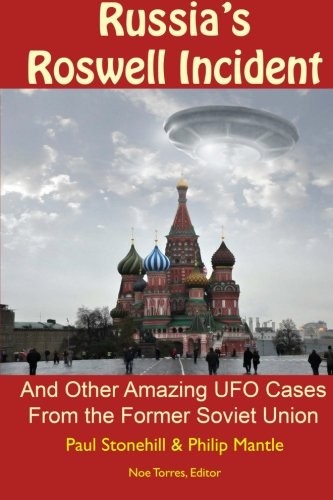
Russia's Roswell Incident
And Other Amazing UFO Cases From the Former Soviet Union — The English-Language Record of a Case the USSR Academy of Sciences Actually Investigated
Find on Amazon →As an Amazon Associate, OverClassified may earn from qualifying purchases made through this link, at no extra cost to you.
Why This Is Essential Reading
Read it for the archive, and keep this site's case file open beside it. Russia's Roswell Incident is a self-published compilation with no external editorial apparatus, and its Tunguska chapter is a genuine misjudgement — but it is also the only place an English-language reader will find the Dalnegorsk Height 611 investigation described in the detail that makes it worth discussing: a hundred-plus witnesses, a regional investigator with real institutional access, and a material-analysis chain running through roughly eleven institutes of the USSR Academy of Sciences that produced findings its own authors called anomalous. Stonehill and Mantle include the evidence that cuts against them, which is the best reason to trust the rest of their reporting. Treat the book as a translated primary record rather than as an argument, and go to this site's Dalnegorsk case file for the weighing.
Related Cases & Theories
Sources Cited
- Stonehill, Paul, and Philip Mantle. Russia's Roswell Incident: And Other Amazing UFO Cases From the Former Soviet Union. Noe Torres, ed. CreateSpace Independent Publishing Platform, May 26, 2012, 302 pp. ISBN-10 147523015X / ISBN-13 9781475230154. amazon.com
- Google Books record, Russia's Roswell Incident: And Other Amazing UFO Cases from the Former Soviet Union — bibliographic data. books.google.com
- ThriftBooks edition record, Russia's Roswell Incident by Philip Mantle and Paul Stonehill — publication and format data. thriftbooks.com
- Goodreads edition record, Russia's Roswell Incident — reader ratings (small sample) and edition history. goodreads.com
- BetterWorldBooks listing, Russia's Roswell Incident, ISBN 9781475230154 — independent bibliographic confirmation. betterworldbooks.com
- Project 1947, "Preliminary Catalogue of Analysis of Alleged Fragments from UAP" — the standing comparative catalogue of physical-sample analyses, including the Dalnegorsk material and the Kholodninskoye lead-isotope attribution. project1947.com
- International UFO Museum and Research Center (Roswell), "The Height 611 UFO Incident" — an institutional summary of the case, including Jacques Vallée and Martine Castello's 1990 Soviet visit, the Zolotov and Kazantsev introductions, and Vallée's "ordinary piece of human technology" assessment. roswellufomuseum.com
- HuffPost, "Russian Roswell UFO Debris Is Part Of Area 51 Exhibit At National Atomic Testing Museum" — mainstream coverage of the Dalnegorsk material's later museum display in Las Vegas. huffpost.com
- Stonehill, Paul, and Philip Mantle. The Soviet UFO Files: Paranormal Encounters Behind the Iron Curtain — the companion survey volume. OverClassified breakdown
- Mantle, Philip. Pascagoula Uncovered: Witnesses, Files & Audiotapes, 2025. OverClassified breakdown
- Torres, Noe. Mexico's Roswell: The Chihuahua UFO Crash, 2nd ed., 2007 — by this book's editor, in the same regional-crash-claim genre. OverClassified breakdown
- OverClassified case file, The Dalnegorsk Height 611 Crash — source for the January 29, 1986 sequence, Valeri Dvuzhilny's recovery of the metallic mesh, glassy lead-bearing beads and scorched material, the roughly eleven research institutes and three academic centres of the USSR Academy of Sciences, the vacuum-heating and gold-concentration anomalies, the lead isotope trace to a known Siberian ore deposit, Jacques Vallée's 1990 hands-on examination, and the Yuli Platov / IZMIRAN reporting network active 1978–1990.
- OverClassified case file, The Voronezh Landing — the September 1989 case reported by TASS.
- OverClassified case file, Kapustin Yar UAP Sighting — the Soviet missile range's sighting record.
- OverClassified essential-reading breakdown, UFOs Over Modern China — a comparable language-bridging compilation for a different national record.
- OverClassified essential-reading breakdown, UFOs Over Africa — likewise.
Have corrections, additional research, or peer-reviewed sources? Help improve this entry.
Suggest an Edit