
Mexico's Roswell
The Chihuahua UFO Crash, 2nd Edition
Core Thesis
Mexico's Roswell: The Chihuahua UFO Crash is Noe Torres and Ruben Uriarte's book-length investigation of the claimed August 25, 1974 UFO crash near Coyame, Chihuahua, Mexico — a case this site's own Coyame, Mexico UFO Crash Claim file documents in exhaustive detail and rates DISPUTED, tracing the entire story to a single anonymous 1992 letter with no named eyewitness ever identified. First self-published in 2007 through Virtualbookworm.com Publishing and reissued in an expanded second edition through Lulu Press in 2008, the book followed rather than preceded television coverage of the case — Uriarte had already appeared as an expert commentator on History Channel's UFO Files episode "Mexico's Roswell" in 2005. This article treats the book as what it is: a genuine, sustained secondary-research effort into an extraordinarily thinly sourced claim, not an independent field investigation with firsthand witnesses of its own.
About the Author
Noe Torres has worked as a librarian at McAllen High School in Texas since 1999 and holds a Bachelor's in English and a Master's in Library Science from the University of Texas at Austin. A longtime MUFON member and former Texas state section director, he has built a prolific self-publishing career around Texas-Mexico border UFO cases specifically, authoring or co-authoring titles including Fallen Angel: UFO Crash Near Laredo, Texas (on a claimed 1948 case), The Other Roswell: UFO Crash on the Texas-Mexico Border, The Real Cowboys & Aliens: UFO Encounters of the Old West, and, with Uriarte and eyewitness Donald R. Shrum, Aliens in the Forest (2011) — already covered in full elsewhere on this site as its own Essential Reading entry on the Cisco Grove Encounter. Torres has also organized several regional UFO conferences in South Texas and appeared on Coast to Coast AM and the Jeff Rense Program.
Ruben Uriarte holds a Bachelor's in Psychology and Latin American Studies from California State University, East Bay (then Cal State Hayward), and has been a MUFON member for more than two decades, serving as the organization's Northern California state director and as its liaison to OMIFO, a Mexican civilian UFO research group. His involvement with the Coyame case predates this book by two years: he appeared as an on-camera expert in History Channel's 2005 UFO Files episode devoted to the case, meaning the television treatment brought him into the story before he and Torres turned it into a book.
One detail on the book's own cover is worth correcting directly, since it circulates inaccurately elsewhere, including in this site's own prior citation of the book: Stanton T. Friedman's contribution is credited on the cover itself as an afterword, not a foreword, and appears alongside cover-blurb endorsements from George Noory and Jim Marrs rather than as a substantive introductory essay. This article corrects that framing rather than repeating the more commonly circulated "foreword" description.
Historical Context & Origins
The Coyame story's actual documentary trail is unusually short and unusually well-established as short: this site's own case file traces it entirely to an anonymous 1992 letter, signed only "J.S." and claiming membership in an unverified "Deneb Team," which researcher Elaine Douglass passed to Leonard Stringfield, who published the full text in his 1994 UFO Crash Retrievals Status Report VII while noting the real risk that it might be, in his own words, "a bunch of baloney." Torres and Uriarte's 2007 book is, by two decades, a downstream elaboration of that single anonymous document rather than an independent original investigation.
The case's actual public visibility arrived through television before this book did: History Channel's UFO Files devoted an episode, "Mexico's Roswell," to the case in 2005, with Uriarte appearing as an expert commentator, and the network's UFO Hunters followed with an episode titled "Crash and Retrieval" in February 2008, shortly after this book's second edition. That sequence — television coverage first, book-length treatment second, expanded second edition following further television attention — is a pattern common to several of Torres's other border-UFO titles and worth noting as context for how the case's public profile actually built, rather than assuming the book was the original source of public interest.
Torres and Uriarte went on to publish a further, more extensive standalone treatment of the same case, The Coyame Incident: UFO Crash Near Presidio, Texas (2013), incorporating additional secondhand regional testimony gathered in the intervening years and laboratory analysis of small metal fragments the authors say are associated with the crash site. This site's own case file covers that 2013 book's specific claims, and Kevin Randle's published critical review of it, in far greater depth than a review of the original 2007 volume needs to repeat; readers wanting the fullest evidentiary accounting, including the metallurgical lab results, should consult that case file directly.
Core Arguments & Key Concepts
The book's central narrative follows the anonymous 1992 account closely: a U.S. radar operator allegedly tracking an unidentified object crossing from the Gulf of Mexico at extreme speed, a mid-air collision with a small civilian aircraft, a silver disc recovered by Mexican military forces near Coyame, and a subsequent covert American extraction effort after the Mexican recovery convoy was reportedly found dead. Torres and Uriarte's contribution is to contextualize this account within the region's broader history and to seek out whatever additional regional testimony and detail could still be gathered more than three decades after the claimed event, rather than to supply a new firsthand witness in place of the original anonymous source.
Some retellings of this case that circulate online attach additional specific details — a named local witness, or a direct connection to a specific regional drug trafficker — that this article could not verify against either this book's own confirmed content or any independent source, including a biographical Wikipedia entry for the trafficker in question that makes no mention of the case at all. This article does not repeat those specific unverified details as fact, consistent with this site's practice of flagging claims it cannot independently substantiate rather than silently passing them along.
By the authors' own account, quoted in this site's case file from a review of their companion 2013 book, Torres and Uriarte are candid in their own presentations about the case's evidentiary limits, stating plainly that "the evidence is definitely thin." That kind of self-aware hedging, present in their own public talks even as their books present the fullest possible case for the claim's plausibility, is a genuinely distinguishing feature of their approach compared to less careful crash-retrieval literature.
Key Cases & Evidence Discussed
This site's own Coyame, Mexico UFO Crash Claim case file documents the full evidentiary picture — the anonymous 1992 letter's exact content and chain of custody, the complete absence of any named eyewitness or FAA record, the inconclusive metallurgical lab results from later fragment analysis, and the far better-evidenced 1980 narcotics-plane crash in the same immediate area this site's own research treats as the likelier real-world seed of the story — in far greater depth than this book review needs to repeat, and readers wanting the complete, evenly weighted account should read that case file directly rather than relying on this book alone.
What is specific to this particular volume, as distinct from the case generally, is its place as the first book-length treatment: it established the narrative framework in print that both the 2013 expanded follow-up and this site's own case file now work from and critically examine, and its publication followed rather than preceded the case's initial television exposure via History Channel's 2005 UFO Files episode.
Critical Reception & Controversies
As of this article's research (August 2026), the book's reception on Goodreads is split across at least three separate edition listings with very small sample sizes: one Kindle-edition listing shows 4.50 out of 5 from just 2 ratings, a second listing shows 4.20 from 10 ratings and 1 written review, and the second-edition listing specifically shows 4.00 from 5 ratings with no written reviews. None of these samples is large enough to support a confident reception assessment, and this article presents them as such rather than as a settled consensus.
The book's cover and marketing lean on endorsement quotes from Coast to Coast AM host George Noory, UFO/conspiracy author Jim Marrs, and Stanton T. Friedman's afterword — promotional support from recognizable ufology-adjacent figures rather than independent critical reviews. This article could not locate any trade or mainstream press review of the book, nor any Amazon aggregate rating, due to repeated access errors when attempting to fetch Amazon's own product pages directly.
The most substantive independent assessment of the underlying case comes from fellow UFO researcher Kevin Randle, whose review of Torres and Uriarte's companion 2013 volume — quoted at length in this site's own case file — credits the authors' research diligence while concluding the evidentiary base remains "definitely thin" and that the case "cries out for more data." That assessment, made by an experienced UFO investigator rather than an outside skeptic, is the closest thing to a critical review this case has received, and this article treats it as directly applicable to the case Torres and Uriarte's original 2007 book first brought to book-length treatment.
Influence & Legacy
The book's clearest measurable impact runs through television rather than print: the case's History Channel exposure across UFO Files (2005) and UFO Hunters (2008) gave it a mainstream visibility that this self-published, thinly-reviewed title likely would not have achieved through book sales alone, and that same made-for-television framing — "Mexico's Roswell" as a marketable label — has stuck as the case's most common public name ever since.
Within Torres and Uriarte's own body of work, this book is one entry in a broader, career-spanning project cataloguing Texas-Mexico border UFO claims specifically, sitting alongside their already-covered Aliens in the Forest and their other border-focused titles; read across that body of work, the Coyame case is best understood as one of several claims the pair has worked to document and contextualize with broadly similar methods and broadly similar evidentiary limits.
The Book
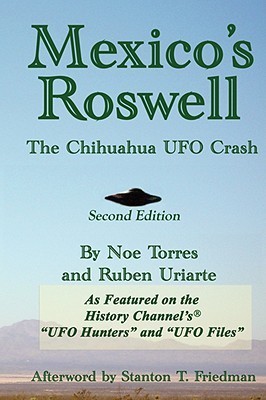
As an Amazon Associate, OverClassified may earn from qualifying purchases made through this link, at no extra cost to you.
Why This Is Essential Reading
Mexico's Roswell earns a place on this reading list not because it resolves the Coyame case — it does not, and this site's own far more exhaustive Coyame, Mexico UFO Crash Claim file treats the underlying story as one of the thinnest-evidenced crash-retrieval claims in its entire archive, resting on a single anonymous, unverifiable 1992 letter that no subsequent investigation, including this book's own, has ever traced to a real, named original source — but because it represents the first sustained attempt to give that claim a book-length historical and regional context, later expanded in the authors' own 2013 follow-up. Readers should approach it exactly as this article does: as a genuine secondary-research effort into an extraordinarily thin original claim, best read alongside this site's own case file and Kevin Randle's independent assessment that the evidence "cries out for more data," rather than as a documented crash-retrieval case in its own right.
Related Cases & Theories
Sources Cited
- Torres, Noe, and Ruben Uriarte. Mexico's Roswell: The Chihuahua UFO Crash, 2nd ed. Lulu Press, 2008 (ISBN 0981759718 / 9780981759715; 1st ed. Virtualbookworm.com Publishing, 2007, ISBN 1602640130 / 9781602640139). amazon.com
- "Mexico's Roswell: The Chihuahua UFO Crash, 2nd Edition." Goodreads (reader rating 4.00/5, 5 ratings, as fetched Aug 2026). goodreads.com
- "Mexico's Roswell: The Chihuahua UFO Crash." Goodreads (separate edition listing, 4.20/5, 10 ratings, 1 review). goodreads.com
- "Mexico's Roswell: The Chihuahua UFO Crash, 2nd Edition." Lulu (publisher's own product listing). lulu.com
- "Mexico's Roswell." Google Books entry (table of contents, confirming Friedman's contribution is listed as an afterword). books.google.com
- Randle, Kevin. "The Coyame UFO Crash." Kevin Randle's blog, 2013 (critical review of Torres and Uriarte's companion 2013 volume and the case's evidentiary gaps). kevinrandle.blogspot.com
- "UFO Files: Mexico's Roswell" (2005). IMDb (television episode preceding the book, featuring Ruben Uriarte). imdb.com
- "UFO Hunters: Crash and Retrieval" (2008). IMDb (History Channel episode following the book's second edition). imdb.com
- "McAllen High Librarian Publishes Book Disclosing 1800s UFO Sightings." Texas Border Business (background on Noe Torres's career and bibliography). texasborderbusiness.com
- "Ruben Uriarte." Coast to Coast AM guest page (biographical background, MUFON Northern California role). coasttocoastam.com
- "Pablo Acosta Villarreal." Wikipedia (independent biography of the regional drug trafficker sometimes linked to this case in secondary retellings; the article makes no mention of any UFO connection). en.wikipedia.org
- This site's own Coyame, Mexico UFO Crash Claim case file, drawing on the original 1992 Deneb Team letter, Leonard Stringfield's 1994 publication of it, and Kevin Randle's full critical review (complete sourcing documented there).
Have corrections, additional research, or peer-reviewed sources? Help improve this entry.
Suggest an Edit