
The Cisco Grove Encounter
On the night of September 4–5, 1964, Donald Shrum, a bow hunter in his late twenties who worked at Aerojet General’s missile plant near Sacramento, got lost near Cisco Grove in California’s Sierra Nevada and spent the night in a pine tree. He told an Air Force interviewer that lights circled him, that two silver-suited figures and a “robot” tried to dislodge him, that a vapor knocked him out, and that he fired arrows and threw burning clothing at them. The Air Force kept his dented arrow and taped interview and filed the case as “Other (Psychological).” Later retellings added a cigar-shaped mother ship, goggled beings and a twelve-hour siege.
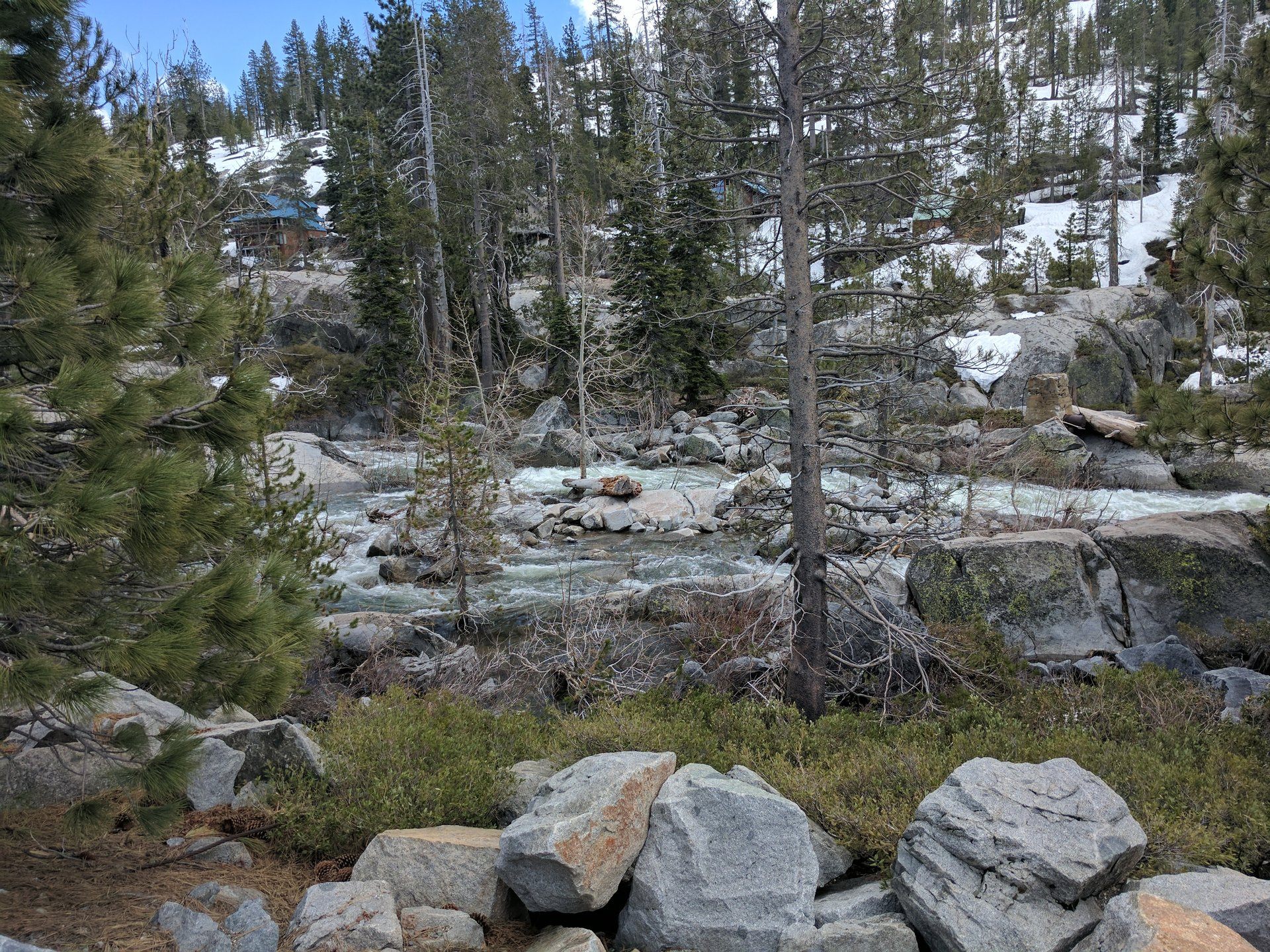
Pictured: Hampshire Rocks in the Tahoe National Forest, granite outcrops and conifer forest along the Yuba River corridor typical of the Sierra Nevada terrain near Cisco Grove — not the actual clearing and pine tree where Donald Shrum spent the night in September 1964. The precise site was never publicly pinpointed or photographed at the time, so this image represents the surrounding wilderness rather than the exact location.
Theoretical Alignment
Proponents read the case as an Extraterrestrial Hypothesis encounter because of the reported landing, the humanoid figures and the “robot.” The Air Force file points the other way: Blue Book attributed the encounter to psychological causes, and the Foreign Technology Division asked whether owls or other animals and an overactive imagination could explain it. A lost, cold, frightened man alone in a tree overnight is a setting in which psychological explanations deserve serious weight, though they have never been tested against the witness, who was described in 1964 as stable and consistent. The physical evidence consists of one dented arrow.
Background
The Cisco Grove encounter of September 4–5, 1964 is one of the best-known “siege” cases in UFO literature: a witness who, instead of watching from a distance, describes an hours-long standoff from a tree. The sole witness to the figures, Donald Shrum, was a married man in his late twenties from Orangevale, near Sacramento, who worked at Aerojet General’s missile plant (the Air Force message gives his age as about 27; later sources say 28).
The encounter took place in the Tahoe National Forest near Cisco Grove, in the Sierra Nevada, in granite and conifer country around the Loch Leven Lakes. On the Labor Day weekend of 1964 Shrum and two companions, Vincent Alvarez and Tim Trueblood, drove up from the Sacramento area to hunt deer with bows; the party had taken out a fire permit at a nearby ranger station.
Aerojet General’s plant near Sacramento was then building liquid-propellant engines for the Titan missile and the Apollo service module, and the Air Force message describes Shrum’s employer simply as “a local missile production plant.” His job there has often been described as missile tracking technician; the 1964 documents do not give a title. His concern for his job is documented: he told Killick he did not want the story in the newspapers or his name made public.
Complete Timeline
| Date/Time | Event |
|---|---|
| Sept 4, 1964 (late afternoon) | Separation. Donald Shrum and two companions, bow-hunting for deer in the Loch Leven Lakes area south of Cisco off Highway 40, split up. As darkness falls Shrum realizes he is lost and decides to stay put until dawn. |
| Sept 4, 1964 (dusk) | Lights and signal fires. He sees lights moving along a ridge, takes them for a helicopter searching for him and lights signal fires (three, in the Air Force account). The lights approach and circle at an estimated 50–100 feet. |
| Sept 4–5, 1964 (night) | The figures. Hearing crashing in the brush, he climbs a pine. Two human-like figures about five feet tall in silver-like suits, and later one or two “robot”-like objects, come to the tree. A vapor from the robots makes him gag and black out; his bow, wedged in a limb, keeps him from falling, and he later straps himself to the tree with his belt. |
| Sept 4–5, 1964 (night) | Arrows and fire. He fires arrows (three, per Killick’s letter), one of which hits a robot “with a metallic sound,” and sets fire to parts of his camouflage clothing and drops them; the figures react and withdraw. |
| Sept 5, 1964 (dawn) | Dawn. He comes to at first light, finds everything gone and rejoins his companions, who suggest the lights had to do with a meteorite the government was looking for. |
| Sept 5, 1964 | First report. His mother-in-law telephones Victor W. Killick of the Sacramento City College observatory, who speaks to Shrum. |
| Sept 9, 1964 | Killick’s letter. After meeting Shrum, his wife and brother, who bring the arrow with a dented point, Killick writes to the commander at Mather AFB. |
| Sept 21–25, 1964 | Air Force interview. Capt. McCloud and SMSgt R. Barnes of the 552nd AEW&C Wing at McClellan AFB interview and tape Shrum; the wing reports the sighting on September 25. |
| Oct 8, 1964 | Specimens forwarded. The tape, the arrowhead and Killick’s letter go to the Foreign Technology Division. Project Blue Book concludes “Other (PSYCHOLOGICAL).” |
| 2011 | The later account. Noe Torres and Ruben Uriarte publish Aliens in the Forest, with contributions credited to Shrum and his wife Judi, presenting the fuller version with a cigar-shaped craft, goggled beings and a second robot. |
Two Versions of the Night
The Cisco Grove encounter exists in two layers that should not be blended. The first is the contemporaneous record: a letter written on September 9, 1964 by Victor W. Killick, who ran the astronomical observatory at Sacramento City College and was the first outsider the witness spoke to, and the U.S. Air Force file opened after Donald Shrum was interviewed at McClellan Air Force Base later that month. The second is the fuller, more dramatic account that Shrum and his family gave decades later, published by Noe Torres and Ruben Uriarte in Aliens in the Forest (2011) and repeated in podcasts and documentaries. This page sets out both, and notes where they differ.
The 1964 Account: Killick’s Letter
On Saturday, September 5, 1964, a woman telephoned Killick at home; the Sacramento Union had referred her to him. Her son-in-law, she said, had seen strange lights in the sky the night before while hunting in the mountains, and wanted to know whether anyone else had reported them. Killick told her about a bright meteor seen over Los Angeles that had exploded over the Sierra east of Visalia, but that had been on Thursday night. She then put her son-in-law on the phone.
As Killick recorded it, the man said that on Friday, September 4, he and two companions had gone bow-hunting for deer in the region of the Loch Leven Lakes, south of Cisco off Highway 40. They separated in the late afternoon. As darkness came he realized he was lost, and rather than try to find his way back to camp over rough ground in the dark he decided to stay put until dawn. Killick added a check of his own: “This part of the story checks, as there was no moon that night.”
The man found a tree in a protected spot, climbed it and fastened himself to a branch with his belt. He then noticed a glowing light moving and hovering along a nearby ridge, laterally and vertically, without sound; some sort of vehicle appeared to land on the ridge. Shortly afterwards he heard someone approaching through the brush. Two human-like beings about five feet tall came to the tree and looked up at him; later two other, robot-like moving objects appeared, which emitted a noxious gas that made him gag and choke. He shot three arrows at them, one of which hit a robot “with a metallic sound” and was recovered later. Finally he tore off parts of his camouflage suit, set them alight with matches and dropped them, hoping to start a small fire that would bring the Forest Service; this, he said, made the visitors withdraw.
Killick learned that the man was married, worked at Aerojet General’s plant, and had a brother at the same plant; that the hunting party had obtained a fire permit at a nearby ranger station; and that the man knew his story was hard to believe and did not want it in the newspapers or his name made public. A few days later the man, his wife and his brother visited Killick with a Forest Service map marking the location and with “the arrow in question with a dented point.” Killick told them he was skeptical himself but would help them get to the bottom of it. They agreed to an Air Force investigation provided there was no publicity. “The family believes the man’s story,” Killick wrote; when he got home he was “as pale as a sheet” and badly shaken. Killick probed for an ulterior motive without finding one, and wrote that he had “a certain degree of confidence in their veracity and sincerity.” He sent the letter to the commanding officer at Mather Air Force Base.
The 1964 Account: The Air Force Interview
Intelligence officers at Mather passed the matter to McClellan Air Force Base, where Captain McCloud and Senior Master Sergeant R. Barnes of the intelligence branch of the 552nd Airborne Early Warning and Control Wing interviewed the witness on September 21 and taped the conversation. The wing’s message of September 25 summarized his statement. He had seen three objects, each with a protruding, rotating light, in the Loch Leven Lake area from early dusk; believing them to be a helicopter looking for him, he lit three signal fires on a ridge overlooking the Granite Creek valley. The lights, which he took to be three silvery objects, came toward him, appeared to drop two unknown objects, and circled his position at an estimated 50 to 100 feet. Within minutes he heard loud crashing in the underbrush coming his way and took refuge in the lower branches of a tall pine.
Two human-like figures in silver-like suits approached; he described them as having no visible neck and eyes that protruded markedly. He believed they tried to dislodge him from the tree. A third figure of a different type, which he called a “robot” for lack of a better word, appeared. He fired some arrows at the robot, but they failed to distract or divert any of the figures. He set fire to parts of his clothing and threw them, and the figures reacted violently; the objects overhead also rose in response to the fire. He reacted physically to a vapor emitted by the robots and blacked out; his bow, wedged in the crotch of a limb, kept him from falling, and later, under continued harassment, he climbed higher and strapped himself to the tree with his belt. The figures communicated with an unintelligible “cooing” noise. He regained consciousness at early dawn to find everything gone, rejoined his companions, and was told it probably had something to do with “the meteorite that the government was looking for.” His father-in-law urged him to contact the authorities.
The interviewers described the witness as about 27, married, employed at a local missile production plant, “stable and consistent in telling his story,” and convinced that it happened as described. In the taped interview he told Sergeant Barnes that he had since had a complete physical on his own initiative — electrocardiogram, chest X-rays, blood tests — because he worried about radioactivity or damage to his lungs, and that the only after-effect was a small pain in his chest, which might have come from clinging to the tree or the cold; his brother had heard a forecast of 36 to 65 degrees, and he had ended the night in just his T-shirt, having burned everything else.
The extract of the tape preserved in the file is short but natural in tone. Barnes runs through what Shrum recovered from the site — his canteen and the arrow — and asks whether the experience still bothers him; Shrum says he would not want to meet it again, and certainly would not want to have been on the ground. When Barnes remarks that the event happened about a week earlier, Shrum corrects him: it was about two weeks. Barnes’s closing comment, that it was a wonder he had not caught pneumonia, is a reminder of how cold and exposed the witness was through the night. Nothing in the extract suggests a man embellishing for an audience; it also contains none of the details that later made the story famous.
The Foreign Technology Division at Wright-Patterson asked for the tape and the arrow and put further questions to the interviewers, including whether the occurrence “could have been attributed to an owl or other such birds or animals, coupled with an overactive imagination on the part of the witness.” The wing forwarded the tape, the arrowhead and Killick’s letter on October 8, noting that the area could not be searched because it lay within a fire-danger closure. Project Blue Book recorded the case as “Sacto Area, California” and concluded “Other (PSYCHOLOGICAL)”: “Encounter with ‘beings’ attributed to psychological causes.” The arrowhead and the taped interview went into its specimen file.
The Later Account
The version most often told today comes from Shrum’s later retellings and from Aliens in the Forest, which credits Shrum and his wife Judi among its contributors. In it, Shrum, then 28, first took a white, zig-zagging light for a rescue helicopter and signaled to it; an enormous cigar-shaped craft then released a smaller scout ship. Two humanoids wearing what looked like “welding goggles” and a robot with “fiery orange eyes” came to the tree; the robot shot white vapor from its mouth that knocked him out. He shot arrows at the robot, and one strike produced a spark, suggesting a metal surface. He threw lighted matches and burning material, a second robot joined, and more vapor knocked him out again. The encounter is described as lasting most of the night, often rounded to twelve hours, and Shrum is said to have woken at dawn hanging from the tree by his belt. Hunting companion Vincent Alvarez is reported to have given a written statement that he too saw a bright craft that night.
Some elements of the later account — the cigar-shaped mother ship, the goggles, the glowing eyes, the spark, the second robot and Alvarez’s sighting — do not appear in the 1964 record. Others differ: in 1964 the lights were three round objects, the beings had protruding eyes and no neck, he fired three arrows (Killick) or “some arrows” that “failed to distract” the figures (Air Force), and his companions dismissed the lights as a meteorite. Retellings tend to grow; the 1964 documents are the closest record of what Shrum said at the time.
Where the Encounter Happened
The 1964 documents place the encounter in the Loch Leven Lakes area south of Cisco off old U.S. Highway 40, between Auburn and Truckee, on a ridge overlooking the Granite Creek valley; the Air Force message gives “eight miles from Cisco Grove.” The country is Sierra Nevada granite and conifer forest at roughly 5,600 to 6,800 feet. Early September nights there are cold, and there was no moon: the moon was a thin waning crescent, two days from new. The precise tree was never publicly identified, and the Air Force did not search the area because of the fire closure.
Shrum worked at Aerojet General’s plant near Sacramento, which built liquid-propellant rocket engines for the Titan missile and the Apollo service module. The Air Force message calls his employer “a local missile production plant.” Later accounts describe him as a “missile tracking technician” or a “missile defense contractor”; the 1964 documents do not give his job title, and claims once made on this page that he was trained in telemetry and atmospheric physics, was a military veteran and an expert archer, and first reported the case to APRO and NICAP under the pseudonym “Mr. S” have no documented source.
What the Physical Evidence Was
The documented physical evidence is small: one arrow with a dented point, which Shrum brought to Killick and which the Air Force kept in its specimen file, and Shrum’s statement that he burned most of his clothing. Earlier versions of this page described several bent arrows with flattened broadheads, a charred hunting cap recovered at the site, damage to the tree bark examined by investigators, and pseudo-technical analyses of the “blue sparks,” the arrows’ kinetic energy and the pharmacology of the gas. None of that rests on any examination; it was this page’s own speculation and has been removed. No laboratory analysis of the arrow, the site or the vapor was ever made.
The case reached the UFO literature through civilian researchers. Later bibliographies cite it in NICAP’s 1969 compilation Strange Effects from UFOs and in J. Allen Hynek’s The Hynek UFO Report (1977), which drew on Blue Book files, and the Lorenzens of APRO included it in Encounters with UFO Occupants (1976). Claims made here before that the Condon Committee’s 1969 report discussed the case, and that physicist James E. McDonald investigated it, have no documented basis.
The Air Force’s Follow-Up Questions
The Foreign Technology Division’s letter of October 2, 1964 is the most revealing document in the file, because it shows what the Air Force’s analysts thought needed checking. It asked the McClellan interviewers seven questions. Had they felt that the occurrence could have been attributed to an owl or other birds or animals, “coupled with an overactive imagination on the part of the witness”? Why had the witness believed the lights were a helicopter looking for him? How close had the two human-like figures come, and were the objects that reacted to his fire the same ones that had crashed through the brush? What form did the “violent reaction” to the fire take, and were the objects on the ground when he threw it? What harassment had driven him higher into the tree? Was the movable figure with a light described in detail? And what was the basis for calling him “mature and stable”?
The wing’s answers of October 8 were brief. To the first question the answer was “Yes”: the interviewers felt the experience could have been owls or other animals combined with imagination, adding that the area could not be searched because it lay in a fire-danger closure. He had thought the lights were a helicopter because he believed his companions had begun a search for him. The closest approach of the figures was about six to ten feet. Their reaction to the fire was to withdraw from the immediate area, and they were on the ground throughout. The harassment consisted of attempts to climb the tree or dislodge him. The movable figure with a light was described on the tape. The judgement that he was stable rested on an interview with a Sacramento City College instructor (evidently Killick) and on the interviewers’ own observations. The “psychological” conclusion on the Blue Book record card follows directly from that exchange.
Victor Killick, the First Investigator
Victor W. Killick had been in charge of the astronomical observatory at Sacramento City College for thirteen years in 1964. In his letter he explained that he regularly received calls from civilians, officials and the military asking him to identify things they had seen in the sky, that most turned out to be astronomical objects, aircraft or searchlights, and that “as yet, I have never had a hoax reported.” His first thought on hearing about lights in the Sierra was a bright meteor that had crossed Los Angeles and exploded over the mountains east of Visalia, but that had been on the Thursday night, a day too early.
Killick’s letter is valuable for its restraint. He recorded that he was skeptical, that he had tested the story against the moon (there was none), that he looked for an ulterior motive and found none, and that the family plainly believed the man. He offered to arrange a private meeting between the family and Air Force investigators. That is the route by which the case reached Mather and then McClellan, and it is why the Blue Book file is filed under “Sacto Area” rather than Cisco Grove.
Aerojet and the Witness’s Caution
Aerojet General’s plant at Rancho Cordova, about fifteen miles east of downtown Sacramento, was one of the largest rocket works in the country. The company built engines for every version of the Titan rocket, supplied propulsion for the Navy’s Polaris and for Minuteman, and was developing the main engine for the Apollo command and service module. Shrum and his brother both worked there. That background explains the caution Killick recorded: Shrum did not want his name in the papers or the story published, and the family agreed to an Air Force investigation only if there was no publicity.
His employer does not, however, make him a trained observer of aerial objects. Earlier versions of this page built a long argument on his supposed expertise in missile tracking, telemetry and atmospheric physics; the 1964 documents say only that he worked at a missile production plant. His reliability rests on what Killick and the interviewers observed of him, not on a job description.
Other “Siege” Cases
The Cisco Grove encounter is often grouped with two earlier American cases in which witnesses described being besieged by small figures at night. At Kelly, near Hopkinsville, Kentucky, on August 21–22, 1955, members of the Sutton and Taylor families said that small creatures with large pointed ears, claw-like hands and glowing yellow eyes repeatedly approached their farmhouse, and the men fired at them. Police, state troopers and military police from Fort Campbell found only broken windows and holes in screens. Project Blue Book classified the case as a hoax; Joe Nickell and Brian Dunning have argued that the families mistook great horned owls, which have yellow eyes and defend their territory aggressively.
At Flatwoods, West Virginia, on September 12, 1952, a group of local people investigating a light that came down on a hillside reported a tall figure with glowing eyes and a sickening mist; Nickell later proposed that they had seen a meteor and a barn owl perched in a tree. The parallels with Cisco Grove are clear enough — a night-time light, figures with striking eyes, a noxious gas or mist, frightened witnesses who fought back — and so is the shared conventional candidate the Air Force raised in 1964: owls seen by frightened people in the dark.
Reading the Two Accounts
The differences between the 1964 record and the later account follow a familiar pattern. Details that were uncertain at the time became definite (“robot-like moving objects” became a robot with “fiery orange eyes”); objects grew (three round lights became an enormous cigar-shaped craft releasing a scout ship); and the duration lengthened from a dusk-to-dawn night in which he spent long periods unconscious to a “twelve-hour” siege. Corroboration also appeared later: the companions’ 1964 reaction was to suggest a meteorite, while later accounts credit Vincent Alvarez with a written affidavit that he saw a bright craft. None of this shows that Shrum was dishonest. It shows why the earliest documents should be preferred where the versions conflict.
What both versions share is the core: a lost hunter in a tree, lights that came close, small suited figures and a mechanical “robot” at the foot of the tree, a choking vapor and loss of consciousness, arrows, and burning clothing thrown down. That core was told within a day of the event, to a skeptical stranger, by a man who did not want publicity, and it was told consistently to the Air Force two weeks later.
What Remains Unknown
Several things that would help settle the case are missing. The full Air Force tape has not been published; the Blue Book file contains only a short extract and a summary. The arrow’s later fate is unknown, and it was never examined. Neither companion appears by name in the 1964 documents, and Vincent Alvarez’s later statement has not been published in full. No ranger-station record of the party’s fire permit, or of any report that night, has been located. The exact tree was never identified, and the site was never searched. Shrum’s own later life is thinly documented; this site has not confirmed the date of his death.
The Setting: Loch Leven Lakes
The Loch Leven Lakes — Lower, Middle and High Loch Leven — lie in the Tahoe National Forest south of what was then U.S. Highway 40 and is now Interstate 80, near Big Bend and Cisco Grove. Today the trail to them starts on Hampshire Rocks Road just east of the Big Bend exit, crosses the railroad tracks, and climbs about 1,100 feet over granite benches before levelling out; the lakes sit at roughly 6,800 to 7,000 feet, about three to four miles from the trailhead. The country is open granite slabs broken by stands of pine and fir, with steep drops into the canyons on either side — easy ground to become separated on late in the day, and hard ground to cross safely in the dark, which is exactly the choice Shrum described making.
The Air Force message adds two details of place: the party had been hunting “between Auburn and Truckee on US Highway 40,” and Shrum lit his signal fires “on the ridge overlooking Granite Creek valley.” Its location line gives “eight miles from Cisco Grove.” Together with Killick’s “region of the Loch Leven lakes” and the Forest Service map the family brought to him, these place the encounter on the high ground south of the highway, though not at any precisely known spot.
How the Report Travelled in 1964
The paper trail shows how a civilian report reached Project Blue Book in 1964. The witness’s family went first to a local astronomer, Killick, who wrote to the nearest Air Force base, Mather. Mather’s intelligence officers passed the matter to McClellan, whose 552nd Airborne Early Warning and Control Wing interviewed the witness and reported the sighting under Air Force Regulation 200-2, the regulation then governing UFO reports, to Air Defense Command, the Air Force Systems Command and Headquarters USAF. The Foreign Technology Division at Wright-Patterson, which ran Blue Book, then asked for the specimens and put its questions; in the same letter it asked that future UFO reports be sent to it directly rather than to the Systems Command office at Andrews.
The whole exchange took about five weeks, from Shrum’s night in the tree on September 4–5 to the forwarding of the tape and arrow on October 8. No one from the Air Force visited the site, which was closed because of fire danger.
Blue Book’s Verdict in Context
Project Blue Book handled the two best-known close-encounter reports of 1964 very differently. Five months before Cisco Grove, on April 24, 1964, police officer Lonnie Zamora reported a landed object and two small figures at Socorro, New Mexico; after an investigation that included J. Allen Hynek, Blue Book left that case “Unidentified.” Socorro had a police witness, landing marks examined by investigators within hours, and a site that could be searched. Cisco Grove had one civilian witness, an unsearchable site and a single arrow, and its interviewers themselves thought owls and imagination could account for it. The “psychological” verdict was not a finding that Shrum was mentally ill; it recorded the Air Force’s view that the beings came from the witness’s state of mind that night rather than from anything physical.
Blue Book’s earlier treatment of the Kelly–Hopkinsville case, which it classified as a hoax, shows the alternative it did not choose here. Nothing in the Cisco Grove file suggests the Air Force thought Shrum was lying; the interviewers described him as convinced of what he reported.
The Case in Later Popular Culture
Cisco Grove became widely known only decades later. Torres and Uriarte’s Aliens in the Forest (2011) brought the fuller account to print, and the case has since been retold in online documentaries, including an episode of The Why Files, and in podcasts. Most of these retellings follow the later version — the cigar-shaped mother ship, the goggled beings and the twelve-hour siege — and few mention that the Air Force file still exists, or that its own interviewers thought owls could explain much of what Shrum saw. The 1964 documents are freely available on the Internet Archive and are the best place to start.
Witness / Key Figure Cards
Donald Shrum
The only witness to the figures. In 1964 he was about 27, married, living in Orangevale and working at Aerojet General’s missile plant near Sacramento. He told Victor Killick and Air Force interviewers that he spent the night of September 4–5 in a pine tree near Cisco Grove while silver-suited figures and robot-like objects tried to dislodge him. The Air Force interviewers found him “stable and consistent”; Project Blue Book attributed the encounter to psychological causes. His fuller account appeared in Aliens in the Forest (2011).
Vincent Alvarez
One of Shrum’s two hunting companions. In the 1964 Air Force account the companions, on hearing Shrum’s story at dawn, suggested the lights had to do with a meteorite the government was looking for; the file records no sighting of their own. Later accounts say Alvarez gave a written statement that he too saw a bright craft that night. Claims made here before that he was lost on a neighboring ridge, watched a red light making “non-ballistic” maneuvers, and saw damaged arrows and burned clothing the next morning have no documented source.
Tim Trueblood
Shrum’s second hunting companion. He is not named in the 1964 documents, which mention only that Shrum rejoined his companions at dawn. Claims made here before that he searched for Shrum and helped recover physical evidence at the tree have no documented source.
The Five Observables Assessment
The Five Observables framework is applied to the performance characteristics reported in this case:
Assessment: All four observables once marked Present rest on Shrum’s later retelling (a silent cigar-shaped craft that vanished at extreme speed). In the 1964 Air Force account the lights circled at 50–100 feet, emitted “cooing” noises and a “whirring sound,” and rose in response to his fire; no extreme acceleration or speed was described, and there was no radar to test low observability. The indicators are therefore Speculative at most.
Why "Disputed"
The Cisco Grove encounter is classified as Disputed. In favor of the account: the witness reported promptly, sought no publicity, had himself medically checked, and struck both Victor Killick and the Air Force interviewers as sincere and consistent. Against it: the figures, the gas and the robot rest on his testimony alone; the only physical evidence is one arrow with a dented point; the companions’ reported sighting appears only in later accounts; the story grew substantially between 1964 and 2011; and Project Blue Book concluded that the encounter had psychological causes. Earlier versions of this page also relied on a fabricated endorsement by James E. McDonald and a fabricated metallurgical analysis; both were removed before this review.
Sensor & Instrumentation Detection Profile
No radar or instrumental data exist for this case. The record consists of Shrum’s statements (to Killick on September 5–9 and on tape to the Air Force on September 21), one arrow with a dented point, and the Air Force correspondence. The Air Force did not search the site because it lay in a fire-danger closure.
Environmental & Geospatial Context
The encounter took place in the Loch Leven Lakes area of the Tahoe National Forest, in granite country at roughly 5,600 to 6,800 feet. There was no moon (Killick checked this; it was two days before new moon), and Shrum said the forecast had been 36 to 65°F. The ground was dry enough for a fire-danger closure. Steep, broken terrain explains how he became separated from his companions.
Observer Credibility & Occupational Profile
The case’s credibility rests almost entirely on one witness. In 1964 Killick, who said he had never had a hoax reported to him, probed for an ulterior motive and found none, and the Air Force interviewers described him as stable and consistent. He did not want publicity. That supports his sincerity, not the accuracy of every detail; the encounter with the figures was witnessed by no one else, and he was alone, lost, cold and frightened when it happened.
His account was not unchanged over the decades. The 1964 version has three round lights, figures with protruding eyes and no neck, a vapor that made him black out until dawn, and arrows that “failed to distract” the figures; the later version adds a cigar-shaped mother ship and scout craft, goggled beings, glowing eyes, sparks, a second robot and a twelve-hour siege. The claim made here before that the companions saw bent arrows and a charred cap, and that Alvarez’s sighting provides “critical corroboration,” is not supported by the 1964 record.
Physical & Material Assays
No laboratory examination of the arrow was ever conducted or published. A prior version of this case file claimed that “microscopic scrapings retrieved from the tips contained anomalous ratios of nickel and chromium”; no such analysis exists, and the claim was removed. No record shows that APRO or NICAP examined or photographed the arrow, which was in Air Force hands from October 1964.
The one arrow known to have been kept was not lost by a visiting investigator, as this page once said. Shrum brought it, with its dented point, to Killick, and it was later handed to the Air Force; the 552nd AEW&C Wing forwarded “the only arrow fired during this encounter” and the tape to the Foreign Technology Division on October 8, 1964, and Blue Book recorded the arrowhead and the taped interview in its specimen file. Its later fate is unknown.
Historical Precedents & Archive Matches
The Cisco Grove encounter shares notable similarities with other famous "siege" cases in UFO history, such as the Kelly-Hopkinsville encounter of 1955 and the Flatwoods Monster sighting of 1952. In these cases, witnesses reported being trapped and actively fending off entities that approached their positions. Both of those cases are described above under “Other ‘Siege’ Cases.”
Material Analysis
The physical evidence in the Cisco Grove encounter is one arrow. Shrum told Killick he shot three arrows, one of which hit a robot “with a metallic sound” and was recovered later; he brought that arrow, “with a dented point,” to Killick, and the Air Force kept it in the Blue Book specimen file with the taped interview. He also said he burned most of his clothing, ending the night in his T-shirt.
No examination of the arrow is recorded. A dented point is what an arrow shot at night from a tree would be expected to show if it struck rock, a stump or the ground, and it is equally consistent with Shrum’s account of hitting something metallic; the arrow cannot distinguish between them. Earlier descriptions on this page of two arrows with “flattened and dulled” broadheads, and of a charred hunting cap recovered at the site, have no source in the 1964 record.
Shrum maintained that he fired at close range at the figures and heard a metallic sound. In the 1964 account, however, the arrows “failed to distract or divert” the figures, and the “blue sparks” of later retellings are not mentioned; the later account speaks of a single spark.
Supporting Anomalous Origin
- Shrum produced one arrow with a dented point within days, before any publicity, and handed it to the Air Force
- He told a consistent story to Killick and to the Air Force interviewers, who judged him stable and sincere
- He sought a full medical examination on his own initiative, worried about radiation or lung damage
Supporting Conventional Explanation
- A dented arrowhead could result from striking rock or wood; no examination was made
- The figures, the gas and the robot were seen by no one else
- Project Blue Book attributed the encounter to psychological causes, and the Foreign Technology Division asked whether owls or other animals and an overactive imagination could explain it
- The account grew substantially between 1964 and its 2011 book-length telling
- The composition of the “knockout gas” was never identified, and the site was never searched
Conventional Explanation Candidates
To maintain analytical objectivity, we must evaluate three terrestrial or conventional explanation candidates for the events of September 4, 1964:
Candidate 1: Misidentified Great Horned Owls
InconclusiveThis was the Air Force’s own first question: the Foreign Technology Division asked whether the occurrence “could have been attributed to an owl or other such birds or animals, coupled with an overactive imagination on the part of the witness.” Great horned owls live in the Sierra, are about two feet tall, and their eyes shine in firelight. Plausibility Analysis: owls could account for glowing eyes and silent movement near a fire, but not for figures that tried to dislodge him, or for the vapor he described. The interviewers’ answer, on October 8, was “Yes.” The hypothesis remains possible for parts of the experience, though it cannot by itself explain the whole account as he told it.
Candidate 2: Psychological Hallucination or Sleep Paralysis
PlausibleThis is the conclusion Project Blue Book reached: “Encounter with ‘beings’ attributed to psychological causes.” Shrum was lost, cold (he burned most of his clothing, ending the night in a T-shirt), frightened, and spent the night strapped to a tree; he said he blacked out and woke at dawn. Exhaustion, hypothermia, the hypnagogic states of a night half-asleep, and panic can all produce vivid, frightening experiences, and lost hunters are well known to misread animals and firelit shapes. Plausibility Analysis: this explanation fits the setting and the Air Force’s own conclusion. Against it, Shrum struck Killick and the interviewers as stable and consistent, and he had a dented arrow that he said struck a robot. The companion sighting sometimes cited against this explanation appears only in later accounts.
Candidate 3: Secret Military/Aerojet Defense Tests
LowGiven Shrum’s employment at Aerojet General, some have suggested he stumbled on a classified test or exercise — remote-controlled equipment and technicians in protective suits testing a gas. Plausibility Analysis: no record of any such test in the Tahoe National Forest has surfaced, a chemical test in a national forest open to hunters during a fire closure would be hard to explain, and the 1964 account’s circling lights with a whirring sound would fit helicopters better than anything exotic. The hypothesis is unsupported by evidence either way.
Related Cases
Confirmed Documents & Official Records
The Blue Book file is filed as “Sacto Area, California.” It contains the record card (conclusion “Other (PSYCHOLOGICAL)”), the 552nd AEW&C Wing’s message of September 25, 1964, Foreign Technology Division correspondence, Victor Killick’s letter of September 9, and an extract of the taped interview; the arrowhead and tape went to the specimen file. A scanned copy is on the Internet Archive (item 1964-09-9421270-SactoArea-California). The link here is NARA’s general Blue Book guide.
UNCLASSIFIED (released via FOIA)National Archives holdings of Project Blue Book files, including the California cases of 1964.
UNCLASSIFIED (declassified)The Condon Committee’s final report (1969). No discussion of the Cisco Grove case has been found in it; it is listed here only as the main scientific study of the period.
UNCLASSIFIEDSearch Government Archives Directly
Further Reading — Recommended Literature
Aliens in the Forest
The only book-length account of the Cisco Grove encounter, presenting the fuller version Shrum and his family gave decades later; read alongside the 1964 Air Force file.
The UFO Experience
Hynek's seminal work introducing the close encounter classification system this case is analyzed under; this specific case is discussed in Hynek's later The Hynek UFO Report (1977), not in this 1972 volume.
Passport to Magonia
Vallee’s study of landing and occupant reports in the light of folklore, with a catalogue of landings to 1968; this site has not confirmed whether Cisco Grove is among its entries.
The UFO Evidence: Volume II
Hall’s documentary survey of reports from 1964 onward; this site has not confirmed its treatment of Cisco Grove.
DISCLOSURE: Some links above are affiliate links. If you purchase through them, OverClassified receives a small commission at no additional cost to you. This helps support independent research.
Essential Viewing
The Disturbing Cisco Grove Incident
A documentary overview of the September 4, 1964 event, covering Shrum's account, his background at Aerojet General, and the stand-off in the Tahoe National Forest.
Astonishing Legends: Battle at Cisco Grove
Detailed long-form audio investigation of the 1964 bow-hunting incident, reviewing Donald Shrum's timeline and the defense of the tree stand.
Donald Shrum Original Audio Interview
Archival recording of witness Donald Shrum detailing his terrifying overnight encounter and firing arrows at the humanoid entities.
Sources
- U.S. Air Force, Project Blue Book. “Sacto Area, California, 4 Sep 64”: record card (“Other (PSYCHOLOGICAL)”), 552nd AEW&C Wing message of 25 Sep 1964, FTD letter of 2 Oct 1964 and reply of 8 Oct 1964, and tape extract. Scan: Internet Archive, item 1964-09-9421270-SactoArea-California. archive.org
- Killick, Victor W. (Astronomical Observatory, Sacramento City College). Letter to the commanding officer, Mather AFB, September 9, 1964 (in the Blue Book file above).
- Hynek, J. Allen. The Hynek UFO Report, Dell Publishing, 1977 (cited for the case in later bibliographies; page reference not verified).
- Torres, Noe & Uriarte, Ruben. Aliens in the Forest: The Cisco Grove UFO Encounter, Roswell Books, 2011.
- Hall, Richard H. The UFO Evidence: Volume II — A Thirty-Year Report, Scarecrow Press, 2001.
- Vallee, Jacques. Passport to Magonia: From Folklore to Flying Saucers, Regnery, 1969.
- U.S. Air Force. Project Blue Book Archive File: "Cisco Grove Sighting — September 4, 1964," National Archives Record Group 341. archives.gov
- No 1964 newspaper coverage of the incident has been located; Killick’s letter records that the witness and his family agreed to an investigation only on condition of no publicity.
- Lorenzen, Coral & Lorenzen, Jim. Encounters with UFO Occupants, Berkley Medallion, 1976.
- Keel, John A. UFOs: Operation Trojan Horse, Putnam, 1970.
- Torres, Noe. “Cisco Grove UFO Humanoids Incident — Aliens in the Forest,” author blog post, Goodreads (summary of the later account; cites NICAP, Strange Effects from UFOs, 1969). goodreads.com
- Clark, Jerome. The UFO Encyclopedia: The Phenomenon from the Beginning, 2nd ed., Omnigraphics, 1998 (entry on the Cisco Grove case).
- National Investigations Committee on Aerial Phenomena (NICAP). Strange Effects from UFOs, 1969 (cited for the case by Torres; not seen for this review).
- "Ep 246: Battle at Cisco Grove," Astonishing Legends podcast, November 12, 2022. astonishinglegends.com
- "The 1964 Cisco Grove Encounter," UFO Insight. ufoinsight.com
Corrections (October 2026)
This page was checked in October 2026 against the Project Blue Book file (“Sacto Area, California,” including Victor Killick’s letter of September 9, 1964, the 552nd AEW&C Wing message of September 25, the FTD letter of October 2 and the reply of October 8), and against summaries of Torres and Uriarte’s 2011 book. Corrected: Blue Book did not log the case as “unexplained” but concluded “Other (PSYCHOLOGICAL)”; the interviewers answered “Yes” when asked whether owls or animals and imagination could explain it; the one arrow kept was brought to Killick and then forwarded by the Air Force to its specimen file, not lost by a visiting investigator; the moon (none, not a late-rising gibbous moon); and the 1964 account itself (three round lights with rotating lights and “cooing” noises, figures with protruding eyes, three arrows, burning clothing, unconsciousness until dawn, companions who suggested a meteorite). The cigar-shaped mother ship, goggled beings, glowing robot eyes, sparks, second robot and twelve-hour siege are now attributed to the later account. Removed as unsupported: the witness’s training in telemetry and atmospheric physics, military service and archery expertise; a “Mr. S” pseudonym used with APRO and NICAP; companions who saw a red light and recovered bent arrows and a charred cap; tree-bark damage examined by investigators; pseudo-technical analyses of sparks, arrow energy, the gas and ponderosa bark; a 55-pound bow and magnesium flares; the wet-handkerchief respirator; the Condon Report reference; and fabricated or unverifiable sources (an APRO Bulletin “Tree Siege” article, a 1964 UFO Investigator article, a “Walter N. Webb” NICAP report, and a nonexistent Wikipedia article). The Five Observables were changed from Present to Speculative, the owl explanation from Implausible to Inconclusive, and the psychological explanation from Low to Plausible, because the Air Force record supported them. The stamp and Data Integrity Score were not changed in this review.
Following this review, the rating was changed from Disputed 52 to Disputed 35 (October 26, 2026), because the higher rating had rested partly on claims corrected or removed above.
See something inaccurate? Have additional information or sources?
Suggest an Edit →Last Updated: June 2026