
Los OVNIS y la ciencia
Introducción a la Ufología científica — The Methodology Book Spanish Ufology Was Built On
Core Thesis
Most books in this field begin with the cases. This one begins with the question of what a case is. Vicente-Juan Ballester Olmos and Miguel Guasp devote five full sections of Los OVNIS y la ciencia to methodology — how reports are gathered, how they should be classified, what a sample of them can and cannot support, how witness testimony behaves, where statistical treatment helps and where it produces confident nonsense — and only then turn to the Spanish and Portuguese record. Ballester Olmos's own stated purpose was to contribute to establishing scientific methodology as the proper tool for deciphering what UFO reports contain. The book's importance is not that it settled anything. It is that it is the document in which a young Spanish researcher wrote down the rules he would spend the next four decades following, including the ones that would eventually cost his own field several of its best-loved cases.
About the Author
Vicente-Juan Ballester Olmos was born in Valencia on 27 December 1948 and began investigating UFO reports in 1966, at seventeen. He was thirty-two when the first edition of this book appeared. He worked at Ford Motor Company in Spain from 1976 to 2005 and did all of his research outside working hours.
By 1981 he had already published two books: A Catalogue of 200 Type-I UFO Events in Spain and Portugal, issued by the Center for UFO Studies in the United States in 1976, and OVNIS: El fenómeno aterrizaje with Plaza & Janés in 1978. The CUFOS catalogue is significant because of who published it — J. Allen Hynek's organisation, which was then the most serious institutional attempt at scientific UFO study anywhere — and because it established him internationally before he was thirty.
He describes his own education as reaching pre-university level, with a programming diploma taken in 1973, and calls himself a self-taught student of several scientific disciplines. That is worth registering precisely because this is a book about method: its authors had to acquire the method deliberately rather than absorbing it from a university department, which is one reason they set it out so explicitly.
What came afterwards followed the pattern set here. The Enciclopedia de los encuentros cercanos con OVNIs (1987) applied the method to nearly 600 Iberian close encounters and printed the solved ones. Expedientes insólitos (1995) covered the Spanish military declassification he had personally proposed to the Air Force General Staff in March 1991. FOTOCAT, his photographic-case database, now holds more than 12,000 entries. He has produced upwards of 480 publications and served as consultant or representative to MUFON, CUFOS, the Society for Scientific Exploration and NARCAP.
Forewords to his books have been written by Hynek, by Jacques Vallée and by Dr. Richard Haines. In 1982, the year after this book first appeared, the Fund for UFO Research awarded him a scholarship to study Spanish and Portuguese close encounters; in 1983 he shared the Alvin Lawson Award with John Schuessler for advances in the scientific understanding of the phenomenon.
Little biographical information is publicly available about the co-author, Miguel Guasp, beyond his collaboration on this volume, and this article will not invent any. The partnership is documented on the book's own cover and across every catalogue record; what Guasp contributed to which sections is not something an outside reader can establish, and the book is credited jointly throughout.
Historical Context & Origins
The book was written into the wreckage of the first serious attempt to make UFO study a science, and that context explains almost everything about its shape.
The Condon Report, published in 1969, had recommended that further study was unlikely to be productive, and the U.S. Air Force closed Project Blue Book shortly afterwards. This site examines what that report actually found in The Condon Report and the dispute over it in UFOs? Yes!. The practical effect was that after 1969 the subject had no institutional home in any Anglophone country and no route into ordinary science.
What filled the gap was a scattered international effort by people determined to do the work properly anyway. Hynek founded the Center for UFO Studies in 1973. Allan Hendry's UFO Handbook (1979) worked 1,307 cases through systematic identification and reported the residue honestly. Claude Poher's statistical work in France fed into the creation of GEPAN inside the national space agency in 1977. Peter Sturrock surveyed professional astronomers. This book belongs squarely to that generation.
The Spanish situation was distinctive in two respects. The country had a large, dense close-encounter record and an active domestic research community; it also had, in the aftermath of the dictatorship, almost no academic infrastructure willing to touch the subject. A methodology book therefore had to do double duty: teach the method and argue that the method was applicable at all.
There was a specific target too. The commercially dominant Spanish UFO literature of the late 1970s was revelation-led — official secrets, government documents handed to journalists, the promise that the unexplained pointed one way. The most successful example, J.J. Benítez's 1977 Ovnis: Documentos Oficiales del Gobierno Español, sold enormously. A book whose subtitle is Introducción a la Ufología científica and whose cover promises the most scientific and rigorous report on the phenomenon is positioning itself against that, explicitly.
The 1989 reissue, which is the edition cited here, arrived at the other end of the decade — after the Enciclopedia, and two years before the report that opened the Spanish military archive. By then the method had a track record.
Core Arguments & Key Concepts
Method comes before cases. The book's organising decision: five sections on how to collect, classify, sample and test reports, before the reports themselves. In a field where the standard structure is a parade of incidents followed by a conclusion, this inversion is the argument.
Scientific methodology is the right tool, and it has to be imported deliberately. Ballester Olmos's own stated purpose. Nothing about the subject makes ordinary standards of evidence inapplicable, and nothing about the subject supplies them automatically either.
A catalogue is a sample, and samples have properties. The insight underlying his entire career. Cases arrive through reporting channels that filter them; any conclusion drawn from a catalogue is a conclusion about what got reported and preserved, not directly about what happened.
The uninteresting cases are load-bearing. Solved and mundane reports are not waste product. They calibrate the catalogue, and a collection stripped of them cannot support any quantitative statement at all.
Witness testimony is a measurable variable. Reliability varies systematically with conditions, duration, distance, familiarity and time elapsed. It can be studied rather than merely asserted — a theme Ballester Olmos returned to throughout his later work.
Statistics on UFO data are useful and dangerous in the same measure. The book addresses topics the authors judged most researchers had ignored or avoided. The cautionary example was already famous in Spain and France: Aimé Michel's “orthoteny” alignments, statistically indistinguishable from chance once tested properly — see Flying Saucers and the Straight-Line Mystery.
Classification should describe observations, not conclusions. Categories built from what witnesses reported can be applied consistently by different investigators; categories built from what investigators believe happened cannot.
Key Cases & Evidence Discussed
A note on scope. This article works from the book's documented structure — 382 pages, five sections given to methodology, a bibliography at pp. 372–378 — and from the authors' own stated purpose, together with the Spanish and Portuguese case record their other work catalogues. It does not claim to summarise chapters it has not read, and the entries below describe the methodological problems the book is organised around, with the cases on this site that illustrate them.
The Iberian close-encounter corpus. The evidentiary base behind all of Ballester Olmos's work: the reports gathered from 1966 onward that became the 1976 CUFOS catalogue of 200 Type-I events and, eventually, the nearly 600 cases of the Enciclopedia.
The orthoteny problem. Aimé Michel's claim that 1954 French sightings fell on straight lines, and its statistical demolition — the canonical demonstration in European ufology that a striking pattern in a small, self-selected dataset is usually a property of the dataset.
Landing-trace cases. The class where physical evidence is claimed and can in principle be tested, and therefore the class where method matters most; see Physical Traces Associated with UFO Sightings.
The Gando / Gáldar sighting of 22 June 1976. Spain's most famous case, unexplained when this book was written, and resolved two decades later by Ballester Olmos and Ricardo Campo Pérez using declassified U.S. Navy Poseidon C-3 launch records. The method described here is what eventually produced that result.
The Manises emergency landing, 11 November 1979. Two years before the first edition: an airliner diverted to Manises Airport after an encounter over the Mediterranean, and still contested. A case with an official file, professional witnesses and a disputed conventional explanation is precisely the object the book's apparatus is built for.
Misidentification classes. Aircraft, balloons, advertising planes, re-entries, astronomical objects and atmospheric optics — the identifiable stimuli any catalogue must be able to recognise before its residue means anything. Compare Allan Hendry's parallel treatment in The UFO Handbook.
The reporting channel. How a sighting reaches a researcher — press, police, military, an organisation's hotline — and what each channel systematically over- and under-collects. The most consequential and least discussed source of bias in the entire field.
Critical Reception & Controversies
This book has never been reviewed in English and has no critical literature attached to it that this site could locate. Its standing inside Spanish ufology, though, is not in doubt: it appears in every listing of Ballester Olmos's principal works, it carries a record in Dialnet — the Spanish academic bibliographic index — and it is consistently described in Spanish-language sources as characterised by seriousness, rigorous documentation and an absence of concessions to sensationalism. That last phrase recurs almost verbatim across independent accounts of his output.
The substantive criticism a modern reader should bring is about ambition versus delivery, and it is not a criticism of the authors so much as of what was possible in 1981. A methodology for a field is only as good as the data it can be applied to, and the Spanish case record of the 1960s and 1970s was gathered by volunteers of very uneven training, mostly from press reports, with no standard instrument and no controls. You cannot retro-fit sampling discipline onto a corpus assembled without it. The book sets out the right rules for a dataset that did not exist and could not be built retrospectively.
The statistical material has dated in the ordinary way. Techniques available to two researchers working with 1981 computing resources are not what a modern analyst would bring, and some of what the book treats as difficult is now routine. This is not a defect; it is what happens to methodology books. The reasoning survives better than the arithmetic.
There is a deeper limitation the authors could not solve and did not pretend to. Scientific method depends on being able to specify what observation would change your mind, and UFO reports are historical events that cannot be repeated, sampled at will, or subjected to controlled variation. What the book can supply is discipline about inference from testimony — which is real and valuable — and not the experimental leverage the word “science” in its title might suggest to an unwary reader.
It is also, plainly, a difficult book. 382 pages of Spanish-language methodological argument aimed at practitioners was never going to compete with the revelation-led literature it was written against, and it did not. The commercially dominant Spanish UFO books of the same decade sold in numbers this one never approached, which is a fact about publishing rather than about quality but is part of the honest picture.
The strongest defence of the book is what its author did next. A methodology is worth something if the person who wrote it applies it to their own favourite cases and accepts the results. Ballester Olmos catalogued the solved cases in 1987, argued the Air Force into opening its files in 1991, supplied the British MoD with the data that dissolved most of the 1993 Cosford wave, and in 2001 identified Spain's single most celebrated sighting as an American missile test. That is what a method looks like when it is meant rather than advertised.
One edition caution for anyone buying: the 1981 first edition (ISBN 8401331986) and the 1989 reissue (ISBN 8401390303) are both Plaza & Janés and both circulate second-hand, at 382 pages. This article cites the 1989 printing, which is the one carrying a verifiable amazon.com listing.
Influence & Legacy
The clearest measure of this book's influence is that its author's later career is a series of applications of it, each producing a result the field would not have chosen.
The 1987 Enciclopedia is the method as catalogue: nearly 600 Iberian close encounters, solved and unsolved together, so that the residue is a measurable quantity rather than a rhetorical one. FOTOCAT is the same discipline applied to photographs at a scale of more than 12,000 cases.
The 1991 report to the Spanish Air Force General Staff is the method as politics. A researcher asking a national air force to open its archive is in a far stronger position if he has spent twenty-five years demonstrating that he publishes his own negative results, and the 1992–1999 release of 84 files covering 122 sightings is, in a real sense, a downstream consequence of the position staked out here.
Internationally, the book belongs to a small convergent tradition that reached the same conclusions independently on different continents: Hendry in the United States, Poher and GEPAN in France, Sturrock's survey work, and this. That convergence is the strongest available argument that the discipline is the right one rather than a temperament.
The lesson worth carrying out of it is unglamorous and permanent. The interesting question in this subject is almost never whether a particular story is true. It is whether the collection of stories you are reasoning from was assembled in a way that lets you reason from it at all. Very little of the literature asks that. This book asks nothing else for five sections running.
The Book
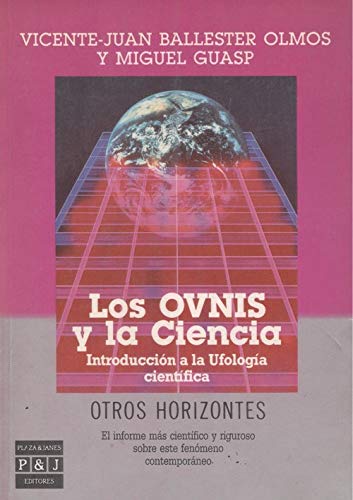
Los OVNIS y la ciencia
Introducción a la Ufología científica — The Methodology Book Spanish Ufology Was Built On
Find on Amazon →As an Amazon Associate, OverClassified may earn from qualifying purchases made through this link, at no extra cost to you.
Why This Is Essential Reading
This is the rulebook, and it is on the shelf because everything else its author did is an application of it. Los OVNIS y la ciencia gives five full sections to method — collection, classification, sampling, witness reliability, statistics — before it goes anywhere near a case, which is the reverse of how this field normally writes, and which is the whole point. Ballester Olmos was thirty-two at the first edition and had already published a Type-I catalogue through Hynek's Center for UFO Studies; over the following two decades he catalogued nearly 600 Iberian close encounters with the solved ones left in, talked the Spanish Air Force into releasing 84 files, and identified his own country's most famous sighting as a U.S. Navy missile test. The honest limitations are real: the sampling discipline it prescribes could not be retro-fitted onto a case record gathered without it, the statistical apparatus has dated, and no method can supply experimental leverage over events that happened once. It is also 382 pages of Spanish-language argument written for practitioners. Read it with Hendry's UFO Handbook, which reached the same place independently, and then with the Enciclopedia, which is this book's promise kept.
Related Cases & Theories
Sources Cited
- Ballester Olmos, Vicente-Juan, and Miguel Guasp. Los OVNIS y la ciencia: Introducción a la Ufología científica. Plaza & Janés Editores, Barcelona, 1989 (first edition 1981). 382 pp. ISBN-10 8401390303 / ISBN-13 9788401390302. amazon.com
- Dialnet (Universidad de La Rioja) bibliographic record for the title — the Spanish academic index's entry. dialnet.unirioja.es
- AbeBooks catalogue record, ISBN 9788401390302 — the source for the 1989 Plaza & Janés Barcelona imprint, the 382-page extent, the black-and-white photographs, the bibliography at pp. 372–378, and the cover art reproduced here. abebooks.com
- AbeBooks catalogue record, ISBN 9788401331985 — the 1981 first edition, confirming the earlier printing and its separate ISBN. abebooks.com
- Iberlibro listing for Ballester Olmos and Guasp, Los ovnis y la ciencia — independent Spanish-language second-hand record confirming joint authorship. iberlibro.com
- Buscalibre catalogue record for the 1981 edition — further independent bibliographic confirmation. buscalibre.com
- NICAP, “Ballester Olmos Detailed Bio” — the source for his birth date, education and 1973 programming diploma, his 1976–2005 Ford Motor Company career, the full bibliography with publishers and years (including the 1976 CUFOS Catalogue of 200 Type-I UFO Events in Spain and Portugal), the FOTOCAT scale, and the 1982 Fund for UFO Research scholarship and 1983 Alvin Lawson Award. nicap.org
- Anomaly Archives collection file on Vicente-Juan Ballester Olmos — research affiliations, forewords by Hynek, Vallée and Haines, and the Fundación Anomalía role. anomalyarchives.org
- EuroUFO researcher profile, “Ballester Olmos, Vicente-Juan (Spain)” — independent biographical confirmation and his role in the 1992–1999 declassification. euroufo.net
- Wikidata entry Q11954628, Vicente-Juan Ballester Olmos — structured biographical record. wikidata.org
- Wikipedia, “Condon Report” — the 1969 study whose conclusions closed Project Blue Book and removed the subject's institutional home, the situation this book was written into. en.wikipedia.org
- Wikipedia, “Center for UFO Studies” — the Hynek organisation that published Ballester Olmos's 1976 Type-I catalogue. en.wikipedia.org
- Wikipedia, “GEIPAN” — the French state study group created inside CNES in 1977, the contemporaneous European model for institutional UFO study. en.wikipedia.org
- Wikipedia, “UFO sightings in Spain” — national context, including the 1976 release of report summaries to J.J. Benítez and the 1992 declassification. en.wikipedia.org
- OverClassified, Gando Air Base / Canary Islands UFO — the case Ballester Olmos and Ricardo Campo Pérez eventually resolved using U.S. Navy launch records.
- OverClassified, Manises UFO Emergency Landing — the contested Spanish case that best illustrates why the method matters.
Have corrections, additional research, or peer-reviewed sources? Help improve this entry.
Suggest an Edit