
Expedientes insólitos
El fenómeno OVNI y los archivos de Defensa — Spain's Military UFO Files, Written from Inside the Declassification
Core Thesis
There is a small, unusual category of book: the account of a state opening its secret files, written by the person who talked it into doing so, published before the process had finished. Expedientes insólitos is one of them. In March 1991 Vicente-Juan Ballester Olmos put a report to the Spanish Air Force General Staff setting out how other NATO countries had already declassified their UFO archives and what Spain stood to gain by doing the same. The Air Force agreed. Between 1992 and 1999 it released 84 files — roughly 2,000 pages covering 122 sightings between 1962 and 1995. This book appeared in 1995, from a mainstream Madrid house, with the release halfway through, and its subject is that process: what the military archive actually held, how it was assembled, and what a citizen should and should not conclude from it.
About the Author
Vicente-Juan Ballester Olmos was born in Valencia on 27 December 1948 and has investigated UFO reports since 1966. He worked at Ford Motor Company in Spain from 1976 to 2005, latterly as Manager of Insurance, Benefits and Pensions, taking early retirement at the end of that period. He describes his formal education as reaching pre-university level, supplemented by a 1973 programming diploma and a great deal of self-teaching.
By 1995 he had published five books, four of them with Plaza & Janés, and had spent nearly thirty years assembling the Spanish and Portuguese case record. The relevant ones for this volume are the Catalogue of 200 Type-I UFO Events in Spain and Portugal (CUFOS, 1976), Los OVNIS y la ciencia (1981, with Miguel Guasp) and the Enciclopedia de los encuentros cercanos con OVNIs (1987, with Juan Antonio Fernández Peris). Forewords to his work have been written by J. Allen Hynek, Jacques Vallée and Richard Haines.
That publication record is the reason the 1991 approach worked, and it is worth being explicit about why. A researcher asking a national air force to open its files is asking for a favour that costs the institution time, exposes it to embarrassment, and produces nothing it needs. What Ballester Olmos brought to the conversation was twenty-five years of catalogued civilian case data, a demonstrable habit of publishing his own solved cases, and a comparative argument about what other NATO members had already done. He was not a petitioner but a counterpart.
His later work continued in the same direction. He curates FOTOCAT, a photographic-case database of more than 12,000 entries; he is vice-president and research director of the Fundación Anomalía; he has served as a consultant or representative to MUFON, the J. Allen Hynek Center for UFO Studies, the Society for Scientific Exploration and NARCAP; and he edited UPIAR's journal in the mid-1980s. His total output runs to several hundred publications.
He is also, when the evidence points that way, a demolisher of cases. In 1994 he supplied Nick Pope at the British Ministry of Defence with a NORAD trajectory statement and a computer simulation identifying the Cosmos 2238 rocket-body re-entry as the source of the main sighting cluster in the March 1993 Cosford wave. In 1999 he obtained declassified U.S. Navy Eastern Test Range Poseidon C-3 launch records and, with Ricardo Campo Pérez, identified the source of Spain's most famous sighting.
That last point matters for reading this book. The person who argued hardest for the Spanish files to be opened is the same person who has resolved more Spanish cases than anyone. Those are not opposite activities. They are the same activity.
Historical Context & Origins
Spain's relationship with its own military archives cannot be understood apart from its politics. The Franco regime ended in 1975; the constitution came in 1978; the attempted coup was in 1981. By the late 1980s a democratic Spain was still working out which of the previous state's habits of secrecy it intended to keep, and the answer was being decided institution by institution.
The UFO files sat inside that. The Spanish Air Force had been collecting sighting reports since the early 1960s, filing them with the standard military apparatus — location, date, summary of facts, considerations, conclusions, proposed classification. They were classified not because of what they contained but because of the channel they had travelled through, which is the ordinary reason most things are classified and one of the most persistently misunderstood facts in this subject.
The public had already seen fragments. In October 1976 a senior Air Force general handed twelve report summaries to the journalist J.J. Benítez, who published them in La Gaceta del Norte and then as Ovnis: Documentos Oficiales del Gobierno Español in 1977. A further tranche followed at the end of the decade. Those releases were ad hoc, personal and unrepeatable — a general's decision, not a policy.
What changed in 1991 was that someone proposed a policy. Ballester Olmos's report to the Air Force General Staff argued the comparative case: France had created GEPAN inside its national space agency in 1977; other NATO members had opened archives without harm. The Ministry of Defence decided to analyse its holdings and reduce their classification so the public could see them.
The release ran from 1992 to 1999 in phases: 84 files, close to 2,000 pages, 122 sightings spanning 1962 to 1995, eventually placed in the Ministry of Defence's own virtual library. It made Spain one of the earliest NATO countries to put a military UFO archive in front of the public, years ahead of Britain's National Archives releases and two decades ahead of the American AARO era.
This book was written into the middle of that. Published in April 1995, in a Temas de Hoy series called España Hoy — a current-affairs list, not a paranormal one — it is addressed to a Spanish reading public that had just been handed several hundred pages of its own military's UFO paperwork and had no idea what to make of it. The cover design makes the pitch: a manila envelope, a black-barred document, and a red DESCLASIFICADO stamp.
Core Arguments & Key Concepts
The files exist, and their existence is not the revelation. The premise a Spanish reader in 1995 most needed. A military that receives reports of unidentified aircraft over its territory files them; that is what militaries do, and it implies nothing about what the objects were.
Classification is about channels, not contents. The single most useful corrective this literature can offer, and one this site has found repeatedly — see Kevin Randle's version of the same point. A report is secret because of who wrote it, on what form, through which command, not because of what it says.
Declassification was proposed from outside and accepted from inside. The historical claim the book is uniquely placed to make, and its author's own role in it.
An open archive serves the state as well as the researcher. The comparative argument put to the General Staff in 1991: other NATO countries had opened their files without institutional damage, and secrecy about a subject with no security content generates suspicion at no benefit.
The released files mostly document ordinary things. The finding a reader should expect and a researcher should say plainly: a military archive of sighting reports is largely an archive of aircraft, balloons, re-entries, astronomical objects and honest error.
A residue remains, and it is small and real. The position Ballester Olmos has held consistently across five decades — that the unexplained remainder is genuinely unexplained, genuinely small, and not improved by exaggeration.
The right response to an opened archive is work. Files released are not conclusions delivered. Each case in them still has to be investigated, and the book is in part an argument that Spanish researchers should now go and do it.
Key Cases & Evidence Discussed
A note on scope. No scanned copy or table of contents for this book could be located, and this article has therefore not audited its case list. What is documented is the book's subject — the UFO phenomenon and the Defence archives, per its own subtitle — its publisher, series, extent and date, and the author's central role in the declassification it describes. The entries below set out the archive's real contents and the cases from it that this site covers in its own right.
The archive itself. 84 files, roughly 2,000 pages, 122 sightings between 1962 and 1995, released in phases from 1992 to 1999 and now held in the Spanish Ministry of Defence's virtual library. Each file carries a standard structure: location, date, summary of facts, considerations, conclusions, and a proposed classification.
The Manises emergency landing, 11 November 1979. The single most consequential file in the archive — a Supercaravelle diverted to Manises Airport after an encounter over the Mediterranean, with military interception. Ballester Olmos's co-author on the 1987 Enciclopedia, Juan Antonio Fernández Peris, later devoted a 200-page study to the declassified file alone.
The Gando / Gáldar sighting, 22 June 1976. The Canary Islands case whose file was formally declassified in 1994, and which Ballester Olmos and Ricardo Campo Pérez identified in 2001 as a U.S. Navy Poseidon C-3 missile test, using American launch records rather than Spanish ones.
The Talavera la Real sentry encounter, November 1976. A close encounter at a Spanish air base in Extremadura, investigated contemporaneously by Benítez for Flying Saucer Review and covered by the later declassification.
The 1976 and 1979 pre-declassification releases. The twelve report summaries handed to Benítez and the tranche that followed — the informal precedent that made the formal programme thinkable.
The Cosmos 2238 re-entry, March 1993. Not a Spanish case, but the clearest demonstration of the method: Ballester Olmos supplied the British MoD with NORAD trajectory data and a simulation resolving most of the Cosford wave. Archives are useful to the extent that people work them.
The French comparison. GEPAN, created inside CNES in March 1977, was the model of a state body studying the phenomenon openly rather than filing it secretly — the benchmark the 1991 report used. See Les OVNI du CNES.
Critical Reception & Controversies
This book has no reviews in any venue this site could locate, in Spanish or in English, and its bibliographic footprint is unusually thin for a title from a major publisher — catalogue records, second-hand listings, a Goodreads entry with no reviews. That is worth stating rather than papering over, and it shapes what can honestly be said here.
What can be verified is real and substantial: a genuine trade publisher (Temas de Hoy, part of the Planeta group), a genuine current-affairs series, a 286-page extent with photographic plates, a firm April 1995 publication date, and an author whose identity, career and central role in the events described are documented in detail by independent sources including NICAP, EuroUFO, Wikidata and the Anomaly Archives. This is not a print-on-demand title with an untraceable author; it is a mid-1990s Spanish trade book that has fallen out of print and out of the online record, which is the ordinary fate of most mid-1990s Spanish trade books.
What cannot be verified from outside is the book's internal argument in detail. No scanned copy, contents listing or substantive review could be found, and this article does not pretend to summarise chapters it has not read. Where the account above describes the book's subject and context, it is drawing on the documented record of the declassification and of the author's own published positions, not on the text.
The most substantive criticism available is structural and applies regardless of contents. The author was the principal external advocate for the declassification. He is therefore the least disinterested possible narrator of whether it was a success, whether the Air Force released everything, and whether the process was conducted in good faith. Nothing about his record suggests he would misrepresent it — his career is built on publishing findings that disappoint his own field — but a reader should know that this is a participant's account, and that no independent audit of the Spanish release has been published.
A second, related limitation is timing. The book appeared in 1995, four years before the release finished. Whatever it says about the archive's completeness was written with roughly half the files still unpublished, and later releases could not have been assessed.
There is also a question the book was well placed to ask and that this site cannot confirm it asked: whether the files that were released constitute everything. Spain's declassification was conducted by the institution being declassified, on its own schedule, applying its own judgement about what fell inside the programme. That is the standard weakness of every voluntary state release of records, and it applies to the Spanish files exactly as it applies to Blue Book, to the British MoD releases and to AARO. A researcher can only work with what is handed over, and the completeness of what was handed over is not something the recipient can check.
The honest summary is that this is a well-provenanced book by a rigorously documented author on a rigorously documented episode, whose own text has slipped out of the accessible record. Readers who want the argument rather than the context should seek the book itself; readers who want the episode will find it here and in the sources below.
Influence & Legacy
The episode this book documents has outlasted the book. Spain's 1992–1999 release is now a standard reference point in the international argument for state transparency on this subject, cited under the name Ballester Olmos gave it in his own later English-language writing: the Spanish Model.
Its distinguishing features are worth naming, because they are what made it a model rather than a gesture. The release was systematic rather than responsive to individual requests; it was complete files rather than summaries; it ran to a published schedule; and it ended with the material in a permanent, publicly accessible institutional archive rather than in a researcher's filing cabinet.
Its most concrete downstream effect on this site's own work is that Spanish cases can be investigated against primary military paperwork in a way most countries' cases cannot. The Manises, Gando and Talavera la Real files all exist as documents a reader can consult, which is why the analysis on those pages can be as specific as it is.
The release also produced a result its advocates could have found awkward and did not: several of the archive's most celebrated cases have since been solved. The Canary Islands sighting turned out to be a Poseidon missile launch. That is what an open archive does — it lets the phenomenon shrink where it should shrink, which is the only way the remainder ever comes to mean anything.
For a reader outside Spain the general lesson is the one this book's author has spent fifty years making: the fight over access and the fight over interpretation are different fights, and winning the first does not settle the second. Spain opened its files thirty years ago. The arguments about what is in them are still running.
The Book
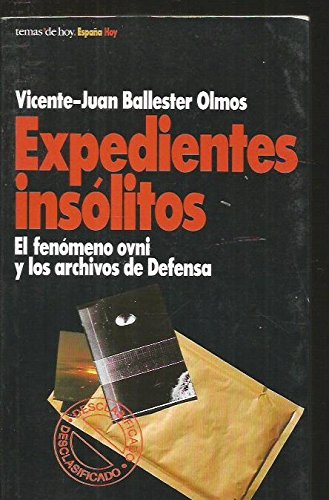
Expedientes insólitos
El fenómeno OVNI y los archivos de Defensa — Spain's Military UFO Files, Written from Inside the Declassification
Find on Amazon →As an Amazon Associate, OverClassified may earn from qualifying purchases made through this link, at no extra cost to you.
Why This Is Essential Reading
This belongs on the shelf as the participant's account of the first properly systematic state UFO declassification. In March 1991 Vicente-Juan Ballester Olmos persuaded the Spanish Air Force General Staff to open its archive; between 1992 and 1999 it released 84 files, some 2,000 pages, 122 sightings from 1962 to 1995; and in April 1995, with the process half done, Ediciones Temas de Hoy published his account of it in a mainstream current-affairs series. That is a rare kind of book and it is why this one is here. Two honest caveats. First, it is a participant's narrative of a process he advocated, and no independent audit of the Spanish release has ever been published — a voluntary disclosure conducted by the institution disclosing is only ever as complete as that institution chose to make it. Second, the book itself has fallen almost entirely out of the accessible record: no scan, no contents listing and no review could be located, so this article describes its documented subject and provenance rather than summarising chapters it has not read. Read it alongside the Enciclopedia, which is the civilian case record the declassification argument was built on, and Benítez's 1977 book, which is what the ad hoc version looked like.
Related Cases & Theories
Sources Cited
- Ballester Olmos, Vicente-Juan. Expedientes insólitos: el fenómeno OVNI y los archivos de Defensa. Ediciones Temas de Hoy, Madrid, 6 April 1995, colección España Hoy. 286 pp. ISBN-10 8478805176 / ISBN-13 9788478805174. amazon.com
- AbeBooks catalogue record, ISBN 9788478805174 — the source for publisher, series, April 1995 publication date, page extent and black-and-white plates. abebooks.com
- Goodreads edition record — independent bibliographic listing, series attribution and the cover image reproduced here. goodreads.com
- Uniliber (Spanish antiquarian booksellers' network) listing — independent Spanish-language second-hand record. uniliber.com
- Iberlibro listing for the title — second-hand market record and edition confirmation. iberlibro.com
- NICAP, “Ballester Olmos Detailed Bio” — the source for his birth date and place, education, 1976–2005 Ford Motor Company career, full bibliography with publishers and years, the FOTOCAT project's scale, and his awards. nicap.org
- EuroUFO researcher profile, “Ballester Olmos, Vicente-Juan (Spain)” — independent confirmation of his role in promoting and supervising the 1992–1999 Spanish Air Force declassification. euroufo.net
- Anomaly Archives collection file on Vicente-Juan Ballester Olmos — research affiliations, Fundación Anomalía role and UPIAR editorship. anomalyarchives.org
- Wikidata entry Q11954628, Vicente-Juan Ballester Olmos — structured biographical record. wikidata.org
- Ballester Olmos, Vicente-Juan. “UFO Declassification: The Spanish Model” — the author's own English-language account of the process this book describes in Spanish. academia.edu
- Internet Archive, Spanish UFO Files (Ministerio de Defensa) — the released archive itself: 84 files covering 122 sightings between 1962 and 1995, in close to 2,000 pages, each structured as location, date, summary of facts, considerations, conclusions and proposed classification. archive.org
- Biblioteca Virtual de Defensa (Spanish Ministry of Defence), Expedientes OVNI — the ministry's own permanent public archive of the declassified files. bibliotecavirtual.defensa.gob.es
- El Debate, “Expediente OVNI en España: los archivos desclasificados de Defensa” (31 July 2023) — contemporary Spanish press account of the archive and its contents. eldebate.com
- Wikipedia, “UFO sightings in Spain” — background on the 1976 release of twelve Air Force report summaries to J.J. Benítez and on the 1992 declassification. en.wikipedia.org
- OverClassified, Manises UFO Emergency Landing — this site's case file on the archive's most significant single entry.
- OverClassified, Gando Air Base / Canary Islands UFO — this site's case file on the 1994 declassification of the June 1976 file and its later Poseidon C-3 identification.
Have corrections, additional research, or peer-reviewed sources? Help improve this entry.
Suggest an Edit