
Ovnis: Documentos Oficiales del Gobierno Español
The Twelve Air Force Files a General Handed a Journalist in October 1976 — Spain's First UFO Disclosure
Core Thesis
In October 1976, eleven months after Franco's death, a senior officer of the Spanish Air Force handed a journalist twelve of his service's own UFO report summaries. J.J. Benítez published them in La Gaceta del Norte that December and, in March 1977, as this book — whose cover states the transaction plainly: for the first time in Spain, the government provides a journalist with the evidence for the existence of UFOs. That framing is both the book's historical significance and its central problem. What Benítez actually received was a small selection of military paperwork, chosen by the institution that held it, released without process, obligation or any means of checking what had been left out. It is the earliest substantial state UFO release in Europe, it made the Gáldar and Talavera cases internationally famous, and it is the model that Spain's evidence-led researchers spent the following two decades trying to replace with something systematic.
About the Author
Juan José Benítez was born in Pamplona in 1946 and is, by a wide margin, the most commercially successful writer on this subject in the Spanish language — and the most frequently criticised. Both facts are relevant to reading this book, and neither should be allowed to swallow the other.
He trained and worked as a journalist, and in the mid-1970s was reporting for La Gaceta del Norte in Bilbao. His first UFO book, 100.000 kilómetros tras los ovnis, appeared in 1976 and is advertised on this volume's own cover — a signal of how quickly the subject became his territory.
The October 1976 handover is the event his career turns on. A senior Air Force general gave him twelve UFO report summaries directly; the material had never been public. He ran it in the newspaper in December and expanded it into this book by March. Weeks later he went to Extremadura and investigated the Talavera la Real sentry encounter himself, publishing “Encounter at Talavera” in the British journal Flying Saucer Review in February 1978 — among the earliest detailed accounts of that case anywhere, and two decades ahead of Spain's systematic declassification.
What followed was a very large body of work. Benítez has published dozens of titles, including the enormously successful Caballo de Troya novels, and remained the dominant popular voice on the subject in Spanish for half a century. In October 2025 he published Están aquí, a 984-page career-spanning compilation, with Planeta.
The criticism is equally real and has come from inside Spanish research rather than only from outside it. His method is revelation-led: a document is presented, a source is quoted, a conclusion is drawn, and the work of eliminating conventional explanations is not the point of the exercise. Bruno Cardeñosa, who dates his own interest in the subject to reading Benítez in 1986, has built a career whose method is in large part a reaction against that model — see El misterio Ovni. So, from a different direction, has Vicente-Juan Ballester Olmos.
The fair assessment for this particular book is narrower than a verdict on his career. In 1976 and 1977 he was a working journalist who obtained a genuine, previously unpublished set of military documents and put them in front of the public quickly and accurately. That is journalism, and it was worth doing. What he built on top of them is a separate question.
Historical Context & Origins
Spain's UFO documents did not become public because a policy changed. They became public because a general decided to hand some over, in a year when nobody was quite sure what the rules were any more.
Franco died in November 1975. By October 1976 the country had a reform government, a press that had just been substantially unmuzzled, and an officer corps working out how much of the old opacity it intended to keep. The Air Force had been filing UFO reports since the early 1960s using standard military documentation — location, date, summary of facts, considerations, conclusions, proposed classification — and the files were classified for the ordinary reason: not because of what they said, but because of the channel they had travelled through.
Twelve of those report summaries went to Benítez. There is no published account of a decision process behind it, and that absence is the point: it was a personal act by an individual officer, not a programme. A second tranche followed at the end of the decade on the same informal basis.
The timing gave the material extraordinary force. Four months earlier, on 22 June 1976, the Gáldar sighting had been seen from five Canary Islands and had already dominated the Spanish press; the Air Force had opened a 107-page file on it. Three weeks after the handover, on 12 November 1976, a sentry at Talavera la Real air base in Extremadura reported a close encounter. Benítez was publishing official documentation about a phenomenon that was simultaneously live news.
Internationally, this preceded almost everything. The United States had closed Project Blue Book in 1969 and released its files to the National Archives, but that was a terminated programme's archive rather than a live service handing over current paperwork. Britain's Ministry of Defence files would not begin reaching the National Archives until 2008. France created GEPAN inside its space agency in March 1977, five months after the Spanish handover, and that was a research body rather than a release.
The formal Spanish programme came fifteen years later, and it came because someone argued for it. Ballester Olmos's March 1991 report to the Air Force General Staff produced the 1992–1999 declassification of 84 files covering 122 sightings between 1962 and 1995 — roughly 2,000 pages, permanently archived and available to anyone. The contrast between that and twelve summaries handed to one journalist is the whole argument about what disclosure means.
Core Arguments & Key Concepts
The Spanish state holds UFO files, and here are some. The book's foundational and entirely correct claim, and a genuine revelation to a Spanish readership in 1977.
The files are military paperwork, not sensational documents. What the summaries actually contain: locations, dates, witness accounts, considerations, conclusions. Any reader expecting a smoking gun encounters, instead, the ordinary texture of an armed service processing reports.
The government provided them to a journalist. The cover's own claim, and the historical fact the book rests on. It is true. It is also, on inspection, a description of a personal favour rather than a policy.
The Canary Islands events were officially investigated. The book's most consequential specific contribution: it gave the June 1976 Gáldar sighting mass exposure, and the case entered the international literature through this route rather than through any independent investigation.
Official interest implies official significance. The inference the book invites and does not defend. A military that files reports of unidentified aircraft over its territory is doing what militaries do, and the existence of a file is not evidence about the object.
Secrecy is concealment. The implicit frame throughout. The more useful account — that classification tracks the channel a document travelled through rather than its contents — is one this site has found repeatedly; see Kevin Randle's version of it.
A journalist can obtain what researchers cannot. True in 1976, and the reason the book exists. It is also why the material arrived without provenance, without a stated selection criterion, and without any way to know what the twelve were selected from.
Key Cases & Evidence Discussed
A note on scope. No accessible copy or contents listing of this book could be located, and this article does not claim to summarise chapters it has not read. What is independently documented is the transaction — twelve Spanish Air Force UFO report summaries released to Benítez in October 1976, published in La Gaceta del Norte that December and in book form in March 1977 — and the specific cases that reached a wide public through it. Those are described below.
The twelve report summaries. The book's actual content and its reason for existing: the first Spanish military UFO documentation ever made public, fifteen years before any systematic release.
The Gáldar sighting, 22 June 1976. Independently documented as having received its first wide public exposure through this book, nearly two decades before its own file's formal 1994 declassification. An expanding dome of light over the Atlantic seen from Gáldar and four other islands, with a single close-range occupant account. Identified in 2001 as a Poseidon C-3 missile launch; see El ovni de Gáldar.
The Talavera la Real sentry encounter, 12 November 1976. Investigated by Benítez personally within weeks and published in Flying Saucer Review in February 1978 — among the earliest detailed treatments of a case that would not be officially declassified for another two decades. The base is at Talavera la Real, Badajoz.
The standard Air Force report format. The template every file in the archive follows, visible in the 1976 summaries and confirmed by the later full release: location, date, summary of facts, considerations, conclusions, proposed classification.
The second, end-of-decade tranche. A further informal release following the 1976 one, on the same personal basis and with the same absence of process.
The Manises emergency landing, 11 November 1979. Two years after this book: an airliner diverted to Manises Airport after an encounter over the Mediterranean. Benítez wrote it up in 1980 as Incidente en Manises, and it became the flagship file of the eventual declassification.
The 1992–1999 declassification. The systematic programme this book's informal precedent helped make thinkable: 84 files, 122 sightings, 1962 to 1995, permanently archived. See Expedientes insólitos.
Critical Reception & Controversies
The book sold heavily and made its author's reputation, and no substantive review of it in a scholarly or serious critical venue could be located — which is itself informative about the Spanish publishing landscape it appeared in.
The criticism that matters came later and came from Spanish research rather than from foreign skeptics. Its core is not that Benítez fabricated anything — the twelve summaries were real, and his 1978 Flying Saucer Review write-up of Talavera is a legitimate piece of field journalism — but that the book established a model of disclosure that is deeply unsatisfactory once you look at its structure.
Consider what the transaction actually was. An institution selected twelve documents from an archive of unknown size, chose the recipient, set no conditions, made no commitment to further release, and retained complete control over what was withheld. The journalist could not know the selection criterion, could not sample the remainder, and had no mechanism to ask for more. Every quantitative statement anyone might want to make — how many files exist, what proportion were released, whether the released ones are representative — is unanswerable by construction.
That is not a criticism of Benítez's honesty. It is a criticism of treating a favour as a disclosure, and it is exactly the objection that this site's standing rule on official statements exists to make. A government body that chooses what to release about itself is not a neutral source, and the twelve summaries are a curated sample from an interested party, however genuine each individual document is.
The second criticism is about interpretation. The book's framing invites the reader to conclude that official interest implies official significance — that a military file about an unidentified object is evidence about the object. It is not. It is evidence that someone reported something and that the report was processed.
The third is what the subsequent record did to the book's flagship case. Gáldar, which reached the world through these pages, was identified in 2001 by Ballester Olmos and Ricardo Campo Pérez as a submarine-launched Poseidon C-3 missile, using declassified American launch records that no Spanish military file contained. The solution came from outside the archive entirely — which is a useful reminder that having the government's paperwork is not the same as having the answer.
There is also a broader point about what this model taught a generation. If disclosure means a journalist receiving documents from a friendly official, then access depends on relationships, and the researcher with the best relationships defines the record. The alternative — a published programme, complete files, a schedule and a permanent public archive — is what Spain eventually built, and it is what makes cases decidable rather than merely famous.
In fairness, and this should be said plainly: without the 1976 handover it is not obvious that the 1991 argument would have had anything to appeal to. Benítez demonstrated that the sky did not fall when the Air Force released UFO paperwork. That is a real contribution, and it belongs on the credit side.
Influence & Legacy
This is the book that made Spanish UFO cases international. Gáldar, Talavera and the wider Spanish record entered the English-language literature substantially through this route, and the versions that circulated for the next twenty-five years are the versions established here.
It also made its author. Benítez became, and remains, the dominant popular voice on the subject in Spanish, with a career running from this book to Están aquí in 2025 — a 984-page compilation published by Planeta nearly fifty years later, still built on the same combination of witness interviews, military sources and document reproduction.
Its most interesting legacy is oppositional. Spain produced, in the same decades, an unusually strong evidence-led research tradition — Ballester Olmos's catalogues and methodology, Fernández Peris's case monographs, Campo Pérez's Canary Islands work, the Fundación Anomalía — and a substantial part of that tradition defines itself against the model this book established. Cardeñosa has said his own interest began by reading Benítez, and his method is a reaction against him. Fields are shaped by what they are arguing with.
The disclosure question it opened is still open, and has simply moved country. Every subsequent argument about what a government owes the public on this subject — the British MoD releases, the French GEIPAN archive, the 2021 ODNI assessment, AARO — runs on the same axis this book put in place: selective release by an interested institution versus systematic release under a published programme.
For a modern reader the durable lesson is the one Spain itself learned between 1976 and 1992. Twelve documents handed to a journalist made a famous case. Eighty-four files placed in a public archive made a solvable one.
The Book
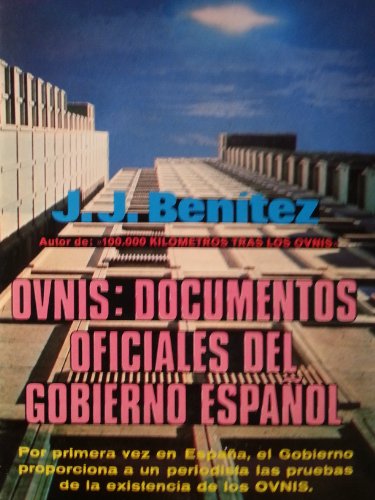
Ovnis: Documentos Oficiales del Gobierno Español
The Twelve Air Force Files a General Handed a Journalist in October 1976 — Spain's First UFO Disclosure
Find on Amazon →As an Amazon Associate, OverClassified may earn from qualifying purchases made through this link, at no extra cost to you.
Why This Is Essential Reading
This is on the shelf as a historical document rather than as a reliable account, and it earns the place on that basis. In October 1976 a Spanish Air Force general handed J.J. Benítez twelve of his service's UFO report summaries; Benítez ran them in La Gaceta del Norte that December and published this book in March 1977, fifteen years before Spain's formal declassification and thirty-one before Britain's. It made the Gáldar case internationally famous, established its author as the dominant Spanish voice on the subject, and demonstrated that a European air force could release UFO paperwork without consequence — which is a real contribution to everything that followed. What it is not is disclosure in any sense a researcher can work with. Twelve documents, selected by the institution holding them, given to a chosen recipient, with no process, no stated criterion and no way to know what was withheld, cannot support any statement about the archive they came from. Fifteen years later Ballester Olmos persuaded the same service to release 84 complete files under a published programme, and the difference between the two is the whole subject. Read this with Expedientes insólitos and El ovni de Gáldar, which is what happened to its flagship case.
Related Cases & Theories
Sources Cited
- Benítez, J.J. Ovnis: Documentos oficiales del Gobierno español. Plaza & Janés Editores, Barcelona, colección Otros Mundos; first published March 1977, second edition 1978, 270 pp. Amazon ASIN B00BRQWMHA. amazon.com
- Dialnet (Universidad de La Rioja) bibliographic record 115734, Ovnis, documentos oficiales del gobierno español — the Spanish academic index's entry. dialnet.unirioja.es
- AbeBooks catalogue record, ISBN 9788401331275 — independent bibliographic listing and the source of the cover art reproduced here. abebooks.com
- AbeBooks catalogue record, ISBN 9788401311062 — a further Plaza & Janés printing, confirming the edition history. abebooks.com
- AbeBooks catalogue record, ISBN 9788401470691 — a later printing in the same series. abebooks.com
- Google Books record for the title — independent bibliographic confirmation. books.google.com
- Iberlibro listings for the title — Spanish second-hand market records across the 1977–1979 printings. iberlibro.com
- Wikipedia, “UFO sightings in Spain” — the source for the release of twelve Air Force UFO report summaries to J.J. Benítez and their use as the basis of this book, and for the 1992 declassification that followed. en.wikipedia.org
- Internet Archive, Spanish UFO Files (Ministerio de Defensa) — the eventual systematic release: 84 files covering 122 sightings between 1962 and 1995, in close to 2,000 pages, each following the standard report structure the 1976 summaries share. archive.org
- Biblioteca Virtual de Defensa (Spanish Ministry of Defence), Expedientes OVNI — the ministry's permanent public archive of the declassified files. bibliotecavirtual.defensa.gob.es
- Ballester Olmos, Vicente-Juan. “UFO Declassification: The Spanish Model” — the account of how the informal 1976 and 1979 releases were superseded by the systematic 1992–1999 programme. academia.edu
- El Debate, “Expediente OVNI en España: los archivos desclasificados de Defensa” (31 July 2023) — Spanish press account of the declassified archive and its structure. eldebate.com
- Spanish Wikipedia, “J. J. Benítez” — biographical orientation on the author's journalism career and publishing record; the English-language biography article has been deleted, though the English List of works by J. J. Benítez survives. es.wikipedia.org
- OverClassified, J.J. Benítez — this site's key-figures card, the source for his Pamplona birth in 1946, the October 1976 handover by a senior Air Force general, publication in La Gaceta del Norte in December 1976 and in book form in March 1977, and his February 1978 Flying Saucer Review article “Encounter at Talavera.”
- OverClassified, Gando Air Base / Canary Islands UFO — this site's case file on the sighting this book gave its first wide public exposure, including the 107-page Air Force file and the 2001 Poseidon C-3 identification.
- OverClassified, Talavera la Real Air Base Sighting — this site's case file on the November 1976 sentry encounter Benítez investigated in person.
Have corrections, additional research, or peer-reviewed sources? Help improve this entry.
Suggest an Edit