
Están aquí
¿Qué ocultan los militares sobre los ovnis? — Fifty Years of Benítez's Files in 984 Pages
Core Thesis
Forty-nine years after a Spanish Air Force general handed him twelve UFO files, J.J. Benítez published the summation of everything that followed: 984 hardcover pages from Editorial Planeta, more than two hundred cases from around the world, and a documentary base he describes as some three thousand witnesses, among them between three and four hundred military personnel. The thesis is in the subtitle — what are the military hiding about UFOs? — and Benítez's answer is that they are hiding everything that matters, that the American declassifications of the last decade are, in his own phrase, el chocolate del loro, a token gesture, and that the United States is holding the Roswell craft and four bodies in formalin. This is the most complete statement of a fifty-year career, published by Spain's largest trade house, and it is worth taking seriously as a document. It is also, in its central claim, unassessable, and this article will say exactly why.
About the Author
Juan José Benítez was born in Pamplona in 1946, trained as a journalist, and has been the dominant popular voice on this subject in the Spanish language for half a century. He is also the most criticised, and both facts have to sit in the same paragraph.
His career turns on October 1976, when a senior Spanish Air Force general handed him twelve of his service's UFO report summaries. Benítez published them in La Gaceta del Norte that December and, in March 1977, as Ovnis: Documentos Oficiales del Gobierno Español — the first substantial state UFO release in Europe. Weeks later he investigated the Talavera la Real sentry encounter in person, publishing “Encounter at Talavera” in Flying Saucer Review in February 1978.
In 1980 he wrote Incidente en Manises, the first account of the airliner diversion that became Spain's most argued-over case. In 1993 he published Materia reservada, which this book explicitly presents itself as continuing and going beyond. Between and around all of it he wrote the Caballo de Troya novels, which sold in numbers no other Spanish author in this territory has approached.
The criticism from inside Spanish research is not that he invents things but that his method is revelation-led rather than eliminative. A source is found, a document is shown, a witness is quoted, and the reader is invited to a conclusion; the work of establishing what else could have produced the report is not the exercise. Bruno Cardeñosa, whose own interest began with reading Benítez in 1986, built a career in deliberate reaction against that model — see El misterio Ovni. So, from a different direction, did Vicente-Juan Ballester Olmos, whose catalogues print the solved cases and whose 1991 report opened the Spanish military archive properly.
The most consequential single example is his own flagship case. Gáldar reached the world through Benítez's 1977 book; in 2001 Ballester Olmos and Ricardo Campo Pérez identified it as a submarine-launched Poseidon C-3 missile, and Campo devoted a 2023 monograph to how the misreading survived — El ovni de Gáldar.
He was seventy-nine when this appeared, and told the Spanish press he published now because he felt the matter could no longer be deferred. Whatever one makes of the contents, a book of this length at that age, on the subject he has worked since he was thirty, is plainly meant as a final statement.
Historical Context & Origins
The book arrives at the end of the strangest decade this subject has had, and its argument is essentially a verdict on that decade.
Between December 2017 and 2025 the American position changed in public: the New York Times reported the existence of AATIP; the Pentagon released three Navy infrared videos and confirmed them as authentic; the ODNI published a preliminary assessment in June 2021 covering 144 incidents; Congress held hearings; the All-domain Anomaly Resolution Office was created in 2022 and has published annual reports since.
For most of the field this was vindication. Benítez's position is the opposite, and it is the reason this book exists in the form it does: he regards the American releases as deliberately trivial — el chocolate del loro, a Spanish idiom for a token economy that changes nothing — and argues that the substance remains withheld.
That position has a genuine evidentiary basis worth stating fairly. The ODNI's 2021 assessment explained one of its 144 incidents. AARO's subsequent work has been criticised from several directions for the opacity of its sourcing. And this site's own standing rule holds that official conclusions from military and intelligence bodies are one input among several rather than a verdict, precisely because the record of such bodies on this subject includes incomplete, delayed and later-revised explanations. Benítez is not alone in distrusting them.
The Spanish context is different again, and Benítez knows it better than anyone. Spain conducted its own systematic declassification between 1992 and 1999 — 84 files, roughly 2,000 pages, 122 sightings from 1962 to 1995, permanently archived and public. That programme came from a proposal by a researcher whose method is the opposite of Benítez's, and its most famous file, Gáldar, dissolved once someone worked it against American launch records.
The publishing context matters too. This is Editorial Planeta, Spain's largest trade house, issuing a 984-page illustrated hardcover in its own dedicated Biblioteca J. J. Benítez collection. That is a substantial commercial commitment and it says something real about the author's standing in Spanish publishing, whatever it says about the evidence.
Core Arguments & Key Concepts
The world's military establishments are concealing the reality of the phenomenon. The book's thesis, stated in its subtitle and pressed, in the author's own description, boldly.
The American declassifications are a token. Benítez's assessment of the post-2017 releases in his own words: el chocolate del loro. A real position, held by others, and the organising judgement of the book.
The evidentiary base is the accumulated career. More than two hundred cases worldwide and, by his account, testimony from around three thousand witnesses gathered since the 1970s — names, documents, images and dates, presented as investigative work rather than speculation.
Military witnesses are the load-bearing category. Between three and four hundred of the witnesses are military personnel, and the book's argument depends on them: serving officers describing what their services recorded.
The United States holds physical remains. The specific and extraordinary claim — that Washington should produce the craft that crashed at Roswell and the four creatures it holds in formalin. This is the claim the book will be remembered for and the one that cannot be assessed.
This extends Materia reservada (1993). The book presents itself as going substantially beyond the author's earlier treatment of military secrecy, with previously unpublished material.
Disclosure can no longer wait. The stated motive for publishing now, at seventy-nine.
The record is the argument. The book's method throughout, and the same one used in 1977: accumulate documented testimony until its weight becomes the case. Whether accumulation can substitute for elimination is the question a reader has to answer.
Key Cases & Evidence Discussed
A note on scope. This article works from the publisher's own description, the author's public statements at launch and the independently documented outline of his career. It has not read the book and does not claim to summarise its 984 pages case by case. Publisher and press accounts state that it covers more than two hundred cases worldwide and names Roswell and Manises among them; the entries below describe those and the cases from Benítez's own career that this site covers independently.
Roswell, July 1947. Named in press coverage as the book's most famous case, and the subject of its single most extraordinary claim: that the United States is holding the recovered craft and four bodies preserved in formalin.
The Manises emergency landing, 11 November 1979. Also named in press coverage. A Spanish airliner diverted to Manises Airport after an encounter over the Mediterranean, with military interception. Benítez wrote the first account of it in 1980; see Incidente en Manises.
The Talavera la Real sentry encounter, November 1976. Benítez's own field investigation, conducted weeks after the event at the base at Talavera la Real in Badajoz, and published in Flying Saucer Review in February 1978.
The Gáldar sighting, 22 June 1976. The case that made his name and that was later identified as a Poseidon C-3 missile launch — the most instructive test available of what his method does and does not catch.
The twelve Air Force summaries of October 1976. The documents that started the career this book concludes, and the subject of Ovnis: Documentos Oficiales del Gobierno Español.
Military testimony. The book's declared core: interviews with senior officers and high-profile figures accumulated across five decades, of which three to four hundred witnesses are described as military.
The post-2017 American releases. AATIP, the confirmed Navy videos, the 2021 ODNI assessment and AARO — the material Benítez dismisses as token, and the benchmark against which his claim of continuing concealment has to be measured.
Critical Reception & Controversies
The book was published on 29 October 2025 and covered widely in the Spanish-language press — a wire report carried by Infobae, features in 65ymas, Bekia and Qué Leer, and coverage of a launch appearance in the Dominican Republic in Diario Libre. That is publicity rather than review; no substantive critical assessment had appeared at the time of writing, which is normal for a book this recent and this long.
The claim that will define its reception is the one Benítez made to reporters at launch: that the United States should produce the craft that crashed at Roswell and the four creatures it holds in formalin. This has to be addressed directly rather than passed over, and the honest position is that it cannot be assessed at all. No physical evidence, chain of custody, named source, document or photograph supporting it has been made public. A claim of that magnitude offered without any of those things is not a weak claim; it is a claim outside the reach of evidence entirely, and a reader has no way to evaluate it except by deciding in advance whether to trust the person making it.
The same problem, in a milder form, runs through the book's declared method. Three thousand witnesses is an impressive number and it is also an unauditable one. Nobody outside the author can check the list, sample it, assess how the accounts were elicited, or determine what proportion of the reports were traced to conventional stimuli — and that last figure is the one that would make the residue mean anything. This site has praised exactly the opposite discipline in Ballester Olmos's Iberian catalogue and Hendry's UFO Handbook, both of which print the solved cases so the unsolved ones can be counted.
The military-witness argument deserves more careful handling than it usually gets, because it is the book's strongest card and it is routinely overplayed. That serving officers reported unidentified objects is well documented and not in dispute anywhere. What their testimony establishes is that trained personnel observed something they could not identify. It does not establish that one phenomenon underlies the reports, and a pilot's professional competence in aircraft recognition, radio discipline and instrument reading confers no particular authority on judging the distance, size or nature of an unfamiliar light at night — the same distinction this site drew in UFOs Above the Law about police witnesses.
On the central historical judgement, though, Benítez is not obviously wrong, and it would be dishonest to pretend otherwise. The 2021 ODNI assessment did explain one incident out of 144. Official bodies investigating this subject do have a documented record of incomplete and later-revised explanations — the CIA's own 1997 acknowledgement that it deliberately let U-2 and OXCART flights be misattributed to UFOs is the standing example. Treating a government's account of its own conduct as one input rather than as a verdict is this site's own policy. Where Benítez goes beyond that is in inferring, from institutional evasiveness, a specific concealed content; evasiveness is evidence of evasiveness.
There is a further problem specific to this author, and it is the one the last fifty years supply. The case that made his career — Gáldar — was solved in 2001 by researchers working American launch records against Spanish military files. His method did not catch it in 1977, and the popular version he established outlived the solution by decades. A 984-page compilation built on the same method invites the question of how many of its two hundred cases would survive the same treatment. Nobody can answer that from outside, which is the point.
In fairness, the positive case is real. Fifty years of continuous investigation, with names, dates, documents and images, by a working journalist with genuine access to Spanish and international military sources, is a substantial archive by any standard. Even a reader who rejects the framing entirely will find material here that exists nowhere else, and the book's documentary layer is likely to outlast its argument.
Influence & Legacy
It is too early to assess this book's influence and this article will not pretend otherwise. What can be said is what it consolidates.
Benítez's career defined how a Spanish-speaking public understands this subject, in the same way Donald Keyhoe's did for an American one seventy-five years earlier — and by a strikingly similar route: a journalist, a service contact, documents released outside any process, and a book that made the case famous before anyone had investigated it. That is not a coincidence of biography; it is a recurring mechanism, and it is worth recognising as one.
The counter-tradition his work provoked is arguably the more durable legacy. Spain produced, in the same decades, an unusually strong evidence-led research culture — Ballester Olmos's catalogues and methodology, Fernández Peris's case monographs, Campo Pérez's Canary Islands work, the Fundación Anomalía, Cardeñosa's document-led journalism — much of it explicitly defining itself against the model Benítez established. This site's Spanish shelf now carries both sides of that argument, which is the only way either half makes sense.
The book's own argument — that the post-2017 American disclosures are a token — will be tested by ordinary events rather than by criticism. Either further material emerges that vindicates it or the record continues to accumulate without producing anything resembling what he describes. That is the useful thing about a claim pitched this specifically: time can adjudicate it.
For this site's purposes the value is comparative. Read against the 1977 book, this one shows what fifty years of a method produces when the method never changes. That is worth knowing, whichever conclusion a reader draws from it.
The Book
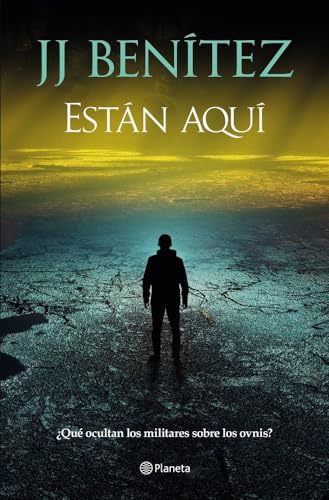
Están aquí
¿Qué ocultan los militares sobre los ovnis? — Fifty Years of Benítez's Files in 984 Pages
Find on Amazon →As an Amazon Associate, OverClassified may earn from qualifying purchases made through this link, at no extra cost to you.
Why This Is Essential Reading
Included as the summation of the most influential career in Spanish-language ufology, read with its central claim held at arm's length. Están aquí is 984 illustrated pages from Editorial Planeta, published 29 October 2025, drawing on what J.J. Benítez describes as around three thousand witnesses gathered since the 1970s, three to four hundred of them military, across more than two hundred cases including Roswell and Manises. Its historical judgement — that the post-2017 American releases are a token and that the substance is still withheld — is a defensible position that this site's own rule on official statements does not dismiss. Its specific claim, made to reporters at launch, that the United States holds the Roswell craft and four bodies in formalin, is offered with no evidence, no named source and no document, and is therefore not a weak claim but an unassessable one. The deeper problem is the method: three thousand unauditable witnesses cannot yield a countable residue, and the one case from this author's own career that has been independently tested — Gáldar, made famous by his 1977 book and identified in 2001 as a Poseidon missile — did not survive the test. Read it beside where he started and what happened to his best case.
Related Cases & Theories
Sources Cited
- Benítez, J.J. Están aquí: ¿Qué ocultan los militares sobre los ovnis? Editorial Planeta, 29 October 2025. Hardcover, 984 pp. ISBN-10 8408305948 / ISBN-13 9788408305941. amazon.com
- Planeta de Libros, publisher's page for Están aquí — the official description: a compilation of hundreds of UFO cases investigated from the author's beginnings in journalism to the present, with witness interviews, senior military officers and other figures, classic ufology material and photographs, presented as going beyond his 1993 Materia reservada. planetadelibros.com
- Infobae (agency report), “J.J. Benítez afirma que los alienígenas ya ‘Están aquí’” (30 October 2025) — the source for his statements at launch, including that the declassified U.S. reports are el chocolate del loro, his call for the United States to produce the Roswell craft and four creatures held in formalin, the documentary base of roughly 3,000 witnesses including 300–400 military personnel worldwide, and his stated reason for publishing now. infobae.com
- 65ymas, “J.J. Benítez regresa con ‘Están aquí’, un libro sobre secretos militares y ovnis” — Spanish press coverage of the book's contents and framing. 65ymas.com
- Diario Libre (Dominican Republic), coverage of Benítez presenting the book, November 2025 — independent international press record of the launch. diariolibre.com
- Qué Leer, “J. J. Benítez regresa a la investigación ovni” (December 2025) — Spanish literary-press coverage. que-leer.com
- Bekia, “J.J. Benítez publica ‘Están aquí’, una obra con documentos” — further independent Spanish press coverage of the publication. bekia.es
- Lecturalia entry for Están aquí — independent Spanish bibliographic and reader-review record. lecturalia.com
- Agapea catalogue record, ISBN 9788408305941 — independent Spanish bookseller listing. agapea.com
- Fnac España catalogue record — further independent retail listing confirming publisher, format and date. fnac.es
- Google Play Books edition record — independent confirmation of the digital edition. play.google.com
- Office of the Director of National Intelligence, Preliminary Assessment: Unidentified Aerial Phenomena (25 June 2021) — the American assessment covering 144 incidents of which one was explained, the benchmark against which the book's “token disclosure” argument has to be measured. dni.gov
- All-domain Anomaly Resolution Office (AARO), U.S. Department of Defense — the successor body whose published work forms the post-2021 official record. aaro.mil
- Spanish Wikipedia, “J. J. Benítez” — biographical orientation on his journalism career and publishing record; the English-language biography article has been deleted, though the English List of works by J. J. Benítez survives. es.wikipedia.org
- OverClassified, J.J. Benítez — this site's key-figures card, the source for his 1946 Pamplona birth, the October 1976 handover of twelve Air Force UFO files, and his February 1978 Flying Saucer Review article on Talavera.
- OverClassified, Gando Air Base / Canary Islands UFO — this site's case file on the sighting Benítez made famous and that was subsequently identified as a Poseidon C-3 missile launch.
Have corrections, additional research, or peer-reviewed sources? Help improve this entry.
Suggest an Edit