
UFOs Above the Law
True Encounters with Law Enforcement — and What a Badge Actually Certifies
Core Thesis
Two former New York law enforcement officers — Jim Bouck, a former New York State Park Police officer and New York State director of MUFON, and Frank Soriano, a retired New York State corrections officer and MUFON field investigator — collected UFO encounters reported by police and other government personnel, and printed the dispatch transcripts alongside them. That is the book's real contribution: radio traffic between dispatchers and patrol officers during sightings in progress, which is contemporaneous documentary material of a kind this literature is usually short of. The framing around it is a different matter. Schiffer's own description says the reports "prove that UFOs are not only real, but that they are here en masse," and the volume rests throughout on the premise that a police officer's testimony carries special evidential weight. That premise is worth examining rather than accepting, and examining it is the most useful thing a reader can do with this book.
About the Author
Jim Bouck served as a New York State Park Police officer and went on to become the New York State director of the Mutual UFO Network. Frank Soriano is a retired New York State corrections officer who worked as a MUFON field investigator. Both report having had sightings of their own, and both spent years investigating other people's.
That combination — law enforcement career plus organised field investigation — is what the book is selling, and it is genuinely relevant. Officers who have taken statements professionally know how to conduct an interview, and investigators who have worked MUFON cases know what a report form needs to contain.
It also produces the book's blind spot. Neither author is positioned to be sceptical about the value of police testimony, because the value of police testimony is the premise they started from and the credential they bring.
The foreword is by Richard M. Dolan, whose UFOs and the National Security State is among the more rigorously documented works in the field. His involvement signals the audience the book was aimed at.
The publisher is Schiffer, a real trade house in Atglen, Pennsylvania, with a long list in regional history, antiques and the paranormal. The book carries a Library of Congress control number, sits in library catalogues internationally, and has a scanned copy at the Internet Archive — a documentary footing most self-published UFO compilations do not have.
It is worth being clear about what the authors are not claiming. They do not present physical evidence, instrumented data or an explanatory theory. The book is a compilation, and it is honest about being one.
Historical Context & Origins
The police witness has been central to American ufology since 1964, when Lonnie Zamora, a patrolman in Socorro, New Mexico, reported a landed egg-shaped object and two small figures, leaving physical trace evidence at the site. J. Allen Hynek called it one of the best cases he ever worked, and this site's file rates it Credible.
Socorro established the pattern. Zamora had no interest in the subject, no history of unusual claims, an ordinary job with a public record, and something on the ground afterwards. Every police-witness argument since has been an argument that this pattern repeats.
It does not always repeat cleanly. The Portage County chase of 1966, in which deputies pursued an object out of Portage County, Ohio and across two states, and the Val Johnson case of 1979 in Marshall County, Minnesota, are both officer-witness cases and both rated Disputed on this site — each with a serious conventional explanation on the table that the officers themselves rejected.
The authors' own region supplies the largest police-adjacent event in the modern record. The Hudson Valley wave of 1982–86 produced thousands of reports across Westchester and Putnam counties, including from officers, and is the subject of Night Siege. It is also the case in which a group of pilots flying in formation was demonstrated to account for a substantial share of sightings.
MUFON is the organisational context. Founded in 1969, it runs the largest volunteer field-investigator network in the subject, with state directors and a standard report protocol — the structure through which both authors worked and from which much of this material comes.
By 2011, when the book appeared, the police-witness argument had been in circulation for nearly fifty years without being systematically tested. What had never been done was the boring, necessary work of assembling the dispatch records rather than the anecdotes.
The wider context is that this was published a decade before the 2021 ODNI preliminary assessment made military-witness testimony respectable in mainstream coverage. The argument from occupational credibility was, in 2011, still a fringe argument. It has since become the central one.
Core Arguments & Key Concepts
Police officers are trained observers whose reports deserve weight. The book's foundational premise and the one everything else rests on. It is half right, and the half that is wrong matters.
Officers have a strong disincentive to report. The strongest version of the argument, and it is a real one. An officer who files a UFO report risks his professional credibility in a job where credibility is the working currency, and in departments where it can affect assignment and promotion. That asymmetry is genuine evidence about sincerity.
Dispatch transcripts are contemporaneous documentation. The book's most valuable claim, and its best material. A radio log records what a witness said while it was happening, before reconstruction, media contamination or narrative shaping — a class of evidence this field almost never has.
Officers frequently do not report, so the record understates the phenomenon. A reasonable inference from the disincentive, and consistent with what the authors say they encountered as investigators.
The volume of law enforcement reports demonstrates the phenomenon is real and widespread. The publisher's framing, and the point at which the argument overreaches. A large collection of sincere reports establishes that many officers saw things they could not identify. It does not establish what those things were, and the two are routinely conflated.
Investigative procedure can be applied to sighting reports. The authors' methodological contribution, drawn from MUFON field practice — the interview, the report form, the site check — and it is the right instinct even where the results are thin.
What a badge actually certifies. The examination the book invites but does not conduct. Police training produces reliability at describing human behaviour, vehicles, sequences of events and physical scenes at close range under stress. It confers no training whatever in judging the distance, size, altitude or identity of unfamiliar lights in a night sky — the specific perceptual task in which everyone, trained or not, performs badly, and which most of these reports involve.
Key Cases & Evidence Discussed
The Socorro landing, 1964. The foundation of the police-witness argument: Lonnie Zamora, physical traces, Hynek's endorsement, and a Credible rating on this site.
The Portage County chase, 1966. Deputies Dale Spaur and Wilbur Neff pursuing an object across the Ohio–Pennsylvania line, with radio traffic throughout — the archetype of the transcript material this book collects, and rated Disputed here.
The Val Johnson incident, 1979. A Marshall County deputy whose cruiser sustained documented damage during an encounter; physical evidence, an officer witness, and still Disputed — a useful corrective to the idea that a badge closes a case.
The Herbert Schirmer case, 1967. A Nebraska police sergeant whose account expanded dramatically under hypnotic regression, and the clearest illustration of why occupational credibility does not survive an unreliable method.
The Hudson Valley wave, 1982–86. The authors' own region, thousands of reports including from officers, and a demonstrated conventional contributor in the form of a formation-flying pilot group.
The Coyne helicopter encounter, 1973. An Army Reserve crew rather than police, but the same argument from occupational competence, and rated Credible here — the strongest version of the case the book is making.
The Todmorden and St Athan encounters. British police cases, including a police helicopter crew, showing the pattern is not an American artefact.
The Pretoria police station encounter. A South African case with multiple officer witnesses, and further evidence that the phenomenon of officers reporting is genuinely international.
Critical Reception & Controversies
The book has had little formal review, which is the normal condition for a Schiffer paranormal title. It sits in library catalogues, it is scanned at the Internet Archive, and it circulates within the field rather than outside it.
The substantive criticism is not about honesty; it is about inference. The publisher's claim that these reports "prove that UFOs are not only real, but that they are here en masse" does not follow from anything in the volume. What the reports establish is that a large number of officers saw things they could not identify and were willing to say so on the record.
The trained-observer premise needs unpacking rather than rejecting, and this is where the book leaves the most on the table. Police training is real training and it produces real reliability — in scene description, in sequence recall, in noting detail under stress, in giving evidence. None of that is training in astronomy, aviation or atmospheric optics.
The specific perceptual failure at issue is well established and applies to everyone. A light in a dark sky provides no reliable cues to distance, and without distance there is no size, no speed and no altitude. An observer who cannot establish range will construct one, and every subsequent judgment inherits the error. A badge does not help with this, and there is no occupation that trains it.
The disincentive argument survives all of that, and it is the part of the book's case that deserves to be kept. Officers who report have something to lose, which is real evidence about their sincerity — and sincerity is precisely what is not in question in most of these cases anyway.
The transcripts are the part a future researcher will actually use. Radio logs are timestamped, contemporaneous, generated by a third party, and immune to the reconstruction that afflicts recalled testimony. Assembling them was worth doing, and it is a shame the book does not do more with them than reproduce them.
There is one more thing the volume gets right that is easy to skip past. Reports from officers arrive already attached to an institutional paper trail — a shift, a call sign, a unit, a dispatch time, sometimes a written report filed for reasons unrelated to the sighting. That is not a small advantage. Most UFO testimony has nothing behind it but the witness's own account of when and where he was; here there is an independent record that at minimum confirms the person was on duty, in that place, at that hour. It is a low bar, and almost nothing else in this literature clears it.
The comparison that clarifies the book's standing is with Night Siege, which covers the authors' own region with an investigative apparatus and a named conventional explanation for part of the wave. This volume has the better raw material in places and much less analysis of it.
Influence & Legacy
The book's argument has aged into the mainstream. In 2011 the claim that occupational credibility should shift the assessment of a sighting was a fringe position; after the 2017 New York Times reporting and the 2021 ODNI preliminary assessment, testimony from naval aviators became the centre of the public conversation. The structure of the argument is identical, and it now runs in national newspapers.
That makes the unexamined half of the premise more consequential rather than less. Military aircrew, like police officers, are highly trained — in flying, in systems operation, in threat identification within a doctrine. They are not trained in judging the range of unfamiliar lights, and the sensor-artefact and parallax explanations advanced for several of the Navy videos turn on exactly that.
The transcripts point at a research programme nobody has run. Police radio traffic and computer-aided dispatch logs are public records in most American jurisdictions, they are timestamped, and they exist independently of anyone's memory. A systematic retrieval of UFO-related dispatch records across a defined region and period would produce something this field has almost none of: a dataset not assembled by believers from the recollections of witnesses.
What the book leaves, then, is a good instinct incompletely executed. It located the right kind of evidence, printed a useful sample of it, and stopped at the point where the analysis should have started. Read it for the transcripts and for the honest picture of what officers actually say when the object is still in front of them; read past the claim on the back cover, which the contents do not support and do not need to.
The Book
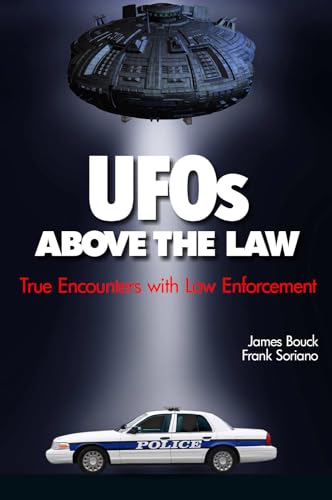
UFOs Above the Law
True Encounters with Law Enforcement — and What a Badge Actually Certifies
Find on Amazon →As an Amazon Associate, OverClassified may earn from qualifying purchases made through this link, at no extra cost to you.
Why This Is Essential Reading
Worth having for the transcripts; read the premise with care. Jim Bouck and Frank Soriano brought two things to this that most compilers lack — law enforcement careers and MUFON field-investigation experience — and they used them to gather the one class of evidence this literature is chronically short of: contemporaneous dispatch traffic, timestamped, generated by third parties, recorded while the object was still in the sky. That material is genuinely valuable and it is why the book earns a place here. The framing does not survive the same scrutiny. Schiffer's claim that these reports prove UFOs "are here en masse" does not follow from a collection of sincere reports, and the trained-observer premise needs the distinction the book never draws: police training produces real reliability in scene description, sequence recall and testimony under stress, and confers nothing at all on the specific task of judging the distance, size and identity of unfamiliar lights at night — at which everyone performs badly. What survives intact is the disincentive argument. Officers who file these reports risk the professional credibility their work depends on, and that is real evidence about sincerity. Read it beside Night Siege and this site's Socorro, Portage County and Val Johnson files — one Credible, two Disputed, all three officer witnesses.
Related Cases & Theories
Sources Cited
- Bouck, James, and Frank Soriano. UFOs Above the Law: True Encounters with Law Enforcement. Schiffer Publishing, Atglen, Pennsylvania, 9 November 2011, 192 pp., illustrated. ISBN-10 0764339206 / ISBN-13 9780764339202. Foreword by Richard M. Dolan. amazon.com
- Schiffer Publishing product page — the publisher's own description ("a collection of UFO reports from law enforcement officers and other government officials that prove that UFOs are not only real, but that they are here en masse"), the communication transcripts between dispatchers and officers, the authors' backgrounds as a former NYS Park Police officer and a retired New York State corrections officer, the Dolan foreword, and the 192-page 6 × 9 paperback specification. schifferbooks.com
- Internet Archive scanned copy, UFOs above the law: true incidents of law enforcement officers' encounters with UFOs — catalogue record giving Frank Soriano as author with Jim Bouck as contributing editor, Schiffer Publishing 2011, 189 pp. of text, 23 cm, illustrated, OCLC 1330862292, LCCN 2011938450, with bibliographical references and index. archive.org
- Open Library work record OL16521144W — Schiffer Pub., 2011, 189 pages, both ISBNs. openlibrary.org
- AbeBooks catalogue record, ISBN 9780764339202 — independent bibliographic listing and cover-art source. abebooks.com
- Goodreads edition record — reader reception and edition history. goodreads.com
- ThriftBooks author listing, Frank Soriano — independent catalogue record for the title. thriftbooks.com
- Wikipedia, "Schiffer Publishing" — the Atglen, Pennsylvania trade house that issued the volume. en.wikipedia.org
- Wikipedia, "Mutual UFO Network" — the volunteer field-investigator organisation, its state-director structure and report protocol, through which both authors worked. en.wikipedia.org
- Wikipedia, "Lonnie Zamora" — the 1964 Socorro patrolman whose case established the police-witness argument. en.wikipedia.org
- Wikipedia, "Val Johnson incident" — the 1979 Marshall County, Minnesota deputy case, its documented vehicle damage and its contested assessment. en.wikipedia.org
- Wikipedia, "Herbert Schirmer" — the Nebraska police sergeant whose 1967 account expanded under hypnotic regression. en.wikipedia.org
- Wikipedia, "Hudson Valley UFO sightings" — the 1982–86 wave in the authors' own region, its scale, and the formation-flying pilot group identified as a contributor. en.wikipedia.org
- Wikipedia, "National UFO Reporting Center" — the parallel civilian reporting infrastructure through which many such accounts enter the record. en.wikipedia.org
- National Library Board Singapore catalogue record for the title — evidence of international library holding. nlb.gov.sg
Have corrections, additional research, or peer-reviewed sources? Help improve this entry.
Suggest an Edit