
El misterio Ovni
Un alto secreto al descubierto — Bruno Cardeñosa's Journalistic Survey of the UFO Question in Spanish
Core Thesis
El misterio Ovni: Un alto secreto al descubierto is a 368-page Spanish-language survey of the UFO question by Bruno Cardeñosa Chao, one of Spain's most widely read investigative journalists on anomalous subjects. Its publisher's framing is unusually precise about what it is trying to be: a current, serious, rigorous and journalistic treatment, functioning as both reportage and essay, written for believers and sceptics alike, tracing the phenomenon from the second half of the twentieth century to the present. The reason it belongs in an English-language library is context rather than novelty. Spain released roughly two thousand pages of Air Force UFO files between 1992 and 1999 — an open-records exercise no English-speaking government has matched — and this book is written for a readership that has actually seen its own state's files. That changes what a national survey can assume, and it shows on every page.
About the Author
Bruno Cardeñosa Chao was born in Ourense, Galicia, on October 18, 1972, spent his childhood in Zaragoza, and studied journalism at the University of the Basque Country in Bilbao. He has said his interest in the subject began in 1986 with J. J. Benítez's La punta del iceberg — a detail worth noting, because Benítez is the most commercially successful and most frequently criticised UFO writer in the Spanish language, and Cardeñosa's own work is in large part a reaction against that model.
His career has been in mainstream Spanish media rather than in ufology's own institutions. He has presented and produced on radio — Mundo Misterioso and the long-running La Rosa de los Vientos on Onda Cero — directed a section on the television channel Cuatro, served as editor-in-chief of Más Allá, and written for Año Cero and Enigmas. He is the author of more than a thousand articles and some twenty-three books.
Only a minority of his output is about UFOs. He has written on Wikileaks, on organised crime, on political secrecy and on historical enigmas, and that range is relevant: his approach to the UFO question is the approach of a journalist who also covers government opacity in other domains, and who treats official secrecy as a normal institutional behaviour rather than as evidence of anything exotic.
Within the UFO field his significant earlier titles are 50 años de ovnis: las mejores evidencias (América Ibérica, 1997) and, more importantly, Ovnis en España: lo que oculta el Ejército del Aire (América Ibérica, 2002), a study of the Spanish Air Force's holdings built on pilot and military testimony. That book is the direct ancestor of this one and explains its documentary confidence.
The honest caveat is that Cardeñosa is a broadcaster and popular writer, not a researcher in the sense that Vicente-Juan Ballester Olmos is. He synthesises, interviews and narrates; he does not compile case catalogues or perform technical analysis. Spanish ufology has a strong sceptical and documentary tradition, and readers should know that the country's most rigorous work on its own files was not done by him.
Historical Context & Origins
The single most important fact about Spanish ufology is that the state opened its files, and did so early. Between 1992 and 1999 the Spanish Ministry of Defence declassified 84 records comprising close to two thousand pages and covering 122 sightings between 1962 and 1995. Nothing comparable happened in the United States, and the British and French equivalents came later or were narrower in scope.
That process had an author. Vicente-Juan Ballester Olmos promoted and supervised the declassification through sustained cooperation with the intelligence section of the Air Operative Command, pressing not merely for release but for completeness — ensuring that missing reports were located and added. In 1994 he established the existence of a classified dossier of more than four hundred further pages including official correspondence, studies by Spain's national aerospace institute INTA, and a substantial analytical report by the American Battelle Institute.
The result is that Spanish readers have a relationship with their national UFO record that Anglophone readers do not. Arguments about what the military knows are conducted in Spain with reference to documents both sides have read. That is the environment this book was written into, and it explains why its register is journalistic rather than revelatory: the secret has already been opened, and the interesting question is what is in it.
The Spanish case record itself is substantial. The Manises incident of November 11, 1979 — a TAE Supercaravelle diverted to Manises airport near Valencia after its crew reported lights on a collision course, with Mirage interceptors scrambled from Talavera la Real — remains the best-documented commercial-aviation UFO diversion anywhere in Europe. The Canary Islands events of 1976 produced military witnesses and an official file of their own.
The Spanish popular literature has been dominated for fifty years by J. J. Benítez, whose enormous sales and repeatedly contested sourcing are the backdrop against which every subsequent Spanish writer on the subject has had to position themselves. Cardeñosa acknowledges Benítez as the reason he became interested and then writes in a completely different mode, which is itself a kind of argument.
Spain also has an unusually strong sceptical tradition in this field, with researchers such as Ricardo Campo Pérez producing detailed case reconstructions that resolve specific incidents to conventional causes. Any assessment of a Spanish popular survey has to be made against that comparison, and Cardeñosa's book is less rigorous than that work while reaching a vastly larger audience.
The book's series placement is a signal in itself. Nowtilus published it in Investigación Abierta — 'open investigation' — a general-interest nonfiction line rather than an occult or New Age imprint, aimed at readers who buy history and current-affairs books. The framing is deliberate and the book largely lives up to it.
Core Arguments & Key Concepts
The subject can be reported rather than believed or debunked, and Spanish readers deserve that treatment. This is the book's organising claim and it is stated openly in the publisher's own description: a work suited to believers and sceptics alike. Cardeñosa's position is that the UFO question is a legitimate object of journalism — documents, witnesses, institutions, chronology — and that both the advocacy literature and the reflexive dismissal have failed readers who simply want to know what is on the record.
The documentary record is the foundation, not the testimony. Coming out of his earlier work on the Spanish Air Force holdings, Cardeñosa builds outward from files rather than inward from encounters. This is the correct methodological order and it is rarer in popular UFO writing than it should be. A survey grounded in what a government actually wrote down is checkable in a way that a survey grounded in interviews is not.
Official secrecy is ordinary institutional behaviour and should be interpreted accordingly. Cardeñosa's parallel career covering political secrecy, intelligence and leaks informs the book's most useful methodological stance: that militaries classify air-defence material as a matter of routine, that classification of a UFO report therefore establishes nothing about its contents, and that the interesting question is always what the document says rather than what stamp is on it.
The Spanish declassification is the model and other states should be held to it. The book's implicit international argument, and the one most worth exporting. A mid-sized NATO member released nearly two thousand pages of air-force UFO reporting in the 1990s, survived the experience, and was not embarrassed by what emerged. Every subsequent official claim that such material cannot be released has to answer that precedent.
Chronological continuity matters more than spectacular cases. The book runs from the second half of the twentieth century to the present rather than orbiting a handful of famous incidents. That structure resists the field's usual gravitational collapse toward Roswell and a dozen greatest hits, and it makes visible the thing a case-by-case treatment hides: that reporting is continuous, that its character changes with technology and media, and that no single event is load-bearing.
The weakest strand is the absence of a stated evidential standard. Journalism's characteristic failure mode in this subject is even-handedness as a substitute for judgement, and this book is not immune. Presenting the strongest cases and their strongest counter-explanations without ever saying which the author finds persuasive reads as fairness but functions as evasion, and a reader finishes the book knowing what has been claimed without knowing what Cardeñosa thinks is true.
It is also, being a survey, thin where Spanish research is strongest. The country's most valuable contribution to the field is detailed case-level analysis — Ballester Olmos's cataloguing, the INTA and Battelle material, the sceptical reconstructions of specific incidents. A 368-page general survey cannot reproduce that, and this one does not try. Readers who want the depth have to go to the sources.
Key Cases & Evidence Discussed
The Spanish Air Force declassification, 1992–1999. The 84 released records, the roughly two thousand pages, the 122 sightings between 1962 and 1995, and the institutional process by which they came out. The documentary spine of Cardeñosa's whole approach to the subject.
The Manises incident, November 11, 1979. The TAE Supercaravelle's emergency diversion to Manises after its crew reported lights closing on the aircraft, and the Mirage F1 scrambled to investigate. Examined in this site's case file and the most consequential aviation UFO event in Spanish history.
The Canary Islands events of 1976. The military and civilian sightings around Gran Canaria that generated one of the earliest Spanish official files, covered in this site's Gando air base case file and later the subject of detailed sceptical reconstruction.
The INTA and Battelle material. The classified dossier of more than four hundred pages identified in 1994 — official correspondence, studies by Spain's national aerospace institute, and an extensive analytical report by the American Battelle Memorial Institute — establishing a documented technical link between the Spanish and American official records.
Military and airline pilot testimony. The body of Spanish aircrew reporting that Cardeñosa assembled for his earlier Ovnis en España and draws on here. Pilot testimony is the strongest witness class in the subject and Spain's is unusually well documented because much of it exists inside released files.
The international comparison cases. The book does not confine itself to Spain, tracking the phenomenon from the mid-twentieth century onward with the standard international landmarks used as chronological anchors rather than as objects of investigation in their own right.
The Benítez legacy. Not a case but a presence. The dominance of Spanish popular ufology by a single enormously successful and repeatedly criticised writer is the condition Cardeñosa's journalism was written against, and it is the reason the book's insistence on documents rather than revelation matters in Spanish more than the same insistence would matter in English.
Critical Reception & Controversies
The book has no reception in English at all, which is the ordinary fate of Spanish-language ufology and part of the reason this article exists. It was published into a general-interest nonfiction line, sold steadily enough to be reissued in multiple formats including an ebook edition, and has never been translated.
In Spain, Cardeñosa's standing is that of a mainstream media professional rather than a movement figure, and that has been both his protection and the source of criticism from both directions. Committed believers regard his refusal to conclude as evasion; sceptics regard the book's willingness to leave cases open as a failure to apply the standards his own journalism applies elsewhere.
The sceptical criticism has real force, and it is best understood by comparison. Spanish researchers working on individual cases have resolved a number of the country's better-known incidents to conventional causes through detailed reconstruction — the kind of work that requires a full article per case. A survey that presents such incidents as open questions is, in effect, declining to report the resolution, and readers should check individual cases against the specialist literature rather than relying on the survey.
The countervailing point is about audience. Ballester Olmos's catalogues and the technical case reconstructions are read by a few hundred people; a Nowtilus trade paperback by a national radio presenter is read by a few tens of thousands. A book that gets a general readership to the position that the documents exist, that they can be read, and that reading them is the appropriate response, has done something the rigorous literature demonstrably cannot do on its own.
There is also a straightforward apparatus problem shared with almost every book in this genre in any language. The book is written as narrative journalism, with sources named in the text rather than in notes, and a reader wanting to follow a specific claim back to a released file has no direct route from the page to the document.
One structural criticism deserves stating plainly. Cardeñosa's own account of his origins — that he came to the subject through Benítez in 1986 — is disarming, but the book does not really settle accounts with that inheritance. A Spanish survey published in 2010 that does not squarely address why the country's best-selling UFO literature has been so persistently unreliable has left its most important local question unasked.
Read as what it is — a competent, well-structured, document-grounded general survey written for a national audience with unusually good access to its own government's files — it is a good book. Read as a research contribution it is not one, and it does not claim to be.
Influence & Legacy
Its durable function is as the standard Spanish-language general survey of the period, the book a Spanish reader is pointed toward first. In a language with a very large popular UFO literature and a very small rigorous one, a competent middle term matters more than it would in English.
It also consolidated a shift in Spanish coverage of the subject away from the revelation model and toward the documentary one. Cardeñosa's media platforms — national radio, magazines, television — carried that framing to an audience far beyond book buyers, and the current Spanish public conversation about UFOs is noticeably more file-centred and less prophet-centred than the one that existed when he started.
For an English-speaking reader the book's real legacy is the argument its existence makes. Spain declassified its air-force UFO record in the 1990s and the sky did not fall; the resulting national conversation is more grounded, not less, than the Anglophone one; and the standard objection that such files cannot be released has a thirty-year-old counterexample sitting in the Spanish Ministry of Defence.
Its cautionary legacy is about journalistic balance. Reporting every claim and every rebuttal without adjudicating between them looks like rigour and is not, and this book — better than most — still shows how a conscientious journalist can leave a reader informed and undecided about matters that are in fact decidable. The remedy is the specialist literature, and the book's most useful service is pointing toward it.
The Book
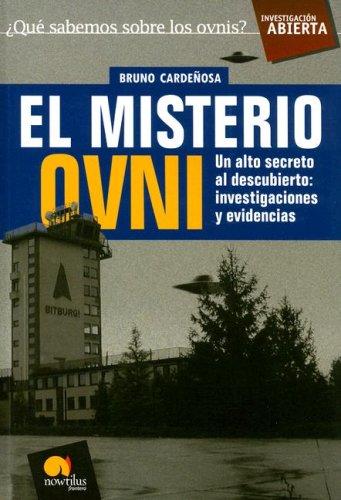
El misterio Ovni
Un alto secreto al descubierto — Bruno Cardeñosa's Journalistic Survey of the UFO Question in Spanish
Find on Amazon →As an Amazon Associate, OverClassified may earn from qualifying purchases made through this link, at no extra cost to you.
Why This Is Essential Reading
Read it if you read Spanish; know what it does if you do not. El misterio Ovni is a competent, document-grounded, deliberately even-handed national survey by a professional journalist, published on a general nonfiction list for readers whose government had already opened its UFO files — and that last fact is why it is worth an English-speaking researcher's attention even untranslated. Its argument is that the subject is reportable: that files, chronology and named witnesses beat both revelation and reflexive dismissal. Its limitation is that it reports without concluding, and that Spain's genuinely rigorous work on its own cases — Ballester Olmos's cataloguing and supervision of the 1992–99 declassification above all — is where a researcher should actually go. Take from it the model rather than the contents: a mid-sized NATO state released two thousand pages of air-force UFO reporting thirty years ago, and every government still refusing has to explain why it cannot.
Related Cases & Theories
Sources Cited
- Cardeñosa Chao, Bruno. El misterio Ovni: Un alto secreto al descubierto: investigaciones y evidencias. Ediciones Nowtilus, Madrid, 2010, series Nowtilus Frontera: Investigación Abierta. 368 pp. ISBN-10 8497633415 / ISBN-13 9788497633413. amazon.com
- Google Books edition record, El misterio Ovni — Ediciones Nowtilus, 2010, 368 pages, the Investigación Abierta series placement, and the publisher's description of the book as a current, rigorous and journalistic treatment written for believers and sceptics alike. books.google.com
- Open Library edition record, ISBN 8497633415 — bibliographic verification and cover-art source. openlibrary.org
- AbeBooks catalogue record, ISBN 9788497633413 — edition and format verification. abebooks.com
- Wikipedia (Spanish), "Bruno Cardeñosa" — born Ourense October 18 1972; childhood in Zaragoza; journalism studies at the University of the Basque Country; his 1986 introduction to the subject through J. J. Benítez's La punta del iceberg; his work on Mundo Misterioso and La Rosa de los Vientos at Onda Cero, at Cuatro, as editor-in-chief of Más Allá and as a writer for Año Cero and Enigmas; and his bibliography including 50 años de ovnis (1997) and Ovnis en España (2002). es.wikipedia.org
- Lecturalia author page for Bruno Cardeñosa — biography and full bibliography. lecturalia.com
- Todos Tus Libros author page for Bruno Cardeñosa — the Spanish booksellers' association record of his published titles and editions. todostuslibros.com
- Internet Archive, "Spanish UFO Files" (Ministry of Defence, Spain) — the declassified Spanish Air Force UFO records themselves, released 1992–1999. archive.org
- NICAP biographical file, "Who is Vicente-Juan Ballester Olmos" — his role from 1992 to 1999 promoting and supervising the Spanish Air Force declassification through cooperation with the intelligence section of the Air Operative Command, the 84 records and roughly 2,000 pages covering 122 sightings from 1962 to 1995, and his 1994 identification of the further 400-page classified dossier including INTA studies and the Battelle Institute analysis. nicap.org
- FOTOCAT blog, Vicente-Juan Ballester Olmos — the continuing English- and Spanish-language record of Spanish UFO research, cataloguing and declassification history. fotocat.blogspot.com
- Wikipedia, "Manises UFO incident" — the November 11, 1979 diversion of the TAE Supercaravelle to Manises and the Mirage scramble from Talavera la Real. en.wikipedia.org
- Wikipedia (Spanish), "J. J. Benítez" — the writer whose La punta del iceberg brought Cardeñosa to the subject and whose dominance of Spanish popular ufology is the context for this book. es.wikipedia.org
- Wikipedia (Spanish), "Ovni" — the Spanish-language reference article on the subject and its national research history. es.wikipedia.org
- Amazon Spain edition record for the Kindle edition (ASIN B005PQYFO6) — the electronic edition of the same text. amazon.es
Have corrections, additional research, or peer-reviewed sources? Help improve this entry.
Suggest an Edit