
Enciclopedia de los encuentros cercanos con OVNIs
Respuestas al inquietante tema de los ovnis — Nearly 600 Close-Encounter Reports from Spain and Portugal, Explained and Unexplained
Core Thesis
This is a catalogue, and its argument is made by its architecture rather than by its prose. Vicente-Juan Ballester Olmos and Juan Antonio Fernández Peris gathered nearly 600 reported UFO landings and close encounters from Spain and Portugal up to 1985 — the most complete regional close-encounter inventory anyone had built for the Iberian peninsula, and one of the most complete for any country — and then made a decision that separates it from almost everything else on the shelf beside it: they printed the solved cases too. Reports traced to aircraft, balloons, re-entries, advertising planes, hoaxes and honest misperception appear in the same catalogue, described in the same detail, as the ones that resisted explanation. The point is not that most UFO reports are explicable, which every serious investigator already knew. The point is that a catalogue which quietly removes the explicable ones has stopped being a record and started being an argument.
About the Author
Vicente-Juan Ballester Olmos was born in Valencia, Spain, on 27 December 1948 and has investigated UFO reports since 1966. He describes his own formal education as reaching pre-university level, with a programming diploma taken in 1973, and calls himself a self-taught student of several scientific disciplines — a self-description worth quoting because the quality of his output has never depended on a credential.
His working life was spent at Ford Motor Company in Spain, from 1976 to 2005, latterly as Manager of Insurance, Benefits and Pensions. He took early retirement in 2005. The UFO research was done in evenings and weekends across four decades, which is the ordinary condition of serious work in this field and is worth stating plainly.
By the time this book appeared he had already published four others, three of them with the same house. A Catalogue of 200 Type-I UFO Events in Spain and Portugal (1976) was issued by the Center for UFO Studies in the United States and is the direct ancestor of this volume. OVNIS: El fenómeno aterrizaje followed in 1978, Los OVNIS y la ciencia in 1981 with Miguel Guasp, and Investigación OVNI in 1984. Forewords to his books have been written by J. Allen Hynek, Jacques Vallée and Dr. Richard Haines.
The awards are relevant because of what they were given for. In 1982 the Fund for UFO Research in Washington awarded him a scholarship specifically for the study of close-encounter cases reported in Spain and Portugal — which is to say, the research that produced this book was externally funded on its merits before it was written. In 1983 he shared the Alvin Lawson Award with John Schuessler for advances in the scientific understanding of the phenomenon.
Everything he is now best known for came later. His March 1991 report to the Spanish Air Force General Staff, documenting how other NATO countries had already opened their UFO archives, led directly to Spain's phased 1992–1999 declassification of 84 case files; he curates the FOTOCAT photographic database, which has catalogued more than 12,000 image cases; and he is vice-president and research director of the Fundación Anomalía. He has produced upwards of 480 publications.
His co-author Juan Antonio Fernández Peris is an engineer and researcher who went on to write El Expediente Manises (2000), the most detailed independent analysis of the declassified Spanish Air Force file on the Manises emergency landing, and won the Fundación Anomalía's Premio Ricardo Caruncho for it.
One characterisation of Ballester Olmos recurs in the Spanish-language literature and is fair: he began as a believer in extraterrestrial visitation in the 1960s and moved, over decades and in public, toward a rigorously evidence-led position. He did not convert to skepticism as a stance; he arrived there by cataloguing.
Historical Context & Origins
Spain in 1987 was eleven years out of dictatorship and in the middle of a genuine national argument about what its state institutions had been keeping. The UFO question sat inside that argument in a way it did not in Britain or the United States, because Spain's military UFO files were held by an Air Force that had, until very recently, answered to nobody.
The public side of that story had begun a decade earlier. In October 1976 a senior Air Force general handed twelve UFO report summaries to the journalist J.J. Benítez, who published them in La Gaceta del Norte that December and in book form the following March as Ovnis: Documentos Oficiales del Gobierno Español. That was the sensational entrance to the subject. This book is the other one.
Internationally, the moment favoured catalogues. The 1970s and early 1980s had produced serious attempts at systematic close-encounter inventories — Ted Bloecher's 1947 wave study, the humanoid catalogues, and the landing-trace collections examined here in Physical Traces. Vallée's Type-I classification, covering reports of objects on or near the ground with associated physical or physiological effects, gave the work a common vocabulary.
Spain and Portugal were an unusually good test bed for that vocabulary, and this is the substantive reason the catalogue matters beyond its own borders. The Iberian peninsula produced a large, dense body of close-encounter reports; it had an active domestic research community; and it had, in the 1950s to 1970s, relatively low aircraft traffic outside the corridors, which makes the identifiable stimuli in a given report easier to enumerate than in more crowded airspace. Portugal contributes its own military dimension to the same corpus — this site's record of the peninsula includes the encounter at Ota Air Base north of Lisbon.
The book also arrived at the end of a specific arc in its principal author's own work. The 1976 CUFOS catalogue held 200 Type-I events. This one holds nearly 600 and extends to 1985. What happened in between was eleven years of collection, correspondence and re-investigation — and, crucially, of solving cases that the 1976 catalogue had listed as unexplained.
Five years after publication, the process Ballester Olmos had spent his career arguing for arrived: Spain began releasing its own military UFO files, a programme he had personally proposed to the Air Force General Staff. This site covers what those files contained in its case work on Manises, Gando and Talavera la Real.
Core Arguments & Key Concepts
A regional catalogue must be exhaustive to be worth anything. The organising principle. Nearly 600 reports for Spain and Portugal up to 1985, gathered rather than selected, because a sample chosen for interest cannot support any statement about the population it came from.
Solved cases belong in the catalogue. The book's most consequential and least imitated editorial decision. Reports resolved to conventional stimuli are documented in the same detail as the unresolved ones.
The resolution rate is itself a finding. Once explained and unexplained cases sit in one inventory, the proportion between them becomes a measurable quantity rather than a rhetorical claim, and it can be tracked as re-investigation proceeds.
Classification should follow observation, not interpretation. Cases are organised by what was reported — object on the ground, occupants, physical traces, physiological effects — rather than by what the compilers thought had happened.
Witness quality is a variable, not a verdict. A recurring theme across Ballester Olmos's work, and later the subject of dedicated study: the reliability of testimony varies systematically and can be examined rather than simply asserted.
Regional density patterns are worth measuring. With a near-complete inventory in hand, geographic and temporal clustering across the peninsula becomes analysable instead of anecdotal.
The catalogue is a tool for other researchers, not a monument. The whole point of publishing nearly 600 case summaries with sources is that someone else can go back and check, re-investigate, and disagree.
Key Cases & Evidence Discussed
The corpus itself. Nearly 600 reported UFO landings and close encounters from Spain and Portugal to 1985, explained and unexplained together. This article has not audited the case list item by item and makes no claim that any specific incident named below appears in it; the entries that follow describe the categories the catalogue is built from and the Iberian cases on this site that belong to the same body of material.
Type-I events. The Vallée category the whole project is organised around — objects reported on or near the ground, with or without occupants, with or without physical traces. Ballester Olmos's 1976 CUFOS catalogue of 200 such events for the same territory is this book's direct predecessor.
Landing-trace reports. Cases with claimed ground marks, scorching, vegetation damage or soil disturbance — the subset most amenable to physical re-examination, and the subject of Physical Traces Associated with UFO Sightings.
Occupant reports. Encounters involving described entities, a category the Spanish record contains in quantity and one the compilers treated as observational data to be recorded rather than as a separate class of claim; compare Flying Saucer Occupants.
Solved cases. The catalogue's distinguishing content: reports traced to aircraft, weather balloons, advertising aircraft, atmospheric re-entries, astronomical objects and hoaxes, retained and described rather than discarded.
The Manises emergency landing, 11 November 1979. Spain's single most famous case, in which a passenger jet diverted to Manises Airport after an encounter over the Mediterranean. Fernández Peris later devoted an entire book to the declassified file.
The Gando / Gáldar sighting, 22 June 1976. The Canary Islands event later identified by Ballester Olmos and Ricardo Campo Pérez as a U.S. Navy Poseidon C-3 missile test — a case that moved from unexplained to explained by exactly the archival method this catalogue exists to enable. See El ovni de Gáldar.
The Talavera la Real sentry encounter, 12 November 1976. A close encounter at a Spanish air base, investigated at the time by Benítez and later covered by the declassification programme.
Critical Reception & Controversies
This book has never been reviewed in an English-language venue, and that is part of its story. It is a Spanish-language reference work published by a Spanish trade house in 1987, and its readership outside Spain has been confined to researchers who read Spanish and knew to look for it. Its standing inside Spanish ufology, by contrast, is settled: it is a standard reference, and the Dialnet bibliographic database — the Spanish academic index — carries a record for it, which is not true of most books in this genre.
The substantive criticism a modern reader should apply is about the sources feeding the catalogue rather than the catalogue's construction. A regional inventory of this kind is assembled from press reports, local investigator files, correspondence and organisational archives of very uneven quality. Spain's UFO research community in the 1960s and 1970s produced excellent field work and also produced a good deal that was not, and no compiler can retroactively raise the quality of an investigation that was never done properly. The book's near-completeness is a real virtue that also guarantees it contains a substantial quantity of thin material.
The second limitation is temporal, and it is nobody's fault. The catalogue closes at 1985 and was published in 1987 — five years before Spain began declassifying its military files. Several of the peninsula's most significant cases have since acquired an official documentary layer that did not exist when this was compiled, and in at least one instance — the Canary Islands sighting of June 1976 — the eventual resolution came from records that were not available to anyone in 1987. A reader using this as a current reference is using a snapshot.
A third point is about the resolution rate itself, and it cuts both ways. Including solved cases makes the proportion measurable, but it does not make it stable: the ratio depends on how much re-investigation has been done, and re-investigation is not evenly distributed. Cases that attracted attention got checked; obscure ones did not. The unexplained residue in any catalogue is therefore partly a measure of the phenomenon and partly a measure of how hard anyone looked, and this catalogue cannot separate the two.
It is also worth being honest about the practical objection: 383 pages of Spanish-language case summaries is a reference work, not a book to read through, and its intended user is another investigator. Nothing here is written to persuade a general reader of anything.
The strongest thing to be said in its favour is comparative. Set it beside the commercially successful Spanish UFO literature of the same decade — which sold on revelation, official secrets and the promise that everything unexplained pointed one way — and the difference in intellectual posture is stark. This book's authors had every incentive to publish only the good cases, and did not. That decision has aged extremely well, and it is the reason a catalogue closed in 1985 is still cited.
One caution about the edition. The Amazon listing under ASIN B00E1FIT1W names only Ballester Olmos as author; the book's own cover names both him and Fernández Peris, and this article follows the cover. Secondary sources occasionally give the co-author's first name as José rather than Juan; the printed cover and the Spanish research record both give Juan Antonio.
Influence & Legacy
The catalogue's most durable legacy is methodological rather than evidential. It demonstrated, in print and at scale, that a regional inventory including its own solved cases is more useful than one that quietly excludes them — and it did so at a moment when the commercial incentive ran hard the other way.
It is the direct ancestor of Ballester Olmos's later work. FOTOCAT, his photographic-case database of more than 12,000 entries, applies the same principle to images: catalogue everything, record the identifications, publish the residue honestly. The through-line from a 1976 catalogue of 200 landings to a 12,000-entry image database is one continuous methodological argument.
For Spain specifically, the book helped make the case that the country's UFO record was substantial and orderly enough to be worth an official archive — an argument Ballester Olmos put directly to the Air Force General Staff in March 1991 and which produced the 1992–1999 declassification. A researcher arguing that a state should open its files is in a much stronger position if he can show he has already catalogued the civilian record.
Its co-author's later career shows the same influence. Fernández Peris's El Expediente Manises takes the catalogue habit — exhaustive documentation, conventional explanations pursued seriously — and applies it to a single case at book length, producing a proposed explanation that the pilots themselves rejected and that other researchers have contested on geometric grounds. That is what a live research culture looks like.
For an English-speaking reader the useful comparison is with Allan Hendry's The UFO Handbook (1979), which reached a similar conclusion by a different route: catalogue everything, work the identifications hard, and report the residue without inflating it. That two researchers on different continents arrived independently at the same discipline is the strongest available evidence that it is the right one.
The Book
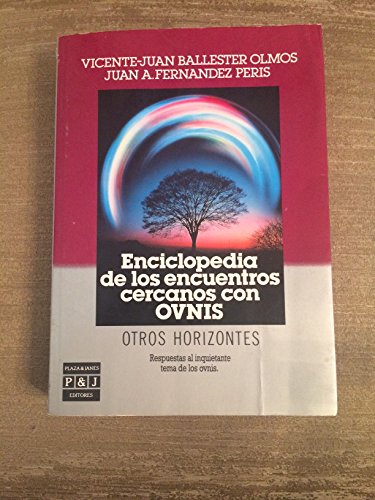
Enciclopedia de los encuentros cercanos con OVNIs
Respuestas al inquietante tema de los ovnis — Nearly 600 Close-Encounter Reports from Spain and Portugal, Explained and Unexplained
Find on Amazon →As an Amazon Associate, OverClassified may earn from qualifying purchases made through this link, at no extra cost to you.
Why This Is Essential Reading
This earns its place for one editorial decision, taken in 1987 and still not widely imitated: it prints the solved cases. Enciclopedia de los encuentros cercanos con OVNIs is the most complete close-encounter inventory ever built for Spain and Portugal — nearly 600 reported landings up to 1985, in 383 pages from a major Spanish trade house — and its authors chose to document the reports that turned out to be aircraft, balloons, re-entries and hoaxes in the same detail as the ones that did not. That choice is what makes the unexplained residue mean something. Ballester Olmos had already been funded by the Fund for UFO Research specifically to do this work and had already shared the Alvin Lawson Award for it; four years later he would persuade the Spanish Air Force to open its own archives. The limitations are real and mostly unavoidable: the source material feeding any regional catalogue is of very uneven quality, the inventory closes seven years before Spain's declassification began, and it is a Spanish-language reference work rather than a book anyone reads through. Read it beside Hendry's UFO Handbook, which reached the same discipline independently, and Los OVNIS y la ciencia, where the same author set out the method first.
Related Cases & Theories
Sources Cited
- Ballester Olmos, Vicente-Juan, and Juan Antonio Fernández Peris. Enciclopedia de los encuentros cercanos con OVNIs. Plaza & Janés Editores, Barcelona, 1987, colección Otros Horizontes. 383 pp. ISBN-10 8401390249 / ISBN-13 9788401390241. amazon.com
- Dialnet (Universidad de La Rioja) bibliographic record for the title — the Spanish academic index's entry, and independent confirmation of the work's standing as a reference. dialnet.unirioja.es
- AbeBooks catalogue record, ISBN 9788401390241 — the source for publisher, collection, 383-page extent, the cover art reproduced here, and the description of the work as presenting and analysing close to 600 reported UFO landings, explained and unexplained, from Spain and Portugal up to 1985. abebooks.com
- Todos Tus Libros (Spanish booksellers' federation catalogue), ISBN 978-84-01-39024-1 — independent Spanish-language bibliographic record. todostuslibros.com
- Iberlibro (AbeBooks Spain) listing, ISBN 9788401390241 — second-hand market record and edition confirmation. iberlibro.com
- Goodreads edition record — independent listing and reader reception. goodreads.com
- NICAP, “Ballester Olmos Detailed Bio” — the primary source used here for his birth in Valencia on 27 December 1948, his self-described education and 1973 programming diploma, his 1976–2005 career at Ford Motor Company, the full book list with publishers and years (including the 1976 CUFOS Catalogue of 200 Type-I UFO Events in Spain and Portugal), the FOTOCAT project's scale, and the 1982 Fund for UFO Research scholarship and 1983 Alvin Lawson Award. nicap.org
- Anomaly Archives collection file on Vicente-Juan Ballester Olmos — independent confirmation of his research affiliations, his role at the Fundación Anomalía, and his editorship at UPIAR. anomalyarchives.org
- EuroUFO researcher profile, “Ballester Olmos, Vicente-Juan (Spain)” — second independent biographical source, including his role in the 1992–1999 Spanish Air Force declassification. euroufo.net
- Wikidata entry Q11954628, Vicente-Juan Ballester Olmos — structured biographical record. wikidata.org
- Internet Archive, Spanish UFO Files (Ministerio de Defensa) — the declassified Spanish Air Force archive released between 1992 and 1999, the process Ballester Olmos's March 1991 report set in motion. archive.org
- Wikipedia, “UFO sightings in Spain” — background on the twelve Air Force report summaries released to J.J. Benítez in 1976 and on the 1992 declassification. en.wikipedia.org
- Wikipedia, “Close encounter” — the Hynek and Vallée classification vocabulary, including the Type-I category the catalogue is organised around. en.wikipedia.org
- OverClassified, Manises UFO Emergency Landing — this site's case file, and the subject of Fernández Peris's later monograph.
- OverClassified, Gando Air Base / Canary Islands UFO — this site's case file on the June 1976 sighting and its eventual Poseidon C-3 identification.
- OverClassified, Talavera la Real Air Base Sighting — this site's case file on the November 1976 sentry encounter.
Have corrections, additional research, or peer-reviewed sources? Help improve this entry.
Suggest an Edit