
Flying Saucers from Outer Space
The Book the Air Force Helped Write — and Then Spent Twenty Years Living Down
Core Thesis
Flying Saucers from Outer Space is the middle volume of Donald E. Keyhoe's flying-saucer trilogy — published by Henry Holt on October 5, 1953, between The Flying Saucers Are Real (1950) and The Flying Saucer Conspiracy (1955) — and it is the only one of the three written from inside the building Keyhoe spent the rest of his life accusing. Its argument is stated flatly in its own foreword: three years earlier Keyhoe had written that the Air Force knew the answer and was hiding it; now, he says, "Since July, 1952, in a new investigation of the saucers, I have been privileged to cooperate with the Air Force," and "Scores of impressive sighting reports by service pilots have been cleared for me, with the conclusions of Air Technical Intelligence — some so incredible they would have been ridiculed two or three years ago." The book's central claim is therefore not that the Air Force is lying about the saucers, but something stranger and, for 1953, more destabilizing: that the Air Force's own Wright-Patterson intelligence apparatus privately held conclusions its public affairs operation could not afford to say out loud, and that Keyhoe had been shown them on purpose. Everything the book is praised and attacked for — its insider access, its confident interplanetary reading of that access, and its habit of narrating the Pentagon's internal deliberations as though Keyhoe had a seat at the table — follows from that single premise.
About the Author
Donald Edward Keyhoe (1897–1988) was a U.S. Naval Academy graduate and retired Marine Corps major who came to UFO writing from aviation journalism rather than from science or the occult. He had managed Charles Lindbergh's 1927 national tour and written Flying with Lindbergh about it, and he had spent the 1930s and 1940s as a working pulp and magazine writer — a professional background that shaped every book he wrote afterward, for better and worse. This site's breakdown of The Flying Saucers Are Real covers his 1949 True magazine assignment and the extraordinary reaction to it in full; Flying Saucers from Outer Space picks up the story three years later, and Keyhoe himself uses the earlier episode as the book's baseline. "In 1949, after months of investigation, I wrote an article for True magazine, stating that the saucers were probably interplanetary machines," he recalls in chapter 2. "Within 24 hours the Air Force was swamped with demands for the truth. To end the uproar the Pentagon announced that the saucer project was closed."
What changed between 1950 and 1953 was access. In July 1952 — the month of the Washington, D.C. radar-visual flap — the Air Force's public posture toward Keyhoe shifted from stonewalling to something close to collaboration. His principal channel was Albert M. Chop, described in the book as "the Air Force civilian expert on UFO's" who, "Two years before, as acting press chief at Dayton… had learned most of the flying saucer story from Project Intelligence officers" before transferring to the Pentagon as the service's press specialist on the subject. Keyhoe's portrait of Chop is unusually granular for a book of this kind — "A quiet, blue-eyed, serious-faced man in his mid-thirties, he sometimes had a dead-pan expression that told exactly nothing" — and Chop's real institutional position is what makes the book's provenance checkable rather than merely asserted: he was a named, salaried Air Force public information officer whose job was, in part, deciding what Keyhoe could see.
The second channel was Captain Edward J. Ruppelt, then running Project Blue Book. Keyhoe reports Chop relaying a startling offer: "Ed's going to recommend that you go on active duty with the Project, for a couple of weeks anyway. You'd be able to see everything in their files, and it would save time clearing reports." Nothing in the historical record suggests Keyhoe ever took up that recall to active duty, and Ruppelt's own The Report on Unidentified Flying Objects (1956) tells the same period from the opposite chair — the two books are best read against each other, since they cover the same eighteen months from inside and just outside the same office, and disagree less about the facts than about what the facts meant.
Keyhoe's later career — the 1957 founding of NICAP, the 1958 Armstrong Circle Theatre broadcast in which CBS cut his microphone mid-sentence, and the increasingly adversarial books that followed — is often read backward onto this one. That is a mistake. Flying Saucers from Outer Space is the least adversarial book Keyhoe ever wrote about the Air Force, and its closing note is cooperative rather than accusatory: "I should like to thank all the officers and civilian officials — not only of the Air Force, but other government departments — who so generously aided me in this long investigation."
Historical Context & Origins
The book was written in the eighteen months bracketing the single most disruptive period in the U.S. Air Force's public handling of UFO reports. July 1952 produced the largest sighting wave on record to that point, culminating in two consecutive weekends of radar returns and visual sightings around Washington National Airport and the capital's restricted airspace. Keyhoe registers the institutional aftershock directly: "Six months before, in July, a wave of published reports, topped by the eerie happenings at Washington Airport, had almost blown off the lid. It had taken a special Air Force press conference to debunk the saucers and ward off the rising panic. Even then, it had been close."
That "special Air Force press conference" was the July 29, 1952 Pentagon briefing led by Maj. Gen. John A. Samford, then Director of Air Force Intelligence — the largest Pentagon press conference held since the Second World War, and the event at which the temperature-inversion explanation for the Washington radar returns entered the public record. Keyhoe was present in the building's orbit for the period surrounding it, and his account of the Air Force's internal argument over what to say publicly is the book's real subject. This site's own Washington, D.C. UFO Flap case file treats the sightings and the inversion explanation on their own evidentiary merits; Keyhoe's book is a contemporaneous record of how the explanation was chosen.
A second, less-remembered piece of context sits behind the book's opening pages. Keyhoe leads chapter 1 not with an American case but with the May 2, 1953 crash of a BOAC de Havilland Comet shortly after takeoff from Dum Dum Airport, Calcutta, killing all 43 aboard. He notes accurately that the Indian Civil Air Ministry's guarded initial statement said the Comet had been "hit by an unidentified flying body," and then does something the rest of the book does repeatedly: he lets the phrase do work it cannot support. "(In the United States the official term for a flying saucer is 'unidentified flying object.')" The Comet crashes of 1953–54 were subsequently traced to metal fatigue in the aircraft's square window frames — a finding that closed one of the most consequential accident investigations in aviation history and had nothing to do with anything unidentified. Keyhoe's opening is a fair illustration of both the book's narrative power and its central methodological problem.
Commercially, the book arrived on the crest of a wave its predecessor had created. The Flying Saucers Are Real had sold well over half a million copies in paperback, establishing that a mass market existed for a serious-sounding, aviation-literate treatment of the subject. Three years later Henry Holt priced the hardcover at $3 and printed a dust jacket carrying the line "IMPORTANT: SEE BACK OF JACKET" — where a blurb from Albert M. Chop characterized Keyhoe as a "responsible, accurate reporter" and expressed guarded approval of his arguments. A serving Air Force press officer endorsing a book that argues the saucers are interplanetary is, on its face, the single most remarkable fact about this publication, and it is one no later Keyhoe book could replicate.
Core Arguments & Key Concepts
The Air Force's private conclusions ran ahead of its public statements. Keyhoe's core structural claim is that between 1951 and 1953 a selected group of senior officials received closed-door UFO briefings from Air Force Intelligence whose content was materially more alarming than anything released publicly: "Since 1951 a selected group of high government officials has been secretly briefed on the saucers by Air Force Intelligence. More than one former skeptic, after these closed-door sessions, has emerged badly jolted by the Intelligence officers' disclosures." He claims to have seen most of that same evidence. The claim is not self-verifying, but it is also not a bare assertion: the specific mechanism he names — case reports cleared for him individually through a named press officer, with ATIC's own conclusions attached — is exactly the mechanism his named sources occupied.
The reconnaissance model. Where The Flying Saucers Are Real argued mainly that the objects existed and were not American, this book argues about intent. Keyhoe reads the accumulated sighting pattern as a long survey operation approaching a decision point: "From the sighting patterns, the long saucer reconnaissance is possibly nearing its climax." He is careful, at least in the abstract, not to assert hostility — "So far, there is no proof of hostility" — while devoting an entire chapter ("Friends or Foes?") to the possibility. This framing, more than any specific case, is what the book contributed to the genre: the idea that sighting statistics can be read as an operational timeline.
The interception problem. Chapter 2, "Intercept — But Don't Shoot!", takes up the operational dilemma facing air defense: pilots were being scrambled against objects they could not catch, under rules of engagement nobody wanted to test. Keyhoe treats this as the practical reason for official secrecy rather than as evidence of conspiracy — an unusually restrained position for him, and one worth noting given how his reputation was later fixed by the more accusatory books that followed.
A direct, on-the-record challenge to Donald Menzel. The book's most durable passage is not a case narrative at all but a set of four questions Keyhoe says he put to Project Blue Book about Dr. Donald H. Menzel's published explanations, reproduced with their answers. Asked whether ATIC accepted Menzel's "sundog" explanation of the Mantell case, the answer was "No." Asked about his explanation of the 1948 Eastern Air Lines sighting near Montgomery, Alabama: "No." Asked whether ATIC accepted his light-reflection solution in the Gorman case: "No." Asked whether Menzel had obtained all available ATIC records in those three cases, the reply was more damaging still: "He did not obtain this information. In answer to a query, he was offered all Project data on these and other cases, through usual channels. We have heard nothing further from Dr. Menzel in regard to this." Keyhoe then quotes Menzel's own public complaint that scientists "did not receive detailed information necessary for a serious" study — and lets the contradiction stand. Whatever else the book gets wrong, this exchange is a real, checkable piece of documentary journalism, and it is why the book still gets cited in case-file bibliographies seventy years later.
Key Cases & Evidence Discussed
The Gorman Dogfight (Fargo, North Dakota, October 1, 1948). This site's own Gorman Dogfight case file cites this exact book as the source of the still-unresolved theodolite objection to the Air Force's lighted-balloon explanation. Keyhoe summarizes Menzel's competing account — that Lt. George Gorman "had seen only a light reflection from a distance, caused by a whirlpool of air over the fighter's wingtip" — and then reports ATIC's flat rejection of it. Note one error worth flagging for anyone citing the book directly: Keyhoe's text places Fargo in "South Dakota." Fargo is in North Dakota. It is a small mistake, but it is characteristic of a book written fast, and it is the kind of thing a careful reader should expect to check rather than inherit.
The Thomas Mantell crash (Fort Knox, Kentucky, January 7, 1948). Keyhoe uses the Mantell case primarily as a test of Menzel's method rather than re-narrating it: the "sundog" explanation Menzel had published was, per Keyhoe's own query to Blue Book, not accepted by the Air Force's technical intelligence arm either. This site's Mantell case file reaches a considerably more skeptical conclusion than Keyhoe did — the Skyhook balloon explanation is strong and lacks only a single dated launch log tying it to the exact site — but Keyhoe's point survives the disagreement: ATIC did not, in 1953, endorse the specific debunking that was circulating publicly under a Harvard astronomer's name.
The Laredo, Texas encounter (winter 1952–53). Keyhoe presents the Laredo intelligence report as his first substantial demonstration of the new clearance arrangement: "Several weeks later I learned the full details of the Laredo encounter. The Intelligence report was cleared for me by Albert M. Chop, the Air Force civilian expert on UFO's." The passage is less interesting for the case than for the process it documents — a private citizen being handed a classified-adjacent intelligence report by name, on the record, in print, in 1953.
The screened film footage. Two separate pieces of film run through the book: a set of "South Carolina pictures" Keyhoe says he personally arranged to have submitted for analysis and was then invited to a private Pentagon screening of, and a second, more sensitive reel referred to throughout only by the code letter "U." Keyhoe's handling of the latter is a good example of the book's frustrating habit — "I knew what the secret film showed, and what Intelligence was considering. If the plan went through, a lot of Americans were due for a big surprise" — a tease that the book never fully cashes out and that no subsequent researcher has been able to independently identify from the description given.
The 1952 Washington flap and the Samford press conference. Chapters 4 and 5 ("The July Crisis" and "The Powder Keg") are the book's spine. Keyhoe's own summary of the stakes — that a wave "topped by the eerie happenings at Washington Airport, had almost blown off the lid" and that the debunking press conference "had been close" — is a contemporaneous, first-hand characterization of institutional panic that historians of the period still quote. Whether it accurately describes what Air Force Intelligence actually believed is exactly the question later writers have divided on.
Critical Reception & Controversies
The book's most consequential critic was the man it interrogates. Donald H. Menzel, the Harvard astronomer whose later work with Lyle G. Boyd became the standard scientific counter-text, dismissed the entire genre Keyhoe was writing in on the grounds that the interpreters, not the reports, were the problem: "In my opinion, it's not the reports of flying saucers that should be analyzed, it's the non-qualified interpreters themselves who argue that these saucers come from outer space." That is a real rebuttal to Keyhoe's authority, though it does not answer the specific documentary point Keyhoe made about Menzel's own failure to request the ATIC files he was offered.
The sharpest modern historiographical critique comes from Curtis Peebles, whose Watch the Skies! A Chronicle of the Flying Saucer Myth treats Keyhoe as the central architect of the cover-up narrative rather than as its discoverer. Peebles' two-sentence diagnosis of the method is difficult to argue with once you have read the book: "All the information was filtered through Keyhoe's absolute belief that flying saucers were real and [that] the Air Force knew it," and Keyhoe's technique was "to make an assumption, then write as if it were a fact." Both charges land against specific passages here — the Comet crash opening, the unnamed "U" film, and the confident reconstruction of Pentagon conversations Keyhoe was not present for all fit the pattern exactly.
The book nonetheless retains a documentary value its critics generally concede. Its verbatim reproduction of Blue Book's four answers about Menzel is the sort of primary material that does not depend on trusting Keyhoe's inferences, and its portraits of Chop and Ruppelt are among the few contemporaneous outside descriptions of those two men doing their actual jobs. Read alongside Ruppelt's own 1956 account, it is a genuinely useful cross-check rather than a redundancy.
Its cultural afterlife ran further than its arguments. In 1956 Columbia Pictures released Earth vs. the Flying Saucers, credited as "suggested by" the book — screenplay credited to Raymond T. Marcus, a pseudonym for the blacklisted screenwriter Bernard Gordon, with Ray Harryhausen's stop-motion saucers attacking Washington landmarks. The film has essentially nothing to do with Keyhoe's actual argument, but it fixed his imagery in the popular imagination far more effectively than the book did, and it is a fair illustration of how quickly the 1950s entertainment industry absorbed and flattened serious UFO reporting.
A note on what the book cannot tell you: Keyhoe's foreword claims the book "reveals, I believe, all that the Air Force has learned about the flying saucers." That claim was not true in 1953 and is provably not true now — Blue Book's own files, the CIA's 1953 Robertson Panel (convened in January of that year, and not mentioned in this book), and the later-declassified record all contain material Keyhoe plainly did not have. The absence of the Robertson Panel from a book published nine months after it met is itself a useful measure of how partial his access actually was, however genuine it was.
Influence & Legacy
Flying Saucers from Outer Space occupies a specific and slightly awkward place in this site's own library. It is the book most often reached for when a mid-century case file needs the Air Force's own contemporaneous internal position on a sighting rather than its press release — the Gorman Dogfight file's use of the theodolite objection is the clearest example — and it is simultaneously the book whose narrative framing needs the most active discounting. Both things are true at once, and neither cancels the other.
Its more lasting structural contribution was to establish the template that nearly every subsequent government-cover-up book has followed: the named-insider source, the cleared-but-unpublished report, the reconstructed internal debate, and the reader positioned as someone finally being let in. Timothy Good's Above Top Secret (1987) and Richard Dolan's UFOs and the National Security State (2000) both work this seam with vastly more documentary material behind them, but the shape of the argument is Keyhoe's.
The book also marks the high-water line of official cooperation with a civilian UFO writer. Within four years Keyhoe had founded NICAP explicitly to pressure the Air Force rather than work with it; within five, CBS had cut his microphone on live television. Whatever the Air Force thought it was accomplishing by clearing scores of pilot reports for a man who had already published that the saucers were interplanetary, the arrangement did not survive contact with what he wrote. That reversal — access granted, then withdrawn, then converted by the recipient into evidence of conspiracy — is a pattern the UFO field has repeated so many times since that it is easy to forget it started here.
The Book
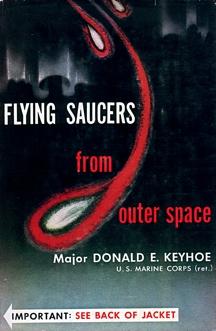
Flying Saucers from Outer Space
The Book the Air Force Helped Write — and Then Spent Twenty Years Living Down
Find on Amazon →As an Amazon Associate, OverClassified may earn from qualifying purchases made through this link, at no extra cost to you.
Why This Is Essential Reading
Read it for the documents and the portraits, not for the thesis. Flying Saucers from Outer Space is the only major UFO book of the 1950s written with the active, named cooperation of the U.S. Air Force's own public information apparatus, and that fact makes its verbatim material — Blue Book's four flat answers about Menzel's debunking, Chop's clearance of the Laredo report, Ruppelt's offer to recall Keyhoe to active duty — genuinely valuable primary evidence that does not depend on believing anything Keyhoe concluded from it. The conclusions themselves should be handled the way Curtis Peebles recommends: as assumption written as fact. If you are reading the trilogy in order, this is the volume where the relationship between Keyhoe and the Air Force is at its closest, which is precisely what makes it the most useful of the three and the one whose framing needs the most discounting.
Related Cases & Theories
Essential Viewing
Sources Cited
- Keyhoe, Donald E. Flying Saucers from Outer Space. New York: Henry Holt and Company, 1953 (first edition, 276 pp., LCCN 53-9588). Full scanned text consulted for all direct quotations. archive.org
- Keyhoe, Donald E. Flying Saucers from Outer Space, Tandem paperback edition, 1974 (ISBN-10 0426144104 / ISBN-13 9780426144106). amazon.com
- Keyhoe, Donald E. Foreword and Chapter 1, "Behind the Scenes" — source of the "privileged to cooperate with the Air Force" and "selected group of high government officials" passages quoted above.
- Keyhoe, Donald E. Chapter 2 — source of the Albert M. Chop description, the Laredo report clearance, the "South Carolina pictures" screening, and Ruppelt's active-duty proposal.
- Keyhoe, Donald E. Chapter 2 — source of the four Project Blue Book questions and answers regarding Dr. Donald H. Menzel's published explanations of the Mantell, Eastern Air Lines, and Gorman cases.
- Peebles, Curtis. Watch the Skies! A Chronicle of the Flying Saucer Myth. Smithsonian Institution Press, 1994 — source of the "filtered through Keyhoe's absolute belief" and "make an assumption, then write as if it were a fact" assessments. OverClassified breakdown
- Ruppelt, Edward J. The Report on Unidentified Flying Objects. Doubleday, 1956 — the Project Blue Book chief's own account of the same 1952–53 period. OverClassified breakdown
- Menzel, Donald H., and Lyle G. Boyd. The World of Flying Saucers. Doubleday, 1963 — the developed scientific counter-position. OverClassified breakdown
- Wikipedia, "Flying Saucers from Outer Space" — publication data (Henry Holt, October 5, 1953, 276 pp., $3) and the Earth vs. the Flying Saucers adaptation credit. en.wikipedia.org
- Wikipedia, "Earth vs. the Flying Saucers" (Columbia Pictures, 1956) — "suggested by" credit, Bernard Gordon's pseudonymous screenplay credit as Raymond T. Marcus, Ray Harryhausen effects. en.wikipedia.org
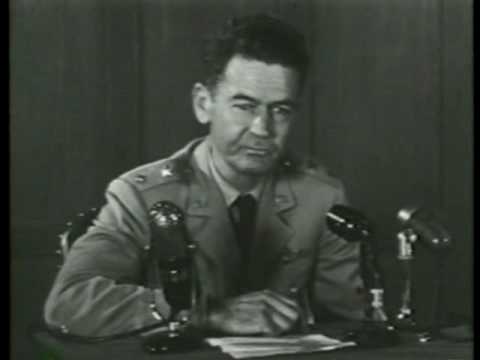
- The Black Vault, "July 31, 1952 'Flying Saucer' / UFO Press Conference with Maj. Gen. John A. Samford and Donald Keyhoe" — National Archives film reel of the Pentagon briefing. theblackvault.com
- Saturday Night Uforia, "General Samford Meets The Press" — detailed contemporary analysis of the July 29, 1952 Pentagon briefing and the hedging that followed from an incomplete investigation. saturdaynightuforia.com
- Goodreads, "Flying Saucers from Outer Space" by Donald E. Keyhoe — edition records for the 1953 Henry Holt first edition and later reprints. goodreads.com
- OverClassified case file, The Gorman Dogfight — the theodolite-tracking objection this book originated.
- OverClassified case file, The Washington, D.C. UFO Flap of 1952 — the radar-visual sightings behind the Samford press conference.
- OverClassified case file, The Thomas Mantell P-51 Crash — this site's own assessment of the case Keyhoe uses to test Menzel's method.
Have corrections, additional research, or peer-reviewed sources? Help improve this entry.
Suggest an Edit