
The World of Flying Saucers
A Scientific Examination of a Major Myth of the Space Age
Core Thesis
The World of Flying Saucers: A Scientific Examination of a Major Myth of the Space Age is Donald H. Menzel and Lyle G. Boyd's second UFO book, arriving a decade after Menzel's 1953 Flying Saucers had already made him the most prominent scientist publicly arguing that UFO reports reduce to conventional astronomical, atmospheric, and mechanical causes. Where the first book leaned on a comparatively narrow set of explanations built around the 1952 Washington, D.C. radar-visual flap, this 302-page Doubleday casebook works through thirteen chapters — from balloons and meteors to "Phantoms on Radar" and "Living Lights" — applying a considerably wider explanatory toolkit to a fresh decade of famous individual cases, drawing in part on Air Force files the authors say were "generously opened" to them without restriction in 1959. Its most durable specific contribution is a straightforward optical observation: examining the widely circulated 1952 Barra da Tijuca photographs, Menzel and Boyd noticed that the photographed disc is lit from one side while the landscape beneath it is lit from the other — a shadow-direction inconsistency no single sun could produce in one exposure, later independently confirmed by the U.S. government's own 1968 Condon Report. Elsewhere the book is considerably more contested: its searchlight-and-haze-layer explanation for the Nash-Fortenberry sighting required inventing a temperature inversion the era's own Weather Bureau data did not support, drawing a direct, documented technical rebuttal from physicist James E. McDonald, and its defense of the Air Force's ball-lightning explanation for Levelland rested on probability rather than proof. This entry treats the book's genuine methodological achievements and its overreaches as equally real and separately documented, consistent with how this site's own case files already cite it.
About the Author
Donald Howard Menzel (April 11, 1901 – December 14, 1976) was born in Florence, Colorado, and by any conventional measure was a genuinely eminent mainstream scientist rather than an outsider commentator on astronomy. He earned bachelor's and master's degrees in chemistry from the University of Denver before completing a second master's degree in astronomy and a 1924 Ph.D. in astrophysics at Princeton under Henry Norris Russell, one of the founders of modern stellar astrophysics. After teaching posts at the University of Iowa and Ohio State and a stint at Lick Observatory from 1926, Menzel joined Harvard in 1932, served as a Navy lieutenant commander heading an intelligence division during World War II, and returned to academic astronomy afterward. He became acting director of the Harvard College Observatory in 1952, was appointed permanent director in 1954, held that post until 1966, and remained on the Harvard faculty until his 1971 retirement. According to his official National Academy of Sciences biographical memoir, Menzel "was one of the first practitioners of theoretical astrophysics in the United States," pioneering the application of quantum mechanics to astronomical spectroscopy and publishing foundational work on the solar chromosphere, the chemistry of stars, the atmosphere of Mars, and the physics of gaseous nebulae; in 1955 he arranged the move of the Smithsonian Astrophysical Observatory onto the Harvard Observatory grounds, a merger that evolved into today's Center for Astrophysics. None of this credentialed mainstream career is in dispute, and it is precisely what made Menzel's public UFO skepticism carry more institutional weight than any other scientist's in the 1950s and '60s.
Menzel's entry into ufology traces directly to the widely publicized July 1952 Washington, D.C. radar-visual sightings, which he addressed in Life magazine's April 1952 feature "Have We Visitors From Space?" and then at book length in 1953's Flying Saucers, arguing that temperature inversions, optical mirages, and radar ducting explained the reports — a template the Air Force itself leaned on at its July 29, 1952 press conference. This book, published a decade later, was his second full-length treatment of the subject, and, as this site's own key-figures entry on Menzel already documents, decades afterward researcher Stanton Friedman discovered in Menzel's own papers at the Harvard Archives that he had simultaneously held a Top Secret Ultra clearance and worked for more than thirty years as a classified cryptologic consultant to the National Security Agency, the Defense Intelligence Agency, and other bodies — a dual role reportedly unknown even to his own wife, and one that continues to complicate any simple reading of an independent scientist who merely happened to agree with the Air Force's public explanations. Even setting the classified work aside, Menzel's reputation among contemporaries was sharply divided: astronomer Dorrit Hoffleit, a Harvard Observatory colleague, later recalled that Menzel ordered the destruction of roughly a third of the observatory's photographic plate collection "in such a hurry that no records were kept," a decision unrelated to ufology but consistent with UFO historian David Halperin's own retrospective finding that "veteran UFOlogists" who had dealt with Menzel directly remembered him as dogmatic, opinionated, and "contemptuous of anyone who dared disagree with him."
Lyle Gifford Boyd, Menzel's co-author and the book's less publicly visible half, grew up in St. Joseph, Missouri, and graduated from the University of Kansas in 1931 with a degree in English rather than any scientific field. She married biochemist William Clouser Boyd, a Boston University Medical School geneticist and pioneer of blood-group research, and spent much of the 1950s through 1970s working as an editor and editorial assistant, including for the Harvard College Observatory itself, for the reference work Notable American Women, and for the Dictionary of American Biography. Beyond this book, she co-authored The Harvard College Observatory: The First Four Directorships with Bessie Zaban Jones, with a foreword supplied by Menzel, and later co-wrote Writing a Technical Paper with Harvard English professor Howard Mumford Jones — a career profile of a working science editor rather than a research astronomer, and one that plausibly explains the book's comparatively organized, chapter-by-chapter structure even where its individual conclusions proved contested. Her personal papers are held at the University of Kansas's Kenneth Spencer Research Library.
Historical Context & Origins
By 1963, American ufology had moved well past the single dramatic flap that launched Menzel's first book. Major Donald E. Keyhoe's National Investigations Committee on Aerial Phenomena (NICAP), founded in 1957, had become the era's most visible civilian advocacy organization, publicly and repeatedly pressing the case that the Air Force's Project Blue Book was concealing evidence of extraterrestrial visitation rather than genuinely investigating it. This book arrived squarely into that adversarial climate, and its own preface documents the relationship's low point directly: the authors state they had originally intended to cite sources and preserve original phrasing "following common practice in scientific discussion," but "have been forced to abandon the more scholarly method of presentation because one author (Major Donald E. Keyhoe) refused permission to quote from his works" — a documented, verifiable breakdown in cooperation between the field's leading skeptic and its leading advocate, preserved in the book's own text.
The book also predates by five years the Condon Report, the University of Colorado's U.S. Air Force-commissioned scientific review that would not appear until 1968, meaning Menzel and Boyd were writing without the benefit — or the cover — of that later, more institutionally authoritative study. The authors instead built their case substantially on their own direct access to Air Force records, writing that in the spring of 1959 Air Force "officials generously opened their files to us without restriction," a genuine research advantage over most UFO books of the period, set against an earlier 1952 episode in which Menzel had declined a similar offer of access specifically because it came with security restrictions that would have prevented him from discussing his findings publicly.
Structurally, the book also reflects Menzel's own methodological evolution. His 1953 book had leaned heavily on the Washington flap as its central case; this one spreads across a much wider range of individual reports — the 1952 Guantánamo naval "dogfight," the 1952 Nash-Fortenberry sighting, the 1952 Barra da Tijuca and Island of Trindade photographs, the 1957 Levelland encounters, a 1960 Wallops Island rocket-launch misidentification — while still returning to Washington, D.C. directly in its "Phantoms on Radar" chapter. The authors frame their governing method early on with an analogy that became one of the book's most quoted passages: when "told there's a horse in the bathtub," they write, "the sensible man" does not begin speculating about how it got there but "first goes to find out whether the horse is really there," insisting throughout on a distinction "between an observed fact, which is evidence, and an interpretation of that fact, which is not evidence."
This book's publication a full eleven years before Philip J. Klass's UFOs Explained (1974) situates it as the direct methodological forerunner of the case-by-case skeptical casebook Klass would later formalize into his own "UFOlogical Principles" — this site's own entry on that later book already documents Klass as Menzel's institutional successor as the field's most prominent professional skeptic after Menzel's 1976 death.
Core Arguments & Key Concepts
The book's organizing method is comparative and case-specific rather than built on a single physical mechanism: rather than proposing one explanation to cover most sightings, Menzel and Boyd work chapter by chapter through balloons, aircraft, astronomical objects, meteors and fireballs, ball lightning and other "living lights," and radar anomalies, matching each case to whichever conventional cause its specific details seem to support. This case-by-case structure — rather than any single named principle — is the book's most direct throughline to Klass's later, more systematized "UFOlogical Principles," and this site's own essential-reading entry on UFOs Explained documents Klass applying the identical comparative, records-based approach to an overlapping set of famous cases a decade later.
The book's most technically rigorous and most durable contribution is its shadow-direction analysis of the 1952 Barra da Tijuca photographs: examining the widely circulated fourth exposure, Menzel and Boyd identified that the photographed disc is illuminated from one side while the palm fronds and hillside foliage in the same frame are illuminated from the opposite side — a physical impossibility for a single photograph taken under natural sunlight, and the signature of a composite image built from two separately lit source exposures. This is a straightforward, checkable optical observation rather than an interpretive judgment call, and this site's own case file on the incident credits it as the founding document of the skeptical case against those photographs.
For the 1952 Nash-Fortenberry sighting, by contrast, the book's explanation is its most elaborately constructed and most contested: after years of direct correspondence with pilot William B. Nash, Menzel proposed that a distant searchlight or ground light source, refracted through a series of hazy atmospheric layers created by an undetected temperature inversion, could produce the sighted "series of discs" that appeared to "spread out, exhibit perspective," and "ricochet." The explanation required Menzel to hypothesize an inversion layer despite the Weather Bureau's own contemporaneous report for that night recording none, a gap this site's own case file on the incident documents as "the theory's single biggest evidentiary problem."
For Levelland (1957), the book defends a version of the Air Force's official ball-lightning explanation on essentially probabilistic grounds, arguing that the phenomenon's inherently transient, unrepeatable nature made the "overwhelming probability" favor a natural electrical event over an exotic craft — an argument this site's own case file on the incident notes has genuine surface appeal, since ball lightning is a real if poorly understood phenomenon and a storm system had passed through the region days earlier, but one whose unfalsifiable framing (a phenomenon too transient to ever be directly checked) is structurally different from the checkable, geometry-based Barra da Tijuca finding.
A final, less famous but methodologically instructive case is the Island of Trindade photographs (1958), where Menzel proposed that photographer Almiro Barauna had faked the images using a small model combined with separate sky photographs via double exposure — a specific, mechanistic hoax theory that this site's own case file on the incident notes was independently arrived at again, decades later and from completely different directions, by Emília Bittencourt's 2010 account and researcher Tim Printy's technical "internal mask" analysis.
Key Cases & Evidence Discussed
The Barra da Tijuca Sighting (Case File #093, 1952) receives this book's single most consequential specific finding: Menzel and Boyd's shadow-direction critique of the fourth exposure, later independently reproduced by the 1968 Condon Report's photographic analysts working from enlarged negatives, and again by Ground Saucer Watch's early-1980s computer-enhanced digitization — three separate analytical methods across three decades, all converging on the same specific defect in the same frame.
The Nash-Fortenberry Sighting (Case File #088, 1952) gets the book's most extensively developed and most directly disputed single explanation. Physicist James E. McDonald reviewed Menzel's searchlight-and-haze-layer theory in his own written case notes and dismissed it as "an almost entirely ad hoc assumption," concluding that "rapid motion, abrupt course-reversal, and the change from negative to positive angles of elevation…seem to preclude any meteorological-optical explanation." Pilot William B. Nash rebutted Menzel's sequence of proposed explanations point by point in a published exchange, closing with the observation that "pilots do not excite easily."
The Levelland case (Case File #037, 1957) gets the book's defense of the Air Force's ball-lightning/St. Elmo's-fire explanation for the multiple-witness vehicle-stalling encounters near Levelland, Texas, argued on probabilistic rather than demonstrative grounds.
The Clyde Tombaugh Sighting (Case File #069, 1949) gets one of the book's most detailed individual treatments, at pp. 266–270, where Menzel and Boyd reproduce astronomer Clyde Tombaugh's own preferred temperature-inversion optical explanation for the sighting at length rather than proposing a novel theory of their own.
The Island of Trindade photographs (Case File #105, 1958) get the book's original published hoax theory — that photographer Almiro Barauna faked the images with a model and double exposure — a theory this site's own case file documents as anticipating, by decades, the same basic mechanism independently proposed by researcher Emília Bittencourt in 2010 and by Tim Printy's separate technical analysis.
The BOAC Stratocruiser "Centaurus" Sighting (Case File #199, 1954) is cited on this site more generally, useful for situating the aircraft-reflection and optical-mirage theories that shape-shifting, multi-witness case attracted within Menzel's broader analytical framework rather than for a single named explanation specific to that flight.
The July 1952 Washington, D.C. radar-visual flap (Case File #015) is this book's returning case rather than a new one: this site's own case file on the incident documents Menzel's original temperature-inversion explanation to his 1953 book Flying Saucers, and this 1963 book revisits the same case directly in its "Phantoms on Radar" chapter, restating the inversion-and-radar-ducting mechanism for the specific radar returns rather than introducing a materially different theory.
Critical Reception & Controversies
The most detailed contemporary review appeared in the October 1963 Journal of Borderland Research, where reviewer Riley Crabb was sharply critical of both the book's tone and its selective use of evidence, dismissing it at one point as "flumduddery" and accusing Menzel of "most unscientific prejudice" for devoting nine pages to attacking the character of the Trindade photographer rather than addressing the photographic evidence directly. Crabb also charged that the authors omitted a detail that would have complicated their case — that electrical equipment aboard the Brazilian Navy ship present at Trindade reportedly failed during the sighting — and quoted the Nash-Fortenberry pilots' own on-record certainty that "we are certain in our own minds that they were intelligently operated craft from somewhere other than this planet" as evidence the book minimized inconvenient witness testimony. Crabb did allow the book some genuine credit, calling it "well-planned, well-written" and useful as "a handy review under one cover of all the major sightings," while closing with the pointed question, "Why did Menzel and Boyd write it for a dead market?"
The book's own preface documents its most concrete institutional conflict without any outside critic's help: the authors state plainly that Major Donald E. Keyhoe, head of NICAP and the era's most prominent UFO advocate, "refused permission to quote from his works," forcing them to abandon their preferred, more fully sourced method of presentation in the sections that touch his material — a rare instance of a skeptical book's own text preserving direct evidence of how adversarial its relationship with the leading advocacy organization of the day had become.
No skeptic engaged with this book's central Nash-Fortenberry explanation more directly than physicist James E. McDonald, the University of Arizona atmospheric scientist who separately challenged the Air Force's temperature-inversion explanation for the 1952 Washington radar sightings as well. Reviewing Menzel's searchlight-and-haze-layer theory in his own case notes, McDonald called it "an almost entirely ad hoc assumption" that failed to account for the objects' specific coloration, sharply defined edges, or synchronized formation maneuvers — a documented, named scientific rebuttal from within the same broader scientific community Menzel belonged to, not a generic believer-side dismissal.
Menzel's own reputation among people who dealt with him directly was genuinely divided in ways that go beyond any single case. UFO historian David Halperin's own research found that "veteran UFOlogists" who remembered Menzel firsthand described him as "a nasty man…dogmatic and opinionated," and "contemptuous of anyone who dared disagree with him," while Halperin separately documents that by this second book Menzel had "shifted to advocating the straight Air Force line" more fully than his more exploratory 1953 debut, noting that "what UFOs were had receded into the background of his interest; all he now cared about was what they were not."
The revelation, decades after this book's publication, that Menzel simultaneously held a Top Secret Ultra clearance and worked for more than thirty years as a classified NSA/DIA cryptologic consultant complicates any simple reading of his public skepticism, as this site's own Washington D.C. 1952 case file already notes: the dual role "does not by itself invalidate his physics…It does, however, complicate any simple reading of ‘an independent scientist happened to agree with the Air Force.’"
Influence & Legacy
This book's most independently verifiable influence is preserved directly on this site: this exact 1963 Doubleday first edition, under ASIN B0007IW8PA, is cited across resources.html in connection with five separate case-file pages — Barra da Tijuca, the BOAC Stratocruiser "Centaurus" Sighting, the Clyde Tombaugh Sighting, the Nash-Fortenberry Sighting, and the Island of Trindade photographs — giving it one of the broader documented citation footprints of any single skeptical title in this site's own library.
Its most durable single finding, the Barra da Tijuca shadow-direction critique, was independently reproduced by the U.S. government's own 1968 Condon Report and again by Ground Saucer Watch's early-1980s digital-image analysis, and this site's own case file on the incident states plainly that "no skeptical rebuttal of the shadow-geometry finding itself…has been published in the six decades since Menzel and Boyd first raised it" — a genuinely rare case of a mid-century skeptical claim holding up, unmodified, against every subsequent technical re-examination.
Within the broader history of organized UFO skepticism, this book is the direct methodological ancestor of Philip J. Klass's 1974 UFOs Explained: both books work case by case through famous individual sightings rather than leaning on one physical mechanism, and Klass explicitly succeeded Menzel as the field's most prominent professional skeptic after Menzel's December 1976 death, a generational handoff this site's own entry on Klass's book documents from the other side.
Menzel's UFO-skeptic career continued for one further book after this one: The UFO Enigma (1977), co-written with Ernest H. Taves and published the year after his death, extended the same case-by-case skeptical method into the Condon Report era and the early years of Ufology's abduction-narrative turn, closing out a UFO-skeptic bibliography that ran, across three books and twenty-four years, from 1953's Flying Saucers through this 1963 volume to that final 1977 title.
The Book
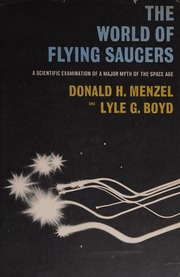
The World of Flying Saucers
A Scientific Examination of a Major Myth of the Space Age
Find on Amazon →As an Amazon Associate, OverClassified may earn from qualifying purchases made through this link, at no extra cost to you.
Why This Is Essential Reading
The World of Flying Saucers earns its place on this list as the direct methodological forerunner of the case-by-case skeptical casebook that Philip J. Klass would later formalize, written by the single most institutionally credentialed scientist ever to build a public career debunking UFO reports: Donald H. Menzel, Harvard College Observatory's own director, working here with science editor Lyle G. Boyd. Its record, laid out honestly in this entry's Critical Reception section, is genuinely mixed in exactly the way that makes it worth reading closely rather than simply citing: the Barra da Tijuca shadow-direction finding is a real, rigorous piece of optical analysis that has survived sixty years and three independent re-examinations unmodified, while the Nash-Fortenberry searchlight theory required inventing a temperature inversion the period's own weather data did not support, and drew a direct, documented rebuttal from physicist James E. McDonald that this site's own Nash-Fortenberry case file preserves in full. Layer onto that the book's own preface, which documents Major Donald Keyhoe's refusal to let the authors quote him, and the decades-later revelation that its author held a Top Secret Ultra clearance as a classified NSA/DIA consultant throughout his public skeptic career, and this book becomes essential less as a settled verdict on any individual case than as the founding document of an entire skeptical tradition — one whose specific individual claims, exactly like the claims of the believers it set out to debunk, hold up unevenly under the same case-by-case scrutiny it demanded of everyone else.
Related Cases & Theories
Essential Viewing
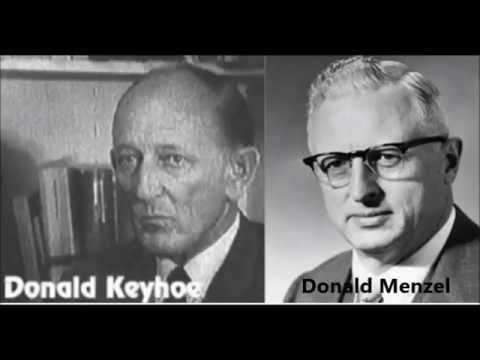
UFO: Donald Menzel & Donald Keyhoe - The Skeptic and The Believer
W C — A direct examination of the adversarial relationship between Menzel, this book's author, and Donald Keyhoe, the NICAP director whose documented refusal to grant quotation permission is preserved in this book's own preface. Verified via YouTube oEmbed before inclusion.
Mystery Objects and the Donald Menzel Conspiracy | Richard Dolan Show w/Dr. Beatriz Villarroel
Richard Dolan Intelligent Disclosure — A discussion of Menzel's dual public-skeptic/classified-consultant career, the revelation this entry's Critical Reception section documents in full. Verified via YouTube oEmbed before inclusion.
Sources Cited
- Menzel, Donald H., and Boyd, Lyle G. The World of Flying Saucers: A Scientific Examination of a Major Myth of the Space Age. Doubleday & Company, Garden City, NY, 1963 (ASIN B0007IW8PA, LCCN 63-012989, cited here, matching the edition already cited across this site's own resources library). Full public-domain text: gutenberg.org
- "Donald Howard Menzel." Wikipedia (biography: birth/death, education, Harvard Observatory directorship, UFO-skeptic bibliography). en.wikipedia.org
- "Donald Howard Menzel." Biographical Memoirs, Volume 60. National Academy of Sciences / National Academies Press (official scientific biography: chemistry and astrophysics degrees, Princeton Ph.D. under Henry Norris Russell, theoretical astrophysics pioneer, solar chromosphere and stellar-chemistry research). nap.nationalacademies.org
- "Collection: Papers of Donald Howard Menzel, 1931-1986." HOLLIS for Archival Discovery, Harvard University (archival record of Menzel's personal papers, source of Stanton Friedman's later NSA/DIA research). hollisarchives.lib.harvard.edu
- "Collection: Personal papers of Lyle Boyd." Kenneth Spencer Research Library Archival Collections, University of Kansas (biographical record: St. Joseph, Missouri upbringing, 1931 University of Kansas English degree, marriage to William Clouser Boyd, editorial career). archives.lib.ku.edu
- Crabb, Riley. "Donald H. Menzel & Lyle G. Boyd's 'The World of Flying Saucers' (A Review)." Journal of Borderland Research, Vol. 19, No. 7, October 1963 (contemporary critical review: the Trindade character-attack criticism, the Nash-Fortenberry pilot quote, and the "well-planned, well-written" concession). borderlandsciences.org
- Halperin, David J. "Donald Menzel, Phil Klass – the Men We Loved to Hate." davidhalperin.net (retrospective assessment of Menzel's and Klass's shared skeptical method and reputations, including the "dogmatic and opinionated" characterization from veteran UFO researchers). davidhalperin.net
- This site's own case file: The Nash-Fortenberry Sighting, which documents James E. McDonald's direct rebuttal of Menzel's explanation from this exact book in full.
- This site's own case file: The Barra da Tijuca Sighting, which credits this exact book as the founding document of the case's shadow-direction skeptical critique.
- This site's own case file: The Levelland UFO Encounters, which documents this book's defense of the Air Force's ball-lightning explanation.
- This site's own case file: The Clyde Tombaugh Sighting, which cites this book directly to pp. 266–270.
- This site's own case file: The Island of Trindade Sighting, which documents this book's original hoax theory and its later independent confirmation.
- This site's own case file: Washington D.C. 1952, for the documented Stanton Friedman research on Menzel's classified NSA/DIA consulting role.
- This site's own essential-reading entry: UFOs Explained, Philip J. Klass's 1974 methodological successor to this book.
- This site's own key-figures entry: Donald H. Menzel, for his broader site-wide case connections beyond this book.
- "The world of flying saucers." Open Library (bibliographic record: Doubleday, 1963, 302pp, LCCN 63012989, Dewey 629.1334). openlibrary.org
- "The World Of Flying Saucers." Internet Archive, item worldofflyingsau0000dona (scanned copy and source of this entry's cover art). archive.org
- "The World of Flying Saucers: A Scientific Examination of a Major Myth of the Space Age." Amazon.com product listing for ASIN B0007IW8PA (edition cited here, matching this site's own resources library citation). amazon.com
- This site's own resources library: Full Reading List, where this exact edition (ASIN B0007IW8PA) is cited across five separate case-file pages.
Have corrections, additional research, or peer-reviewed sources? Help improve this entry.
Suggest an Edit