
Beyond the Light Barrier
The Autobiography of Elizabeth Klarer — A Cambridge-Trained Meteorologist's Account of Bearing a Child on a Planet of Proxima Centauri
Core Thesis
Beyond the Light Barrier is the full autobiographical statement of the most extraordinary claim in the contactee literature, and it was published twenty-six years after the events it describes began. Elizabeth Klarer (1910–1994) said that on December 27, 1954, on her family's farm in the Drakensberg foothills of Natal, she watched a disc descend on a hillside the family came to call Flying Saucer Hill; that in April 1956 she boarded a sixty-foot scout craft piloted by a man calling himself Akon; that in July 1956 she photographed his ship with a Brownie box camera; that at Cathkin Peak in April 1958 she and Akon conceived a child; and that in 1959 she was carried to Meton, a planet of Proxima Centauri, where she lived four months, bore a son named Ayling, and returned. The book is written in the register of a romance rather than a report, and that is deliberate. This site's case file stamps the claim Debunked. The book remains essential because it is the only place the claim exists in the claimant's own words, and because Klarer is not the person the summaries suggest.
About the Author
Elizabeth Woollatt was born on July 1, 1910 at Mooi River in Natal, to Samuel Bancroft Woollatt, a pioneering veterinary surgeon and shorthorn farmer, and Florence Woollatt. Her education was unusually broad for a South African farm daughter of her generation: St. Anne's Diocesan College in Pietermaritzburg, art and music study in Florence, and a four-year diploma in meteorology at Girton College, Cambridge. Her first husband taught her to fly a De Havilland Tiger Moth. In 1932 she and her sisters formed the Connington polo team, in what is recorded as the first officially recognised ladies' match in South Africa, and during the Second World War she held a position in RAF Intelligence.
That biography is the reason the case has never been easy to dismiss outright, and it is the reason careful writers keep returning to it. A meteorologist, a licensed pilot and a wartime intelligence worker is not the profile of a naive witness, and Klarer's descriptions of atmospheric and flight phenomena carry a technical vocabulary most contactee narratives lack.
Her claimed experiences ran further back than the 1954 date the case is filed under. She said she and her sister Barbara had seen a silver disc and an orange-red 'planetoid' near the farmhouse when she was seven, and alluded to an earlier sighting at about three. Whether that indicates lifelong genuine experience or a narrative constructed backwards from an adult belief is not determinable from the book.
She wrote the manuscript roughly between 1960 and 1966 and it reached print slowly and in pieces. The Swedish ufologist Edith Nicolaisen published a Swedish booklet, I rymdskepp över Drakensberg, in 1959 with a second edition in 1967; a German edition, Jenseits der Lichtmauer, appeared in 1977; the English Beyond the Light Barrier only in 1980, republished in 2008. An unfinished second book, The Gravity File, intended to cover the military and political dimensions of UFO research and Akon's electro-gravity propulsion, was incomplete when she died of breast cancer on February 9, 1994.
Her public reception in her lifetime was warmer than her evidentiary position warranted, and specifically warmer in Europe than in the Anglophone research community. In November 1975 the rocket pioneer Hermann Oberth invited her to address the 11th International Congress of UFO Research Groups in Wiesbaden, where she received a standing ovation; in 1992 her address to the Unidentified Flying Object Club in Pietermaritzburg drew an audience the venue could not hold.
Historical Context & Origins
Klarer's account belongs to the contactee tradition established by George Adamski in 1953, and it follows the formula closely in most respects — a benevolent, human-appearing visitor; a technological explanation; a warning about nuclear weapons; a spiritual message. What it adds is the romantic and reproductive dimension, which no major prior contactee claim included and which made the case both more memorable and considerably harder for the research community to engage with.
Its Southern Hemisphere setting matters. South African ufology in the 1950s and 1960s was small, geographically isolated from the American scene, and mediated to the wider world through a handful of individuals — principally the Zimbabwe-based researcher Cynthia Hind, whose interview with Klarer in 1968 produced a write-up in Fate magazine that August and who devoted substantial space to the case in her later work. This site covers Hind's UFOs Over Africa separately.
The case's early European reception ran through specific named channels rather than through the general press: Edgar Sievers published 'Encounter in South Africa' in the German magazine Uranus in December 1956; J. Heinrich Ragaz published on it in the Swiss Weltraumbote in 1957; Edith Nicolaisen published the Swedish booklet; and the first published account, 'Landing in South Africa,' appeared in Flying Saucer Review in December 1956. That continental network, largely sympathetic to contactee material, is why Klarer was better known in Germany and Scandinavia than in the United States.
The physics in the book is period-specific and worth noticing. Klarer's Meton is in the Proxima Centauri system, roughly 4.2 light years away, and she invokes relativistic time dilation to explain a journey she describes as four months of Earth time and nine years of Meton time. The direction of that dilation is backwards for a round trip, but the invocation of relativity at all — by a meteorologist writing in the 1960s — distinguishes her account from the frankly magical transport of most contactee narratives.
The book arrived in English in 1980, which is late. By then the contactee era had ended, the abduction paradigm established by the Hill case and Budd Hopkins had replaced it, and a benevolent-romance narrative read as an artefact of a previous generation. Klarer's book never found the audience her 1950s contemporaries had.
Core Arguments & Key Concepts
The contact was physical, repeated, and located. Klarer's account names specific places — the family farm near Rosetta, Flying Saucer Hill, the Cathkin Peak plateau at 3,183 metres — and specific dates across nearly a decade. That specificity is what makes the case assessable at all, and it is the reason it can be, and has been, checked.
The photographs are the testable element. Klarer said she took seven photographs of Akon's craft on July 17, 1956, describing a shimmering heat haze around it. Photographs are the only part of the claim amenable to ordinary forensic examination — unlike the pregnancy, the Meton journey or the telepathy — and they are consequently where the case was decided.
The relationship is the argument. Klarer's book is structured as a love story, and the encounter's meaning for her is relational rather than evidential. This is not incidental framing: it explains why she published so late, why she was largely uninterested in convincing researchers, and why the book reads as it does. Assessing it as a failed investigative report misses what it was written to be.
The propulsion is electro-gravitic. Akon's explanations concern gravity control rather than reaction propulsion, and Klarer intended to develop this at length in the unfinished Gravity File. Her handling of it is more technically literate than most contactee physics and still contains no testable content.
What the book cannot support, in its own author's absence of corroboration. Klarer is the sole primary witness to every central claim. Her son David has stated on record that he has no recollection of any absence or pregnancy in 1959 that could correspond to the four months she says she spent on Meton bearing a child — testimony from inside her own household, and the single most damaging fact in the case.
The honest reason it is in this library. This site's case file describes the book as essential primary-source reading for understanding exactly what was claimed and how the narrative evolved into its final published form. A claim that took twenty-six years and three languages to reach its final shape is a case study in how contactee accounts develop, and that process is only visible in the book itself.
Key Cases & Evidence Discussed
The December 27, 1954 sighting. The first claimed event, on the Woollatt family farm near Mooi River and Rosetta in the Natal Midlands. See this site's Elizabeth Klarer & the 'Akon' Contact case file.
The April 1956 boarding. Klarer's account of entering a silver scout disc roughly sixty feet across, piloted by Akon.
The July 17, 1956 photographs and the two competing hoax theories. Klarer's onetime supporter and manuscript typist Philipp Human later reversed his position entirely, calling the photographs 'a standing joke' and stating flatly that they showed 'an ordinary motor car hubcap' — and separately that he did not believe 'one word' of her contacts. A different hoax-cataloguing source instead identifies the object as a 'Spin-O-Reno,' a children's toy spinning plate thrown into the air. This site's case file records that it could not locate any account reconciling the two, and presents both as named claims rather than resolving them artificially. Note that several secondary sources, including Wikipedia, misattribute the hubcap line to Edgar Sievers; the site's case file has this right and the encyclopedia does not.
Sievers' technical objection. Writing in Uranus in December 1956, Edgar Sievers took a sympathetic view of Klarer's pre-1957 experiences and raised a genuine objection to the hubcap theory on its own terms: that she could not plausibly have thrown a hubcap and photographed it convincingly with an unassisted Brownie box camera simultaneously, and that no hubcap he knew of matched the photographed disc's profile. This site treats that as a good-faith counterargument worth recording — while noting that defeating one specific reconstruction does not establish the photographs are genuine.
Cathkin Peak (November 1957 and April 1958). The claimed second boarding and the day-long rendezvous at which Klarer says the child was conceived, on a 3,183-metre plateau in the central Drakensberg.
Meton (1959). The journey to a planet of Proxima Centauri, four months' residence, and the birth of Ayling. Uncorroborated by any witness, contradicted by her son David's stated recollection, and the point at which even sympathetic European supporters — Edith Nicolaisen explicitly — drew a line.
Critical Reception & Controversies
The case's reception split geographically and has never really converged. It was warmly received in South Africa and among continental European contactee circles, and largely disbelieved by North American and British UFO researchers — a division that had less to do with the evidence than with which tradition each community belonged to.
The most careful sympathetic assessment came from Cynthia Hind, who interviewed Klarer in 1968 and recorded her absolute personal conviction while suspecting 'an active imagination or illusions borne from a dream-state of euphoria.' Hind nonetheless argued that cases like this warrant examination rather than dismissal — a position this site's own library is built on.
Thomas James Streicher's 2012 Extra-Planetary Experiences supplies the most-quoted modern verdict: Klarer's claims are 'generally poorly substantiated, despite some of them being corroborated by witnesses,' with the specific clinical suggestion that she may have been a 'fantasy-prone individual' who imagined most of her experiences. This site's case file cites Streicher directly for that assessment.
The reversal that did the most damage came from inside her own circle. Philipp Human had been sympathetic enough to type her manuscript personally before repudiating the photographs and, ultimately, the whole account. A supporter close enough to handle the manuscript who then says he does not believe one word of it is a different order of criticism from an outside sceptic's.
The Johannesburg chapter of Mensa dismissed her claims and heckled her during an address — an episode that says as much about the reception environment as about the claim, and one worth setting against the standing ovation at Wiesbaden seven years earlier.
The strongest single evidentiary objection remains her son's. David Klarer's stated absence of any recollection of a 1959 pregnancy or four-month absence is testimony from the household, and no version of the claim survives it intact.
Influence & Legacy
Klarer's is the best-known South African UFO case by a wide margin, and it is essentially the only one with international recognition. That gives it a place in the record independent of its truth: it is how the rest of the world encountered South African ufology, and it is why Cynthia Hind's work reached an international audience at all.
Within the contactee tradition it is the outlier that reveals the structure. Every other major 1950s claimant reported a message; Klarer reported a relationship, a pregnancy and a child. Stripping the didactic frame away and leaving the emotional core exposed makes visible what the genre was actually satisfying in its claimants and its readers, and that is worth more analytically than another lecture from a Venusian.
Its cultural afterlife has continued. A 2023 documentary, Beyond the Light Barrier, directed by Uga Carlini, revisited the case for a general audience; Klarer has been the subject of podcast episodes and songs. That persistence, seventy years on, is disproportionate to the evidence and entirely proportionate to the story.
Within this site's library the book sits with Adamski and Fry as a founding contactee primary source, kept because the claims cannot be assessed without them. Its companion volumes here — Streicher for the psychological assessment, Paul Christopher for the religious framing, Hind for the regional record — are the three lenses through which the case has actually been examined.
The Book
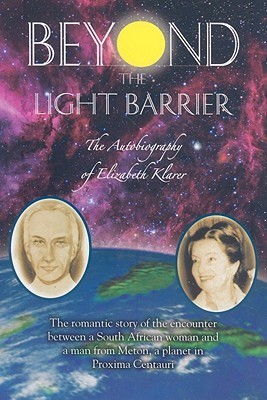
Beyond the Light Barrier
The Autobiography of Elizabeth Klarer — A Cambridge-Trained Meteorologist's Account of Bearing a Child on a Planet of Proxima Centauri
Find on Amazon →As an Amazon Associate, OverClassified may earn from qualifying purchases made through this link, at no extra cost to you.
Why This Is Essential Reading
Read it, and read this site's case file beside it. Beyond the Light Barrier is the only place Elizabeth Klarer's claim exists in her own words, and it is not the book its summaries suggest: its author held a Girton meteorology diploma, flew a Tiger Moth, and worked in RAF Intelligence, and she wrote a love story rather than a report. That is the honest description and it cuts both ways. The 1956 photographs were repudiated as an 'ordinary motor car hubcap' by her own manuscript typist; the pregnancy and the four months on Meton are contradicted by her own son's recollection; and no independent witness supports any central claim. This site stamps the case Debunked. What the book preserves is the fullest statement of the strangest case the contactee era produced, by a woman whose credentials made it impossible to dismiss casually and whose story made it impossible to accept.
Related Cases & Theories
Sources Cited
- Klarer, Elizabeth. Beyond the Light Barrier: The Autobiography of Elizabeth Klarer. First English edition Howard Timmins, 1980 (ISBN-10 0869781782); republished 2008, ISBN-10 1891824775 / ISBN-13 9781891824777. amazon.com
- Internet Archive, scanned copy of Beyond the Light Barrier: The Autobiography of Elizabeth Klarer. archive.org
- Wikipedia, "Elizabeth Klarer" — birth July 1, 1910 at Mooi River to Samuel Bancroft and Florence Woollatt; St. Anne's Diocesan College, art and music study in Florence, four-year meteorology diploma at Girton College, Cambridge; Tiger Moth flying; the 1932 Connington polo team; RAF Intelligence war service; the 1954–1963 encounter timeline; the July 17, 1956 Brownie photographs; the Meton and Ayling claims; her son David's stated absence of recollection; Streicher's and Hind's assessments; Philipp Human's reversal; the Mensa Johannesburg heckling; the 1975 Wiesbaden address at Hermann Oberth's invitation; the unfinished Gravity File; and her death from breast cancer on February 9, 1994. en.wikipedia.org
- Encyclopedia.com, "Klarer, Elizabeth (1910–1994)" — independent reference biography. encyclopedia.com
- Håkan Blomqvist, "The Edith Nicolaisen — Elizabeth Klarer correspondence," AFU archives blog — the Swedish publication history, including I rymdskepp över Drakensberg (1959, 2nd ed. 1967), and Nicolaisen's own qualified position. ufoarchives.blogspot.com
- Hind, Cynthia. "African Encounters" — the Zimbabwe-based researcher's documentation of the Klarer case, archived. sites.google.com
- AbeBooks bibliographic record, Beyond the Light Barrier, ISBN 9780620319058 — edition history. abebooks.com
- Goodreads edition record, Beyond the Light Barrier: The Autobiography of Elizabeth Klarer — cover-art source and reader reception. goodreads.com
- Barnes & Noble listing, Beyond the Light Barrier by Elizabeth Klarer — independent bibliographic confirmation. barnesandnoble.com
- Streicher, Thomas James. Extra-Planetary Experiences: Alien-Human Contact and the Expansion of Consciousness. Bear & Company, 2012 — source of the 'generally poorly substantiated' and 'fantasy-prone individual' assessments. OverClassified breakdown
- Christopher, Paul. Alien Intervention: The Spiritual Mission of UFOs. Huntington House, 1998 — the religious-framework treatment of Klarer's claims. OverClassified breakdown
- Hind, Cynthia. UFOs Over Africa, 1997. OverClassified breakdown
- OverClassified case file, Elizabeth Klarer & the "Akon" Contact — source for the December 27, 1954 and April 6–7, 1956 dates, the sixty-foot scout disc, Flying Saucer Hill, Philipp Human's 'standing joke' and 'ordinary motor car hubcap' repudiation, the competing 'Spin-O-Reno' toy-plate hoax theory, Edgar Sievers' December 1956 Uranus technical objection, the Cathkin Peak conception claim, the Meton journey, David Klarer's stated absence of recollection, and this site's Debunked assessment.
Have corrections, additional research, or peer-reviewed sources? Help improve this entry.
Suggest an Edit