
Elizabeth Klarer & the "Akon" Contact
Beginning on her family's cattle farm in the Drakensberg foothills near Rosetta, Natal, a Cambridge-trained meteorologist and licensed pilot named Elizabeth Klarer said she watched a disc descend on December 27, 1954, boarded a scout craft piloted by an entity calling himself Akon on April 6–7, 1956, and that July photographed his ship from the farm's own "Flying Saucer Hill" — evidence her onetime supporter and manuscript typist, Philipp Human, later dismissed in his own words as "an ordinary motor car hubcap." Klarer said the relationship deepened at Cathkin Peak, a 3,183-metre plateau in the central Drakensberg, where she boarded Akon's craft again in November 1957 and, at a further claimed rendezvous the following April, conceived a child. She said she was flown in 1959 to Akon's home world, Meton, in orbit around Proxima Centauri, gave birth there to a son she named Ayling, and continued seeing Akon in person until 1963. She did not publish the account in full until 1980, as Beyond the Light Barrier, twenty-six years after her first claimed sighting — and her own son David has stated on record that he has no memory of any absence or pregnancy in the year she says she was carrying and delivering an extraterrestrial's child.
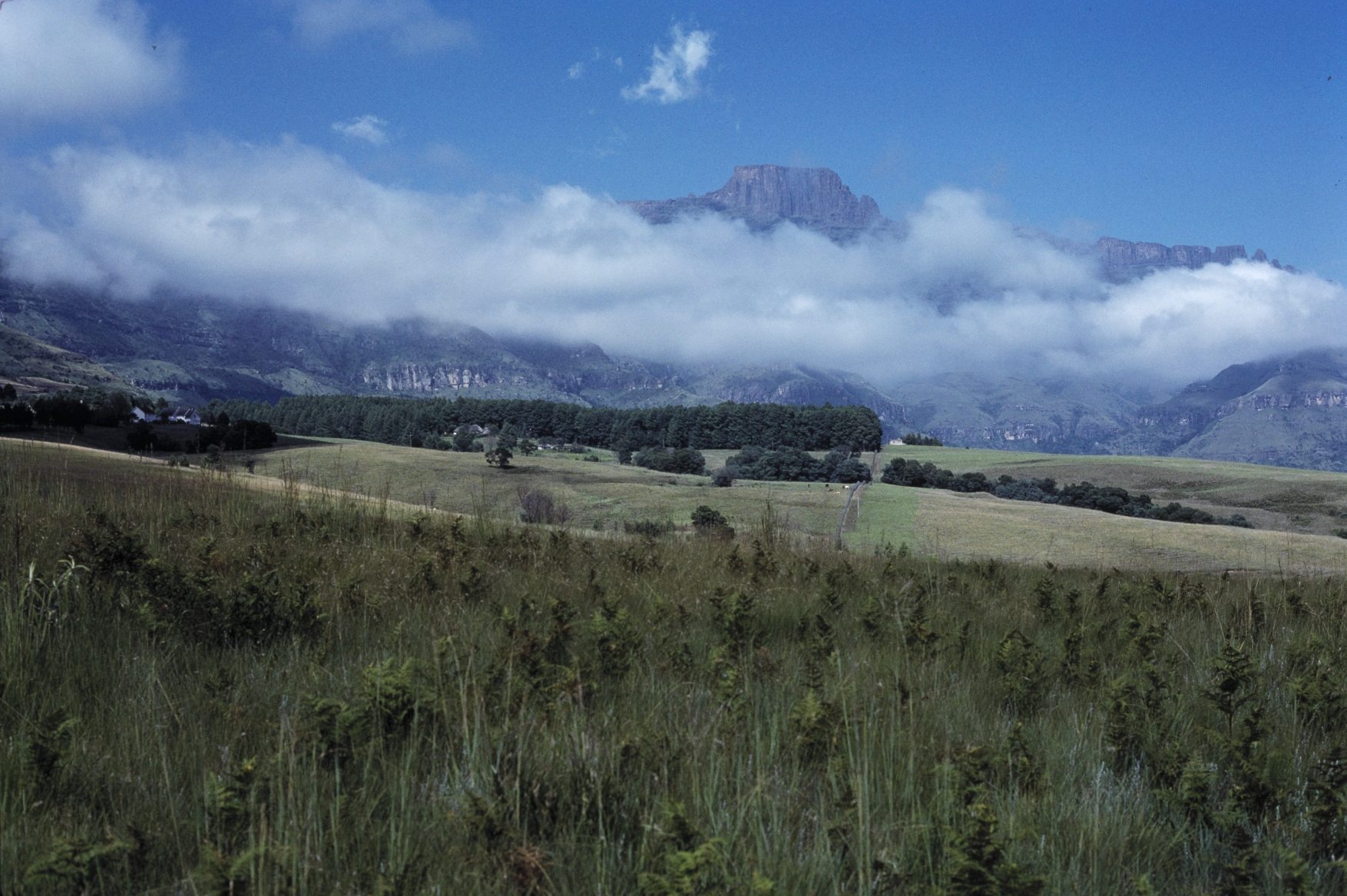
Pictured: Cathkin Peak, the 3,183-metre Drakensberg plateau Elizabeth Klarer named as the specific site of her claimed November 1957 boarding and April 1958 rendezvous with "Akon" — not a photograph of the claimed craft itself. Photographed February 1986, looking west from the Champagne Castle Hotel in Cathkin Park near Winterton. No rights-clear photograph of Klarer's own family farm or its "Flying Saucer Hill" near Mooi River/Rosetta is known to exist publicly; her own disputed 1956 photographs of the claimed craft are addressed directly in Material Analysis below.
Theoretical Alignment
This file, like this site's assessments of the Daniel Fry / White Sands Contact and Truman Bethurum & the "Captain Aura Rhanes" Contacts it sits alongside chronologically and structurally, applies the Psycho-Social Hypothesis in its broad sense — not a claim that Klarer sincerely misperceived a real stimulus, but the category that best captures what this case actually is: an uncorroborated personal narrative, sustained and progressively elaborated over nearly four decades by a claimant with genuine technical credentials, that became a durable fixture of South African ufology and a commercially published book. The Extraterrestrial Hypothesis receives a somewhat higher baseline alignment than this site grants most contactee-era files, worth stating explicitly: unlike Daniel Fry's paleocontact framing (Lemurian/Atlantean human survivors) or the ambiguous origin stories some contemporaries gave their contacts, Klarer's Akon was consistently described, from her earliest published accounts onward, as coming from a real, named star system — a planet called Meton, orbiting Proxima Centauri, our nearest stellar neighbor at roughly 4.24 light-years — making this, in narrative shape alone, one of the more textbook ETH-structured claims this site has documented. That structural resemblance to a "real" ETH case is precisely why this file still scores actual ETH alignment low: the claim's evidentiary support does not improve merely because its cosmology is more scientifically literate than average, and the case's central evidentiary problems — a single uncorroborated witness, disputed photographic evidence, and a direct denial from her own son regarding the pregnancy central to the entire Meton narrative — are unrelated to how plausible the story's astronomical setting sounds.
Background
Elizabeth Margery Klarer, née Woollatt, was born July 1, 1910, in Mooi River, Natal, South Africa, the youngest daughter of Samuel Bancroft Woollatt, a pioneering veterinary surgeon, and his wife Florence. S.B. Woollatt subsequently settled at Connington farm, near Rosetta in the Natal Midlands, where he became a successful Shorthorn cattle breeder; this farm, and a specific rise on it that later became known as "Flying Saucer Hill," is the site of nearly all of Klarer's earliest claimed sightings and remained the emotional and geographic center of her story for the rest of her life. She was educated at St. Anne's Diocesan College in Pietermaritzburg before moving to Florence, Italy to study art and music, and later completed a four-year meteorology diploma at Girton College, part of the University of Cambridge — a genuine, independently plausible technical credential this file returns to directly in Observer Credibility below, since a formally trained meteorologist's testimony about atmospheric and celestial phenomena carries different evidentiary weight, in principle, than an untrained observer's.
Klarer married her first husband, Captain William Stafford Phillips, a Royal Air Force pilot, in 1932; he taught her to fly a de Havilland Tiger Moth light aircraft, giving her a second independently plausible technical skill relevant to her later claims of recognizing genuinely anomalous aerial phenomena. The same year, she took part in what has been described as the first officially recorded ladies' polo match in South Africa. During the Second World War she held a position with South African Air Force Intelligence and, by several accounts, assisted Royal Air Force codebreaking work involving intercepted German communications — wartime intelligence service that, like her meteorology diploma and pilot's training, is independently plausible background for a South African woman of her generation and class, though this file was unable to locate any surviving service record or citation independently confirming the specific claim beyond secondary biographical retellings. She married a second husband, Paul Klarer, in 1946, the source of the surname under which she would later become internationally known; the couple had at least one son, David. A third marriage, to Aubrey Fielding, followed in 1963, the same year this case's central claimed period of in-person contact with Akon comes to a close.
Klarer's own account traces her connection to Akon back to early childhood, well before any of the case's evidentially significant claims. She said that around age seven, while feeding puppies outside the Connington farmhouse with her sister Barbara, the two girls witnessed a silver disc intercept what she described as a plummeting, pock-marked meteor, the object glowing with an orange-red light; she dated a separate, earlier version of the same general childhood-sighting claim to as young as age three. She said a second sighting followed months later, this time with a Zulu farm manager she identified by the name Ladam. Klarer also noted, as background color rather than as an independent sighting of her own, that Zulu farm workers in the district separately reported a folkloric "lightning bird" around the same general period — a detail this file records as reported cultural context Klarer herself cited, not as corroborating evidence of any specific aerial event. None of these childhood claims were reported publicly, investigated, or corroborated at the time; they exist entirely as Klarer's own later retrospective narrative, first given public shape only decades afterward, once her adult contact claims had already begun.
In 1937, Klarer said she and her first husband witnessed a saucer-shaped object during a flight between Durban and Baragwanath; this file was able to confirm, consistent with several secondary sources, that the South African Air Force holds no record of any such incident from that period. Nothing in the available record indicates Klarer had any documented public interest in flying saucers, contactee literature, or comparable esoteric movements before her first major public claim in December 1954 — a genuine point of contrast with contactees like George Adamski, who had spent decades embedded in self-styled spiritual teaching before his own 1952 claim, though this file notes that Klarer's own retrospective childhood-sighting claims, first surfacing only after her adult claims already existed, complicate any simple "came from nowhere" narrative in the other direction.
Complete Timeline
Dates below are drawn primarily from Klarer's own 1980 autobiography Beyond the Light Barrier, cross-checked against contemporaneous 1950s magazine coverage (Flying Saucer Review, Uranus, Weltraumbote), Wikipedia's own well-cited biographical article, South African newspaper profiles, Håkan Blomqvist's analysis of Klarer's surviving 1956–1976 correspondence with Swedish publisher Edith Nicolaisen, and the 2023 documentary Beyond the Light Barrier. Every date describing a claimed contact event, rather than an independently documentable biographical or publication fact, reflects Klarer's own account only.
| Date | Event |
|---|---|
| Jul 1, 1910 | Elizabeth Margery Woollatt born, Mooi River, Natal, South Africa |
| c. 1913–1917 | Claimed earliest childhood sightings (age three or seven, by different retellings) at the Woollatt family's Connington farm near Rosetta, with sister Barbara and later a farm manager identified as Ladam |
| 1932 | Marries first husband, RAF pilot Capt. William Stafford Phillips, who teaches her to fly a Tiger Moth; takes part in South Africa's first officially recorded ladies' polo match |
| 1937 | Claimed saucer sighting during a Durban–Baragwanath flight with her husband; the South African Air Force holds no record of the incident |
| 1939–1945 | Serves with South African Air Force Intelligence during the Second World War; reportedly assists RAF codebreaking of intercepted German communications |
| 1946 | Marries second husband, Paul Klarer, the source of the surname under which she later publishes |
| Dec 27, 1954 | First major claimed sighting. On "Flying Saucer Hill" at the family farm, Klarer says a starship descends, hovers roughly three metres above the ground with a soft hum, and she sees a humanoid figure — later identified as "Akon" — through a porthole |
| Apr 6–7, 1956 | First boarding. Klarer says Akon's scout craft, roughly 60 feet in diameter, lands; she is taken aboard, meets a second, unnamed crew member she describes as a botanist and astrophysicist, and is transported to a larger mother ship where she is shown images of Akon's home planet, Meton |
| Apr 30, 1956 | Separate observers reportedly note a steady red glow on the hillside from 17:45 until roughly 2:00am the following morning |
| Jul 17, 1956 | The photographs. Using a Brownie box camera, Klarer takes seven photographs of a disc she says was Akon's ship, describing a "shimmering heat haze" around it; later disputed as a hoax by more than one named critic (see Material Analysis) |
| Dec 1956 | "Landing in South Africa," the case's first published account, appears in Flying Saucer Review; German ufologist Edgar Sievers separately publishes "Encounter in South Africa" in Uranus magazine |
| Mar–Apr 1957 | J. Heinrich Ragaz publishes "Mein Flug in einem Raumschiff" ("My Flight in a Spaceship") on the case in the Swiss publication Weltraumbote |
| Nov 1957 | Cathkin Peak. Klarer says she boards Akon's craft again, this time on the high plateau of Cathkin Peak in the central Drakensberg |
| Apr 1958 | The rendezvous. Klarer says a day-long reunion with Akon on the Cathkin Peak plateau culminates in the gift of a silver ring said to enhance telepathic connection, and that their relationship is consummated and a child conceived |
| 1959 | Edith Nicolaisen's Parthenon press publishes a Swedish translation of Klarer's pre-romance 1956 account, I rymdskepp över Drakensberg ("In a Spaceship over the Drakensberg") |
| 1959 | Meton. Klarer says she is transported to Akon's home planet, Meton, in orbit around Proxima Centauri, where she spends roughly four months (subjectively equated, in her account, to nine years under Meton's own time) and gives birth to a son, whom she names Ayling, before returning to Earth and leaving the child to be raised there |
| 1963 | Marries third husband, Aubrey Fielding; per this case's own scope, the last year of claimed in-person contact with Akon |
| 1967 | Second Swedish edition of I rymdskepp över Drakensberg published |
| Nov 2, 1975 | At the invitation of rocketry pioneer Hermann Oberth, Klarer addresses the 11th International Congress of UFO Research Groups in Wiesbaden, West Germany, and reportedly receives a standing ovation from scientists representing 22 nations |
| 1977 | German-language edition, Jenseits der Lichtmauer, published |
| 1980 | Publishes Beyond the Light Barrier: The Autobiography of Elizabeth Klarer in full English form, including for the first time the romantic relationship, pregnancy, and Meton material absent from her 1956–1959 published accounts |
| 1981 | Third husband Aubrey Fielding dies; his ashes are scattered on Flying Saucer Hill |
| 1983 | Klarer claims, in accounts not independently documented outside her own and sympathetic secondary retellings, to have addressed the British House of Lords and to have had a paper read at a United Nations-linked UFO congress |
| Jan 1984 | South African ufologist Kitty Smith reports her own sighting of what she identifies as "Akon's ship," after having read Klarer's account |
| May 1992 | Gives an oversubscribed talk at the UFO Club in Pietermaritzburg |
| Feb 9, 1994 | Elizabeth Klarer dies in Durban, South Africa, of breast cancer, aged 83; her second book, The Gravity File, is left unfinished |
| 2012 | Academic Thomas James Streicher publishes a critical assessment of the case in Extra-Planetary Experiences; South African journalist Stephen Coan profiles Klarer in The Witness ("Written in the Stars") |
| Mar 2019 | Researcher Håkan Blomqvist publishes a detailed analysis of Klarer's surviving 1956–1976 correspondence with Swedish publisher Edith Nicolaisen |
| Jun–Oct 2023 | The documentary Beyond the Light Barrier, directed by Uga Carlini, premieres at the Encounters South African International Documentary Film Festival and is released worldwide on Amazon Prime; Klarer's son David states on record that he has no memory of any absence or pregnancy matching the 1959 Meton narrative |
Flying Saucer Hill and the First Contact (1954–1956)
By Klarer's own account, the modern phase of her story begins on December 27, 1954, when she climbed the rise on her family's Connington farm that would become permanently known, in her own retellings and in every subsequent secondary source, as "Flying Saucer Hill." She said a starship descended silently, hovering roughly three metres above the ground while emitting a soft hum, and that she glimpsed a humanoid figure through one of its portholes — a figure she would later identify by name as Akon. No second witness is named for this specific event; it rests entirely on Klarer's own retrospective account, first given public written shape no earlier than the December 1956 Flying Saucer Review article, roughly two years after the date it describes.
The relationship, as Klarer told it, escalated markedly on the night of April 6–7, 1956. She said Akon's scout craft, which she estimated at roughly sixty feet in diameter, landed at Flying Saucer Hill, and that she was invited aboard, where she met a second, unnamed crew member she described as a botanist and astrophysicist. From the scout craft she said she was transferred to a considerably larger orbiting mother ship, where Akon showed her images of his home world, a planet he called Meton. This file notes, as it does for every claimed-contact narrative in this cluster of cases, precisely what is and is not independently corroborated at this stage: Klarer's real biographical background — her meteorology training, her flying experience, her wartime intelligence service — is independently plausible, but no part of the April 1956 boarding, the mother ship, the second crew member, or the images of Meton has any source beyond Klarer's own testimony, delivered in published form months to years after the claimed event.
A separate detail recorded in Klarer's own chronology and repeated in several secondary accounts describes unnamed observers noting a steady red glow on the hillside from 17:45 on April 30, 1956 until roughly 2:00am the following morning — a genuinely distinct claim from the April 6–7 boarding, involving people other than Klarer herself, though this file was unable to locate any named individual account of this specific observation, its precise vantage point, or any contemporaneous written record predating Klarer's own later retellings. It is presented here, as in the broader secondary literature, as an unverified secondhand claim rather than independent corroboration.
The July 1956 Photographs
On July 17, 1956, using a simple Brownie box camera, Klarer took a set of seven photographs she said showed Akon's scout ship, describing the object in the resulting images as surrounded by a "shimmering heat haze." By her own account and several secondary retellings, the photographs were taken in the presence of two other people, though this file was unable to locate either witness's name in any source consulted, and no contemporaneous statement from either purported witness has ever been published independently of Klarer's own account. These photographs became, and remain, the single most consequential piece of physical evidence in the entire case — the one claim in Klarer's story that was, in principle, independently testable by ordinary photographic and forensic analysis, unlike the pregnancy, the Meton trip, or any of the telepathic communication she described.
The Hubcap and the Toy Plate: Two Competing Hoax Theories
The photographs' credibility did not survive scrutiny from within Klarer's own circle of former supporters. Philipp Human, who had initially been sympathetic to Klarer's story and had personally typed her original manuscript, later reversed his position entirely, calling the photographs "a standing joke" and stating flatly, in a phrase repeatedly quoted in later secondary literature, that they showed "an ordinary motor car hubcap." A separate hoax-cataloguing source, working independently of Human's specific claim, instead identifies the object as a "Spin-O-Reno" — a children's toy plate, designed to be spun on a stick in imitation of a circus balancing act — thrown into the air and photographed against the sky. This file was unable to locate a single unified account reconciling these two specific competing identifications; they may simply reflect two different critics reaching for the nearest plausible household disc-shaped object, rather than either constituting a rigorously tested reconstruction, and this file presents both explicitly as named claims rather than resolving them artificially to one.
Not every contemporary assessment agreed the photographs were fraudulent, and the disagreement itself is evidentially significant. Edgar Sievers, writing in Uranus magazine in December 1956, took a more sympathetic view of Klarer's earlier (pre-1957) experiences specifically, describing them as "physical rather than psychic" in nature, and separately raised a technical objection to the hubcap-hoax theory on its own terms: he argued Klarer could not plausibly have simultaneously thrown a hubcap into the air and photographed it convincingly with an unassisted Brownie box camera, and that no specific hubcap he was aware of matched the photographed disc's actual profile. This file weighs Sievers's specific technical objection as a genuine, good-faith counterargument worth recording rather than dismissing, while also noting that it does not resolve the case in Klarer's favor: a defense against one particular reconstruction (a thrown hubcap, photographed unaided, by one person) does not establish that the photographs are genuine, particularly once a second person is acknowledged to have possibly assisted, and it does nothing to address the entirely separate "Spin-O-Reno" toy-plate identification. Neither the original negatives nor any of the seven prints are known to have ever been submitted to independent forensic photographic analysis by any qualified laboratory, a specific investigative gap later noted explicitly by Zimbabwean/South African researcher Cynthia Hind.
Cathkin Peak and the Akon Romance (1957–1958)
Klarer's narrative shifted in November 1957, when she said she boarded Akon's craft a second time, now at a considerably more remote and dramatic location: the high plateau of Cathkin Peak, a 3,183-metre subsidiary summit of Champagne Castle in the central Drakensberg, roughly forty kilometres from the family farm where her earlier claimed encounters took place. Where the 1954–1956 events occurred on a hill within sight of her own farmhouse, the Cathkin Peak claims moved the story onto genuinely remote, difficult-to-access mountain terrain — terrain that, as with several other cases this site has documented involving isolated wilderness settings, structurally eliminated any realistic possibility of an incidental passerby witness, independent of whether anything unusual actually happened there.
The relationship, on Klarer's account, reached its decisive turn the following April. She described a day-long reunion with Akon on the same Cathkin Peak plateau in April 1958, during which he presented her with a silver ring she said enhanced their telepathic connection, and during which, in her own words, their "love was consummated" and a child conceived. This is the single claim on which nearly the entire remainder of the case's most extraordinary content depends: without it, Klarer's story remains within the broader (already uncorroborated, but at least genre-typical) category of 1950s contactee claims: telepathic messages, a landed craft, a benevolent visitor with a message for humanity. With it, the case becomes something considerably rarer even within contactee literature — a claimed interspecies pregnancy and birth, a category this site has documented in very few other cases with comparable specificity.
The ring itself survives, at least as a physical object, independent of whether its claimed origin is genuine: Klarer's close friend, confidante, and travel companion Piroska Clements inherited it after Klarer's 1994 death and, according to the 2023 documentary, later passed it to her own daughter. Cynthia Hind, in her own published assessment of the case, noted that the ring's stones were described as not corresponding to any known earthly mineral — but also noted, as a specific investigative failure, that the ring was never submitted to any independent gemological or materials analysis capable of actually testing that claim one way or the other. A physical object that has survived for decades, changed hands at least twice, and has never once been examined by a qualified outside laboratory is, this file finds, a more striking absence than a claim with no physical object attached at all: it represents a genuinely testable piece of potential evidence that, through inaction rather than destruction or loss, was simply never tested.
Pregnancy, Meton, and the Birth of Ayling (1959)
Klarer's fullest and most extraordinary claim holds that in 1959 she was transported — in some retellings, oddly, by way of her own MG motorcar, a detail this file records exactly as several secondary sources report it without being able to resolve its apparent internal inconsistency with a claimed interstellar journey — to Akon's home planet, Meton, which she and Akon described as orbiting Proxima Centauri, the red dwarf component of the Alpha Centauri system and, at roughly 4.24 light-years, the closest star to the Sun. She said she remained on Meton for approximately four months by her own subjective experience, a period she and Akon reconciled with a much longer elapsed time under Meton's own reference frame — described in various retellings as equivalent to as much as nine years — through an unspecified relativistic or dimensional effect that this file, consistent with its treatment of comparable technical claims in Daniel Fry's file, records as unfalsifiable narrative color rather than a testable physical prediction. During this period she said she gave birth to a son, whom she named Ayling, and that she left him on Meton to be raised and educated among Akon's own people before returning to Earth.
Klarer described Meton itself in terms consistent with the broader utopian-contactee genre common to this entire era of claims: a world with "no cities or skyscrapers," homes "scattered in park-like grounds," an "unlimited supply of energy," and no monetary system — an idealized, essentially post-scarcity society that closely parallels the cosmic-brotherhood and abundance themes running through George Adamski's, Truman Bethurum's, and Fry's own contemporaneous accounts, discussed further in Historical Precedents below. Akon, per Klarer's account, also told her she was herself a reincarnated Venusian and his own long-lost soulmate, and that his people occasionally took human women as partners to strengthen their own race — a claim that, notably, differs from her own earliest 1956-era account, in which Blomqvist's analysis of her contemporaneous correspondence records her describing Akon simply as being "from Venus," rather than from a planet of a distant star system at all. This file treats that shift — from a same-solar-system Venusian in 1956 to a Proxima Centauri planet by the time of the 1980 book — as a genuine, documented evolution in the narrative's own cosmology over roughly two and a half decades, not a minor inconsistency to be silently smoothed over; it is directly relevant to how this file weighs the claim's overall reliability in Observer Credibility below.
No physical, medical, or documentary evidence of any kind supports the central claim of this section: no birth record, no physician's note, no photograph, and, most consequentially, no contemporaneous account from any relative describing a four-month absence in 1959 has ever surfaced. This file addresses that absence, and the direct denial from Klarer's own son David given in the 2023 documentary, at length in Evidence Assessment, Why "Debunked," and Observer Credibility below, rather than treating it as a minor gap alongside an otherwise well-supported claim.
Continuing Contact and Public Life (1959–1994)
Klarer's own chronology describes continued contact with Akon, and in some later retellings with the adult Ayling, through 1963, after which the pattern of claimed in-person meetings this file's scope covers comes to a close; she nonetheless continued, for the remainder of her life, to treat the relationship as ongoing in some form, telling acquaintances before her 1994 death that Ayling had grown into an astrophysicist who, by then, was said to be "crisscrossing the universe" with Akon, a further figure she called Clea, and a child of their own. Klarer maintained an annual personal pilgrimage to Flying Saucer Hill on the anniversary of her claimed contacts for the rest of her life; in later years, when age made the ride on horseback difficult, she was reportedly assisted by South African Air Force helicopter pilots willing to fly her to the site. Her third husband, Aubrey Fielding, whom she married in 1963, is reported to have been entirely unconcerned by his wife's claimed relationship with an extraterrestrial, reportedly remarking that he had no objection "as long as he stays in space"; his own ashes were scattered on Flying Saucer Hill after his 1981 death.
Klarer did not publish her account in full — including the romantic relationship, the pregnancy, and the Meton narrative — until 1980, in Beyond the Light Barrier, more than two decades after the claimed events themselves. Her earlier published accounts, including the 1956 Flying Saucer Review article and the Swedish translations Edith Nicolaisen's Parthenon press issued in 1959 and 1967, covered only the pre-romance sighting and boarding material. Nicolaisen's own later reaction to the expanded manuscript is directly relevant to how this file weighs the narrative's evolution: per Håkan Blomqvist's 2019 analysis of the two women's surviving correspondence, Nicolaisen explicitly refused to publish "E. Klarer's story with her Venusian lover," citing her own strict, Rudolf Steiner-influenced ascetic religious views — a refusal rooted in Nicolaisen's personal discomfort with the romantic content rather than in any specific factual objection to it, but one that nonetheless documents a sympathetic, longtime supporter drawing a hard line at the expanded story's most extraordinary later addition.
Klarer's claims of formal international scientific and political recognition require careful, source-by-source treatment rather than blanket acceptance or blanket dismissal. Her 1975 invitation from rocketry pioneer Hermann Oberth to address the 11th International Congress of UFO Research Groups in Wiesbaden, West Germany, and the standing ovation she reportedly received there, is corroborated across multiple independent secondary sources and is treated by this file as a genuine, verifiable event, discussed further in Observer Credibility below. Her separate claims to have addressed the British House of Lords and to have had a paper read at a United Nations-linked UFO congress in 1983, by contrast, rest on Klarer's own and sympathetic secondary accounts alone; this file, consistent with Wikipedia's own treatment of the same claims, was unable to locate any independent parliamentary, UN, or press record corroborating either specific event, and presents them here explicitly as claimed rather than established.
Beyond the Light Barrier and International Reception
Reaction to Klarer's story split sharply along familiar contactee-era lines, and this file records the specific, named positions on both sides rather than a generic "some believed, some didn't" summary. Cynthia Hind, the respected Zimbabwe-based MUFON representative and longtime chronicler of Southern African UFO cases who separately interviewed Klarer for Fate magazine in 1968, took a notably careful middle position: she suspected Klarer's account might stem from "an active imagination or illusions borne from a dream-state" rather than deliberate lying, while explicitly declining to dismiss the case as an obvious hoax, and she documented one specific piece of secondhand, weak potential corroboration — a Natal hotel owner who reportedly described encountering a tall, blond stranger matching Akon's description before Klarer herself ever arrived at that hotel, a claim this file records exactly as thin as it is: unnamed, undated precisely, and known only through Hind's own secondhand retelling.
Edith Nicolaisen and Edgar Sievers each maintained a qualified belief that some genuine contact experience underlay at least Klarer's earlier claims, even as both drew explicit lines elsewhere — Nicolaisen at the romantic and reproductive material, and Sievers at the specific hubcap-hoax explanation for the 1956 photographs, discussed above. South African ufologist Kitty Smith went further, reporting her own claimed sighting of "Akon's ship" in January 1984, explicitly after having read Klarer's account — a sequence this file notes as a documented instance of a later witness's claim following, rather than independently preceding, exposure to the original story, relevant to how much independent weight it can carry as corroboration.
On the skeptical side, academic researcher Thomas James Streicher concluded in his 2012 book Extra-Planetary Experiences that Klarer's claims were, in his own words, "generally poorly substantiated, despite some corroborations by witnesses," and offered a specific clinical hypothesis: that Klarer may have been what he termed a "fantasy-prone individual." Philipp Human's reversal from supportive manuscript typist to public critic, discussed above regarding the photographs, extended to the entirety of her later claims; he is quoted stating plainly that he did not believe "one word" of her contacts. A group from Mensa Johannesburg reportedly dismissed her claims outright and heckled her during at least one public address. Most significantly for this file's own overall assessment, Klarer's own son David, interviewed for the 2023 documentary Beyond the Light Barrier, stated on record that he had no recollection of any event, absence, or pregnancy involving his mother in 1959 — a direct, named, close-family denial of the specific, central physical claim (a months-long absence and a full-term pregnancy in a woman then approaching fifty) on which the entire Meton and Ayling narrative depends. The documentary itself, directed by Uga Carlini, adopted a deliberately neutral investigative tone rather than either endorsing or debunking the claims outright, but one reviewer specifically noted, after viewing Klarer's own surviving portrait of Akon, that the face she had painted "looked like herself" — an observation this file records as a single reviewer's own visual impression rather than an established clinical finding, but one consistent with Streicher's independently-reached fantasy-proneness hypothesis. The same review separately reported plagiarism accusations against Klarer's unfinished second book, The Gravity File, from other named authors in the field; this file was unable to independently corroborate that specific claim beyond the one review and records it here with that caveat rather than as an established fact.
Key Witnesses
Elizabeth Klarer
The case's only witness to every central claimed event — the 1954 sighting, the 1956 boarding and photographs, the 1957–1958 Cathkin Peak encounters, and the 1959 Meton pregnancy and birth. A genuinely credentialed observer by background (Cambridge-trained meteorologist, licensed pilot, wartime intelligence service), but no independent witness ever corroborates any of her central romantic, reproductive, or interstellar-travel claims, her 1956 photographs were called a hoax by more than one former supporter, and her own son later denied any memory of the 1959 pregnancy the entire Meton narrative depends on.
Akon
The extraterrestrial visitor Klarer said she communicated with telepathically from childhood and met in person beginning in 1956. Akon has no independent existence outside Klarer's own testimony: no other person is ever named as having directly perceived him, spoken with him, or verified any detail of his identity, and his own described origin shifted over time in Klarer's own retellings, from a fellow Venusian in her earliest 1956-era account to an inhabitant of a planet orbiting Proxima Centauri by the time of her 1980 book. Consistent with this site's established practice for claimed contact entities without independently verifiable identities (see this site's treatment of "Alan" in the Daniel Fry file and "Aura Rhanes" in the Truman Bethurum file), no key-figures.html card has been created for Akon; he is documented here as a named element of Klarer's own claim rather than as a registered historical figure.
Cynthia Hind
The Zimbabwe-based MUFON representative and longtime chronicler of Southern African UFO cases who interviewed Klarer for Fate magazine in 1968 and later wrote about the case at length in her own UFO Afrinews newsletter. Hind's assessment remained genuinely undecided rather than credulous or dismissive: she suspected Klarer's account might reflect "an active imagination or illusions borne from a dream-state," documented one piece of weak secondhand potential corroboration (an unnamed Natal hotel owner's reported encounter with a stranger matching Akon's description), and explicitly identified the specific investigative opportunities — forensic photo analysis, gemological testing of the ring, geological testing of the "Meton rock," and contemporaneous relative testimony — that were never pursued while they were still possible.
The Five Observables Assessment
Because this case's central claims were never subjected to any external test capable of confirming or denying the described craft's performance, the assessment below documents only what Klarer herself claimed, without independent corroboration of any kind.
The Five Observables framework is applied to the performance characteristics claimed in this case:
Assessment: Klarer's account is unusual among this site's contactee-cluster cases in claiming interstellar, rather than merely intra-atmospheric or orbital, travel — an actual journey to a planet of another star system, described only in the vaguest terms (an unspecified relativistic or dimensional time-differential, no stated propulsion mechanism comparable to Bethurum's or Fry's more detailed if equally unverifiable technical exposition). This is marked "Claimed Only (Interstellar)" under Trans-Medium Travel rather than a standard atmosphere-to-space transition, since the claim's scale is categorically larger than most comparable cases this site documents. Every other performance characteristic attributed to the craft — its silent hovering, its landing and departure, its interior — is reported entirely through Klarer's own retelling, with no instrumented measurement, external observation, or corroborating witness of any kind. No radar, official visual, or verified photographic data exists to independently evaluate any claimed capability; the disputed 1956 photographs, addressed at length in Material Analysis, are this case's only claimed physical documentation of the craft itself.
Evidence Assessment
As with this site's other solo-witness 1950s-era contactee files, evaluating this case does not primarily involve weighing thin or ambiguous physical evidence against a strong alternative; it involves weighing a single, progressively elaborated personal narrative, sustained across nearly four decades, against disputed photographic evidence and a direct denial from the claimant's own closest living relative regarding the narrative's most consequential specific event.
Points Cited by Proponents
- Klarer held genuine, independently plausible technical credentials — a Cambridge meteorology diploma, a pilot's license, and wartime intelligence service — giving her a more substantive claimed observational background than several contemporaries
- Rocketry pioneer Hermann Oberth's 1975 invitation to address an international UFO research congress, and the standing ovation she reportedly received there, is independently corroborated and represents a genuine credibility signal from a credentialed scientific figure
- A silver ring and an unidentified "Meton rock," both said to be physical gifts from Akon, survive as physical objects to this day and were never claimed to have been lost or destroyed
- Edgar Sievers, an early investigator, raised a specific, good-faith technical objection to at least one proposed hoax explanation (the thrown-hubcap theory) for the 1956 photographs
- Cynthia Hind, an experienced regional investigator with no evident motive to protect Klarer's reputation, declined to dismiss the case as an obvious hoax despite documenting its evidentiary weaknesses in detail
Findings Against the Case
- No independent witness ever corroborates the Cathkin Peak encounters, the romantic relationship, the pregnancy, or the Meton journey — the case's most extraordinary claims rest entirely on Klarer's own uncorroborated testimony
- Philipp Human, who had personally typed Klarer's manuscript, later called the 1956 photographs "an ordinary motor car hubcap" and "a standing joke"; a separate source identifies the object as a children's "Spin-O-Reno" toy plate
- Neither the ring nor the "Meton rock" was ever submitted to independent gemological or geological analysis, despite surviving intact for decades and changing hands at least twice
- Klarer's own son David stated on record, in the 2023 documentary, that he has no memory of any absence or pregnancy matching the claimed 1959 Meton events
- Akon's own described origin shifted over time in Klarer's own account, from a fellow Venusian in her earliest 1956-era private correspondence to an inhabitant of a planet of Proxima Centauri by her full 1980 published narrative
- Klarer's separate claims to have addressed the British House of Lords and had a paper read at a United Nations UFO congress in 1983 are not independently documented outside her own and sympathetic secondary accounts
- The full romantic, reproductive, and Meton narrative was not published until 1980, twenty-two to twenty-six years after the claimed events, and was specifically declined for publication by Klarer's own longtime Swedish publisher when first proposed
Why "Debunked"
This case receives a DEBUNKED classification. This site reserves that rating for cases where independent examination produces specific, largely conclusive counter-evidence rather than merely an absence of proof, and this file finds that bar cleared here by a convergence of three separate, independently significant findings.
First, the case's one piece of claimed physical evidence — the July 1956 photographs — was identified as a hoax by more than one person with direct, close knowledge of Klarer's story, including a man who had personally typed her manuscript and had every early reason to be sympathetic to her account. That two separate critics reached for two different specific mundane objects (a hubcap; a children's toy plate) to explain the same photographs suggests less a single, carefully reconstructed debunking than a broad and enduring consensus, even among former supporters, that the images were not what Klarer said they were — a form of corroborated skepticism this file weighs seriously, even while noting Sievers's specific, good-faith technical objection to the narrower hubcap theory.
Second, and weighted most heavily in this file's own assessment, is the direct, on-record statement from Klarer's own son David that he has no memory of any absence or pregnancy matching the events she said occurred in 1959. This file treats a close family member's direct denial of a specific, checkable physical event — a mother of three then approaching fifty years old being away from her family for a period of months and completing a full-term pregnancy — as evidentially comparable in seriousness to Daniel Fry's own later admission of a deliberately altered encounter date or Truman Bethurum's documented, twice-revised account of Clarion's location: in each case, evidence considerably more specific and probative than a simple absence of corroboration directly contradicts a central factual claim in the story as told.
Third, this file weighs the twenty-two-to-twenty-six-year gap between the claimed events (1956–1959) and their full publication (1980) — and, within that gap, Klarer's own longtime and initially sympathetic publisher's specific, documented refusal to publish the romantic and reproductive material when it was first proposed — as a further point against straightforward acceptance. A genuine, unaltered memory does not typically require two and a half decades and a publisher's initial refusal before its most extraordinary content reaches print; this file finds that pattern more consistent with a narrative that grew substantially between its earliest (1956-era, Venusian, non-romantic) form and its final (1980, Proxima Centauri, pregnancy-and-birth) form than with a single, stable account simply waiting for the right moment to be told in full.
This file does not conclude Klarer was a cynical, calculated fraud from the very first childhood sighting; her documented, decades-long consistency in returning to Flying Saucer Hill every year, her willingness to face public ridicule (including being heckled by a Mensa Johannesburg audience) rather than abandon the story, and Cynthia Hind's own considered, undecided assessment after direct personal interviews all complicate a simple profit-motive or pure-hoax explanation. What the available evidence does support, with reasonable confidence, is that the specific claims in Beyond the Light Barrier do not describe a real, unaltered account of an actual physical relationship, pregnancy, and interstellar journey — a narrower and more defensible conclusion than a claim about Klarer's total insincerity, and the one this file's DEBUNKED rating is actually meant to convey.
Sensor & Instrumentation Detection Profile
No radar, aviation, military, or scientific instrument of any kind is associated with any claimed event in this case. Klarer never reported any of her encounters through an official South African government or military channel comparable to the U.S. Project Blue Book; her story reached the public exclusively through 1950s-era UFO magazines (Flying Saucer Review, Uranus, Weltraumbote), Edith Nicolaisen's Swedish-language translations, her own 1980 book, and her later international lecture appearances. The July 1956 photographs are the case's only claimed instrumented documentation of any kind, and were taken on an unassisted consumer box camera rather than any calibrated or verifiable instrument; no negative, print, or camera has ever been submitted for independent forensic photographic analysis by any named laboratory or qualified examiner, a specific gap identified by Cynthia Hind herself.
Environmental & Geospatial Context
The Drakensberg — called uKhahlamba, "barrier of spears," in Zulu — is a roughly 1,000km basalt-and-quartzite escarpment forming much of the border between South Africa and Lesotho, rising to 3,482m at its highest point, Thabana Ntlenyana. The Woollatt family farm sat in the range's eastern foothills, in the Natal Midlands near Mooi River and Rosetta, giving Klarer's earliest (1954–1956) claimed encounters a private, familiar, and easily revisited setting directly on her own family's land. Cathkin Peak itself, the specific site of the case's central 1957–1958 romance claims, is a considerably more remote, high-altitude subsidiary peak of Champagne Castle roughly forty kilometres from the farm — terrain genuinely difficult to access casually, which, as with several other wilderness-set cases this site documents, structurally eliminated any realistic incidental witness independent of whether Klarer's account of what happened there is true.
No specific atmospheric or astronomical phenomenon is required to explain this case's central claims, since the case's chief evidentiary problem is not a plausible misidentification of a genuine but mundane aerial stimulus; it is an uncorroborated personal narrative that grew substantially in scope and specificity over more than two decades, disputed photographic evidence, and a direct, named family denial of its most consequential factual claim. This file notes, as background rather than as an explanation, that Klarer's own formal meteorology training gives her at least a plausible technical basis for distinguishing an ordinary weather phenomenon from something she perceived as genuinely anomalous in her earliest sightings — though that same training does nothing to independently verify a claimed romantic relationship, pregnancy, or interstellar journey occurring years or decades later.
Observer Credibility & Occupational Profile
Klarer's occupational and educational background is a genuinely unusual and, on balance, credibility-relevant feature of this case relative to most other 1950s-era contactees this site has documented. Unlike Truman Bethurum (a truck driver and mechanic with no scientific training) or, in a different way, even Daniel Fry (a largely self-taught rocket-instrumentation technician), Klarer held a formal university-level scientific credential — a four-year meteorology diploma from Cambridge — along with a pilot's license and reported wartime intelligence service, giving her both genuine technical vocabulary and a more conventionally credentialed public platform than most of her contemporaries. Rocketry pioneer Hermann Oberth's independently corroborated 1975 invitation to address an international UFO research congress is a further, genuine credibility signal from a source with real scientific standing, independent of whether Oberth's own later-career interest in unconventional physics and UFOs is itself weighed as diminishing the value of his endorsement.
Set against this background, several specific, documented findings weigh directly against Klarer's reliability as a source for her own most extraordinary claims. Most significant is her own son David's direct, on-record denial of any memory of an absence or pregnancy in 1959 — testimony from the single person, other than Klarer herself, in the best possible position to know whether his mother was in fact away from the family and pregnant that year. Second is the documented, substantial evolution of the narrative's own core cosmology: Akon described as a fellow Venusian in Klarer's earliest 1956-era private correspondence, and only later, by the time of the 1980 book, relocated to a planet of Proxima Centauri — a change in a claimed contact's basic identity and origin that a static, unaltered memory would not typically produce. Third is the twenty-two-to-twenty-six-year gap between the claimed events and their full publication, including her own longtime publisher's specific, documented refusal to publish the romantic and reproductive material when first proposed. Fourth is the disputed status of the case's one piece of claimed physical evidence, called a hoax by more than one person with direct, sympathetic prior knowledge of Klarer's story.
This file also records, as a genuinely mitigating pattern rather than omitting it for a cleaner narrative, that Klarer sustained the same core story with substantial internal consistency across four decades, in the face of real public ridicule, without any documented instance of abandoning or substantially retracting it under pressure — a different pattern from, for example, Daniel Fry's own admitted after-the-fact alteration of a specific factual detail. This file's Conventional Explanation Candidate section below weighs that specific pattern of sustained, elaborated conviction directly, rather than treating persistence alone as evidence of truth.
Physical & Material Assays
Two physical objects are associated with this case's central claims: a silver ring Klarer said Akon gave her at the April 1958 Cathkin Peak rendezvous, and a rock or crystal she said originated on Meton itself. Both objects reportedly survive; the ring passed, after Klarer's 1994 death, to her close friend Piroska Clements and later to Clements's own daughter. Cynthia Hind, in her own published assessment of the case, explicitly identified the absence of any independent testing of either object as a specific, avoidable investigative failure: the ring was never submitted to gemological analysis capable of determining whether its stones correspond to any known terrestrial mineral, and the Meton rock was never submitted to geological or isotopic analysis of the kind this site's other case files (see Material Analysis in Roswell or the Trans-en-Provence file) treat as a baseline, achievable standard for a claimed extraterrestrial physical artifact. This file records that absence as a genuine, specific evidentiary gap rather than treating the objects' mere continued physical existence as evidence in either direction.
Historical Precedents & Archive Matches
Klarer's case occupies a distinctive position within the broader 1950s contactee wave this site's related files on George Adamski, Truman Bethurum, and Daniel Fry document at length: her first claimed adult sighting (December 1954) sits chronologically between Adamski's already-famous November 1952 claim and Bethurum's July 1952 claim on one side, and postdates all of them by roughly two years, placing her account squarely within a period when Adamski's Flying Saucers Have Landed (1953) had already established a proven commercial and narrative template for contactee literature — a benevolent, human-appearing visitor; nuclear-era anxiety as backdrop; a message of cosmic brotherhood and environmental stewardship; an idealized, abundance-based home world. Klarer's own description of Meton's cityless, energy-abundant, moneyless society closely follows this same template, and this file weighs that resemblance as directly relevant to the Cultural Contagion candidate examined in the Conventional Explanation Candidate section below.
Klarer's case is also, within this same broader genre, among the very few to claim a specific, named interspecies child, placing it in a considerably smaller sub-category than the general contactee wave; this site was unable to identify a comparably detailed claimed-parentage narrative published in the same decade outside Klarer's own account. Her earliest published version of the contact, in which Akon is described as a fellow Venusian rather than a visitor from another star system, also situates the case's origin within an even earlier and by 1956 already largely discredited tradition of claimed Venusian contact (following Adamski's own original 1952 Venusian claim for "Orthon"), before the account's own cosmology was revised, over the following two and a half decades, to keep pace with advancing astronomical knowledge that had by then made a habitable Venus scientifically untenable — a specific, documented instance of a contactee narrative's setting being updated to remain plausible as real science moved past its original claims, discussed further above and in the Conventional Explanation Candidate section below.
Material Analysis
This case's material evidence is genuinely present, in a way several comparable contactee files this site documents (including both Fry's and Bethurum's, neither of which produced any surviving photograph) are not — but that evidence has been directly disputed by name, and the case's other physical objects were never independently tested despite surviving intact for decades.
The Photographs: Two Competing Hoax Identifications
The July 17, 1956 photographs remain the case's central and most heavily litigated piece of evidence, addressed at length in its own section above. In summary: Philipp Human, Klarer's own former manuscript typist and early supporter, identified the object as an ordinary car hubcap; a separate hoax-cataloguing source identifies it instead as a children's "Spin-O-Reno" spinning toy plate. Edgar Sievers offered a specific, good-faith technical objection to the narrower hubcap theory on its own terms, without thereby establishing the photographs' authenticity. No independent forensic photographic analysis of the original negatives by any qualified laboratory is known to have ever been conducted.
The Ring and the "Meton Rock": Untested Physical Objects
Both objects Klarer said were gifts from Akon — the silver ring given at the April 1958 Cathkin Peak rendezvous and the rock or crystal she said originated on Meton — reportedly survive today, the ring having passed through at least two known owners since Klarer's 1994 death. Cynthia Hind's own published assessment specifically flagged the absence of independent gemological and geological testing of these objects as an avoidable investigative failure, one this file agrees represents a genuine, specific evidentiary gap rather than a mere general absence of proof: unlike a claim with literally nothing physical offered for examination, these are surviving objects that could, in principle, still be tested today.
Points Favoring the Claim's Physical Basis
- Unlike several comparable contactee cases, this case does have surviving claimed physical evidence — seven photographs, a ring, and a rock — rather than nothing at all
- Edgar Sievers's specific technical objection to the thrown-hubcap theory (that Klarer could not plausibly have simultaneously thrown and photographed the object unaided) has never been directly refuted in any source this file located
- The ring and rock's continued physical survival, changing hands honestly rather than being lost or destroyed, is at minimum consistent with Klarer's own claimed sincerity about their origin
Points Against the Claim's Physical Basis
- More than one person with direct, sympathetic prior knowledge of Klarer's story independently identified the 1956 photographs as depicting a mundane household or toy object, not a genuine craft
- Neither the ring nor the "Meton rock" was ever submitted to independent gemological or geological testing despite decades of continued physical availability
- No negative or print from the 1956 photograph series has ever been submitted to independent forensic photographic analysis
- No physical, medical, or documentary evidence of any kind supports the claimed 1959 pregnancy and birth, and Klarer's own son has directly denied any memory of the event
The Conventional Explanation Candidate
Four genuinely distinct candidates account for this case, and as with this site's related contactee files, this file finds meaningful support for elements of more than one rather than a single, fully dispositive answer.
Sincere Confabulation and Fantasy-Prone Personality, Progressively Elaborated
The strongest single candidate on the available evidence holds that Klarer sincerely experienced, and continued for decades to sincerely believe in, some genuine subjective event or set of events — beginning with a real, if misperceived, childhood memory or dream — that was then progressively and largely unconsciously elaborated over more than two decades into the fuller romantic, reproductive, and interstellar narrative eventually published in 1980. This candidate is explicitly the one academic researcher Thomas Streicher proposed in his own published assessment, describing Klarer as a plausible "fantasy-prone individual," a recognized psychological category describing people with an unusually strong and sustained capacity for vivid, deeply held imaginative experience that can, in some documented cases, be subjectively indistinguishable from memory of real events. This candidate accounts well for the documented, decades-long consistency of Klarer's core conviction, for her willingness to face real public ridicule rather than retract the story, and for the narrative's own gradual, internally consistent-seeming elaboration over time (a Venusian origin becoming a Proxima Centauri planet; a boarding becoming a romance becoming a pregnancy) — a pattern this file finds more consistent with genuine, evolving personal belief than with a single, calculated fabrication invented whole and then simply withheld from the public for over twenty years.
Deliberate Fabrication for Status, Platform, and Movement Leadership
A second, harder-edged candidate holds that Klarer knowingly invented some or all of the specific claims, whether from the outset or through conscious embellishment over time, with the resulting platform — international lecture invitations, a published autobiography, and lasting recognition as South Africa's most prominent contactee — as at least a contributing motive. This candidate is supported directly by the documented, specific identification of the 1956 photographs as a hoax by more than one person with close prior knowledge of Klarer's own methods, and by her own son's direct denial of the 1959 pregnancy central to the story's most extraordinary later content; producing or knowingly permitting fraudulent photographic evidence, and building an entirely fictional pregnancy and birth into an already-public narrative, are qualitatively different from an evolving, sincerely held subjective belief. This file finds this candidate genuinely complementary to, rather than simply competing with, the confabulation candidate above: a claimant capable of sincere, fantasy-prone belief in an underlying contact experience is not thereby incapable of also, at specific later points, consciously choosing to embellish or fabricate specific supporting details (a photograph; a pregnancy) once the story's public and organizational potential had already become clear.
Cultural Contagion from the Established Contactee Wave
A third candidate holds that the specific published shape of Klarer's narrative, whatever its underlying origin, was substantially influenced by the wider contactee movement that George Adamski's 1952/1953 fame had already established as a proven commercial and cultural template well before Klarer's own December 1954 first major claim. Klarer's earliest account — a benevolent, human-appearing visitor from Venus, delivering a message of peace and cosmic brotherhood — closely follows Adamski's own original template in nearly every particular, including the same now-scientifically-obsolete choice of Venus as the visitor's home world; her later 1980 relocation of Akon's origin to a planet of Proxima Centauri reads, under this candidate, as a documented later correction made to keep the narrative astronomically plausible as real scientific knowledge of Venus's hostile surface conditions became too well established by the 1970s for a sincere or knowing storyteller to credibly maintain the original setting. This candidate does not fully explain Klarer's own claimed motive for going public in the first place, but it plausibly accounts for the narrative's specific early shape and its later, scientifically-driven revision.
Genuine Contact (At Face Value)
Included for completeness, as this site does for every case, the candidate that holds Klarer's account largely as stated — a genuine relationship with, and child by, an extraterrestrial visitor from a planet of Proxima Centauri — finds no persuasive support in the available evidence. It requires treating the identification of the 1956 photographs as a hoax by more than one former supporter as either mistaken or somehow coincidentally wrong twice over, requires dismissing or explaining away her own son's direct, on-record denial of the 1959 pregnancy, and requires no explanation for why Akon's own basic planetary origin changed between Klarer's earliest and latest published accounts of the same relationship.
Sincere Confabulation and Fantasy-Prone Personality, Progressively Elaborated
PlausiblePLAUSIBLE. Best single explanation for the story's decades-long internal consistency, Klarer's willingness to face public ridicule rather than retract it, and its own gradual, internally-consistent-seeming elaboration over more than two decades.
Deliberate Fabrication for Status, Platform, and Movement Leadership
Plausible (as a contributing factor)PLAUSIBLE as a contributing factor. Directly supported by the hoax identification of the 1956 photographs and by her own son's denial of the 1959 pregnancy; complements rather than replaces the confabulation candidate.
Cultural Contagion from the Established Contactee Wave
Inconclusive (as a contributing factor)INCONCLUSIVE as a contributing factor. Well-supported for the narrative's specific Adamski-derived early shape and its later, scientifically-driven revision from Venus to Proxima Centauri, but does not on its own explain Klarer's underlying motive to go public.
Genuine Contact (At Face Value)
ImplausibleIMPLAUSIBLE. Requires dismissing the hoax identification of the case's own photographic evidence by more than one named former supporter and Klarer's own son's direct denial of the central 1959 pregnancy claim.
Related Cases
The cases below sit within the same 1950s "contactee" cluster this case belongs to, offering direct points of comparison on evidentiary strength, claimed technical background, and the broader movement Klarer's own story helped sustain internationally for nearly four decades.
Confirmed Documents & Official Records
No South African, U.S., U.K., or other national government or military body is known to have ever officially investigated, endorsed, or refuted Elizabeth Klarer's contact claims. Klarer never reported her encounters through Project Blue Book or any comparable official channel, and this file located no South African National Defence Force, South African Air Force, or National Archives of South Africa record referencing her claims in any capacity beyond the unrelated, independently unconfirmed 1937 Durban–Baragwanath flight sighting. Because no official government or military statement, finding, or resolution is cited anywhere in this file as evidence bearing on whether Klarer's claims are genuine, this file finds the site's Skepticism Disclaimer for official government/Pentagon statements does not apply here — there is no official government conclusion, favorable or unfavorable, for that disclaimer to qualify. This is, in short, a purely private contactee narrative with no government-investigation dimension at all, structurally comparable in that specific respect to this site's Truman Bethurum and Daniel Fry files.
Search Government & Military Archives Directly
Further Reading — Recommended Literature
Beyond the Light Barrier: The Autobiography of Elizabeth Klarer
Klarer's own full account of the Flying Saucer Hill sightings, the Cathkin Peak romance with Akon, the pregnancy, and the journey to Meton — essential primary-source reading for understanding exactly what was claimed and how the narrative evolved into its final published form.
Extra-Planetary Experiences: Alien-Human Contact and the Expansion of Consciousness
The source of this file's citation of Streicher's specific "poorly substantiated" and "fantasy-prone individual" assessment of Klarer's claims, situated within a broader academic survey of contact-experience psychology.
Alien Intervention: The Spiritual Mission of UFOs
Examines the New Age and occult dimensions of the contactee movement, including a dedicated discussion of Klarer's claims within the broader spiritual-mission framework many 1950s–80s contactees, including Klarer herself, presented their messages under.
Maverick: Extraordinary Women from South Africa's Past
A South African journalist and novelist's own profile of Klarer, situating her within a broader gallery of unconventional South African women and treating her story as much as a piece of national cultural history as a UFO claim.
The UFO Encyclopedia: The Phenomenon from the Beginning
The standard reference work situating Klarer's case within the full scope of documented contactee literature, alongside the historical and skeptical context of the broader 1950s ufology movement she belonged to.
DISCLOSURE: Some links above are affiliate links. If you purchase through them, OverClassified receives a small commission at no additional cost to you. This helps support independent research.
Essential Viewing
Sources
- "Elizabeth Klarer," Wikipedia. en.wikipedia.org
- "Beyond the Light Barrier (2023 film)," Wikipedia. en.wikipedia.org
- Exopaedia: "Klarer, Elizabeth." exopaedia.org
- "Klarer, Elizabeth (1910-1994)," Encyclopedia.com. encyclopedia.com
- Blomqvist, Håkan. "The Edith Nicolaisen – Elizabeth Klarer correspondence," Håkan Blomqvist's blog, 16 March 2019 (analysis of 23 surviving letters, 1956–1976). ufoarchives.blogspot.com
- "Elizabeth Klarer," UFOexperiences (blog), May 2005. ufoexperiences.blogspot.com
- "Elizabeth Klarer ~ Contactee," Dragon at the End of Time. dragonattheendoftime.com
- "The Best UFO Pranks and Hoaxes" (Klarer/"Spin-O-Reno" toy-plate hoax entry), MidiMagic. midimagic.sgc-hosting.com
- "Conspiracy Corner: Elizabeth Klarer," OFM. ofm.co.za
- "Uga Carlini on 'Beyond the Lightbarrier: The Elizabeth Klarer Story,'" OFM. ofm.co.za
- "'Beyond The Light Barrier' Summary & Review: Was Elizabeth Klarer's Story Trustworthy?" Film Fugitives. fugitives.com
- Beyond the Light Barrier (2023), IMDb. imdb.com
- Hind, Cynthia. "Woman takes photo of flying saucer," UFO Afrinews, vol. 5, March 1992. ufoafrinews.com
- Hind, Cynthia. UFO Afrinews, no. 20, July 1999. ufoafrinews.com
- Klarer, Elizabeth. Beyond the Light Barrier: The Autobiography of Elizabeth Klarer. Timmins, 1980; New Vision, Cape Town, 2008 reprint. ISBN 978-1-891824-77-7.
- Streicher, Thomas James, Ph.D. Extra-Planetary Experiences: Alien-Human Contact and the Expansion of Consciousness. Bear & Co., 2012, pp. 56–59.
- Christopher, Paul. Alien Intervention: The Spiritual Mission of UFOs. Huntington House, 1998, pp. 156–157.
- Beukes, Lauren. Maverick: Extraordinary Women from South Africa's Past. Penguin Random House South Africa, 2004, pp. 241–.
- Clark, Jerome. The UFO Encyclopedia: The Phenomenon from the Beginning. Omnigraphics, 1998.
- Sievers, Edgar. "Encounter in South Africa," Uranus, vol. 3, no. 3, December 1956, pp. 56–59.
- Ragaz, J. Heinrich. "Mein Flug in einem Raumschiff," Weltraumbote, nos. 16/17, March–April 1957, pp. 3–8.
- Coan, Stephen. "Written in the Stars: On World UFO Day, Stephen Coan Takes a Look at KwaZulu-Natal's Very Own Elizabeth Klarer," The Witness, 2 July 2012. witness.co.za
- "Cathkin Peak," PeakVisor. peakvisor.com
- "Drakensberg," Wikipedia. en.wikipedia.org
- "File:ETH-BIB-Drakensberge, Cathkin Peak-Dia 298-05956.jpg," Wikimedia Commons (ETH-Bibliothek Zürich Image Archive, photo by Gustav Neuenschwander, February 1986; CC BY-SA 4.0). commons.wikimedia.org
- "Hermann Oberth," Britannica. britannica.com
- "BEYOND THE LIGHT BARRIER | Official Trailer (2023)," YouTube (Towerkop Creations). youtube.com
- "George Adamski," Wikipedia (for comparative contactee-movement context and timing). en.wikipedia.org
See something inaccurate? Have additional information or sources?
Suggest an Edit →Last Updated: August 2026