
The Daniel Fry / White Sands Contact
On the night of Independence Day — either July 4, 1950, the date printed in every edition of his own book, or July 4, 1949, the date he began giving privately and eventually in public a decade later — a 41-year-old rocket-instrumentation technician named Daniel W. Fry, employed by the Aerojet General Corporation at White Sands Proving Ground, New Mexico, said he missed the last bus into Las Cruces for the town's holiday fireworks, walked out alone into the desert to cool off, and came upon a landed, unmanned disc roughly thirty feet across. A voice from the hull warned him not to touch it — "it's still hot" — and identified itself as a remote operator named "Alan" (Fry rendered it "A-lan"), flying the craft by telepathic-linked instruments from a mothership Alan said orbited nine hundred miles up. Fry says he was invited aboard for what became, by his own account, a thirty-minute, roughly eight-thousand-mile-an-hour round trip to New York City and back, during which Alan discussed magnetic propulsion, a reinterpretation of E=mc², and his own people's claimed descent from the survivors of Lemuria and Atlantis. After four years of silence, Fry went public in 1954 with The White Sands Incident, immediately volunteered for and failed a televised polygraph examination, and the following year founded Understanding, Inc., a contactee organization that grew, on its own 1959 accounting, from nine founding members into more than sixty chapters and roughly 1,500 dues-paying members across several continents before its slow decline after Fry's 1992 death. This file treats the case's own unresolved authorship of its central date — changed once, semi-publicly, by Fry himself, for reasons he directly connected to keeping his story's internal timeline intact — as itself among the most evidentially significant facts in the record, not a footnote to be silently resolved one way or the other.
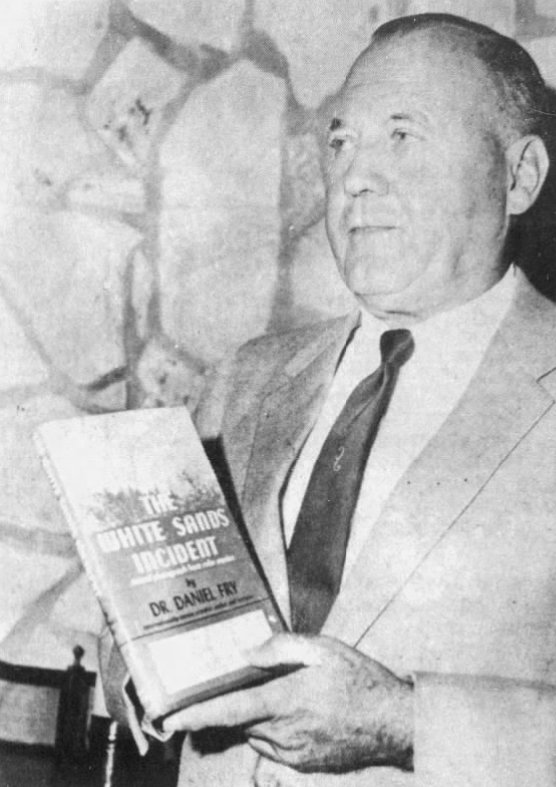
Pictured: Daniel Fry photographed in 1967 holding a copy of his own book — a contemporaneous photograph, in the public domain in the United States for lack of a copyright notice. No photograph or film of any kind exists of the craft or "Alan" from the original 1949/1950 White Sands encounter itself; Fry never claimed to have had a camera with him that night, and the only UFO film he is known to have publicly shown (from an unrelated 1964 Oregon sighting) is addressed separately in Material Analysis below.
Theoretical Alignment
This file, like this site's assessments of the George Adamski Desert Center Contact and Truman Bethurum & the "Captain Aura Rhanes" Contacts it sits alongside chronologically and structurally, applies the Psycho-Social Hypothesis in its broad sense — not a claim that Fry sincerely misperceived a real stimulus, but the category that best captures what this case actually is: an uncorroborated personal narrative, delivered by a technically credentialed man with a documented reason to eventually monetize and organize around it, that became a durable international movement. The Extraterrestrial Hypothesis receives only minimal alignment for a further, case-specific reason worth stating explicitly: Fry's own account, as Alan explained it, does not actually describe extraterrestrial visitors at all. Alan told Fry his people descended from human survivors of Earth's own lost civilizations, Lemuria and Atlantis, who left the planet millennia ago and were now returning — a paleocontact/return-migration narrative that sits closer to what some UAP taxonomies term an Ultraterrestrial framework than to a classical ETH claim of visitors from another planet, and this file scores it accordingly rather than defaulting to the site's usual ETH-first framing for a claimed non-human contact.
Background
Daniel William Fry was born July 19, 1908, in Verdon Township, Minnesota, to Fred Nelson Fry and Clara Jane Baehr. His mother died in 1916 and his father in 1918, during the influenza pandemic, leaving Fry orphaned at age ten and raised by his grandmother alongside an older sister. The family relocated to South Pasadena, California in 1920, where Fry attended El Centro Elementary and later Antelope Valley High School. He never obtained a college degree; by his own and others' accounts he was substantially self-educated, using the Pasadena Public Library to teach himself chemistry, explosives handling, and the fundamentals of rocketry — an unusual, largely autodidactic technical background that would nonetheless carry him into real, verifiable defense-contractor engineering work within two decades.
Through the 1930s and into the 1940s, Fry worked as a "powder man," an explosives supervisor on large civil-engineering projects including the Salinas Dam and sections of the Pan-American Highway — hands-on, technically demanding blue-collar work with real safety stakes, and a plausible pipeline into the postwar rocketry and ordnance industry that would soon be hiring heavily in the Southwestern United States. He married his first wife, Elma, in 1934; the couple would have three children before divorcing in 1964.
In 1949, Fry was hired by the Aerojet General Corporation — a private rocket-propulsion contractor founded in 1942 by members of Caltech's GALCIT rocket research group, not a government or military body itself — to work at White Sands Proving Ground, New Mexico, designing and installing telemetry transducers used to measure and record rocket performance during test firings. This detail is worth stating precisely because it is sometimes blurred in retellings of this case: Fry was a civilian employee of a private defense contractor doing measurement-instrumentation work, not a uniformed serviceman, not a government scientist, and not (so far as any source this file located establishes) cleared into or working on classified weapons-design work himself. Aerojet's own documented White Sands-era work in this period included Aerobee sounding-rocket development for the Navy's Bureau of Ordnance and propellant supply for the Bumper WAC Corporal program, so Fry's stated employer and worksite are independently well-attested pieces of Cold War-era rocketry history entirely apart from anything he later claimed happened to him there.
Nothing in the available record suggests Fry had any prior public interest in flying saucers before his claimed 1949/1950 encounter; his technical, self-taught background and verifiable rocketry-adjacent employment gave him, unusually among 1950s contactees, an actual credential-shaped platform from which to speak — a "man who works with rockets says he rode in one" framing that several contemporaries lacked and that this file weighs directly in Observer Credibility below, in both directions.
Complete Timeline
Dates through 1954 are drawn from Fry's own books and from the extensive documentary chronology maintained by the dedicated research site danielfry.com (which itself cites primary correspondence, FOIA-released FBI records, and Fry's own recorded lectures); the July 1949/1950 encounter date is presented here exactly as the record actually is — genuinely contested, in Fry's own words, across different points in his life — rather than resolved to a single figure.
| Date | Event |
|---|---|
| Jul 19, 1908 | Daniel William Fry born in Verdon Township, Minnesota |
| 1916 – 1918 | Both parents die (mother 1916; father 1918, influenza pandemic); Fry orphaned at ten, raised by his grandmother |
| 1920 | Family relocates to South Pasadena, California |
| 1930s–1940s | Works as an explosives supervisor ("powder man") on the Salinas Dam and Pan-American Highway projects; self-educates in chemistry and rocketry via the Pasadena Public Library |
| 1934 | Marries first wife, Elma |
| 1949 | Hired by Aerojet General Corporation as a rocket-instrumentation technician at White Sands Proving Ground, New Mexico |
| Jul 4, 1949 or 1950 | Claimed contact. Fry says he missed the last bus to Las Cruces's Independence Day festivities, walked into the desert, and encountered a landed, unmanned disc whose remote pilot, "Alan," warned him telepathically not to touch the still-hot hull |
| Same night | Per Fry's account, Alan invites him aboard for an approximately 30-minute, ~8,000-mph round-trip flight to New York City and back, discussing magnetic propulsion, a reinterpretation of E=mc², and his people's claimed descent from survivors of Lemuria and Atlantis |
| 1949–1954 | "Four years of silence" (Fry's own description) before going public; continues working at Aerojet |
| 1954 | Publishes The White Sands Incident and Alan's Message: To Men of Earth, both listing the encounter date as July 4, 1950 |
| Jun 1954 | Appears on Paul Coates's Los Angeles television program Confidential File; polygraph examiner Chris Gugas concludes Fry was "definitely deceptive" on key questions about the encounter |
| 1954 | Fry publishes a rebuttal, "My Experience with the Lie Detector," in Saucers magazine, disputing the test's validity |
| 1954 | Leaves Aerojet; co-founds Crescent Engineering & Research Company with Edmund Sawyer, developing guidance-system components for the Atlas missile program; becomes Vice President of Research and a company stockholder |
| 1955 | Founds "Understanding" in El Monte, California, with nine members |
| 1956 | The Understanding monthly newsletter begins publication |
| 1958 | FBI records (later released via FOIA) show Fry and Understanding's mailing list drawn into a broader espionage investigation centered on an associate, Robert Stark |
| Early 1960s | Understanding, Inc. peaks at roughly 1,500 paid members and more than 60 units across the United States, Canada, the United Kingdom, Australia, New Zealand, Sweden, Finland, and South America |
| 1960 | Fry begins using the title "Dr.," based on a "Doctorate of Cosmism" from the mail-order Saint Andrew's College, London |
| 1963 | Further FBI memo references Fry and Understanding in the same espionage inquiry |
| May 1964 | Fry films a separate, unrelated UFO sighting in Oregon; the 16mm footage later draws public skepticism from UFO researcher Timothy Good |
| Early 1960s | Sells his stake in Crescent Engineering; relocates to Merlin, Oregon to run the Merlin Development Company |
| 1964 | Divorces first wife, Elma |
| 1966 | Second edition of The White Sands Incident published; Fry asks his publisher to correct the date to 1949, but the publisher declines, citing established publicity value in the 1950 date |
| Mid-1970s | Marries third wife, Florence, in Oregon; relocates to Tonopah, Arizona to manage Understanding's property |
| 1972 | Runs as the Universal Party's candidate for U.S. Vice President, on a ticket headed by fellow contactee Gabriel Green |
| 1974 | Understanding, Inc. receives a 55-acre donated property with eight buildings near Tonopah, Arizona |
| 1978 | An arsonist destroys the kitchen and library at the Tonopah property |
| Oct 1979 | The Understanding newsletter ceases regular publication after 240-plus monthly issues; Fry continues a reduced, single-page version until 1989 |
| 1980 | Third wife Florence dies of breast cancer |
| 1982 | Marries fourth wife, Cleona, in Alamogordo, New Mexico |
| 1989 | Gives a talk at a MUFON conference; states, on record, that the encounter occurred in 1949 |
| Dec 20, 1992 | Daniel Fry dies in Alamogordo, New Mexico, aged 84 |
| After 1992 | Understanding, Inc. ceases to operate as an active entity |
The Missed Bus and the Encounter
By Fry's own repeated telling, the encounter began with an entirely ordinary, checkable circumstance: he had planned to ride the bus from his quarters near White Sands Proving Ground into Las Cruces, roughly forty miles north, for the town's Independence Day festivities, and missed the last scheduled departure. Rather than spend the evening alone at the isolated facility, he says he walked out into the surrounding Tularosa Basin desert to pass the time and cool off in the night air — a mundane, unremarkable decision that, on his account, put him alone, unobserved, and on foot in open desert after dark, precisely the circumstances under which no version of what followed could ever have a second, independent witness.
Fry said he first noticed stars disappearing from a patch of sky above him, then watched a smooth, oval craft roughly thirty feet in diameter and sixteen feet high descend silently and land about seventy feet away. He described its hull as polished silver with a faint violet iridescence. Approaching out of curiosity, he says he reached toward the hull and was stopped by a disembodied voice warning him, in his own later-quoted phrasing, "Better not touch the hull, pal, it's still hot" — explaining that the craft's repulsion field would cause fatal liver damage on prolonged contact. The voice identified itself as an operator named "A-lan" (rendered "Alan" in most later retellings and in this file), controlling the vessel remotely, by telepathic-linked instrumentation, from a mothership he said orbited roughly nine hundred miles above Earth. Alan told Fry he had never personally set foot on the planet; the landed craft was explicitly described as a small, unmanned "cargo" vessel, not Alan's own physical location.
It is worth stating plainly, as this file does for every solo-witness contactee claim it covers, exactly what is and is not independently corroborated here. What is corroborated, at the most basic factual level, is that Fry was in fact employed by Aerojet General at White Sands during this general period — his employment itself is not in dispute in any source this file located. Every other specific detail — the craft, the voice, Alan's identity and explanations, the entire substance of the exchange — rests exclusively on Fry's own retrospective account, first committed to print no earlier than 1954, by his own description four or more years after the fact.
The Ride to New York and Back
Fry says Alan then invited him inside the craft's passenger compartment, which he described as containing four comfortable seats and an unfamiliar viewing apparatus. When the vessel accelerated, Fry reported feeling no sensation of movement at all, despite what Alan told him was a cruising speed near eight thousand miles per hour — an absence of felt acceleration Alan explained by describing a field that acted equally on all matter within the craft, including its occupant, rather than any structural cushioning. The craft climbed to an altitude Fry gave as roughly thirty-five miles and turned east.
Over the following minutes, Fry says he watched the lights of American cities pass beneath him before the craft leveled at around twenty miles over New York City. His own most-quoted description of the view — "a vast array of millions of blue white diamonds, scintillating and coruscating against a black velvet background" — is one of the case's most frequently reproduced lines in secondary literature, precisely because, unlike most of the encounter's content, it describes something genuinely checkable in principle (what a lit metropolitan area looks like from altitude) even though the claimed vantage point itself has no independent corroboration of any kind. The full round trip, per Fry, took approximately thirty minutes.
During the flight, Fry says Alan discussed several technical subjects at some length: a magnetic-field-based propulsion system, in which the craft's own field repelled against Earth's magnetic field to generate thrust without combustion; a reinterpretation of Einstein's mass-energy relationship in which matter and energy were described as two aspects of a single underlying entity rather than directly interconvertible quantities; and an explanation of why the high claimed speed produced no crushing g-force, tied to the same field effect that eliminated felt acceleration. None of this content is independently testable against known physics in any way that would validate or falsify the claim on its own physical merits within the scope of this file; it functions in the narrative as explanatory color rather than as a checkable prediction, in the same general genre as Truman Bethurum's and George Adamski's own contemporaneous technical exposition from their claimed contacts.
On the return descent, Fry says the craft's reduced apparent gravity let him float briefly inside the cabin, during which he noticed a symbol worked into one of the seats — a tree entwined with a serpent — that he recognized from Earth mythology. Alan reportedly confirmed the connection directly: his people, he said, were descendants of survivors of two ancient, technologically advanced Earth civilizations, Lemuria (called "Mu" in some of Fry's retellings) and Atlantis, whose own final war — fought, in Alan's account, with weapons Fry understood him to mean were comparable to nuclear arms — had driven the survivors' ancestors off-world millennia ago. Alan said his people had recently begun trying to reintegrate into Earth's biosphere and required a further four years to complete their biological adaptation before more direct contact could occur; Earth's own escalating nuclear-weapons tensions, in the years immediately following the first hydrogen-bomb tests, were presented as the immediate reason for making contact with a human intermediary at all, squarely within the same nuclear-anxiety motif that runs through nearly every other contactee narrative of the era, including Adamski's and Bethurum's. The craft set down, Fry stepped out, and he says he watched a band of orange light circle the hull before it departed skyward "at tremendous speed." Fry reported that Alan promised to make contact again within a few months; by Fry's own account, he remained at White Sands afterward uncertain whether that promise would be kept, and it would be years before he spoke publicly of the encounter at all.
The Date That Wouldn't Stay Fixed: 1950 or 1949
This file treats the date of Fry's claimed encounter as a genuinely open, unresolved feature of the case's own primary record — not a typo, not a simple case of a decades-old memory drifting by a year, and not something this file will silently pick a side on. Every published edition of The White Sands Incident, from its original 1954 printing onward, states the date as July 4, 1950. But according to the dedicated research site danielfry.com and to UFO researcher Timothy Good's 1998 book Alien Base, Fry told researchers directly, roughly a decade after publication, that the actual date was July 4, 1949 — a full year earlier than what his own book said.
Fry's own explanation for the discrepancy, as recorded by Good, is the single most consequential specific detail in this entire file's assessment of the case's credibility, and deserves to be quoted rather than paraphrased: asked why the date changed, Fry described it as a deliberate security measure, so that "had the Pentagon... taken this book seriously, at the time there was a pretty good chance they could have tracked him down. There had to be an escape mechanism. The fact is that on the evening of the Fourth of July 1950, I was not at White Sands – I didn't arrive there until later in July." Fry also separately noted that Alan's promised return was tied to a roughly four-year timeline that ended up taking five, a mismatch he mentioned but did not tie directly to the date change itself. Whichever detail is emphasized, both describe the same underlying fact in Fry's own words: the date in his published book was not simply what he remembered happening, but a number he chose for reasons unrelated to historical accuracy.
Fry's follow-through on his own correction was itself inconsistent. When preparing the 1966 second edition of The White Sands Incident, he asked his publisher to change the date to 1949; the publisher declined, reportedly on the grounds that the story's established 1950 date already had publicity value and readership recognition, and the second edition went to print still reading 1950. Yet Fry continued, at least intermittently, to give 1949 as the real date in other contexts — including, per available records, a 1989 talk at a MUFON conference, three years before his death, where he again stated 1949. Danielfry.com's own researchers, who are broadly sympathetic to Fry and have spent years compiling primary documentation of his life, reach a notably candid, unresolved conclusion on this specific point: that independent verification would require locating Aerojet or White Sands personnel records or coworker testimony from the relevant year, that no such corroboration has ever surfaced, and that "we really only have Daniel's word" for which year is correct.
This file's own position, consistent with the case's actual primary record rather than with either convenient resolution, is that the date cannot be honestly settled to a single year on the evidence available, and that the fact of Fry's own admitted, motivated alteration of a specific factual detail in his published account — regardless of which underlying year turns out to be "true," if either is — is itself among the strongest pieces of evidence this file has for assessing the reliability of the account as a whole. A witness's memory drifting by a year across four decades of retelling would be unremarkable and would carry little evidentiary weight either way; a witness's own stated, purposeful choice to publish a different date than the one he says actually happened, for reasons tied to protecting the story's internal narrative logic, is a materially different and more serious finding, and this file weighs it as such throughout the sections below rather than treating it as a minor footnote.
From Silence to Publication: The White Sands Incident (1954)
Fry described a gap of roughly four years between the claimed encounter and going public — a "four years of silence" he attributed, in later retellings, to Alan's own request for time and to his own uncertainty about how the story would be received given his position at a sensitive defense-contractor worksite. In 1954, he published The White Sands Incident and a companion pamphlet, Alan's Message: To Men of Earth, presenting Alan's claimed statements as a direct extraterrestrial (in Fry's own framing) communication to humanity. The book arrived into a contactee marketplace that George Adamski's Flying Saucers Have Landed (1953) had already made commercially viable the year before — a publication-timing fact this file returns to directly in the Conventional Explanation Candidate section below, since it bears on how much of Fry's specific narrative choices, once he decided to go public, may have been shaped by the surrounding contactee wave rather than by the underlying 1949/1950 event itself.
Almost immediately after the book's release, Fry appeared on Paul Coates's Los Angeles television program Confidential File and volunteered for a polygraph examination administered on-air by examiner Chris Gugas. Gugas concluded Fry had been "definitely deceptive" on several of the critical questions concerning the encounter. Fry disputed the result at length in a subsequent article, "My Experience with the Lie Detector," published in Saucers magazine, arguing the test's interpretation depended entirely on operator neutrality rather than any objective physiological signal of truthfulness, and describing what he characterized as irregularities in how the broadcast's accompanying private-investigator segment had presented deliberately mixed true-and-false biographical details (including, he said, a false claim about where his wife was born) as if they were independently verified findings. This file addresses the polygraph result and Fry's rebuttal together, on their actual merits, in Observer Credibility below, rather than treating either the failed test or Fry's contestation of it as automatically dispositive on its own.
The same year, Fry left Aerojet and co-founded Crescent Engineering & Research Company with engineer Edmund Sawyer, developing guidance-system components for the U.S. Atlas intercontinental ballistic missile program — a further, independently verifiable data point establishing that Fry's technical career did not end or become discredited by his public contactee claims; he continued working in real, security-relevant defense engineering for roughly a decade afterward, eventually serving as the company's Vice President of Research and holding an ownership stake.
Founding Understanding, Inc.
In 1955, Fry founded "Understanding" in El Monte, California, beginning with nine members. The organization's own 1959 promotional pamphlet described its growth in terms this file quotes directly rather than paraphrasing, since the specific figures are independently checkable against the organization's own surviving publications: "From a start of nine members at El Monte, California in 1955, Understanding Inc., has grown into an international organization of more than sixty units and many members-at-large throughout the world." Independent secondary sources place the organization's peak, in the early 1960s, at roughly 1,500 paid members organized into more than sixty local units across the United States, Canada, the United Kingdom, Australia, New Zealand, Sweden, Finland, and parts of South America — genuinely substantial reach for a organization built entirely around one man's uncorroborated personal testimony, and comfortably matching the "60-plus chapters" figure this case has been publicly described by prior to this file's publication.
Understanding's monthly newsletter, also called Understanding, began publication in 1956 and ran, at roughly twenty pages an issue, for more than 240 consecutive monthly issues through October 1979 — a genuinely long publishing run by the standards of small independent organizational newsletters of any kind, contactee-themed or otherwise. The organization's stated mission, per its own literature, was "bringing about a greater degree of understanding among all the peoples of the earth and preparing them for their eventual inevitable meetings with other races in space," a framing that situated Understanding within the broader current of Cold War-era cosmic-brotherhood and nuclear-anxiety themes common to the entire contactee movement, discussed further in Historical Precedents below. Some later scholars of new religious movements have classified Understanding as a UFO religion in the academic sense of that term, a characterization Fry himself is on record disputing, preferring to present the organization's activities as educational and philosophical rather than devotional.
In 1960, Fry began using the honorific "Dr.," based on a "Doctorate of Cosmism" issued by the mail-order Saint Andrew's College of London — a non-accredited correspondence credential, not a genuine research doctorate from any recognized university, though danielfry.com's own archivists report having located an actual photocopy of the certificate, confirming at minimum that a real document of this kind was genuinely issued to him rather than the title being invented outright. This file treats the distinction as material: Fry did not fabricate holding a credential that never existed in any form, but he did adopt and publicly use an academic title from a non-accredited diploma mill in a manner that would reasonably lead unfamiliar audiences to assume a legitimate scientific doctorate, a genuine and specific credibility problem addressed further in Observer Credibility below.
The FBI's Interest
FBI records later released under the Freedom of Information Act, dated 1958 and 1963, show that Fry and Understanding's own mailing list were drawn into a broader federal espionage investigation centered on an associate named Robert Stark, whose cross-country movements and contacts (including reported ties to Russian United Nations personnel) the Bureau tracked using mail covers, financial-transaction monitoring, and interviews with landlords, neighbors, employers, and coworkers conducted under false pretenses. The surviving, heavily redacted file (forty of forty-one released pages, with one page withheld entirely) indicates investigators were specifically concerned that Understanding's newsletter and mailing infrastructure, reaching a documented 43 nationwide study groups by that point, might have been usable as a channel for distributing classified or subversive material, though the released records do not establish that any such use actually occurred, and no public record this file located shows Fry himself was ever charged with or formally accused of any offense arising from the investigation.
This file includes the FBI investigation as a directly relevant biographical fact — it demonstrates that Understanding's reach and mailing infrastructure were substantial enough to draw genuine federal counterintelligence attention independent of the truth or falsity of Fry's underlying UFO claim — while being explicit that it is not being presented as evidence bearing on whether the White Sands encounter itself was real or fabricated, and it does not constitute an official government finding, favorable or unfavorable, regarding that separate question. No official U.S. government body is on record anywhere in the available literature as having investigated, endorsed, or refuted the truth of Fry's 1949/1950 contact claim itself; Fry never reported the encounter through Project Blue Book or any comparable official channel.
Later Life and the Organization's Decline
Fry sold his stake in Crescent Engineering in the early 1960s and relocated to Merlin, Oregon to run the Merlin Development Company, entering a common-law partnership with a woman named Bertha (also known as Tahahlita) after his 1964 divorce from Elma. It was in Oregon, in May 1964, that Fry filmed the separate UFO sighting whose 16mm footage later drew public skepticism, discussed in Material Analysis below. He continued lecturing extensively through this period and the 1970s, by some accounts delivering thousands of talks nationally over his career, generally for modest honoraria rather than the kind of sustained commercial lecture-circuit income associated with contemporaries like Adamski or Bethurum — a distinction this file weighs directly in the Conventional Explanation Candidate section below, since it bears meaningfully on how strong a pure financial-motive explanation for the claim can be.
In the mid-1970s Fry married a third wife, Florence, in Oregon, and the couple relocated to Tonopah, Arizona, where Fry managed a property that would become Understanding's operational base; the organization received a 55-acre donated site with eight buildings there in 1974. In 1972, Fry ran as the Universal Party's candidate for Vice President of the United States, on a ticket headed by fellow contactee Gabriel Green (founder of the Amalgamated Flying Saucer Clubs of America), a further data point illustrating how thoroughly Fry's public identity had merged with the broader organized contactee movement by this point in his life.
An arsonist destroyed Understanding's kitchen and library at the Tonopah property in 1978, and the organization's flagship newsletter ceased regular monthly publication in October 1979 after more than 240 issues, though Fry continued a reduced, single-page version until 1989. Florence died of breast cancer in 1980; Fry married a fourth wife, Cleona, in Alamogordo in 1982, and remained married to her until his own death. He gave a MUFON conference talk in 1989, three years before he died, restating the 1949 date for his encounter. Daniel Fry died December 20, 1992, in Alamogordo, New Mexico, aged 84; Understanding, Inc. did not survive him as an active organization, effectively dissolving in the years immediately following his death after nearly four decades of continuous operation.
Key Witnesses
Daniel W. Fry
The case's only claimed witness, and the sole source of every specific detail of the encounter, the flight, and Alan's statements. No coworker, bus-stop bystander, or other person is ever named as having seen anything unusual that night, or as having heard Fry's account contemporaneously rather than years later. Fry volunteered for and failed a 1954 televised polygraph examination; separately and independently, he later admitted, by his own account as recorded by researcher Timothy Good, to deliberately publishing an incorrect encounter date in his own book for reasons tied to his narrative's internal consistency. He nonetheless held real, independently verifiable technical employment at Aerojet General and later Crescent Engineering throughout and after the period of his public claims, and founded an organization, Understanding, Inc., that reached a documented sixty-plus chapters and roughly 1,500 members internationally.
Alan (A-lan)
The remote craft operator Fry said he communicated with by voice and, in later retellings, telepathically, on the night of the encounter and in follow-up contacts Fry described in subsequent books. Alan has no independent existence outside Fry's own testimony: no other person ever claimed to have heard or perceived him, and no recording, transcript, or physical trace of any kind is associated with him beyond Fry's own retrospective written and spoken retellings. Consistent with this site's established practice for claimed contact entities without independently verifiable identities (see this site's treatment of "Orthon" in the George Adamski file and "Aura Rhanes" in the Truman Bethurum file, neither of which carries a key-figures card), no key-figures.html card has been created for Alan; he is documented here, and referenced elsewhere on this site, as a named element of Fry's own claim rather than as a registered historical figure.
The Five Observables Assessment
Because this case's central claims were never subjected to any external test capable of confirming or denying the described craft's performance, the assessment below documents only what Fry himself claimed, without independent corroboration of any kind.
The Five Observables framework is applied to the performance characteristics claimed in this case:
Assessment: Fry's own account is unusual among this site's contactee-cluster cases for the amount of specific performance detail it attributes to the craft — a claimed ~8,000 mph cruising speed, a magnetic-repulsion propulsion system, and a field effect eliminating felt acceleration are all marked "Claimed Only" rather than "Present" because every one of them is reported entirely secondhand, through Fry's own retelling of what Alan told him, rather than through any instrumented measurement, external observation, or corroborating witness. No radar, visual, or photographic data of any kind exists to independently evaluate any claimed performance characteristic; the craft is described as landed and stationary at first contact and returning to a landed, stationary state at the end of the flight, so Low Observability and Trans-Medium Travel are marked Absent rather than Claimed, since Fry never described either occurring.
Evidence Assessment
As with the site's other solo-witness 1950s contactee files, evaluating this case does not primarily involve weighing thin or ambiguous physical evidence; it involves weighing a single, uncorroborated personal narrative against a specific, documented failed polygraph result and a directly admitted, motivated alteration of the account's own central date.
Points Cited by Proponents
- Fry's employment at Aerojet General at White Sands, and later at Crescent Engineering on the Atlas missile program, is independently, verifiably real defense-contractor engineering work, giving him a more substantive technical background than several contemporaries
- Understanding, Inc.'s documented growth to more than sixty chapters and roughly 1,500 members internationally, sustained for nearly four decades, is a genuine, independently checkable organizational achievement regardless of the underlying claim's truth
- Fry voluntarily submitted to a polygraph examination rather than avoiding one, and publicly and specifically contested its methodology rather than simply ignoring the result
- Fry's lecturing career, by most accounts, was conducted for modest honoraria rather than the sustained high-income commercial circuit some contemporaries built, weakening a pure financial-fraud explanation somewhat relative to other contactee cases
Findings Against the Case
- No coworker, bystander, or other named person is ever cited as an independent witness to any part of the encounter
- A 1954 televised polygraph examination concluded Fry was "definitely deceptive" on key questions about the encounter
- Fry himself later admitted, per researcher Timothy Good's account, to deliberately publishing an incorrect encounter date for reasons tied to his story's internal narrative logic — a materially more serious finding than an ordinary memory lapse
- No photograph, film, or physical trace of any kind exists from the original encounter itself
- A separate 16mm UFO film Fry later showed publicly (from an unrelated 1964 Oregon sighting) was assessed by a sympathetic UFO researcher as visually resembling a suspended model on fine wire
- Fry publicly used the title "Dr." based on a non-accredited mail-order correspondence credential rather than a genuine academic doctorate
Why "Debunked"
This case receives a DEBUNKED classification. This site reserves that rating for cases where independent examination produces specific, largely conclusive counter-evidence rather than merely an absence of proof, and this file finds that bar cleared here by a convergence of three separate, independently damaging findings rather than any single one alone.
First, and most directly, a polygraph examination Fry himself volunteered for — not one imposed on him against his wishes — concluded he was being deceptive on the specific questions concerning the encounter's core details. This file weighs Fry's own published rebuttal seriously (polygraph examinations are genuinely imperfect instruments, and Fry's specific documented complaint about the broadcast's private-investigator segment mixing fabricated and true biographical details is a legitimate procedural concern), but a failed test that the subject himself requested, on a topic he was actively promoting for public and financial benefit, remains meaningful negative evidence that this file does not discount to zero.
Second, and considerably more significant in this file's own weighting, Fry's later, semi-public admission — recorded independently by researcher Timothy Good and corroborated by Fry's own recorded 1989 MUFON conference statement — that he deliberately published an incorrect date in his own book, for reasons he directly tied to protecting his narrative's internal timeline, is qualitatively different from an ordinary case of memory drifting across decades of retelling. It is a first-person admission of intentionally altering a specific, central, checkable fact in a published account presented to the public as true. This file treats that admission as functionally comparable in evidentiary seriousness to Truman Bethurum's documented three-stage revision of Clarion's location under scientific pressure: both are cases where the claimant's own subsequent conduct, not merely an absence of corroboration, demonstrates that the published account does not straightforwardly represent "what the claimant remembers happening," but something closer to a managed narrative.
Third, the one piece of filmed evidence Fry is known to have publicly presented in support of his broader UFO claims — the 1964 Oregon footage — was independently assessed, by a UFO researcher broadly sympathetic to contact claims generally, as visually consistent with a small suspended model rather than a genuine unidentified craft. This file is careful, in Material Analysis below, to note this footage documents a separate 1964 sighting, not the original 1949/1950 White Sands encounter itself, for which no photographic evidence was ever claimed to exist; but a documented instance of apparently fabricated UFO evidence from the same claimant, offered to the same audience in support of the same broader body of claims, is directly relevant background for assessing his overall reliability as a witness.
This file does not conclude that Fry was necessarily a cynical fraud from the very first night, nor that every element of his account is equally suspect; his genuine technical employment, Understanding's genuine organizational reach, and the comparatively modest financial scale of his lecturing career are all real, verified facts that complicate a simple profit-motive explanation. What the available evidence does support, with reasonable confidence, is that the specific claims in The White Sands Incident do not describe a real, unaltered account of an actual physical encounter with a genuine non-human intelligence — a narrower and more defensible conclusion than a claim about Fry's total sincerity, and the one this file's DEBUNKED rating is actually meant to convey.
Sensor & Instrumentation Detection Profile
No radar, aviation, military, or scientific instrument of any kind is associated with the claimed encounter itself. Fry never reported the White Sands contact through Project Blue Book or any other official channel at the time; his story reached the public exclusively through his own 1954 book, the Confidential File television appearance, his lecture circuit, and Understanding's own publications. No photographic or film evidence exists of the original encounter to analyze. The one piece of filmed UFO evidence in the case's broader record — the May 1964 Oregon footage, addressed in Material Analysis below — documents an entirely separate, later sighting rather than instrumentation of the White Sands claim itself, so it cannot be treated as detection data for this case's central event.
Environmental & Geospatial Context
White Sands Proving Ground occupies a roughly 3,200-square-mile stretch of the Tularosa Basin in south-central New Mexico, established July 9, 1945 to test captured German V-2 rockets under Wernher von Braun's team and rapidly expanded into a full multi-service guided-missile range in the years immediately following. Its remote, restricted-access desert setting — precisely the quality that made it useful for rocket testing — is also the quality that placed Fry's claimed solo encounter far from any potential unrelated witness, the same structural evidentiary problem this site's coverage of solo-witness contactee claims documents repeatedly. Las Cruces, the town whose Independence Day festivities Fry says he missed by bus, sits roughly forty miles north in the Mesilla Valley along the Rio Grande.
No specific atmospheric or astronomical phenomenon is required to explain this case, since its central evidentiary problem is not a plausible misidentification of a genuine but mundane stimulus; it is an entirely uncorroborated personal narrative with a documented failed polygraph result and a directly admitted alteration of its own central factual claim. The desert setting's chief evidentiary relevance is the same one this site's related contactee files identify repeatedly: total privacy for a claimed encounter under circumstances that made independent corroboration structurally impossible from the very outset, regardless of whether anything unusual actually happened that night.
Observer Credibility & Occupational Profile
Fry's occupational background is a genuinely unusual and, on balance, credibility-relevant feature of this case relative to most other 1950s contactees this site has covered. Unlike Adamski (a self-styled spiritual teacher with no technical training) or Bethurum (a truck driver and mechanic with no engineering background), Fry held real, independently verifiable technical employment directly relevant to the subject matter of his claim — first as an Aerojet General instrumentation technician at the actual rocket-testing facility where his encounter is set, and later as a Vice President of Research at a company building missile-guidance hardware for the U.S. Atlas program. This file weighs that background as genuinely distinguishing, in the specific sense that it gave Fry both real technical vocabulary to draw on in constructing Alan's explanations and a more substantive public platform than most contactees possessed — a "rocket engineer says he flew in an alien craft" framing carries different, and in some audiences greater, persuasive weight than an equivalent claim from someone with no comparable background, independent of whether the underlying claim is true.
Three specific, documented behavioral findings weigh directly against Fry's reliability as a witness, and this file treats them as more probative than his occupational background alone in either direction. First, his 1954 polygraph result, discussed at length above, found deception on the encounter's key questions. Second, and weighted most heavily in this file's overall assessment, is Fry's own later admission — not a skeptic's inference, but Fry's own stated explanation as recorded by researcher Timothy Good — that he deliberately altered the published date of his own account for reasons tied to the story's internal timeline. Third is his adoption of the "Dr." title from a non-accredited mail-order institution beginning in 1960, a specific, documented instance of Fry presenting his own credentials as more authoritative than they in fact were, independent of anything relating to the White Sands claim itself.
Set against these findings, this file also notes what it considers a genuinely mitigating pattern worth stating honestly rather than omitting: Fry's lecturing career, sustained across roughly three decades, was by most available accounts conducted for modest honoraria rather than the kind of high-volume commercial circuit that generated substantial, well-documented personal income for contemporaries like Adamski. This does not rehabilitate the specific findings above, but it meaningfully complicates any simple, single-cause "he did it for the money" explanation of the case as a whole, and this file's Conventional Explanation Candidate section below treats that complication directly rather than eliding it for a cleaner narrative.
Physical & Material Assays
No physical artifact of any kind is associated with the original 1949/1950 encounter. Fry did not claim to have retained any object, sample, or document from the craft or from Alan; unlike Bethurum's claimed (and subsequently withheld) "Clarion document," this case's central claim never included a physical artifact for independent examination to even be offered or declined. The only physical evidentiary item in the case's broader record is the May 1964 16mm film from Fry's separate Oregon sighting, addressed directly in Material Analysis immediately below, which is itself evidence about Fry's general reliability as a source of UFO documentation rather than physical evidence bearing on the White Sands claim specifically.
Historical Precedents & Archive Matches
Fry's case occupies a genuinely distinctive chronological position within the 1950s contactee wave that this file's related files on George Adamski and Truman Bethurum document at length: his claimed encounter date, whichever year is correct, predates both Adamski's November 1952 Desert Center claim and Bethurum's July 1952 Mormon Mesa claim by two to three years. But Fry did not go public until 1954, a year after Adamski's Flying Saucers Have Landed had already become a genuine publishing sensation and established the commercial and narrative template — a benevolent, human-appearing or human-voiced visitor; nuclear anxiety as a stated motive; a lost or hidden origin story; a message of cosmic brotherhood — that the entire subsequent wave, including Bethurum's 1954 book and Fry's own, would closely follow. This file treats this timing distinction carefully rather than glossing over it: the underlying claimed event may genuinely predate the wider contactee wave, but the specific published shape, framing, and publication timing of Fry's public account came after that wave was already a proven commercial and cultural phenomenon, a distinction directly relevant to the Cultural Contagion candidate examined below.
Fry's account also sits within a specific sub-tradition inside the broader contactee genre: claimed contact with beings who describe themselves not as visitors from another planet, but as descendants of ancient, technologically advanced Earth civilizations (Lemuria/Mu and Atlantis) returning after millennia away. George Hunt Williamson, later a member of the six-person group present at Adamski's own Desert Center encounter, independently developed extensive Lemuria-and-ancient-astronaut material in his own subsequent writing, and this same lost-continent motif recurs across a wide swath of 1950s-60s contactee and esoteric literature untethered to any single originating source — suggesting, as this site's other contactee files have found repeatedly, that specific narrative elements circulated as shared cultural vocabulary within the movement rather than each contactee independently arriving at nearly identical claims.
Material Analysis
This case's material evidence, like Bethurum's, is absent rather than merely thin for the encounter that is actually the subject of this file. The one filmed UFO evidence connected to Fry at all belongs to a separate, later incident, and this file addresses it here precisely because separating what is and is not evidence of the White Sands claim specifically is itself part of doing this case justice honestly.
The Missing Record of the Original Encounter
Fry never claimed to have had a camera, recording device, or any other means of documentation with him on the night of the encounter; nothing in any version of his account suggests photographic or physical evidence of the craft, Alan, or the flight to New York ever existed in any form. This is, in one sense, an internally consistent detail — a man who missed a bus and went for an impromptu evening walk would plausibly not be carrying a camera — but it also means the case's central claim has never been, and can never now be, evaluated against any physical trace beyond Fry's own retrospective testimony.
The 1964 Oregon Film
In May 1964, while living in Merlin, Oregon, Fry filmed a separate UFO sighting on 16mm film — the one occasion in his public career where he presented moving-image evidence for a UFO claim of any kind. UFO researcher Timothy Good, in his 1998 book Alien Base, described the footage directly: he wrote that he had "always been dubious about the authenticity of Fry's 16 mm films of UFOs," and that the object in question "looks like a couple of lampshades or similarly shaped devices fixed together and suspended with fine twine," noting the object's movement "gives every indication of being a suspended fake," while adding the caveat "perhaps I am wrong." Good's assessment is particularly significant to this file's overall weighing because Good was, on the whole, a UFO researcher sympathetic to the reality of extraterrestrial contact generally, not a professional skeptic organization with an institutional incentive toward debunking — a broadly sympathetic source independently reaching a specific, visually-grounded conclusion that a piece of evidence offered by the claimant himself resembled a deliberately staged fake carries particular weight precisely because it did not come from a source predisposed to find fraud.
Points Favoring the Claim's Physical Basis
- Fry's underlying employment at White Sands during the general claimed period is independently, verifiably real
- No physical evidence was ever claimed to exist for the original encounter itself, meaning there is no specific fabricated artifact from that night to weigh against the account (unlike, e.g., Bethurum's withheld Clarion document)
- The absence of any camera or recording device is consistent with the mundane, unplanned circumstances Fry describes leading up to the encounter
Points Against the Claim's Physical Basis
- No photograph, film, recording, or physical trace of any kind exists connecting to the original 1949/1950 encounter
- The only UFO film Fry is known to have publicly presented, from a later, unrelated 1964 sighting, was independently assessed by a sympathetic UFO researcher as resembling a small suspended model
- No coworker, bystander, or other person is ever named as having independently observed any element of the original encounter
The Conventional Explanation Candidate
Three genuinely distinct conventional explanations account for this case, and as with this site's related contactee files, this file finds meaningful support for elements of more than one rather than a single, fully dispositive answer.
Deliberate Fabrication for Status, Platform, and Organizational Purpose
The strongest single candidate on the available evidence holds that Fry invented some or all of the specific claims, whether from the outset or through progressive embellishment across the "four years of silence" and subsequent retellings, with the resulting platform — a national media appearance, a book, and eventually an international organization built around his personal testimony — as at least a contributing motive. This candidate accounts directly for the failed 1954 polygraph result and, most significantly, for Fry's own admitted, purposeful alteration of the account's published date: a genuine memory does not require a claimant to consciously choose which year to publish based on how it affects the story's internal timeline. It is worth noting, honestly, that this candidate is somewhat complicated relative to Bethurum's or Adamski's comparable cases by the more modest financial scale of Fry's lecturing career and by his continued, independently verifiable technical employment for a decade after going public — suggesting that status, intellectual legacy, and the specific platform Understanding, Inc. provided may have mattered as much or more to Fry than direct financial gain, without changing this file's assessment that the account was substantially shaped by Fry's own deliberate choices rather than being a straightforward, unaltered record of a real event.
Sincere Confabulation, Later Elaborated and Defended
A softer variant holds that Fry may have genuinely believed some version of his own account, whether originating in an ordinary dream, hypnagogic experience, or other subjectively vivid mental event during a solitary, unplanned desert walk at night, later elaborated, consciously or not, into the fuller narrative under the reinforcing effect of public interest and his own repeated retelling over decades. This file finds it a less complete standalone explanation than deliberate fabrication, for the same reason it applies to Bethurum's case: it does not naturally account for a specific, purposeful, later-admitted alteration of a factual detail for reasons Fry himself connected to protecting the narrative's internal consistency — a response pattern considerably more consistent with an aware narrator actively managing a story than with someone consistently reporting a single, sincerely and unalteredly held memory. As with Bethurum, the two candidates are not mutually exclusive: a genuinely and sincerely experienced initial event could plausibly have been followed by conscious, purposeful embellishment once the story's public and organizational potential became clear.
Cultural Contagion from the Emerging Contactee Wave
A third candidate holds that the specific published shape of Fry's 1954 account, whatever its underlying origin, was substantially influenced by the surrounding contactee movement that Adamski's 1952/1953 fame had already made into a proven commercial and cultural phenomenon by the time Fry actually went public. This file weighs this candidate carefully rather than uncritically: unlike Bethurum, whose claimed encounter date (July 1952) came after Adamski's, Fry's own claimed encounter date (1949 or 1950) genuinely predates the wider wave by two to three years, so this candidate cannot explain the origin of Fry's underlying claim the same way it plausibly can for later contactees. What it can and does plausibly explain is Fry's choice of when and how to go public in 1954, a year after Flying Saucers Have Landed had demonstrated a receptive mass audience and an established narrative template (benevolent human-appearing or -sounding visitors, nuclear anxiety as motive, a hidden or ancient origin story) that Fry's own account, whatever its origin, closely follows in its published form.
Genuine Contact (At Face Value)
Included for completeness, as this site does for every case, the candidate that holds Fry's account largely as stated — a genuine encounter with a remotely piloted, non-human-operated craft and a real telepathic exchange — finds no persuasive support in the available evidence. It requires treating Fry's failed 1954 polygraph result as either invalid or coincidentally misleading, requires treating his own later admission of a deliberately altered publication date as somehow not what it plainly states, and requires no explanation for the complete absence of any corroborating witness across the entire encounter.
Deliberate Fabrication for Status, Platform, and Organizational Purpose
PlausiblePLAUSIBLE. Best accounts for the failed polygraph and, especially, for Fry's own admitted, purposeful alteration of the account's published date — though the modest financial scale of his lecturing career suggests status and platform, not simple profit, as the more likely primary motive.
Sincere Confabulation, Later Elaborated and Defended
InconclusiveINCONCLUSIVE. Plausible as an origin for an initial subjective experience during a solitary night walk, but does not on its own explain the specific, later, self-admitted purposeful alteration of the account's central date.
Cultural Contagion from the Emerging Contactee Wave
Inconclusive (as a contributing factor)INCONCLUSIVE as a contributing factor. Cannot explain the origin of Fry's underlying claim, which predates the wider wave, but plausibly shaped the specific published form and 1954 timing of his going public.
Genuine Contact (At Face Value)
ImplausibleIMPLAUSIBLE. Requires dismissing a failed polygraph result and treating Fry's own admitted, purposeful alteration of the account's central date as something other than what it plainly states.
Related Cases
The cases below sit within the same 1950s "contactee" cluster this case belongs to, offering direct points of comparison on evidentiary strength, claimed technical background, and the broader movement Fry's organization helped sustain for nearly four decades.
Confirmed Documents & Official Records
A 41-page FBI file (one page withheld in full), released via FOIA and summarized with primary-document links by independent FOIA researchers, showing Fry and Understanding, Inc.'s mailing list were drawn into a broader espionage investigation centered on an associate, Robert Stark, during the late 1950s and early 1960s. This file does not represent, and should not be read as, an official government investigation into the truth of Fry's UFO claim itself — the released records concern suspected misuse of Understanding's mailing infrastructure for espionage purposes, a separate question the FBI's own records do not resolve either way. No Project Blue Book or other formal U.S. government investigation of the White Sands encounter claim itself is known to exist; Fry never reported his claims through any official channel. Because no government or official body is cited anywhere in this file as evidence bearing on whether the UFO claim itself is genuine or explained, this file finds the site's Skepticism Disclaimer for official government/Pentagon statements is not directly applicable to that separate question here — there is no official finding, favorable or unfavorable, on the encounter for that disclaimer to qualify. Readers should still note, as general context, that a federal counterintelligence file exists and was compiled using surveillance methods (mail covers, financial monitoring, pretextual interviews) that a modern reader may reasonably view with independent skepticism regarding their own justification, entirely apart from the UFO question.
Publicly released (FOIA)Search Government & Military Archives Directly
Further Reading — Recommended Literature
The White Sands Incident: Including An Extraterrestrial Statement
Fry's own original account of the encounter, the ride to New York, and Alan's message to humanity — essential primary-source reading for understanding exactly what was claimed and how it was framed for the public.
Alien Base: The Evidence for Extraterrestrial Colonization of Earth
The source of this file's direct quotation on both Fry's own explanation for his changed encounter date and Good's independent assessment of Fry's 1964 Oregon UFO film as resembling a suspended model.
Flying Saucer Pilgrimage
A genuine two-year, 23,000-mile field investigation of the era's leading contactees, situating Fry's claims alongside Adamski's, Bethurum's, and George Hunt Williamson's within the same firsthand-researched survey.
The Encyclopedia of Extraterrestrial Encounters
A comprehensive A-Z reference situating Fry's claims and Understanding, Inc. within the full scope of documented alien-contact literature, contributed to by dozens of researchers across the field's competing perspectives.
The UFO Encyclopedia: The Phenomenon from the Beginning
The standard reference work covering Fry, Understanding, Inc., and the broader historical and skeptical context of 1950s ufology, including the contactee movement's origins and organizational afterlives.
DISCLOSURE: Some links above are affiliate links. If you purchase through them, OverClassified receives a small commission at no additional cost to you. This helps support independent research.
Essential Viewing
Sources
- "Daniel Fry," Wikipedia. en.wikipedia.org
- "Biography:Daniel Fry," HandWiki (Wikipedia mirror with citation detail). handwiki.org
- "Daniel Fry," Kook Science / Hatch Wiki (biographical and career detail). hatch.kookscience.com
- "Fry, Daniel (1908- )," Encyclopedia.com. encyclopedia.com
- Exopaedia: "Fry, Daniel." exopaedia.org
- Daniel Fry Dot Com — "Was Contact Made In 1950 or 1949?" (primary-source-cited discussion of the date discrepancy). danielfry.com
- Daniel Fry Dot Com — "Polygraph Test?" danielfry.com
- Daniel Fry Dot Com — "Controversies" index. danielfry.com
- Daniel Fry Dot Com — "The White Sands Incident" (case narrative summary). danielfry.com
- Good, Timothy. Alien Base: The Evidence for Extraterrestrial Colonization of Earth. Century, 1998 (source of Fry's own quoted explanation for the changed encounter date, and Good's independent assessment of the 1964 Oregon film).
- Lee, Regan. "Daniel Fry, Contactee," UFOs, et al (summarizing and quoting Timothy Good's film assessment and the 1954 polygraph episode). thechurchofufology.blogspot.com
- "FBI Espionage Investigation Included UFO Contactee Daniel Fry," Expanding Frontiers Research (FOIA document analysis, Dec. 2025). expandingfrontiersresearch.org
- Fry, Daniel W. The White Sands Incident. New Age Publishing Co., 1954 (2nd ed. 1966).
- Fry, Daniel W. Alan's Message: To Men of Earth. New Age Publishing Co., 1954.
- Fry, Daniel W. Steps to the Stars. Understanding Publishing Co., 1954.
- Reeve, Bryant & Helen. Flying Saucer Pilgrimage. Amherst Press, 1957.
- Story, Ronald D., ed. The Encyclopedia of Extraterrestrial Encounters. NAL Trade, 2001.
- Clark, Jerome. The UFO Encyclopedia: The Phenomenon from the Beginning. Omnigraphics, 1998.
- "Understanding Inc," Encyclopaedia Britannica. britannica.com
- "A Brief History of White Sands Proving Ground, 1941-1965," White Sands Missile Range Museum. wsmrmuseum.com
- "Aerojet-General Corp. -- Company History," Company-Histories.com. company-histories.com
- "Aerojet Rocketdyne History: More Than A Century In The Making," L3Harris. l3harris.com
- "George Adamski," Wikipedia (for comparative contactee-movement context and timing). en.wikipedia.org
- "George Hunt Williamson," Wikipedia. en.wikipedia.org
- File:Daniel Fry holding his book, 1967.png, Wikimedia Commons (public domain, no copyright notice, published 1931–1977). commons.wikimedia.org
- "Daniel Fry Series: UNDERSTANDING/Rare Speech," YouTube (Libertad450). youtube.com
- "#293 Man Rides UFO — Daniel William Fry & the White Sands Incident," But It Was Aliens podcast. open.spotify.com
See something inaccurate? Have additional information or sources?
Suggest an Edit →Last Updated: August 2026