
The White Sands Incident
Including An Extraterrestrial Statement — Daniel Fry's Own Account of the Contact That Launched a Sixty-Chapter Organization
Core Thesis
The White Sands Incident is the primary document of one of the four or five founding American contactee claims, and it is essential reading for exactly that reason: everything subsequently written about Daniel W. Fry traces back to it. Fry's account is that on the evening of July 4 — the year is the case's central unresolved problem — he was a 41-year-old rocket-instrumentation technician employed by Aerojet General at the White Sands Proving Ground, missed the last bus into Las Cruces for the holiday fireworks, walked out into the desert, and came upon a landed, unmanned disc about thirty feet across. A voice from the hull warned him not to touch it — 'it's still hot' — and identified itself as a remote operator called 'A-lan,' flying the craft by telepathically-linked instruments from a mothership nine hundred miles up. Fry says he was invited aboard for a thirty-minute, roughly eight-thousand-mile-an-hour round trip to New York City, during which A-lan discussed magnetic propulsion, a reinterpretation of E=mc², and his people's descent from the survivors of Lemuria and Atlantis. This site's case file stamps the claim Debunked; the book remains the only place to see exactly what was claimed and how it was framed.
About the Author
Daniel W. Fry (1908–1992) worked in rocket instrumentation for the Aerojet General Corporation at White Sands, and that employment is the load-bearing element of his credibility claim — it is why he is remembered as the contactee with a technical job rather than as one more figure on the lecture circuit. The role was real; the significance attached to it is not obvious, since an instrumentation technician's expertise does not bear on whether he met an alien in the desert.
The book's most consequential fact is what happened immediately after it appeared. In June 1954, on a Sunday broadcast of Paul Coates' television programme Confidential File, Fry volunteered for a polygraph examination about his claims. The operator, Chris Gugas, concluded: 'In my opinion Mr. Fry HAS BEEN DEFINITELY DECEPTIVE. HE HAS BEEN DECEITFUL TO SOME OF THE CRITICAL QUESTIONS.' Fry's own subsequent defence — preserved on the site maintained in his name — is that the polygraph 'does not indicate truth or falsehood, but merely records the physiological reactions,' that interpretation requires an unbiased operator, and that the investigator had prejudged him. That defence has real force as a general point about polygraphy, which modern scientific assessment regards as unreliable; it does not make a failed test evidence in his favour.
The second consequential fact is the date. Every edition of this book prints July 4, 1950. Fry later began giving 1949 privately, and eventually publicly, roughly a decade on. An author who changes the date of his own singular life-defining experience, without a clear documentary reason, has created a problem that no amount of subsequent testimony resolves — and this site's case file treats that unresolved authorship of the central date as the case's defining weakness. Timothy Good's Alien Base is the source for Fry's own explanation of the change.
What Fry built on the book outlasted the book. In 1955 he founded Understanding, Inc., which published a monthly newsletter of the same name and grew — on its own 1959 accounting — from nine founding members to more than sixty chapters and roughly 1,500 dues-paying members across several continents, declining slowly after his death in 1992. Whatever one concludes about the encounter, Fry was an effective organiser, and the organisation is a more interesting historical object than the claim.
Historical Context & Origins
1954 is the contactee movement's peak year. George Adamski and Desmond Leslie's Flying Saucers Have Landed had appeared in 1953 and sold enormously; Truman Bethurum's Aboard a Flying Saucer appeared the same year as Fry's book; and the annual Giant Rock convention at Giant Rock, California had established a circuit where contactees lectured to substantial paying audiences. Fry's book is a competent entry in a crowded market with an established formula.
The formula's elements are all present and worth naming, because their consistency across independent claimants is itself the phenomenon's most interesting feature: a benevolent, human-appearing or human-descended visitor; a technological demonstration; a warning about nuclear weapons; a spiritual or philosophical message; and a lost-civilisation genealogy. Fry's A-lan supplies all five, including the Lemuria and Atlantis descent that recurs across the 1950s contactee literature and derives ultimately from Theosophy rather than from anything in the sky.
Fry's differentiator is technical vocabulary. Where Adamski offered Venusians and philosophy, Fry offered magnetic propulsion, a reinterpretation of mass-energy equivalence, and a remotely-piloted unmanned vehicle controlled from orbit — a notably prescient concept in 1954, and one that reads considerably better in the drone era than it did at the time. Whether that reflects genuine technical imagination or a rocket technician's professional vocabulary applied to a fabricated story is exactly the question.
The polygraph episode belongs to a specific media moment. Confidential File was a Los Angeles current-affairs programme with a debunking streak, and putting a contactee on a lie detector on television was good broadcasting before it was good evidence. The result damaged Fry permanently within the emerging serious research community — NICAP and its successors were actively distancing themselves from contactees precisely to protect their own credibility — while doing little to slow Understanding's growth among believers.
The reprint edition this article cites bundles the book with An Extraterrestrial Statement by 'Rolf Telano,' a purported message from an extraterrestrial source. That pairing is characteristic of the contactee publishing tradition, in which channelled or dictated material circulates alongside first-person encounter narratives and the two are presented as mutually reinforcing.
A final piece of context that explains why contactee books of this period read as they do. Almost none of them were published by trade houses. Fry's original was issued by New Age Publishing in Los Angeles; Adamski's sequels, Bethurum's and most of the rest came through small metaphysical or self-funded imprints, sold at lectures and conventions and through subscriber lists rather than bookshops. That distribution model rewarded a specific product — a personal testimony with a spiritual message and an organisation to join — and it is why the encounter narratives converge so tightly on a single structure. They were not competing to be believed by sceptics; they were competing for the same subscriber base.
Core Arguments & Key Concepts
The craft was unmanned and remotely operated. Fry's genuinely distinctive contribution. A-lan is not a pilot aboard the disc but an operator controlling it from a mothership at altitude via telepathically-linked instruments. This is a materially different claim from every other major contactee account of the period, and it is the one element of Fry's story that has aged into plausibility rather than out of it.
The propulsion is magnetic and the physics is revisable. A-lan's lecture covers magnetic field propulsion and a reinterpretation of E=mc². Readers should assess this as what it is: a rocket technician's account of a physics lesson from an alien, containing no testable prediction and no content that could not have been assembled from mid-century popular science writing.
The visitors are human, and they are us. The Lemuria and Atlantis descent claim means A-lan's people are not aliens in the ordinary sense but the descendants of a terrestrial civilisation that left. This move recurs throughout the contactee literature and does specific narrative work: it makes the visitors comprehensible, morally legible, and entitled to lecture humanity.
The message is the point. Like every book in this tradition, the encounter is a frame for an ethical warning — about nuclear weapons, about human immaturity, about the need for understanding, which Fry made the literal name of his organisation. The narrative exists to license the sermon.
What the book cannot support. No witness, no photograph, no physical trace, no documentation of any kind. Fry was alone in the desert. Every element of the account rests on his word, which is why the polygraph result and the date change matter so much more here than they would in a multiply-witnessed case.
The honest reason to read it anyway. This site's case file describes the book as essential primary-source reading for understanding exactly what was claimed and how it was framed for the public. Contactee claims are almost always encountered through summary, and summaries systematically smooth away the specific texture — the Atlantean genealogy, the physics lecture, the exact phrasing — that makes them assessable.
Key Cases & Evidence Discussed
The White Sands contact itself (New Mexico, July 4, 1950 or 1949). The landed thirty-foot disc, the warning not to touch a hot hull, A-lan's identification as a remote operator, the invitation aboard, and the claimed thirty-minute round trip to New York at roughly 8,000 mph. This site's case file is stamped Debunked and treats the unresolved date as central.
The date discrepancy. 1950 in every printed edition; 1949 in Fry's later private and then public accounts. The most damaging single fact about the claim, and one for which no documentary explanation has ever been produced.
The Confidential File polygraph (June 1954). Chris Gugas' finding of definite deception, Fry's contemporaneous and later objections, and the general unreliability of polygraphy as a truth-detection method — all three are true simultaneously, and this article states them together rather than selecting.
Understanding, Inc. (founded 1955). Sixty-plus chapters, roughly 1,500 dues-paying members on its own 1959 accounting, a monthly newsletter, and an international footprint. As a study in how a contactee claim converts into an institution, this is among the best-documented examples available.
The 1964 Oregon film. Fry's later UFO footage, which Timothy Good — a broadly sympathetic writer — independently assessed as resembling a suspended model. This site's case file cites Good directly for that judgement, and it is significant that the assessment comes from within the proponent literature rather than from a debunker.
The contactee comparison set. Adamski (1953), Bethurum (1954), and later Elizabeth Klarer supply the pattern Fry's account sits inside. Reading them together makes the shared structure impossible to miss.
Critical Reception & Controversies
Fry's reception splits along a line that defined 1950s ufology. Among the emerging serious research organisations he was a liability — NICAP under Donald Keyhoe was actively working to separate the investigation of unexplained aerial objects from contactee narratives, and a failed televised polygraph made Fry the exact example they did not want associated with the subject.
Among believers he was durable, and Understanding's growth is the measure. The organisation's reach — sixty-plus chapters, an international membership, a monthly publication — substantially exceeded what most contactees achieved, and it survived the polygraph, the date change and decades of scrutiny.
The most telling criticism comes from inside the proponent literature. Timothy Good, whose Alien Base is broadly credulous by this site's standards, examined Fry's 1964 Oregon film and judged it to resemble a suspended model, and recorded Fry's own explanation for the changed encounter date without endorsing it. When a sympathetic researcher's independent assessment of your photographic evidence is 'that looks like a model on a string,' the case is in serious trouble.
The polygraph deserves a fair hearing on both sides, because this article's own site rules require it. Polygraphy does not reliably detect deception; the National Research Council's 2003 assessment and the broader scientific literature are clear on this, and Fry's general objection is correct. But a volunteer test administered at the subject's own request, failed publicly, is not neutral either — and Fry's specific complaint that the operator was prejudiced is unfalsifiable in the same way his encounter is.
This site's own assessment is the sternest available: the case file is stamped Debunked, which this site reserves for claims actually disproven or reduced to a single self-contradicting source rather than merely uncorroborated. The date change, made by Fry himself, is what carries it there. A witness who revises the fundamental fact of his own account, decades later, without documentation, has removed the only thing that made the account assessable.
Influence & Legacy
Fry's institutional legacy is larger than his evidentiary one. Understanding, Inc. was among the most successful contactee organisations ever built, and its structure — chapters, dues, a periodical, a founder-lecturer — became a template that later movements reproduced. For historians of new religious movements, the organisation is a better subject than the encounter.
The remote-operation idea is his one genuinely interesting technical contribution and deserves noting without overclaiming. A 1954 account describing an unmanned vehicle controlled from orbit by an operator who is not aboard is unusual for its moment; whether that is evidence of anything or simply a rocket technician's imagination working on available concepts is not determinable.
Within this site's library, Fry sits alongside Adamski and Klarer as one of the founding contactee primary sources — kept not because the claims hold up but because the claims cannot be assessed without them, and because the contactee movement is a real and consequential piece of twentieth-century cultural history whatever one concludes about its origins.
The case also functions here as a methodological illustration. It is the clearest available demonstration of why this site distinguishes a Debunked stamp from a Disputed one: the Coyame claim, covered elsewhere in this library, is merely uncorroborated and scores 9 out of 100 as Disputed; Fry's is Debunked, because the witness himself changed the central fact. The difference is not about plausibility. It is about whether the account can be checked against itself.
The Book
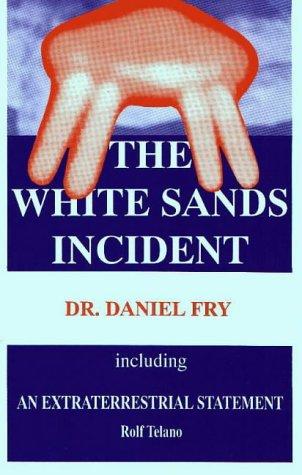
The White Sands Incident
Including An Extraterrestrial Statement — Daniel Fry's Own Account of the Contact That Launched a Sixty-Chapter Organization
Find on Amazon →As an Amazon Associate, OverClassified may earn from qualifying purchases made through this link, at no extra cost to you.
Why This Is Essential Reading
Read it as a primary source and nothing else. The White Sands Incident is where the Daniel Fry claim exists in its original form — the hot hull, A-lan the remote operator, the eight-thousand-mile-an-hour round trip to New York, the magnetic propulsion lecture, the Atlantean genealogy — and every later account is a summary of it. Fry volunteered for a televised polygraph within months of publication and was found 'definitely deceptive'; polygraphy is genuinely unreliable and his objection to it has real force, but he then changed the date of the encounter itself a decade later without explanation, and that is not a problem any amount of argument about lie detectors can repair. Even Timothy Good, reading sympathetically, thought Fry's later film looked like a suspended model. Read it to see the founding contactee formula stated in full by one of its more technically fluent practitioners, and read this site's case file for why it is stamped Debunked.
Related Cases & Theories
Sources Cited
- Fry, Daniel W. The White Sands Incident, Including An Extraterrestrial Statement (with Rolf Telano). First published 1954; reprint edition ISBN-10 1881852008 / ISBN-13 9781881852001. amazon.com
- Google Books record, The White Sands Incident by Daniel W. Fry and Rolf Telano — bibliographic data. books.google.com
- BetterWorldBooks listing, The White Sands Incident Including an Extraterrestrial Statement, ISBN 9781881852001 — independent bibliographic confirmation. betterworldbooks.com
- AbeBooks first-edition record, The White Sands Incident [including An Extraterrestrial Statement] — edition history. abebooks.com
- danielfry.com, "Polygraph Test?" — the estate/foundation site's own account: the June 1954 Sunday broadcast of Paul Coates' Confidential File, operator Chris Gugas' finding that 'Mr. Fry HAS BEEN DEFINITELY DECEPTIVE,' and Fry's defence that the polygraph 'does not indicate truth or falsehood, but merely records the physiological reactions.' danielfry.com
- Wikipedia, "Daniel Fry" — biography, the White Sands employment, the 1954 publication, the failed polygraph, and the 1955 founding of Understanding, Inc. and its newsletter. en.wikipedia.org
- AbeBooks author search results for Daniel Fry, The White Sands Incident — the full edition and printing history across the book's several reissues. abebooks.com
- National Research Council, The Polygraph and Lie Detection (National Academies Press, 2003) — the standing scientific assessment of polygraphy's reliability, which bears on both sides of the 1954 Confidential File episode. nap.nationalacademies.org
- Shepherd, "Why read The White Sands Incident?" — an independent summary of the book's content and claims. shepherd.com
- Good, Timothy. Alien Base: Earth's Encounters with Extraterrestrials, 1998 — source of Fry's own explanation for his changed encounter date, and of Good's independent assessment of Fry's 1964 Oregon film as resembling a suspended model. OverClassified breakdown
- Adamski, George, and Desmond Leslie. Flying Saucers Have Landed, 1953 — the contactee template Fry's book follows. OverClassified breakdown
- OverClassified case file, The Daniel Fry / White Sands Contact — source for the Aerojet General employment, the July 4 date dispute (1950 in every printed edition versus the 1949 Fry later gave), the 'it's still hot' warning, A-lan's remote operation from a mothership nine hundred miles up, the claimed 8,000 mph round trip to New York, the magnetic-propulsion and Lemuria/Atlantis content, the failed televised polygraph, Understanding Inc.'s 1959 accounting of sixty-plus chapters and roughly 1,500 members, and this site's Debunked assessment.
- OverClassified case file, Coyame, Mexico UFO Crash Claim — the Disputed-versus-Debunked comparison discussed above.
Have corrections, additional research, or peer-reviewed sources? Help improve this entry.
Suggest an Edit