
Alien Base
Earth's Encounters with Extraterrestrials
Core Thesis
Alien Base: Earth's Encounters with Extraterrestrials is the third book in Timothy Good's informal trilogy that began with Above Top Secret (1987) and continued with Alien Liaison (1991), and it makes Good's most extraordinary claim yet: that Earth is not merely visited by extraterrestrial craft but actively used as an operating base by multiple non-human species, some of whom, in Good's account, maintain a persistent physical presence in remote, hard-to-verify locations on and beneath the planet's surface. Structured as a worldwide survey rather than a single-case investigation, the book moves through alleged alien-body retrievals predating Roswell, reports of repairs performed on grounded craft, claimed underwater and underground installations, and encounter narratives spanning 1920 to 1997, before closing on Puerto Rico — where a wave of 1990s sightings, later entangled with the emerging chupacabra legend, forms the book's culminating case for a terrestrial alien base still active at time of writing. This article treats the book's core colonization thesis with the same caution the book's own reviewers, including sympathetic ones, applied at the time: Alien Base represents a marked evidentiary decline from Above Top Secret's document-driven approach toward compiled, largely secondhand testimony and, in places, explicitly mystical source material Good's earlier work never leaned on.
About the Author
Timothy Good's biography — his training as a professional violinist with the London Symphony Orchestra, his 1955 and 1961 reading of Keyhoe and Ruppelt that first drew him into UFO research, and the commercial breakthrough of Above Top Secret in 1987 — is covered in full in this site's own essential-reading breakdown of that earlier book. By 1998, when Alien Base appeared, Good had already published Alien Liaison (1991) and built a reputation, per The Observer's 1987 description, as "Britain's leading UFO researcher" — a status resting, as with his earlier books, on volume of contact and correspondence with military, intelligence, and political sources rather than on academic credentials or peer-reviewed research.
Alien Base marks a documented shift in Good's own method. Where Above Top Secret drew heavily on leaked and declassified government documents, Alien Base relies far more on secondhand contactee and witness testimony compiled from other researchers' files, with comparatively little independent verification of his own — a change a 2020 critical review by blogger and UFO-literature commentator "Arthur" at Fake Geek Boy specifically identifies, writing that "very, very little in the way of research from Good himself" appears in the book compared to his earlier work. The same review also flags Good's use of explicitly mystical source material, including Harvey Spencer Lewis's Rosicrucian writings, as a marked departure from even the loosely-sourced but secular framing of his first two books.
The book's publisher marketing leaned into this shift rather than away from it, describing Alien Base as "the most authoritative and comprehensive account of alien visitation and colonization in the 20th century" and "the culmination of nearly 40 years' research" — language that, per the same critical review, oversells a book whose actual content is compiled testimony rather than Good's own new investigative work. Alien Base nonetheless found a real readership: it reportedly reached No. 4 on the Guardian's own bestseller list on release, evidence that Good's brand from Above Top Secret carried commercial weight independent of this specific book's evidentiary rigor.
Historical Context & Origins
Alien Base arrived in 1998, near the peak of 1990s American UFO-culture visibility — the same decade that produced The X-Files' mainstream popularity, the Roswell 50th-anniversary media coverage of 1997, and a saturated market for "government cover-up" and "alien base" paperbacks. Good's book sits squarely inside that commercial moment: its back-cover promise of "the first convincing photographs of aliens" and "retrievals of alien craft and bodies predating Roswell" is pitched at exactly the audience The X-Files and its imitators had built.
The book's Puerto Rico material connects it to a real, dated regional flap: a wave of 1990s Puerto Rican UFO and cryptid sightings that coincided with, and became culturally entangled with, the first widely reported chupacabra livestock-mutilation cases beginning in March 1995, when eight sheep were found dead and drained of blood near Orocovis. The best-known individual witness account, Madelyne Tolentino's August 1995 description of a bipedal, dark-eyed creature outside her home in Canóvanas, followed within months, and more than 200 chupacabra reports had accumulated across the island by the end of that year alone, several of them (including a November 1995 sighting near the El Yunque rainforest by employees of a nearby U.S. government facility) folding UFO and cryptid elements into the same regional narrative Good's book draws on. Good's book treats these Puerto Rico encounters as evidence for an active alien base rather than examining the chupacabra phenomenon's own separate, better-documented trajectory toward a mundane explanation (a mix of misidentified mangy canids and cultural contagion via sensationalized regional media) that later cryptozoological research converged on. This site's own registered location entries for Aguadilla and the Puerto Rico Trench reflect the same island's disproportionate share of reported USO and coastal UFO activity that Good's book leans on for its colonization argument.
The book's brief, skeptical visit to Dulce, New Mexico situates it within the specific "Dulce Base" rumor-mill that originated with UFO researcher Paul Bennewitz in the early 1980s. Bennewitz, an Albuquerque-based physicist and businessman, became convinced he was intercepting alien communications and, per multiple later investigations, was deliberately fed escalating disinformation by fellow ufologist William Moore and Air Force Office of Special Investigations agent Richard Doty as part of a counterintelligence operation exploiting Bennewitz's own paranoia — a documented episode that ended with Bennewitz's psychiatric hospitalization. Good visited Dulce and, by his own account, found nothing unusual there; the 2020 critical review cited above notes that Good does not connect the site's quiet decline to Bennewitz's institutionalization, nor does he tell readers the underlying Dulce claims trace to a documented disinformation operation rather than independent testimony — a significant omission given how much weight "Dulce Base" claims still carry in later alien-base literature.
Core Arguments & Key Concepts
The book's central and title-defining argument is that Earth hosts persistent extraterrestrial installations — underground, underwater, and in remote surface locations — used by more than one non-human species for purposes ranging from resource extraction to biological study to what Good frames as long-term habitation. This is a substantially stronger claim than the "occasional visitation" framing of most UFO literature, including Good's own earlier books, and the book does not offer physical, chain-of-custody evidence (soil samples, structural remains, verified photographs of an actual installation) to support it beyond witness testimony.
A second major argument concerns unidentified submerged objects (USOs): Good compiles reports from naval personnel describing sonar contacts and visual sightings of craft entering and exiting the ocean at speeds and depths inconsistent with known submarine technology, treating this material as evidence for undersea alien bases specifically rather than merely unexplained oceanic phenomena. This site's own case-file research treats similar naval-testimony USO reports as genuinely unresolved anomalies worth logging on their own terms, without extending them into a colonization claim the underlying sonar/visual data alone cannot support.
A third argument, building on the book's contactee-testimony chapters, is that inconsistencies between different contact accounts (differing physical descriptions of the beings involved, differing stated origins or motives) should be read as evidence of multiple distinct alien species operating on Earth simultaneously, rather than as a signal that at least some accounts are unreliable, confabulated, or influenced by prior contactee literature. The Fake Geek Boy review specifically criticizes this move as inconsistent logic — treating similarity across accounts as corroboration while treating difference as evidence of multiplicity, a framing that can absorb almost any pattern in the data as supporting the thesis.
The book's final major argument, built around its Puerto Rico chapter, is that the mid-1990s wave of Puerto Rican encounters represents the clearest contemporary evidence of an active, ongoing alien base — a claim the book's own reviewers note receives comparatively thin substantive treatment relative to its prominence on the book's back-cover marketing, with the chupacabra angle in particular left largely unexamined as a parallel, separately-explainable regional phenomenon.
Key Cases & Evidence Discussed
This site's own Daniel Fry / White Sands Contact case file cites this exact book directly and substantively: Good is the source, per this site's own research, for the detail that Fry privately told researchers his encounter actually occurred on July 4, 1949, a full year before the 1950 date every published edition of Fry's own book The White Sands Incident states — a discrepancy Fry himself explained, per Good's account, as a deliberate security measure. This site's case file treats that admission as among the strongest evidence available for assessing Fry's overall reliability as a witness.
The same case file also cites Good's direct visual assessment of Fry's 1964 Oregon 16mm UFO film, which Good described as looking "like a couple of lampshades or similarly shaped devices fixed together and suspended with fine twine," with movement that "gives every indication of being a suspended fake" — a skeptical conclusion this site's research flags as carrying particular weight precisely because it came from a UFO researcher broadly sympathetic to extraterrestrial-contact claims generally, not from a professional debunking organization with an institutional incentive to find fraud.
This site's own Popocatépetl Volcano UFO Sightings case file cites this book as context for evaluating — and critically weighing — the "portal"/underground-base framing some researchers have applied to the volcano's own recurring anomalous-light reports, treating Alien Base's broader colonization framework as one interpretive lens among several rather than an established fact.
The book's own extended, if ultimately inconclusive, visit to Dulce, New Mexico connects it to the broader Paul Bennewitz/Richard Doty disinformation episode this site's own research elsewhere on the site (and the historical record generally) documents as a case study in how a single individual's paranoid misinterpretation, deliberately amplified by a counterintelligence operation, can generate UFO-lore claims that persist in the literature for decades after their actual origin is a matter of public record.
Critical Reception & Controversies
The most substantive critical review identified for this book comes from UFO-literature blogger "Arthur" at Fake Geek Boy (2020), who reviewed Alien Base specifically against Good's earlier, more document-driven work and found it wanting: "very, very little in the way of research from Good himself" appears in the book, which instead compiles secondhand contactee testimony; the review specifically criticizes Good's treatment of contactees who admitted to fabricating supporting evidence, noting Good's excuse — that they faked evidence to bolster genuine underlying experiences — strains credulity, since "faking evidence feels like an utterly ridiculous risk to take" for someone with a real story to tell. The same review flags Good's inconsistent evidentiary standard (treating similarities across contactee accounts as corroboration while treating differences as evidence of multiple alien species) as "absolutely incredible" logic, and identifies his uncritical citation of Harvey Spencer Lewis's Rosicrucian writings as a new, more mystically-inflected sourcing standard than his earlier books employed.
The book's Amazon listing carries only a single visible customer rating (3.0 out of 5 stars) as of this article's research — too small a sample to treat as representative of broader reader sentiment, and this article reports it as such rather than implying a meaningful consensus from one data point.
This site's own independent case-file research provides a useful internal check on the book's reliability: where Good's Alien Base is cited directly on this site (the Daniel Fry case file), it is cited specifically for a moment of Good's own skepticism — his blunt assessment that Fry's 1964 UFO film looks like a staged fake — rather than for any of the book's own colonization claims. That pattern is telling: even a book built around an extraordinary central thesis contains individually useful, skeptically-toned observations that hold up on their own merits, separable from the larger framework the book is trying to build around them.
Set against Good's own bibliography, Alien Base is broadly regarded, including by researchers otherwise sympathetic to his work, as the weakest of his major books evidentially — a decline from Above Top Secret's genuine document-sourcing strength toward compiled testimony and, in places, source material (Rosicrucian mysticism) well outside even ufology's own usual evidentiary norms.
Influence & Legacy
On this site specifically, Alien Base functions as a working secondary source in exactly the way its more skeptical passages earn: this site's own Daniel Fry case file relies on Good's direct, quoted assessment of Fry's 1964 film and his account of Fry's own admitted date discrepancy, both load-bearing details in that case file's overall credibility assessment of Fry as a witness — a demonstration that the book's value to careful researchers lies less in its central colonization thesis than in specific, well-documented interview material Good gathered along the way.
The book's Puerto Rico chapter sits at the edge of, without fully engaging, one of 1990s cryptozoology's most consequential episodes: the chupacabra phenomenon's spread from a single 1995 Puerto Rican livestock-mutilation wave into a hemisphere-spanning cultural phenomenon. Alien Base's alien-colonization framing of the same regional moment represents a road not taken by that phenomenon's own later, more mundane consensus explanation, illustrating how the same regional facts can be absorbed into entirely different interpretive frameworks depending on which book a reader encounters first.
Within Good's own career, Alien Base marks a hinge point after which his subsequent books (Unearthly Disclosure, 2000; Need to Know, 2007, also covered on this site) returned to a more document- and testimony-balanced approach closer to Above Top Secret's original method — suggesting Alien Base's heavier reliance on compiled contactee material and mystical sourcing was a specific, not-repeated departure rather than a permanent shift in Good's overall research standard.
The Book
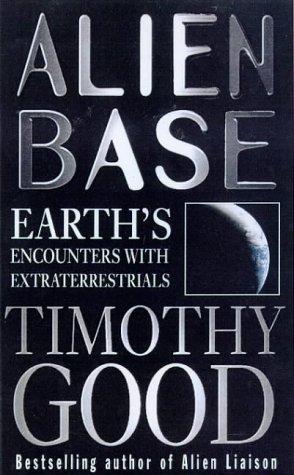
As an Amazon Associate, OverClassified may earn from qualifying purchases made through this link, at no extra cost to you.
Why This Is Essential Reading
Alien Base earns a place in this site's library not as a reliable account of terrestrial alien colonization — its own critical reception, including from researchers broadly sympathetic to Good's earlier work, treats that central thesis as the weakest-sourced claim of his career — but as a working reference this site's own case-file research has already found genuinely useful in a narrower, more honest role: Good's direct, skeptically-toned assessment of Daniel Fry's 1964 UFO film, and his documentation of Fry's own admitted date discrepancy, are exactly the kind of specific, quotable, independently valuable detail that can survive even when the book built around them cannot bear its own central weight. Read it, if at all, the way this site's Daniel Fry case file already does: as a source for individual interview material and Good's own occasional flashes of skepticism, not as evidence that Earth hosts an active extraterrestrial base at Dulce, underwater, or in Puerto Rico.
Related Cases & Theories
Sources Cited
- Good, Timothy. Alien Base: Earth's Encounters with Extraterrestrials. Century, 1998 (Arrow pbk., ISBN-13 9780712683289). amazon.com
- "Alien Base." Open Library (bibliographic record: publisher, publish date, cover art). openlibrary.org
- "Timothy Good Goes Way Off-Base." Fake Geek Boy (fakegeekboy.wordpress.com), August 6, 2020 (critical review of sourcing, logic, and the Dulce/Bennewitz omission). fakegeekboy.wordpress.com
- "Timothy Good." Wikipedia (biography: violinist career, Above Top Secret's 1987 success, Pentagon 1998 visit). en.wikipedia.org
- "Paul Bennewitz." Wikipedia (Dulce Base rumor origin, Richard Doty/William Moore disinformation operation, 1980s psychiatric hospitalization). en.wikipedia.org
- "Chupacabra." Wikipedia (1995 Canóvanas, Puerto Rico origin of the modern chupacabra phenomenon, Madelyne Tolentino's account). en.wikipedia.org
- "Alien Base: The Evidence for Extraterrestrial Colonization of Earth." Goodreads (129 ratings, 17 reviews). goodreads.com
- "Alien Base." Open Library (bibliographic record: 1999 Arrow paperback printing, cover art). openlibrary.org
- This site's own resources library: Full Reading List, where this book is cited across two case-file pages.
- This site's own case file: Daniel Fry / White Sands Contact, for this book's own quoted analysis of Fry's 1964 film and date discrepancy.
- This site's own case file: Popocatépetl Volcano UFO Sightings, for this book's cited use as underground-base context.
- This site's own key-figures entry: Timothy Good, for his full biography and further case connections.
- This site's own essential reading entry: Above Top Secret, for Good's earlier, more document-driven breakthrough book.
Have corrections, additional research, or peer-reviewed sources? Help improve this entry.
Suggest an Edit