
The Popocatépetl Volcano UFO Sightings
On September 7, 1991, residents of Puebla and Tlaxcala began reporting strange lights moving among the slopes of Popocatépetl, the 17,694-foot volcano looming over the eastern edge of the Valley of Mexico. More than three decades later, the sightings have never stopped. Mexico's own government volcano-monitoring agency, CENAPRED, has operated public webcams trained on the crater since January 1995 for the sole purpose of watching for eruptions — and those same cameras have repeatedly recorded luminous, fast-moving, and apparently maneuvering objects entering, circling, and vanishing into the volcano's smoke. Individual incidents have been explained one at a time, as meteors, aircraft, comets, and camera artifacts, by professional astronomers and the agency's own scientists. No comprehensive, agency-wide investigation of the pattern as a whole has ever been conducted, and the case has become one of the most heavily filmed, most publicly accessible, and most contested UFO hotspots on Earth.
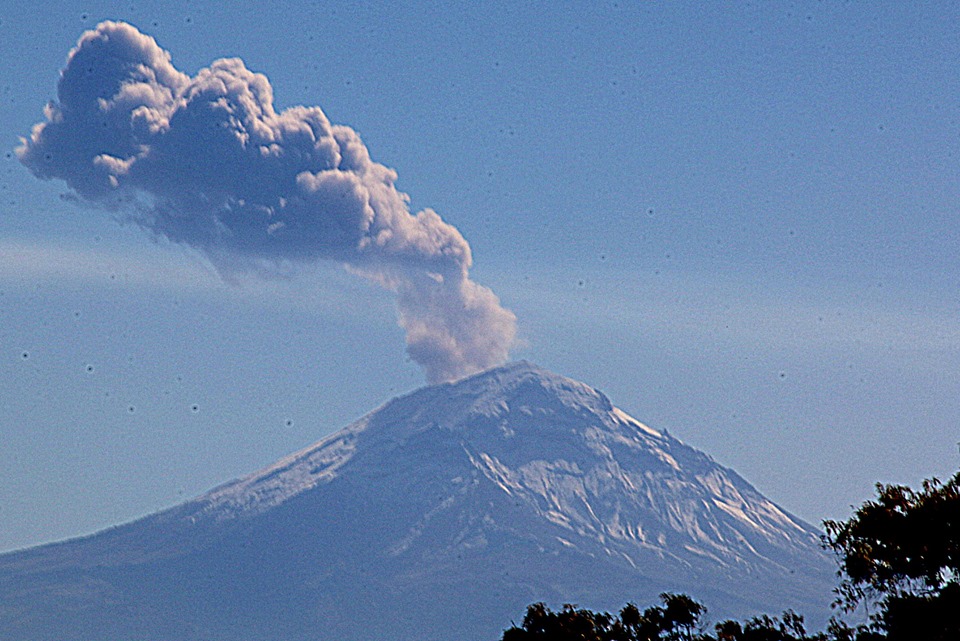
Pictured: Popocatépetl erupting in December 2018, photographed from the eastern side of the Valley of Mexico. This is a real photograph of the volcano itself during a real eruptive episode — not a still from any of the disputed webcam "UFO" clips discussed in this case file. No rights-clear frame grab from CENAPRED's own webcam footage of the specific incidents described below is known to exist in the public domain; the agency's live and archived streams are copyrighted broadcast material, not released for reuse.
Theoretical Alignment
The case aligns most strongly with the Psycho-Social Hypothesis: three decades of confirmation bias, a genuine local folk tradition that already personifies the volcano as a sentient being ("Don Goyo"), and a media ecosystem that amplifies every ambiguous frame of low-resolution night footage. The Interdimensional Hypothesis receives a modest rating almost entirely because of ufologist Jaime Maussan's own "X-points"/portal framing, not because of any instrumented evidence supporting it. The Extraterrestrial Hypothesis is rated lowest of the three: nothing about the footage — no radar correlation, no physical trace, no repeatable morphology — distinguishes it from mundane light sources filmed at night through a heat-shimmering, ash-laden atmosphere.
Background
Popocatépetl — Nahuatl for "Smoking Mountain" — is Mexico's second-highest peak at 5,393 meters (17,694 feet), sitting at the tripoint of the states of Puebla, Morelos, and México, roughly 70 kilometers (43 miles) southeast of Mexico City. Together with its neighboring peak Iztaccíhuatl, it forms the core of the Iztaccíhuatl-Popocatépetl National Park, one of Mexico's oldest protected areas and, for generations, a destination for mountaineers, pilgrims, and sulfur miners who once worked the crater's fumaroles. In local Nahua tradition the volcano is not merely a geological feature but a personified figure, "Don Goyo" (from "Don Gregorio"), whose legend holds that an elderly man calling himself Gregorio Chino Popocatépetl appeared to a peasant near Santiago Xalitzintla, Puebla, and revealed himself as the mountain's living spirit. Every March 12, residents still gather near the volcano to mark "Don Goyo's" saint day with offerings of food, flowers, and liquor, and self-described mediums who claim to communicate with the volcano remain influential figures in nearby communities — a folk tradition of a sentient, watching mountain that predates the UFO reports by centuries and forms an important interpretive backdrop for everything that follows.
Popocatépetl was volcanically quiet for most of the twentieth century. After a period of dome-building activity in the 1920s, it settled into decades of only minor fumarolic venting. That calm is the backdrop against which the first UFO reports emerged: the September 1991 sightings predate any renewed eruptive activity by more than two years. Seismicity, gas emission, and crater-lake temperature only began rising again in 1993, and the volcano's modern eruptive phase is formally dated to December 21, 1994, when a sudden series of phreatic explosions sent ash plumes up to three kilometers into the air after roughly seventy years of relative dormancy. Phreatic explosions continued through the end of 1994 and into 1995, and a pattern of repeated lava-dome growth and destruction beginning in March 1996 has continued, with fluctuating intensity, ever since — at least ninety separate dome-building cycles have been documented over the following three decades. Popocatépetl remains active today, cycling through Mexico's color-coded Semáforo de Alerta Volcánica (Volcanic Traffic Light) at Yellow Phase for most of the period since reactivation, punctuated by periodic explosions, ashfall over Puebla and Mexico City, and airport disruptions.
It was specifically to monitor this reactivated volcano — not to hunt for anomalies — that Mexico's Centro Nacional de Prevención de Desastres (CENAPRED), the federal disaster-prevention agency under the Secretaría de Gobernación, built out a network of remote visual monitoring cameras. The first camera was installed at the Altzomoni station, roughly 12 kilometers north of the summit, by UNAM's Instituto de Ingeniería in January 1995 — barely a month after the December 1994 eruption began. Two further stations, at Tlamacas and Tianguismanalco, were added afterward to cover the volcano's northern and eastern approaches. These cameras, run continuously and streamed publicly (later mirrored by private services including the popular social-media account Webcams de México), transformed Popocatépetl from a remote peak into one of the most continuously filmed volcanoes on the planet — and, inadvertently, into a UFO hotspot with a video archive stretching back three decades.
Complete Timeline
| Date | Event |
|---|---|
| Sept. 7, 1991 | First reported sightings. Residents of Puebla and Tlaxcala, in towns near Popocatépetl and Iztaccíhuatl, report unusual lights moving through vegetation and along mountain routes near their homes — initially folk-framed by some observers as "brujas" (witches) rather than aircraft or spacecraft. Popocatépetl itself is still volcanically dormant at this time. |
| July 11, 1991 | Weeks before the September reports, a total solar eclipse crosses central Mexico. At least seventeen independent camera crews in Mexico City film a metallic-looking object near the darkened sun, launching the "1991 Mexico City Eclipse UFO Wave" and making ufologist Jaime Maussan a national figure just weeks before the Popocatépetl reports begin. (Listed here out of strict date order because it is the essential media/cultural context for what follows.) |
| 1989–1993 | The Atlixco-Metepec UFO boom. Residents of Atlixco and the adjoining village of Metepec, Puebla — roughly 20 minutes from Popocatépetl's western flank — report a wave of nighttime lights. Engineer Norberto Gil Salgado documents a separate roadside optical illusion nearby and names it "Punto Marconi"; Maussan visits and popularizes the site on his television program. UFO fever peaks around 1991–1992 and tapers sharply after 1993, though the site remains a fixture of Mexican ufology. |
| Jan. 1995 | UNAM's Instituto de Ingeniería installs the first permanent visual monitoring camera at the Altzomoni station, ~12 km north of the summit, on behalf of CENAPRED — explicitly to watch for eruptive activity following the December 1994 reactivation, not to search for anomalies. |
| March 1996 | Popocatépetl enters its long-running pattern of dome growth-and-destruction cycles, continuing intermittently to the present day and providing near-constant volcanic backdrop — steam, gas, ash, and incandescent ejecta — against which every subsequent webcam "anomaly" has been filmed. |
| Oct. 25, 2012 (20:43–20:45) | The "giant tube" incident. A Televisa camera at Altzomoni records a roughly two-second clip of a luminous, elongated object — estimated by some observers at up to a kilometer long and 200 meters wide — appearing to enter the crater at a speed exceeding that of an aircraft. None of CENAPRED's three other cameras record anything, and CENAPRED's own seismic network logs no correlating event. UNAM astronomers and government scientists attribute the shape to camera-sensor oversaturation and the object itself to a probable bolide from the overlapping Táurid/Orionid meteor showers, or possibly re-entering satellite debris. |
| Feb. 2013 | Self-described 20-year UFO investigator Salvador Guerrero, filming at the Altzomoni refuge (4,200 m elevation, 10.4 km from the crater) alongside a History Channel crew producing a Latin American UFO series, records a 16-second HD clip of a silvery object that hovers briefly before vanishing behind the volcano. |
| Dec. 2012 – ongoing | Mountaineer Guillermo "Huracán" Vidales begins publicly describing repeated encounters, during high-altitude rescue operations, with extremely tall, thin figures ascending the glacier toward the crater far faster than any climber, and unusual heel-marked prints in the snow — claims that circulate widely in Mexican media over the following decade but are never independently corroborated by a second witness or any photograph. |
| June 9, 2014 | Viewers of the Televisa morning show El Mañanero see what is described as a dark object emerge from volcanic smoke behind the on-air presenter; a separate Webcams de México camera angle appears to capture the same event independently. |
| Jan. 27, 2020 | During two evening eruptions that eject incandescent material and ash columns over 600 meters high, a Webcams de México clip shows a small, fast-moving object crossing behind the volcano in its final seconds. The clip goes viral and #OVNI trends as the second-highest topic on Mexican Twitter; Webcams de México itself publicly identifies the object as a passing airplane. |
| Dec. 3, 2024 | Two separate webcams simultaneously record a glowing, triangular-appearing light ascending near the crater during a fumarole event. Analysts subsequently identify the object as a comet, its apparently triangular shape produced by a rounded coma (the "point" that isn't sharp) trailing a debris tail. |
| Aug. 29, 2025 | Footage from CENAPRED's Altzomoni camera, redistributed by the Webcams de México account, shows several objects moving at high speed around the crater. CENAPRED offers a range of possible conventional explanations — aircraft, research drones, satellite reflections, meteors, or ash-related atmospheric effects — without settling on one. |
| Oct. 1–30, 2025 | A cluster of viral clips, including a time-lapse showing dozens of small luminous points "darting" near the crater and an October 30 clip of a single oval object that hovers and then accelerates away, coincides with a period of 19 recorded low-intensity explosions on October 30 alone. Jaime Maussan publicly revives and expands his claim that the volcano's magnetic activity creates "X-points" — a real NASA term for magnetic reconnection sites in Earth's magnetosphere, borrowed and applied speculatively, without institutional support, to a terrestrial volcano — functioning as an interdimensional "wormhole." |
| Jan. 18, 2026 | A luminous body recorded over the crater generates renewed regional media coverage and social debate, continuing the pattern with no sign of the phenomenon's public interest fading more than three decades after it began. |
The September 1991 Origin, and What It Doesn't Have to Do With the Eclipse
Popular retellings of this case frequently fold the Popocatépetl reports directly into the far more famous 1991 Mexico City Eclipse UFO Wave, as though they were the same event. They were not. The eclipse wave began on July 11, 1991, when Televisa cameraman Guillermo Arreguín and at least sixteen other independent videographers filmed a metallic-looking object near the darkened sun over Mexico City — footage that aired that same evening on anchor Jacobo Zabludovsky's flagship newscast 24 Horas, and which a week later Jaime Maussan re-broadcast on Imevisión's 60 Minutos, generating an estimated 40,000 viewer calls. The Popocatépetl reports proper began separately, nearly two months later, on September 7, 1991, when residents in towns across Puebla and neighboring Tlaxcala — not, as some later summaries have claimed, Morelos — began describing lights moving through vegetation and along paths near the volcano and Iztaccíhuatl. Notably, at least one contemporaneous account frames the phenomenon not in the language of ufology at all, but in older folk terms: certain lights were described by locals as "brujas," witches said to be lurking near homes and land, rather than as spacecraft. This detail matters for an honest accounting of the case: the earliest 1991 reports emerged from a cultural context already primed to interpret unexplained lights supernaturally, months before "OVNI" (the Spanish UFO acronym) became the dominant frame layered onto the same raw observations by the media coverage that followed.
The two 1991 events are nonetheless genuinely connected, just not identically. Mexican residents interviewed decades later — including Rafael Martínez, a longtime resident of Metepec, Puebla, quoted in regional press — describe the two waves as part of one continuous mood: "everything began with the solar eclipse of July 11, 1991, when many cameras captured an object suspended for a good while." The eclipse wave's saturation media coverage, and Maussan's overnight transformation from a general-assignment reporter into Mexico's most recognized ufologist, created both the vocabulary ("OVNI," "aparatos," flying saucers) and the incentive structure (a receptive national audience, a proven path to television airtime) that shaped how the September Popocatépetl reports were framed, investigated, and amplified. Whether the underlying lights near the volcano in September 1991 had any physical connection to whatever was filmed over Mexico City in July remains impossible to establish from the surviving record — no contemporaneous investigator cross-referenced the two — but the cultural throughline, from one national UFO sensation directly into the next, is well documented.
A note on the location claim in the case's own original framing: earlier, less carefully sourced summaries of this case (including an earlier placeholder version of this very entry) described the September 1991 origin point as "Puebla/Morelos." Independent verification for this case file found no primary source placing the September 7, 1991 reports in Morelos specifically; the sources that do exist consistently name Puebla and Tlaxcala. Morelos does share a real administrative border with Popocatépetl on its southern flank, and has generated its own, separate UFO reports over the volcano's more than three-decade modern history — so its broader inclusion in later years' reporting is plausible and likely accurate for the case's ongoing record — but crediting Morelos specifically with the 1991 origin story is not supported by the sources this case file was able to independently verify, and this file corrects that error rather than repeating it.
Punto Marconi and the Atlixco-Metepec UFO Boom
The most concretely documented piece of the early-1990s wave sits not on the volcano's slopes but on a stretch of two-lane highway between Metepec and San Baltazar Atlimeyaya, both small communities within Atlixco municipality, Puebla — roughly twenty minutes' drive from Popocatépetl's western flank, with a clear line of sight to the volcano. Around 1990, engineer Norberto Gil Salgado identified a stretch of road there where automobiles in neutral appear to roll uphill and thrown water appears to run upward — a genuine, well-documented optical illusion caused by the surrounding terrain's gentle grading, not a magnetic or gravitational anomaly, confirmed by later altimeter surveys showing an apparent 80-degree slope variation that is purely visual. Jaime Maussan visited the site around 1990 and gave it the name it still carries: "Punto Marconi," an allusion to the location's supposed electromagnetic character.
Independently of the road illusion, the surrounding area experienced a genuine cluster of nighttime light reports between approximately 1989 and 1993, peaking in intensity around 1991–1992 and falling off sharply after 1993 — the same general window as the volcano's broader reports. Local accounts describe "formas extrañas y luces que cruzaban a través del cielo" ("strange shapes and lights that crossed through the sky"), particularly at night, in the countryside bordering Atlixco and the neighboring municipality of San Juan Tianguismanalco. The area's identity as a UFO destination became permanent rather than a passing 1990s fad: a decommissioned water tank donated by Puebla's Benemérita Universidad Autónoma (BUAP) was converted into a UFO-shaped monument by Chilean artist Ricardo Vivar, weekend performers dressed as extraterrestrials became a fixture for visiting tourists, and in August 2022 Deputy Daniela Mier Bañuelos unveiled a plaque at the monument site marking the 30th anniversary of the "first UFO phenomenon in Metepec," crediting five local figures — Jaime Romero, Norberto Gil, Roberto Sánchez, Carlos Flores, and Ernesto Rubí — as the boom's original chroniclers. Present-day Mexican ufological literature routinely describes Punto Marconi as one of a small handful of the world's most-visited UFO observation sites, though that ranking traces to UFO-tourism promotional material rather than any independent, verifiable census of global sighting locations.
CENAPRED's Cameras and the Modern Webcam Era
Everything that makes the modern Popocatépetl case distinctive — the sheer volume of footage, its 24/7 availability to any internet user, and the fact that a national government agency is the one operating the cameras — traces back to a purely practical decision made in the weeks after the volcano's December 1994 reactivation. CENAPRED's Altzomoni camera, joined over time by additional units at Tlamacas and Tianguismanalco and eventually supplemented by privately-run feeds (most visibly the social-media account Webcams de México, which redistributes both CENAPRED's own imagery and independently-hosted webcams), exists to give scientists, civil-protection officials, and the public continuous visual confirmation of the volcano's activity level: ash columns, incandescent ejecta, dome growth, and steam-and-gas plumes, cross-referenced against the agency's seismic, infrasound, gas-spectrometry, and ground-deformation instrument network.
That same continuous, public, unattended video record — running through the night, in infrared and low-light modes, pointed directly at a source of heat, steam, ash, and intermittent incandescence — has turned out to be close to ideal conditions for generating ambiguous footage. A slope-following insect illuminated by an infrared floodlight, a distant aircraft's strobe light, a satellite catching sunlight at the wrong angle, a bright meteor, or simple video compression artifacts around an overexposed bright point can all appear, in a few seconds of grainy, low-resolution footage, as a fast, "impossible" maneuver. Because the cameras run continuously and unattended, every frame of that ambiguity gets recorded and, given the volcano's built-in viral appeal, widely redistributed — a structural condition this case shares with other long-running, camera-driven "hotspots" such as Australia's Wycliffe Well (see this site's case file) and Norway's Hessdalen Valley (see this site's case file), though unlike Hessdalen, Popocatépetl has never had a dedicated, purpose-built scientific instrument array installed specifically to characterize the anomalous-light phenomenon itself, separate from the volcanic-hazard monitoring the cameras were actually built for.
Notable Webcam Incidents, 2012–2026
Several individual incidents stand out from the broader, harder-to-characterize stream of viral clips because they were specifically, publicly addressed by named scientists or the monitoring agency itself:
- October 25, 2012 — the "giant tube." The case's most rigorously examined single incident. A Televisa camera at Altzomoni recorded roughly two seconds of a luminous, elongated shape — described by some viewers as resembling a "tube" — appearing to descend into or pass near the crater at a speed exceeding that of a conventional aircraft, with some size estimates running as large as a kilometer long. Crucially, of CENAPRED's four cameras monitoring the volcano that night, only Altzomoni recorded anything, and CENAPRED's separate camera at that same station produced a visibly different shape than Televisa's simultaneous recording of the same few seconds — a genuine internal inconsistency that has never been fully resolved. CENAPRED's instrument network recorded no correlating seismic or acoustic event. UNAM's Instituto de Astronomía and the International Astronomical Union attributed the elongated shape to camera-sensor oversaturation from an overexposed point source, with the underlying object most likely a bolide from the overlapping Táurid and Orionid meteor showers, active at the time, or possibly re-entering satellite debris. Mexican astronomer Julieta Fierro, then of UNAM's Instituto de Astronomía, offered a memorably honest assessment of the evidentiary limits at play: "No sabes si cayó ahí, o cayó adelante, o cayó atrás. Igual es una galaxia que está a 20 mil millones de años luz" ("You don't know if it fell there, or in front, or behind. It could just as easily be a galaxy 20 billion light-years away") — not an endorsement of any UFO reading, but a pointed statement about how little a two-second, single-camera clip can actually establish about depth, distance, or scale.
- February 2013 — the Altzomoni HD clip. Self-described UFO investigator Salvador Guerrero, filming from the Altzomoni refuge with a visiting History Channel crew producing a series on Latin American UFO phenomena, captured a 16-second high-definition clip of a silvery object that hovered briefly before disappearing behind the mountain. Unlike the October 2012 incident, no scientific body has published a specific analysis of this clip; it remains an unaddressed data point rather than either a confirmed anomaly or a debunked one.
- January 27, 2020 — identified as an aircraft. During two evening explosions that produced ash columns over 600 meters tall, a small, fast object crossed behind the volcano in the final seconds of a Webcams de México clip. The footage went viral (#OVNI briefly trended as Mexico's second-highest Twitter topic) before Webcams de México itself — the same account that filmed and distributed it — posted a plain, unambiguous correction: "Se trata de un avión. ¡Saludos!" ("It's an airplane. Greetings!"). This incident is a useful corrective against assuming every viral Popocatépetl clip goes uninvestigated or unexplained by its own source.
- December 3, 2024 — identified as a comet. Two webcams recorded the same glowing, triangular-appearing light from different angles during a fumarole event. Analysts subsequently concluded the "triangle" was an optical artifact of a comet's rounded coma trailed by a debris tail, not three discrete points of light on a rigid craft.
- August–October 2025 — still unresolved. The most recent major cluster, including an August 29, 2025 clip of several objects moving rapidly around the crater and an October 2025 wave including a time-lapse of numerous small luminous points and a single oval object recorded hovering and then accelerating away on October 30. CENAPRED, asked directly about the footage, offered a menu of possible conventional causes — aircraft, drones being used for volcanic research, satellite reflections, meteors, or ash-related atmospheric optical effects — without formally committing to any single explanation. This is the most recent point at which the case remains genuinely open in the specific, narrow sense that no named analysis has yet resolved it.
The "Beings" and Ground-Level Claims
Separate from the webcam footage, a smaller and far less substantiated thread of testimony describes humanoid figures on the volcano's slopes. The most frequently cited source is mountaineer Guillermo "Huracán" Vidales, an experienced high-altitude climber involved in mountain rescue work, who has stated in multiple media interviews that he and his rescue team, during operations on the glacier, observed extremely tall (roughly 2 to 2.5 meter), unusually thin figures climbing rapidly toward the crater without any visible cold-weather or climbing equipment, at an elevation and pace Vidales describes as implausible for an unequipped human climber. He has also described unusual footprints in the snow, with heel markings he likened to spurs. Local guide Luis Esteban Soriano, known locally as "El Tlaxquiche," has separately displayed a pre-Hispanic ceramic vessel he interprets as depicting an oval craft with three occupants, framing the volcano's strangeness within a much older, pre-Columbian interpretive tradition rather than a modern extraterrestrial one.
These ground-level claims are treated in this case file with considerably more caution than the webcam footage. Vidales's professional occupation as a mountain rescue climber gives his testimony a baseline of physical credibility that a casual hiker's account would lack — he is, by trade, a trained, repeat observer of that exact terrain under exactly those conditions. But his specific claims about the figures themselves have never been corroborated by a second named witness, a photograph, a video frame, or a physical trace (a footprint cast, for instance), despite decades of intense video-camera coverage of the same mountain. No skeptical investigator or scientific body appears to have directly examined or responded to his specific claims in the way UNAM astronomers responded to the 2012 webcam footage — this thread of the case remains, honestly, folklore-adjacent oral testimony rather than an investigated incident.
Jaime Maussan and the "Interdimensional Portal" Theory
Jaime Maussan's involvement with this case predates the modern webcam era by years: he was the figure who named Punto Marconi in 1990 and who, as Mexico's most visible ufologist since his 1991 eclipse-wave broadcasts, has repeatedly returned to Popocatépetl footage on his long-running program Tercer Milenio. In 2025, amid the October viral cluster, Maussan advanced a specific, named theoretical claim: that the volcano's magnetic activity generates "X-points" — a real term borrowed from NASA's magnetospheric physics, describing sites of magnetic reconnection in Earth's magnetic field where field lines cross and release energy — and that these terrestrial "X-points," supposedly generated by the volcano itself, function as an "interdimensional portal" or "wormhole" through which craft pass. No magnetospheric physicist, volcanologist, or peer-reviewed publication has endorsed this specific application of the term to a terrestrial volcano; NASA's own X-point research concerns reconnection events far above Earth's surface, in the magnetosphere and solar wind, not geological formations. Any reader evaluating this specific claim should weigh it against Maussan's own documented credibility history, detailed at length in this site's 1991 Mexico City Eclipse UFO Wave case file: independently of his real role in popularizing the Popocatépetl case, Maussan has also promoted multiple claims later shown to be hoaxes, including the 2015 "Roswell Slides" (later identified as a 1894 Mesa Verde child mummy display placard), a 2015 "Metepec creature" (identified by UNAM as a shaved monkey), and the September 2023 presentation of alleged "non-human" bodies to the Mexican Congress, which UNAM publicly stated it had never authenticated and which independent anatomical review concluded were fabricated.
Key Witnesses
Jaime Maussan
Named the "Punto Marconi" site near Atlixco around 1990 and, following his central role in the July 1991 Mexico City eclipse broadcasts, has repeatedly featured Popocatépetl footage on his program Tercer Milenio over more than three decades. In 2025 he publicly advanced the claim that the volcano's magnetic activity generates "X-points" functioning as an interdimensional portal for craft — a theory with no institutional or peer-reviewed scientific support. His involvement gives the case sustained national visibility, but his personal credibility is independently and seriously contested: he has also promoted the 2015 "Roswell Slides" (a misidentified museum mummy display placard) and the September 2023 alleged "non-human bodies" presented to the Mexican Congress, which UNAM said it never authenticated.
Guillermo "Huracán" Vidales
An experienced climber involved in mountain-rescue operations on Popocatépetl's glacier who has stated, in multiple media interviews over roughly a decade, that he and his team observed extremely tall, thin humanoid figures climbing the mountain toward the crater at a pace and in conditions he considers impossible for an unequipped human, along with unusual footprints in the snow. His professional occupation lends baseline physical credibility as a trained, repeat observer of the exact terrain in question, but his specific claims have never been corroborated by a second named witness, photograph, or physical trace, despite the mountain's extensive video-camera coverage.
Salvador Guerrero
Described in Mexican press as a UFO investigator with roughly two decades of experience monitoring the skies around Popocatépetl, Guerrero was present at the Altzomoni refuge in February 2013 filming alongside a visiting History Channel production crew when he captured a 16-second HD clip of a silvery object that hovered briefly before vanishing behind the volcano. His specific biographical and professional background beyond this reporting could not be independently verified in additional sources; his account is included here as a documented, named participant in one of the case's specific incidents, not as a professionally credentialed investigator in the way an academic or government scientist would be.
The Five Observables Assessment
Assessment: Objects in the 2012 "giant tube" footage and several later clips appear, on video, to accelerate and vanish abruptly — but "instant acceleration" is speculative here rather than confirmed, because none of these events has ever been cross-checked against radar, infrasound, or any instrument besides the optical camera that recorded it, and multiple examined incidents (the 2012 meteor, the 2020 airplane, the 2024 comet) show that apparent "impossible" motion on a single low-resolution camera is fully explainable by mundane objects at unknown, misjudged distances. Low Observability is rated Present in the narrow sense that objects genuinely do go unrecorded by every camera except one on multiple occasions (as in 2012, when three of CENAPRED's four cameras saw nothing) — though this is at least as consistent with a narrow field of view and inconsistent camera framing as with any deliberate stealth characteristic of the object itself. Hypersonic and Trans-Medium observables are not applicable: no case in this file's record involves confirmed extreme velocity data or any object entering water or another physical medium.
Evidence Assessment
Supporting an Anomalous Pattern
- The recording instrument is not a private citizen's cellphone but a government disaster-monitoring agency's own camera network, run continuously and without any UFO-related agenda, for more than thirty years
- The pattern has genuinely recurred across three-plus decades and multiple independent camera systems and operators (CENAPRED, Televisa, private webcams), not a single source
- At least one incident (October 2012) shows a documented internal inconsistency — two simultaneous cameras at the same station recording visibly different shapes of the same few seconds — that has never been fully resolved
- Several individual clips, including the February 2013 Altzomoni footage and the August–October 2025 cluster, have never received a specific, named scientific analysis or explanation, unlike the 2012, 2020, and 2024 incidents
- Mountaineer Guillermo Vidales's ground-level claims, while uncorroborated, come from a professionally credentialed, repeat observer of the exact terrain
Supporting Conventional Explanations
- Every specific incident that has received rigorous scientific attention (October 2012, January 2020, December 2024) has been assigned a mundane explanation — a meteor/possible satellite debris, an airplane, and a comet, respectively — by named astronomers, meteorologists, or the filming source itself
- CENAPRED's own instrument network — seismic, infrasound, and gas-monitoring sensors specifically built to detect real volcanic and atmospheric events — has never once recorded a corroborating signal for any of the visually "anomalous" incidents
- The cameras run in low-light and infrared modes at night, pointed at a heat source with ash and gas emissions — conditions well documented to produce insect, dust, and lens-artifact false positives on consumer and institutional night-vision equipment alike
- The case's most visible promoter, Jaime Maussan, carries an extensively documented history of promoting hoaxed evidence in other cases, which reasonably lowers confidence in his framing of this one, even though he did not originate the 1991 or 2012 reports himself
- The September 1991 origin reports were themselves initially framed in supernatural folk terms ("brujas"), not ufological ones, suggesting the phenomenon was culturally reinterpreted through a UFO lens after the fact rather than beginning as one
- No physical trace, debris, or radar-confirmed track exists for any incident across the entire thirty-plus-year record
Why "Disputed"
This case earns a DISPUTED classification, not "Debunked," because a genuine residue of unresolved footage remains even after the most rigorously examined incidents are set aside. The October 2012, January 2020, and December 2024 incidents were investigated by name and closed with specific, credible conventional explanations; the February 2013 and August–October 2025 incidents were not, and simply remain unaddressed rather than explained away. A "Debunked" stamp would overstate how much of the archive has actually been examined; a "Credible" or "Verified" stamp would badly understate how thin the evidentiary record is once the folklore, the promotional infrastructure (a UFO monument, a festival, tourist performers), and one repeatedly hoax-associated promoter are set to one side. What is not disputed: sightings genuinely began in September 1991, before the volcano's modern eruptive phase; a real, still-operating government agency has genuinely and repeatedly recorded ambiguous objects on camera since at least 2012; and, thirty-plus years on, no comprehensive scientific study of the pattern as a whole — as opposed to a series of one-off incident responses — appears to have ever been conducted by CENAPRED, UNAM, or any other Mexican scientific institution.
Sensor & Instrumentation Detection Profile
Popocatépetl is one of the most heavily instrumented volcanoes in North America: CENAPRED's monitoring network includes multiple seismometers, infrasound sensors, gas-emission spectrometers (measuring SO₂ and other volcanic gases), GPS ground-deformation stations, thermal cameras, and several visual-light webcams (Altzomoni, Tlamacas, and Tianguismanalco), all cross-referenced continuously to assess eruptive hazard. Despite this dense non-visual sensor coverage, not one seismic, infrasound, or gas-anomaly reading has ever been reported as correlating with any of the visually "anomalous" webcam incidents in this case file — including the October 2012 event, for which CENAPRED explicitly stated no seismic or other instrumented event was registered at the relevant time. Every documented "anomaly" in this case's history has been captured exclusively by an ordinary optical video camera, and even among CENAPRED's own multiple simultaneous camera units, objects are typically recorded by only one camera at a time (as in 2012, when three of four saw nothing) — a pattern equally consistent with narrow, non-overlapping fields of view as with any deliberate evasion of detection.
Environmental & Geospatial Context
Popocatépetl has been continuously active, at fluctuating intensity, since its December 1994 reactivation, meaning virtually every webcam clip in this case's record was filmed against a backdrop of steam, volcanic gas, and intermittent ash or incandescent ejecta — conditions that produce heat shimmer, backlit particulate, and bright, moving light sources (glowing ejecta, illuminated ash and steam plumes) under completely mundane volcanic mechanisms. The region sits within a well-documented meteor-shower corridor for the Northern Hemisphere's autumn sky, with the Táurid and Orionid showers both active during the specific window of the October 2012 incident. The area's high elevation (Altzomoni's camera station alone sits at roughly 4,200 meters) and correspondingly thin, dry, seeing-friendly night air also make it an unusually good vantage point for observing distant aircraft, satellites, and meteors with minimal atmospheric distortion — a double-edged quality that makes both genuine anomalies and mundane misidentifications equally easy to capture with unusual clarity.
Observer Credibility & Occupational Profile
The case's observer pool spans an unusually wide credibility range. At one end: Julieta Fierro, a career UNAM astronomer, UNESCO Kalinga Prize laureate, and one of Mexico's most credentialed science communicators, along with unnamed representatives of Mexico's Academy of Sciences and National Meteorological Service, all of whom offered specific, hedged, non-sensational analysis of the 2012 footage without ever endorsing an anomalous reading. At the other end: Jaime Maussan, a career broadcast journalist with three decades of ufology promotion but also a well-documented history of championing since-debunked hoaxes, and Salvador Guerrero, a self-described independent investigator whose claimed twenty years of monitoring experience could not be independently verified beyond the press coverage of his single documented 2013 recording. In between sits Guillermo Vidales, whose mountain-rescue occupation gives his testimony genuine situational credibility as a trained, repeat observer of the specific terrain, even though his most extraordinary claims — the humanoid figures — remain entirely uncorroborated. CENAPRED itself, as an institution, has consistently avoided sensational framing in every instance where it has been asked to comment directly, favoring ranges of conventional possibilities over firm conclusions either way.
Physical & Material Assays
None exist. Despite more than three decades of reported activity and a government camera network in continuous operation since 1995, this case has produced zero physical debris, zero recovered material, zero soil or trace samples, and zero radar-confirmed tracks. Every piece of evidence in the entire record is optical video, recorded at night, at unknown and unverified distances, through an atmosphere frequently laden with volcanic ash and gas. This absence is itself a meaningful data point rather than an oversight to note in passing: a genuinely physical craft repeatedly entering and exiting a fixed, heavily monitored geographic feature for thirty years without ever leaving a single verifiable physical trace is, at minimum, a pattern any complete assessment of the case has to account for.
Historical Precedents & Archive Matches
Popocatépetl belongs to a recognizable category of long-running "hotspot" cases built around continuous, often camera-driven observation of a single location rather than a discrete incident — a structure this site has also documented at Australia's Wycliffe Well UFO Hotspot (decades of logged sightings at a remote roadhouse) and Norway's Hessdalen Lights (recurring anomalous lights in a valley now monitored by a dedicated, purpose-built research station). The comparison to Hessdalen is instructive specifically because of what Popocatépetl lacks: Hessdalen's decades-long study has produced a real, scientifically-run instrument array (the "Hessdalen Automatic Measurement Station") designed specifically to characterize the light phenomenon on its own terms; Popocatépetl's cameras, by contrast, were built and remain operated purely for volcanic-hazard monitoring, with UFO analysis occurring only reactively, incident by incident, by scientists responding to public pressure rather than as a designed research program. UFO researchers and tabloid coverage have separately asserted broadly similar "volcano UFO" patterns at Mount Etna (Italy), Kīlauea (Hawaii), and various Icelandic volcanoes, though none of those comparisons has been verified in the course of this case file's research and they are noted here only as a claimed pattern, not a confirmed one. Within Mexico specifically, this case's closest genuine precedent is the 1991 Mexico City Eclipse UFO Wave — not because the two events are the same phenomenon, but because the eclipse wave supplied the national media apparatus, the popularized vocabulary, and the same central promoter (Jaime Maussan) that shaped how the Popocatépetl reports, beginning just weeks later, would be told and retold for the next three decades.
Material Analysis
Because no physical sample has ever been recovered from this case, "material analysis" here necessarily means analysis of the video record itself — the only tangible artifact the case has ever produced. The October 2012 incident is the only one to have received a genuine forensic-style visual analysis: astronomers examined the recorded shape, cross-referenced it against CENAPRED's other three cameras (which recorded nothing), checked it against the seismic and gas-monitoring instrument logs (which showed no correlating event), and cross-referenced the date against active meteor-shower calendars (finding an overlapping Táurid/Orionid window). This is a genuine, if narrow, model of how a single incident within a "hotspot" case can be rigorously tested even without any physical sample to examine directly.
What the Video Record Can and Cannot Establish
Every clip in this case's record shares the same fundamental evidentiary limitation: a single, fixed, wide-angle camera, filming at night, at an unknown and unverifiable distance from its subject, cannot by itself establish an object's true size, speed, altitude, or trajectory. Julieta Fierro's 2012 comment about the "giant tube" — that the footage alone could not distinguish an object at the volcano's crater from one far in front of or behind it — applies with equal force to nearly every other clip examined in this case, from the 2013 Altzomoni footage to the still-unaddressed 2025 cluster. Two-dimensional video of a bright point moving against a dark sky is consistent with an enormous range of true distances, sizes, and speeds; without a second simultaneous camera angle, radar cross-reference, or a known reference object in frame, no clip in this archive can be definitively sized, ranged, or clocked.
Supporting Non-Terrestrial or Genuinely Anomalous Origin
- The recurring pattern spans more than three decades and multiple independent, non-collaborating camera operators and witnesses
- At least two well-documented incidents (Feb. 2013, Aug–Oct. 2025) remain formally unaddressed by any named scientific analysis
- The October 2012 incident shows a genuine, unresolved discrepancy between two simultaneous camera recordings of the same event
- The government agency itself has never issued a single dismissive statement covering the phenomenon as a whole, only case-by-case responses
Supporting Terrestrial, Conventional Origin
- Every incident actually subjected to expert analysis has been assigned a specific, named, mundane cause
- No physical trace, debris, or instrumented (radar, seismic, infrasound) corroboration exists for any incident in the record
- Documented false-positive mechanisms — camera-sensor oversaturation, infrared-illuminated insects, meteor showers active during the region's autumn nights, and comets — are independently well established and directly match the described morphology of multiple specific incidents
- The phenomenon's most prominent promoter carries a substantial, independently documented history of endorsing hoaxed evidence in unrelated cases
The Conventional Explanation Candidate (CEC)
No single conventional explanation accounts for the entire thirty-plus-year Popocatépetl record, because the record itself is not one phenomenon but a loose grouping of visually similar but mechanistically distinct events, unified mainly by the location, the camera systems, and the media appetite for "volcano UFO" content. Three genuinely distinct conventional-explanation candidates each account for a meaningful share of the documented incidents.
Ball Lightning & Volcanic Plasma Phenomena
Active volcanoes are known to generate genuine electrical phenomena — "volcanic lightning," produced by charge separation among ash particles and rock fragments during eruptive events, is a well-documented, scientifically accepted phenomenon at Popocatépetl and volcanoes worldwide. Some researchers have separately proposed that plasma-based "ball lightning," a genuine but still poorly understood atmospheric-electricity phenomenon capable of forming stable, glowing, mobile spheres for brief periods, could preferentially form near volcanic vents and fault zones where electrical charge accumulates. This mechanism is physically plausible in general terms and would explain the roughly spherical, glowing appearance of several Popocatépetl clips. However, no specific Popocatépetl incident has ever been instrumentally confirmed as ball lightning — the phenomenon remains difficult to study even in laboratory conditions, and no electrical-field or plasma-diagnostic instrument has ever been deployed at Popocatépetl specifically to test for it during a reported sighting.
Camera Artifacts: Lens Flares, IR-Illuminated Insects & Pixel Saturation
CENAPRED's own scientists explicitly invoked sensor oversaturation to explain the "giant tube" shape recorded in October 2012 — a well-documented phenomenon in which an overly bright point source overwhelms a camera sensor's dynamic range, causing it to "bloom" into an elongated or oversized shape unrelated to the true form of the light source. Separately, infrared and low-light night cameras are extensively documented, across security and wildlife-camera literature generally, to register insects passing near the lens or the infrared illuminator as bright, fast-moving orbs or streaks — the insects' small size and close proximity to the lens combine with the camera's infrared floodlight to produce a bright reflection that the sensor renders as a large, glowing, "impossibly fast" object relative to the distant, genuinely large background (the volcano). Given that Popocatépetl's cameras run continuously, at night, in infrared mode, in an insect-populated mountain ecosystem, and pointed at a heat source that itself attracts airborne insects, this mechanism plausibly accounts for a significant share of the shortest, least distinct "orb" clips in the record, though it has not been specifically confirmed for any single named incident in this case file.
Conventional Aircraft, Drones, Satellites & Astronomical Misidentification
This candidate has the strongest direct evidentiary support of the three, because it is the one actually invoked, by name, for the case's most closely examined individual incidents. The January 2020 object was identified as an airplane by the very account that filmed and distributed it. The December 2024 "triangular" light was identified as a comet, its apparent geometric shape explained by a rounded coma trailed by a debris tail. The October 2012 "giant tube" was attributed to a probable meteor from the overlapping Táurid/Orionid showers, with re-entering satellite debris raised as a secondary possibility. CENAPRED's own response to the August 2025 cluster explicitly listed aircraft, research drones, and satellite reflections among its stated possible causes. Venus and other bright planets/stars, already independently confirmed as the source of the visually similar July 1991 Mexico City eclipse object in this site's separate case file, remain a plausible if unconfirmed candidate for some of Popocatépetl's own stationary or slow-moving "hovering" light reports as well.
Ball Lightning / Volcanic Plasma
InconclusiveA real, scientifically accepted phenomenon that plausibly occurs near active volcanic vents in general, but never instrumentally confirmed for any specific Popocatépetl incident. No electrical or plasma-diagnostic equipment has ever been deployed at the volcano to test for it during a reported sighting.
Camera Artifacts (Lens/Insect/Pixel Saturation)
Highly PlausibleExplicitly invoked by CENAPRED's own scientists for the case's single most rigorously examined incident (Oct. 2012) and independently well-documented as a cause of similar "orb" footage on infrared night cameras generally. Most consistent with the shortest, least distinct clips in the archive.
Aircraft, Drones, Satellites & Astronomical Misidentification
PlausibleThe candidate with the strongest direct, named evidentiary support: confirmed by the filming source itself for the Jan. 2020 incident, confirmed as a comet for the Dec. 2024 incident, and the leading hypothesis (meteor/satellite debris) for the Oct. 2012 incident.
Related Cases
Official Records & Live Monitoring
Official federal disaster-prevention agency page for the institution that has operated Popocatépetl's public monitoring webcams since January 1995. This case is a Mexican civil-monitoring matter, not a classified or FOIA'd U.S. military record; CENAPRED's own reporting is the closest primary-source equivalent.
PUBLIC (government of Mexico)Example of CENAPRED's recurring official daily volcanic-activity report format, published through the Secretaría de Gobernación's gob.mx portal — the same reporting channel used for the agency's statements on specific webcam incidents.
PUBLIC (government of Mexico)Search Government & Scientific Archives Directly
Further Reading — Recommended Literature
UFOs Over Mexico!: Encounters with Unidentified Aerial Phenomena
An updated English translation of the Mexican researchers' original Spanish-language survey, compiling fifty years of Mexican aviation-related UFO incidents, many with radar confirmation and direct pilot testimony — essential background for the broader Mexican ufology context this case sits within.
The UFO Hotspot Compendium: All the Places to Visit Before You Die or Are Abducted
A MUFON-sourced travel guide to 35 of the world's most persistent UFO observation sites, covering the "hotspot" phenomenon — a repeatedly-filmed or repeatedly-witnessed location rather than a single dated incident — that Popocatépetl exemplifies.
Alien Base: Earth's Encounters with Extraterrestrials
A veteran British ufologist's survey of claims that extraterrestrial forces maintain terrestrial bases, including underground and geologically-anchored locations — useful context for evaluating (and critically weighing) the "portal"/underground-base framing some researchers have applied to Popocatépetl.
Mexico's Roswell: The Chihuahua UFO Crash
A detailed investigation of a separate, specific 1974 Mexican UFO-collision case, useful as a contrasting example of a single-incident Mexican case file against which this volcano's decades-spanning, camera-driven "hotspot" pattern can be compared.
UFOs and Aliens (Mysteries, Legends, and Unexplained Phenomena)
A general reference encyclopedia covering major UFO cases, hotspots, and phenomena categories worldwide, useful for placing Popocatépetl's specific mechanisms — camera artifacts, ball lightning, meteor misidentification — within the broader documented UFO literature.
DISCLOSURE: Some links above are affiliate links. If you purchase through them, OverClassified receives a small commission at no additional cost to you. This helps support independent research.
Essential Viewing
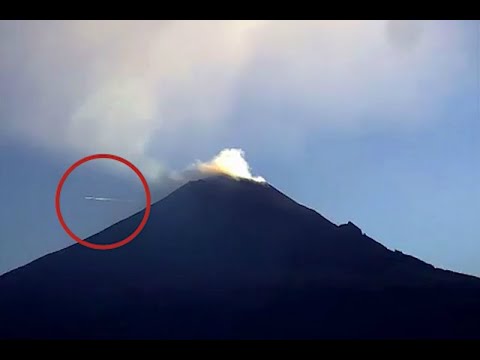
Captan supuesto OVNI en cercanías del Popocatépetl
Report from El Universal, one of Mexico's leading national newspapers, on a webcam-recorded object near the volcano.
Captan supuestos OVNIS en el Popocatépetl
Short-form report from Excélsior, another major Mexican daily newspaper, on webcam-recorded objects near the crater.
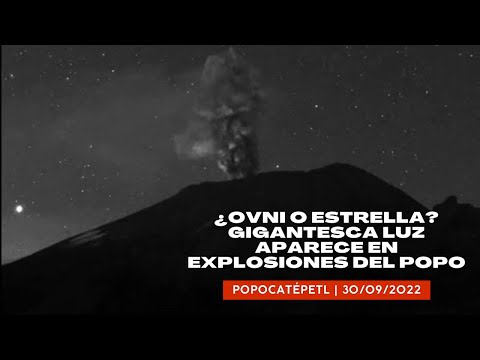
¿OVNI? Luz Gigante Durante Explosiones del Volcán
Raw footage directly from the Webcams de México channel — the same monitoring service that films and redistributes the majority of this case's viral clips — showing a bright light during a volcanic explosion event.
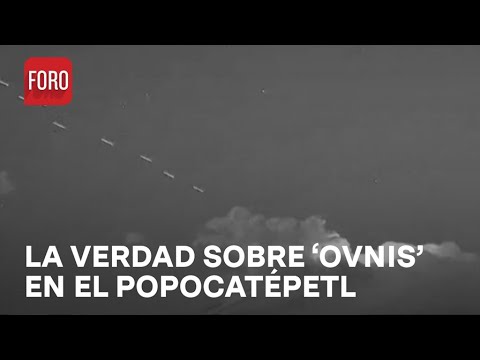
¿Ovnis salen del volcán Popocatépetl? Científico explica la verdad
NMás news segment presenting a scientist's skeptical, conventional explanation for the volcano's viral "UFO" footage — a useful counterweight to the raw sighting clips above.
Sources
- El Universal (Puebla). "Expediciones, accidentes y hasta OVNIs se han visto alrededor del Popocatépetl." eluniversal.com.mx
- e-consulta.com. "Volcán Popocatépetl: Más de tres décadas de avistamientos de ovnis," Jan. 11, 2023. e-consulta.com
- e-consulta.com. "Fenómeno OVNI en Puebla: reavivan avistamientos en Atlixco," Aug. 26, 2023. e-consulta.com
- Mexico Daily Post. "UFOs? This is what we know about the lights seen over Popocatépetl," Aug. 29, 2025. mexicodailypost.news
- Almanaque Revista. "Develan placa a 30 años de primeros avistamientos OVNI en Metepec." almanaquerevista.com
- Milenio. "Punto Marconi en Puebla: lugar para observar ovnis y fenómenos ópticos." milenio.com
- El Universal (Interactivo). "10 Años de Enigmas: Popocatépetl," Yohanan Díaz, 2018. interactivo.eluniversal.com.mx
- Mexico Unexplained. "Mexican Volcanoes, UFOs and Strange Humanoids." mexicounexplained.com
- Mexico News Daily. "Mexico attracts people not only of this world, but from outer space too." mexiconewsdaily.com
- Sopitas.com. "Cenapred aclara el misterioso caso del 'tubo gigante' que cayó en el Popocatépetl," Nov. 2012. sopitas.com
- El Universal (archive). "Captan a objeto 'entrando' a cráter del Popocatépetl," Oct.–Nov. 2012 (quotes Julieta Fierro, William Lee, Raúl Rivera). archivo.eluniversal.com.mx
- iHeartRadio / Coast to Coast AM. "Glowing Triangular UFO Spotted Flying Near Mexican Volcano," Dec. 10, 2024. news.iheart.com
- NMás. "¿OVNI en el Popocatépetl? Captan en Video Extraña Luz sobre el Volcán," Dec. 2024. nmas.com.mx
- Infobae México. "La verdad detrás del video del supuesto OVNI que apareció tras la explosión del Popocatépetl," Jan. 28, 2020. infobae.com
- El Siglo de Torreón. "¿Qué hay en el volcán Popocatépetl? Harvard opina sobre los avistamientos 'Ovni'," 2024. elsiglodetorreon.com.mx
- Lomas, T., Case, B., & Masters, M.P. "The Cryptoterrestrial Hypothesis: A Case for Scientific Openness to a Concealed Earthly Explanation for Unidentified Anomalous Phenomena." Philosophy and Cosmology, Vol. 33 (2024). ispcjournal.org
- NewsTarget. "Mexico's Popocatépetl volcano: UFO hotspot or interdimensional portal?," Oct. 6, 2025. newstarget.com
- The Week. "Mexico volcano 'a wormhole' for aliens." theweek.com
- El Universal Puebla. "FOTO. Captan OVNI sobre el volcán Popocatépetl desde Atlixco." eluniversalpuebla.com.mx
- Global Volcanism Program, Smithsonian Institution. "Popocatepetl (Mexico) — December 1994 Report." volcano.si.edu
- Global Volcanism Program, Smithsonian Institution. Popocatépetl volcano profile. volcano.si.edu
- CENAPRED / Secretaría de Gobernación. Official volcano monitoring reports (gob.mx). gob.mx
- France 24. "'Don Goyo's angry': the legends behind rumbling Mexican volcano," May 27, 2023. france24.com
- Mexico News Daily. "Popocatépetl volcano: central Mexico's volatile guardian." mexiconewsdaily.com
- Fundación UNAM. "Julieta Fierro, la astrónoma que deseaba ser cirquera." fundacionunam.org.mx
- El Financiero. "Muere Julieta Fierro, astrónoma de la UNAM, a los 77 años," Sept. 19, 2025. elfinanciero.com.mx
- Wikimedia Commons. Photograph of Popocatépetl erupting, Dec. 2018 (photographer: Chilangabacho), CC BY-SA 4.0. commons.wikimedia.org
See something inaccurate? Have additional information or sources?
Suggest an Edit →Last Updated: August 2026