
The UFO Hotspot Compendium
All the Places to Visit Before You Die or Are Abducted — Thirty-Five Sites, Treated as a Travel Guide Rather Than an Argument
Core Thesis
The UFO Hotspot Compendium is a travel guide, and it should be assessed as one. Craig Campobasso takes thirty-five UFO-related sites — Skinwalker Ranch, Area 51, Joshua Tree, MUFON's top twenty-five locations for reported sightings, a run of roadside kitsch, some sacred-retreat destinations, and several places he suggests the reader should know about rather than visit — and gives each the when, the where, the backstory, the investigative history and a list of things to do on arrival. The site material is drawn from MUFON investigators, from interviews with experiencers, and from the author's own travel. As a practical guide to going to these places it is the best thing available. As a source on what happened at them it repeats the received version of every story, and that is the distinction a reader has to hold.
About the Author
Craig Campobasso came to this subject from film rather than from research. He began in the entertainment industry at fifteen, worked behind the scenes on David Lynch's Dune and on Arnold Schwarzenegger pictures including Conan the Destroyer and Total Recall, moved into casting on Steven Spielberg's Amazing Stories, and received an Emmy nomination for outstanding casting on David E. Kelley's Picket Fences.
He describes a spiritual awakening at twenty-six as the origin of his writing, which produced The Autobiography of an ExtraTerrestrial Saga, originally a four-part series. His other nonfiction is The Extraterrestrial Species Almanac, a taxonomy of reported non-human beings, and this volume.
The film work matters for how the book reads. Campobasso also directed, wrote and produced the short film Stranger at the Pentagon, adapted from Frank Stranges' book about the claimed Venusian visitor Valiant Thor, which won science-fiction prizes at the Burbank and WorldFest Houston festivals. That is contactee material of the most traditional kind, and it locates the author's orientation precisely: he is inside the experiencer and exopolitics tradition rather than the investigative one.
The practical consequence is a book with excellent production values and no evidential filter. Campobasso is a professional storyteller who has visited many of these places, talked to people there, and organised the material clearly. He is not assessing whether the stories are true, and he does not claim to be.
His sourcing is better than the genre's average, and this should be credited. The site material draws on MUFON's trained field investigators and on MUFON's own sighting-density rankings, which means the selection of locations is grounded in an actual reporting database rather than in reputation alone. That is a real methodological choice and it is the book's strongest feature.
Historical Context & Origins
UFO tourism is a real industry and it is older than most people assume. Roswell has run a festival since 1996; the Extraterrestrial Highway in Nevada was designated in the same decade; Marfa built a public viewing platform for its lights; and Skinwalker Ranch has moved from a private research property to a television production and a paid-access destination. A guidebook was a commercially obvious idea by 2022.
What made it newly viable was the post-2017 shift in the subject's standing. The New York Times reporting on AATIP, the release of Navy sensor video, the 2021 preliminary assessment and the subsequent congressional hearings moved UFOs from stigma to mainstream curiosity, and a mainstream publisher — Red Wheel Weiser through its Hampton Roads imprint — could put out an accessible site guide to a general audience.
The MUFON top-twenty-five framing is the book's most defensible organising device. MUFON runs the largest civilian sighting database in the United States, its case reports are filed by trained field investigators, and ranking locations by report density is a legitimate use of that data. It says nothing about what causes the reports, but it does identify where they cluster.
That said, report density measures reporting rather than phenomena, and a guidebook built on it inherits every bias in the underlying data: population, road access, existing local reputation, the presence of an active MUFON chapter, and the feedback effect by which a known hotspot generates more reports because more people are looking. The book does not raise this.
The sites themselves span the full range of the subject's credibility. Hessdalen in Norway has hosted an instrumented scientific field station for decades and has produced peer-reviewed papers. Marfa has a partial and well-documented conventional explanation in vehicle headlights on a distant highway, with a residue that predates the road. Skinwalker Ranch is a private property with a television contract and no published data. Dulce is a rumour with a documented origin in the disinformation fed to Paul Bennewitz.
A guidebook that treats those four as members of a single category is doing something a reader needs to notice. They are not comparable, and the differences between them — instrumented study, partial explanation, commercial exploitation, deliberate fabrication — are the most interesting thing about the set.
The kitsch material is a genuine part of the story and the book is right to include it. Roadside museums, alien-themed diners, the Nevada highway signage and the Roswell gift trade are how the phenomenon actually exists in American public life, and a guide that covered only the serious sites would misrepresent what a traveller will find.
Core Arguments & Key Concepts
These places can be visited and the practical information is worth having. The book's actual purpose and its real contribution. Access, seasons, nearby towns, what is on public land and what is not, what the local reception is like, what there is to do besides watch the sky. Nobody else has assembled this, and it is genuinely useful.
MUFON's sighting-density data is a legitimate basis for selecting locations. Grounding the top twenty-five in an actual case database rather than in folklore is the right methodological instinct and distinguishes this book from the many that simply list famous places. The limitation — that density measures reporting, not phenomena — is real and unaddressed.
The kitsch and the serious belong in the same book because they belong to the same phenomenon. An implicit argument and a defensible one. The cultural life of the subject — museums, festivals, highway signs, gift shops — is a real and studiable thing, and a guide that included only the instrumented research sites would give a false picture of what the American UFO landscape is.
Experiencer testimony gathered on site is the book's primary material. Campobasso interviewed people at these locations and reports what they told him. As ethnography of what local communities believe about their own hotspots this has value. As evidence about events it has essentially none, and the book does not distinguish the two uses.
The weakest feature is the absence of any evidential hierarchy across thirty-five sites. Hessdalen's instrumented data, Marfa's documented headlight explanation, Skinwalker's unpublished television research and Dulce's traceable disinformation origin are presented in the same format at similar length. A reader learns where to go and learns nothing about which of these places has ever produced anything worth examining.
The Dulce material is the clearest example of the problem. The underground-base story has a documented origin in fabricated material supplied to Paul Bennewitz by Air Force counterintelligence in the early 1980s. A site guide that recounts the legend without recording that it was manufactured is passing on a known disinformation product as local colour.
The author's contactee orientation shapes the selection more than the book admits. Sacred-retreat destinations and sites significant to the experiencer community appear alongside the sighting-density locations without the reader being told that these are two different kinds of criterion. A traveller following the book will visit several places whose UFO significance is entirely a matter of what a particular community believes about them.
Key Cases & Evidence Discussed
Skinwalker Ranch, Utah. The Uintah Basin property with a claimed history of anomalous activity, purchased successively by Robert Bigelow and Brandon Fugal and now the subject of a television series. This site's case file covers what has and has not been published from it.
Area 51 and the Extraterrestrial Highway, Nevada. The Groom Lake facility, the perimeter, Rachel and the Little A'Le'Inn — the single most visited UFO destination in the world and the one where the practical access information matters most, since much of the surrounding land is restricted.
Joshua Tree, California. The desert park and the surrounding contactee landscape, including the Integratron and the long tradition of skywatching gatherings that runs back to the Giant Rock conventions of the 1950s.
Marfa, Texas. The lights, the official viewing platform, and the substantial published work attributing most observations to vehicle headlights on US Route 67 — with a residual set of reports predating the highway. Covered in this site's case file.
Hessdalen, Norway. The valley with an automated instrumented observation station operating since the 1980s, the only site on the list subject to continuous scientific monitoring and the source of actual published measurements. This site's case file covers the research programme.
Rendlesham Forest, Suffolk. The December 1980 events near the twin American air bases, now marked by a waymarked forest trail with interpretive signage — the clearest instance of a contested case becoming an official tourist amenity. See this site's case file.
Dulce, New Mexico. The claimed underground joint human-alien facility beneath Archuleta Mesa, whose origin in material fabricated for Paul Bennewitz by Air Force counterintelligence is documented and which the book recounts without that context.
The MUFON top twenty-five. The sighting-density ranking drawn from MUFON's case database, which supplies the book's spine and is its most defensible selection criterion.
The kitsch circuit. Roadside museums, alien-themed businesses, festival towns and highway signage — the commercial and cultural infrastructure that has grown around the subject and that a traveller will actually encounter.
Critical Reception & Controversies
The book was published by a mainstream metaphysical-and-general-interest house, received no reviews in the literary or scientific press, and sits on reader platforms with modest ratings from a small number of readers. It has been covered on talk radio and in the podcast circuit, where Campobasso is a regular guest.
It has never been assessed as a research contribution because it does not present itself as one. The publisher's framing is explicitly a bucket-list trip, and the subtitle — all the places to visit before you die or are abducted — announces the register accurately.
The substantive criticism is the one this article has already made: thirty-five sites of radically different evidential standing presented in a single uniform format. A reader who does not already know which of these places has been studied and which is a legend will come away with a flattened picture in which Hessdalen's instrumented station and Dulce's manufactured underground base occupy the same category.
The Dulce treatment is the sharpest instance and worth stating as a specific fault rather than a general one. The origin of the underground-base story in disinformation supplied to Paul Bennewitz is not obscure; it is one of the best-documented episodes in the field's history. Repeating the legend in a 2022 guidebook without it is a real omission.
Against that, the practical material is genuinely good and no one else has done it. Where to go, when, what is accessible, what is private, what the town is like, what else is worth seeing — this is the information a person planning such a trip actually needs, and it is assembled with the competence of someone who has been to many of these places.
The MUFON grounding also deserves more credit than a sceptical reader might give it. Selecting locations by reported sighting density from a real case database is a defensible and unusual choice, and it produces a list that includes several places with no popular reputation at all — which is more interesting than another tour of the famous sites.
The fair placement is straightforward. This is the best available practical guide to visiting UFO sites and it is not a source on what occurred at any of them. Used for the first purpose it works; used for the second it will mislead, and the reader should treat every case summary in it as a starting point requiring verification elsewhere.
Influence & Legacy
The book's contribution is to a genre that barely existed: the serious practical guide to UFO sites. Travel writing about the subject had previously been either journalistic colour pieces or promotional material produced by the destinations themselves, and a 240-page reference organised around a real sighting database is a different kind of object.
It also documents, incidentally and valuably, the state of UFO tourism in the early 2020s — which sites had public access, which had interpretive signage, which had been commercialised, and which had become television properties. That snapshot will be useful to anyone later studying how the subject's cultural infrastructure developed after 2017.
For readers of this site its practical use is as a locations index. Many of the places it covers have their own case files here, and the guide's site-by-site organisation makes it a convenient way to find the geographic entry point into a case — provided the reader then goes to the case file for the evidence.
Its cautionary legacy is about the flattening effect of uniform format. Presenting an instrumented research valley, a partially explained optical phenomenon, a commercially exploited private ranch and a documented disinformation product in the same layout at the same length teaches a reader that they are the same kind of thing. They are not, and the differences between them are the most instructive material the subject has.
The Book
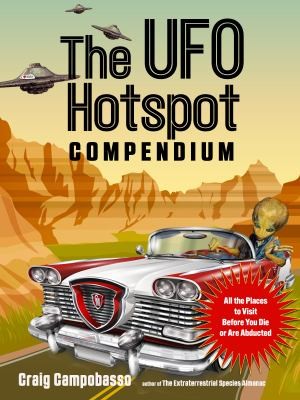
The UFO Hotspot Compendium
All the Places to Visit Before You Die or Are Abducted — Thirty-Five Sites, Treated as a Travel Guide Rather Than an Argument
Find on Amazon →As an Amazon Associate, OverClassified may earn from qualifying purchases made through this link, at no extra cost to you.
Why This Is Essential Reading
Buy it if you are going, not if you are researching. The UFO Hotspot Compendium is a well-made, well-organised practical guide to thirty-five UFO-related destinations, grounded partly in MUFON's actual sighting-density data rather than in reputation, and written by someone who has been to many of them. For access, seasons, local conditions and what else there is to do, it is the best thing available and nothing else is close. Its case summaries are another matter: thirty-five sites of wildly different evidential standing get the same format and the same length, and the Dulce chapter recounts a legend whose origin in fabricated material fed to Paul Bennewitz is documented and unmentioned. Use it to plan the trip, and use this site's case files on Hessdalen, Marfa, Rendlesham and Skinwalker Ranch to know what you are looking at when you get there.
Related Cases & Theories
Sources Cited
- Campobasso, Craig. The UFO Hotspot Compendium: All the Places to Visit Before You Die or Are Abducted. Hampton Roads / Red Wheel Weiser, October 1, 2022. 240 pp. ISBN-10 1590033051 / ISBN-13 9781590033050. amazon.com
- Google Books edition record, The UFO Hotspot Compendium — publisher, October 2022 date, 240-page extent, and the publisher description of the thirty-five sites, the MUFON top-twenty-five sighting locations, the kitsch and sacred-retreat categories, and the sourcing from MUFON field investigators, experiencer interviews and the author's own travel. books.google.com
- Open Library edition record, ISBN 1590033051 — bibliographic verification and cover-art source. openlibrary.org
- Goodreads edition record — edition data, reader ratings, and the description naming Skinwalker Ranch, Area 51 and Joshua Tree among the featured locations. goodreads.com
- Barnes & Noble catalogue record — edition and format verification. barnesandnoble.com
- ThriftBooks catalogue record — independent bibliographic listing. thriftbooks.com
- Coast to Coast AM guest profile for Craig Campobasso — biography, his film and casting career, his Emmy nomination, and his UFO bibliography. coasttocoastam.com
- IMDb profile for Craig Campobasso — his credits on Dune, Conan the Destroyer, Total Recall, Amazing Stories and Picket Fences, and his direction of the short film Stranger at the Pentagon. imdb.com
- Wikipedia, "Mutual UFO Network" — the organisation whose case database and field investigators supply the book's sighting-density rankings and much of its site material. en.wikipedia.org
- Wikipedia, "Skinwalker Ranch" — the Utah property's ownership history, research claims and current status. en.wikipedia.org
- Wikipedia, "Area 51" — the Nevada facility, the surrounding restricted land, and the tourism that has grown around its perimeter. en.wikipedia.org
- Wikipedia, "Marfa lights" — the Texas phenomenon, the official viewing area, and the published work attributing most observations to vehicle headlights on US Route 67. en.wikipedia.org
- Wikipedia, "Hessdalen lights" — the Norwegian valley and the automated instrumented observation station that makes it the only scientifically monitored site on the book's list. en.wikipedia.org
- Wikipedia, "Rendlesham Forest incident" — the December 1980 events and the waymarked forest trail that now interprets them for visitors. en.wikipedia.org
- Wikipedia, "Dulce Base" — the claimed New Mexico underground facility and the documented origin of the story in material supplied to Paul Bennewitz. en.wikipedia.org
- Wikipedia, "Joshua Tree National Park" — the California desert park and surrounding area covered as one of the book's featured destinations. en.wikipedia.org
Have corrections, additional research, or peer-reviewed sources? Help improve this entry.
Suggest an Edit