
The Wycliffe Well UFO Hotspot
A tiny former roadhouse on the Stuart Highway, about 130km south of Tennant Creek and roughly 375–380km north of Alice Springs in Australia's Northern Territory, Wycliffe Well has spent more than four decades marketing itself as "the UFO capital of Australia." The claim rests on a documented, still-corroborated foundation — a visitor sighting logbook whose lineage traces to a WWII-era servicemen's record book, stolen in 1990 and replaced by a new one that ran continuously for over three decades — wrapped in a much thicker layer of commercial promotion, self-mythologizing, and, in the case of a widely repeated "formal RAAF investigation" claim, apparent invention. This file traces the site's own 80-plus-year history as a phenomenon: its origin as an army market garden, its transformation by owner Lew Farkas into a full alien-themed tourist attraction, its decline under later owners, and its abandonment after a catastrophic December 2022 flood left it a vandalized ruin still closed as of this writing.
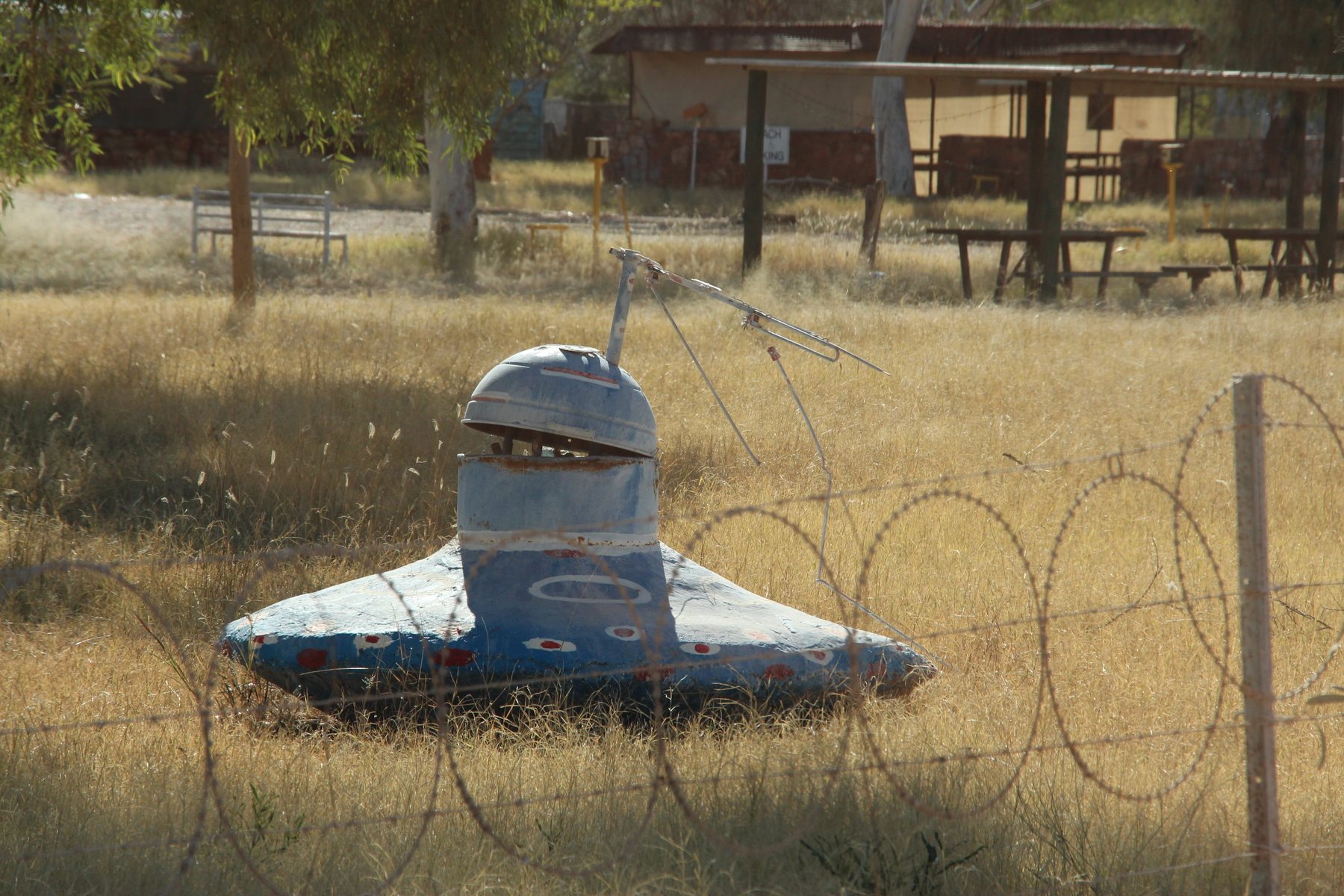
Pictured: one of Wycliffe Well's decades-old UFO-themed roadside sculptures, photographed behind the property's perimeter fencing in 2023, roughly a year after the flood that forced the roadhouse's abandonment. This is a genuine, case-specific photograph of the actual site (public domain, via Wikimedia Commons) — not a reconstruction — showing the attraction's real, present-day derelict condition rather than its 1990s–2010s tourist-boom appearance.
Theoretical Alignment
Wycliffe Well aligns most strongly with the Psycho-Social Hypothesis (PSH): a self-reinforcing folk tradition, actively marketed for commercial gain, in which a real but low-specificity pattern of nocturnal light reports is amplified by expectation, alcohol, tourist volume, and a business model explicitly built around encouraging visitors to look for and report exactly this phenomenon. Nothing in the public record — no radar track, no recovered material, no peer-reviewed instrumented study — supports a strong Extraterrestrial Hypothesis reading, though the sheer duration and volume of independently logged reports across more than 80 years keeps a weak ETH alignment from being dismissed outright. An Interdimensional Hypothesis reading finds essentially no support in any source consulted for this file.
Background
Wycliffe Well takes its name from a well sunk in late 1875, one of four government wells established as watering points along the Old Telegraph Line stock route between Tennant Creek and Alice Springs in Australia's Northern Territory. A grazing license granted in 1917 allowed vegetable cultivation on the site, and by 1939 two local miners were growing produce to sell to nearby wolfram and gold mining operations. In 1941, with the outbreak of the Pacific War and the buildup of Australian and Allied forces along the Stuart Highway corridor supplying Darwin, Wycliffe Well was formally converted into an army farm, remaining in that role until 1945.
It is in this wartime period — a remote staging post on a heavily trafficked military supply road, its population made up almost entirely of transient servicemen — that Wycliffe Well's UFO reputation is said to have begun. According to multiple independent sources, including Amusing Planet's history of the site, servicemen stationed at Wycliffe Well during the war began keeping records of unidentified objects they observed in the night sky, writing their observations in an old binder book kept for the purpose. One specific, though unverified, individual account has been attached to this period: Army transport driver Viv Martin is said, according to an account his son Phil later gave to Australian Geographic, to have seen a small silver craft hovering over a group of Australian soldiers near Karlu Karlu / Devils Marbles, and to have attempted to photograph it, though the object had reportedly vanished by the time he retrieved his camera. No photograph has ever surfaced, and the story reaches the historical record only second-hand, decades later, through a family member rather than a contemporaneous report — it is treated here as an origin anecdote rather than a documented sighting.
What is much better corroborated, appearing consistently across careful, independent sources with no evident financial stake in the claim — Wikipedia, Australian Geographic, and Amusing Planet among them — is that the wartime servicemen's logbook habit became an established local tradition that outlived the war itself. As Stuart Highway traffic increased in the postwar decades and a roadhouse eventually grew up around the old army farm site (a petrol pump was added around 1960, and the roadhouse structure built in the 1960s reportedly reused an old military building slab as its foundation), the practice of keeping a running log of nightly sky-watching observations continued, kept on the counter of the site's small restaurant for any passing traveller to read or add to. This is the direct institutional ancestor of the visitor logbook still associated with the site today, and it is the single best-documented pillar of Wycliffe Well's entire UFO reputation.
Complete Timeline
| Date | Event |
|---|---|
| 1875 | A well is sunk at the site, one of four government wells built as watering points along the Old Telegraph Line stock route between Tennant Creek and Alice Springs. The site takes the name Wycliffe Well. |
| 1917 | A grazing license is granted, enabling small-scale vegetable cultivation at the site. |
| 1939 | Two local miners are cultivating vegetables at Wycliffe Well for sale to nearby wolfram and gold mining operations. |
| 1941 | Wycliffe Well becomes an army farm, supplying troops moving along the Stuart Highway corridor to and from Darwin during WWII. According to multiple sources, servicemen stationed here begin keeping a binder-book log of nightly unidentified aerial sightings — the origin of the site's UFO reputation. An unverified, second-hand family account places a sighting by driver Viv Martin near Karlu Karlu / Devils Marbles in this period. |
| 1945 | The war ends; Wycliffe Well's formal army-farm role ends, though vegetable growing and highway traffic continue. |
| c. 1960 | A petrol pump is installed at the site as Stuart Highway traffic increases. |
| 1960s | A roadhouse building is constructed, reportedly using an old military building slab as its foundation. The servicemen's logbook tradition is maintained by whoever runs the site, kept on the restaurant counter for travellers to read and add to. |
| Late 1980s | A Tennant Times newspaper article on alleged local UFO sightings draws regional and eventually international attention to Wycliffe Well. |
| 1985 | Lew Farkas, a former Royal Australian Navy sailor, purchases the small roadhouse store with his wife and infant son. |
| 1985–c. 2009 | Farkas invests an estimated $4 million over roughly 25 years transforming the stop into an explicitly alien-themed attraction — a landing pad, a 300-seat "Galaxy Auditorium" restaurant, alien murals and statues, a UFO lookout tower, a replica steam train, and what the roadhouse advertised as the largest beer selection in the Northern Territory — branding the site "the UFO capital of Australia." Farkas maintains and promotes the visitor sighting logbook throughout this period. |
| 1990 | The original servicemen's-lineage logbook is stolen from the restaurant counter, reportedly by a visiting tourist. A new logbook is started; unlike the original, it survives and remains in continuous use for more than three decades afterward. |
| 2009–2010 | Farkas sells the roadhouse to Anthony "Arc" Vanderzalm, who continues operating it as a UFO-themed attraction and adds further alien paraphernalia. |
| Early-to-mid 2020s | Vanderzalm sells the property to fuel company United Petroleum, which by most accounts deprioritizes the UFO theming in favor of standard fuel-stop operations. By August 2019, day-to-day management is reported under a group of Indian-Australian entrepreneurs. |
| December 2022 | A catastrophic flash flood strikes the region, forcing evacuation of the roadhouse and caravan park. The site is not reopened afterward. |
| 2023–2024 | The abandoned property is repeatedly vandalized — alien statues decapitated, windows broken, walls stripped, guest rooms and the café ransacked — and suffers structural termite damage (Mastotermes darwiniensis) to its wooden buildings. Photographs from this period (including this file's hero image) document the derelict state. |
| July 2024 | ABC News profiles the site as a "ransacked ghost town," reporting local tourism-industry sources who consider restoration "difficult" given current investment conditions. |
| June 2025 | Australian Geographic reports the site remains closed, with reported UFO sightings in the area having "dropped significantly" since the roadhouse's abandonment — a detail directly relevant to assessing whether the site's reputation reflects an independent physical phenomenon or a tourism-and-attention-driven reporting pattern. |
| Early 2026 | The site remains closed as of the most recent reporting available at the time of this file's research, with no announced restoration timeline. |
The Servicemen's Logbook and the 1990 Theft
The single best-corroborated element of Wycliffe Well's entire UFO reputation is the logbook tradition itself — not any specific sighting recorded in it, but the fact that a running, semi-official record of nightly sky-watching has existed at this location, in some form, for the better part of a century. Independent sources with no commercial stake in the roadhouse's UFO branding — Wikipedia, the travel-history site Amusing Planet, and Australian Geographic's own on-the-ground reporting — converge on the same basic account: WWII-era servicemen stationed at what was then an army farm began keeping written records of unusual aerial observations, the practice persisted informally after the war as the site grew into a highway roadhouse, and a version of that original binder book sat on the restaurant's front counter for anyone passing through to read or contribute to.
That original book was stolen in 1990. Pedestrian.tv's account, based on interviews conducted during a visit to the site, describes it as taken by a visiting tourist, though the precise circumstances of the theft are not documented in any source consulted for this file — no police report, insurance claim, or contemporaneous news article describing the theft has been located. What is well documented is what happened next: rather than treating the loss as the end of the tradition, the roadhouse's operators started a new logbook, and that replacement book remained in continuous use, collecting visitor-submitted sighting reports, for more than three decades — making it, by any reasonable measure, one of the world's longest-running, still-actively-recorded UFO sighting archives at the time of the site's 2022 abandonment. Multiple travel writers who visited Wycliffe Well during its operating years describe this second logbook as physically substantial — "bursting at the seams," in Amusing Planet's phrasing, with hundreds of individual entries and accompanying newspaper clippings pinned up around it.
It is worth being precise about exactly what this corroboration does and doesn't establish. What is well-sourced is the existence, physical continuity, and public visibility of the logbook tradition itself as a real, decades-spanning social and cultural artifact — a genuine phenomenon in its own right, regardless of what any individual entry in it actually represents. What is not independently verified is the content of any specific historical entry, the WWII binder book's own physical survival or examination by any researcher (it disappeared in 1990 and, so far as this file's research could establish, was never photographed, transcribed, or archived before the theft), or any claim that goes beyond "visitors and staff wrote down what they believed they saw." The logbook is real; its evidentiary weight as documentation of any given individual sighting is limited by exactly the same considerations that apply to any uncontrolled, self-selected, non-instrumented visitor log anywhere.
Lew Farkas and the Making of "The UFO Capital of Australia"
Lew Farkas, a former Royal Australian Navy sailor, purchased the small roadhouse store at Wycliffe Well in 1985 together with his wife and nine-month-old son. According to his own account, given years later to Vice, a late-1980s article in the local Tennant Times newspaper about the area's alleged UFO sightings sparked far wider interest than he expected, and Farkas made a deliberate business decision to lean into it completely: "Every aspect of Wycliffe Well had to become alien-oriented or space-oriented," he told the outlet.
Over roughly the next 25 years, Farkas is reported to have invested approximately $4 million developing the site into a full-scale alien-themed tourist attraction. This included a 300-seat "Galaxy Auditorium" restaurant, a designated flying-saucer landing pad, extensive alien-themed murals covering walls and even restroom facilities, life-sized green alien statues positioned around the grounds, a dedicated UFO lookout tower, a replica steam train, and, in one frequently repeated detail, a novelty Incredible Hulk-themed mailbox that won a competition on the Australian television program Burke's Backyard. The roadhouse also advertised what it claimed was the largest range of beer available anywhere in the Northern Territory — a detail multiple visiting journalists have since noted, half-jokingly, as itself a plausible contributing factor to reported sightings among overnight guests. Farkas personally conducted nighttime UFO-watching tours for guests and maintained the visitor logbook throughout his ownership, later describing his own experience to Vice: "lights flashing around the sky doing crazy manoeuvres that you just couldn't explain."
Farkas's own preferred explanation for the phenomenon, as reported by Vice and other outlets, invoked "ley lines" — a non-scientific, pseudo-archaeological concept with no basis in mainstream geophysics or astronomy, originally popularized in 1920s England as a claim about alignments between ancient monuments and later absorbed into New Age and UFO folklore as an explanation for supposedly energetic locations. That an active promoter of the site's UFO reputation, over a 25-year commercial tenure, settled on an explicitly non-scientific framework as his own preferred account is itself a relevant data point for assessing how much of Wycliffe Well's mythology reflects considered analysis of the sighting reports versus marketing-driven storytelling.
Several outlets, including Time Magazine and the Sun Herald according to secondary reporting, ranked Wycliffe Well among the world's leading UFO hotspots during this period, and comparisons to Roswell, New Mexico became a recurring feature of travel journalism about the site. The roadhouse became a genuine, internationally recognized destination on the Stuart Highway — one of relatively few reasons for travellers to stop between Tennant Creek and Alice Springs on an otherwise long, remote drive.
Ownership After Farkas: Vanderzalm, United Petroleum, and Decline
Farkas sold the property around 2009–2010 to Anthony "Arc" Vanderzalm, who continued operating Wycliffe Well as a UFO-themed attraction and, by his own later account, added further alien paraphernalia to the site. Vanderzalm told the ABC he appreciated the property's unique, isolated desert setting, but eventually sold to fuel company United Petroleum. Under United Petroleum's ownership, according to Vanderzalm and other reporting, the UFO theming was noticeably deprioritized in favor of standard highway fuel-stop operations — the company, in Vanderzalm's words, showed comparatively little interest in maintaining the alien branding that had defined the site for a quarter-century. By August 2019, day-to-day management of the property is reported to have passed to a group of three Indian-Australian entrepreneurs, operating within United Petroleum's broader ownership structure.
This ownership trajectory — from a single owner whose entire business identity was built around promoting and personally curating the UFO mythology, through a second owner who maintained but did not originate it, to a corporate fuel operator with comparatively little stake in the theming at all — is itself a useful lens on the site's reputation. Multiple journalists who visited during the United Petroleum period noted a visibly diminished emphasis on the UFO branding compared to the Farkas era, even before the property's ultimate abandonment.
The December 2022 Flood and Abandonment
A catastrophic flash flood struck the region in late December 2022, forcing evacuation of the Wycliffe Well roadhouse and caravan park. The property was not reopened afterward. ABC News, reporting from the site in July 2024, described it as a "ransacked ghost town": alien statues left decapitated, windows broken, interior walls stripped, and guest rooms and the café ransacked by vandals in the roughly eighteen months since the flood. The site's wooden structures also suffered structural damage from Mastotermes darwiniensis, a termite species native to northern Australia capable of severe damage to timber buildings left unmaintained.
Local tourism-industry figures interviewed for the ABC report expressed genuine regret over the closure. Justin Harris, manager of the nearby Devils Marbles Hotel, called the now-abandoned site "a very eerie place." Danial Rochford, CEO of Tourism Central Australia, told the ABC he hoped the property could eventually be restored, but acknowledged the practical difficulty: "The dollars out there for investment are not like they were and so I'd be hopeful but at this stage it is a difficult environment." A former manager quoted in the same reporting was more pessimistic, doubting the site would ever return to its earlier prominence.
Australian Geographic's June 2025 follow-up confirmed the site remained closed nearly three years after the flood, with no announced restoration plan or timeline. That same reporting noted something directly relevant to any assessment of the underlying phenomenon: reported UFO sightings in the area have "dropped significantly" since the roadhouse's closure. A search for more recent coverage found the property still listed as closed as of early 2026, with no indication of reopening. As of this file's research, Wycliffe Well's reported resident population is effectively zero, and the fate of the second visitor logbook — last documented as still in active use before the flood — is not addressed in any source located for this file; whether it survived the flood, the subsequent vandalism, or the site's ongoing abandonment is, as of this writing, unknown.
What the Logbooks Actually Contain: The Nature of the Sightings
No source consulted for this file — including the careful, independent journalism from Australian Geographic, ABC News, and Vice — reproduces detailed individual entries from either the original WWII-lineage logbook or its 1990s-onward replacement. This is itself informative: despite the logbook's decades-long fame as a physical object, no researcher or journalist appears to have systematically catalogued, dated, or cross-checked its contents against other records. What survives in the secondary literature is characterization rather than transcription — descriptions of the book as thick with entries and accompanying press clippings, and of the roadhouse's own promotional framing (Amusing Planet quotes the roadhouse's own marketing line: "UFO sightings are so common, that if you stayed up all night looking, you would be considered unlucky not to see anything, rather than lucky to see something").
The reported sightings themselves, so far as any source describes them, are overwhelmingly nocturnal lights — moving, flashing, or hovering points of light seen against the outback night sky, consistent with the "Nocturnal Lights" (NL) category in J. Allen Hynek's classification system rather than any close-encounter or physical-trace category. No source located for this file describes a landing, a physical trace, an instrumented radar or camera capture, or any recovered material connected to a Wycliffe Well sighting at any point in its history. This is a meaningful evidentiary ceiling: whatever the true rate and cause of genuine anomalous sightings at this location, the entire public record consists of uncorroborated visual reports collected in a self-selected, promotionally encouraged visitor log, with no instrumented cross-check of any kind.
The "Formal RAAF Investigation" Claim, Examined
A specific claim recurs across a cluster of secondary and tertiary UFO-tourism blog articles about Wycliffe Well: that the volume of sightings became significant enough that the Royal Australian Air Force (RAAF) conducted "its own investigation," or that the RAAF "stopped in to investigate." This file's research found this claim in near-identical wording — "There were so many sightings that the Royal Australian Air Force conducted its own investigation" — on at least two low-editorial-oversight travel/UFO blog sites, with no source, citation, date, document reference, or named investigator attached to either version. Neither site offers any indication of where the claim originated.
Critically, the claim is absent from every more careful, independently reported source consulted for this file. Wikipedia's article on Wycliffe Well makes no mention of a formal RAAF investigation. Australian Geographic's dedicated 2025 feature on the site — original on-the-ground reporting by an outlet with an editorial fact-checking process, covering the WWII origins, the Viv Martin anecdote, and the site's current abandoned state in detail — contains no reference to any RAAF investigation at all. Amusing Planet's history of the site, the single most detailed independent account of the servicemen's logbook and its 1990 theft located for this file, likewise makes no mention of a formal RAAF inquiry. ABC News's and Vice's on-the-ground reporting, both drawing on interviews with former owners and current tourism officials, do not reference one either.
One of the few useful framing sentences available comes from a general-interest travel piece describing Wycliffe Well's reputation as attracting "all types" of interest — including noting, in passing and without elaboration, that "even the Royal Australian Air Force has stopped in to investigate." Taken at face value this reads less like a documented formal inquiry with a case file, a report, or a named officer, and more like an informal, undocumented visit — the kind of casual curiosity a famous roadside oddity might reasonably attract from personnel stationed at a nearby base, without constituting an actual air force investigation in any meaningful sense. No source located for this file identifies a specific date, unit, officer, or outcome for any RAAF visit, formal or otherwise, and no Freedom of Information or National Archives of Australia record has been located that documents one. The most defensible reading of the available evidence is that a folk tradition of local sightings, real and long-running in its own right as a documented social phenomenon, has at some point acquired an embellished detail — a formal-sounding "RAAF investigation" — that appears nowhere in the careful reporting and exists only in derivative blog content that echoes earlier undocumented claims rather than citing any primary source.
Consistent with this site's standing editorial policy of substantiating every specific factual claim, this file does not assert that a formal RAAF investigation of Wycliffe Well occurred. The well-corroborated core of the story — the WWII servicemen's logbook, its 1990 theft, and the decades-long, still-actively-recorded visitor archive that followed — stands on its own as a genuine, documented phenomenon and does not require an invented official investigation to be notable. Readers encountering the "formal RAAF investigation" claim elsewhere should treat it as unverified pending the discovery of an actual primary source.
Proposed Explanations for the Hotspot
Across the available reporting, four broad categories of explanation recur for why Wycliffe Well in particular acquired its reputation, ranging from the pseudo-scientific to the frankly self-deprecating:
Geological and "Energy" Theories
Farkas's own preferred "ley lines" framework sits within a broader, non-scientific cluster of explanations reported by travel journalists: claims about the alignment of local landforms, tectonic plates, and man-made structures supposedly generating "UFO-friendly energy." None of these claims are grounded in any peer-reviewed geophysics, and no source located for this file describes any actual geological survey, magnetometer study, or scientific investigation of the area comparable to, for instance, the instrumented research program maintained at Norway's Hessdalen Lights site. A related, equally unsubstantiated variant attributes the phenomenon to the "pulling power" of the massive granite boulders at nearby Karlu Karlu / Devils Marbles Conservation Reserve, roughly 100km to the north — a site of genuine and well-documented Aboriginal cultural and spiritual significance, but one with no established connection to aerial phenomena in any scientific or Aboriginal traditional source consulted for this file.
Proximity to Pine Gap
Some ufologists cited in travel reporting have linked Wycliffe Well's activity to the presence of Pine Gap, the joint US–Australian signals-intelligence facility near Alice Springs. The theory has an obvious surface plausibility — a classified military-intelligence installation is a genuine candidate source of unusual aerial activity or unconventional aircraft elsewhere in the UFO literature — but the geography works against it: Pine Gap sits roughly 375–380km south of Wycliffe Well, a distance that makes any direct visual or overflight connection between the two sites implausible for the great majority of reported ground-level sightings. The theory persists in popular coverage more as an evocative association between "secret base" and "UFO hotspot" than as a geographically coherent mechanism.
Tourism-Driven Reporting and Confirmation Bias
The single most evidentially grounded pattern available is also the most mundane: Australian Geographic's 2025 reporting that sightings dropped sharply once the roadhouse itself closed. If Wycliffe Well's "hotspot" status were an independent physical phenomenon tied to the location itself, sighting reports would be expected to continue roughly unaffected by whether a business happened to be open nearby. That reports instead tracked the roadhouse's own operating status — falling as visitor traffic, active promotion, and the logbook's public visibility fell — is a strong circumstantial indicator that at least a substantial share of the reporting pattern reflects tourism volume, active priming ("stay up all night and you'd be unlucky not to see something"), and self-selected reporting by an audience specifically primed to interpret ambiguous lights as anomalous, rather than a location-intrinsic phenomenon that would persist independent of visitor numbers.
Mundane Aerial and Atmospheric Sources
Pedestrian.tv's own on-the-ground reporting offers the most concretely mundane account: frequent RAAF training flights over the area, and flat, unobstructed desert terrain that allows distant vehicle headlights on the Stuart Highway to remain visible for many kilometers — a combination the outlet suggests "can (if you're drunk and/or really fanging for a UFO sighting) look like unexplained lights in the sky." Standard nocturnal-light misidentification sources common elsewhere in the UFO literature — meteors, satellite flares, aircraft navigation lights, and atmospheric optical effects over the featureless outback horizon — are also plausible contributors, though no source consulted for this file conducted a systematic astronomical or aviation cross-check of specific logged dates.
Key Witnesses
Viv Martin
According to an account his son Phil gave to Australian Geographic decades later, Viv Martin, an Australian Army transport driver active along the Stuart Highway supply corridor during WWII, spotted a small silver craft hovering over a group of soldiers near Karlu Karlu / Devils Marbles and attempted to photograph it, though the object had vanished by the time he retrieved his camera. No photograph has surfaced, and the account is second-hand and posthumous rather than a contemporaneous report. It is frequently cited as an origin point for the wartime servicemen's logbook tradition, though the logbook tradition itself is independently corroborated regardless of whether this specific anecdote is accurate.
Lew Farkas
Purchased the Wycliffe Well roadhouse in 1985 and built its entire "UFO capital of Australia" identity over the following 25 years. Farkas personally maintained the visitor logbook, conducted nighttime sky-watching tours, and reported his own sightings of unexplained lights "doing crazy manoeuvres." As both the site's chief promoter and its most-quoted eyewitness, Farkas occupies a uniquely dual role in this case: a direct observer with sustained, repeated exposure to the local night sky over decades, and simultaneously the person with the strongest financial incentive of anyone connected to the case to characterize what he saw as anomalous. His own preferred explanation — non-scientific "ley lines" — is itself a relevant data point on how the site's promotional and evidentiary narratives were never fully separated during his ownership.
Anthony "Arc" Vanderzalm
Purchased the roadhouse from Farkas and continued its UFO-themed operation for roughly a decade before selling to United Petroleum. Vanderzalm's later, more measured public comments — describing the site's isolated desert setting as its genuine draw, and noting United Petroleum's comparative lack of interest in maintaining the alien branding — provide useful outside perspective on how much of the site's "hotspot" identity was actively curated rather than organically sustained once its most invested promoter had sold on.
The Five Observables Assessment
The Five Observables framework, developed by former AATIP director Luis Elizondo, is used to classify UAP encounters based on performance characteristics that exceed known technology:
Assessment: Because the entire evidentiary record for Wycliffe Well consists of unaided visual reports of distant nocturnal lights with no instrumented tracking, no radar data, and no recovered material, almost none of the Five Observables can be meaningfully assessed. There is no documented case of an object closing distance, accelerating, or maneuvering in a way that was independently measured rather than subjectively estimated by an observer. The single observable that receives even a speculative rating is Low Observability, on the loose basis that logged objects are described as appearing and vanishing from view without an obvious visible flight path back to any conventional source — though this is equally consistent with a light source (a distant vehicle headlight, an aircraft navigation light, a meteor) simply moving behind terrain or out of the observer's field of view. The framework, designed around instrumented military and commercial-aviation encounters, is a poor fit for a decades-long visitor-logbook tradition of this kind.
Evidence Assessment
Supporting a Genuine Anomalous Pattern
- The WWII servicemen's logbook tradition and its 1990 theft are independently corroborated by multiple careful sources (Wikipedia, Australian Geographic, Amusing Planet) with no evident financial stake in the roadhouse's UFO branding
- The replacement logbook remained in continuous, documented use for over three decades, constituting a genuinely unusual, long-running body of self-reported sighting data
- Multiple independent owners and outside journalists across a 40-plus-year span consistently describe the same basic pattern of frequent nocturnal light reports, rather than a single promoter's invented claim
- The site's remote, dark-sky desert location does remove some common urban/suburban light-pollution confounds that affect many other reported hotspots
Supporting a Non-Anomalous (Social/Tourism) Explanation
- No photograph, video, radar return, or physical trace connected to any Wycliffe Well sighting has ever been produced or independently examined
- The site's most prolific promoter and most-quoted witness, Lew Farkas, had a direct, sustained financial interest in maximizing the site's UFO reputation and personally favored a non-scientific "ley lines" explanation
- Reported sightings dropped sharply once the roadhouse itself closed in December 2022, tracking the business's operating status rather than any location-intrinsic phenomenon
- A specific, formal-sounding "RAAF investigation" claim central to the site's popular mythology traces only to unsourced, mutually derivative blog content and is absent from every carefully reported independent source
- Multiple concrete mundane candidates — RAAF/civil flyovers, headlights visible for many kilometers across flat desert terrain, meteors, alcohol, and simple confirmation bias among a primed, self-selected visitor population — are directly documented by on-the-ground journalists rather than merely hypothesized
- No scientific, instrumented study of the site (comparable to the research program at Norway's Hessdalen valley) has ever been conducted
Why "Disputed"
Wycliffe Well receives a DISPUTED classification, with a correspondingly low numeric score, because the case genuinely bifurcates into two very different claims that are too often conflated in popular coverage. The first claim — that a real, documented, decades-long tradition of visitor sky-watching and sighting-logging exists at this specific Northern Territory roadhouse, with a credible WWII origin and a well-corroborated 1990 theft — is not seriously disputable; it is confirmed by multiple careful, independent sources with no shared financial interest in the outcome. The second claim — that this pattern reflects a genuine, location-intrinsic anomalous phenomenon, investigated at some point by the Royal Australian Air Force, worthy of comparison to the world's most significant UFO hotspots — rests on evidence this file's research could not substantiate. The specific formal-investigation claim traces only to unsourced blog content; the site's own sighting rate appears to track its own tourism marketing rather than persisting independent of it; and not a single photograph, instrument reading, or piece of physical evidence has ever emerged from a location that has now been actively promoting itself as a UFO hotspot for more than four decades.
What is not disputed: WWII servicemen at Wycliffe Well kept a logbook of night-sky observations; that book was stolen in 1990; a replacement book ran for over thirty years afterward; Lew Farkas built a genuine, internationally recognized tourist attraction on the strength of that tradition starting in 1985; and the site was abandoned after a real flood in December 2022 and remains derelict as of this writing. What is disputed, and in the case of the formal RAAF investigation claim specifically appears to be unsubstantiated invention layered onto a real folk tradition, is whether any of it points to a genuine unexplained aerial phenomenon rather than a well-documented, self-reinforcing tourism and folklore pattern.
Sensor & Instrumentation Detection Profile
No radar, infrared, magnetometer, or any other instrumented sensor system has ever been deployed at Wycliffe Well to record or corroborate a sighting, in any source consulted for this file. All reported observations across the site's entire 80-plus-year history are unaided naked-eye visual accounts, self-recorded by observers in a handwritten logbook. This stands in direct contrast to hotspot cases elsewhere in the UFO literature that have attracted genuine scientific instrumentation, such as Norway's Hessdalen Lights, where a permanent research station has operated magnetometers, spectrum analyzers, and automated cameras since the 1990s. No comparable scientific infrastructure has ever existed at Wycliffe Well.
Environmental & Geospatial Context
Wycliffe Well sits in the arid Barkly region of Australia's Northern Territory, on flat, sparsely vegetated desert terrain typical of the outback interior. The region's dark, largely light-pollution-free night skies are genuinely favorable for both astronomical observation and, correspondingly, for a higher baseline rate of ambiguous celestial and atmospheric phenomena (meteors, planets, satellite flares, aircraft lights) being noticed by observers who might not see them from a brighter urban sky. The flat, unobstructed terrain also means that distant, ground-level light sources — most concretely, headlights from vehicles on the long, straight stretches of the Stuart Highway — remain visible from many kilometers away, a specific mundane confound documented directly by on-the-ground journalists reporting on the site. The area's remoteness, and the roadhouse's own role as one of the few reasons to stop on a long desert drive, also concentrated a self-selected population of overnight travellers — exactly the audience most likely to be awake, outdoors, and actively looking skyward late at night, primed by the roadhouse's own signage and marketing to interpret what they saw as anomalous.
Observer Credibility & Occupational Profile
The observer population behind Wycliffe Well's sighting record is fundamentally different in character from most case files on this site, which typically center on one or a small number of named, credentialed witnesses (pilots, radar operators, law enforcement, military personnel) whose occupational background can be individually assessed. Here, the record instead comprises hundreds of largely anonymous visitors and roadhouse staff across more than eight decades, with occupational and credibility information available for only a small number of named individuals. Viv Martin's WWII account, while occupationally plausible (a military transport driver would genuinely have been present and alert to unusual aerial activity during wartime), reaches the record only second-hand through a family member, decades after the fact, with no contemporaneous documentation — a combination that substantially limits its evidentiary weight regardless of Martin's own presumed sincerity. Lew Farkas, the most-quoted individual witness, had sustained, repeated nighttime sky exposure over 25 years, which is a genuine credibility asset, but combined it with an equally sustained direct financial interest in the site's UFO reputation and a stated preference for a non-scientific explanatory framework, both of which weigh against treating his characterizations as disinterested testimony. The great majority of the underlying sighting volume comes from unnamed visitors whose individual backgrounds, sobriety, familiarity with the night sky, and viewing conditions are entirely unknown and unrecoverable from the available record.
Physical & Material Assays
No physical material, debris, trace evidence, or recovered object connected to any Wycliffe Well sighting has ever been reported, collected, or analyzed by any source consulted for this file. This is a hard evidentiary ceiling on the case: across more than 80 years and, by the roadhouse's own promotional claims, hundreds of individual sighting reports, not a single physical artifact has emerged for independent examination.
Historical Precedents & Archive Matches
Wycliffe Well sits within a well-recognized international pattern of commercially promoted "UFO hotspot" tourist destinations, most closely comparable in structure (though not necessarily in underlying phenomenology) to sites like Roswell, New Mexico and Marfa, Texas in the United States — places where a real or claimed historical sighting tradition has been actively developed into a tourism draw, with resulting sighting-report volume difficult to disentangle from visitor numbers, marketing, and self-selection effects. Within Australia specifically, Wycliffe Well is the country's most prominent single-location UFO hotspot, distinct in kind from Australia's other well-documented UAP case files — the Frederick Valentich disappearance over Bass Strait, the Knowles family's Nullarbor Plain encounter, the RAAF Williamtown "Operation Close Encounter", and the Tully saucer nests — each of which centers on a single, dated incident with named witnesses and (in Williamtown's case) an actual documented RAAF file, rather than a diffuse, multi-decade visitor-reporting tradition. The contrast is instructive: Williamtown's case file is built on a real, declassified RAAF document trail; Wycliffe Well's popular "RAAF investigation" claim, by comparison, has no such documented trail at all, despite superficially similar framing in popular coverage of both.
Material Analysis
Because no physical material connected to any Wycliffe Well sighting has ever been produced, this section instead addresses the closest available analogue: analysis of the case's own evidentiary "material" — the logbooks themselves, and the broader promotional record built around them.
The Logbooks as Historical Artifacts
The original WWII-lineage binder book, if it survived intact until 1990, would itself have constituted a significant piece of primary-source UFO history — a contemporaneous, multi-decade written record predating the modern UFO era's start (conventionally dated to Kenneth Arnold's June 1947 sighting) by several years. Its theft in 1990, before any researcher appears to have systematically photographed, transcribed, or archived its contents, represents a genuine and apparently permanent loss to the historical record, regardless of what its actual entries would have shown. The replacement logbook, while itself a real and substantial physical object by contemporaneous travel-writer accounts, has likewise never been systematically digitized, dated, cross-referenced against astronomical or aviation records, or deposited with any archive or research institution so far as this file's research could establish. Its current physical fate, following the site's 2022 flood and subsequent vandalism, is unknown.
The Absence of Independent Documentation
No source consulted for this file — academic, journalistic, or governmental — describes any independent researcher having examined either logbook in detail, cross-checked specific dated entries against contemporaneous meteor showers, satellite passes, or aircraft movements, or published any systematic analysis of the reporting pattern beyond general characterization ("bursting at the seams," "hundreds of entries"). This absence is itself analytically significant: a genuinely rigorous UFO hotspot investigation, such as the one conducted at Hessdalen, produces exactly this kind of granular, checkable data. Wycliffe Well's evidentiary record, by contrast, has remained at the level of travel journalism and roadhouse marketing copy for its entire documented history.
Supporting a Genuine Underlying Pattern
- The consistency of the basic sighting-report pattern (nocturnal lights, unusual movement) across more than 40 years and multiple independent owners argues against pure single-promoter fabrication
- The dark, remote desert sky provides genuinely favorable conditions for both real anomalous phenomena and a wide range of ambiguous mundane phenomena to be noticed and reported
Supporting a Non-Anomalous Origin
- Zero physical evidence has ever been produced across the entire documented history of the site
- No researcher has ever systematically analyzed logbook contents against astronomical or aviation data
- The reporting rate tracked the roadhouse's own operating and promotional status rather than persisting independently of it
- The site's own most prolific promoter favored an explicitly non-scientific "ley lines" explanation over any evidence-based account
The Conventional Explanation Candidate: Tourism-Driven Reporting, Light Misidentification, and Folklore
Unlike most single-incident case files on this site, Wycliffe Well has no single conventional explanation candidate tied to one specific date or event. Instead, the available evidence points toward a combination of several genuinely documented, mundane contributing factors operating together over decades — each individually well-supported by on-the-ground reporting, and collectively sufficient to account for the great majority of the site's reputation without requiring any anomalous physical phenomenon.
Commercial Priming and Confirmation Bias
The roadhouse's own marketing directly and explicitly told visitors they would very likely see something unexplained if they simply watched the sky — "you would be considered unlucky not to see anything, rather than lucky to see something," in the site's own advertised phrasing. Decades of psychological research on expectation and ambiguous-stimulus interpretation supports the straightforward prediction that an audience told in advance to expect UFOs, staying overnight specifically because of that expectation, will report seeing UFOs at a substantially elevated rate compared to an unprimed population — regardless of any change in the true underlying rate of anomalous aerial activity. The sharp drop in reported sightings once the roadhouse itself closed in 2022, noted directly by Australian Geographic, is the single strongest piece of evidence for this explanation: a location-intrinsic physical phenomenon should not track a business's opening hours.
Light Misidentification Across Flat, Remote Terrain
Pedestrian.tv's on-the-ground account specifically identifies distant vehicle headlights on the flat, straight Stuart Highway, combined with frequent RAAF training flights over the area, as concrete, observed sources of ambiguous night lights near the roadhouse. Both are well-documented, non-exotic phenomena capable of producing exactly the kind of moving, appearing-and-disappearing light reports that dominate the logbook tradition, particularly when viewed by an observer unfamiliar with how far a single set of headlights remains visible across genuinely flat desert terrain with no intervening obstructions.
The Unsubstantiated "Formal RAAF Investigation" Claim
As detailed above, the specific claim that the RAAF formally investigated Wycliffe Well's sightings could not be traced to any primary source, official record, or careful independent report. Whether this detail originated as an innocent misreading of an informal, undocumented base-personnel visit, or was invented outright at some point in the site's promotional history and then propagated uncritically between low-oversight blog articles, cannot be determined from the available evidence — but its absence from every carefully sourced account is itself the most important single finding of this file's research.
Tourism-Driven Reporting & Confirmation Bias
Highly PlausibleDirectly supported by the documented correlation between the roadhouse's operating status and reported sighting volume, and by the site's own explicit marketing encouraging visitors to expect and look for anomalous lights.
Light Misidentification (Headlights, Aircraft, Meteors)
PlausibleConcretely documented conditions (flat terrain, distant headlight visibility, RAAF training flights) provide a ready mundane source for the great majority of reported nocturnal lights, though no systematic case-by-case cross-check against astronomical or aviation data has ever been conducted.
Genuine Location-Intrinsic Anomalous Phenomenon
UnprovenNo instrumented, physical, or photographic evidence has ever been produced across 80+ years, and the reporting rate's dependence on the roadhouse's own commercial operation argues against a phenomenon genuinely intrinsic to the location itself.
Formal RAAF Investigation (as popularly claimed)
UnsubstantiatedTraceable only to unsourced, mutually derivative blog content; absent from every independently reported, fact-checked source consulted for this file, including Wikipedia, Australian Geographic, and Amusing Planet.
Related Cases
On the Absence of a Documented Investigation
Unlike this site's Australian Mystery Aeroplane Scare of 1918 or RAAF Williamtown "Operation Close Encounter" case files — both anchored by real, citable files held in the National Archives of Australia — no specific National Archives of Australia file, RAAF investigation report, or other government document referencing Wycliffe Well by name has been located for this case. This absence is itself a documented research finding, not an oversight; readers are encouraged to search the archives below directly, and to treat any claim of a specific "RAAF file" on Wycliffe Well as unverified pending discovery of an actual record.
Search Government Archives Directly
Further Reading — Recommended Literature
The Oz Files: The Australian UFO Story
By the first outside researcher granted access to the RAAF's own classified UFO files, this remains the essential general reference for how Australia's air force has (and hasn't) formally engaged with UFO reports — useful context for weighing the unsourced Wycliffe Well "RAAF investigation" claim against how a real RAAF UFO inquiry actually looks on paper.
UFOs Down Under: Australasian Encounters
Thirty individually re-examined Australian, New Zealand, and Papua New Guinean encounters, each checked against witness testimony and newspaper reports — a useful comparison set for assessing how a rigorously investigated single-incident Australasian case differs from Wycliffe Well's diffuse, multi-decade visitor-logbook tradition.
Big Things: Australia's Amazing Roadside Attractions
A tour of Australia's oversized roadside icons — the exact cultural category Wycliffe Well's alien statues and UFO landing pad belong to — offering essential context for the site as a piece of Australian roadside-attraction tourism history, independent of any UFO claim.
Australia's Strangest Mysteries
A broad survey of unresolved Australian outback riddles, from the Frederick Valentich disappearance to lesser-known regional anomalies, situating Wycliffe Well's own folklore within the wider tradition of remote-Australia mystery storytelling this book catalogs.
New Roadside America
The classic guide to America's own UFO-themed and oddball roadside attractions, offering a direct comparative lens on the commercial "UFO tourism" playbook — landing pads, alien murals, visitor logbooks — that Lew Farkas independently applied at Wycliffe Well on the other side of the world.
DISCLOSURE: Some links above are affiliate links. If you purchase through them, OverClassified receives a small commission at no additional cost to you. This helps support independent research.
Essential Viewing

The UFO Capital of Australia: Wycliffe Well
On-the-ground travel coverage of Wycliffe Well during its operating years, touring the alien murals, landing pad, and visitor logbook that defined the roadhouse's UFO tourism identity.
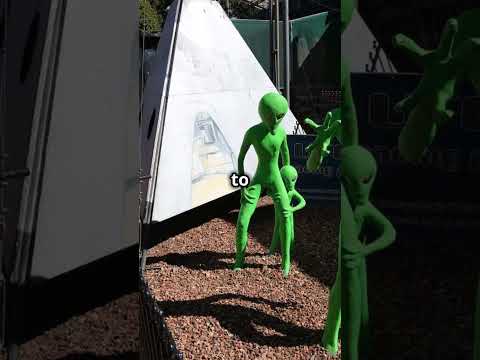
Wycliffe Well: UFO Capital of Australia, Now Abandoned
Post-flood footage documenting the roadhouse's present derelict state — the decapitated alien statues, stripped interiors, and overgrown grounds described in ABC News's 2024 reporting on the site's abandonment.
Sources
- "Wycliffe Well," Wikipedia. en.wikipedia.org
- Tim the Yowie Man. "Wycliffe Well: Australia's outback UFO hotspot," Australian Geographic, June 2025. australiangeographic.com.au
- "Wycliffe Well: The UFO Capital of Australia," Amusing Planet, July 2015. amusingplanet.com
- "How Wycliffe Well went from beloved outback roadhouse to a ransacked ghost town," ABC News, July 22, 2024. abc.net.au
- "The Strange Story of Australia's Outback UFO Capital," Vice, 2019. vice.com
- "Close encounters: We go UFO spotting in the Northern Territory," TNT Magazine. tntmagazine.com
- "UFO Sightings: We Visited Wycliffe Well, The UFO Capital Of Australia," Pedestrian.tv. pedestrian.tv
- "Wycliffe Well is out of this world," Without a Hitch. withoutahitch.com.au
- "Wycliffe Well NT," Exploroz. exploroz.com
- "Wycliffe Well," Discover the Barkly (official Barkly regional tourism page). discoverthebarkly.com
- "Looking Back At Wycliffe Well," UFORQ.org — cited here specifically as one of the uncorroborated sources repeating the unsourced "formal RAAF investigation" claim examined and rejected in this file. uforq.org
- "Discover Wycliffe Well – The UFO Capital of Australia," Erldunda Roadhouse — cited here specifically as a second source repeating the same unsourced RAAF-investigation claim in near-identical wording, with no citation provided. erldundaroadhouse.com
- "Karlu Karlu / Devils Marbles Conservation Reserve," Wikipedia. en.wikipedia.org
- "Karlu Karlu / Devils Marbles Conservation Reserve," Northern Territory Government (Parks and Wildlife). nt.gov.au
- "UPDATE: Fatal crash – Wycliffe Well," NT Police, Fire & Emergency Services newsroom, January 2026 (confirms the site's continued closed/inactive status into 2026). pfes.nt.gov.au
- Category: Wycliffe Well, Wikimedia Commons (source of this file's hero image and other site photography). commons.wikimedia.org
- "Pine Gap," locations entry, OverClassified — background on the joint US–Australian intelligence facility cited in the "proximity" theory for Wycliffe Well's reputation. overclassified.org
- Elizondo, Luis. Public statements and interviews establishing the "Five Observables" framework used throughout this site's case files.
- Hynek, J. Allen. The UFO Experience: A Scientific Inquiry, Henry Regnery Company, 1972 — source of the Close Encounter/Nocturnal Lights classification system referenced in this file's craft-type and observables assessment.
- Chalker, Bill. The Oz Files: The Australian UFO Story, Duffy & Snellgrove, 1996 — general reference on documented RAAF engagement with UFO reports in Australia.
- National Archives of Australia, RecordSearch collection database (searched for, and returning no located record of, a Wycliffe Well-specific RAAF investigation file). recordsearch.naa.gov.au
See something inaccurate? Have additional information or sources?
Suggest an Edit →Last Updated: August 2026