
The Australian Mystery Aeroplane Scare of 1918
Between March and November 1918, roughly 200 ordinary Australians — policemen, schoolteachers, farmers, a headmaster, a decorated fighter pilot — reported seeing aircraft in the skies over New South Wales and Victoria. In the last, most anxious months of the First World War, with Germany's Spring Offensive threatening to break the Western Front, the fear was specific and plausible: that a German commerce raider was launching seaplane reconnaissance — or worse, bombing runs — against an undefended continent. Major-General J.G. Legge, Australia's highest-ranking army officer, ordered the country's first-ever coastal air–sea search. A young, wounded Royal Flying Corps veteran named Charles Kingsford Smith — a decade before he became "Smithy," the most famous aviator in Australian history — spent a night on a Terrigal beach watching for the enemy and filed his own unexplained sighting. The Royal Australian Navy's own file on the affair survives today in the National Archives of Australia. No German aircraft was ever found, because none was ever there.
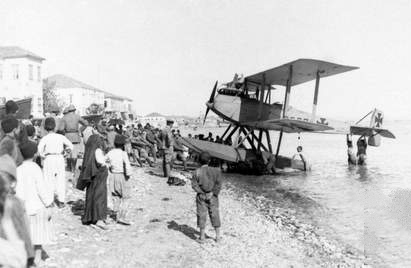
Pictured: a Friedrichshafen FF.33L, the same German naval seaplane type carried aboard the commerce raider SMS Wolf and widely blamed by Australian authorities and the press for the 1918 sightings — this specific photograph, held by the Australian War Memorial, was taken by Australian forces at Beirut in 1917, not in Australian skies. No photograph of an actual enemy aircraft over Australia exists from this episode, because no credible evidence any German aircraft was ever present has ever surfaced; this image illustrates the type of machine the public and military feared, not a document of the case itself.
Theoretical Alignment
This case is not a UAP encounter in the conventional sense — it is included as a rigorously documented historical case study in mass misperception under wartime stress, directly relevant to how later UAP sighting waves are analyzed. Every element of the modern "flap" — a triggering rumor, a credulous press, escalating reports, official investigation, and eventual quiet climb-down — is present in miniature. The case aligns almost entirely with the Psycho-Social Hypothesis: contemporary investigators, using 1918 tools, reached essentially the same conclusion a modern skeptical analysis would reach today. There is no coherent reading of the evidence that supports an extraterrestrial or interdimensional explanation; the built-in "exotic" candidate here was mundane but geopolitically real — an actual, if wildly exaggerated, German raider threat.
Background
By early 1918, Australia had been at war for nearly four years. Recruitment for the volunteer Australian Imperial Force was falling, two bitterly divisive conscription referenda (1916 and 1917) had both failed, industrial strikes were spreading, and the country was, in the words of one contemporary, "war-weary and on edge." An estimated 7,000 German-Australians and other "enemy aliens" had already been interned as a precaution against the sabotage and espionage the public was primed to believe was everywhere. Historian Brett Holman, whose peer-reviewed research is the foundation of the modern understanding of this episode, situates the panic within what he calls "airmindedness" — the early twentieth-century cultural anxiety that the airplane had erased the protection of distance and made even a remote, ocean-girt continent vulnerable to attack from the sky, exactly as Zeppelins and Gotha bombers were then attacking London.
That anxiety had a specific recent trigger. On 16 March 1918, most of Australia's major daily newspapers ran a sensational story: an officer of the German commerce raider SMS Wolf had reportedly boasted that the ship's seaplane, a Friedrichshafen FF.33 nicknamed Wölfchen ("Little Wolf"), had secretly flown a reconnaissance mission over Sydney Harbour in the winter of 1917, observing the disposition of Allied shipping undetected. The claim was chilling precisely because Wolf itself was not fiction: under Kapitänleutnant Karl August Nerger, the raider had spent much of 1916–17 sinking and capturing Allied shipping from the Cape of Good Hope to the South Pacific, and one of its mines had sunk the steamer SS Cumberland off Gabo Island, Victoria, in July 1917. A ship that had genuinely operated in Australian waters and never been intercepted made the seaplane story credible on its face. Postwar research, including Holman's, has found the specific Sydney overflight claim almost certainly false — Wölfchen was very likely not even operational during Wolf's closest approach to Sydney — but in March 1918 no one in Australia had the means to check, and the story ran essentially unchallenged.
Wolf's actual voyage record helps explain why the March 1918 story landed with such force. Under Fregattenkapitän Nerger, the raider had spent 444 days at sea without ever making port, covering roughly 64,000 miles between November 1916 and its return to Kiel on 24 February 1918, capturing or sinking 14 ships outright and sinking a further 13 with mines it had laid across the Indian Ocean and off Australia's own southern coast — among them the SS Cumberland. Wolf arrived home carrying 467 Allied prisoners of war, and it was only in the weeks immediately following that return — precisely when the ship's officers and crew were first free to speak publicly about their voyage — that the specific claim of a secret reconnaissance flight over Sydney Harbour began circulating and reached the Australian press on 16 March. A raider that had genuinely, demonstrably operated undetected in Australian waters for months, laying real minefields that sank real ships, was not a hypothetical threat inflated from nothing; it was a documented one, which is precisely what made the embellished claim about its seaplane so difficult for the Australian public and military to dismiss out of hand.
Five days later, on 21 March 1918, Germany launched its Spring Offensive on the Western Front, the last great German gamble of the war. Field Marshal Haig's famous "backs to the wall" order followed on 11 April, signalling to the Australian public that the Allies might actually lose. It was against this backdrop of real, escalating dread that the first mystery aeroplane report of 1918 was filed — on the very day the German offensive began.
Complete Timeline
| Date | Event |
|---|---|
| March 16, 1918 | Australian newspapers nationwide report a German officer's claim that the raider SMS Wolf's seaplane Wölfchen secretly overflew Sydney Harbour in 1917 — the story that primes the coming panic. Postwar analysis finds the claim almost certainly false. |
| March 21, 1918 | First sighting. Police Constable Wright reports "two aeroplanes flying very high" heading west over the rail line near Nyang, close to Ouyen in Victoria's Mallee. The same day, Germany launches its Spring Offensive in France. |
| March 25, 1918 | Melbourne's Age newspaper publishes a skeptical editorial questioning the emerging mystery-aircraft reports. |
| April 11, 1918 | Field Marshal Haig issues his "backs to the wall" order as the German offensive threatens to break the Allied line — intensifying the climate of dread in which subsequent reports are filed. |
| April 13, 1918 | Detective F.W. Sickerdick (Victoria Police) and Lieutenant Edwards (Royal Flying Corps) are dispatched to interview mystery-aircraft witnesses across western Victoria. Sickerdick later concludes the objects seen "were either hawks or pelicans." |
| April 18, 1918 | Mrs. Conway of Christmas Hills, near Melbourne, reports a low-flying aircraft with two occupants wearing caps at 8:15 p.m. Constable Ramsay of Yarra Glen privately notes she "romances," though he cannot disprove the account. |
| April 20, 1918 | Official air–sea search ordered. Major-General J.G. Legge, Chief of the General Staff, orders Australia's first-ever coastal aerial reconnaissance. Two armed F.E.2b aircraft are dispatched — one to Toora in South Gippsland, one via HMAS Protector to Twofold Bay, NSW — alongside Wilsons Promontory reconnaissance and nearly every available Navy vessel. The same day, a genuine RAAF training flight from Point Cook to south Gippsland is misreported as a mystery aircraft over French Island before intelligence officers correctly match the report to the real flight. |
| April 23, 1918 | Open press coverage of new sightings effectively ends. Defence begins actively suppressing publication of further reports under the War Precautions Act; afterward, newly filed reports overwhelmingly reach authorities through censorship channels rather than the newspapers. |
| April 28, 1918 | The Directorate of Military Intelligence, under Major E.L. Piesse, issues its first formal "appreciation" assessing the volume and credibility of sightings to date. |
| May 2, 1918 | A Mr. Sandman reports an aircraft near the Kongwak butter factory in South Gippsland, one of dozens of reports concentrated in that district. |
| May 3, 1918 | A pseudonymous letter signed "Oxbro," published in the Windsor and Richmond Gazette, proposes that the mystery aeroplanes are being fabricated or exaggerated by profiteering politicians and arms manufacturers to justify home-defence spending — the "conspiracy of boodlers" theory. |
| May 4, 1918 | Military Intelligence issues its third appreciation (document HB56), cataloguing 21 new reports since the previous survey (HB53) and noting official skepticism is hardening: "the number of reports is now so great that it is very difficult ... to attribute them to flights either from vessels at sea or from land bases." |
| May 6–7, 1918 | Wounded RFC officer Second Lieutenant Charles Kingsford Smith travels to Gosford, NSW, to investigate reports from Terrigal. On May 7 he interviews resident Lily Moir and finds her account "very reliable." |
| May 8, 1918 (2:30 a.m.) | Watching from Terrigal beach with returned soldier Gunner McNaughton, Kingsford Smith himself reports "what was extremely like a white Very light fired from a point about 3000 feet up and a mile north of us," with a small dark object moving rapidly inland — while candidly noting it could as easily have been "falling meteorites, and passing birds." |
| May 9, 1918 | The Navy Office cables the Admiralty in London that the reports lack real foundation, concluding that press coverage of the initial sightings caused the public to anticipate aircraft, "thus stimulating imagination." |
| May 11–12, 1918 | Trinity Grammar School headmaster Frank Shann and his wife, at Kew in Melbourne, report apparent searchlight or Morse-code-like signalling near the Hawthorn tram lines around 3 a.m. — interpreted within the naval intelligence framework of the ongoing panic by Commander F.G. Cresswell, the Navy's Director of Radio Service. |
| June 4, 1918 | A sighting at Charlton, Victoria, involving nine or ten witnesses including a returned soldier, is reported in the Melbourne Age. |
| June 5, 1918 | The Ballarat Courier reprints the Charlton account. |
| June 14, 1918 | The Naval Secretary issues a further, sharply skeptical reply on the state of the investigation, effectively closing the active phase of the inquiry. |
| November 1, 1918 | One of the last reports of the entire episode is logged, from the King Island area of Bass Strait. |
| November 11, 1918 | The Armistice ends the First World War. |
| November 18, 1918 | Final act of the panic. A week after the Armistice, the minesweeper HMAS Coogee, under Lieutenant Commander George D. Warren RANR, is still investigating a reported aircraft sighting at King Island, Bass Strait — the last recorded action taken on any 1918 mystery aeroplane report. |
The First Sightings: Ouyen and the Victorian Mallee
The panic's opening report came not from a excitable civilian but from a serving police officer. On 21 March 1918, Constable Wright, stationed at Ouyen in Victoria's remote, sparsely settled Mallee wheat country, reported observing "two aeroplanes flying very high," travelling west over the railway line near the nearby siding of Nyang. As a police report rather than a private letter to a newspaper, Wright's account carried official weight from the first moment, and it landed just five days after the sensational Wölfchen-over-Sydney story had run in the metropolitan press. Coming from an unpopulated inland district hundreds of kilometres from any coastline a genuine raider seaplane could plausibly have reached, the Ouyen report was, on any dispassionate reading, already the least likely kind of sighting to represent a real German aircraft — and yet it was the one that set the entire machinery of press, public, and military investigation into motion.
Within weeks the reports had spread across the state and interstate, with Victoria Police and Defence intelligence officers finding themselves fielding a rapidly rising tide of correspondence, phone calls, and formal statements from every corner of the state.
The Panic Spreads: Terrigal and the New South Wales Coast
No single location produced more sustained official attention than Terrigal, a small beachside town on the NSW Central Coast near Gosford. Repeated reports from local resident Lily Moir through March and April 1918 were serious enough that Gosford police, under Sergeant Morris, floated a specific theory: that the reports were connected to Wolf, the same raider whose seaplane had allegedly overflown Sydney the previous year.
That theory was taken seriously enough to warrant sending a trained combat aviator to investigate in person. Second Lieutenant Charles Kingsford Smith — a Royal Flying Corps fighter pilot recovering in Australia after being shot down and wounded in France, for which he had been awarded the Military Cross — travelled to Gosford in early May 1918. On 7 May he interviewed Moir directly and judged her "very reliable," a notable assessment given that he, of all the investigators involved in the entire episode, had the professional aviation background to be genuinely skeptical of amateur aircraft reports. The following night, stationed on Terrigal beach with a returned soldier, Gunner McNaughton, Kingsford Smith made his own observation: at 2:30 a.m. on 8 May, he reported "what was extremely like a white Very light fired from a point about 3000 feet up and a mile north of us," and at the same moment "a small black object rapidly going inland." Characteristically for a man who would go on to become one of history's most methodical long-distance aviators, Kingsford Smith did not overclaim: he explicitly noted the difficulty of night observation and allowed that the phenomenon could as easily have been "falling meteorites, and passing birds" as an aircraft. His report is the single most credible-witness account to survive from the entire panic — not because it proves an aircraft was present, but because it demonstrates that even a trained, skeptical, professionally qualified observer, actively looking for exactly this phenomenon under controlled conditions, could not rule out a mundane cause.
Elsewhere on the NSW coast, the Royal Australian Navy's surviving file on the episode (NAA MP1049/1, 1918/066) documents further reports from Casterton, West Footscray, Mornington Junction, Hunters Hill and Cremorne on Sydney Harbour, Newcastle, Cockatoo Island, and Grafton, alongside a formal report titled "Report of an aeroplane seen in the vicinity of Terrigal Haven" filed by a Mr. W. Morris. A 62-year-old woman from Footscray West told investigators: "I saw an aeroplane flying very low down…carrying a very bright light in front." A returned soldier and drover named Sutton, together with two assistants, reported near Macarthur in western Victoria a still more elaborate story of witnessing a nighttime aircraft landing, complete with signal rockets and apparent contact with the pilot — one of the most extravagant claims logged in the entire file, and one intelligence officers treated with open doubt.
South Gippsland: The Epicenter
No single region generated more reports, proportionally, than South Gippsland, in southeastern Victoria. Reports converged from Toora, Kongwak, and Korumburra through April and May 1918, thick enough that the district became the obvious destination for one of the two armed reconnaissance aircraft Legge dispatched on 20 April. At Kongwak, a Mr. Sandman reported an aircraft near the local butter factory on 2 May. At Korumburra, Constable A.E. Duvanel investigated a report of a hovering aircraft and determined, after careful observation, that the "aircraft" was in fact "a star…continuously twinkling" — stellar scintillation, a well-documented cause of misidentified aerial lights that recurs throughout the UFO literature to the present day. At Toora itself, one report was formally annotated by investigators with a note that survives in the file: "The informant is reported to drink heavily and consistently" — a blunt, contemporaneous assessment of witness reliability rarely preserved so candidly in any official record, anywhere.
Not every South Gippsland report was dismissed so easily, however. The district's sheer volume of independent, geographically clustered sightings is precisely what made it, in the eyes of Legge and the Directorate of Military Intelligence in the last weeks of April 1918, the most operationally credible candidate for an actual concealed enemy base or raider anchorage — and precisely why it received a real, armed military search rather than a desk-bound dismissal.
Melbourne and the Suburbs
Melbourne, Australia's wartime administrative and naval command center and the seat of both the Navy Office and the Directorate of Military Intelligence, generated its own cluster of suburban reports even as it processed everyone else's. At Christmas Hills, northeast of the city, Mrs. Conway reported a low-flying aircraft carrying two occupants "wearing caps" on the evening of 18 April 1918; the local constable, Ramsay of Yarra Glen, privately noted in his own report that she "romances," while conceding he had no way to actually disprove her account. At Hastings, on Western Port, police radioed "Aeroplane seen here four p.m. today," flying toward San Remo — a report that investigators were able to trace, within hours, to one of the Army's own reconnaissance aircraft already in the air as part of the 20 April search, a rare case in the whole affair of a report being definitively and correctly resolved.
The most socially prominent report came from Kew, an inner Melbourne suburb, where Trinity Grammar School headmaster Frank Shann and his wife reported apparent searchlight or signalling activity near the Hawthorn tram lines in the small hours of 11–12 May 1918, repeatedly observing what looked like a light flashing in patterns resembling Morse code. The Navy's Director of Radio Service, Commander F.G. Cresswell, examined the Shanns' account within the broader intelligence framework then being assembled; Shann himself, notably, never claimed to have seen an actual aircraft, only unexplained light activity, illustrating how the panic's atmosphere caused genuinely unrelated phenomena — distant vehicle headlights, tram sparks, astronomical bodies — to be folded into the same explanatory framework once the "mystery aeroplane" idea had taken hold of the public imagination. Further afield, a letter-writer using the pseudonym "Anxious" wrote to the Melbourne Herald reporting a sighting from bayside Brighton, while a family elsewhere in the western suburbs described what they took to be "a Zeppelin lit up by lightning" during a storm — almost certainly lightning illuminating storm clouds, misread through the same anxious lens.
The Military Response: Search, Intelligence, and the "Conspiracy of Boodlers"
The defining institutional response to the panic was Legge's order of 20 April 1918 for a coordinated air–sea search — the first coastal aerial reconnaissance operation in the history of Australian military aviation. Two armed F.E.2b training aircraft, fitted with Lewis guns and manned partly by Royal Flying Corps and Australian Flying Corps personnel, were dispatched: one to Toora in South Gippsland, one carried aboard HMAS Protector to Twofold Bay on the far south coast of NSW, with additional reconnaissance flown over Wilsons Promontory. Nearly every Navy vessel available in Australian waters was drawn into the search in some capacity. It found nothing.
Behind the search, the Directorate of Military Intelligence under Major E.L. Piesse produced a running series of formal "appreciations" — at least five between late April and mid-June — assessing the reports as a body of evidence rather than case by case. The trajectory of official opinion across these documents is unusually well preserved and unusually candid: the first appreciation (28 April) still treated a genuine raider threat as a live possibility; the third (HB56, 4 May), cataloguing 21 fresh reports in under two weeks, records officers explicitly struggling with the sheer volume of claims, noting it had become "very difficult…to attribute them to flights either from vessels at sea or from land bases"; and by 9 May the Navy Office was cabling the Admiralty in London with an unambiguous verdict: press coverage of the earliest reports had caused the public to anticipate aircraft, "thus stimulating imagination." A final, "withering" reply from the Naval Secretary on 14 June effectively closed the file's active phase. Alongside the shift in tone came a shift in press policy: after 23 April, the Defence Department began actively suppressing open publication of new sightings under the War Precautions Act, so that of the documented press references before that date, ten of twelve were published articles, while afterward only one further article reached print — the rest were either submitted for censorship approval or communicated privately from newspapers directly to Defence.
The panic also had a political afterlife that survives largely in one remarkable document: a letter published 3 May 1918 in the Windsor and Richmond Gazette under the pseudonym "Oxbro," proposing that the mystery aeroplanes were not a German threat at all but a fabrication — a "conspiracy of boodlers," in the slang of the day, meaning corrupt profiteers — engineered by politicians and armaments interests to justify home-defence spending and military contracts. It is a striking early instance of a conspiracy theory about a conspiracy theory, offered contemporaneously rather than in hindsight, and it captures a genuine strand of public skepticism that existed alongside the credulous reports even at the height of the scare.
A Parallel Panic: New Zealand, 1918
Australia's neighbor experienced its own, closely related mystery-aeroplane panic in the very same weeks of 1918, documented by Brett Holman in a companion comparative study. This 1918 New Zealand episode is a genuinely distinct event from this site's separately filed New Zealand Airship Wave of 1909, an earlier, unrelated phantom-airship scare rooted in the pre-war fear of a mysterious inventor's secret flying machine rather than wartime fear of a specific named enemy raider. The near-simultaneous eruption of near-identical panics on both sides of the Tasman Sea, driven by the same news cycle and the same wartime anxieties but investigated by entirely separate colonial military bureaucracies, is one of the strongest pieces of circumstantial evidence that the phenomenon was social and psychological in origin rather than the product of any single physical stimulus common to both countries.
The Scare Subsides
The mystery aeroplane scare did not end with a single dramatic disproof; it simply ran out of momentum once the Directorate of Military Intelligence's own analysis, the Navy Office's cable to the Admiralty, and the tightened wartime censorship regime combined to starve it of the public oxygen that had sustained it. Reports continued to trickle in through the winter and spring of 1918 — the Charlton sighting of early June, involving nine or ten witnesses including a returned soldier, was substantial enough to make the Melbourne Age and be reprinted in the Ballarat Courier — but the machinery of formal investigation had by then already reached its settled, skeptical conclusion. Remarkably, the episode's very last act came after the war itself had ended: a week after the 11 November 1918 Armistice, the minesweeper HMAS Coogee, under Lieutenant Commander George D. Warren, was still investigating a reported sighting at King Island in Bass Strait — bureaucratic momentum outlasting both the war that had caused the panic and the enemy the panic had imagined.
Key Witnesses
Major-General James Gordon Legge
Australia's highest-ranking army officer in 1918. Legge told newspaper editors bluntly that German raiders "are knocking about" the coast with seaplanes and that Australia had "not got a single gun here to shoot at them," and on 20 April 1918 personally ordered the first coastal air–sea reconnaissance in the history of Australian military aviation in direct response to the scare. His willingness to commit scarce wartime aircraft and naval assets to the search is itself strong evidence that, at the operational level, the panic was taken with genuine seriousness by the most senior officers in the country — not dismissed from the outset as public hysteria.
Major Edmund Leolin Piesse
Ran the Melbourne-based intelligence office responsible for compiling and assessing the flood of mystery-aircraft reports through a series of formal "appreciations," including the 4 May 1918 summary (HB56) cataloguing 21 new reports in under two weeks. Piesse's office presided over the shift from initial official concern to the 9 May conclusion that the reports lacked real foundation. He went on to become one of Australia's first professional strategic analysts on Japan and the Pacific.
Second Lieutenant Charles Kingsford Smith
A wounded, decorated RFC fighter pilot sent to investigate reports at Terrigal in May 1918, a decade before he became "Smithy," the aviator who made the first trans-Pacific flight to Australia in the Southern Cross (1928) and was knighted for it (1932). He judged witness Lily Moir "very reliable," and on the night of 8 May 1918 reported his own unexplained sighting of a flare-like light and a small dark moving object — while explicitly, honestly allowing it could have been a meteor or a bird. As the single most professionally qualified observer involved in the entire episode, his careful, hedged testimony is the strongest and most credible data point the case produced, and it still falls well short of confirming an aircraft.
Lily Moir
A Terrigal resident whose repeated reports of aircraft activity along the NSW Central Coast in March–April 1918 were serious enough to prompt the Defence Department to send a trained combat aviator to interview her in person. Kingsford Smith's assessment of her as "very reliable" is one of the very few positive credibility judgments any civilian witness received from a qualified investigator during the entire scare.
Constable Wright
Filed the report that opened the entire episode: "two aeroplanes flying very high," observed on 21 March 1918 near the rail siding of Nyang in Victoria's remote Mallee district, the same day Germany launched its Spring Offensive in France. As a serving police officer, his report carried immediate official weight and set the pattern — and the machinery of investigation — for the roughly 200 reports that followed over the next eight months.
The Five Observables Assessment
Assessment: None of the Five Observables framework's performance characteristics apply to this case in any form, speculative or otherwise. Every report across the entire eight-month episode describes conventional, physically unremarkable aerial behavior consistent with an ordinary early-1918-era biplane or seaplane — or, in the great majority of cases, with birds, stars, planets, lightning, meteors, kites, or genuine friendly aircraft. No report describes hovering flight incompatible with a fixed-wing aircraft, no report describes instantaneous acceleration or velocity beyond contemporary aviation, and no report includes any credible claim of a craft transitioning between air and water or exhibiting sensor-defeating characteristics. This case is included on OverClassified specifically as a historical control case — a fully investigated, extensively documented wartime sighting wave with a knowable, non-exotic outcome — rather than as a candidate anomalous encounter.
Evidence Assessment
Supporting a Genuine Aerial Threat
- SMS Wolf was a real German commerce raider that genuinely operated in Australian and New Zealand waters in 1917, sinking the SS Cumberland off Gabo Island — the underlying threat was not pure fantasy
- Charles Kingsford Smith, a trained and combat-experienced aviator with every professional reason for skepticism, personally reported an unexplained light and moving object at Terrigal on 8 May 1918
- Multiple independent witnesses across widely separated locations (Ouyen, Terrigal, South Gippsland, Melbourne suburbs) described broadly similar phenomena without any apparent coordination between them
- The most senior officers in the Australian military — Major-General Legge and the Directorate of Military Intelligence — treated the reports seriously enough to commit scarce wartime aircraft and naval vessels to a real search
- A formal Royal Australian Navy investigative file (NAA MP1049/1, 1918/066) was opened and maintained for the better part of a year, indicating the matter was never dismissed out of hand
Supporting Misidentification & Imaginative Contagion
- The Royal Australian Navy's own contemporary conclusion, cabled to the Admiralty on 9 May 1918, was that press coverage of early reports caused the public to "anticipate aircraft, thus stimulating imagination"
- Specific investigated reports were repeatedly traced to concrete mundane causes: a "hovering aircraft" at Korumburra proved to be a twinkling star; a Hastings sighting was traced within hours to the Army's own search aircraft; a French Island report matched a genuine RAAF training flight
- The postwar historical record found the foundational trigger story — Wölfchen's 1917 Sydney overflight — almost certainly never happened at all
- Reports came overwhelmingly from locations with no plausible tactical value to a raider (remote inland Mallee farmland, suburban Melbourne backyards) rather than clustering around genuinely strategic coastal or harbor targets
- No physical evidence — wreckage, photographs, confirmed radio intercepts, or a captured airman — was ever produced across roughly 200 separate reports and eight months of active investigation
- An almost identical, independently investigated panic broke out in New Zealand in the same weeks, strongly suggesting a shared social and media trigger rather than a shared physical stimulus
Why "Debunked"
OverClassified classifies the Australian Mystery Aeroplane Scare of 1918 as DEBUNKED — the rare case where the contemporaneous official investigation itself, using the standards and tools available in 1918, reached a firm, still-defensible skeptical conclusion, and where over a century of subsequent historical research (most thoroughly by Brett Holman) has found nothing to overturn it. Every individually investigated report that produced a definite finding — the Korumburra "star," the Hastings military aircraft, the French Island training flight — resolved to a mundane cause. No report in roughly 200 filed across eight months produced physical evidence of any kind. The single most credible witness, RFC combat veteran Charles Kingsford Smith, explicitly declined to claim more than his evidence supported, describing what he saw in terms that left open ordinary explanations even as he reported it.
This case earns its place in the archive not as an open mystery but as a rigorously documented historical demonstration of exactly how a modern UAP "flap" forms, spreads, and resolves: a real, if wildly exaggerated, underlying threat; a credulous initial press report; rapid multiplication of independent but socially and psychologically linked sightings; escalating official concern culminating in a real military response; and a quiet, evidence-driven climb-down once investigators actually looked. The National Archives of Australia file survives specifically because Australia's wartime defence establishment treated it as a serious matter worth documenting thoroughly — which is precisely why it is now possible, over a century later, to trace with unusual confidence exactly how and why the panic happened, and exactly why no German aircraft was ever found.
Sensor & Instrumentation Detection Profile
The episode predates radar, infrared imaging, and any form of instrumented aerial detection by more than two decades; every report is unaided visual (and in a handful of cases auditory) observation by civilians, police, or military personnel. The closest the episode comes to instrumented corroboration is the Navy's Director of Radio Service, Commander F.G. Cresswell, assessing whether reported light-signalling activity near Melbourne could represent genuine wireless or Morse communication — itself a subjective human judgment call rather than a recorded instrument trace. No radio intercepts, hydrophone contacts, or coast-watch station logs from 1918 have ever been produced corroborating an actual aircraft.
Environmental & Geospatial Context
The panic spanned eight months (March–November 1918) and two states with markedly different climates and terrain — from the semi-arid Mallee wheat belt of northwestern Victoria to the temperate, often overcast South Gippsland coast and the humid NSW Central Coast — meaning no single weather pattern, seasonal condition, or astronomical event can account for the reports as a body. Individual investigated reports were traced to specific, mundane environmental phenomena: stellar scintillation (the "twinkling star" mistaken for a hovering aircraft at Korumburra), a clergyman on Mount Dandenong reportedly mistaking the stars of Orion for aircraft lights, and one family's account of "a Zeppelin lit up by lightning" during a storm, almost certainly lightning illuminating cloud from within. The geographic and seasonal spread of the reports is itself evidence against a single physical cause and consistent with a socially transmitted expectation effect operating independently across many separate, unconnected observers.
Observer Credibility & Occupational Profile
Witnesses spanned an unusually broad occupational cross-section for a single case: a police constable (Wright), a decorated Royal Flying Corps combat pilot (Kingsford Smith), multiple additional police constables and detectives tasked with formal follow-up investigation, a prominent private-school headmaster and his wife (Frank and Mrs. Shann), returned soldiers, farmers, and ordinary private citizens including several unnamed women whose reports survive in the file. This breadth is itself informative: it demonstrates the panic was not confined to any single social class, education level, or profession, and that even trained observers with direct aviation experience — the single group best positioned to distinguish a real aircraft from a misidentification — produced only cautious, explicitly hedged testimony rather than confident identification. Investigating officers (Sickerdick, Edwards, Duvanel, Ramsay) generally approached witness testimony with professional skepticism, several explicitly noting reliability concerns (a witness who "romances," an informant "reported to drink heavily and consistently") in their own official reports, indicating a genuine, functioning system of institutional quality control operating throughout the investigation rather than uncritical acceptance of every claim.
Physical & Material Assays
No physical evidence of any kind was ever recovered or produced across the entire episode — no wreckage, no photographs, no film, no metal fragments, and no captured or identified aircraft, airman, or equipment. This absence stands in sharp contrast to the volume of testimonial evidence (roughly 200 separate reports) and is one of the strongest single factors in the case's ultimate classification. A genuine, sustained German seaplane reconnaissance or bombing campaign operating over populated areas of two states for eight months, entirely undetected by any camera, unwitnessed by any credible ground-based technical observer, and leaving absolutely no physical trace, is difficult to reconcile with the operational realities of 1918-era aviation, which required regular fuel, maintenance, and basing that a raider operating thousands of miles from any German-controlled port could not plausibly have sustained for anywhere near that length of time.
Historical Precedents & Archive Matches
The 1918 Australian panic sits within a well-documented international pattern of "phantom airship" and "mystery aeroplane" scares stretching back more than two decades. The Great Airship Wave of 1896–1897 across the American Midwest and West established the template: a triggering rumor of a secret inventor's flying machine, a credulous press, and a rapid multiplication of independent sightings with no physical corroboration ever produced. The New Zealand Airship Wave of 1909 and Britain's contemporaneous 1909 airship scares repeated the pattern on the other side of the world, driven that time by pre-war fear of German Zeppelin development rather than an active shooting war. The Great New England Airship Wave of December 1909, triggered by businessman Wallace Tillinghast's unverified claim to have secretly built and flown a working aircraft, is this site's most directly comparable American case — also formally investigated, also debunked by contemporary investigators, and also driven by a single unverified initial claim escalating through press coverage into hundreds of independent sightings. The 1918 Australian and New Zealand episodes represent the wartime evolution of the same underlying phenomenon: the trigger shifted from an ambiguous domestic inventor to a real, named, geopolitically plausible foreign threat, but the psychological and social mechanics of how the panic spread, multiplied, and eventually subsided are essentially identical across all four episodes, separated by more than two decades and two hemispheres.
Material Analysis
Because the case produced zero physical evidence, "material analysis" in this instance means assessing what the reported phenomena most likely actually were, based on the specific, resolvable reports that survive in the record. Several patterns recur clearly across the file. First, astronomical misidentification: stellar scintillation (the Korumburra "hovering aircraft," later identified as "a star…continuously twinkling"), a clergyman's confusion of the stars of Orion for aircraft lights at Mount Dandenong, and near-certain misreadings of Venus or bright planets in several unresolved night reports, are all specifically documented or strongly indicated in the surviving record. Second, genuine aircraft: the Hastings and French Island reports were both definitively traced to real Australian military aircraft already airborne as part of routine training or the search itself — direct proof that at least some fraction of the roughly 200 reports describe real aircraft, just not enemy ones. Third, atmospheric and natural phenomena: lightning illuminating storm clouds (the "Zeppelin lit up by lightning" account), and almost certainly meteors, given Kingsford Smith's own explicit acknowledgment that his Terrigal sighting might have been "falling meteorites." Fourth, and hardest to fully resolve, ordinary wildlife: Detective Sickerdick's blunt conclusion after his 13 April field investigation across western Victoria — that the objects reported "were either hawks or pelicans" — is a specific, named, professionally investigated finding rather than a generic dismissal, and large soaring raptors at altitude, backlit or seen against cloud, are a well-documented cause of aircraft misidentification in the broader UFO literature.
Terrestrial Origin: The Case for Misidentification
Supporting Terrestrial, Mundane Origins
- Every individually investigated report that reached a definite conclusion resolved to a specific mundane cause: a star, a genuine friendly aircraft, or an unreliable witness
- The panic's own trigger event (Wölfchen over Sydney, 1917) has been independently researched and found almost certainly never to have happened
- No sustained, undetected foreign military aviation operation of the scale implied by 200 reports over eight months is logistically plausible given 1918 aircraft range, fuel, and maintenance requirements
- Reports cluster in time with press coverage and dissipate in direct correlation with official censorship and skeptical public messaging, the signature of a socially transmitted rather than physically caused phenomenon
Remaining Open Questions
- A minority of reports, including Kingsford Smith's own, were filed by observers with genuine relevant expertise and were not fully resolved to any specific named cause
- SMS Wolf's actual, documented 1917 presence in Australasian waters means the underlying fear, however exaggerated in its specific 1918 form, was not entirely without a real historical basis
- The full National Archives of Australia file (MP1049/1, 1918/066) has not been comprehensively digitized or transcribed report-by-report in any published secondary source, meaning some individual claims cannot currently be checked against the original document beyond what has already been extracted by researchers
The Conventional Explanation Candidate: Wartime Mass Misperception
Unlike most case files on this site, the Australian Mystery Aeroplane Scare of 1918 does not require weighing an anomalous explanation against a conventional one — the entire episode is itself the conventional explanation, and it is unusually well documented by the standards of any historical mass-sighting event. The genuine analytical question this case poses is which specific psychological and social mechanism, or combination of mechanisms, best accounts for how roughly 200 independent reports accumulated across two states and eight months without a single confirmed physical cause. Three named candidates, all well supported by the surviving evidence, are assessed below.
Imaginative Contagion & Media-Primed Expectation
This is the explicit, contemporaneous verdict of the Royal Australian Navy itself, cabled to the Admiralty on 9 May 1918: that the 16 March press coverage of the (almost certainly false) Wölfchen-over-Sydney story primed the public to expect and therefore perceive aircraft, and that subsequent press coverage of each new sighting further primed the next wave of reports in a self-reinforcing cycle. This mechanism is well documented in the broader phantom-airship literature covering the 1896–97 American wave, the 1909 British and New Zealand scares, and the Great New England Airship Wave of 1909–10, all of which show the same pattern of a single ambiguous trigger event escalating through press coverage into hundreds of geographically dispersed reports.
A caveat on a wartime naval verdict: a service cabling its own explanation to the Admiralty in the middle of a war carries an obvious institutional interest beyond dispassionate analysis — calming public panic, projecting control over home-front airspace, and avoiding the embarrassing admission that roughly 200 reports over eight months produced not one confirmed contact. This file still rates the Navy's verdict as the best-supported explanation because it is corroborated by the documented, near-identical pattern in unrelated phantom-airship waves elsewhere in the world that no Australian wartime authority had any interest in explaining away, not because a 1918 cable to London should be taken as the final word on its own.
Astronomical & Atmospheric Misidentification
Specifically documented in multiple individually investigated reports: the Korumburra "hovering aircraft" identified as stellar scintillation; the Mount Dandenong clergyman's reported confusion of Orion for aircraft lights; lightning illuminating storm clouds mistaken for "a Zeppelin"; and Kingsford Smith's own candid acknowledgment that his Terrigal observation might have been a meteor. Venus and other bright planets, though not specifically named in any surviving report examined for this case file, are a standard, well-established cause of exactly this class of misidentification and cannot be ruled out for a substantial share of the unresolved night sightings.
Genuine Friendly Aircraft & Wildlife Misidentification
Directly documented in at least two cases (Hastings, French Island) where reports were traced within hours or days to real Australian military training flights out of Point Cook, and in Detective Sickerdick's specific, named 13 April conclusion that western Victorian sightings were "either hawks or pelicans." Given that Australian military aviation was itself actively training and, from 20 April onward, actively searching the same skies the public was watching, some fraction of reports plausibly describe entirely real, entirely friendly aircraft misread as the enemy.
Imaginative Contagion / Media Priming
Highly PlausibleThe Navy's own contemporary conclusion, directly supported by the documented correlation between press coverage, censorship policy, and report volume over time. The single best-supported explanation for the episode as a whole.
Astronomical & Atmospheric Misidentification
PlausibleDirectly confirmed as the specific cause of at least one investigated report (Korumburra) and strongly implicated in several others, including by the most credible witness's own hedged testimony.
Genuine Friendly Aircraft / Wildlife
Plausible (Partial)Directly confirmed for at least two specific reports and a named professional conclusion covering an entire district (western Victoria); plausible as a partial contributor rather than a sole explanation for the full 200-report body.
Related Cases
Confirmed Documents & Official Records
The Royal Australian Navy's own surviving file on the 1918 mystery aeroplane reports, held by the National Archives of Australia, containing dozens of individual witness reports, press clippings, and censorship correspondence from Terrigal, Casterton, West Footscray, Mornington Junction, Hunters Hill/Cremorne, Newcastle, and other locations.
UNCLASSIFIED (public archival record)The third in a series of at least five formal military intelligence appreciations assessing the volume and credibility of mystery-aircraft reports, cataloguing 21 new reports received since the previous appreciation and documenting the Directorate's growing official skepticism.
UNCLASSIFIED (declassified, held in National Archives of Australia collection)The Australian Navy Office's formal cable to the Admiralty in London concluding that press coverage of initial reports caused the public to "anticipate aircraft, thus stimulating imagination" — the clearest surviving contemporary statement of the official skeptical verdict.
UNCLASSIFIED (declassified)Search Government Archives Directly
Further Reading — Recommended Literature
The Next War in the Air: Britain's Fear of the Bomber, 1908–1941
By the leading historian of the 1918 Australian scare itself: a scholarly study of the broader early-20th-century "airmindedness" that made publics across the British Empire believe aerial attack from the sky was imminent, inevitable, and unstoppable.
Broken Nation: Australians in the Great War
The award-winning, definitive one-volume history of Australia's home front and military experience in World War I, providing the essential social and political context — conscription, internment, censorship, and war-weariness — against which the 1918 panic unfolded.
Solving the 1897 Airship Mystery
A detailed investigation into the foundational American "phantom airship" wave of 1896–97, the direct ancestor of every mystery-aircraft panic that followed, including Australia's in 1918.
The Great Airship Mystery: A UFO of the 1890s
A readable, well-sourced account of the 1896–97 American airship wave that established the recurring template — triggering rumor, credulous press, mass sightings, no physical evidence — that the 1918 Australian scare would independently repeat two decades later.
The UFO Encyclopedia: The Phenomenon from the Beginning
The standard reference encyclopedia covering the full pre-1947 "airship era" of aerial mystery sightings, situating cases like the Australian 1918 scare within the century-and-a-half history of the broader phenomenon.
DISCLOSURE: Some links above are affiliate links. If you purchase through them, OverClassified receives a small commission at no additional cost to you. This helps support independent research.
Essential Viewing
No Videos Available
Sources
- Holman, Brett. "Dreaming War: Airmindedness and the Australian Mystery Aeroplane Scare of 1918." History Australia, vol. 10, no. 2, 2013. tandfonline.com
- Holman, Brett. "The Enemy at the Gates: The 1918 Mystery Aeroplane Panic in Australia and New Zealand." Research repository entry. rune.une.edu.au
- Holman, Brett. "Seeing Things: How Mystery Aeroplanes Caused a Scare on the Homefront in 1918." Wartime, vol. 61, Summer 2013; republished by Military History & Heritage Victoria (MHHV). mhhv.org.au
- Holman, Brett. "Fear, Uncertainty, Doubt — I." Airminded, 22 May 2012. airminded.org
- Holman, Brett. "Fear, Uncertainty, Doubt — V." Airminded, 2 June 2012. airminded.org
- Holman, Brett. "Smithy and the Mystery Aeroplane." Airminded, 8 March 2012. airminded.org
- Holman, Brett. "Dreaming War, Seeing Aeroplanes — I." Airminded, 9 June 2011. airminded.org
- Holman, Brett. "A Conspiracy of Boodlers." Airminded, 7 February 2020. airminded.org
- Holman, Brett. "Saturday, 20 April 1918." Airminded (post-blogging series), 2018. airminded.org
- Holman, Brett. "Saturday, 4 May 1918." Airminded (post-blogging series), 2018. airminded.org
- Holman, Brett. "Sunday, 12 May 1918." Airminded (post-blogging series), 2018. airminded.org
- Holman, Brett. "Monday, 18 November 1918." Airminded (post-blogging series), 2018. airminded.org
- National Archives of Australia. Series MP1049/1, Item 1918/066 — Royal Australian Navy file on mystery aeroplane reports, 1918.
- National Archives of Australia. RecordSearch collection database. naa.gov.au
- Australian War Memorial. Collection database, Friedrichshafen FF.33L seaplane photograph, item B01852. awm.gov.au
- Adams, Phillip (presenter); Correy, Stan (producer). "The Enemy at the Gates: The 1918 Mystery Aeroplane Panic in Australia." Late Night Live, ABC Radio National, 25 April 2018. abc.net.au
- "SMS Wolf (1913)." Historical background on the German commerce raider active in Australian and New Zealand waters, 1916–18. en.wikipedia.org
- "Friedrichshafen FF.33." Technical background on the German naval reconnaissance seaplane type (including the raider Wolf's embarked aircraft Wölfchen). en.wikipedia.org
- Legge, James Gordon — service record and biography. Australian War Memorial. awm.gov.au
- Piesse, Edmund Leolin — biography and papers. National Library of Australia finding aid. nla.gov.au
- Piesse, Edmund Leolin (1880–1947) — biography. Encyclopedia of Australian Science and Innovation. eoas.info
- National Museum of Australia. "Charles Kingsford Smith Crosses the Pacific." Defining Moments in Australian History. nma.gov.au
- "Charles Kingsford Smith." Biographical overview: RFC service, Military Cross, 1928 trans-Pacific flight, 1932 knighthood, 1935 disappearance over the Andaman Sea. en.wikipedia.org
- Beaumont, Joan. Broken Nation: Australians in the Great War. Allen & Unwin, 2013.
- Holman, Brett. The Next War in the Air: Britain's Fear of the Bomber, 1908–1941. Ashgate/Routledge, 2014.
See something inaccurate? Have additional information or sources?
Suggest an Edit →Last Updated: August 2026