
Solving the 1897 Airship Mystery
Core Thesis
Solving the 1897 Airship Mystery is Michael Busby's six-year investigation into the American "mystery airship" wave of November 1896 through May 1897, built from more than 1,200 period newspaper accounts, patent records, and census research. Busby's central and genuinely striking claim is not that the wave was primarily hoax and misidentification, but the opposite: drawing on his own background in avionics and flight-test engineering, he argues that at least some of the reported airships were real, electrically powered flying machines, built by identifiable if now largely forgotten American inventors more than fifteen years before the Wright brothers' 1903 flight at Kitty Hawk — and that a series of crashes and the deaths of the inventors involved cut the program short before it could become a recognized part of aviation history. This is a substantially more credulous thesis than either of the two earlier book-length treatments of the same wave, and this article evaluates it against this site's own independent case-file research rather than simply repeating Busby's framing.
About the Author
Michael Busby earned his engineering degree from the University of Texas and served in the United States Marine Corps from 1969 to 1977. His subsequent career placed him squarely in the aerospace and defense engineering world his later book would draw on directly: he worked as supervisor of the Naval Space Surveillance System and as an engineering manager for Rockwell International, a role that took him to more than two dozen countries across Europe, the Middle East, Asia, and Africa on Department of Defense assignments; a separate published summary of the book also identifies him as an avionics systems test engineer for Lockheed Martin Aeronautics, consistent with a career spanning multiple major U.S. aerospace and defense contractors rather than a single employer. During the 1979 Iran hostage crisis, Busby was among those who had to escape the country under threat of an Iranian firing squad, an experience distinct from but contemporaneous with the technical career that would later inform his historical research.
After nearly two decades in avionics, space-surveillance, and flight-test engineering, Busby left full-time engineering employment in 1989 to work as a contract engineer, and began writing in 1997 — the same year, coincidentally, marking the centennial of the wave he would spend the next six years researching. Solving the 1897 Airship Mystery, published in 2004 by Pelican Publishing, drew on more than 1,200 period newspaper stories and other contemporary accounts, applying an engineer's evaluative standard — what could a real 1896-97 flying machine actually have been built to do — to a body of testimony previous historians had approached primarily as journalism history or social psychology.
This background distinguishes Busby's contribution from the two earlier book-length treatments of the same wave this site's own case file also cites: Daniel Cohen's 1981 The Great Airship Mystery, written by a prolific popular-nonfiction author and CSICOP-affiliated skeptic, and Robert Bartholomew's 1990 Skeptical Inquirer article, written by a medical sociologist specializing in mass psychogenic illness. Where Cohen and Bartholomew each brought a specific disciplinary lens — journalism history and collective-behavior sociology, respectively — Busby's engineering career gave him a comparatively rare technical vantage point for assessing which claimed 1896-97 "secret inventors" had any plausible engineering basis for their claims at all.
Historical Context & Origins
Pelican Publishing released Solving the 1897 Airship Mystery in 2004, more than a century after the wave itself and 23 years after Cohen's pioneering 1981 treatment had established the subject as a legitimate topic for serious historical research rather than pure UFO-culture ephemera. The book's six-year research process, compiling more than 1,200 period newspaper accounts, gave Busby access to a far larger primary-source base than either of his predecessors had systematically assembled in print.
The wave itself unfolded against a specific and well-documented technological and media backdrop this site's own case file lays out in detail: Samuel Langley's Smithsonian-funded Aerodrome No. 5 flew 3,300 feet near Quantico, Virginia on May 6, 1896, witnessed by Alexander Graham Bell, and Aerodrome No. 6 flew 4,200 feet that November — eleven days after the wave's opening Sacramento sighting. None of this produced a passenger-carrying airship, but it gave the American reading public a technically plausible frame — "a real airship, built by a real but secretive inventor" — through which to interpret unexplained aerial lights, six years before Kitty Hawk. Simultaneously, William Randolph Hearst's 1895 purchase of the New York Morning Journal had triggered an aggressive circulation war against Joseph Pulitzer's New York World, pushing newspapers nationwide toward more sensational copy at precisely the moment the wave began; the term "yellow journalism" itself was coined in early 1897, the same months the wave neared its national peak.
Busby's book arrived at a moment when the wave's historiography had already established its basic shape — a contained California phase in November-December 1896, then a much larger Midwest-and-South phase from February through April 1897 sweeping through Nebraska, Kansas, Iowa, Missouri, Illinois, Oklahoma, and Texas — but had not yet produced a single-volume, newspaper-by-newspaper accounting of the specific individuals behind the wave's competing "secret inventor" claims. That gap is precisely what Busby's engineering-trained, promoter-focused research method was built to fill.
Core Arguments & Key Concepts
The book's central and most distinctive argument is a positive claim rather than a debunking one: Busby concludes that he can identify as many as five specific American inventors who built genuine, electrically powered flying machines during this period, and that these real if primitive craft — not mass hallucination, not newspaper invention alone — account for a meaningful share of the wave's best reports. This is a substantially more credulous thesis than either of the two earlier book-length treatments of the same wave, and this site's own independent research does not endorse it: this site's own case file's theoretical-alignment assessment finds the wave's best-documented features — a clean statistical correlation between press coverage and new report volume, at least two confirmed deliberate hoaxes, one confirmed faked photograph, and a newspaper industry mid-circulation-war — read as textbook drivers of a genuine mass social phenomenon for most of the wave's volume, with no surviving physical evidence (patent, prototype, wreckage) for any of Busby's proposed real airships ever having been located.
A second theme, and the one this site's own case files draw on most directly and without reservation, is Busby's use of contemporaneous press retraction as a research tool for identifying the wave's clearest fabrications: his investigation into the Collins-Benjamin episode treats San Francisco attorney George D. Collins's own November 29, 1896 recantation — "I never saw the airship and don't know anything about it" — as more historically significant than his original claim, since a hoax's own collapse, documented in the contemporary record, is a rare piece of near-certain ground truth in a body of testimony otherwise resistant to verification. This part of Busby's method — separating manufactured claims from the residue he considers genuine — is where this site's own research finds his work most independently verifiable and useful, distinct from his more speculative real-inventor thesis.
A third theme, consistent with Busby's own engineering background, is applying technical plausibility standards to specific claimed inventions: Collins's original description of the airship — 150 feet long, built "on the aeroplane system" with two 18-foot canvas wings and a bird-tail rudder, capable of carrying 15 passengers — is exactly the kind of specific technical claim an aerospace-trained investigator is positioned to evaluate against what 1896 materials and propulsion technology could actually have produced, and Busby's own conclusion that this specific case was fabricated stands even though his book's broader thesis argues other, less publicly documented claims were real.
A fourth, connected theme is Busby's account of why any real airship program, if it existed, left so little enduring trace: he argues that crashes and the deaths of the inventors involved cut the effort short before it could become a recognized part of aviation history, a claim that would, if true, explain the absence of surviving patents or prototypes but that this site's own research treats as unfalsifiable on the evidence currently available rather than independently corroborated.
Key Cases & Evidence Discussed
The Great Airship Wave of 1896-1897 (Case File #228) receives this book's full national-scope treatment. This site's own case file credits Busby specifically for his investigation of the Collins-Benjamin "secret inventor" episode: within days of the November 17, 1896 Sacramento, California sighting reaching national press attention, San Francisco patent attorney George D. Collins told reporters he represented a wealthy, secretive inventor who had spent fifteen years developing flying-machine designs, naming him as Dr. E.H. Benjamin, a 34-year-old San Francisco dentist. The story collapsed within days when Collins recanted entirely; no patent, prototype, or independent record of Benjamin as an aviation inventor has ever surfaced. This site's own case file treats Collins-Benjamin, alongside Alexander Hamilton's later "cattle lasso" tall tale (confirmed in 1976-77 as a liars'-club invention), as one of the wave's two clearest documented hoaxes — a conclusion Busby's book, Jerome Clark's research, and the contemporary Sunday Oregonian's own November 29, 1896 skeptical piece all independently converge on.
The wave's other major documented cluster this site's own case file draws on includes the November 22, 1896 Sacramento reappearance, witnessed by the city's own deputy sheriff and district attorney alongside private citizens using telescopes and field glasses; the March 28, 1897 Topeka, Kansas sighting witnessed by several hundred residents including newly inaugurated Governor John W. Leedy; the April 10-11, 1897 Chicago mass sighting drawing thousands of observers across multiple neighborhoods, whose one claimed photograph was later identified as faked; and the concentrated Texas burst of April 13-17, 1897, logging 38 separate sightings across 23 counties in a single week, with the wave's earliest report of the second phase reaching Sioux City, Iowa that February. Two further documented hoaxes round out the wave's clearest fabrications: a widely reported "airship" landing near Waterloo, Iowa on April 16, 1897 was later catalogued as confirmed invention, and Kansas rancher Alexander Hamilton's April 19, 1897 "cattle lasso" story near Le Roy, Kansas — supported at the time by a notarized affidavit signed by eleven local citizens including the sheriff, a physician, a banker, and the postmaster — was confirmed decades later, in 1976, when an elderly Kansas woman came forward stating she had personally heard Hamilton boast to his wife that he invented the story to win a local "liars' club" tall-tale contest, corroborated the following year by Jerome Clark's own investigation. The scale of the wave Busby's research addresses is itself remarkable: the most frequently cited compilation puts the total at upwards of 1,200 individual newspaper articles published across more than 400 papers in 41 states and 6 Canadian provinces over roughly six months, though this site's own case file treats that figure as a compiled estimate rather than an audited count, consistent with the honest evidentiary caution this article applies throughout.
The Aurora UFO Crash (Case File #056, April 17, 1897) at Aurora, Texas sits at the wave's chronological and geographic edge, emerging in the immediate aftermath of that same Texas sighting burst. Local correspondent S.E. Haydon reported that a cigar-shaped airship struck Judge J.S. Proctor's windmill, exploded, and scattered wreckage across several acres, with its non-human pilot recovered and buried the next day. This site's own dedicated case file classifies Aurora as Debunked: no second 1897 source ever corroborated the story, the article's only named "expert" witness has been identified as the town blacksmith rather than the Signal Service astronomer Haydon described, and the town's own longtime historian later stated the story was invented to draw attention to a community in economic decline. Busby's book situates Aurora within the same national promoter-and-hoax investigative framework it applies to Collins-Benjamin, treating both as case studies in how the wave's broader "real secret airship" narrative got manufactured at the local level. The same April 13-17, 1897 Texas burst that produced Aurora's own claimed crash included a Waxahachie judge's claimed conversation with an airship crew and skeptical commentary from an Ennis physician, Dr. E. Stuart — a microcosm, within a single week and a single state, of the credulous-claim-versus-contemporary-skepticism pattern this book traces at national scale. Elsewhere in the wave's second phase, the entire town of Everest, Kansas reportedly watched an object fly roughly 2,100 feet under the cloud ceiling on April 1, 1897, sweeping the ground with its light before departing rapidly to the southeast, while farmer Robert Hibbard's report roughly fifteen miles north of Sioux City, Iowa that March helped mark the wave's eastward spread out of Nebraska.
Critical Reception & Controversies
On Goodreads, the book carries a 3.67-out-of-5 average from 21 ratings and 7 written reviews (checked August 2026) — the largest rating sample of any book in this site's airship-wave coverage, reflecting sustained reader interest in the subject more than two decades after publication. One reviewer praised Busby's "excellent investigation skills," writing that the "story and connections [are] laid out with clarity," calling it "an enjoyable, enlightening and even inspiring read" and recommending it highly.
This site's research attempted to verify an Amazon rating for this title but Amazon's bot-detection system repeatedly blocked automated requests to the listing during this session, returning a CAPTCHA challenge rather than a usable page across multiple attempts. Per this site's own Amazon Rating Display Protocol, this gap is disclosed honestly here rather than fabricated or silently omitted; readers can consult the book's own Amazon listing directly via the link in this article's Book Profile card.
The book's most substantial independent validation on this site specifically is its citation record: two case files — the wave as a whole and its single most notorious individual incident, Aurora — cite Busby's research directly, and this site's own independent investigation of the Collins-Benjamin hoax reaches conclusions consistent with his published account of that specific episode, a form of convergent validation across genuinely separate research efforts even where this site's own broader assessment of the wave does not endorse his book's central real-airship thesis.
A February 2004 review in the Louisiana newspaper L'Observateur praised the book as "entertaining, witty and a fascinating read" despite its technical content, highlighting its charts, graphs, tables, and reproduced patent sketches as genuine research strengths, and offered no significant pushback against Busby's central claim that real inventors built real electrically powered airships during this period. By contrast, this site's research located a separate academic review, published in a peer-reviewed venue and indexed via Gale Academic OneFile, that reaches a more skeptical verdict: per available secondary summaries of that review, the reviewer concludes Busby "has not succeeded in solving the mystery," while still crediting the book's principal strength — its extensive newspaper-archive research — as, in the same review's own framing, also its principal weakness, since exhaustive period press coverage documents what people reported and wrote, not what was physically true. This site's research could not access the full text of that academic review directly (it sits behind a subscription paywall this session's tools could not bypass), and discloses that limitation honestly rather than overstating confidence in a secondhand summary.
Influence & Legacy
The clearest evidence of this book's lasting relevance on this site specifically is its citation record across two of this site's own case files documenting the same wave from different vantage points — the national phenomenon as a whole, and its most infamous single local incident — demonstrating a genuinely useful reference scope for a specialist historical investigation more than two decades after publication.
As the third major book-length treatment of the wave, following Cohen's 1981 journalism-and-folklore-focused account and Bartholomew's 1990 sociological analysis, Busby's engineering-trained, promoter-focused investigation filled a specific gap the earlier literature had not: a systematic, newspaper-by-newspaper accounting of the real people behind the wave's competing "secret inventor" claims, evaluated against genuine technical plausibility standards rather than narrative plausibility alone.
That same technical grounding is also what gives Busby's book its most durable value independent of whether his central real-airship thesis holds up: the specific witness detail his research and this site's own case file both draw on for the opening Sacramento sighting includes named, credentialed observers rarely available for 1890s aerial reports — the city's own deputy sheriff and district attorney, plus Colonel W.H. Menton of the Southern Pacific Railroad and Samuel Foltz, advertising manager of the San Francisco Call and Post, among the period's named Bay Area witnesses as the sightings spread from Sacramento into Oakland and San Francisco. A body of testimony with this level of named, occupationally verifiable witness detail is unusually well-suited to exactly the kind of systematic newspaper-archive research Busby's book undertakes, whatever conclusion a given reader ultimately draws from it.
Read alongside Daniel Cohen's earlier treatment of the same wave, Busby's book represents a documented progression in how the wave has been studied: from Cohen's pioneering but necessarily broader 1981 survey, through Bartholomew's sociological reframing, to Busby's 2004 return to primary newspaper sources with a specifically technical evaluative lens — each generation of research building on, rather than simply repeating, the last.
The Book
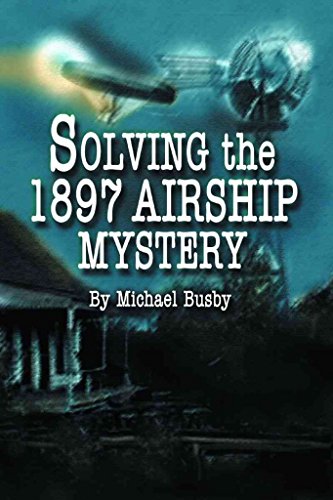
Solving the 1897 Airship Mystery
Find on Amazon →As an Amazon Associate, OverClassified may earn from qualifying purchases made through this link, at no extra cost to you.
Why This Is Essential Reading
Solving the 1897 Airship Mystery earns its place on this list not because this site's own research endorses its central claim, but because it is the most technically ambitious of the three major book-length investigations into America's first great UFO wave, written by an aerospace and defense engineer applying real engineering standards to a body of 19th-century testimony most previous researchers approached from a purely historical or sociological angle. Michael Busby spent six years and more than 1,200 newspaper accounts on the project, and where his research investigates specific manufactured claims like the Collins-Benjamin hoax, this site's own independently conducted case-file research reaches strikingly consistent conclusions with his. His book's broader, more credulous thesis — that real inventors built real electrically powered airships this same period, cut short by fatal crashes before reaching the historical record — is a substantially stronger claim than this site's own research finds the surviving evidence supports, a tension disclosed honestly here rather than smoothed over. Its citation record across two of this site's own case files, spanning the wave's full national scope and its single most notorious local incident at Aurora, Texas, demonstrates real, continuing reference value regardless of where a reader ultimately lands on Busby's central thesis. Read alongside Daniel Cohen's earlier, more skeptical treatment of the same wave, this book is essential precisely because the contrast between the two is itself instructive: two serious researchers, working the same 1890s newspaper record decades apart, reaching substantially different conclusions about how much of it was real.
Related Cases & Theories
Essential Viewing

Sources Cited
- Busby, Michael. Solving the 1897 Airship Mystery. Pelican Publishing, 2004 (ISBN 1-58980-125-3, cited here).
- "Solving the 1897 Airship Mystery." Goodreads (rating 3.67/5, 21 ratings, 7 written reviews, checked August 2026). goodreads.com
- "Solving the 1897 Airship Mystery." AbeBooks (ISBN 9781589801257, marketplace listing photograph used for this article's cover image). abebooks.com
- "Michael Busby." Goodreads Author Page (bibliography cross-check). goodreads.com
- "Busby, Michael." Encyclopedia.com (biography: engineering career, Marine Corps service, Iran hostage crisis escape, publication history). encyclopedia.com
- "Airship Mystery of 1896 and 1897." Jimmy Akin's Mysterious World via StarQuest Media, YouTube (video verified via oEmbed; documentary treatment of the wave this book investigates). youtube.com
- This site's own resources library: Full Reading List, where this exact 2004 edition is cited across 2 separate case-file pages.
- This site's own key-figures entry: Michael Busby, for his full biography and site-wide case connections.
- This site's own case file: The Great Airship Wave of 1896-1897, which documents the wave's full national timeline and the Collins-Benjamin hoax Busby investigated.
- This site's own case file: Aurora UFO Crash, the wave's single most notorious local incident, classified Debunked by this site's own research.
- This site's own essential-reading entry: The Great Airship Mystery by Daniel Cohen, the earlier 1981 book-length treatment of the same wave.
- Bartholomew, Robert E. "The Airship Hysteria of 1896-97." Skeptical Inquirer, Vol. 14, No. 2 (Winter 1990), pp. 171-181. skepticalinquirer.org
- "Book Review: Solving the 1897 Airship Mystery." L'Observateur, February 20, 2004 (contemporary review quoted above, praising the book's research presentation). lobservateur.com
- "Solving The 1897 Airship Mystery." Gale Academic OneFile (academic review; full text behind a subscription paywall this session's tools could not access, secondhand summary quoted above and disclosed as such). go.gale.com
Have corrections, additional research, or peer-reviewed sources? Help improve this entry.
Suggest an Edit