
The Great New England Airship Wave
On December 13, 1909, the Boston Herald published a lengthy interview with Wallace E. Tillinghast, a well-to-do Worcester, Massachusetts, manufacturing executive who claimed to have secretly designed, built, and repeatedly flown the world's first practical heavier-than-air flying machine — including a 300-mile night flight to New York City and back around the Statue of Liberty. Tillinghast refused to show the craft to anyone. Within days, newspapers across New England were flooded with "sightings" of his airship; by Christmas Eve, thirty-three separate reports had poured in from Maine to New York in a single night. The wave ran for roughly ten weeks, drew tens of thousands of claimed witnesses, and ended in February 1910 exactly as it began: with no airship, no photograph, no wreckage, and no explanation from the man whose name had launched it all.
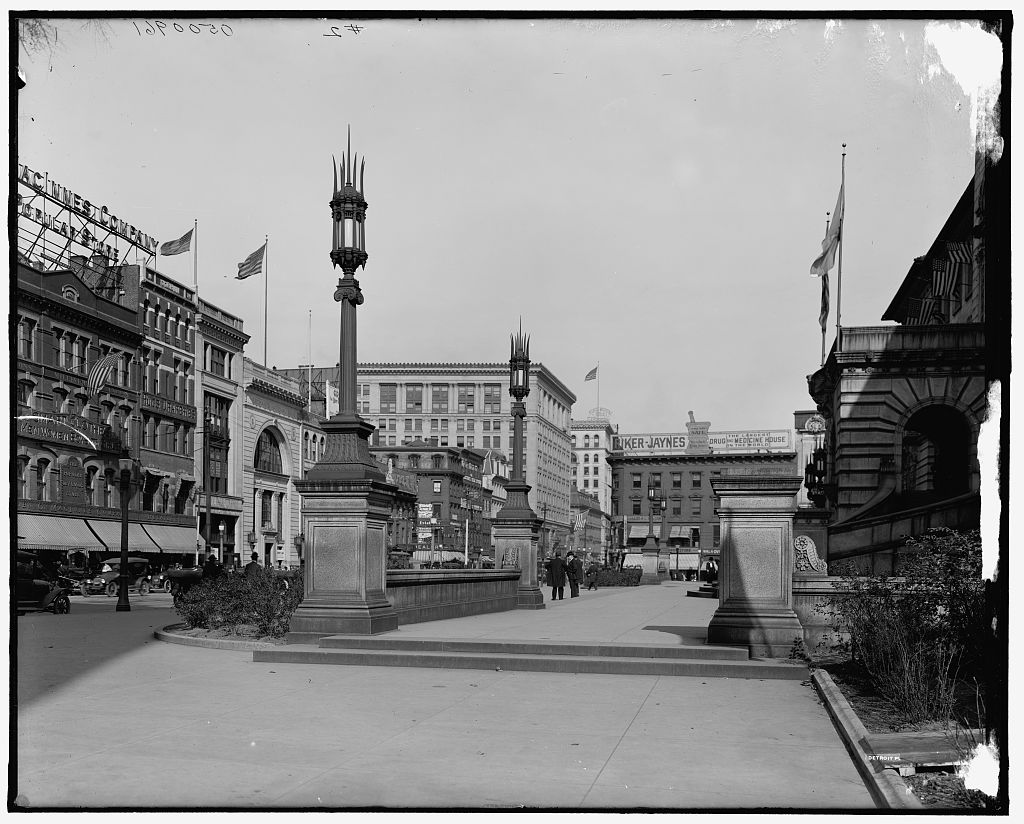
Pictured: City Hall Plaza on Main Street in downtown Worcester, Massachusetts, photographed by the Detroit Publishing Company circa 1910–1920 (Library of Congress, Prints & Photographs Division, no known restrictions on publication) — the same downtown business district where crowds of Christmas shoppers gathered on the night of December 22, 1909 to watch the reported "airship." This is a real period photograph of the case's primary location, not a depiction of the alleged craft itself. No verified photograph of Wallace Tillinghast, his claimed machine, or any of the reported nightly lights is known to exist — despite an estimated tens of thousands of witnesses over ten weeks, no contemporary camera ever captured the phenomenon everyone was looking at.
Theoretical Alignment
Overwhelming alignment with the Psycho-Social Hypothesis (PSH): a single unverified, self-interested claim by a named individual with a personal financial motive (entering upcoming aviation contests "as a sure winner") generated a media-driven wave of misidentification, suggestion-based pattern-seeking, and at least one admitted copycat hoax, with a documented contemporary investigation ("faker" verdict) and zero physical evidence across ten weeks and thousands of claimed witnesses. Neither the Extraterrestrial nor Interdimensional Hypotheses are meaningfully engaged by the source material; nothing in the record proposes non-human origin for any sighting — the entire controversy concerned whether a specific Massachusetts businessman had privately built a very fast airplane six years after the Wright Flyer's first hop, not whether anything otherworldly was involved.
Background
By December 1909, powered flight was six years old and still a fragile novelty. Wilbur and Orville Wright's December 1903 flights at Kitty Hawk had covered a few hundred feet; even by 1909, the fastest verified airplanes in the world — including Louis Blériot's Channel-crossing monoplane of that July — struggled to sustain 45–50 miles per hour over short distances, required daylight and calm weather, and were flown by publicly known aviators in front of witnesses specifically because a flight's authenticity depended on being seen and verified. No airplane anywhere in the world in 1909 could fly 300 miles at night, sustain 120 miles per hour, carry three passengers, or survive a mid-air engine failure long enough for the pilot to perform repairs at 4,000 feet and continue — the exact claims Wallace Tillinghast made about his machine. Any of those individual claims would have been a world-historical aviation achievement; together, they described a machine roughly two generations ahead of anything that actually existed.
The country had also been primed for exactly this kind of story before. A wave of "mystery airship" sightings had swept the American Midwest and West in 1896–97 (see this site's own Great Airship Wave of 1896-1897 case file), built around rumors of secretive local inventors who had supposedly solved powered flight years ahead of the Wrights. That wave, too, produced thousands of witnesses, competing newspaper scoops, at least two confirmed hoaxes, and not a single verified photograph or piece of wreckage. Twelve years later, the pattern repeated almost exactly, this time in the opposite corner of the country and squarely inside the real, ongoing excitement of the actual early aviation era — a detail that gave the 1909 New England wave a credibility the 1896-97 wave never had: heavier-than-air flight was no longer science fiction, it was in every newspaper, which made an individual secret breakthrough sound plausible rather than fantastical.
Worcester, Massachusetts was, in 1909, the second-largest city in the state and a major national center of light manufacturing — wire, machine tools, textiles, and precision instruments — the kind of industrial city that produced exactly the sort of "respectable, self-made inventor" figure the era's popular press loved to celebrate. Tillinghast fit the type: contemporary newspaper accounts describe him consistently as a well-to-do, well-regarded Worcester citizen and vice president of a local manufacturing concern, not a crank or an outsider. That respectability is precisely why his claim was taken seriously at all.
Complete Timeline
| Date | Event |
|---|---|
| Sept.–Oct. 1909 (claimed) | Wallace Tillinghast's claimed first flights. Tillinghast later told the Boston Herald that he had begun flying his secret machine under cover of darkness roughly two months before going public, ultimately claiming more than one hundred undocumented night flights, including an alleged 300-mile round trip from Worcester to New York City circling the Statue of Liberty at 4,000 feet, with an in-flight cylinder repair during a 48-minute engine-failure glide. |
| December 12, 1909 | Tillinghast, a Worcester manufacturing-company vice president, tells a Boston Herald reporter he has "successfully invented, built and tested" a monoplane capable of carrying three passengers 300 miles at 120 miles per hour. He refuses to display the craft or its location, citing fear that rivals will steal his design, and states he intends to enter Boston-area aviation contests the following year "as a sure winner." |
| December 13, 1909 | The Boston Herald publishes the full interview. The claimed specifications — a 1,550-pound monoplane with a 72-foot wingspan, a 120-horsepower engine, and unusual box-kite "feelers" for stability in any wind — circulate nationally within days. |
| Dec. 14–21, 1909 | Scattered reports of unexplained night lights begin appearing in New England papers, with descriptions and claimed specifications increasingly echoing Tillinghast's own published numbers. |
| December 22, 1909 (~6:45 PM) | Mass sighting over Worcester. At the peak of the evening Christmas-shopping rush in downtown Worcester, an estimated 1,000–1,500-plus people reported an object hanging "hawk-like" over the city and sweeping the streets below with a searchlight. The New York Times ran the story nationally the next morning under the headline "Airship Flies High Above Worcester"; the Washington Post ran a parallel account the same day. |
| December 23, 1909 | Reports multiply: an airship with a searchlight is reported departing westward from Marlboro, Massachusetts in the evening; a separate craft is reported doing the same from Southbridge, roughly 40 miles away, the same night; further sightings are logged over Providence and Pawtucket, Rhode Island. |
| December 24, 1909 (Christmas Eve) | Peak of the wave. Thirty-three separate sighting reports are logged across New England in a single night. In Providence, Rhode Island, a crowd gathers in the business district to watch a bright light in the sky; 19-year-old H.P. Lovecraft is among them and immediately identifies the object as the planet Venus. U.S. Immigration Service official Arthur Hoe separately reports strange lights near Providence the same night. |
| December 26, 1909 | The Providence Sunday Journal publishes Lovecraft's own account of the Christmas Eve crowd, titled "Venus and the Public Eye" (later reprinted in Lovecraft's Collected Essays, Volume 3: Science, ed. S.T. Joshi). Lovecraft describes correcting bystanders who insisted the planet was Tillinghast's airship, and their only "mild surprise" at being wrong. |
| Late December 1909 | The investigation begins. J. Walter Flagg, director of the New England Aero Club, opens what he calls "a searching investigation" into Tillinghast's claims. Aviation pioneer Wilbur Wright is asked for comment and dismisses the story as "too palpably absurd from the first to take seriously." A Worcester resident, C.D. Rawson, publicly (and implausibly) claims responsibility for some sightings, saying he attached small lanterns and reflectors to the legs of owls as a prank — a claim most contemporary observers found impossible to credit as an explanation for a searchlight-equipped "airship" seen by over a thousand people at once. |
| January 1910 | Sporadic sightings continue to be reported across Connecticut, New Hampshire, Vermont, and Maine, though with declining frequency and shrinking newspaper coverage as skepticism grows. The Washington Post (Jan. 9) and other national papers begin openly questioning the story. |
| Late January–February 1910 | Flagg completes his investigation and issues a public verdict: "I believe this man is a faker, that the claims he has made are unfounded, and I do not believe he has made a single flight… After a searching investigation I do not find one fact to warrant the statement that he has ever made an ascension or completed a machine in which to fly." |
| February 1910 | Tillinghast's promised public demonstration of the machine never occurs. No aircraft, wreckage, workshop, or corroborating mechanic is ever produced. Sightings and press coverage taper off almost entirely by month's end. The Los Angeles Times (Feb. 13) and Popular Mechanics (March issue) run retrospective pieces treating the affair as a settled hoax. |
| 1910 onward | Tillinghast never publicly confesses to or explains his original claim. He fades from the historical record; no further aviation activity, patent, or public statement from him is documented. The affair itself is largely forgotten within a few years, overshadowed by rapid genuine advances in aviation. |
| 2002 | Historians Stephen Whalen and Robert E. Bartholomew publish "The Great New England Airship Hoax of 1909" in The New England Quarterly, the first substantial modern academic treatment of the affair, situating it within the broader history of media-driven mass delusions. |
The Boston Herald Interview and the Machine That Never Was
The affair began, as far as the documentary record shows, with a single newspaper interview. On December 12, 1909, Wallace E. Tillinghast — described in the resulting article as "a well-to-do citizen and Vice President of a Worcester, Massachusetts manufacturing company" — told a Boston Herald reporter that he had privately solved powered flight. Published the next day, the interview described a monoplane weighing 1,550 pounds, with a 72-foot wingspan and a 120-horsepower engine — a power-to-weight ratio and top speed (120 mph) that would not be matched by any publicly verified aircraft for years. The design incorporated unusual "feelers," described as small box kites mounted to stabilize the craft in any wind condition, and Tillinghast claimed it could carry three passengers a distance of 300 miles.
Tillinghast said he had flown the machine more than one hundred times over the preceding two months, always at night, and always alone or with unnamed companions whose identities he never disclosed. His signature claim — the one that did the most to seed the wave that followed — was a single flight from Worcester to New York City and back, during which he said he circled the Statue of Liberty at roughly 4,000 feet before a cylinder failure forced a 48-minute glide, during which he claimed to have made in-flight repairs and resumed powered flight. He refused to reveal where the machine was kept, name any witness to a single flight, or permit any inspection, explaining that he feared rival inventors would steal his design. He told the reporter he intended to keep the machine secret until he could "enter into Boston contests next year as a sure winner" — a direct, stated financial and competitive motive for both the original claim and its continued secrecy.
No part of this account was ever independently corroborated. No named passenger, employee, or mechanic ever came forward. No workshop, hangar, or storage site was ever identified. No photograph of the machine exists in any archive. Nothing about the claimed specifications is consistent with any documented aviation technology of 1909; nothing about the claimed flight profile — night navigation over 300 miles of Atlantic seaboard with no radio, no lighted airfields, and no aerial charts, at a cruising speed no other aircraft on Earth could then sustain — is physically plausible for the period.
December 22: Mass Sighting Over Worcester
Ten days after the Herald interview, the wave produced its most heavily documented single event. At roughly 6:45 PM on December 22, 1909 — the height of the evening Christmas-shopping rush in downtown Worcester, with sidewalks "packed with pedestrians," according to contemporary accounts — an object was reported hanging "hawk-like over the city," sweeping the streets below with a powerful searchlight. Shoppers stopped mid-errand and gathered in the street, looking east, hoping the light would return after it passed from view. The New York Times reported the following morning that "the mysterious craft made its appearance over the city about 6:45 o'clock tonight, sailed about in circles and was seen by more than 1,500 people," with an operator apparently working a searchlight from aboard. The Washington Post ran a similar wire account the same day. Within 24 hours, the Worcester sighting had gone from a local curiosity to a national news story.
The Wave Spreads: December 23–24
The night after the mass Worcester sighting, reports multiplied rather than subsided. An airship equipped with a searchlight was reported departing westward from Marlboro, Massachusetts in the evening of December 23; a separate craft was reported doing exactly the same thing from Southbridge, roughly 40 miles away, at almost the same hour — a physical impossibility for a single vehicle regardless of its performance, and a strong early indicator that the "wave" was a pattern of independent, unrelated misidentifications rather than a single object being tracked across the region. That same night, further sightings were logged over Providence and Pawtucket, Rhode Island.
The wave peaked on Christmas Eve, December 24, 1909, with thirty-three separate sighting reports logged across New England in a single night — spreading south into Rhode Island and Connecticut, north into Vermont and Maine, and west as far as New York. In Providence's business district, a crowd gathered to watch a bright light moving in the evening sky. Among them was 19-year-old aspiring writer H.P. Lovecraft, then still years from any literary fame, who immediately recognized the light as the planet Venus — prominent as the brilliant "evening star" in the western sky that December — and said so to the people around him. His own account, published two days later, describes the crowd's reaction to being corrected not as embarrassment or reconsideration but as only "mild surprise," before returning their attention to the sky. It is one of the clearest primary-source snapshots anywhere in the historical UFO literature of how a genuine astronomical object, misattributed to a specific, publicized, and emotionally compelling claim, can hold a crowd's belief even after correction.
Skeptics Investigate: Flagg, Wright, and the "Faker" Verdict
The aviation community's own response to Tillinghast's claim was immediate and almost uniformly dismissive. Asked for comment, Wilbur Wright — who, with his brother, held the only fully documented and repeatedly witnessed powered, controlled, sustained flights on record anywhere in the world at that point — called the story "too palpably absurd from the first to take seriously." J. Walter Flagg, director of the New England Aero Club and the person best positioned within the actual regional aviation community to know who was building what, opened a formal inquiry. His conclusion, delivered publicly in early 1910 after what he described as "a searching investigation," was unambiguous: "I believe this man is a faker, that the claims he has made are unfounded, and I do not believe he has made a single flight… After a searching investigation I do not find one fact to warrant the statement that he has ever made an ascension or completed a machine in which to fly." No aviation body, journalist, or later researcher has ever produced evidence contradicting Flagg's finding.
The affair also produced at least one confirmed, if farcical, secondary hoax. A Worcester man named C.D. Rawson publicly claimed he was personally responsible for some of the reported sightings, saying he had attached small lanterns and reflectors to the legs of owls as a prank. Most contemporary and modern commentators treat this claim skeptically in turn — it strains credibility that a lantern-carrying owl could produce a sustained, searchlight-like beam sweeping city streets and be seen "quite plainly" with visible framework by over a thousand simultaneous witnesses — but Rawson's willingness to claim credit at all is itself telling: it shows how quickly the affair had become a magnet for opportunistic claims once the story's national profile made it attractive to attach oneself to, honestly or not.
A Suspiciously Well-Informed Witness
Not every account was second-hand or vague. Alex Randell, of Revere, Massachusetts, presented himself to reporters as an expert in aeronautics and motors and gave one of the wave's most detailed individual accounts: he said he had seen the craft's frame "quite plainly," described its wings as having "a sweep of seventy feet," its tail and propeller as roughly forty-five feet, and reported hearing the engine clearly enough to judge, from the pattern of explosions, that it was either a six- or eight-cylinder motor. Randell told reporters he had never heard of Tillinghast or his flying machine before he was interviewed. When reporters subsequently informed him that Tillinghast's own publicized specifications described a machine with a 72-foot wingspan and an eight-cylinder engine, Randell's account was found to align almost exactly with numbers that had already been circulating in the press for over a week — a correspondence close enough that it substantially undermines, rather than supports, the claim that his testimony was independent. Randell's case is preserved here specifically because it is such a clean, contemporaneously documented example of a phenomenon this site's other case files repeatedly encounter in modern form: publicized technical details from an original, uncorroborated claim leaking into "independent" corroborating witness testimony, whether through direct media exposure, rumor, or unconscious confabulation.
Media Contagion and the Geography of a Rumor
What makes the New England wave a particularly clean case study is how visibly the geography of the sightings tracked the geography of newspaper circulation rather than any single physical object's plausible flight path. A craft cannot depart Marlboro and Southbridge — forty miles apart — heading west at nearly the same hour on the same night, as was reported on December 23. It can, however, easily produce two separate, independent misidentifications in two towns that both read the same wire-service Worcester story the day before and were primed to interpret an ordinary light in the sky through that specific lens. The Providence Journal reporter covering the Rhode Island end of the wave described the situation, in a phrase widely quoted afterward, as an "epidemic of infected vision" — witnesses were not lying, in the main, but they were looking for something specific, at a specific time of evening, having been told exactly what to expect it would look like.
The pattern is consistent with what later researchers — most substantially sociologist Robert E. Bartholomew, writing both on this case specifically and on mass sociogenic phenomena generally — describe as a media-driven panic or collective delusion: an ambiguous, genuinely present stimulus (a bright planet, a star, a real fire balloon, a genuine but mundane light such as a train signal or a distant lit window) interpreted through a shared cultural expectation actively created and sustained by press coverage, producing a self-reinforcing cycle in which each new "sighting" headline primes the next night's crowd to look for, and find, the same thing. Unlike the darker, invasion-anxious "phantom airship" scares that would sweep Britain later that same year — which this site covers separately (see The Sheerness Phantom Airship Incident) — the American 1909 wave was, as several historians of the phenomenon have noted, distinctly optimistic in tone: New Englanders overwhelmingly framed the mystery craft as a homegrown American technical triumph rather than a foreign threat, a framing that made the story more, not less, attractive to believe.
Modern perceptual psychology offers a specific mechanism that fits the wave's pattern closely: the autokinetic effect, in which a small, stationary point of light viewed against a featureless dark background — a bright planet low in a clear night sky is a textbook example — appears to an observer's eye to drift, wander, or move on its own, an artifact of tiny involuntary eye movements rather than any real motion of the light itself. A witness already primed by newspaper headlines to expect a maneuvering airship, watching Venus appear to "sail about," drift, or circle against the dark winter sky, is describing a genuine and well-documented visual phenomenon — just misattributing its cause. This does not require any dishonesty on the witness's part; it is closer to the same basic principle later UFO researchers would summarize as "believing was seeing" rather than the reverse, and it is precisely the effect Lovecraft's account inadvertently demonstrates: a fixed, brilliant planet, described by an excited crowd as behaving like a piloted craft in motion.
Aftermath and Historical Memory
The affair ended not with a confession but with silence. Tillinghast's promised February 1910 demonstration simply never happened, and unlike many hoaxers who eventually recant, explain themselves, or are caught in some corroborating lie, Tillinghast appears to have said nothing further to the press about his claim for the remainder of his life. No patent application, workshop, business partner, or later reminiscence connected to the claimed aircraft has ever surfaced. Real aviation, meanwhile, moved on quickly and publicly: barely eight months after the wave ended, the Harvard-Boston Aero Meet of September 3–13, 1910 brought more than twenty of the world's actual leading aviators to Squantum Field, Massachusetts, for eleven days of witnessed, judged, publicly documented flights — the exact kind of verifiable public demonstration Tillinghast had specifically promised and never delivered. The contrast, arriving so soon afterward and in the same state, likely did more than any single rebuttal to cement the affair's reputation as a hoax in the public memory of the period.
For decades afterward, the wave survived mainly as a minor curiosity in early-aviation and New England local histories, overshadowed first by the rapid, genuine progress of powered flight through the 1910s and later by the far larger 1947-onward "flying saucer" era, which drew its own name from an unrelated Kenneth Arnold sighting nearly four decades later. The case's modern rediscovery is due substantially to sociologist Robert E. Bartholomew, whose research into mass sociogenic illness and media-driven collective delusions repeatedly returns to 1896-97 and 1909-10 as the cleanest pre-broadcast-era American case studies available — culminating in his and Stephen Whalen's 2002 New England Quarterly article, the first substantial modern academic treatment of the Tillinghast affair specifically. Skeptical outlets, including the Committee for Skeptical Inquiry's affiliated writers and the New England Skeptical Society, have since folded the episode into the broader modern literature on mass delusion alongside cases such as the 1938 "War of the Worlds" broadcast panic and various 20th- and 21st-century "phantom" scares, treating Tillinghast's Worcester claim as an unusually clean, well-documented natural experiment in how a single unverified assertion, amplified by a competitive press, can organize an entire region's worth of ordinary night-sky observations into a shared, temporary, and ultimately false belief.
Key Witnesses
Wallace E. Tillinghast
The affair's sole originating source. A well-regarded Worcester businessman and vice president of a local manufacturing company, Tillinghast told the Boston Herald on December 12, 1909 that he had secretly built and repeatedly flown a 1,550-pound, 72-foot-wingspan monoplane capable of 120 mph and a 300-mile range, including an alleged night flight to New York City and back around the Statue of Liberty. He refused to display the machine, name any witness, or reveal its location, citing fear of design theft and a stated intention to win upcoming Boston aviation contests. He promised a public demonstration by February 1910 that never took place. J. Walter Flagg's formal investigation for the New England Aero Club concluded Tillinghast was "a faker" who had never completed or flown any machine. Tillinghast never publicly retracted or explained his original claim, and no further biographical detail about his life before or after the winter of 1909–1910 is well established in the surviving record.
Alex Randell
Gave one of the most detailed individual sighting accounts of the wave, describing the craft's frame, a 70-foot wingspan, a 45-foot tail and propeller assembly, and an engine he judged to be six- or eight-cylinder from its exhaust pattern. Told reporters he had never heard of Tillinghast beforehand — a claim substantially undermined when his figures were found to closely match Tillinghast's own already-published specifications (72-foot wingspan, eight-cylinder engine). Preserved here as a documented example of publicized claim details contaminating supposedly independent corroborating testimony.
H.P. Lovecraft
Nineteen years old and still years from literary fame, Lovecraft was present in Providence's business district on Christmas Eve 1909 when a crowd gathered to watch a bright light in the sky that onlookers took to be Tillinghast's airship. Lovecraft immediately identified the object as the planet Venus and said so to those around him; his own essay, "Venus and the Public Eye" (Providence Sunday Journal, December 26, 1909), records the crowd's reaction as only "mild surprise" at being corrected. It stands as one of the clearest first-person contemporary debunking accounts connected to the entire wave, written by an eyewitness with no stake in the outcome, published within 48 hours of the event it describes.
J. Walter Flagg
The regional aviation community's own investigator into Tillinghast's claims. Flagg conducted what he called "a searching investigation" in late 1909 and early 1910 and concluded publicly that Tillinghast was "a faker" who had never completed or flown any aircraft, finding "not one fact to warrant the statement" that any flight or machine ever existed. As the head of the organization most likely to know of any genuine regional aviation breakthrough, his verdict carried substantial contemporary authority and has never been credibly contradicted.
The Five Observables Assessment
The Five Observables framework, developed by former AATIP director Luis Elizondo, is used to classify UAP encounters based on performance characteristics that exceed known technology:
Assessment: None of the Five Observables are meaningfully present. The claimed craft, per Tillinghast's own account, was a conventional (if implausibly high-performing) propeller-driven monoplane, not a craft exhibiting exotic propulsion or trans-medium behavior. Its central claimed anomaly — 120 mph sustained flight and a 300-mile night range — is a performance claim about ordinary aerodynamic technology exceeding what existed in 1909, not a claim of physics-defying behavior. The individual nightly "sightings" that made up the wave are overwhelmingly consistent with ordinary, low-observability-absent phenomena: a bright planet (Venus), stars, and small fire balloons or lanterns, all of which are, by definition, easily observed rather than difficult to detect. There is no instrumented data of any kind from this pre-radar, pre-radio era.
Evidence Assessment
Facts Not in Dispute
- Tillinghast gave the Boston Herald interview described above on December 12–13, 1909, and the specific claims attributed to him are consistently reported across multiple contemporary papers
- A genuine, large, multi-witness sighting event occurred over downtown Worcester on the evening of December 22, 1909, independently reported by the New York Times and Washington Post
- Thirty-three independent sighting reports were logged across New England on the single night of December 24, 1909
- The wave's geographic and temporal spread is well documented across multiple, editorially independent contemporary newspapers, not a single source
- J. Walter Flagg's New England Aero Club investigation and public "faker" verdict is a real, contemporaneously reported finding, not a later retrospective judgment
- H.P. Lovecraft's eyewitness account and its identification of Venus is independently published within 48 hours of the event it describes
What Was Never Established
- No machine, wreckage, workshop, hangar, or storage site connected to Tillinghast was ever produced, inspected, or located by anyone
- No named passenger, employee, or mechanic ever corroborated any specific flight
- No photograph of the claimed craft exists in any known archive, despite tens of thousands of claimed witnesses across ten weeks in an era when photography was fully mature technology
- The claimed performance specifications (120 mph, 300-mile range, 3-passenger capacity, mid-air repair) exceed any verified aircraft anywhere in the world in 1909 by a wide margin
- Multiple sightings occurred simultaneously in locations (Marlboro and Southbridge, 40 miles apart) that a single physical craft could not have produced
- At least one named individual (C.D. Rawson) publicly, if dubiously, claimed to have staged a hoax sighting, illustrating the wave's vulnerability to copycat claims
- A named, detailed corroborating witness (Alex Randell) gave specifications matching Tillinghast's own already-published figures, undermining claimed independence
- Tillinghast's promised February 1910 public demonstration never occurred, and he never publicly explained or retracted his original claim
Why "Debunked"
This file carries a DEBUNKED classification because the specific, falsifiable claim that started the wave — that Wallace Tillinghast had built and flown a working heavier-than-air aircraft exceeding any verified performance of the era — was directly investigated by the contemporary regional aviation authority best positioned to know, and found to be baseless. J. Walter Flagg's inquiry did not merely express skepticism; it searched specifically for evidence that any flight or machine existed and found none. Tillinghast's own subsequent silence, his failure to produce the promised February demonstration, and the total absence of any physical trace across ten weeks and an estimated tens of thousands of witnesses are all consistent with a fabricated original claim rather than a genuine, still-unexplained technology.
That does not mean every individual person who reported a light in the sky that winter was lying, or even mistaken about something being there. Venus was genuinely bright and prominent in the December 1909 evening sky, as Lovecraft's contemporaneous, independently corroborated account demonstrates directly. Ordinary fire balloons, kites, stars, and at least one admitted (if implausible) prank were also almost certainly involved. What is debunked is the originating claim — a secret, working, superhumanly capable aircraft belonging to a named Worcester businessman — not the underlying human experience of a startled crowd looking at an unusually bright night sky and being told, repeatedly, by newspapers what they were supposed to be seeing.
Sensor & Instrumentation Detection Profile
None. The entire episode predates radar (which would not exist in any usable form for another three decades), predates any organized civil or military aviation-tracking authority, and predates broadcast radio. Every single report from the wave — without exception — is unaided, naked-eye, nighttime visual testimony. No barometric, acoustic, or optical instrument of any kind was used by any witness or investigator to record, measure, or verify any sighting.
Environmental & Geospatial Context
The wave occurred during the New England winter, in the weeks immediately surrounding the winter solstice, when early sunset puts a bright evening sky — and any prominent planet in it — on display during the exact early-evening commuting and shopping hours (roughly 5:30–7:00 PM) when the largest crowds were outdoors and looking up. Multiple contemporary accounts, including Lovecraft's, describe clear, dry conditions on the nights of the heaviest sighting activity, conditions that maximize visibility of both genuine astronomical objects and small fire balloons or lanterns at altitude. Venus was the dominant, unmistakably bright "evening star" in the western sky throughout this period, directly corroborated by Lovecraft's contemporaneous identification.
Observer Credibility & Occupational Profile
Reported witnesses spanned an unusually broad social cross-section for a case of this kind: ordinary Christmas shoppers, businessmen, more than fifty police officers, and multiple politicians and judges were all reported among the crowd of witnesses at various points in the wave, alongside self-described technical experts such as Alex Randell. This breadth is itself instructive: the wave was never confined to naive or credulous observers, which is exactly what a genuinely contagious, media-primed misidentification event predicts — ordinary perceptual and social psychology, not gullibility, explains why trained observers (police officers among them) reported the same ambiguous stimulus the same way as untrained shoppers standing next to them. Both of the wave's two most substantively documented individual witnesses cut in opposite directions on credibility: Randell's detailed, specific testimony collapsed under scrutiny once his figures were shown to mirror already-published claims, while Lovecraft's account holds up as a genuinely independent, correctly skeptical, contemporaneously published observation from a witness with no stake in the story either way.
Physical & Material Assays
None exist. No metallurgical, isotopic, soil, or material sample of any kind connected to this case has ever been collected, tested, or referenced in any contemporary or later source. This is itself a significant negative data point: unlike later 20th-century cases where a claimed craft's absence of physical evidence is at least partly explained by rapid military recovery or classification, nothing in 1909 prevented Tillinghast, at any point over ten weeks of national press attention, from producing a single bolt, panel, or photograph of a machine he claimed to have flown over one hundred times. He never did.
Historical Precedents & Archive Matches
The 1909 New England wave sits inside a well-documented recurring pattern of "phantom airship" episodes bracketing the true dawn of powered flight. The earliest major American precedent is the Great Airship Wave of 1896-1897, which swept the Midwest and West around rumors of secretive local inventors years before the Wright Flyer existed at all. The pattern also recurred internationally the very same year as the New England wave: a separate, unrelated New Zealand airship wave ran through mid-1909, and Britain's own "scareship" panic — sightings widely attributed by an anxious public to secret German Zeppelins rather than to a hopeful homegrown inventor — broke out later that same year, with a related later English sighting significant enough to prompt an official parliamentary response documented in this site's Sheerness Phantom Airship Incident file. Contemporary press accounts of the New England wave also noted parallel or copycat "mystery airship" reports surfacing that same season in France, Russia, and Brazil, illustrating how quickly an American wire-service story could seed similar sighting patterns abroad. Modern researchers, most substantially Robert E. Bartholomew (in his own 2002 academic treatment of this exact case and his broader scholarship on media-driven panics and mass sociogenic illness), treat the 1896-97 and 1909-10 American waves as the clearest domestic case studies of the phenomenon later theorists would apply to post-1947 "flying saucer" reports.
Material Analysis
Because no physical object was ever recovered, produced, or even convincingly photographed, material analysis in the conventional sense is not possible for this case. What can be analyzed is the internal physical consistency of the testimony itself — and it does not hold together as a description of one real object.
Inconsistent Physical Descriptions
Across the wave's documented reports, witness descriptions of the "airship" vary enormously in apparent size, shape, altitude, sound, and behavior — from a silent, star-like point of light (consistent with Venus or another planet/star) to a large, hawk-like silhouette with a visible frame and audible multi-cylinder engine noise (Randell's account, later shown to mirror Tillinghast's published specifications rather than an independent observation). Simultaneous sightings 40 miles apart on the same night (Marlboro and Southbridge, December 23) are not physically reconcilable with a single craft regardless of its performance. This degree of internal inconsistency is itself a diagnostic signature of a misidentification-and-suggestion wave rather than a real, singular object being repeatedly observed.
The Owl Hoax Claim
C.D. Rawson's claim to have staged sightings using lanterns tied to owls illustrates both the wave's vulnerability to opportunistic hoaxing and the limits of any single explanation: while plausible as an explanation for one or two isolated, distant, dim light reports, it cannot account for a searchlight-like beam sweeping city streets and visible framework reported by over a thousand simultaneous witnesses in downtown Worcester on December 22. No single mechanism — Venus, fire balloons, an owl-and-lantern prank, or outright fabrication — explains the entire wave; the most defensible reading, consistent with how researchers have treated comparable cases, is that several genuinely different mundane stimuli were all independently funneled through the same media-created interpretive frame.
Supporting a Non-Mundane Origin
- A genuinely large, simultaneous, multi-witness event did occur over downtown Worcester on December 22, 1909, independently reported by national wire services
- Some individual descriptions (visible framework, sustained searchlight beam, audible multi-cylinder engine) are more elaborate than a simple astronomical misidentification would predict
- Thirty-three independent reports in a single night (Dec. 24) show the phenomenon, whatever its cause, was widely and consistently reported across a broad geographic area
Supporting a Mundane, Non-Anomalous Origin
- The claim's own originator was formally investigated and found to have fabricated it, per J. Walter Flagg's contemporary New England Aero Club inquiry
- The claimed performance specifications exceed any verified 1909 aircraft by a wide margin and were never demonstrated despite ten weeks of national attention and a specific promised public demonstration date
- A named, independent, contemporaneously published eyewitness (H.P. Lovecraft) directly identified the most prominent Christmas Eve sighting as the planet Venus
- The wave's most detailed "independent" corroborating witness (Alex Randell) gave figures matching already-published claim details rather than a genuinely separate observation
- Simultaneous, geographically incompatible sightings on Dec. 23 rule out a single physical craft as the common cause
- At least one named individual admitted to staging sightings as a prank
- No photograph, wreckage, or physical trace of any kind was ever produced across the entire episode
The Conventional Explanation Candidate
Unlike most case files on this site, the New England airship wave does not have one single conventional explanation competing against an anomalous alternative — it has several genuinely different mundane mechanisms that, together, account for the full range of documented reports. Evaluating each on its own merits, rather than forcing the entire ten-week episode into a single cause, produces the most historically accurate picture.
Media-Driven Mass Suggestion (Psychogenic Contagion)
The dominant explanation for the wave as a whole. A single, widely publicized, emotionally compelling claim from a named, respectable local figure created a shared expectation that was then actively reinforced, night after night, by competitive newspaper coverage racing to report the next sighting. Ambiguous or genuinely ordinary stimuli — a bright planet, a distant light, a kite — were then interpreted through that expectation by crowds primed to look for exactly the object described in the original interview. This mechanism directly explains the wave's rapid geographic spread along newspaper circulation lines rather than any plausible single flight path, the internal inconsistency of witness descriptions, and the documented "epidemic of infected vision" dynamic described by contemporary reporters.
Astronomical Misidentification (Venus)
Directly and independently confirmed for at least the wave's single most-witnessed Christmas Eve event by H.P. Lovecraft's contemporaneous, published account. Venus was a genuinely brilliant, unmistakable object in the December 1909 evening sky, exactly the kind of steady, extremely bright, slow-moving point of light that a primed observer — told to expect a searchlight-equipped airship — could easily and honestly misinterpret.
Fire Balloons, Kites, and Copycat Hoaxes
Small hot-air "fire balloons" (paper lanterns lifted by a candle flame) and kites flown at night were common period novelties capable of producing a moving light at altitude, and were specifically cited by contemporary skeptics as a likely source for some reports. C.D. Rawson's claimed owl-and-lantern prank, however dubious as a complete explanation, demonstrates that at least one person was actively and knowingly staging false sightings once the story achieved national attention — a pattern with direct modern parallels in other well-documented UFO flaps.
Tillinghast's Own Fabrication as the Originating Trigger
Distinct from, and prior to, all three mechanisms above: none of them explain why the wave began specifically in Worcester in mid-December 1909, rather than at any other time or place. The most parsimonious answer is the one J. Walter Flagg's contemporary investigation reached directly — that Tillinghast fabricated his original claim, whether for the stated competitive motive (winning upcoming aviation contests), simple attention, or some combination, and that fabrication is what supplied the specific expectation (a searchlight-equipped monoplane, flying at night, over New England) that then organized several pre-existing, unrelated mundane stimuli into a single coherent-seeming "wave."
The Assessment
Media-Driven Mass Suggestion
Highly PlausibleThe best-supported explanation for the wave's scale, speed, and geography. Directly consistent with the documented "epidemic of infected vision" pattern, the Marlboro/Southbridge simultaneity problem, and the internal inconsistency of witness descriptions across the episode.
Astronomical Misidentification (Venus)
Confirmed (Partial)Directly confirmed for the wave's single most-witnessed event by an independent, contemporaneously published eyewitness account. Plausible as a major contributing factor across other reports during the same weeks, though not independently confirmed for each one.
Fire Balloons, Kites & Copycat Hoaxes
Plausible (Partial)Consistent with some individual, isolated, dim-light reports, and directly claimed by at least one named individual (Rawson). Cannot account for the scale or detail of the largest single event (the Dec. 22 Worcester sighting), so is best treated as one contributing mechanism among several rather than a complete explanation.
Tillinghast's Claim Was Genuine
ImplausibleContradicted by a direct contemporary investigation from the regional aviation authority best positioned to know, by the total absence of any physical evidence across ten weeks of national attention, by claimed performance specifications no verified aircraft anywhere in the world could then achieve, and by Tillinghast's own failure to deliver the demonstration he himself promised.
Related Cases
Honest Assessment: No Contemporary Government Investigation Exists
The New England airship wave predates any organized U.S. government aviation or UFO-investigation apparatus by decades — the Federal Aviation Administration did not exist until 1958, and Project Blue Book would not begin until 1952. No federal agency is known to have opened a file, conducted a field investigation, or issued any public statement on the wave, either in 1909-1910 or since. The actual investigation into Tillinghast's claim was conducted by a private regional trade body, the New England Aero Club, not any government office. In place of nonexistent federal case records, the closest genuine institutional documentation is archival: digitized period newspaper collections held by the Library of Congress.
Free public digitized archive holding period newspaper coverage of the wave, including the original wire-service accounts of the December 22, 1909 Worcester sighting.
PUBLIC FEDERAL ARCHIVE (Library of Congress)Worcester-based national research library holding period portrait prints, local newspapers, and manuscript collections from the city's early-20th-century business community, including Tillinghast's own era.
PRIVATE NONPROFIT RESEARCH ARCHIVE (not a government body)Search Government Archives Directly (No Wave-Specific Federal Records Exist)
Further Reading — Recommended Literature
Watch the Skies! A Chronicle of the Flying Saucer Myth
A Smithsonian aerospace historian's account of the flying-saucer myth's origins, situating the pre-1947 "airship era" waves — including the 1909 New England episode — as the direct forerunners of the modern UFO phenomenon.
The Martians Have Landed! A History of Media-Driven Panics and Hoaxes
By the same sociologist who co-authored the definitive 2002 academic study of this exact case, this book places the Tillinghast affair within a broader catalogue of press-amplified mass panics and collective delusions.
Wonders in the Sky
A wide-ranging catalogue of historical unexplained aerial reports, useful for placing the 1909 wave's documentation style and witness patterns in the context of earlier and later "airship era" sightings.
The UFO Encyclopedia
The standard reference encyclopedia of the UFO field, with entries covering the pre-1947 "airship" waves and their place in the broader documented history of the phenomenon.
Solving the 1897 Airship Mystery
A deep investigation into the 1896-97 wave's own named claimants and hoaxers, offering the closest direct comparative case study for how a single fabricated claim can seed a much larger, self-sustaining sighting wave.
DISCLOSURE: Some links above are affiliate links. If you purchase through them, OverClassified receives a small commission at no additional cost to you. This helps support independent research.
Essential Viewing
No Videos Available
Sources
- Whalen, Stephen & Bartholomew, Robert E. "The Great New England Airship Hoax of 1909." The New England Quarterly, Vol. 75, No. 3 (September 2002), pp. 466-476. doi.org/10.2307/1559788
- "The Worcester Aeroplane Hoax (1909)." Hoaxes.org (The Museum of Hoaxes, Alex Boese). hoaxes.org
- "Wallace Tillinghast." Wikipedia. en.wikipedia.org
- Novella, Steven. "Two Mass Delusions in New England." The New England Skeptical Society (NESS). theness.com
- Ingram, Mathew. "Wallace Tillinghast and the New England Airship Hoax of 1909." When the Going Gets Weird newsletter. newsletter.mathewingram.com
- "Phantom Flying Machines." JSTOR Daily. daily.jstor.org
- "The Great New England Airship Hoax of 1909 and the Mystery of Wallace E. Tillinghast and his Incredible Flying Machine." Creative History Stories. creativehistorystories.blogspot.com
- Perridas, Chris. "1909 Hoax, A Tillinghast, HPL, and Venus." H.P. Lovecraft and His Legacy. chrisperridas.blogspot.com
- Lovecraft, H.P. "Venus and the Public Eye." Providence Sunday Journal, December 26, 1909. Reprinted in Collected Essays, Volume 3: Science, ed. S.T. Joshi (New York: Hippocampus Press, 2005), pp. 99-100
- "Airship Flies High Above Worcester." New York Times, December 23, 1909, p. 1
- "'Aero' Seen Again at Night." Washington Post, December 23, 1909, p. 1
- Washington Post, January 9, 1910 (skeptical follow-up coverage)
- Los Angeles Times, February 13, 1910 (retrospective coverage treating the affair as a settled hoax)
- Popular Mechanics, March 1910 issue (retrospective coverage)
- Clarke, David. "The Airship Wave of 1909." UFOS.se (archived; cited via Wikipedia, "Wallace Tillinghast")
- Bartholomew, Robert E. & Radford, Benjamin. The Martians Have Landed! A History of Media-Driven Panics and Hoaxes. McFarland, 2011
- Vallée, Jacques & Aubeck, Chris. Wonders in the Sky: Unexplained Aerial Objects from Antiquity to Modern Times. TarcherPerigee, 2010
- Clark, Jerome. The UFO Encyclopedia, 3rd ed. Visible Ink Press / Omnigraphics
- Peebles, Curtis. Watch the Skies! A Chronicle of the Flying Saucer Myth. Smithsonian Institution Press, 1994
- Busby, Michael. Solving the 1897 Airship Mystery. Pelican Publishing, 2004 (comparative case study, 1896-97 wave)
- Library of Congress. Detroit Publishing Company photograph collection, "City Hall plaza, Main Street, Worcester, Mass." (between 1910 and 1920), LC-D4-25695. loc.gov
- "Great Airship Wave of 1896-1897." This site's own case file on the earlier, directly comparable American phantom-airship wave
See something inaccurate? Have additional information or sources?
Suggest an Edit →Last Updated: August 2026