
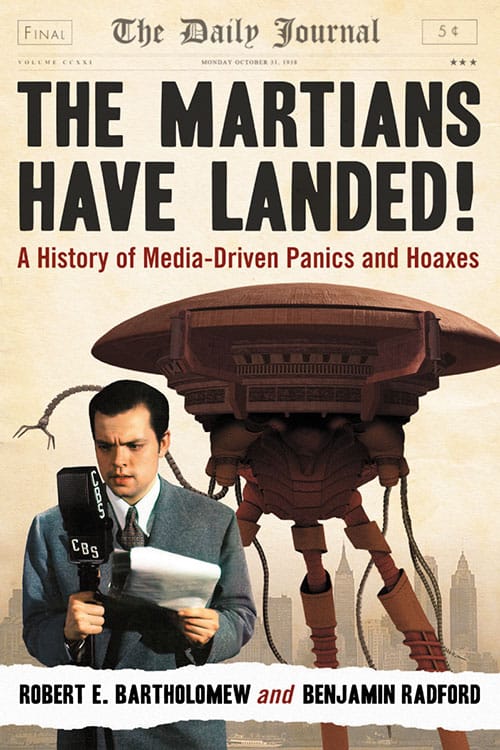
The Martians Have Landed!
A History of Media-Driven Panics and Hoaxes
Core Thesis
The Martians Have Landed! A History of Media-Driven Panics and Hoaxes is medical sociologist Robert E. Bartholomew and skeptical investigator Benjamin Radford's 2011 survey of more than three dozen media-amplified panics and hoaxes spanning the 17th through 21st centuries, organized into six thematic sections covering radio, television, newspapers, the internet, urban legends, and broader social panics. This site cites the book on two case files applying that same collective-delusion framework to specific UFO-adjacent events: the 1909 Great New England Airship Wave, a newspaper-driven hoax Bartholomew had already studied academically in 2002, and the French Taize Landing Case, cited for its mass-suggestion angle on a group of young witnesses retelling an ambiguous nighttime stimulus.
About the Author
This site's own Robert Bartholomew key-figures entry documents him as a medical sociologist specializing in mass psychogenic illness and collective delusions, whose 1998 book UFOs & Alien Contact: Two Centuries of Mystery -- already covered separately on this site -- classified the Knowles family Mundrabilla encounter as a "small group panic." His 1990 Skeptical Inquirer paper "The Airship Hysteria of 1896-97" was among the first to frame the earlier American mystery-airship wave within this same sociological lens, and his 2002 academic paper with historian Stephen Whalen, "The Great New England Airship Hoax of 1909," remains the definitive modern scholarly study of the specific case this newer book revisits within a much broader catalog.
Co-author Benjamin Radford, per this site's own key-figures entry, is deputy editor of Skeptical Inquirer magazine and a Research Fellow with the Committee for Skeptical Inquiry (CSI), born in 1970 and holding degrees in psychology and education. He has authored or co-authored more than twenty books and over a thousand articles on urban legends, unexplained mysteries, and critical thinking, with notable investigations including the Pokemon seizure panic of 1997, phantom clown scares, and the chupacabra, and other titles including Tracking the Chupacabra, Lake Monster Mysteries (with Joe Nickell), and a related later collaboration with Bartholomew, Hoaxes, Myths, and Manias: Why We Need Critical Thinking.
Historical Context & Origins
The book's six-part structure -- radio, television, newspapers, the internet, media-spread urban legends, and broader social panics -- situates the 1909 Tillinghast airship affair within the newspaper-driven section alongside other 19th- and early 20th-century print hoaxes such as the 1835 "Great Moon Hoax" and 1910's Halley's Comet scare, and the more famous 1938 War of the Worlds radio panic in the radio section. This article was not able to confirm the exact chapter title covering the Tillinghast case or the specific passage most relevant to Taize's mass-suggestion dynamics, since no accessible table of contents with page-level detail could be verified -- readers wanting that level of precision should consult the book directly.
This site's own Great New England Airship Wave case file identifies this book specifically as coming from "the same sociologist who co-authored the definitive 2002 academic study of this exact case," giving its inclusion of Tillinghast particular authority relative to a general survey author revisiting a case secondhand.
Core Arguments & Key Concepts
The book's organizing argument is that media technology itself -- whatever form it takes, from 17th-century pamphlets to 21st-century internet forums -- functions as an amplifier that can turn an ambiguous or false initial report into a widespread collective panic, given the right conditions of audience anxiety, uncertainty, and social contagion.
Applied to this site's own cases, that framework treats the Tillinghast affair as a newspaper-era example of the same dynamic later radio and television panics would exhibit, and treats a case like Taize's group sighting as a candidate for the same mass-suggestion mechanics operating at a much smaller, localized scale rather than a nationwide media event.
Key Cases & Evidence Discussed
This site's own Great New England Airship Wave case file documents the Tillinghast affair in far greater depth than this survey book's inclusion of it: the complete timeline of sightings, the promised but never-delivered public demonstration, and the case's lasting obscurity relative to genuine contemporary aviation advances. Readers wanting the complete, independently sourced record should consult that case file directly.
This site's own Taize Landing Case case file cites this book for its mass-suggestion conventional-explanation candidate applied to a group of young witnesses -- a case this book does not appear to discuss by name, making the connection thematic and methodological rather than a shared citation of the same specific event.
Critical Reception & Controversies
As of this article's research (August 2026), the book holds a middling 3.45/5 aggregate rating on Goodreads from 42 ratings and 7 written reviews. Positive reviewers called it "a well-written and entertaining overview of how print, broadcast, and electronic media fuel misconceptions," with short chapters appealing to both general and younger readers; more critical reviews found it repetitive toward the end and felt the underlying concept was stronger than its execution.
A detailed June 2012 blog review praised the book's intriguing concept and broad topic range while criticizing uneven chapter-length allocation -- trivial stories sometimes receiving more space than more serious episodes like the satanic-panic scares -- alongside repetitive passages and occasional editing lapses. This article could not locate a formal academic or library-trade review (such as a Choice magazine notice) despite McFarland's standing as an academic reference publisher, which may reflect a gap in what is indexed online rather than an actual absence of such coverage.
Influence & Legacy
The book's legacy is best understood as a popularizing, broad-scope extension of Bartholomew's more specialized academic work on collective delusions and small-group panics, paired with Radford's own extensive skeptical-investigation background, producing a survey aimed at general readers rather than a narrow scholarly monograph.
Set alongside this site's own case files on the Great New England Airship Wave and the Taize Landing Case, this book functions less as a primary evidentiary source for either specific case than as a broader sociological toolkit -- one whose real analytical weight, for the airship case at least, rests more heavily on Bartholomew's earlier, more narrowly focused 2002 academic paper than on this later popular survey.
The Book
As an Amazon Associate, OverClassified may earn from qualifying purchases made through this link, at no extra cost to you.
Why This Is Essential Reading
The Martians Have Landed! earns its place on this reading list as a broad, accessible survey of the media-amplified panic dynamics its own authors have studied in far greater depth elsewhere -- most authoritatively, for this site's purposes, in Bartholomew's earlier academic papers on the 1896-97 and 1909 airship waves. Read alongside this site's own Great New England Airship Wave and Taize Landing Case case files, which apply this sociological framework to their own independently documented evidence, it remains most valuable as an entry point to the broader collective-delusion literature rather than as the deepest treatment of either specific case.
Related Cases & Theories
Sources Cited
- Bartholomew, Robert E. & Radford, Benjamin. The Martians Have Landed! A History of Media-Driven Panics and Hoaxes. McFarland & Company, 2011. amazon.com
- McFarland & Company, publisher's own product page and cover image. mcfarlandbooks.com
- Goodreads listing for The Martians Have Landed! (aggregate reader rating and reviews). goodreads.com
- Whalen, Stephen & Bartholomew, Robert E. "The Great New England Airship Hoax of 1909." The New England Quarterly, Vol. 75, No. 3, September 2002, pp. 466-476 (the earlier, more narrowly focused academic study of the same case). doi.org
- Radford, Benjamin. Author biography and bibliography, personal site. benjaminradford.com
- Committee for Skeptical Inquiry, Benjamin Radford biography. skepticalinquirer.org
- This site's own Robert E. Bartholomew key-figures entry (his broader body of collective-delusion research).
- This site's own Benjamin Radford key-figures entry (his skeptical-investigation career).
- This site's own Great New England Airship Wave case file (full sourcing on the Tillinghast affair).
- This site's own Taize Landing Case case file (full sourcing on the French sighting).
- This site's own UFOs & Alien Contact Essential Reading entry (Bartholomew's earlier, separately covered 1998 book).
- This site's own Worcester, Massachusetts location entry (the 1909 airship wave's epicenter).
Have corrections, additional research, or peer-reviewed sources? Help improve this entry.
Suggest an Edit