
Flying Saucers Have Landed
The 1953 Book That Split Itself in Two — Desmond Leslie's Ancient-Astronaut Survey and George Adamski's Founding Contactee Claim
Core Thesis
Flying Saucers Have Landed, published in London by T. Werner Laurie in 1953, is not one argument but two, bound under a single title and a single dust jacket. Part I, roughly the first half of the book, is Desmond Leslie's own project: more than two years of research into ancient texts, folklore, and historical records from India, China, the Americas, and Europe, assembled into an argument that "flying saucers" have been visiting Earth since antiquity — a thesis that anticipated Erich von Däniken's Chariots of the Gods? by fifteen years. Part II is George Adamski's roughly fifty-page first-person account of meeting a humanoid he called Orthon near Desert Center, California, on November 20, 1952, and of Orthon's claimed origin on Venus. The two halves do not carry equal evidentiary weight, and this entry treats them separately rather than pretending otherwise: Leslie's survey is speculative pseudohistory by mainstream archaeological and historical standards, but it rests on citable (if selectively read) primary sources and has never been accused of outright fabrication. Adamski's account, and the "scout ship" photographs he released alongside it, are today near-universally regarded — including by ufologists sympathetic to the wider UFO phenomenon — as fraudulent: his central photographic evidence has been identified by independent researchers as a 1930s pressurized-gas lantern shade and ordinary General Electric light bulbs, and his claims of humanoid life on Venus, Mars, and Saturn were subsequently and definitively foreclosed by robotic planetary exploration. What the book indisputably did, regardless of which half of it anyone believes, is launch the 1950s "contactee" movement — friendly, human-looking space visitors delivering moral warnings, as distinct from the colder, more clinical "abductee" narratives that would dominate American ufology a generation later — and made Adamski, for roughly a decade, the most famous individual claimant in the entire field.
About the Author
George Adamski was born April 17, 1891, in Bromberg, in what was then the German Empire (present-day Bydgoszcz, Poland), to ethnically Polish parents who emigrated with him to New York state before his second birthday. His formal education did not extend past the third grade, though he was later addressed by admirers as “Professor” — a title he never earned and did nothing to discourage. He served in the U.S. Cavalry along the Mexican border during the 1913–1916 Pancho Villa Expedition, married Mary Shimbersky in 1917 (she died in 1954; the couple had no children), and spent the 1920s and 1930s drifting through a series of manual jobs before settling into the role that would define the rest of his life: spiritual teacher and showman. In the early 1930s he founded the “Royal Order of Tibet” in Laguna Beach, California, a neo-theosophical organization operating out of a self-styled “Temple of Scientific Philosophy,” which during Prohibition secured a government license to produce sacramental wine — "I made enough wine for all of Southern California," Adamski later told an interviewer, "I was making a fortune!" Historian Curtis Peebles has noted Adamski's own reported remark that he might never have turned to flying saucers had Prohibition not ended and taken his wine business with it.
By 1940 Adamski had relocated to a small property near Palomar Mountain in San Diego County, California, building a campground, diner, and homemade observatory housing a six-inch (later fifteen-inch) telescope. He never worked at, or held any credential from, the genuine Palomar Observatory a short distance away — the Caltech-operated facility whose 200-inch Hale Telescope was, at the time, the largest in the world — but he allowed, and by several accounts actively cultivated, public confusion between his roadside diner-observatory and the famous research institution nearby. He began reporting UFO sightings in 1946, claimed to have photographed a "mother ship" crossing the face of the Moon in early 1947, and by that summer claimed to have observed some 184 unidentified craft. A blurry May 1950 photograph he presented as six spacecraft rising from the Moon — in reality six indistinct bright points against a dark, out-of-focus background — nonetheless proved durable enough to be reproduced on a 1978 Grenadian postage stamp. None of this, however, made Adamski broadly famous. That happened on November 20, 1952, when he told six witnesses, including his secretary Lucy McGinnis, that he had driven into the desert near Desert Center, California, walked alone toward a small "scout ship" hovering in a mountain cove roughly half a mile off, and made contact — through gestures and what he called "rudimentary telepathy" — with a human-looking being he named Orthon: sand-colored hair, an even tan, ox-blood-colored shoes, claiming Venusian origin and expressing concern over Earth's atmospheric nuclear testing. Adamski said he shot seven rolls of film that day with a telescope-mounted camera and that none of the plates came out usable; the photographs that made him internationally famous were taken separately, on December 13, 1952.
Adamski expanded his claims dramatically in the years that followed, publishing Inside the Space Ships (1955) — describing purported journeys aboard motherships to Venus, Mars, and Saturn, where he claimed his late wife had been reincarnated — and Flying Saucers Farewell (1961). By 1960, Flying Saucers Have Landed and Inside the Space Ships had together sold roughly 200,000 copies, and Adamski lectured internationally, meeting Queen Juliana of the Netherlands at her palace in 1959 and debating astronomer Patrick Moore on the BBC's Panorama in April of that year before an estimated nine million viewers. Edward J. Ruppelt, the U.S. Air Force captain who headed Project Blue Book, offered what has become the closest thing to an official verdict, comparing Adamski to circus showman P.T. Barnum and describing him as "a talented con artist" whose stories were built to generate lecture fees and book royalties from a credulous following. Adamski died of a heart attack on April 23, 1965, while staying with friends in Silver Spring, Maryland, and is buried at Arlington National Cemetery on the strength of his decades-earlier Cavalry service. He held no scientific credential of any kind, and no photograph, film, or physical sample he ever produced has withstood independent technical scrutiny.
Desmond Arthur Peter Leslie was born June 29, 1921, near Glaslough, County Monaghan, Ireland (some records give London), the youngest child of Sir Shane Leslie, a writer and first cousin of Winston Churchill, and grew up partly at the family's ancestral seat, Castle Leslie. His father's own strong paranormal interests — Shane Leslie reportedly favored saffron kilts and held firm supernatural beliefs — shaped his son's early worldview; Desmond later dated his own fascination with the unexplained to a 1934 sighting of what he described as "an immense green fireball" while at school in southern England. During the Second World War he flew Spitfires and Hurricanes for the RAF, a service record one family historian summarized wryly as having "destroyed a number of aircraft, most of which he was piloting at the time." After the war he published two novels, Careless Lovers and Pardon My Return, worked briefly in film production, and by the early 1950s had spent more than two years independently researching flying-saucer history through ancient texts, newspaper archives, Charles Fort's catalogs of anomalies, and Sanskrit literature before his manuscript and Adamski's own account were combined into a single volume.
Unlike Adamski, Leslie never faced a comparable credibility collapse, though his own claims — that Venusians had been visiting Earth since roughly 18,617,841 BC and continued monitoring humanity — were never taken seriously by mainstream historians or archaeologists either. He remained a committed believer for the rest of his life, twice returning to the United States to address UFO conferences, and in 1955 helped found Flying Saucer Review, the long-running British UFO research journal, remaining a contributor for decades. Beyond ufology, Leslie was a genuine polymath: he designed one of the earliest effective multi-track sound-mixing desks (built to his specification by the young engineer Rupert Neve), composed musique concrète using a personal library of thousands of recorded sounds, released the experimental album Music of the Future in 1960, and wrote further, more overtly speculative nonfiction including How Britain Won the Space Race (1972) and The Jesus File (1975). He married German-Irish actress and singer Agnes Bernelle in 1945 (divorced 1969) and later Helen Strong, fathering six children in total. From the 1990s he devoted himself to restoring the aging family estate of Castle Leslie before relocating to St. Jeannet in southern France, where he died of emphysema in February 2001, at age 79, in a hospital in nearby Antibes — sources vary on the exact date within that month, a minor discrepancy this entry notes rather than resolves with false precision.
Historical Context & Origins
The book arrived at a specific moment in the still-young flying-saucer genre. Kenneth Arnold's June 1947 sighting had coined the term and launched an American publishing wave; Donald Keyhoe's The Flying Saucers Are Real had become a half-million-copy U.S. bestseller in 1950 by combining aviation credentials with a government-cover-up thesis; and Frank Scully's contemporaneous Behind the Flying Saucers, resting entirely on two men later convicted of fraud, had shown just how far an unverified crashed-saucer story could travel commercially before collapsing. Flying Saucers Have Landed took a third path from either: rather than a government-secrecy thesis or a single dramatic crash claim, it offered readers a sweeping historical argument (Leslie's) bound to a first-person, ongoing-contact claim (Adamski's) — positioning both a distant past and an active present as sites of extraterrestrial visitation.
Leslie began his research independently, well before he had any connection to Adamski, driven by his own long-standing occult and Fortean interests rather than by any specific sighting of his own beyond the 1934 fireball he recalled from adolescence. By the time the two men's work was combined into a single volume, Adamski already had a small local following around his Palomar Mountain diner and several years of increasingly dramatic sighting and photograph claims behind him, but no national or international name recognition. The November 1952 Desert Center claim, arriving only months before the book's 1953 publication, gave the project what it had previously lacked: a specific, dated, first-person contact story to anchor Leslie's much longer historical argument. Cold War atomic anxiety supplied the era's emotional register for both halves of the book — Orthon's warning about nuclear fallout drifting into space closely tracked widespread public fear over above-ground weapons testing, a theme that would recur across nearly every contactee narrative that followed Adamski's template through the rest of the decade.
Commercially, the book succeeded well beyond what either author's individual track record would have predicted. Published by T. Werner Laurie in London in 1953, it became a bestseller translated into more than thirty languages, and together with Adamski's 1955 follow-up Inside the Space Ships sold an estimated 200,000 copies by 1960. That scale of readership, arriving a full generation before the 1961 Betty and Barney Hill case that many historians credit with popularizing the very different "abduction" narrative, made this book's specific contactee template — benevolent, human-looking visitors, moral and ecological warnings, invitations rather than examinations — the dominant public image of extraterrestrial contact in the West for most of the 1950s.
Core Arguments & Key Concepts
Leslie's Part I argues, across roughly the book's first half, that flying saucers are not a postwar phenomenon but a recurring feature of human history, visible once readers know to look for it in myth, scripture, and chronicle. He cites accounts ranging from the biblical Ezekiel's wheel to medieval European "prodigy" reports, classical Indian Sanskrit epics describing aerial vimana craft, Chinese and South American traditions, and the recorded work of Charles Fort, weaving them into a single continuous narrative of extraterrestrial (chiefly Venusian) oversight of human affairs stretching back, in Leslie's own reckoning, over eighteen million years. This is, structurally, the same method later popularized by Erich von Däniken's 1968 Chariots of the Gods? and by writers like Peter Kolosimo: anomaly-by-anomaly accumulation across cultures, read through a single unifying visitation thesis rather than assessed case by case against the specific historical or archaeological scholarship each individual artifact or text actually supports. Leslie's book predates von Däniken's by fifteen years, and TV Tropes and other genre historians credit it as probably the first English-language work to link ancient sources this systematically to the modern saucer phenomenon — a genuine historical priority, even though the underlying method is no more rigorous in Leslie's hands than in his later, more famous successors'.
Adamski's Part II is narrower and far more consequential for the book's later reputation: a first-person account of the November 20, 1952 Desert Center encounter, followed by an expanding set of claims about Orthon's origin and message. Adamski reported that Orthon communicated primarily through gesture and a form of telepathy, explained that the human form was universal throughout the solar system, and warned that Earth's nuclear weapons testing was releasing dangerous radiation that concerned the inhabited worlds nearby — a claim requiring not only that Venus, Mars, and Saturn be habitable, but that their inhabitants monitor Earth closely enough to notice. Adamski went on, particularly in his 1955 sequel Inside the Space Ships, to describe travel aboard alien "motherships" and further contact with Martian and Saturnian beings, extending a narrative that had started, in this book, as a single desert afternoon.
The book's photographic evidence, central to Adamski's public claims from 1953 onward, rests on a small set of images purporting to show Orthon's "scout ship": a bell-shaped craft with three spherical landing struts, photographed on December 13, 1952, using a telescope-mounted camera. Adamski maintained throughout his life that these images were genuine and technically inexplicable by conventional means, a position his modern defenders (documented, for instance, on advocacy sites like the-adamski-case.nl) continue to hold, citing period analysis from Eastman Kodak optical physicist William Sherwood and a panel of Rank Organisation film technicians who found the shadow geometry consistent with either a genuine object or an extremely skillful full-scale fake.
Independent researchers reached a very different conclusion using much simpler methods. German rocket engineer Walther Riedel told investigator James W. Moseley, whose 1955 inquiry is documented in Moseley and Pflock's later book Shockingly Close to the Truth!, that the craft's "landing struts" were ordinary 100-watt General Electric light bulbs, complete with visible GE branding. Contemporary skeptics separately noted the object's general resemblance to the domed top of a poultry "chicken brooder" lamp. Most decisively, UFO researcher Joel Carpenter's 2012 technical analysis, Preliminary Notes on the Adamski Scout Ship Photos, matched the craft's main body precisely to the reflector shade of a mass-produced 1930s pressurized-gas camping lantern, and used depth-of-field analysis to establish that the photographed object was a small model roughly 30–45 centimeters across, held close to the camera — not a genuine ten-meter craft photographed at a distance.
Key Cases & Evidence Discussed
The book's central subject — Adamski's November 20, 1952 Desert Center contact claim itself — does not currently have its own dedicated case file on this site; this entry, together with George Adamski's key-figures entry, is presently this site's most detailed treatment of it. Readers looking for a single documented incident this book discusses will find the fullest existing overlap in the Thomas Mantell P-51 Crash (Case File #038, January 1948), where this site's own research already documents Adamski's later, separate claim — made without evidence and long since set aside by Air Force investigators and by Edward J. Ruppelt specifically — that Captain Mantell's aircraft had been destroyed by a UFO's own power field.
Leslie's Part I ranges across dozens of historical anomaly claims rather than any single documented modern case, functioning as an early, English-language predecessor to the broader body of work this site's own Ancient Astronaut Hypothesis theory file surveys — the same evidentiary approach later taken up at much greater commercial scale by Chariots of the Gods? and by writers like Peter Kolosimo. None of the specific ancient anomalies Leslie cites individually rises to the level of a documented case in this site's own catalog; his contribution is better understood as a template for a later genre than as a source of any single verifiable claim.
Adamski's book also set the template that a wave of later 1950s American contactees — among them Truman Bethurum, Orfeo Angelucci, George Van Tassel, and Howard Menger, none of whom currently has a dedicated case file on this site — would follow with broadly similar friendly-Venusian and moral-warning narratives, none of which fared any better under later scrutiny than Adamski's own claims did.
Critical Reception & Controversies
Contemporary mainstream reviewers were unimpressed even before the photograph controversies fully developed: the Chicago Tribune, reviewing the book on its 1953 release, dismissed it as "one of those outrageous attempts to hypo old superstitions," and science writer Arthur C. Clarke, who would go on to genuine distinction in space advocacy and fiction, later called the entire enterprise "a farrago of nonsense." None of that criticism dented sales; if anything, the book's status as a disreputable but unavoidable cultural phenomenon — what one retrospective piece called making Leslie "a household name with the lunatic fringe" — only grew through the rest of the decade.
The most consequential critical work concerns Adamski's photographs specifically, and it is worth stating plainly: this is not a case with two comparably weighted sides. Edward J. Ruppelt, the Air Force officer with the most direct institutional access to UFO evidence of his era, concluded Adamski was a con artist comparable to P.T. Barnum. James Moseley's 1955 field investigation turned up witnesses who contradicted Adamski's own account and, per Moseley and Pflock's later book, a colleague named Jerrold Baker who claimed to have overheard a tape-recorded rehearsal of the Desert Center story days before it supposedly happened, suggesting a planned production rather than a spontaneous encounter. German rocket engineer Walther Riedel's identification of the craft's "landing struts" as GE light bulbs, and Joel Carpenter's 2012 depth-of-field analysis matching the whole object to a small, common 1930s lantern shade, together constitute about as complete a technical debunking as any single UFO photograph has ever received. Belgian skeptic Marc Hallet's book-length A Critical Appraisal of George Adamski, the Man Who Spoke to the Space Brothers extends this same scrutiny across Adamski's entire later career and reaches the same conclusion by an independent route.
Leslie's own Part I attracted far less sustained critical attention, in part because it made no falsifiable, testable claim comparable to a photograph or a witnessed encounter — there is no single artifact or plate to send to a lab. What criticism exists treats it as speculative pseudohistory of the same general character later leveled at Chariots of the Gods?: selective reading of ancient sources filtered through a single predetermined conclusion, rather than any accusation of deliberate fabrication comparable to what investigators found in Adamski's photographs. This entry treats that distinction as real and worth preserving rather than collapsing both authors into a single verdict: Leslie's work is bad history, but Adamski's is, on the specific documentary record, fraud.
Reader reception on Goodreads has remained modestly positive across the book's many editions — a combined average in the high 3s (3.62 from 90 ratings on one commonly cited edition page, as of this research) — with many reviewers explicitly noting that they found Adamski's personal contact narrative more compelling reading than Leslie's introductory historical survey, even while acknowledging neither half holds up as reliable evidence.
Influence & Legacy
The book's most durable legacy is the contactee movement itself: a specifically 1950s genre of UFO narrative built around friendly, human-looking extraterrestrial visitors delivering peaceful or cautionary messages, as distinct from the colder, more clinical "abductee" narratives that would come to dominate American ufology after the 1961 Betty and Barney Hill case and, later, works like John Mack's Abduction. Adamski was not the only 1950s contactee, but his book's commercial success made him, for roughly a decade, the template every subsequent contactee narrative measured itself against, for better or worse.
Leslie's own institutional legacy runs through Flying Saucer Review, the British UFO research journal he helped found in 1955 and contributed to for decades — a publication with a far more sober editorial reputation than the book that helped launch its founder's public profile. His ancient-astronaut argument, whatever its evidentiary weaknesses, is credited by genre historians as an early, largely unremarked English-language precedent for the far more commercially dominant ancient-astronaut wave of the late 1960s and 1970s.
Adamski's specific factual claims did not merely fall out of fashion; they were affirmatively disproven by subsequent space exploration. Soviet and American probes through the 1960s and 1970s established that Venus's surface reaches roughly 464°C under 92 times Earth's atmospheric pressure beneath permanent sulfuric-acid clouds, and that Mars and Saturn offer no more hospitable environment for humanoid life — conditions flatly incompatible with the tanned, human-looking Venusians Adamski described meeting. Few claims in the history of ufology have been closed off this completely by independent, unrelated scientific progress that had nothing to do with debunking Adamski specifically.
The book's cultural footprint extended well beyond ufology proper: Adamski's specific iconography of small, human-like "Space Brothers" proved unusually influential in postwar Japanese popular culture's own depictions of aliens and UFOs, a reception this site's largely Western-focused case-file archive can otherwise understate. Within American and British ufology specifically, the book's clearest long-run legacy is a cautionary one — alongside Behind the Flying Saucers, it stands as one of the field's two founding examples of how far a compelling, commercially packaged claim can travel before a technical investigation catches up with it.
The Book
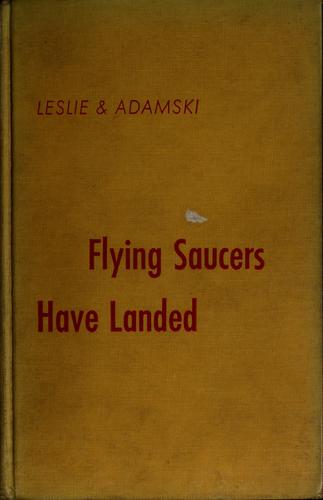
Flying Saucers Have Landed
The 1953 Book That Split Itself in Two — Desmond Leslie's Ancient-Astronaut Survey and George Adamski's Founding Contactee Claim
Find on Amazon →As an Amazon Associate, OverClassified may earn from qualifying purchases made through this link, at no extra cost to you.
Why This Is Essential Reading
Flying Saucers Have Landed earns its place on this list precisely because it will not resolve into one simple verdict, and pretending otherwise would misrepresent it. Desmond Leslie's Part I is speculative, selectively sourced ancient-astronaut pseudohistory, fifteen years ahead of Chariots of the Gods? and never seriously entertained by mainstream historians, but built from real, citable (if misread) sources and never credibly accused of outright fabrication. George Adamski's Part II is the single most consequential contactee narrative of the 1950s and the founding document of an entire UFO subculture — and it is also, on the documentary record assembled by Edward J. Ruppelt, James Moseley, Walther Riedel, and Joel Carpenter across six decades, one of the most thoroughly and specifically discredited bodies of photographic UFO evidence ever produced, down to the identified light bulbs and lantern shade. Read together, the two halves of this book are less a unified argument than a case study in how differently two claims bound under one cover can hold up: one merely unpersuasive, the other conclusively unmasked.
Related Cases & Theories
Essential Viewing
The Man From Venus - The George Adamski Story
Small Town Monsters — Part one of a two-part documentary retelling of Adamski's life and claims, from his Palomar Gardens years through the November 1952 Desert Center encounter this book made famous. Verified via YouTube oEmbed before inclusion.
Secrets in the Skies - The George Adamski Story Part 2
Small Town Monsters — Part two of the same documentary series, covering the photograph controversy and Adamski's later career and legacy. Verified via YouTube oEmbed before inclusion.
Sources Cited
- "George Adamski." Wikipedia (biography, the Royal Order of Tibet, Palomar Gardens, the November 1952 Desert Center claim, photograph identification by Walther Riedel and Joel Carpenter, Ruppelt's assessment, death and burial). en.wikipedia.org
- "Desmond Leslie." Wikipedia (biography, RAF service, Flying Saucer Review co-founding, electronic music career, death). en.wikipedia.org
- "The Man Who Met a Venusian (Allegedly)." Denver Public Library Special Collections & Archives (detailed account of the Desert Center encounter, Adamski's Palomar background, and skeptical scientific assessment of his planetary claims). history.denverlibrary.org
- "Desmond Leslie, Author of Flying Saucers Have Landed and Household Name with the Lunatic Fringe." New York Press (Leslie's aristocratic background, his two-plus years of research, the Chicago Tribune and Arthur C. Clarke critical quotations, his later life). nypress.com
- "Flying Saucers Have Landed (1953)." University of Southern Mississippi Libraries, Item of the Month, October 2021 (book structure, sales figures, edition history). lib.usm.edu
- "Desmond Leslie dies in France at 79." The Irish Times (obituary: death date, location, family present). irishtimes.com
- Carpenter, Joel. "Preliminary Notes on the Adamski Scout Ship Photos." April 2, 2012 (technical photographic analysis identifying the 1930s lantern-shade match and small-model depth-of-field findings). beamsinvestigations.org
- Hallet, Marc. A Critical Appraisal of George Adamski, the Man Who Spoke to the Space Brothers (revised and enlarged ed., 2016), via Internet Archive. archive.org
- "Flying saucers have landed." Open Library (bibliographic record for ISBN 9780854351800, Neville Spearman/British Book Centre, 1970 hardback repr., 281 pp. — the exact edition cited on this site and source of this article's cover scan). openlibrary.org
- "Flying saucers have landed." Internet Archive (digitized scan, Desmond Leslie and George Adamski, T. Werner Laurie first edition). archive.org
- "Flying Saucers Have Landed." Goodreads (aggregated reader ratings and reviews across editions). goodreads.com
- "Flying saucers have landed." Amazon.com product listing (ISBN 0854351809/9780854351800, matching this site's own cited edition). amazon.com
- This site's own key-figures entry: George Adamski, for his full biography and existing Thomas Mantell case connection.
- This site's own key-figures entry: Desmond Leslie, for his full biography and case connections.
- This site's own case file: The Thomas Mantell P-51 Crash, which documents Adamski's separate, evidence-free claim about the cause of Mantell's death.
- This site's own theory file: The Ancient Astronaut Hypothesis, for the broader genre Leslie's Part I anticipated.
- This site's own essential-reading entries: The Flying Saucers Are Real and Behind the Flying Saucers, for the two contemporaneous 1950 bestsellers this book followed into the market.
- This site's own resources library: Full Reading List.
Have corrections, additional research, or peer-reviewed sources? Help improve this entry.
Suggest an Edit