
George Adamski's Desert Center Contact
On November 20, 1952, self-styled "Professor" George Adamski told six companions to wait beside a desert road near Desert Center, California while he walked alone into the sand with a camera and a telescope. An hour later, he said, he had met a human-looking visitor from Venus he named Orthon, communicating by gesture and telepathy about the dangers of atomic testing. The story, expanded into the bestselling Flying Saucers Have Landed (1953), effectively founded the entire 1950s "contactee" movement and its "Nordic space brother" archetype. It is also among the most thoroughly and independently debunked cases in ufological history: the photographic "evidence" was traced to a chicken-brooder top and ordinary General Electric light bulbs, and several of the six named witnesses later told investigators, on the record, that they had seen no spaceship and no spaceman at all.
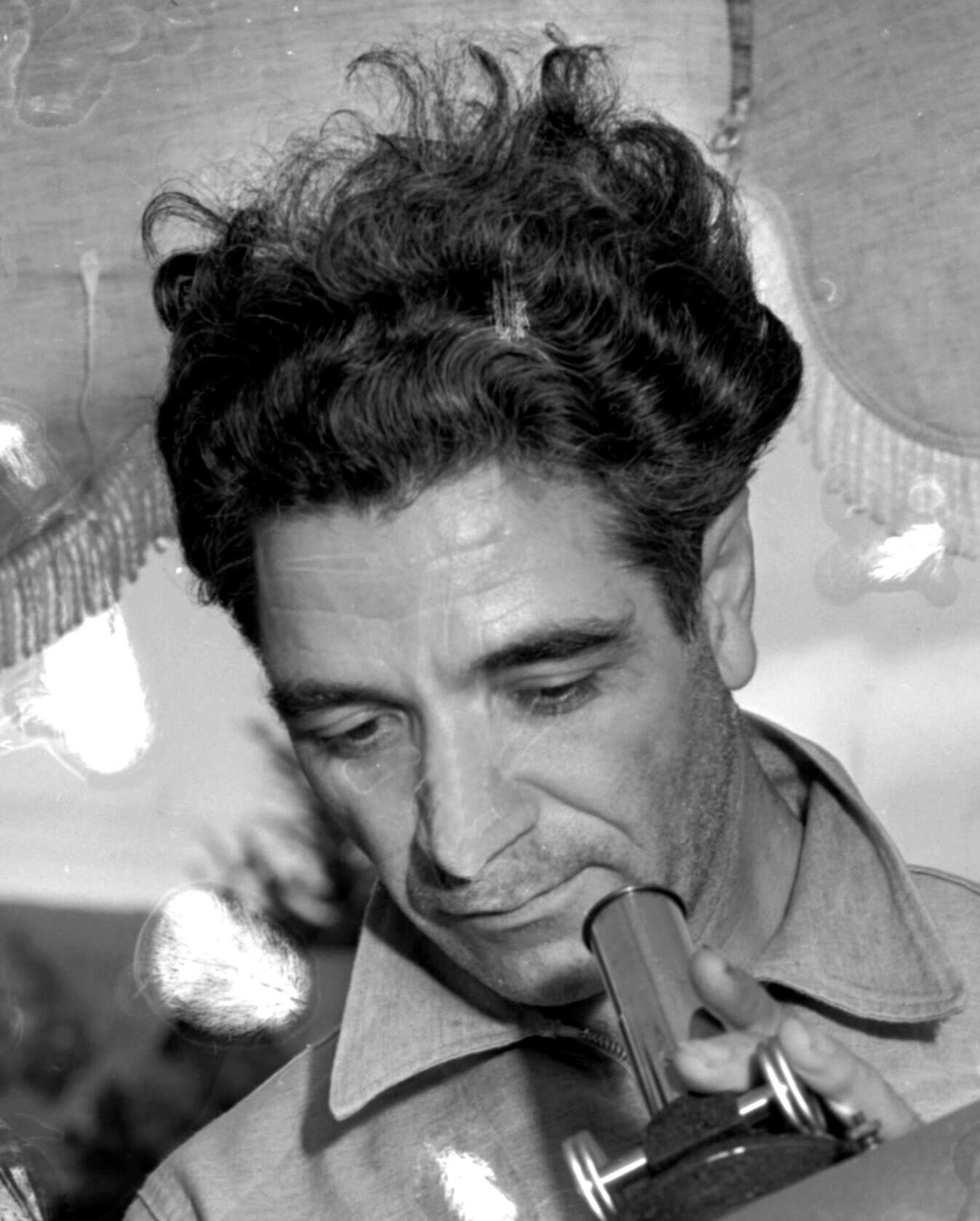
Pictured: George Adamski with a telescope at the Temple of Scientific Philosophy, Laguna Beach, California, April 25, 1938 — fourteen years before the Desert Center contact, during his "Royal Order of Tibet" period and years before he acquired the equipment used in 1952. Los Angeles Times Photographic Collection, UCLA Library, CC BY 4.0. Not a photograph of the actual 1952 event; no independently authenticated photograph of the claimed "scout ship" or Orthon is known to exist outside Adamski's own contested prints.
Theoretical Alignment
This case aligns overwhelmingly with a psycho-social framework, and this file uses that category in its broadest sense — not to suggest Adamski sincerely misperceived a natural phenomenon, but to capture the case's real subject matter: the social and cultural mechanics by which a single, largely unverifiable personal narrative, embedded in a pre-existing spiritual-teacher persona and reinforced by a small circle of associates, became a mass-market publishing phenomenon and the template for an entire subculture. The Extraterrestrial and Interdimensional Hypotheses receive only minimal alignment scores here, reflecting the site's assessment that the specific, independently testable claims in this case (the photographed "scout ship," the described Venusian environment) have been affirmatively contradicted by physical examination and later space-probe data, respectively — a different and stronger evidentiary position than simple unresolved ambiguity.
Background
George Adamski was born April 17, 1891, in Bydgoszcz (then Bromberg, in the German Empire, now Poland), and emigrated to the United States as an infant, growing up in Dunkirk, New York with only a third- or fourth-grade formal education. He served in the U.S. Army's 13th Cavalry Regiment during the 1916 Pancho Villa Expedition. By the 1920s he had become involved in Theosophy, and in the early 1930s he founded the "Royal Order of Tibet" in Laguna Beach, California, running a "Temple of Scientific Philosophy" and falsely claiming prior time studying in Tibetan monasteries. During Prohibition the Order held a license to produce sacramental wine, a business Adamski later described bluntly: "I made enough wine for all of Southern California... I was making a fortune!" — a venture that collapsed when Prohibition ended in 1933. He published his first book, Wisdom of the Masters of the Far East, in 1936.
Between 1940 and 1944, with financial backing from a student and patron named Alice K. Wells, Adamski purchased twenty acres near Mount Palomar and built Palomar Gardens — a home, campground, and small diner on Highway S6, a popular stop for tourists driving to the genuinely famous Palomar Observatory nearby. He built a small wooden observatory of his own on the property, fitted with a six-inch telescope, and allowed visitors to assume, without correcting them, that he had some professional connection to the real observatory — the origin of the self-granted title "Professor Adamski," which he used for the rest of his career despite having no academic credentials of any kind.
Adamski's UFO claims predate the 1952 Desert Center contact by several years, establishing a track record directly relevant to evaluating his later, more elaborate account. On October 9, 1946, he and companions reported seeing a large cigar-shaped object during a meteor shower at Palomar Gardens. In early 1947 he claimed to have photographed the same type of object crossing the Moon. By the summer of 1947 he claimed to have watched 184 separate UFOs pass overhead in a single evening. By 1949 he was lecturing to civic groups for fees, telling audiences (falsely) that government and scientific authorities had confirmed 700-foot spacecraft via radar, and that Mount Palomar Observatory photography proved Martian "canals" were an artificial construction. On May 29, 1950, he photographed what he described as six objects in formation — an image later reproduced, decades on, on a 1978 Grenada postage stamp commemorating UFOs. This pattern — escalating, unverified sighting and photography claims building over six years, from a man already running a tourist-facing spiritual-teacher business at the foot of a famous observatory — is central to how this file, and the great majority of independent investigators since the 1950s, evaluate the credibility of what followed.
Complete Timeline
Exact dates for some early Palomar Gardens period claims are approximate, drawn from Adamski's own retellings; the milestones from 1953 onward are more firmly documented through publication records and independent investigation.
| Date | Event |
|---|---|
| Early 1930s | Adamski founds the "Royal Order of Tibet" in Laguna Beach, falsely claiming prior study in Tibetan monasteries |
| 1940–1944 | Adamski builds Palomar Gardens near Mount Palomar with financing from Alice K. Wells; begins presenting himself as "Professor Adamski" |
| Oct 9, 1946 | Adamski reports a cigar-shaped "mother ship" during a meteor shower at Palomar Gardens |
| 1947–1950 | Adamski claims further sightings and photographs, and begins paid public lecturing |
| Nov 20, 1952 | Adamski and six companions travel to the desert near Desert Center, California; Adamski walks off alone and later claims to have met "Orthon" |
| Dec 13, 1952 | A claimed follow-up visit, during which Adamski says he photographed the scout ship again and received a returned photographic plate bearing symbolic markings |
| 1953 | Flying Saucers Have Landed, co-authored with Desmond Leslie, is published and becomes an international bestseller |
| 1954 | George Hunt Williamson and Al Bailey publish The Saucers Speak, claiming shortwave radio contact with saucer entities, based substantially on Ouija board sessions |
| 1955 | Inside the Space Ships is published, describing Adamski's claimed solar-system travel aboard the visitors' craft; Flying Saucer Review is founded by Desmond Leslie and others |
| 1955 | James W. Moseley begins a field investigation of the Desert Center case for Saucer News |
| 1957 | Moseley and Gray Barker perpetrate the fabricated "Straith letter" hoax on Adamski; Adamski embraces it as genuine even after being informed it was fake |
| Oct 1957 | Saucer News publishes its "Special Adamski Exposé Issue," including on-record witness retractions |
| 1961 | Flying Saucers Farewell, Adamski's third book, is published |
| 1963 | Adamski claims a private papal audience and displays a medal later identified as an ordinary tourist souvenir |
| Apr 23, 1965 | George Adamski dies of a heart attack in Silver Spring, Maryland, at age 74 |
The November 20, 1952 Encounter
By Adamski's account, he and a party of six companions — Alice K. Wells, his private secretary Lucy McGinnis, George Hunt Williamson and his wife, and Al and Betty Bailey — drove from the Palomar Mountain area toward Blythe, California, stopping near Desert Center in the Colorado Desert. The group reported seeing a large, silent, cigar- or submarine-shaped object hovering at high altitude, which Adamski described as a "mother ship." Convinced the ship was specifically looking for him, Adamski had his companions drop him at a point away from the main road, carrying his camera and a six-inch telescope, and walked off alone.
Approximately an hour later, Adamski said, a small saucer-shaped "scout ship," made of a translucent metal, descended and landed nearby. Its pilot, he claimed, was a human-looking figure with tanned skin and long, blond hair, wearing a one-piece suit Adamski described as chocolate-brown. Adamski named this figure Orthon and identified him as a visitor from Venus. Communication, by Adamski's account, occurred through hand gestures and telepathy rather than spoken language; Orthon reportedly expressed concern that atomic weapons testing was releasing dangerous radiation and troubling the "space brothers." Adamski said Orthon declined to be photographed but accepted a blank photographic plate, promising to return it bearing a message.
None of this central content — the physical description of Orthon, the specific substance of the telepathic communication, or any detail of what happened during the roughly one-hour period Adamski was alone — is independently corroborated by any other party present that day. What is corroborated, at the most basic level, is only that Adamski and six named companions were together in the desert near Desert Center on November 20, 1952, and that some of them later signed statements supporting some version of his account. The gap between those two levels of corroboration — a shared physical presence in a general location, versus a detailed and specific first-person contact narrative — is the single most important structural feature of this case, and this file treats it as the primary lens through which every other piece of evidence should be read.
It is also worth noting how directly commercial the case's earliest afterlife was: within roughly a year of the claimed encounter, Adamski had a finished book manuscript, a co-author with existing publishing connections in Desmond Leslie, and a lecture circuit ready to capitalize on the story's reception. This is not, on its own, evidence the story was fabricated for profit — a genuine witness could just as easily have been approached by an interested publisher after the fact — but the unusually short interval between claimed event and full commercial exploitation is a relevant data point this file weighs alongside the photographic and testimonial evidence discussed later, rather than treating the case's later commercial success as incidental to evaluating its underlying credibility.
The book's commercial performance was itself substantial by the standards of the genre: by 1960, Adamski's first two books had reportedly sold a combined total of roughly 200,000 copies across every language in which they were published except Russian, and Adamski undertook extensive international lecture tours across the United States, the United Kingdom, continental Europe, South Africa, Australia, and New Zealand through the remainder of the 1950s. Desmond Leslie's own later, franker assessment of the collaboration is notable: in a 1970 revised edition published after Adamski's death, Leslie candidly acknowledged Adamski's limited facility with written English, and the book's final published form owed a substantial editorial debt to others working from Adamski's raw material — one account names a ghostwriter, Clara L. John, as responsible for shaping Adamski's own sections into publishable prose. A book whose central witness required substantial uncredited editorial assistance to render his own claimed firsthand testimony into a coherent published narrative is a further, modest data point against treating the published text as a transparent, unmediated record of Adamski's original account.
A claimed follow-up encounter occurred on December 13, 1952, during which Adamski said he photographed the scout ship again through his telescope and received back the photographic plate, now bearing strange symbolic markings he and later associates attempted to interpret as a coded message. This second date is the source of Adamski's most widely reproduced "scout ship" photographs, examined in detail in Material Analysis below.
The Six Witnesses and Their Signed Statements
Adamski's own published account, and the great majority of contactee-movement literature that followed it, treats the presence of six named witnesses as the case's central evidentiary strength — a claim repeated so consistently across popular UFO writing that it has become the case's defining shorthand ("witnessed by six observers from half a mile away"). A closer examination of exactly what those six people actually said, and when, substantially undermines this framing.
Alice K. Wells, the Palomar Gardens property owner and Adamski's longtime patron, is generally described as the only one of the six who claimed to have actually glimpsed the humanoid figure at a distance, and she produced a drawing of what she said she saw. Even sympathetic accounts note she was roughly a mile away at the time, a distance from which identifying specific physical features of a human-sized figure would be difficult under ordinary daylight viewing conditions. Lucy McGinnis, Adamski's private secretary, is separately reported to have ghostwritten his earlier 1949 self-published science-fiction novel, Pioneers of Space — a detail later cited by critics who note substantial thematic overlap between that novel and the "true" claims Adamski would go on to publish in Inside the Space Ships.
George Hunt Williamson and his wife were also present; Williamson's own subsequent career, discussed at length below, is itself a significant credibility complication for the group's collective testimony. The most damaging account, however, comes from Alfred (Al) Bailey, who was present with his wife Betty. When investigator James W. Moseley conducted a field investigation of the case beginning in 1955, Al Bailey told him directly that he had seen neither a spaceship nor a spaceman, and stated plainly, "I also feel sure that no one saw any more than I did." A companion named Jerrold Baker, a Palomar Gardens resident in the period surrounding the event (though not one of the original six), separately told Moseley he had overheard a tape recording describing "what was to transpire on the desert" days before the group ever left for Desert Center — that is, a script prepared in advance of the claimed spontaneous encounter — and gave a sworn statement that the famous scout-ship photograph credited to that outing was staged, misdated, and that other photographs taken that day had been destroyed.
Moseley published his findings in Saucer News's October 1957 "Special Adamski Exposé Issue," concluding the case contained "enough flaws to place in very serious doubt both his veracity and his sincerity" — a verdict later called "the definitive" debunking of the case by UFO historian Jerome Clark, himself broadly sympathetic to serious ufological inquiry rather than a reflexive skeptic. A pro-Adamski counter-investigation, Michel Zirger's Authenticating the George Adamski Case: The Desert Center Investigation, exists specifically to argue for the witnesses' credibility against Moseley's findings, and this file notes its existence for balance, while finding Moseley's on-the-record, signed retraction from a named eyewitness the stronger and more directly falsifiable evidence.
Key Witnesses
George Adamski
The case's only witness to the claimed meeting itself, and the source of every specific detail of the encounter. Had a documented six-year history of escalating, unverified UFO sighting and photography claims before 1952, and ran a tourist-facing business built around an implied (false) association with Mount Palomar Observatory. His photographic "evidence" was independently identified as ordinary household objects; his broader career pattern of embracing hoaxes even after being told they were fake (the Straith letter) and displaying a tourist souvenir as a papal medal weighs heavily against treating any of his uncorroborated claims as reliable.
Alice K. Wells
Financed Adamski's Palomar Gardens property in the early 1940s and was among the six companions present November 20, 1952. Generally described as the only witness besides Adamski himself to claim having glimpsed the humanoid figure, from a distance of roughly a mile — a distance skeptics note is too great for reliable identification of specific physical features. Her long-standing financial and personal relationship with Adamski is a relevant consideration when weighing her corroborating testimony's independence.
Alfred "Al" Bailey
Present with his wife Betty among the six companions. When interviewed by investigator James W. Moseley beginning in 1955, Bailey stated directly that he had seen neither a spaceship nor a spaceman that day, and that he doubted any of the other companions had seen more than he did — the single most damaging piece of testimony against the case's core claim, coming from one of the case's own named eyewitnesses rather than an outside skeptic.
George Hunt Williamson
Present among the six companions and credited with making plaster casts of footprints Adamski attributed to Orthon. Williamson's own subsequent career — a 1954 book claiming shortwave radio contact that was later shown to rest substantially on Ouija board sessions, expulsion from the University of Arizona without completing a degree despite later using the title "professor," and an eventual retreat from ufology into Lost-continent and ancient-astronaut writing under a pseudonym — is discussed at length in Historical Precedents below and is directly relevant to evaluating the reliability of his own corroborating account.
The Five Observables Assessment
Because this case's central claims have been affirmatively identified as misrepresented mundane objects rather than merely unverified, the assessment below documents what was claimed while noting, at each point, the specific independent finding that contradicts it.
The Five Observables framework is applied to the performance characteristics claimed in this case:
Assessment: Adamski's own account describes a conventionally landing and departing craft with no claimed sudden acceleration, hypersonic movement, or trans-medium transition. The single performance claim — a controlled descent and landing — is marked "Claimed Only" rather than "Present" because the sole photographic documentation offered for the craft's physical form has been independently matched to a stationary household object (a chicken-brooder top or lantern-shade reflector) rather than any object photographed in the act of flight or landing. This case's Five Observables profile is, by any reasonable standard, the weakest of any file on this site precisely because its core physical evidence has been affirmatively identified rather than merely left unresolved.
Evidence Assessment
Unlike the great majority of case files on this site, evaluating this case does not primarily involve weighing ambiguous or thin evidence against itself. It involves weighing Adamski's own uncorroborated claims against specific, independent, and largely conclusive counter-findings produced by multiple separate investigators across more than half a century.
Points Cited by Proponents
- Six named companions were genuinely present in the desert that day, and several signed statements supporting some version of Adamski's account
- Alice K. Wells claimed to have independently glimpsed a humanoid figure, however distant her vantage point
- The case's cultural and historical significance as the founding contactee narrative is itself undisputed, whatever one concludes about its underlying truth
- A minority scholarly tradition (Timothy Good and others) has argued for at least partial witness credibility against the mainstream skeptical consensus
Independent Findings Against the Case
- Rocket engineer Walther Riedel identified the "scout ship" photograph's landing struts as ordinary 100-watt General Electric light bulbs, reporting he could see the manufacturer's logo under magnification
- Researcher Joel Carpenter later identified an identical visual match between the photographed object and a common 1930s pressurized-gas lantern reflector shade
- Cinematographer J. Peverell Marley, whom Adamski claimed had authenticated the photographs, directly denied to investigator James Moseley ever having made any such analysis or finding
- Witness Al Bailey told Moseley he saw neither a spaceship nor a spaceman, directly contradicting the case's central premise from within its own witness circle
- Witness Jerrold Baker stated the encounter had been scripted in advance and that the credited photograph was staged and misdated
- Adamski's claims of humanoid life and Earth-like conditions on Venus were later definitively foreclosed by robotic space-probe data showing a surface temperature near 900°F and crushing atmospheric pressure
- Adamski embraced the fabricated "Straith letter" as genuine even after being informed by its own creators that it was a hoax, and later displayed an ordinary tourist souvenir medal as evidence of a private papal audience
Why "Debunked"
This case receives a DEBUNKED classification — one of the strongest ratings this site applies, reserved for cases where independent investigation has produced specific, largely conclusive counter-evidence rather than merely unresolved doubt. That threshold is met here on multiple independent grounds simultaneously, which is itself unusual: most debunked cases rest on a single decisive finding, while this one rests on at least four separate lines of independent refutation that would each, individually, be sufficient to seriously undermine the case.
First, the photographic evidence — the single physical artifact central to Adamski's public claims and to the bestselling books that followed — has been identified, by more than one independent researcher using more than one method, as ordinary household objects: a chicken-brooder top or lantern-shade reflector for the craft's body, and standard GE light bulbs (complete with a visible manufacturer's logo under magnification) for its landing gear. Second, the claimed authentication of these photographs by cinematographer J. Peverell Marley was directly and specifically denied by Marley himself when investigators actually located and asked him. Third, and most significantly, the case's own eyewitness pool contains a signed, on-record contradiction: Al Bailey, one of the six named companions Adamski's own account relies on for corroboration, told investigators he saw no spaceship and no spaceman, and stated he doubted anyone else present saw more than he did. Fourth, Adamski's broader pattern of conduct — embracing a hoax letter after being told it was fake, presenting a tourist souvenir as a papal relic, a documented six-year history of escalating unverified claims before 1952 — establishes a track record any reasonable evaluator should weigh heavily when assessing his uncorroborated testimony about a single afternoon in the desert.
This rating is calibrated against this site's other clearly fraudulent cases, including the Aztec, New Mexico Crash Claim, which similarly rests on independently documented fabrication rather than ambiguous or merely unresolved evidence. The Adamski case sits in the same general evidentiary tier: not simply an unconvincing or thinly-sourced report, but a claim for which specific, falsifying counter-evidence exists and has been independently verified by multiple investigators across decades. The case is nonetheless preserved and covered in full here, at comparable depth to any credible case on this site, because of its outsized and undeniable historical influence on the broader UFO phenomenon — a point this file returns to in Historical Precedents below. A Debunked rating on this site is never a judgment about a topic's importance or a reason to cover it any less thoroughly than a genuinely unresolved case; it is a statement specifically about the reliability of the underlying evidence, and this file's length and depth reflect the former consideration rather than the latter.
Sensor & Instrumentation Detection Profile
No radar, official aviation, or military sensor data of any kind has ever been associated with this case. Adamski approached no government or scientific body with his claims in 1952; his story reached the public exclusively through his own 1953 book and subsequent lecture tours.
The closest analogue to instrumented data in this case is the photographic record itself — and it is precisely that record which independent technical examination has identified as depicting ordinary manufactured objects rather than any unconventional aerial technology. Rocket engineer Walther Riedel's identification of GE-branded light bulbs under magnification, and researcher Joel Carpenter's later match to a common lantern-shade reflector, represent the only rigorous technical analysis ever applied to this case's physical evidence, and both point to the same conclusion: the photographed object is a small, stationary, mundane household item, not a craft of any kind.
Environmental & Geospatial Context
Desert Center sits in the Colorado Desert of eastern Riverside County, California, a sparsely populated stretch of open desert along the route between the Palomar Mountain area and Blythe. The location's remoteness is directly relevant to evaluating the case: it placed Adamski's claimed solo encounter far from any potential unrelated witness, any nearby settlement, or any instrumented facility that might have independently recorded unusual aerial activity, while still being accessible enough for a day trip from his Palomar Gardens home.
No specific environmental or atmospheric phenomenon is required to explain this case, since its central evidentiary problem is not a plausible misidentification of a real but mundane event; it is documented physical evidence (the photographs) independently traced to specific manufactured objects, combined with a witness account directly contradicted by one of the case's own eyewitnesses. The desert setting's primary evidentiary relevance is simply that it provided privacy for staged photography and a claimed solo encounter with no independent corroboration realistically possible under the circumstances Adamski himself chose and described.
Observer Credibility & Occupational Profile
Adamski's occupational and personal history, detailed in Background above, is unusually well documented for a UFO case of this era, and unusually unfavorable to his credibility as a witness. A self-granted academic title with no underlying credentials; a religious/philosophical venture built on a fabricated claim of Tibetan monastic study; a business model that traded on an implied, uncorrected association with a genuine scientific institution; and a six-year documented history of escalating, unverified sighting and photography claims before the case this file covers — each of these, considered individually, would be a modest yellow flag. Considered together, and combined with his later, well-documented embrace of a hoax letter and a fake papal medal even after being informed of their falsity, they describe a consistent pattern rather than an isolated lapse.
USAF investigator Edward J. Ruppelt, who personally visited Palomar Gardens and attended an Adamski lecture, is widely quoted comparing him to circus showman P.T. Barnum — while separately noting, with evident personal surprise, that Adamski projected what Ruppelt called "the most honest pair of eyes I've ever seen," a detail this file includes because it illustrates precisely how a sincere-seeming personal manner and a documented pattern of fabrication can coexist in the same individual, a distinction relevant well beyond this single case. Ruppelt's visit is itself notable as one of the only known instances of a genuine, credentialed government UFO investigator engaging directly and in person with Adamski's operation rather than evaluating the claims solely from published secondhand accounts; his resulting comparison to a showman running a "Utopia" sales pitch carries correspondingly more weight than an assessment made purely at a distance, precisely because it was informed by firsthand observation of Adamski's presentation style, his audience, and the commercial context in which the claims were being delivered.
This file also weighs the specific institutional response Adamski's claims eventually provoked. When his public claims began to include assertions of tacit government or Air Force endorsement of his work, the FBI intervened directly, a step significant enough that it produced a formal, signed disclaimer letter from Adamski himself walking back the implied endorsement — a concrete, documentable consequence distinct from the more diffuse skeptical commentary examined elsewhere in this file, and one that indicates federal authorities themselves considered Adamski's claims about official validation serious enough to warrant a formal correction on the record.
Physical & Material Assays
Two physical artifacts are specifically associated with this case: the plaster casts George Hunt Williamson reportedly made of footprints attributed to Orthon, said to contain coded symbols, and the photographic plate Adamski said he gave to Orthon and received back bearing symbolic markings. Neither has ever been subjected to independent laboratory analysis with publicly documented results, and neither has survived in any form accessible to later researchers in a condition permitting forensic re-examination.
The absence of any surviving, independently testable physical artifact from this case — more than seventy years after an event whose only tangible outputs were photographs (independently identified as mundane objects), plaster casts (never analyzed), and a symbol-marked plate (never independently examined) — is itself a significant evidentiary gap, though not, given everything else documented in this file, one that meaningfully changes the case's overall assessment. In a case with a genuinely anomalous origin, the passage of decades without any surviving physical material for modern forensic re-examination would be an unfortunate but unremarkable loss common to many older reports; in a case where the only physical material ever produced has already been independently traced to specific ordinary objects, the same absence simply removes any remaining realistic opportunity to overturn that already well-supported finding through improved future analytical techniques.
Historical Precedents & Archive Matches
This case's historical significance is genuinely unparalleled among case files on this site: rather than following an existing template, it created one. Adamski is widely credited with originating, and possibly coining, the term "contactee" itself, and with establishing the specific narrative pattern — a tall, blond, benevolent, human-looking visitor; communication by gesture or telepathy; a warning about nuclear weapons; a message of cosmic spiritual brotherhood — that would be repeated by dozens of subsequent claimants across the 1950s and 1960s. George Van Tassel established the movement's organizational hub at Giant Rock in the Mojave Desert, hosting an annual "Giant Rock Spacecraft Convention" from 1953 into the late 1970s that drew an estimated 10,000 attendees at its 1959 peak; Van Tassel's own claimed contact with an entity he called "Solganda" began within roughly a year of Adamski's Desert Center encounter. Truman Bethurum claimed contact with "Aura Rhanes," described as the captain of a scout ship from a world called Clarion — the subject of this site's own Truman Bethurum & the "Captain Aura Rhanes" Contacts file; Orfeo Angelucci and Daniel Fry each published their own Adamski-pattern contact narratives; Howard Menger and Buck Nelson extended the same basic template into the early 1960s. Notably, Adamski himself largely avoided the Giant Rock conventions, attending only the 1955 event, where he gave a brief lecture and was interviewed by Edward Ruppelt — a curious distance from the very movement his own case had done more than any other to create, and one some later historians have read as reflecting Adamski's preference for maintaining a more personally curated audience through his own book sales and lecture tours rather than sharing a stage with rival contactees whose claims he had no way of controlling or endorsing.
George Hunt Williamson's own post-1952 career is instructive as a parallel case study in exactly the kind of credibility erosion this file's overall rating reflects. In 1954, Williamson and Al Bailey published The Saucers Speak, claiming to have received shortwave radio Morse code transmissions from friendly saucer pilots; in reality, the book's actual source material was a series of Ouija board sessions the two had been running since 1952, contacting entities with names like "Actar," "Adu," and "Affa," with sample transmissions as garbled as "AFFA FROM THE P. RA RRR OK K5 K5 FROM THE PLA CHANT RRT IT." Williamson went on to write further books, some under the pseudonym "Brother Philip," moving progressively into Lost-continent (Lemuria/Atlantis) and ancient-astronaut territory; he had been expelled from the University of Arizona without completing a degree, despite later using the title "professor" himself, and the FBI monitored his public lectures. He eventually withdrew from ufology entirely, changed his name, and reportedly became a priest in the Assyrian Church of the East before his death in 1986. A witness with this documented a track record of fabricated or badly-sourced claims in his own subsequent career is a directly relevant data point when weighing his corroborating testimony for the 1952 Desert Center event.
The case also invites comparison with the Kenneth Arnold Sighting of 1947, which coined the term "flying saucer" itself five years earlier and, unlike Adamski's case, has never been seriously alleged to involve fabricated evidence — a useful contrast for illustrating that the broader "flying saucer era" contains cases across a very wide credibility spectrum, from genuinely puzzling pilot testimony (Arnold) to affirmatively fabricated contactee narratives (Adamski). The Maury Island Incident, from the same year as Arnold's sighting, is a more directly comparable precedent: an early UFO-era case now broadly regarded as a hoax, involving fabricated physical evidence presented to a credulous public. The Aztec, New Mexico Crash Claim, discussed above in Why Debunked, remains the closest evidentiary parallel on this site: an elaborate, initially widely-reported claim later dismantled by independent investigation into the specific individuals and physical evidence behind it.
Material Analysis
This case's material evidence consists almost entirely of photographs, and the independent technical examination of those photographs is the single most decisive body of evidence in the entire file.
The Photographic Evidence and Its Identification
Adamski's most widely reproduced "scout ship" photograph, associated with the claimed December 13, 1952 follow-up visit, depicts a domed disc resting on three ball-shaped landing struts. Rocket engineer Walther Riedel, who had worked on German V-2 development and later for North American Aviation, examined the photographs as part of James Moseley's investigation and identified the landing struts as ordinary 100-watt General Electric light bulbs, stating he could see the round "GE" logo printed on them under magnification. Separately, Saucer News itself noted the photographed object's close resemblance to a model constructed for a Yankee magazine feature "from a Chrysler hub cap, a coffee can, and three ping pong balls" — an independent illustration of how easily the general silhouette could be reproduced from ordinary materials. In 2012, researcher Joel Carpenter identified a widely available 1930s pressurized-gas lantern reflector shade as, in his words, "an identical visual match to the main portion of Adamski's saucer."
Adamski separately claimed that cinematographer J. Peverell Marley, a professional collaborator of director Cecil B. DeMille, had examined the photographs, identified a "spaceman" figure within them, and declared them the best fakes he had ever seen, if fake. When Moseley actually located and interviewed Marley directly, Marley denied ever having made any such statement, and said he had never enlarged the photographs for analysis or found any figure within them at all — meaning the single claimed professional authentication of Adamski's photographic evidence was, on direct inquiry, retracted by the professional supposedly responsible for it.
Marc Hallet's later book-length analysis, George Adamski Was a Liar, calculated that producing the claimed sequence of images within the brief window Adamski described would have required roughly thirty-five precise manipulations — evidence, Hallet argued, of deliberate studio-style staging rather than a spontaneous field photograph taken under the conditions Adamski described. Separately, Arthur C. Clarke — the science-fiction author and satellite-technology pioneer, no casual observer of either photography or the space sciences — described the "scout ship" images as resembling "electric light fittings with table tennis balls," and noted a specific geometric impossibility in some of the images: the saucer appears to sit outside the circular field of view that Adamski's telescope should have produced, meaning it could not have been photographed through that telescope as claimed.
Astronomical Impossibility of the Venusian Claims
Even judged strictly against 1950s astronomical knowledge, Adamski's specific claim that Orthon was a human-like native of Venus sat in tension with existing spectroscopic evidence already suggesting a carbon-dioxide-dominated, extremely hot Venusian atmosphere. By the time NASA's Mariner 2 probe conducted its 1962 flyby, direct measurement confirmed a surface temperature near 900 degrees Fahrenheit and a crushing atmospheric pressure roughly ninety times Earth's — conditions definitively incompatible with any human-like biology, let alone a described civilization of forests, snow, and cities. Adamski's parallel claims of similar humanoid civilizations on the Moon's far side were likewise contradicted by all available astronomical evidence even before later space-probe confirmation. This is not a case where later science simply outpaced contemporary knowledge; it is a case where the central factual claim has been definitively and specifically foreclosed by direct measurement.
The Straith Letter and the Papal Medal
Marc Hallet's investigation extended beyond the original 1952 photographs to examine later Adamski-associated film evidence as well, including footage attributed to an associate named Rodeffer; Hallet's analysis identified evidence of double exposure in that later material, a technical hallmark of deliberate in-camera compositing rather than a single, spontaneous exposure of a genuinely present object. Considered alongside the still-photograph findings, this later film evidence suggests the pattern of staged or manipulated imagery in Adamski's circle was not confined to the original 1952 case but recurred in subsequent material produced by his associates, further weakening any inference that the original photographs represent an isolated, uncharacteristic lapse rather than a consistent method.
Two further episodes, though occurring after the 1952 case itself, are directly relevant to assessing Adamski's overall reliability as a source. In 1957, Moseley and fellow ufologist Gray Barker fabricated a letter on stolen U.S. State Department letterhead, purportedly from a State Department official named "R.E. Straith," praising Adamski's work — a deliberate hoax intended to test Adamski's judgment. Adamski embraced the letter publicly as genuine vindication and continued citing it for years, even after Moseley and Barker informed him directly that it was fabricated. In 1963, Adamski claimed to have received a private papal audience and displayed a medal he said had been given to him on the occasion; the medal was later identified as an ordinary tourist souvenir sold in shops in Milan and Rome. Both episodes demonstrate the same underlying pattern: a willingness to embrace and continue promoting claims after being presented with direct evidence of their falsity, a pattern this file weighs heavily against treating any of Adamski's uncorroborated personal testimony as reliable.
Independent Technical Findings
- Walther Riedel's identification of GE-branded light bulbs (with visible manufacturer logo) as the photographed "landing struts"
- Joel Carpenter's 2012 identification of a common 1930s lantern reflector shade as an exact visual match for the craft body
- J. Peverell Marley's direct denial of the photograph authentication Adamski attributed to him
- Arthur C. Clarke's identification of a geometric impossibility in the telescope-photograph relationship
- Marc Hallet's calculation of roughly thirty-five manipulations required to produce the claimed image sequence
The Conventional Explanation Candidate: Staged Photography Atop a Fabricated Personal Narrative
Unlike most case files on this site, this section does not need to weigh several genuinely competing candidates against thin or ambiguous evidence. The available independent evidence points overwhelmingly toward a single, well-supported conventional explanation: that George Adamski staged photographs of ordinary household objects (a lantern reflector shade or chicken-brooder top, fitted with standard light bulbs), presented them as documentation of an extraterrestrial encounter he had already decided to claim, and that at least some of his named companion witnesses either did not see what he later described or were never in a position to independently verify it.
This explanation accounts for every major piece of evidence in the case without requiring any anomalous event at all: it explains the photographs (independently matched to specific mundane objects by two separate researchers using two separate methods), the failed authentication claim (Marley's direct denial), the witness contradiction (Al Bailey's on-record retraction), and the broader behavioral pattern (the Straith letter, the papal medal) that shows Adamski continuing to embrace demonstrably false claims even after being informed of their falsity.
Sincere Delusion Rather Than Deliberate Fraud
A softer variant of the conventional explanation holds that Adamski may have genuinely believed some version of his own account, whether through a sincerely mistaken initial experience later embellished without full conscious awareness of the embellishment, or through a psychological pattern in which repeated public retelling gradually blurred the line between an invented narrative and a felt personal truth. Ruppelt's own observation about Adamski's unusually sincere-seeming manner is sometimes cited in support of this reading. This file finds it a less parsimonious explanation than deliberate staging, given the specific, technically sophisticated nature of the photographic fabrication (requiring, per Hallet's analysis, roughly thirty-five distinct manipulations) and the clearly self-interested pattern of embracing the Straith letter and the papal medal even after their falsity was directly demonstrated to him — behavior more consistent with a practiced showman managing a public image than with an individual honestly confused about his own memory.
What Would Resolve This Case Further
Little realistically remains to further resolve this case in either direction. The photographic identification is about as conclusive as forensic photo analysis of this era permits; the central witness contradiction (Al Bailey) is on the public record; and the astronomical impossibility of the Venusian claims has been independently confirmed by direct space-probe measurement. Any surviving original prints, negatives, or the plaster footprint casts, were they to resurface and be subjected to modern forensic examination, could in principle add further technical precision, but would be very unlikely to overturn a conclusion this well-supported by multiple independent lines of evidence.
Genuine Contact (At Face Value)
The candidate this file's own rating treats as least supported by the available evidence, though included here for completeness, holds Adamski's account largely at face value: that he genuinely met a Venusian visitor, and that the identified light bulbs and lantern shade represent either a misidentification by his critics or a separate, staged photograph unrelated to the real encounter. This file finds no persuasive evidentiary basis for this reading, given the convergence of independent technical, testimonial, and astronomical counter-evidence documented throughout this file, and includes it only because a complete accounting requires acknowledging every candidate a thorough reader might raise.
Staged Photography Atop a Fabricated Personal Narrative
PlausiblePLAUSIBLE. Best accounts for the independently identified photographic evidence, the failed authentication claim, the witness contradiction, and Adamski's documented broader pattern of embracing demonstrably false claims.
Sincere Delusion Rather Than Deliberate Fraud
InconclusiveINCONCLUSIVE. Cannot be fully excluded on psychological grounds alone, but sits uneasily against the specifically technical, effortful nature of the photographic fabrication and Adamski's self-interested embrace of known hoaxes.
Misidentification of a Real Natural Phenomenon
ImplausibleIMPLAUSIBLE. The case's central evidentiary problem is documented photographic fabrication of a stationary household object, not a fleeting or ambiguous natural sighting requiring a misidentification theory.
Genuine Contact (At Face Value)
ImplausibleIMPLAUSIBLE. Contradicted by independent photographic identification, a failed authentication claim, an on-record witness retraction, and space-probe data foreclosing the specific Venusian claims.
Related Cases
The three cases below sit at different points along the same early "flying saucer era" credibility spectrum this case helped define — from a puzzling, never-seriously-alleged-fraudulent pilot sighting to directly comparable documented hoaxes.
Confirmed Documents & Official Records
No Project Blue Book or other formal U.S. government investigation of the Desert Center contact itself is known to exist; Adamski never reported the claim through official channels. USAF investigator Edward J. Ruppelt did personally visit Palomar Gardens and attend an Adamski lecture in an informal capacity, documented in his own memoir, and the FBI is separately reported to have monitored public lectures given by George Hunt Williamson and to have intervened when Adamski made false claims of Air Force or government endorsement of his work, resulting in a signed disclaimer letter from Adamski.
Search Government & Military Archives Directly
Further Reading — Recommended Literature
This site's own Essential Reading feature on Flying Saucers Have Landed covers the 1953 book itself in greater depth; the five titles below broaden that coverage to Adamski's full biography, the era's official government perspective, and the wider skeptical literature.
Looking for Orthon
A dedicated, full-length biography of Adamski and this specific case, examining how he "changed the world" through the contactee movement regardless of the underlying claims' truth.
Flying Saucers Have Landed
The original bestseller that launched the contactee movement; essential primary-source reading for understanding exactly what was claimed and how it was framed for a mass audience.
The Report on Unidentified Flying Objects
The former head of Project Blue Book's own account, including his firsthand impressions of Adamski and Palomar Gardens from an investigator who dealt with contactee claims directly.
UFOs Explained
A foundational skeptical treatment of UFO claims broadly, useful for situating Adamski's case within the wider genre of technically debunkable UFO photography and testimony.
The UFO Book: Encyclopedia of the Extraterrestrial
A comprehensive reference covering Adamski, the contactee movement he founded, and the broader historical context of 1950s ufology from a UFO historian who called the Moseley exposé "definitive."
DISCLOSURE: Some links above are affiliate links. If you purchase through them, OverClassified receives a small commission at no additional cost to you. This helps support independent research.
Essential Viewing

Sources
- "George Adamski," Wikipedia. en.wikipedia.org
- "George Hunt Williamson," Wikipedia. en.wikipedia.org
- "George Van Tassel," Wikipedia. en.wikipedia.org
- Moseley, James W. "Saucer News Presents: The George Adamski Exposé." Saucer News, October 1957, reprinted at jimmoseley.com. jimmoseley.com
- Moseley, James W. Investigation reprint. rr0.org
- Hallet, Marc. George Adamski Was a Liar. Full text. archive.org
- "George Adamski," HISTORY.com. history.com
- "George Adamski's Saucers Are Still Flying High," Bad UFOs. badufos.blogspot.com
- "George Adamski," web2.ph.utexas.edu. web2.ph.utexas.edu
- "George Adamski, Contactee," Dragon at the End of Time. dragonattheendoftime.com
- "The Man Who Met a Venusian?" Denver Public Library. history.denverlibrary.org
- "Unraveling the Secret Life of George Hunt Williamson," UFO Digest. ufodigest.com
- "Palomar Gardens Cafe," UFOs and Aliens Substack. ufosandaliens.substack.com
- "Bio of George Adamski," HubPages. hubpages.com
- "Flying Saucers Have Landed (1953)," University of Southern Mississippi Library exhibit. lib.usm.edu
- "Desmond Leslie obituary," New York Press. nypress.com
- "His Reputation," the-adamski-case.nl (pro-Adamski site, cited for balance). the-adamski-case.nl
- "The Cultural Impact of the Contactee Movement," UFO Archives. ufoarchives.blogspot.com
- "UFO Contactee Movements," Hangar1 Publishing. hangar1publishing.com
- "Giant Rock, Space People and the Integratron," PBS SoCal. pbssocal.org
- Ruppelt, Edward J. The Report on Unidentified Flying Objects. Doubleday, 1956.
- Adamski, George & Leslie, Desmond. Flying Saucers Have Landed. Werner Laurie, 1953.
- "Desert Center, California," Wikipedia. en.wikipedia.org
- File:George Adamski.jpg, Wikimedia Commons (Los Angeles Times Photographic Collection, UCLA Library). commons.wikimedia.org
See something inaccurate? Have additional information or sources?
Suggest an Edit →Last Updated: August 2026